UK government announces a further £341m to speed up Sizewell C development
THE UK government has announced that it will provide an additional £341m
(US$432m) to speed up preparations and make the Sizewell C nuclear site
“shovel-ready”, as it seeks to create a new generation of nuclear power
stations in the country.
Chemical Engineer 31st Aug 2023
The UK Government’s seventh Energy Secretary in the space of four years has “a huge amount of catching up to do” to kickstart a renewables revolution.
The UK Government’s seventh Energy Secretary in the space of four years
has been warned she has “a huge amount of catching up to do” to
kickstart a renewables revolution.
Herald 31st Aug 2023
Nuclear weapons testing cause of radioactivity in wild boars, study says

https://www.bbc.com/news/world-europe-66665646— 31 Aug 23
A new study has found that nuclear weapons tests during the Cold War are a major cause of high levels of radioactivity in central Europe’s wild boar population.
The radioactivity found in wild boars has previously been blamed on the 1986 Chernobyl disaster.
But the new research concludes that earlier nuclear weapons testing in the 1960s is a significant cause.
Other wild animals’ radioactivity levels have dropped over the years.
So many wondered why the wild pigs’ contamination levels remained so high.
After testing meat from 48 boars in Germany’s state of Bavaria, scientists from Vienna’s University of Technology and Leibniz University of Hannover found that their radioactivity is to a significant degree caused by older, Cold War nuclear bomb blasts which are still affecting the soil in the area.
Writing in the Environmental Science and Technology journal, the scientists say that radioactive caesium from the tests have sunk into the earth, contaminating deer truffles – the food favoured by wild boars, who dig into the soil to find them.
But the truffles – and the subsequent contamination of wild boars – is unlikely to abate any time soon, the study says.
This is because more radioactive caesium from Chernobyl will seep further into the soil, further contaminating the truffles.
The boars’ continued contamination threatens the Bavarian forests themselves, the study says: as the animals are not shot for their meat, their populations are growing unsustainably.
US Victim of Own Propaganda in Ukraine War
The aggression of Kiev’s coup regime against ethnic Russians in Ukraine, which led to Russia’s intervention, has been airbrushed from history.

The brutality of these neo-Nazis surfaced again on May 2 when right-wing toughs in Odessa attacked an encampment of ethnic Russian protesters driving them into a trade union building which was then set on fire with Molotov cocktails. As the building was engulfed in flames, some people who tried to flee were chased and beaten, while those trapped inside heard the Ukrainian nationalists liken them to black-and-red-striped potato beetles called Colorados, because those colors are used in pro-Russian ribbons.
‘Burn, Colorado, burn’ went the chant.
As the fire worsened, those dying inside were serenaded with the taunting singing of the Ukrainian national anthem. The building also was spray-painted with Swastika-like symbols and graffiti reading ‘Galician SS,’ a reference to the Ukrainian nationalist army that fought alongside the German Nazi SS in World War II, killing Russians on the eastern front.”
Photos and a video can be seen on the original of this article
The U.S. embassy in Prague furthered the suppression of the historical context of the Ukraine conflict, which has dangerously trapped Americans in ignorance about the war.
SCHEERPOST, By Joe Lauria / Consortium News, August 30, 2023
The whitewashing of the historical context for the war in Ukraine has resulted in a profoundly embarrassing episode for the United States embassy in Prague.
An Aug. 21 Tweet from the embassy with a message roughly translated from Czech to mean “Aggression always comes from the Kremlin,” showed two photographs: the first displayed Soviet tanks in the streets of Prague in 1968. The second showed fire burning in front of a building and was marked “Odesa 2023.”
Twitter users were quick to point out the embassy’s error. “The bottom photo is from 2014 Odessa Clashes where pro federalism (mostly pro Russian) got burned alive in clash with Ukrainian nationalist(s) while police and fireman stood watching. To this day no one was jailed,” wrote one commenter.
Someone else wrote: “You vile people, twisting the history to whitewash the crimes of the Ukrainian far-right against peaceful Ukrainians, and in fact using their crimes with the diametrically opposite meaning!”
The embassy got the message. “Thanks for the heads up and apologies for the incorrect use of the graphic. We wanted to illustrate the ongoing Russian aggression against Ukraine and we chose the wrong photo,” it wrote.
That prompted another Twitter user to sarcastically respond: “You wanted to illustrate the Ukrainian aggression against the Russian people and you chose the right photo.”
The embassy then deleted the Tweet. It never acknowledged the event depicted in the bottom photo. That signifies either ignorance of the event or intentional suppression of it. The massacre in Odessa is a key point in understanding the cause of the war and has been buried by the West, creating a propagandized narrative about Russia’s intervention.
May 2, 2014
Demonstrators in Odessa on May 2, 2014 were protesting the violent overthrow two and a half months earlier on Feb. 21, 2014 of the democratically-elected President Viktor Yanukovych. U.S. involvement in the coup is revealed in a leaked telephone conversation between Undersecretary of State Victoria Nuland and Geoffrey Pyatt, the U.S. ambassador to Ukraine at the time.
On May 2, football hooligans and far-right groups deliberately set fire to a labor union building in Odessa where protestors against the coup had taken refuge. As many as 48 people were killed. Police did not intervene. Video footage shows at least one police officer and others firing their guns into the building. The crowd is cheering as many of the people trapped inside jumped to their deaths.
Pleas at the time from the United Nations and the European Union for Ukraine to investigate were ignored. Three Ukrainian local government probes were stymied by the withholding of secret documents.
A report on the incident from the European Council (EC) at the time makes clear it did not conduct its own investigation but relied on local probes, especially by the Verkhovna Rada’s Temporary Investigation Commission. The EC complains in its reports that it too was barred from viewing classified information. The EC said the Ukrainian government probes “failed to comply with the requirements of the European Human Rights Convention.”
Relying only on the flawed local inquiries, the EC reports that pro-Russian, or pro-federalist, protestors attacked a pro-unity march in the afternoon, prompting street battles. Then:…………………………………………………………………………………………………………………….
The local investigation thus blamed the anti-Maidan protestors for starting the fire throughout the building. But this video, which shows events on that day leading to the fire, depicts the main blaze in the lobby. It shows Right Sector extremists lobbing Molotov cocktails into the building and a policeman firing his gun at it.
It does not show any cocktails thrown from the building. It doesn’t show clashes earlier in the day, though one pro-unity protestor says they were attacked at Cathedral Square and they’ve come to burn the anti-Maidan protestors in the building for revenge.
The Fallout
Eight days after the Odessa massacre, coup resisters in the far eastern provinces of Donetsk and Lugansk, bordering on Russia, voted in a referendum to become independent from Ukraine.
The U.S.-backed coup government had launched a military attack two weeks earlier, on April 15, 2014 against ethnic Russians in Donbass protesting against the coup, including seizing government buildings, in defense of a democratic election. This phase of the war continued for nearly eight years, killing thousands of people before prompting Russian intervention in the civil war on Feb. 24, 2022.
Russia says it had proof that the Ukrainian military, which had amassed 60,000 of its troops at the line of contact, was on the verge of an offensive to retake the Donbass provinces. OSCE maps showed a dramatic increase of shelling from the government side into the rebel areas in February last year.
Russia invaded Ukraine with the stated purpose of “de-Nazifying” and “de-militarizing” Ukraine to protect Russian-speakers and the people of Donbass. The events in Odessa on May 2, 2014 played a role.
Western Media Coverage
The New York Times buried the first news of the massacre in a May 2, 2014 story, saying “dozens of people died in a fire related to clashes that broke out between protesters holding a march for Ukrainian unity and pro-Russian activists.”
……………… The late Robert Parry, who founded Consortium News, reported on Aug. 10, 2014:
“The brutality of these neo-Nazis surfaced again on May 2 when right-wing toughs in Odessa attacked an encampment of ethnic Russian protesters driving them into a trade union building which was then set on fire with Molotov cocktails. As the building was engulfed in flames, some people who tried to flee were chased and beaten, while those trapped inside heard the Ukrainian nationalists liken them to black-and-red-striped potato beetles called Colorados, because those colors are used in pro-Russian ribbons.
‘Burn, Colorado, burn’ went the chant.
As the fire worsened, those dying inside were serenaded with the taunting singing of the Ukrainian national anthem. The building also was spray-painted with Swastika-like symbols and graffiti reading ‘Galician SS,’ a reference to the Ukrainian nationalist army that fought alongside the German Nazi SS in World War II, killing Russians on the eastern front.”
Consequences of Suppressing Information
Though they were reported at the time, the events of May 2, 2014 have virtually vanished from Western media. It was one of the seminal events that led to Russia’s eventual intervention in the Ukrainian civil war.
Similarly the role Ukrainian neo-Nazis played in the 2014 coup and the 8-year war on Donbass — which had been widely reported on at the time in Western mainstream media — disappeared, erasing the context of Russia’s invasion. The December 2021 Russian offer of treaties with the U.S. and NATO to avoid war was forgotten too. A campaign was then launched by so-called disinformation monitors to try to suppress alternative media from reporting on these facts.
The consequences of these efforts is clear. The aggression of Kiev’s coup regime against ethnic Russians in Ukraine, which led to Russia’s intervention, has been airbrushed from history.
What’s left is a cartoon version that says the conflict began, not in 2014, but in February 2022 when Putin woke up one morning and decided to invade Ukraine. There was no other cause, according to this version, other than unprovoked, Russian aggression against an innocent country.
Thus the U.S. Embassy in Prague either deceptively used that photo, or more likely, had no idea what happened in Odessa in 2014, as it has hardly been reported on since, thinking that a prime example of Ukrainian aggression against ethnic Russians was instead a photo showing Russian aggression against Ukrainians.
This is what happens when you believe your own propaganda. https://scheerpost.com/2023/08/30/us-victim-of-own-propaganda-in-ukraine-war/
Atomic Blackmail: Ukraine war realises predictions of nuclear power plant threat, says Leicester civil safety expert.

Governments need to be aware of the risk of their country’s nuclear
power plants being weaponised as they turn to nuclear to tackle the ongoing
energy crisis, a University of Leicester civil safety expert has argued. In
his new book Atomic Blackmail?
The weaponisation of nuclear facilities
during the Russia-Ukraine War, Dr Simon Bennett lays out how the ongoing
conflict is confirming long-running concerns about the security of nuclear
power plants and their potential to be weaponised to gain political
traction over an opponent. The events of the Russia-Ukraine War have
demonstrated the capacity that nuclear power plants have to amplify
protagonists’ hitting power, Dr Bennett argues. This is believed to be
the first time in the history of nuclear electricity that nuclear power
plants have been occupied by an invading force.
Leicester University 29th Aug 2023
https://le.ac.uk/news/2023/august/nuclear-power-plant-ukraine
Federal appeals court blocks plan to ship nuclear waste to West Texas.

Marfa Public Radio | By Travis Bubenik, August 30, 2023 https://www.kut.org/energy-environment/2023-08-30/federal-appeals-court-blocks-plan-to-ship-nuclear-waste-to-west-texas
A federal appeals court last Friday blocked a company’s long simmering plan to ship highly radioactive nuclear waste to West Texas, a ruling that further complicates the country’s search for a long-term home for its growing stockpile of waste from nuclear power plants.
The company, Interim Storage Partners, has for years pursued the idea of using an existing site in Andrews County, on the Texas border with New Mexico, as a long-term home for much of the nation’s “high-level” nuclear waste.
In 2021, the Nuclear Regulatory Commission granted the company a license for the plan, despite a move by state lawmakers that same year to ban the proposal. The State of Texas responded with a lawsuit arguing that the NRC didn’t have authority to issue the license.
On Friday, a three-judge panel of the U.S. Fifth Circuit Court of Appeals agreed with the state, ruling that federal law does not give the commission the power to issue such licenses.
“The Atomic Energy Act doesn’t authorize the Commission to license a private, away-from-reactor storage facility for spent nuclear fuel,” U.S. Circuit Judge James Ho wrote for the majority. “And issuing such a license contradicts Congressional policy expressed in the Nuclear Waste Policy Act.”
“This is an important ruling for Texas against a federal agency attempting to overstep its authority,” said Paige Willey, a spokesperson for Texas Attorney General Ken Paxton.
Archbishop Caccia recalls harm done by nuclear energy
The Holy See’s Permanent Observer to the United Nations reiterates Pope Francis’ and Holy See’s stance on nuclear disarmament and testing, at the UN General Assembly.
By Francesca Merlo, https://www.vaticannews.va/en/vatican-city/news/2023-08/archbishop-caccia-permanent-observer-holy-see-united-nations.html 30 Aug 23
Archbishop Gabriele Caccia, the Holy See’s Permanent Observer to the United Nations, echoed Pope Francis’ message regarding nuclear disarmament during the UN’s General Assembly High-level Plenary Meeting commemorating the International Day Against Nuclear Tests (IDANT).
In his address, Archbishop Caccia urged the international community to listen to the “prophetic voices” of nuclear test victims and take decisive steps towards disarmament.
Archbishop Caccia underscored the grave historical reality, saying the Trinity site’s first nuclear-explosive test 78 years ago ignited a dangerous arms race, causing immeasurable harm.
These tests have left a trail of suffering, he said, including “displacement, multigenerational health problems, poisoned food and water” and spiritual disconnection from the Earth.
Indigenous peoples, women, and children have borne the brunt, with minimal assistance provided.
Moral and legal duties
In response, Archbishop Caccia stated that nations relying on nuclear deterrence must fulfill their moral and legal duties to remedy the damages caused by these tests.
He cautioned against the resurgence of nuclear testing, which would heighten global tensions and undermine security.
The Holy See steadfastly supports the Comprehensive Nuclear-Test-Ban Treaty, the culmination of decades of international collaboration
Additionally, the Holy See advocates for reinforcing the nuclear-test ban stipulated in the Treaty on the Prohibition of Nuclear Weapons (TPNW).
Pope Francis’ assertion that nuclear weapons cannot underpin an “ethics of fraternity” resonates with this stance.
UK Government’s investment in Sizewell C nuclear plant passes £1bn
UK Government’s investment in Sizewell C nuclear plant passes £1bn. The
UK Government has confirmed that it will funnel an additional £341m into
the Sizewell C nuclear power plant, on top of £870m already announced to
date.
Edie 29th Aug 2023
https://www.edie.net/uk-governments-investment-in-sizewell-c-nuclear-plant-passes-1bn/
The Economist says West enables Ukrainian drone attacks on Russian civilian targets
https://www.rt.com/news/581931-west-enabling-drone-strikes/ 30 Aug 23
Ukraine relies on Western intelligence and satellite surveillance to guide its drones toward targets within Russia, The Economist reported on Sunday. The report backs up Moscow’s claims that the West is complicit in these “terrorist” strikes.
Russia’s extensive air defense and electronic warfare capacity mean that Ukrainian drone operators often need outside help to hit targets deep inside Russia, The Economist reported, citing anonymous sources within Ukraine’s multiple drone programs. This assistance includes “intelligence (often from Western partners) about radars, electronic warfare, and air-defense assets,” the report stated.
Feedback on the success of a strike is compiled from satellites, the report noted. Ukraine has only a single surveillance satellite, meaning that any imagery collected in between its 15 daily orbits is likely provided by Western satellites.
While Ukraine often attempts to hit military targets within Russia, many of its strikes are focused on civilian infrastructure and residential areas. In the most recent incident, a small drone slammed into an apartment block in the city of Kursk, shattering windows but leaving nobody injured. Successive waves of drone attacks have targeted Moscow’s central business district in recent weeks, and although the strikes on the capital have not killed anyone, an attack on the border region of Belgorod earlier this week left three people dead.
Moscow has previously accused Ukraine’s Western backers of complicity in these “terrorist strikes.” Speaking after a small drone hit the Kremlin in May, government spokesman Dmitry Peskov stated: “We know very well that decisions about such actions, about such terrorist attacks, are made not in Kiev but in Washington.” Moscow has also accused British and American special forces of assisting Kiev’s recent missile attacks on the Crimean Bridge.
According to Peskov, Moscow views the attacks as “acts of desperation,” carried out to compensate for Ukraine’s failures on the battlefield. The strikes are viewed similarly in the West, the New York Times reported on Friday. Citing US officials, the newspaper said that the drone operations are intended “to bolster the morale of Ukraine’s population and troops,” and show that Kiev “can strike back” amid its failing counteroffensive.
Brink of catastrophe: Japan as Pacific polluter
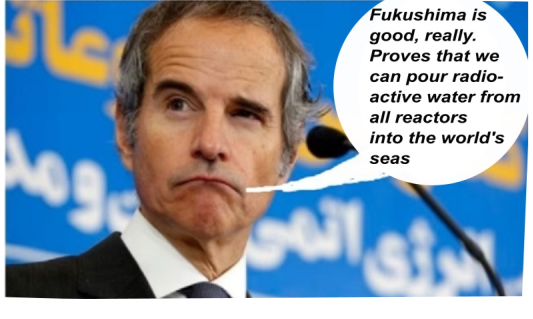
True, the IAEA (the UN’s International Atomic Energy Agency) has provided helpful cover for the Government of Japan (and the TEPCO power company) by taking the view that the environmental impact of discharge of polluted (but “processed” to remove most of the major radio-active materials) cooling water would be “negligible.” That, however, is neither surprising nor decisive.
The IAEA, founded in 1957, is an organisation devoted to the propagation of “safe” civil nuclear energy; the state of Japan is its third largest source of its funds; and the future of the global nuclear industry depends on there being seen to be a “final solution” to the problems posed by Fukushima.
https://johnmenadue.com/brink-of-catastrophe-japan-as-pacific-polluter/ By Gavan McCormack, Aug 30, 2023
In 2011, Fukushima Nuclear Power Plant, roughly 250 kilometres north of Tokyo, was hit by a magnitude 9.0 quake and tsunami. Three reactors stopped immediately but the loss of electricity supply led in the days and months that followed to breakdown of the cooling system and to a series of hydrogen explosions and meltdowns of the cores of Reactors 1 to 3.
Prime Minster Kan Naoto feared for the worst. He faced the possible need to evacuate the whole Kanto region, including the Tokyo metropolitan area. Japan itself, its state and society, stood on the brink of catastrophe. That fate was only narrowly averted.
To this day the flow of water to cool the debris polluted with various forms of radioactivity has had to be maintained. Over the past twelve years some 1.34 million tons of water has accumulated and is being held in a vast array of over 1000 tanks along the coast of Fukushima prefecture. Those tanks are about 98 per cent full, but the flow of contaminated water will have to be continued for at least the next three decades, or till such time as the site can be cleaned up. Nobody today can say with any confidence when that might be.
The polluted waters contain 64 radioactive elements, or radionuclides, of greatest concern being carbon-14, iodine-131, caesium-137, strontium-90, cobalt-60 and hydrogen-3, also known as tritium. Some have short life and might already have ended, but others take longer to decay, with a half-life of more than 5,000 years in the case of carbon-14 (Nature, 29 June 2023). Tritium, which focuses most attention, has a half-life of 12.3 years. Its concentrations may be low, but one hundred years will have to pass before its threat to humans and the ocean becomes truly negligible
The government has yet to find additional sites for expansion, and each day it has to put about 90 tons of newly polluted water somewhere. And, while the people of Japan remain steadfast in opposing any return to the pre-2011 vision of a nuclear-powered, energy self-reliant, superpower Japan future, government and bureaucracy are increasingly open about their determination to pursue just such a goal.
In 2016, the Japanese government considered multiple methods of treating the water. Ruling out simple continuation of the status quo – more and more tanks along an already crowded sea-front – there seemed to be three options: ocean discharge, atmospheric discharge, and underground burial. The cost differential was estimated at 34.9 billion yen to release the problem materials as gas into the atmosphere, 24.3 billion to dig a deep hole and bury it, but just 3.4 billion to pour it out gradually into the sea.
The logic of such math was inescapable. The chosen option was the one that was cheaper by a factor of 7 or more. Time, and the recuperative, regenerative powers of the sea, would come to humanity’s rescue. The materials would be released into the ocean (channelled by giant pipes to a point about one kilometre offshore). That process began on 24 August 2023.
Anxiety, alarm, and increasingly anger, spread, both within Japan (and especially in the Fukushima vicinity that bore the brunt of the initial 2011 disaster) and on the part of Japan’s Pacific neighbour states – China (including Hong Kong), Korea (north and south), Russia, Philippines, and the mini-states of the South Pacific (its 18 countries and regions). In Japan just 44 per cent of people said they had “no worries” over the release, but about 75 per cent said the government had not properly explained what it was doing.
The Japanese government, having promised it would take no step without duly consulting all concerned parties, proceeded to ignore that principle both in regard to its own citizenry (especially those employed in its once vibrant fishing industry) and its Pacific neighbours, whose shores are washed by the same Pacific waters.
True, the IAEA (the UN’s International Atomic Energy Agency) has provided helpful cover for the Government of Japan (and the TEPCO power company) by taking the view that the environmental impact of discharge of polluted (but “processed” to remove most of the major radio-active materials) cooling water would be “negligible.” That, however, is neither surprising nor decisive. The IAEA, founded in 1957, is an organisation devoted to the propagation of “safe” civil nuclear energy; the state of Japan is its third largest source of its funds; and the future of the global nuclear industry depends on there being seen to be a “final solution” to the problems posed by Fukushima.
Though given little attention in media coverage of the problem, a small but significant body of scientific opinion has begun to express severe criticism of IAEA for its failure to apply its own fundamental principles, being in some important respects “at least 10,000 times in error,” neglecting to give proper consideration to the non-dumping solutions, “grossly over-stating” well known facts in its “eagerness to assure the public that harm will be ‘negligible’.” (Arjun Makhijani, “TEPCO’s ALPS-treated Radioactive Water Dumping Plan Violates Essential Provisions of IAEA’s General Safety Guide No. 8 and Corresponding Requirements in Other IAEA Documents, Institute for Energy and Environmental Research [IEER], 28 June 2023.
In this view, the IAEA should, starting with Japan, provide assistance to nuclear-possessing countries to stop dumping so that the oceans that have been much abused in so many ways for so long can at least have a chance to begin recovering.
When then Prime Minster Abe Shinzo told the world in September 2013 that Fukushima was “under control,” he lied. Till 2018, all attempts to locate the missing reactor cores, let alone to place them “under control,” had failed. Only in 2021 did it become possible at least to locate the debris in one reactor. But knowing the location is but the start. Now we know where it is, we are no closer to knowing how to deal with it. The recovery effort for two of the reactors will not commence until 2024. If they succeed in locating the debris, estimated to be about 880 tons, it will then have to be extracted, gram-by-gram. Meanwhile, as of 2023, between 4,000 and 5,000 workers are mobilised each day to perform various (high-risk) tasks in the disaster zone.
To the peoples of the small states of the Pacific, serial victims of waves of nuclear testing, first American, then French, the blow coming from nuclear-victim country Japan was especially bitter. To the shock and harm caused by the initial massive radioactivity release of 2011 has now to be added that of the deliberate, premeditated dumping of nuclear wastes from 2023. The “great powers” in the past had given Island peoples repeated assurances that there would be no risk to health or environment from testing or dumping. Those peoples watch sadly now as nuclear victim country Japan does likewise, engaging in intense propaganda efforts to line up regional states to endorse its wastewater dumping campaign.
Japanese words today rings as hollow to Pacific Island peoples as did once American or French words. Even the Japanese people themselves, when it comes to Fukushima wastewater dumping “have little trust in TEPCO or the Japanese Government.” (Suzuki Tatsujiro, former Vice-Chairman of Japan’s Atomic Energy Commission, quoted in Makhijani, p. 3)
by the current administration and by the process launched on 24 August. The support given Japan’s ocean dumping by prominent Western industrial countries strikes Pacific Islanders as hypocritical (Kalinga Seneviratne, “To the Pacific islands, the West’s support for Japan’s Fukushima nuclear waste ocean dumping is hypocrisy,” South China Morning Post, 20 July 2023,) Motarilavoa Hilda Lini, chief of the Turaga nation of Pentacost Island, Vanuatu, and activist of the Nuclear Free and Independent Pacific (NFIP) movement, puts it this way, “We are people of the ocean. We must stand up and protect it.” She went on,
“We need to remind Japan and other nuclear states of our Nuclear Free and independent Pacific movement slogan: if it is safe, dump it in Tokyo, test it in Paris, and store it in Washington, but keep our Pacific nuclear-free.” (Guardian, 26 April 2023).
Brushing aside the pleas of neighbour states, especially those of the long-suffering peoples of the Pacific Islands, Japan has pressed ahead to dump its nuclear wastes into the ocean, ensuring that in due course a third wave of nuclear pollution will wash over Pacific shores.
Why Ukraine’s Western backers are happy to feed Zelensky’s fantasies about American F-16s
https://www.rt.com/news/581828-ukraine-zelensky-f16-west/ 30 Aug 23
The Wunderwaffe delusion: Why Ukraine’s Western backers are happy to feed Zelensky’s fantasies about American F-16s
The 50-year-old jet won’t turn the tide of the conflict in Kiev’s favor, but it profits its partners to keep pretending
By Chay Bowes, journalist and geopolitical analyst, MA in Strategic Studies,
As the Western establishment media begrudgingly accepts what many analysts have long predicted – that Kiev’s counteroffensive is a catastrophic failure – it seems that Ukrainian President Vladimir Zelensky hasn’t gotten the memo.
He seems adamant that the mercurial F-16 fighter jet is the missing link required to spur his depleted military to victory against Russia. There is, however, a little problem with his thesis – there’s more than one, actually, but let’s start with the most obvious.
Even as Ukraine’s long-awaited, much-hyped, but now obviously failed counteroffensive grinds to a bloody and costly halt, it seems the pro-war enthusiasts in the West and their proxies in Kiev still believe that the F-16, an American fighter jet that first took to the skies nearly 50 years ago, can somehow save the day for Zelensky and his NATO handlers. But at the same time trouble seems to be brewing in paradise as the Western media, which has thus far played such a pivotal role in overhyping Kiev’s military capabilities, is now less than convinced that this aging American castoff can play anything close to a defining role in NATO’s stalling proxy war against Russia.
While Ukrainian casualties mount, Kiev still insists that its long-telegraphed counteroffensive is indeed “inching forward,” even though the stark reality is that only a tiny fraction of its stated goals have been achieved with vast amounts of Western materiel lost in the process.
This all comes as Ukraine’s Western “partners,” who were previously so eager to “stand with Ukraine as long as it takes,” become less and less absolutist in their convictions. A coming winter, domestic woes, failed sanctions against Russia, and endless demands from Kiev to replace cash and equipment are all starting to wear on an increasingly nervous NATO.
. Zelensky’s failed offensive is now accelerating the natural progression of war weariness in the West, where once there was supreme, almost absolute, confidence that Ukraine’s heroic warriors would easily cast out the barbarous Russian invaders. It seems that now even the spokesman for Ukraine’s decimated air force, Yury Ignat, seems to accept that when it comes to actually defeating the huge Russian military machine, talk is very cheap. Ignat recently revealed that Ukrainian fighters can barely take off before they are targeted by an overwhelming array of Russian fighters and anti-aircraft systems. He also noted that Russian fighters are far more advanced and have a far longer combat range, something the Ukrainian president conveniently forgets to mention during his awkward cockpit photo ops in Denmark, where he yet again peddles the now-tired promise of the latest in a long line of “game changers” – all of which the Russian Army has proven to be anything but. All they change, sadly, is the length of the conflict and the number of Ukrainian men doomed to die fighting it.
While the NATO architects of this conflict are of course eager to dangle the carrot of F-16 deployment to an increasingly desperate Kiev, in reality the fighters are highly unlikely ever to see service in the skies above Ukraine, at least not while the conflict is in its current active phase. Only three “partner” countries (Norway, Denmark, and the Netherlands) have promised to hand a few of the fighters over to Kiev, and there are still massive logistical issues that would need to be ironed out before they could even land in Ukraine, let alone take off and enter combat.
It’s important to pay attention to where information about the reality of the F-16s’ potential deployment comes from. That’s why, when US Joint Chiefs of Staff Chair General Mark Milley warned that the planes won’t act as a “magic weapon” for Ukraine, many sober, nonaligned analysts took note. Milley pulled no punches as he tried to pour some cold water on Kiev’s expectations regarding the aging jet. “The Russians have 1,000 fourth-generation fighters,” said the general following a meeting of the multinational Ukraine Defense Contact Group in May. “If you’re gonna contest Russia in the air, you’re gonna need a substantial amount of fourth- and fifth-generation fighters, so if you look at the cost curve and do the analysis, the smartest thing to have done is exactly what we did do, which is provide a significant amount of integrated air defenses to cover the battlespace and deny the Russians the airspace.”
It seems that when a message isn’t playing to the narrative, the message gets conveniently shelved. General Milley’s comments are a sobering reminder of the undeniable battlefield reality, a truth routinely lost on Zelensky and company as the PR prerogative trumps the strategic reality on the ground yet again in Kiev.
Interestingly, Milley also addressed the huge costs associated with the provision of the F-16 to Ukraine: “If you look at the F-16, ten F-16s cost a billion dollars, the sustainment cost [is] another billion dollars, so you’re talking about $2 billion for ten aircraft.” He also suggested that if the cash sent to Ukraine so far had been spent on this type of weapon, not on artillery and air defense, Kiev would be in a much worse position than it is today. “There are no magic weapons in war, F-16s are not and neither is anything else,” he said. Of course, the blunt and, from a Ukrainian point of view, dismal reality is that Ukraine’s dilapidated infrastructure can’t even begin to accommodate these complex jets. Ukraine has no appropriate training facilities on its soil, and a mere eight Ukrainian pilots have begun training in Denmark. More are set to start the process in the US in October, but it would take years of preparation to have adequate pilots in any meaningful numbers. Another fact glossed over by Kiev is that the F-16s, should they ever get as far as Ukraine, will need a lot of ground maintenance infrastructure and highly complex logistical support, all of which would have to be deployed into what is essentially a war zone. No one on the NATO team seems to want to address the minor detail that the Russian Air Force will be hunting both the jets and the infrastructure from day one – another inconvenient reality conveniently ignored.
While it now seems obvious that the actual provision of F-16s to Ukraine is probably nothing more than a far-off mirage, many now see the jet in the context where it actually belongs – as another NATO castoff cynically dumped into Ukraine by Washington’s allies on the promise of higher-tech replacements by a cash-hungry Uncle Sam. But given the dire performance of Western hardware on the battlefield so far, it will surprise no one if the US ultimately cans the entire project rather than suffer the embarrassing, and inevitable, images of burning F-16s joining those of American Bradleys and MaxxPros in the fields of southern and eastern Ukraine.
So as the increasingly uneasy architects of this catastrophic conflict finally begin to accept that this all only ends one way, they’re likely to string Kiev along for as long as possible when it comes to the illusive F-16s, just like they’ve been doing with their promises of EU and NATO membership. Let’s not forget, it was those very same hollow promises that set Ukraine on the road to this devastating conflict with Russia, a conflict only the very foolish could now believe will be won with a handful of 50-year-old fighter jets.
US Doubles Imports of Russian Uranium to Largest Amount Since 2005

– The United States bought 416 tonnes of uranium from Russia in the first half of 2023, which is 2.2 times bigger than in the same period last year and the largest amount since 2005, Sputnik has calculated using data of the US federal statistical system.
In the first six months of 2022, the US bought 188 tonnes of uranium from Russia, and 418 tonnes in January-July 2005.
Russia supplies the US only with uranium-235 enriched fuel, which is the country’s main “radioactive” imports. However, the analysis also took into account data on imports of natural and depleted uranium, which the US purchases from other countries.
The cost of imported Russian uranium amounted to $696.5 million, which is the highest value since 2002, the year when the US started to break data down by months. The cost of supplies increased 2.5 times year-over-year, and Russia’s share in US uranium imports grew by 13 percentage points to 32%.
The US also significantly increased its purchases of uranium from the United Kingdom in 2023 – by 28% to $383.1 million, bringing it to just under 18% of all imports. The most significant increase was observed in France’s exports, which stood at $319 million, 15% of total imports, in 2023 against $1.9 million a year earlier.
Rocket-Launching Billionaires Promise a New Pie in the Sky

Musk and Bezos are peddling new age-y religious drama of disaster and salvation, says author Mary-Jane Rubenstein.
By Kelly Hayes , TRUTHOUT August 17, 2023
hat we’re getting from both Musk and Bezos is this classically new age-y religious drama of disaster and salvation. They preach, they tell us that the end is near, the disaster is coming, that the world is going to end, but there is another world that everybody can build together, a new world and a place that they’ve never seen and a place that seems totally impossible,” says professor Mary-Jane Rubenstein, author of Astrotopia: The Dangerous Religion of the Corporate Space Race. In this episode of “Movement Memos,” host Kelly Hayes and Rubenstein discuss the religiosity of “NewSpace,” and how activists can challenge the new “pie in the sky” ideology that billionaires like Musk and Bezos are crafting.
Transcript
…………………………………………………………………………………………………………………………………………………………………………………………………………………………………….. MJR: So Musk and Bezos are probably the two best known actors in the contemporary corporate space race. As you probably know, Elon Musk wants us to move to Mars. He wants to colonize Mars. Jeff Bezos has a different plan. He thinks Mars is too far away. He wants to build space colonies that are closer to home that are positioned between the moon and the Earth. It would be sort of like living in a mall, a space mall, like a rotating indoor shopping center where the climate is controlled and there’s no real outside. But presumably you’d be able to grow some plants and things like that, and you’d be able to get your food and it would be totally perfect weather all year round and things like that.
So anyway, they have different views about what our lives are going to look like in outer space. Again, Musk has this sort of homesteader ideal that we’re going to terraform Mars and make it habitable for human beings. Bezos wants to keep us a little closer to Earth in these rotating shopping malls. Both of them are convinced that in order for human beings to, well, survive for Elon Musk, or to thrive for Jeff Bezos, we have to leave the Earth. And each of them is using his massive economic status and power to channel ungodly amounts of money and resources into conquering the cosmos so that human beings can have a decent future.
“KH…………………………………………….Bezos’s company Blue Origin and Musk’s SpaceX spent $2 million and $2.4 million, respectively, lobbying for government contracts in 2021. But Musk’s talk of using his vast wealth to “extend the light of consciousness” also helps spin popular mythos around extreme inequality in our times — like a new variation of the Divine Right of Kings. Instead of being chosen by God, men like Musk and Bezos are chosen by the market, and rather than representing an injustice, their absurd wealth supposedly represents our best hope for the future…………………………..
……………………………………… MJR: The environmental damage that the contemporary space race is doing is one of the most under-discussed crises of our contemporary moment.
…………………………………………………………………………………………………….. What I’m trying to say is I don’t think Elon Musk, a private entrepreneur, would have gotten NASA to offload to him so many of its contracts — I don’t think that he would’ve had the wherewithal to set up this massive Starlink Constellation without a big vision that presents itself as humanitarian, as future-oriented, as ideologically pristine, which is to say it’s a vision of the salvation of humanity that’s going to take place on Mars.
And again, once you sort of shake off the ideological patina here, you realize that Mars is terrible. It’s a terrible planet. If you get an invitation to go homestead Mars, probably don’t do it. It’s bad there. It’s really bad there. But I think he needs that vision in order to sell any of it.
KH: So, in Elon Musk, we have a man whose preposterous ideas are propped up by extreme wealth, a cult of personality, and one of the most absurd privatization gambits in U.S. history. But his current endeavors, like those of Jeff Bezos and other men who would like to rule space, are also propped up by some of the same ideas that have allowed the wealthy to loot and pillage the world we currently inhabit.
………………………………………………………………………………………………………………………………………………………………………………………………………………….. MJR I think symbolically and politically and rhetorically, the creation of the Space Force says that we do not agree that space is supposed to be a theater of peace. Rather, it’s supposed to be a theater of war. ………………………
‘……………………………………………………………………………………………………………………………………………………………. Capitalism relies on infinite growth. We can’t have infinite growth. We’re on a finite planet. So what we’re seeing right now [are] convulsions of late stage capitalism; it’s realizing it’s reaching limits and is therefore seeking out other planets and using this humanitarian claim as a justification for primarily economic ends. So we need to know that. This is just as much of an ideological ploy as the idea that Spain needed to conquer the Americas in order to save Indian souls or something like that. So I’m recommending some suspicion when it comes to these big grand narratives about the salvation of all of humanity…………………………………………………………… https://truthout.org/audio/rocket-launching-billionaires-promise-a-new-pie-in-the-sky/
 | |||
| |||
Australian Financial Review gets it not quite right about why nuclear power is the wrong solution

31 Aug 23
The Australian Financial Review says the question of why nuclear power isn’t the right solution for Australia deserves a serious answer.
Fair enough.
The Financial Review argues the rest of the world is moving to nuclear. An odd claim, when the world added 295GW of wind and solar last year but just 1.5GW of nuclear power. The International Energy Agency predicts that “only a small number of units are likely to start operating this decade”.
In fact, there are five serious answers to why nuclear is the wrong solution for Australia.
When thinking about the conundrum of how we manage this massive transformation to a lower-emissions energy grid, it is hard to think of a more ill-fitting solution for Australia than going down the nuclear road.

No.1 issue: cost. Proponents of nuclear energy simply dismiss the multitude of evidence that nuclear power is the most expensive form of energy available. Or, worse, seek to undermine the rigorous independent analysis that finds it so.
GenCost, independently prepared by the CSIRO and Australian Energy Market Operator, is one of many studies which find nuclear the most expensive form of energy. Despite the political attacks on AEMO and CSIRO in recent weeks, it is a robust report and their analysis stands up to scrutiny.
As AEMO has said: “Recent media commentary that AEMO’s Integrated System Plan (ISP) does not include transmission and storage, as well as generation costs associated with providing electricity to Australian customers, is wrong.” And the finding is clear: renewables (including the cost of transmission and storage) are cheaper than nuclear by several multiples.
If you don’t like the work of AEMO and CSIRO, sure, look around for an alternative report. Take a recent report by Lazard on the levelised cost of energy in the US. It found that between 2009 and 2021, utility-scale solar costs came down 90 per cent and wind 72 per cent, while new nuclear costs increased by 36 per cent.

Small modular reactors (SMRs) can supply up to 300 megawatts per plant. They are conservatively costed at $5 billion each. You need quite a few 300MW SMRs to replace say a 2GW coal-fired power station like Eraring. That is an extremely expensive transaction. The leader of the Nationals has said nuclear power wouldn’t cost Australia “a cent”. How can an alternative government make such a ridiculous claim with a straight face?
2. Second, the much-vaunted small modular reactor technology is unproven. There is no commercial SMR operating anywhere in the world. There are two demonstration plants: one floating around on a barge in Russia and one in China.
Last week’s Financial Review editorial lauds Ontario’s plans. Really? Ontario Power Generation has not released any costings for its proposed SMRs and it is yet to receive (or even apply for) environmental approvals. Are we to hang our hat on this technology for our national energy plan?
3. Third, nuclear is notoriously slow to build. Can anyone credibly claim that Australia could have a nuclear plant operating by the early or even mid-2030s, when we need no-emissions technology to be supplying the vast bulk of our power? The answer to that question, reasonable observers would agree, is “no”.
4. inflexibility. The fourth serious answer to the Financial Review’s suggestion of a nuclear path is that it is not a flexible source of energy. As we move to more renewables, we need peaking and firming that can be tuned on and off at short notice to fill gaps in renewable supply. Coal-fired power stations can be turned down, but not off. Likewise, a nuclear power station cannot easily be turned off once it is running.
Nuclear power is largely useless as peaking and firming support for renewables. This is where gas-fired power stations are a useful back-up to renewables. The latest technology allows gas-fired power stations to be turned on with two minutes’ notice.

5. Finally, there’s the matter of nuclear waste. Small modular reactors would produce no small amount of waste. A Stanford University study finds that “… most small modular reactor designs will actually increase the volume of nuclear waste in need of management and disposal, by factors of 2 to 30 for the reactors …”
For 235 years, Australia has searched for comparative advantage. We have found one. It is renewable energy. Imagine having abundant resources of the cheapest form of energy available and choosing, as a matter of policy, to deploy a source of energy much more expensive and slower to build instead? That’s what advocates of nuclear power are arguing for.
After 10 years of denial and delay on climate action, I’m not interested in more years of distraction by a debate on an energy source which clearly doesn’t stack up for our country.
‘Ignorance, Incompetence and Cynicism’ -military and scientific authorities attitudes to Aboriginal rights and safety‘

29th August 2023
NFLA Policy Briefing 274: ‘Ignorance, Incompetence and Cynicism’: The attitudes the military and scientific authorities adopted to Aboriginal rights and safety during and after the testing of British atomic weapons in South Australia 29 Aug 23 https://www.nuclearpolicy.info/briefings/nfla-policy-briefing-274-ignorance-incompetence-and-cynicism-the-attitudes-the-military-and-scientific-authorities-adopted-to-aboriginal-rights-and-safety-during-and-after-the-tes/
1 This Month



19 November – Webinar – The Reality of Reprocessing
Time: 11:00 AM Pacific Time (US & Canada) / 2:00 PM Eastern / 7:00 PM UK / 8:00 PM CET
Register for the Zoom Event Here



Shut down the radiation-damaged Heysham nuclear reactors now
To see nuclear-related stories in greater depth and intensity – go to https://nuclearinformation.wordpress.com

Say No to NASA’s Reckless Nuclear Reactor on the Moon
Say No to NASA’s Reckless Nuclear Reactor on the Moon
-
Archives
- November 2026 (74)
- October 2026 (302)
- September 2026 (339)
- August 2026 (330)
- July 2026 (355)
- June 2026 (287)
- May 2026 (306)
- April 2026 (356)
- March 2026 (251)
- February 2026 (267)
- January 2026 (308)
- December 2025 (358)
-
Categories
- 1
- 1 NUCLEAR ISSUES
- business and costs
- climate change
- culture and arts
- ENERGY
- environment
- health
- history
- indigenous issues
- Legal
- marketing of nuclear
- media
- opposition to nuclear
- PERSONAL STORIES
- politics
- politics international
- Religion and ethics
- safety
- secrets,lies and civil liberties
- spinbuster
- technology
- Uranium
- wastes
- weapons and war
- Women
- 2 WORLD
- ACTION
- AFRICA
- Atrocities
- AUSTRALIA
- Christina's notes
- Christina's themes
- culture and arts
- Events
- Fuk 2022
- Fuk 2023
- Fukushima 2017
- Fukushima 2018
- fukushima 2019
- Fukushima 2020
- Fukushima 2021
- general
- global warming
- Humour (God we need it)
- Nuclear
- RARE EARTHS
- Reference
- resources – print
- Resources -audiovicual
- Weekly Newsletter
- World
- World Nuclear
- YouTube
-
RSS
Entries RSS
Comments RSS

