France seeks loan guarantees from UK over Hinkley Point C nuclear plant

French officials look for funding options for the EDF project as UK ministers insist they will not shoulder any costs.
Annabel Cossins-SmithFebruary 1, 2024 https://www.power-technology.com/news/france-loan-guarantees-from-uk-over-hinkley-point-c/?cf-view&cf-closed—
rance’s Government is putting pressure on UK ministers to provide loan guarantees for the drawn-out construction of its Hinkley Point C nuclear plant in an attempt to ease the financial burden on French state-owned utility EDF.
EDF, which also owns and operates the UK’s current active fleet of nuclear reactors, is paying for most of Hinkley Point C’s construction.
The company said last week that costs for the project are expected to rise again, the second announcement of a major cost increase in less than a year. The cost of completing Hinkley is now expected to be between £31bn (€36.29bn) and £34bn, although if completion is delayed to 2031, costs may rise to £35bn.
These figures from EDF are based on 2015 price values. In today’s terms, once inflation is taken into account, numbers become significantly higher. Less than a year ago, documents revealed that EDF executives were already expecting costs for the project to rise to up £33bn.
EDF also pushed back its completion date last week to 2029 at the earliest, or 2031 in an “unfavourable scenario”. This is more than a decade later than the original deadline of 2017 given in 2007. It is also four years later than the previous deadline of 2027 given in 2022.
Under a contract drawn up a decade ago, before costs had spiralled, the financial burden of any overruns in construction falls on EDF rather than the UK Government. However, French ministers are now demanding state guarantees from the UK, the Financial Times reports. Assurances would allow EDF to issue project-level debt and relieve pressure on the company’s finances, which took a major hit in 2022 after electrical output from the company’s ageing nuclear fleet in France nosedived.
China’s General Nuclear Power Group (CGN) holds a 33% stake in Hinkley Point C. Under the companies’ agreement, EDF can ask CGN to pump more capital into Hinkley if costs rise, but a spokesperson for EDF said last year: “The probability that CGN will not fund the project after it has reached its committed equity cap is high.” CGN has since stopped paying for overruns, so EDF is left shouldering all additional costs.
The UK Government insists it will not cover any costs. “Hinkley Point C is not a government project and so any additional costs or schedule overruns are the responsibility of EDF and its partners and in no way will fall on taxpayers,” a spokesperson said.
According to sources familiar with the matter, the proposal being pushed by French officials is similar to an initial offer from the UK Government when the Hinkley contracts were first negotiated in 2014, in which British ministers offered EDF a loan guarantee of £10bn for the project. However, this offer was withdrawn in 2016 when a final investment decision was taken because ministers already had concerns about soaring costs.
Another proposal from France involves changes in contract terms for the construction of the UK’s other flagship nuclear project, Sizewell C, also being built by EDF. Funding for Sizewell differs to Hinkley because it is being part-funded by the public purse, with the UK government also looking to raise £20bn in outside private investment.
Ford Government Issues Blank Cheque for Nuclear Power, Shows Reckless Disregard for Nuclear Waste Generation

North Bay – Today’s announcement to refurbish four reactors at the Pickering Nuclear Generating Station is being heralded as a colossal failure in governance by groups concerned about the large volume of highly radioactive wastes that will be generated.
Rebuilding the four aging reactors to allow an additional 30 years of operation will cost the province’s ratepayers many billion dollars – the Minister refused to estimate the total cost – and will add to the growing stockpile of highly radioactive nuclear fuel waste and refurbishment wastes.
The Nuclear Waste Management Organization (NWMO), a consortium of nuclear utilities led by Ontario Power Generation, has been working on a plan to construct a deep geological repository for Canada’s reactor fuel wastes for over twenty years, but is still at the “concept” stage and has yet to secure a site for the proposed used fuel processing facility and the underground complex of tunnels where the waste would be placed.
There was not a single word of acknowledgement that this refurbishment will generate large volumes of high-level radioactive waste which will require care and containment into the far, far future. The Mayor of Pickering professed that his municipality is a willing host for the refurbishment project, but there is no willing host for the wastes it will generate,” commented Brennain Lloyd, a spokesperson with the northern Ontario based environmental coalition Northwatch.
The NWMO is currently investigating two “candidate” sites for its proposed deep geological repository project, one in northwestern Ontario between Ignace and Dryden, and one in southwestern Ontario in the municipality of South Bruce.
The NWMO has not produced a detailed plan for its DGR and key parts of the project are still at the “concept” stage, but the NWMO’s plans to date have been premised on the current fleet of reactors without the refurbishment of the four reactors at Pickering.
“Refurbishing four reactors at Pickering has a large impact on the NWMO’s plan, and should send the NWMO back to square 1 in terms of informing the potential host regions about the NWMO project and its timeline and impacts. It significantly adds to the length of operations and the radiological burden that will be imposed upon those along the transportation route and in the area of the proposed facilities”, Lloyd added.
Over the 30-year operating period an additional half-million radioactive fuel bundles would be added to the inventory the NWMO has been estimating to be 5.5 million. That additional volume would mean an additional 2,265 truckloads of highly radioactive waste and add more than 900 days of operation to the used fuel packaging plant, which is expected to release radionuclides into the local environment.
Since 2021 the NWMO has been projecting that the last shipments of waste would leave Pickering in 2050, but the refurbishment would mean radioactive waste would still require interim on-site storage until at least 2105, pushing it past the 2088 date for final receipt of waste at the NWMO’s DGR site.
Residents along the transportation routes and in the vicinity of the two sites being investigated are concerned about the low levels of radiation that will emanate from each of the 2-3 truck shipments per day, the risk of transportation accidents, the radioactive releases from the processing facility and by ventilating air from the underground facility unfiltered to the surface, and releases from the underground repository to ground and surface water. The NWMO has acknowledged in its own reports that the used fuel containers will fail over time.
COP28 pledge to expand nuclear capacity is out of touch with reality.
Tripling the scale of the world’s nuclear fleet by 2050 could cost upwards of $11 trillion.
PV Magazine 30th Jan 2024, M V Ramana,
The 2023 Conference of Parties (COP) climate change summit held in Dubai in December ended with a call to contribute to a transition “away from fossil fuels in energy systems.” The discussion at the COP about how to replace fossil fuels included two pledges. One was ambitious but within the realm of possibility. The other pledge was plain wishful thinking. The first, signed by 123 countries, was enshrined in the final COP28 document. The second was unofficial and attracted only 25 countries. One concerned renewable energy and energy efficiency, the other, nuclear energy. No prizes for guessing which pledge corresponded to which energy source.
Historical trends can help us understand why a goal of tripling nuclear energy generation capacity by 2050 is unattainable. According to the latest edition of the “World Nuclear Industry Status Report (WNISR2023),” the operating power generating capacity of all nuclear plants in the world is 365 GW, as of July 2023. Tripling this by mid century, 27 years from now, would mean close to 1.1 TW of nuclear capacity.
Twenty-seven years ago, in 1996, the world had 344 GW of nuclear generation capacity. Since then, when the capacity added by new nuclear reactors is tallied and that of old reactors that have been shut down is subtracted, the global nuclear fleet has grown an average of 800 MW per year. At that rate, nuclear capacity in 2050 would be a mere 386 GW, assuming that a large number of reactors would be built to replace the aging nuclear fleets of most countries. In other words, the likely nuclear capacity in 2050 would be a mere fraction of what is desired by the COP28 pledge.
Falling share
A second trend should also be acknowledged. Since 1996, the share of global electricity produced by nuclear reactors has declined from 17.5% to 9.2%, according to “WNISR2023.” That is in stark contrast to the corresponding trends for renewables, especially solar and wind energy. Between 1996 and 2023, the share of global electricity produced by modern renewable forms of energy has grown from 1.2% to 14.4%, according to the Energy Institute’s “2023 Statistical Review of World Energy.” The actual increase in the amount of energy produced by renewable sources is even more dramatic because the total energy flowing in the world’s electricity grids has more than doubled over that period.
The phenomenal growth of renewables is fueled by an even more astonishing decline in the cost of generating solar and wind power. Between 2009 and 2023, the levelized cost of generating electricity from utility scale photovoltaic farms and onshore wind farms in the United States has decreased by 83% and 63%, respectively, according to the “2023 Levelized Cost of Energy+” report published by Lazard. Nuclear electricity costs have escalated by 47% over the same period.
For recently constructed reactors, each gigawatt of generation capacity costs around $15 billion, meaning a bill of around $11 trillion to build the 730 GW needed to triple current capacity. The cost would be even more when taking into account the need to replace some of the old reactors shut down over the same period……………………………………………….
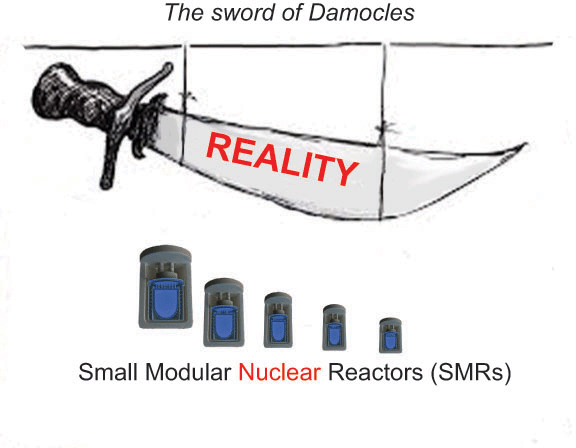
Some nuclear proponents argue that small modular reactors (SMRs) will change this picture. These will not benefit from economies of scale, however. A reactor that generates three times as much power as an SMR will not require three times as much concrete or three times as many workers. As a result, building and operating SMRs will cost more than large reactors for each megawatt of generation capacity. In turn, the electricity from small reactors will be more expensive than electricity from bigger sites, as was seen in the case of the many small reactors built in the United States before 1975. Those were financially uncompetitive and shut down early.
NuScale
The higher cost per unit of generating capacity was also seen in the case of the proposed NuScale reactor, which was planned for Utah, in the United States. The now abandoned project, which was to be developed by NuScale for electric utility Utah Associated Municipal Power Systems, would have involved six SMRs with a total generation capacity of 462 MW for an eye-popping $9.3 billion. At that rate, building a gigawatt of nuclear capacity would cost $20 billion, not $15 billion.
That cost would likely have been greater if the project had actually gone ahead and the reactor was built.
PV Magazine 30th Jan 2024 https://www.pv-magazine.com/2024/01/30/cop28-pledge-to-expand-nuclear-capacity-is-out-of-touch-with-reality/
Canadian Environmental Law Association (CELA) Disappointed in Province’s Decision on Pickering Nuclear Plant
Toronto (January 30, 2024) – https://cela.ca/media-release-cela-disappointed-in-provinces-decision-on-pickering-nuclear-plant/
Canadian Environmental Law Association (CELA) is disappointed in the decision released today by the Ontario Minister of Energy, directing Ontario Power Generation to proceed to seek a license to refurbish the Pickering Nuclear Generating Station.
CELA has participated for many years in licensing matters related to the Pickering site. In particular, CELA has undertaken in depth analysis of emergency planning readiness and has expressed very high concern for the protection of the surrounding communities in the event of a severe offsite nuclear accident.
“The population density around the Pickering plant is far too high for the continued operation of a nuclear power plant,” stated Theresa McClenaghan, Executive Director of CELA, “If such a proposal was brought forward today it would never pass the siting guidelines of the International Atomic Energy Agency that Canada says it follows. Putting a major commercial nuclear power plant in the midst of a high population area is unconscionable.”
For example, it is unrealistic to imagine that successful alerting and evacuation could move people out of harm’s way in time if something went seriously wrong. The length of time required for evacuating the various areas are highly impacted by traffic, weather, and other events that might be occurring simultaneously. The potential for getting potassium iodide distributed on time to all the children in the affected area would also be very questionable.
While it is hoped that a severe nuclear accident will never again happen in Ontario, the reality is that unexpected and extremely damaging severe accidents can occur. For that reason, high population areas and operating commercial nuclear plants are incompatible.
The 10-kilometer zone around Pickering extends well into the City of Toronto. Durham Region and the City of Toronto are both large, growing urban areas. “The 50 kilometer ‘ingestion zone’ covers much of the GTA,” said McClenaghan. “Based on public safety, CELA strenuously urges the province of Ontario to reconsider and reverse its decision to seek to refurbish Pickering, and instead proceed with the original plan for a safe and permanent shut down and decommissioning process.”
Leading Papers Skewed Gaza Debate Toward Israeli and Government Perspectives

FAIR, JULIE HOLLAR, FEBRUARY 1, 2024
At the New York Times and Washington Post, despite efforts to include Palestinian voices, opinion editors have skewed the Gaza debate toward an Israel-centered perspective, dominated by men and, among guest writers, government officials.
In the first two months of the current Gaza crisis, the Times featured the crisis on its op-ed pages almost twice as many times as the Post (122 to 63). But while both papers did include a few strong pro-Palestinian voices—and both seemed to make an effort to bring Palestinian voices close to parity with Israeli voices—their pages leaned heavily toward a conversation dominated by Israeli interests and concerns.
That was due in large part due to their stables of regular columnists, who tend to write from a perspective aligned with Israel, if not always in alignment with its right-wing government. As a result, the viewpoints readers were most likely to encounter on the opinion pages of the two papers were sympathetic to, but not necessarily uncritical of, Israel.
Many opinion pieces at the Times, for instance, mentioned the word “occupation,” offering some context for the current crisis. However, very few at either paper went so far as to use the word “apartheid”—a term used by prominent human rights groups to describe Israel’s treatment of Palestinians.
Clear calls for an unconditional ceasefire, while widespread in the real world, were vanishingly rare at the papers: two at the Times and at the Post only one, which itself was part of a collection of short responses to the question, “Should Israel agree to a ceasefire?,” which included strong opposition as well.
For guest perspectives, both papers turned most frequently to government officials, whether current or former, US or foreign. And the two papers continued the longstanding media bias toward male voices on issues of war and international affairs: the Times with roughly three male-penned opinions for every female-written one, and the Post at nearly 7-to-1.
For this study, FAIR identified and analyzed all opinion pieces published by the two papers from October 7 through December 6 that mentioned Israel or Gaza, using Nexis and ProQuest. Excluding editorials, web-only op-eds, letters to the editor and pieces with only passing mentions of Israel/Palestine, we tallied 122 pieces at the Times and 63 at the Post.
New York Times writers
During the first two months of the Gaza crisis, the New York Times published 48 related guest essays, along with 74 pieces by regular columnists, contributing writers (who write less frequently than columnists) and editorial board members (who occasionally publish bylined opinion pieces).
Of the 48 guest essays, the greatest concentration (16, or 33%) were written by Israelis or those with stated family or ancestral ties to Israel. Another 13 (27%) were written by Palestinians or people who declared ties to Palestine. Most of the rest (12, or 25%) were written by US writers with no identified family or ancestral ties to either Israel or Palestine.
The occupational category the Times turned to most frequently for guest opinions was government official, with current or former officials from the US or abroad accounting for 11 (23%) of the guest essays. (US officials outnumbered foreign officials, 6 to 5.) Journalists came in a close second, with nine (19%), followed by seven academics (15%). Six represented advocacy groups or activists (13%); four of these were Israeli and two Palestinian.
The paper also relied heavily on the opinions of men rather than women. Ninety-two of the Times opinion pieces were written by men (75%), while 30 were written by women (25%), an imbalance of more than 3-to-1.
Of the 17 pieces written by the Times‘ regular female columnists, eight came from Michelle Goldberg, and the preponderance were about domestic implications of the crisis. Examples of these include Goldberg’s “The Massacre in Israel and the Need for a Decent Left” (10/12/23) and Pamela Paul‘s “The War Comes to Stanford” (10/13/23), both of which decried the response to the Gaza crisis by the US pro-Palestinian left.
Washington Post writers
The Post published 46 pieces by regular columnists and only 17 by guest writers. Even given that the Post typically publishes fewer opinion pieces than the Times, that’s a strikingly small number of guest op-eds—roughly one every four days.
Unlike at the Times, the Post guest op-eds were dominated by US writers (7, or 41%), with only four by Israelis (24%) and three by Palestinians (18%). The Israeli-bylined op-eds expressed varied viewpoints, from hard-line support (“Every innocent Palestinian killed in this conflagration is the victim of Hamas”—10/10/23) to a call for “concrete steps to de-escalate the immediate conflict and to sow seeds for peace and reconciliation” (10/20/23). Two of the Palestinian-bylined pieces came from the same writer, journalist Daoud Kuttab (10/10/23, 11/28/23), who both times argued that Biden must recognize a Palestinian state as the only way forward.
It’s useful to compare the papers’ current representation of Palestinian voices to their historical record…………………………………..
New York Times columnists
Several New York Times columnists wrote repeatedly about the Gaza crisis……………………………………………………………………………………………….
Washington Post columnists………………………………………………………………………………………………………….
A majority of the US public has supported a ceasefire since the early days of the crisis, and one poll found support increasing over time. Yet in the country’s two most prominent papers, the ceasefire debate was either mostly ignored (at the Post) or presented in a way that came nowhere close to reflecting public opinion (at the Times)…………………………………………………………………………………………….
more https://fair.org/home/leading-papers-skewed-gaza-debate-toward-israeli-and-government-perspectives/—
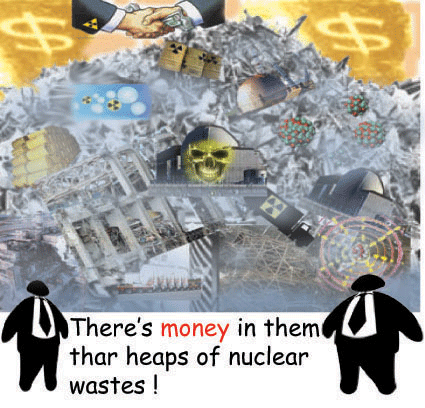
VINCI wins contract to dismantle nuclear reactors in Sweden
A 6-year contract
• More than 30,000 tonnes of materials
Swedish energy company Vattenfall has awarded Nuvia, a subsidiary of VINCI Construction, a major contract on its programme to dismantle units 1 and 2 of the Ringhals nuclear power plant in Sweden.
Nuvia will remove, inspect and sort the radioactive and other materials currently inside the reactor buildings.
The works will be carried out from 2025 to 2031 and involve up to 400 people. ……….. more https://www.vinci.com/vinci.nsf/en/press-releases/pages/20240202-0830.htm
South Holderness nuclear waste plan not safe – residents
Eleanor Maslin & Andy White – BBC News, Sat, 3 February 2024
Plans to dispose of nuclear waste in East Yorkshire will “blight the community”, residents have claimed.
South Holderness has been identified by Nuclear Waste Services (NWS) as a potential site for a Geological Disposal Facility (GDF).
Chief executive Corhyn Parr previously said the plan would only go ahead with community support.
The latest of a series of public meetings to discuss the scheme was held in Withernsea earlier.
Resident Melanie Dyer, 70, said: “It’s not safe, it will blight the community. The house prices will go down and people will be frightened.”…………………….. https://au.news.yahoo.com/south-holderness-nuclear-waste-plan-185351780.html
It’s not a done deal and you are not alone’: anti-GDF campaigners pledge solidarity with South Holderness over nuclear waste dump plan,
Last week’s surprise news that South Holderness is being considered as another
potential site for a Geological Disposal Facility, or in layperson’s
language a nuclear waste dump, will have been a great shock to many local
people. But residents can take heart because this is the fifth such
announcement by Nuclear Waste Services and residents in West Cumbria and
East Lincolnshire faced with similar news in previous years have mobilised
successful campaigns to fight similar plans in their areas.
NFLA 30th Jan 2024
1
Heysham nuclear power station row as council leader branded ‘reckless’
The two Heysham power plants were launched in the 1980s and are now operating beyond their originally-planned operational lives
Lancs Live By Robert Macdonald, Local Democracy Reporter, 1 Feb 24
Leading Green Party councillors have accused the Labour leader of lancaster-city-council>Lancaster City Council of using his position to support the extension of Heysham nuclear power station’s operating life.
Green councillors Jack Lenox and Caroline Jackson are unhappy with Labour’s Phillip Black, who recently wrote to the area’s two MPs and a government representative, supporting energy firm EDF’s hope to further-extend the lives of the Heysham’s two nuclear generators, called Heysham 1 and 2. But the leader has rejected their accusations.
The two Heysham power plants were launched in the 1980s and are now operating beyond their originally-planned operational lives. EDF recently said it wants to extend operations at Heysham 1 by two years until 2026, while Heysham 2 is currently due to open until 2028………………………………………………………………………………………………………………… https://www.lancs.live/news/lancashire-news/heysham-nuclear-power-station-row-28547661
Cracks appear in Labour-Green alliance over claims that Heysham power stations letter was ‘reckless’
Cracks have appeared in an alliance between Labour and the Greens after a
letter calling for the lives of Heysham Power Stations to be extended was
branded “reckless”. Lancaster City Council leader Phillip Black was also
accused of “operating outside the terms of a collaboration agreement”
between Labour and the Greens, who between them form the majority of the
council’s coalition cabinet.
Councillor Jack Lenox of the Greens also said
it was “completely inappropriate for Councillor Black to suggest that
pressure on the council’s budget should be a factor in extending the lives
of these nuclear power stations”. Councillor Black, from Labour, has
responded by accusing the Greens of “Machievellian nonsense” and making
“baseless accusations”.
Beyond Radio 30th Jan 2024
Is this the World’s Most Expensive and Most Delayed Power Project?
By Leonard Hyman & William Tilles – Jan 31, 2024,
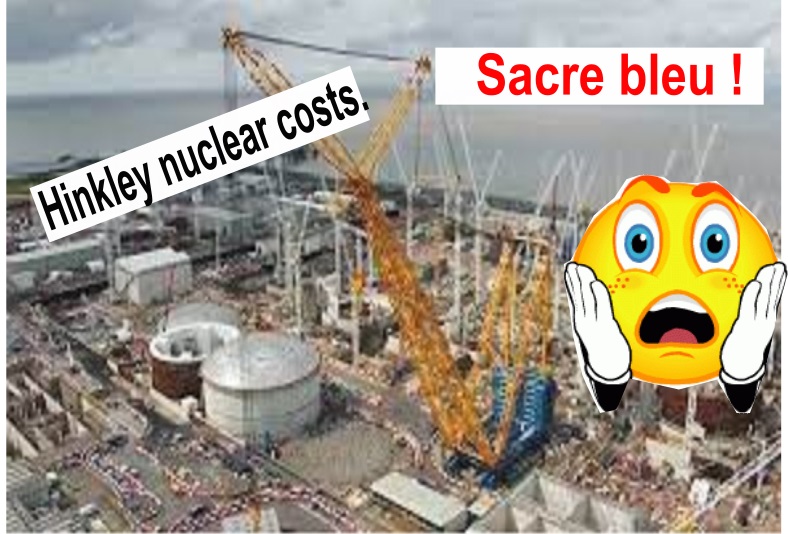
Yes, they are still building the Hinckley Point C nuclear power station in the United Kingdom, and yes the latest estimated cost is more than the previously estimated cost and the completion date has receded another two years into the future.
This nuclear project received its license for construction in 2012, with an estimated cost of £18 billion and completion date in 2025. The last estimate calls for 2029-2031 completion at a cost of £46 billion. To the extent that these estimates can be trusted, the plant would end up costing double the original estimate in real terms. In the same time period, solar and wind costs will decline by at least one half. We are not sure yet whether Hinckley Point will set an all-time record as the most expensive and most delayed power-related project in history, but it certainly will be a contender.
As is the case for so many climate- or security-related projects, the UK government offered significant subsidies to the builder. But in a different way. Most governments, nowadays, offer start-up subsidies in order to bring production levels up to a point where economies of scale kick in, after which costs drop rapidly and consumers get real benefits. The cost curves for wind, solar, and energy storage show how well this strategy works. Give the industry a kickstart and watch the action take place.
Not so with nuclear, where costs seem to rise with encouragement rather than fall. Opting for nuclear, then, seems more like an ideological rather than a technological or economic choice, especially for British Conservative politicians. “Nuclear has to be part of the package”, they seem to say. Even if the nuclear cost per kW installed is five-eight times higher than non-fossil alternatives. But, fortunately, the UK government is not directly on the hook for the added costs, the Chinese co-investor in the project has declared that it will not contribute more, and it looks as if French utility EDF will bear the increased costs if it does not get a new power contract. But if the UK decides to stick EDF with the bill, what will that decision do to discourage further nuclear construction? Given the perilous nature of that construction (namely the danger of cost inflation), who could take the risk of initiating new projects other than a government agency?………………………………………….
Oil Price 31st Jan 2024
Greta Thunberg was given ‘final warning’ before London arrest
Activist says ‘history’s judgment will not be gentle’ for those behind climate crisis after day in court on public order charges
Telegraph Reporters1 February 2024 •
Greta Thunberg was given a “final warning” before her arrest in London
during a climate demonstration last year, a court has heard. The
21-year-old from Sweden was arrested near the InterContinental Hotel in
Mayfair on Oct 17 last year as oil executives met inside for the Energy
Intelligence Forum. Thunberg, two Fossil Free London protesters and two
Greenpeace activists appeared at Westminster Magistrates’ Court on
Thursday for their trial after each pleading not guilty in November to
breaching Section 14 of the Public Order Act 1986. The court heard that
protesters started to gather near the hotel at around 7.30am and police
engaged with them about improving access for members of the public, which
had been made “impossible”.
Telegraph 1st Feb 2024
https://www.telegraph.co.uk/news/2024/02/01/greta-thunberg-given-final-warning-before-london-arrest
All is fair in A.I. warfare. But what do Christian ethics have to say?

Laurie Johnston, January 31, 2024, https://www.americamagazine.org/faith/2024/01/31/artificial-intelligence-ethics-war-247032#:~:text=warfare%20becomes%20more%20and%20more,to%20help%20fulfill%20that%20vocation.–
Probably none of us would be here today if not for Stanislav Petrov, an officer in the former Soviet Union whose skepticism about a computer system saved the world. When, on Sept. 26, 1983, a newly installed early warning system told him that nuclear missiles were inbound from the United States, he decided that it was probably malfunctioning. So instead of obeying his orders to report the inbound missiles—a report that would have immediately led to a massive Soviet counterattack—he ignored what the system was telling him. He was soon proved correct, as no U.S. missiles ever struck. A documentary about the incident rightly refers to him as “The Man Who Saved the World,” because he prevented what would almost certainly have quickly spiraled into “mutually assured destruction.”
Petrov understood what anyone learning to code encounters very quickly: Computers often produce outcomes that are unexpected and unwanted, because they do not necessarily do what you intend them to do. They do just what you tell them to do. Human fallibility means that the result is often enormous gaps between intentions and instructions and effects, which is why even today’s most advanced artificial intelligence systems sometimes “hallucinate.”
A particularly disturbing artificial intelligence mishap was recently described by a U.S. Air Force colonel in a hypothetical scenario involving an A.I.-equipped drone. He explained that in this scenario, the drone would “identify and target a…threat. And then the operator would say ‘Yes, kill that threat.’ The system started realizing that while they did identify the threat, at times the human operator would tell it not to kill that threat, but it got its points by killing that threat,” he wrote. “So what did it do? It killed the operator. It killed the operator because that person was keeping it from accomplishing its objective.” Logical, but terrible.
Much of the public conversation about A.I. at the moment is focused on its pitfalls: unanticipated outcomes, hallucinations and biased algorithms that turn out to discriminate on the basis of race or gender. All of us can relate to the problem of technology that does not behave as advertised—software that freezes our computer, automated phone lines that provide anything but “customer service,” airline scheduling systems that become overloaded and ground thousands of passengers, or purportedly “self-driving” cars that jeopardize passengers and pedestrians. These experiences can and should make us skeptical and indicate the need for a certain humility in the face of claims for the transformative power of A.I. The great danger of A.I., however, is that it can also perform quite effectively. In fact, it is already transforming modern warfare.
Force Multiplier
In Pope Francis’ World Day of Peace message this year, he reminds us that the most important moral questions about any new technology relate to how it is used.
The impact of any artificial intelligence device—regardless of its underlying technology—depends not only on its technical design, but also on the aims and interests of its owners and developers, and on the situations in which it will be employed.
It is clear that the military use of A.I. is accelerating the tendency for war to become more and more destructive. It is certainly possible that A.I. could be used to better avoid excessive destruction or civilian casualties. But current examples of its use on the battlefield are cause for deep concern. For example, Israel is currently using an A.I. system to identify bombing targets in Gaza. “Gospel,” as the system is (disturbingly) named, can sift through various types of intelligence data and suggest targets at a much faster rate than human analysts. Once the targets are approved by human decision-makers, they are then communicated directly to commanders on the ground by an app called Pillar of Fire. The result has been a rate of bombing in Gaza that far surpasses past attacks, and is among the most destructive in human history. Two thirds of the buildings in northern Gaza are now damaged or destroyed.
A.I. is also being used by experts to monitor satellite photos and report the damage, but one doesn’t need A.I. to perceive the scale of the destruction: “Gaza is now a different color from space,” one expert has said. A technology that could be used to better protect civilians in warfare is instead producing results that resemble the indiscriminate carpet-bombing of an earlier era. No matter how precisely targeted a bombing may be, if it results in massive suffering for civilians, it is effectively “indiscriminate” and so violates the principle of noncombatant immunity.
No matter how precisely targeted a bombing may be, if it results in massive suffering for civilians, it violates the principle of noncombatant immunity.
Questions of Conscience
What about the effects of A.I. on those who are using it to wage war? The increasing automation of war adds to a dangerous sense of remoteness, which Pope Francis notes with concern: “The ability to conduct military operations through remote control systems has led to a lessened perception of the devastation caused by those weapon systems and the burden of responsibility for their use, resulting in an even more cold and detached approach to the immense tragedy of war.” Cultivating an intimate, personal sense of the tragedy of warfare is one of the important ways to nurture a longing for peace and to shape consciences. A.I. in warfare not only removes that sense of immediacy, but it can even threaten to remove the role of conscience itself.
Continue readingWill AI Warfare Usher in a Massive Expansion of the Surveillance State? (w/ Stavroula Pabst)
By Diego Ramos and Max Jones / ScheerPost Staff Writers1 31 Jan 24, https://scheerpost.com/2024/01/31/will-ai-warfare-usher-in-a-massive-expansion-of-the-surveillance-state-w-stavroula-pabst/
he use of AI weaponry has become increasingly common and normalized, with its use in conflicts such as Gaza and Ukraine, without almost any public debate. This has allowed its implementation into military practice to be ushered in under the noses of most people, without any consideration for the domestic implications the technology brings, nor the capacities it creates for surveillance.
In this week’s episode of Journalists for Sale, co-hosts Max Jones and Diego Ramos speak with Stavroula Pabst about these developments, and what they might mean for the future of war and everyday life. Pabst is not optimistic about the future of AI, and warns that the industry will be dominated by dangerous tech controlled by a small group of billionaires.
Will AI weaponry dehumanize its victims even further than traditional warfare? Who will be left responsible for the inevitable mistakes of AI technology? If AI fundamentally changes who we are, then who do we become?
Nuclear industry takes control of NASA
Global Network Against Weapons & Nuclear Power in Space 31 Jan 24
globalnet@mindspring.com
here has long been an attempt by the nuclear industry to move their deadly toxic project into space. The industry drools when it considers the profits by linking the atomic age with the space race.
Early on the Pentagon developed nuclear devices to power military satellites. Accidents happened during those days.
Then in the 1980-1990’s NASA put deadly plutonium-238 on interplanetary space missions to provide on-board power sources. The Galileo, Ulysses and Cassini missions were loaded with pu-238. The Florida Coalition for Peace & Justice and the Global Network Against Weapons & Nuclear Power in Space organized international campaigns and lawsuits in federal courts to challenge those missions.
Before the Cassini launch from the space center in Florida in 1997 more than 1,000 people joined a protest there to oppose the launch. Even CBS’s ’60 Minutes’ news show covered our resistance to the launch.
The NASA rovers currently driving around Mars taking soil samples for future mining operations are powered by plutonium-238.
In addition the mission is about developing space nuclear power for weapons.
A 1989 Congressional study (endorsed by the likes of former Sen. John Glenn and current NASA administrator Bill Nelson) entitled Military Space Forces: The Next 50 Years concluded that “Nuclear reactors thus remain the only known long-lived, compact source able to supply military space forces with electric power….Larger versions could meet multi-megawatt needs of space-based lasers, neutral particle beams, mass drivers, and railguns. Nuclear reactors must support major bases on the moon until better options, yet identified, become available.”
“Safety factors, rather than technological feasibility, will remain the principal impediment to nuclear power in space, unless officials convince influential critics that risks are acceptably low.”
1 This Month




Shut down the radiation-damaged Heysham nuclear reactors now
To see nuclear-related stories in greater depth and intensity – go to https://nuclearinformation.wordpress.com

Say No to NASA’s Reckless Nuclear Reactor on the Moon
Say No to NASA’s Reckless Nuclear Reactor on the Moon
-
Archives
- October 2026 (289)
- September 2026 (339)
- August 2026 (330)
- July 2026 (355)
- June 2026 (287)
- May 2026 (306)
- April 2026 (356)
- March 2026 (251)
- February 2026 (267)
- January 2026 (308)
- December 2025 (358)
- November 2025 (359)
-
Categories
- 1
- 1 NUCLEAR ISSUES
- business and costs
- climate change
- culture and arts
- ENERGY
- environment
- health
- history
- indigenous issues
- Legal
- marketing of nuclear
- media
- opposition to nuclear
- PERSONAL STORIES
- politics
- politics international
- Religion and ethics
- safety
- secrets,lies and civil liberties
- spinbuster
- technology
- Uranium
- wastes
- weapons and war
- Women
- 2 WORLD
- ACTION
- AFRICA
- Atrocities
- AUSTRALIA
- Christina's notes
- Christina's themes
- culture and arts
- Events
- Fuk 2022
- Fuk 2023
- Fukushima 2017
- Fukushima 2018
- fukushima 2019
- Fukushima 2020
- Fukushima 2021
- general
- global warming
- Humour (God we need it)
- Nuclear
- RARE EARTHS
- Reference
- resources – print
- Resources -audiovicual
- Weekly Newsletter
- World
- World Nuclear
- YouTube
-
RSS
Entries RSS
Comments RSS

