Why you probably shouldn’t become a Community Interest Company
by preorg, https://preorg.org/why-you-probably-shouldnt-become-a-community-interest-company/
Imagine you have sacrificed hundreds of hours of your volunteering time to a non-profit organisation doing good work. After years of effort, often exhaustion, you discover that the directors don’t care that much about whether you succeeded in helping those people you intended to help. They care mostly about how much time they can spend at the swimming pool at their second home in Spain. Your volunteer hours have helped fund that lifestyle.
How could such a situation arise? Aren’t charities supposed to have boards of governors that keep the organisation on track? But wait, it wasn’t a charity! It was a Community Interest Company. Now, I should say that I don’t currently know of any such dramatic betrayals of people’s goodwill. But what I will argue here is that this situation arising in some CICs is bordering on inevitable, given the operating parameters of CICs. Given the weakness of regulation of the companies, almost boasted about by the CIC Regulator, it’s only a matter of time.
Why would I think that? Most people seem happy with CICs; Community Interest Companies are a success story, we are told. There are now many thousands of CICs in the UK, all having appeared within the space of ten years. This rapid rise in fact means that many people have chosen a form the long-term resilience of which has yet to be tested. It would be exciting to write an article about all the horribly failed CICs littering the social economy landscape. But I don’t know of any; I can only do a much less exciting job: pointing out what’s wrong with CICs before they start to fail. My contention is that, with the help of an FOI request to the CIC Regulator, we can see that certain types of failure are predictable. As for why we haven’t seen the failures yet, it is largely because CICs are young and in most of them the founders are still in charge.
The CIC was designed for organisations with social goals. It must operate in the ‘community interest’, which is defined in the articles of the organisation. It is also chosen over charities as an organisation that can more easily buy and sell commercially. But among the people I have asked, the main reason for opting for a CIC has been that it is easy. It is a lightweight structure, it is unencumbered by bureaucracy. It can be set up in a couple of days and can adapt quickly to changing conditions since it doesn’t have long lists of rules in its constitution. More like a standard profit-making company then, but with social objectives built in. Supposedly. More on that later.
By comparison both charities and co-operatives or community benefit societies (BenComs) have a lot more rules. Rules! How annoying! How limiting! But hang on a moment, why, if rules are so tedious, do those other organisations bother with them? The answer is that most of the rules are about accountability. In the case of a charity, the board of trustees, who must be consulted on significant matters, exist to keep the charity in line with its social aims. In co-ops and BenComs it is the membership who must constantly be consulted, and who choose who leads the organisation. Democracy certainly can be quite annoying.
By comparison a standard CIC is at the mercy of its directors, who needn’t even be many in number. That’s fine, I hear some say, I am the director, and I trust myself to make good decisions. Perhaps, but do you intend to lead the organisation forever? Even if you plan to live forever, what happens if you get ill, or leave through some other reason beyond your control? The purpose behind many accountability mechanisms is that they transcend the ideals of one particular person. They embed the ethics and goals into the DNA of the organisation, whoever may be running it at a given time. So how long do you want your organisation to last?
There is one supposed accountability mechanism in CICs: the government regulator. In theory the Office of the Regulator of Community Interest Companies has a lot of power to force CICs to stick to their aims. In practice it appears to do very little, priding itself on being a ‘light touch’ regulator. When I contacted the Regulator, they explained that in the last year they received 57 complaints, only 3 of which resulted in an intervention by the regulator. None of these 3 were related to the community benefit requirements. The Regulator has so far never wound up a CIC or stripped one of its CIC status. The Regulator has no records of intervening in a CIC on the basis of the standard paperwork submitted each year, which in part reports on the organisation’s performance under its community benefit requirement. That is to say, there appears to be no pro-active monitoring of whether CICs are operating for community benefit.
Even Social Enterprise UK, a fan of the CIC form, has raised questions over the strength of the Regulator. This accountability mechanism begins to look weak, to say the least. I’m not sure it will ever improve either. I doubt the regulator will ever be well enough funded to investigate what is going on in tens of thousands of organisations. We should not look for accountability in the CIC regulator.
Let’s move on to another question, a special case of the accountability problem: what profits can be made from a CIC, often presented as a non-profit structure? There is a CIC limited by shares that is allowed to make a profit. Previously there was a dividend cap of 20% of share value in any given year. This was considered by the government to be ‘inhibiting investment’ so in 2014 they removed the cap. Say that again? Annual 20% profits inhibiting investment?
Let’s leave that aside. In fact the majority of CICs are limited by guarantee and are more genuinely non-profit in form. There are, however, a couple of massive catches. The directors of a CIC can pay themselves whatever they can argue could reasonably be seen as necessary, as long as they are still fulfilling their social objectives. As determined by the aforementioned ‘light touch’ regulator. A CIC with a turnover of some millions a year could in theory pay the directors a million a year, if they could argue that without the salary they couldn’t retain the talent they need. Is it still a non-profit? This raises the aforementioned scenario of people putting in hundreds of volunteer hours for a supposed non-profit while the directors are buying holiday homes in the Mediterranean.
The second problem is that nobody is paying any attention to who CICs contract out work to. If a CIC pays huge ‘management fees’ or overpays on a cleaning contract to a company that happens to be owned by, say, the partner of a director, any money in the organisation can very easily be siphoned out to profit-making enterprises. In a charity the board and regulator would keep a sharp eye on this type of activity; the CIC regulator barely seems to glance at the paperwork.
You, the current director, might not abuse your position so, but can you be so sure of your successors? We only need to look at Housing Associations for a case study in organisational mission drift, in part driven by the high salaries CEOs have been able to pay themselves.
A word too on putting an informal democratic structure on top of an undemocratic CIC: I’m told that the Centre for Alternative Technology in Wales acted for years like a co-operative, and those involved assumed that’s what it was. But it never took a co-operative legal form, so when it ran into trouble, new leadership bulldozed aside the democracy people had assumed was one of the core values of the organisation. CAT is at least a charity, but the lesson is that informal structures can be dispensed with any time the CIC directors get tired of them.
But surely there must be a right situation for a CIC? Perhaps. A CIC could be right for an organisation that is mostly a trading organisation and is for a short-term project which won’t exist for long. If the project is intended to run long-term, I don’t believe the CIC is a reliable form. It is at the mercy of the leadership that follows you, if not your own leadership. The CIC Regulator is not the safety net you need. For most people it would be worth choosing an organisational type that seems more ‘difficult’ in the short term, but will almost certainly be more sustainable and accountable in the long run.
For existing successful CICs, why would they bother to change if they are doing well as they are? Let’s remember they are still young organisations. Do we want to wait twenty years to see the emergence of accountability and mission-drift problems that are, I am suggesting, rather predictable? Mission-drift that the Regulator will never pick up on unless someone reports it?
There are a few ways to mitigate the risks here. The best option for many would be to convert into a co-operative CIC. Co-ops UK offers one set of model rules for this, and the Somerset Rules can also convert a CIC into a multi-stakeholder co-op. It will cost time and money, it is true, to change the rules, but it will surely not be as painful as the organisation going off track in a few years’ time after the founders have retired.
The second best option is to add democratic rules to the CIC. It is a benefit of CICs that they are very flexible. The CIC Regulator offers model rules of a participatory organisation of large membership, though it is still very much director-controlled. It is theoretically possible to set up a more democratic membership structure without being a co-operative. While this method may miss out on embedding some of the checks and balances that co-ops have developed over the years, it could make the organisation more accountable. But remember, rules that can be added can be taken away. Only co-ops and their cousins, community benefit societies, lock democracy in permamently.
Finally, if actual democracy seems too great a task, it is at least possible to simply install more directors onto the CIC board, preferably those affected by what the organisation does, and so establish a strong democratic culture among the CIC directors. It’s not a perfect fix, but increased collective decision-making will mitigate the problems of a top-down culture reliant on the goodwill of two or three people.
For those who haven’t started their organisation yet, this is a plea to consider that a sustainable organisation is an accountable one, and democracy is one of the best ways to ensure accountability. Thankfully others, in the form of the co-operative movement, have already paved the way for us.
Five Years At Belmarsh: A Chronicle Of Julian Assange’s Imprisonment.

Kevin Gosztola, Apr 11, 2024, https://scheerpost.com/2024/04/12/five-years-at-belmarsh-a-chronicle-of-julian-assanges-imprisonment/
Calls for Assange’s freedom are renewed as the WikiLeaks founder marks five years in Belmarsh prison.
At the behest of the United States government, the British government has detained WikiLeaks founder Julian Assange in His Majesty’s Prison Belmarsh for five years.
Assange is one of the only journalists to be jailed by a Western country, making the treatment that he has endured extraordinary. He has spent more time in prison than most individuals charged with similar acts.
Since December 2010, Assange has lived under some form of arbitrary detention.
He was expelled from Ecuador’s London embassy on April 11, 2019, and British police immediately arrested him. Police transported Assange to Belmarsh, a maximum-security facility often referred to as “Britain’s Guantanamo.”
Around the same time, the U.S. Justice Department unsealed an indictment that alleged that Assange had conspired with U.S. Army whistleblower Chelsea Manning to commit a “computer intrusion.” The following month the DOJ issued another indictment with 17 additional Espionage Act charges.
2019
On May 1, Assange was sentenced by a British court to 50 weeks in prison as punishment for seeking political asylum from Ecuador while Sweden was attempting to extradite him. His sentence was longer than the six-month sentence that Jack Shepherd, the “speedboat killer” received for “breaching bail.”
Continue readingWhat’s Inside the President’s Nuclear Football
the creation of the Football, the president’s emergency satchel. But what about the nuclear war plans inside? And what about the Black Book? As surprising as this now seems, until 1960, several of the U.S. military branches had their own individual plans for nuclear war. What this meant was that the Army, Navy, and Air Force chiefs each had authority over a uniquely designated stockpile of nuclear weapons—including the delivery systems for those weapons and lists of targets to strike—for them to use at their own discretion in the event of nuclear war. When incoming Secretary of Defense Robert McNamara learned about these multiple, competing nuclear war plans, he ordered them integrated into a single plan. This is how the Single Integrated Operational Plan, or SIOP, got its name.
What began as the Single Integrated Operational Plan is now the Operational Plan, or OPLAN.
The Operation Plan for nuclear war is a colossal and cumbersome set of documents, too large to be carried around in the Football. Parsed down to a more manageable size, the plans become nuclear strike options as delineated in the Black Book.
plan for “mass extermination.” “evil beyond any human project ever,” “the destruction of most cities and people in the northern hemisphere.”
BY ANNIE JACOBSEN, APRIL 11, 2024 https://time.com/6965539/u-s-presidents-nuclear-footb
Jacobsen’s new book is Nuclear War: A Scenario
Nuclear threats have reemerged on the world stage. Frequently, Vladimir Putin warns the West that Russia is ready for nuclear war. “Weapons exits in order to use them,” Putin says. North Korea accuses the U.S. of having, “a sinister intention to provoke a nuclear war.” Entwined with the rising rhetoric, one physical object stands alone—the president’s emergency satchel, also known as the nuclear Football.
This bulging leather briefcase remains with the president at all times, carried by a military aide, and never more than an arm’s length away. It’s an iconic reminder of preeminent power and national mystery. A “nominally secret command-and-control system used to assure presidential control of nuclear use decisions,” historian William Burr says of the Football. Items located inside the president’s emergency satchel confirm his identity and connect him, as commander in chief, to the National Military Command Center, a nuclear bunker located beneath the Pentagon.
Also inside the Football is the Black Book. This cryptic set of documents, parsed down from a much larger operational plan for nuclear war, provides the commander in chief with nuclear launch options should policy dictate the president needs to act. This includes which targets to strike, which delivery systems to use, and the timing of action. “It’s called the Black Book because it involves so much death,” says Dr. Glen McDuff, a nuclear weapons engineer who served as the classified museum historian at Los Alamos National Laboratory in New Mexico.
The Football is with the president at all times. The first publicly-released photograph of the Football is from May 1963, at the Kennedy Family Compound in Hyannis Port, Massachusetts. It can be seen swinging from the military aide’s hand as he walks directly behind the president. The Football accompanied President Regan to the Red Square in Moscow, in 1988. When President George H.W. Bush was photographed out on jog, his military aide—also in running shorts and sneakers—can be seen just a few steps behind, carrying the iconic briefcase in her left hand.
The Football is always within a few feet of the president of the U.S. Once, when President Clinton was visiting Syria, President Hafez al-Assad’s handlers tried to prevent Clinton’s military aide from riding in an elevator with him. “We could not let that happen, and did not let that happen,” former Secret Service director Lewis Merletti says. Merletti was the special agent in charge of President Clinton’s detail at that time. “The Football must always be with the president,” he asserts. “There are no exceptions.” How the Football came to be has long been shrouded in mystery. “Its origins remain highly classified,” journalist Michael Dobbs wrote in Smithsonian Magazine in 2014. And then, just a few months ago, Los Alamos National Laboratory finally declassified the Football’s origin story. It goes like this.
One day in December 1959, a small group of officials from the Joint Committee on Atomic Energy visited a NATO base in Europe to examine joint-custody nuclear bomb protocols. The NATO pilots stationed there flew Republic F84F jets, the first U.S. Air Force fighter-bomber aircraft designed to carry nuclear bombs. Operation Reflex Action was in effect, air crews were trained and ready to strike predetermined targets in the Soviet Union in less than fifteen minutes from the call to nuclear war. One of the men on this visit was Harold Agnew, a Los Alamos scientist with a unique history.
Agnew was one of the three physicists assigned to fly on the Hiroshima bombing mission as a scientific observer. He carried a movie camera with him and took the only existing film footage of the atomic bombing of Hiroshima, as seen from the air. Now, in 1959, Agnew was at Los Alamos overseeing thermonuclear bomb tests; he later became the lab’s director. During the trip to the NATO base, Agnew noticed something that made him wary. “I observed four F84F aircraft . . . sitting on the end of a runway, each was carrying two MK 7 [nuclear] gravity bombs,” he wrote in a document declassified in 2023. What this meant was that “custody of the MK 7s was under the watchful eye of one very young U.S. Army private armed with a M1 rifle with 8 rounds of ammunition.” Agnew told his colleagues: “The only safeguard against unauthorized use of an atomic bomb was this single G.I. surrounded by a large number of foreign troops on foreign territory with thousands of Soviet troops just miles away.”
Back in the U.S., Agnew contacted a project engineer at Sandia Laboratories named Don Cotter and asked “if we could insert an electronic ‘lock’ in the [bomb’s] firing circuit that could prevent just any passerby from arming the MK 7.” Cotter got to work. He put together a demonstration of a device, a lock and coded switch, that functioned as follows: “[a] 3-digit code would be entered, a switch was thrown, the green light extinguished, and the red light illuminated indicating the arming circuit was live.”
Agnew and Cotter went to Washington, D.C., to demonstrate this locking device—first to the Joint Committee on Atomic Energy, then to the president’s top science advisor and finally to the president himself. “We presented it to President Kennedy, who ordered it be done,” Agnew recalled. The military objected. The man in charge of nuclear weapons at the time, General Alfred D. Starbird, opposed the idea. Glen McDuff, who coauthored (with Agnew) the now declassified paper on the subject, summed up the general’s documented concerns. “How is a pilot, U.S. or foreign, somewhere around the world, going to get a code from the President of the United States to arm a nuclear weapon before being overrun by a massively superior number of Soviet troops?” For the U.S. military, the locking device issue opened Pandora’s box. “If gravity bombs were coded,” McDuff explains, “why not all nuclear weapons including missile warheads, atomic demolition munitions, torpedoes, all of them.” The president decided they needed to be.
The answer came in the creation of the Football, the president’s emergency satchel. But what about the nuclear war plans inside? And what about the Black Book? As surprising as this now seems, until 1960, several of the U.S. military branches had their own individual plans for nuclear war. What this meant was that the Army, Navy, and Air Force chiefs each had authority over a uniquely designated stockpile of nuclear weapons—including the delivery systems for those weapons and lists of targets to strike—for them to use at their own discretion in the event of nuclear war. When incoming Secretary of Defense Robert McNamara learned about these multiple, competing nuclear war plans, he ordered them integrated into a single plan. This is how the Single Integrated Operational Plan, or SIOP, got its name.
Starting in December 1960, for the first time in the nuclear age, the SIOP gave the president, not the military, control of America’s nuclear arsenal. This new locking device designed by Agnew and Cotter, called a Permissive Action Link, or PAL, became an integral part of this new system. Only with the invention of the Football would the order to launch nuclear weapons—and the ability to physically arm them—come from the president alone. “This is how the president got the Football,” writes Agnew.
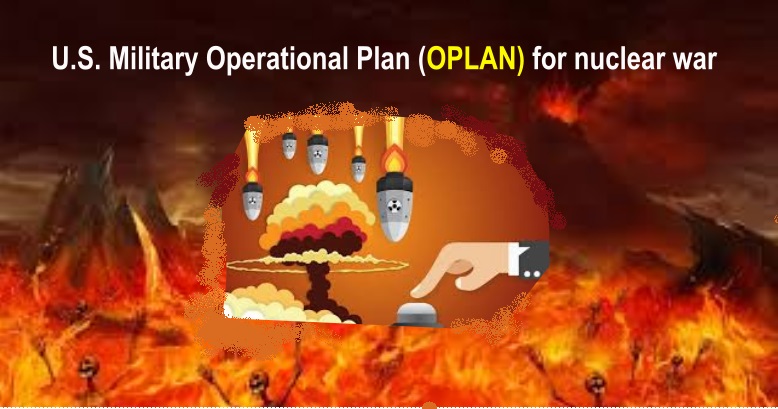
Over the years, the name for the nuclear war plan has changed. What began as the Single Integrated Operational Plan is now the Operational Plan, or OPLAN. For the Nuclear Information Project, in consort with the Federation of American Scientists, project director Hans Kristensen and senior researcher Matt Korda have identified the current Operational Plan as OPLAN 8010-12. It consists of “‘a family of plans’ directed against four identified adversaries: Russia, China, North Korea, and Iran,” the authors write. The Operation Plan for nuclear war is a colossal and cumbersome set of documents, too large to be carried around in the Football. Parsed down to a more manageable size, the plans become nuclear strike options as delineated in the Black Book.
The number of individuals who have written out their first-hand impressions of the SIOP is extremely limited. John Rubel, an avionics expert who served as an assistant secretary of defense under President Kennedy, wrote about the SIOP in his 2008 memoir, Doomsday Delayed. He liked it to a plan for “mass extermination.” Daniel Ellsberg reflected on the SIOP in his 2017 memoir, The Doomsday Machine: Confessions of a Nuclear War Planner. “It depicted evil beyond any human project ever,” Ellsberg wrote. A plan that calls for “the destruction of most cities and people in the northern hemisphere.”
As for the Black Book, few details exist on the public record. In 2015, U.S. Strategic Command battle watch commander Colonel Carolyn Bird shared with CNN previously unreported details. An identical Football resides inside the Stratcom nuclear bunker, viewers learned, locked in a safe beneath Offutt Air Force Base in Nebraska. “The [Black Book inside the] president’s football and our black book are duplicates,” Bird told CNN. “They contain the same information in the same way so that we are talking off the same documents when we are discussing nuclear options.”
In an interview with the History Channel, President Clinton’s former military aide, a colonel named Robert “Buzz” Patterson, likened the Black Book to a “Denny’s breakfast menu.” He made the analogy that choosing retaliatory targets from a predetermined nuclear strike list was as simple as deciding on a combination of food items at a restaurant. “It’s like picking one out of Column A and two out of Column B,” Patterson said.
Dr. Theodore Postol has seen the contents of the Black Book. His thoughts provide unsettling context to Patterson’s observations. From 1982 to 1984 Postol served as the assistant for weapons technology to the chief of naval operations. In this capacity, he worked on technical details regarding submarine launched ballistic missiles, or SLBMs. “Nitty gritty features,” Postol generalizes.
“Seeing the contents of the Black Book,” he recalls, “I was freaked out beyond belief.” Not for reasons he expected; as a weapons technologist Postol was familiar with the mass carnage involved. Instead of being confronted with a succinct summary of these horrifying facts—the targeting of cities, the death tolls in the millions—
Postol found the contents of the Black Book to be an obfuscation of the facts. The nuclear launch plans, he says, “had been sterilized down to military terminology designed to remove you from the reality of what would be happening.” An attempt at sanitizing nuclear war into a seemingly more palatable event. “My first thought,” Postol remembers, was “how would a president understand what these attack options actually mean?” This censoring of grim truths about nuclear war extends to the public as well, Postal contends. “You don’t want your population to know you’re planning genocide.”
What, if any, is the solution to this madness? Between the saber rattling and the secrecy, nuclear matters can present themselves as intractable. And yet, in reporting this story I witnessed a change in attitude from an unlikely source: the Los Alamos National Laboratory, a federal government organization that I’ve covered as a reporter for fifteen years.
“It’s the Oppenheimer effect,” Dr. Glen McDuff told me of this new attitude, “as in Oppenheimer the film.” Ever since the release of Christopher Nolan’s 2023 feature film, “the lab has been inundated with public curiosity about the bomb,” McDuff clarifies. “With requests about nuclear weapons.” And, he says, the lab has done its best to respond. The popularity of the film has renewed dialogue about the existential dangers nuclear weapons pose. And it led to the declassification (at this reporter’s behest) to one of the laboratory’s long-held secrets—the origin story of the Football.
Were the President of the United States to be called upon to open the Football, the situation that would follow would almost certainly spiral out of control. “The world could end in the next couple of hours,” former Stratcom commander General C. Robert Kehler (ret) says of nuclear war.
Nuclear war is the only scenario other than an asteroid strike that could end civilization in a matter hours. The soot from burning cities and forests will blot out the sun and cause a nuclear winter. State-of the art climate modeling predicts five billion humans will die. In the words of Nikita Khrushchev, “the survivors will envy the dead.”
And yet, threats abound. Vladimir Putin insists he is “not bluffing” about the possibility of using weapons of mass destruction. North Korea has test launched more than 100 missiles since January 2022, including nuclear-capable weapons that can hit the U.S. United Nations Secretary General António Guterres warns the world, “Humanity is one misunderstanding, one miscalculation away from nuclear annihilation.” The world balances on the razor’s edge. “This is madness,” Guterres says, “we must reverse course.” Change is possible. Help reverse course. “A nuclear war cannot be won and must never be fought,” President Ronald Reagan and Soviet General Secretary Mikhail Gorbachev cautioned the world in a joint statement in 1985. Conversations between these two leaders led to the reduction in nuclear weapons from an all-time high of 70,481 warheads, to some 12,500 today. Dialogue matters. Join the conversation about nuclear weapons now, while we are all still able to have one.
Flicker of Hope: Biden’s Throwaway Lines on Assange
April 12, 2024 by: Dr Binoy Kampmark, https://theaimn.com/flicker-of-hope-bidens-throwaway-lines-on-assange/
Walking stiffly, largely distracted, and struggling to focus on the bare essentials, US President Joe Biden was keeping company with his Japanese counterpart, Prime Minister Fumio Kishida, when asked the question. It concerned what he was doing regarding Australia’s request that the WikiLeaks founder Julian Assange be returned to Australia.
Assange, who has spent five tormenting years in Belmarsh Prison in London, is battling extradition to the US on 18 charges, 17 tenuously and dangerously based on the US Espionage Act of 1917.
The words that followed from the near mummified defender of the Free World were short, yet bright enough for the publisher’s supporters. “We’re considering it.” No details were supplied.
To these barest of crumbs came this reaction from from Australian Prime Minister Anthony Albanese on ABC’s News Breakfast: “We have raised on behalf of Mr Assange, Australia’s national interest, that enough is enough, that this needs to be brought to a conclusion, and we’ve raised it at each level of government in every possible way.” When pressed on whether this was merely an afterthought from the president, Albanese responded with the usual acknowledgments: the case was complex, and responsibility lay with the US Department of Justice.
One of Assange’s lawyers, the relentless Jennifer Robinson, told Sky News Australia of her encouragement at Biden’s “response, this is what we have been asking for over five years. Since 2010 we’ve been saying this is a dangerous precedent that’s being set. So, we certainly hope it was a serious remark and the US will act on it.” Assange’s brother, Gabriel Shipton, also told Sky News that the statement was significant while WikiLeaks editor-in-chief, Kristinn Hrafnsson thought the utterance “extraordinary”, cautiously hoping “to see in the coming days” whether “clarification of what this means” would be offered by “those in power” and the press corps.
The campaign to free Assange has burgeoned with admirable ferocity. The transformation of the WikiLeaks founder from eccentric, renegade cyber thief deserving punishment to prosecuted and persecuted scribbler and political prisoner has been astonishing.
The boggling legal process has also been shown up as woefully inadequate and scandalous, a form of long-term torture via judicial torment and deprivation. The current ludicrous pitstop entails waiting for a UK Court of Appeal decision as to whether Assange will be granted leave for a full reconsideration of his case, including the merits of the extradition order itself.
The March 26 Court of Appeal decision refused to entertain the glaringly obvious features of the case: that Assange is being prosecuted for his political views, that due process is bound to be denied in a country whose authorities have contemplated his abduction and murder, and that he risks being sentenced for conduct he is not charged with “based on evidence he will not see and which may have been unlawfully obtained.” The refusal to entertain such material as the Yahoo News article from September 2021 outlining the views of intelligence officials on kidnapping and assassination options again cast the entire affair in a poor light.
Even if Assange is granted a full hearing, it is not clear whether the court will go so far as to accept the arguments. The judges have already nobbled the case by offering US prosecutors the chance to offer undertakings, none of which would or could be binding on the DOJ or any US judge hearing the case. Extradition, in other words, is likely to be approved if Assange is “permitted to rely on the First Amendment”, “is not prejudiced at trial (including sentence) by reason of his nationality” and that he “is afforded the same First Amendment protection as a United States citizen, and that the death penalty not be imposed.” These conditions, on the face of it, look absurd in their naïve presumption.
Whether Biden’s latest casual spray lends any credibility to a change of heart remains to be seen. In December 2010, when Vice President in the Obama administration, Biden described Assange as a “high-tech terrorist” for disclosing State Department cables. He failed to identify any parallels with previous cases of disclosures such as the Pentagon papers.
Craig Murray, former British diplomat and Assange confidant, adds a note of cautious sobriety to the recent offering from the president: “I’m not going to get too hopeful immediately on a few words out of the mouth of Biden, because there has been no previous indication, nothing from the Justice Department so far to indicate any easing up.”
For all that, it may well be that the current administration, facing a relentless publicity campaign from human rights organisations, newspapers, legal and medical professionals, not to mention pressure from both his own party in Congress and Republicans, is finally yielding. Caution, however, is the order of the day, and nothing should be read or considered in earnest till signatures are inked and dried. We are quite a way off from that.
BUSINESS AS USUAL FOR BRITAIN’S WEAPONS EXPORTS
WEAPONS MADE ON MY DOORSTEP ARE HELPING TO KILL PEOPLE IN GAZA
British voters want to stop arming Israel, so why are spineless politicians ignoring them, asks Amy Hall.
This week, Foreign Secretary David Cameron confirmed that the UK government will not join the handful of Western countries that have stopped sending arms to Israel. Weapons exports from the UK will continue. The majority of voters are in favour of a ban and three British aid workers were among the seven killed by an Israeli air strike last week. But for Cameron and his cronies, it’s business as usual.
Britain has a long-standing commitment to arming the violence of the Israeli state and its occupation of Palestine. According to the Campaign Against the Arms Trade, Britain licensed around $556 million worth of arms to Israel between 2015 and 2022.
Those of us in Britain who are devastated and incensed by the endless death and destruction in Gaza are apparently to take reassurance from Cameron’s insistence that government ministers have ‘grave concerns around the humanitarian access issue’ there.
But these concerns appear not to be grave enough to challenge Britain’s own arms industry and its role in Israel’s ongoing genocidal campaign on Gaza. The weapons manufacturing taking place in my city assures me of that.
NO BOMBS FROM BRIGHTON’
Just a few kilometres from where I live in Brighton & Hove, on the South Coast of England, locals have set up a protest camp near to a factory that has been oiling the global war machine for many years. L3Harris makes bomb release mechanisms for F35 and F16 fighter jets, used by government armies including the Israeli Defence Forces.
Since 15 March, Brighton Peace Camp has been welcoming visitors, hosting everything from storytelling for kids to workshops on topics ranging from local antifascist history to Dabke, a Palestinian folk dance. The camp has also hosted an Iftar/Shabbat meal organized by Brighton and Hove Jews Against the Occupation.
‘We need to take every action in our power to stop the genocide in Gaza,’ said Sarah, from the group Brighton Against the Arms Trade. ‘We need to look at where the weapons are produced and disrupt the production and supply chain. L3Harris in Brighton is a critical part of that.
‘We demand a just transition towards the development of renewables, which must and can start now. Production at the factory must stop immediately and all components must be decommissioned.’
Local people have been campaigning against L3 Harris (formerly EDO MBM Technology Ltd) for decades. The company is now seeking to further solidify its mark on the city by making permanent an extension to its factory that was built in 2018. But thanks to intense opposition from local people, including some members of Parliament and city councillors, Brighton & Hove City Council (BHCC) has been under pressure not to grant planning permission. Nearly 650 objections were submitted to the application.
The local campaign against the arms factory, StopL3Harris, is asking people to call on their political representatives to join the calls to refuse the planning request. It was due before BHCC’s planning committee in March but was delayed as the Council seeks legal advice. Two out three of the city’s MPs: the Green Party’s Caroline Lucas and Labour’s Lloyd Russell-Moyle have submitted objections. The third MP, Labour representative Peter Kyle, has not.
Brighton is not the only British city where this kind of manufacturing is taking place. CAAT estimates that British industry makes 15 per cent of every F35 combat aircraft that Israel uses in its assault on Gaza. The campaign has mapped UK companies involved in manufacturing components for the F35 and estimates that the value of Britain’s supplies to be worth at least $422 million since 2016.
EXPORTS TO ISRAEL CAN BE STOPPED
In response to growing pressure, a number of countries have already stopped sending arms to Israel. ‘Denmark and Canada have both recently ruled to halt arms sales to Israel – so why not the UK?’ said Marnie, a Brighton & Hove resident who is taking part in the Peace Camp.
In February, a court of appeal in the Netherlands ordered the Dutch government to stop arms exports to Israel within the F35 programme, stating that it would violate the EU Common Rules for Arms Exports and the UN Arms Trade Treaty.
The UN welcomed the decision and called for arms exports to Israel to ‘stop immediately’, as any transfer of weapons or ammunition that would be used in Gaza is likely to violate international humanitarian law.
More than 600 lawyers have also warned the British government that arms exports to Israel risk legal violations. A senior MP for the leading Conservative party has said that the government has kept under wraps advice from its own lawyers that Israel has broken international law.
Too many of our elected representatives seem to be living in a parallel universe, dismissive of international law and apparently unperturbed by the suffering of the Palestinian people. Yet those of us who support a weapons ban, continue to watch in horror the endless stream of videos of crying children carrying their dead siblings, images of skeletal children starved to death, and the massacres of civilians and aid workers in the simple act of delivering food.
Cameron should be more than ‘concerned’ about the six children killed each day during the current offensive in Gaza. If our politicians were serious about the humanitarian situation, our politicians would be pushing for an immediate and permanent ceasefire, an end to the blockade of the Gaza strip, and an end to Israel’s occupation of Palestine.
Until then, as the money keeps flowing and the bombs keep dropping, we will continue to march, boycott, protest, donate, camp and cry until Palestine is free.
Ukraine fatigue: Kiev and the West are tiring of war and each other
The idea of some form of compromise solution to Kiev-Moscow conflict is creeping up on foreign hawks and on more and more locals
Tarik Cyril Amar, https://www.sott.net/article/490581-Ukraine-fatigue-Kiev-and-the-West-are-tiring-of-war-and-each-other 12 Apr 24
What a small band of objective-though-long-disparaged observers in the West have long warned about is now happening: Ukraine and the West are losing their war against Russia. The strategy of using Ukraine to either isolate and slowly suffocate Russia or to defeat and degrade it in a proxy war is coming to its predictable catastrophic end.
This reality is now being acknowledged even by key media and high officials that used to be uncompromising about pursuing the extremely ill-advised aim of military victory over Russia. A Washington Post article has explained that with ”no way out of a worsening war,”
Ukrainian President Zelensky’s options ”look bad or worse.” NATO General Secretary Jens Stoltenberg has discovered the option of ending wars by concessions – Ukraine’s concessions, that is. The sturdy old hardliner Edward Luttwak warns of a ”catastrophic defeat” – for the West and Ukraine. True, Luttwak is still spreading desperate illusions about a direct NATO deployment to avert the worst. In reality, it would, of course, only make things much, much worse again, as in World War III worse. But his fear, not to say panic, is palpable.
The fast-approaching outcome will be a disaster for Ukraine, even if Moscow should be generous regarding the terms of a postwar settlement (not a given, after the costs that Russia has incurred). Ukraine has already been ruined in terms of its demography, territory, economy, and, last but not least, political future. The damage incurred cannot simply be undone and will have long-lasting consequences.
For the West, this war will also mark a dismal turning point, in four main ways that can only be sketched here:
First, the US will have to absorb its worst defeat since Vietnam. Arguably, this latest fiasco is even worse because, even during the Vietnam War, America did not try to attack Russia (then, of course, leading the Soviet Union) as head-on as it does now. Washington’s most over-confident attempt ever to take Moscow off the “grand chessboard” once and for all has backfired perfectly. In general, that will diminish America’s capacity to impress and cajole globally. In particular, the goal of preventing the rise of regional hegemons in Eurasia, the holy grail of US geopolitics, is even farther out of reach than before. The “unipolar” moment and its illusions were passing anyhow, but the US leadership has added a textbook illustration of the West’s limits.
Second, the EU and its individual members – especially myopic warmongers such as Germany, Poland, and France – are far worse off again: Their foolish abandoning of geopolitically imperative caution and balancing (remember: location, location, location) will cost them dearly.
Third, in their own, different ways, cases such as Britain (not even an EU member anymore) and the Baltics (very exposed and very bellicose, a shortsighted combination) are in a class of their own: damage there will be galore. Damage control? The options are paltry.
And, finally, there is, of course, NATO: Over-extended, self-depleted, and having gratuitously exposed itself as much weaker than it would like to seem. Its defeat by Russia in Ukraine will trigger centrifugal tendencies and blame games. Not to speak of the special potential for tension between the US and its clients/vassals in Europe, especially if Donald Trump wins the presidency again, as is likely. And, by the way, he can only thank NATO for proving his point about what a dubious proposition it has become. If you believe that having added more territory on the map (Sweden and Finland) was a “win,” just remember what has happened to the mistaken celebrations of Ukraine’s territorial advances in 2022. Territory may be a price; it is not a reliable indicator of strength.
Yet what about Ukrainians? They have been used as pawns by their Western friends from hell. They are still living under a regime that has just decided to mobilize even more of them for a hopeless meatgrinder, while Zelensky is admitting that Ukraine is on the verge of defeat.
Some Western media are still telling a simplistic and false story about Ukrainians’ unflagging and united will to hold out for victory, as if every single one owed the West to play a Marvel hero to the bitter end. But in reality Ukraine is a normal, if badly misled country. Many of its citizens have long shown what they really think about dying for a toxic combination of Western geopolitics and the narcissism of a megalomanic comedian: by evading the draft, either by hiding in Ukraine or fleeing abroad. In addition, a recent poll shows that almost 54 percent of Ukrainians find the motives of the draft dodgers at least understandable. Kiev’s push for increased mobilization will not go smoothly.
But there is more evidence of the fact that Ukraine’s society is not united behind a Kamikaze strategy of “no compromise.” Indeed, under the title “The Line of Compromise,” Strana.ua, one of Ukraine’s most important and popular news sites, has just published a long, detailed article about three recent and methodologically sound polls.
They all bear on Ukrainians’ evolving attitudes to the war and in particular the question of seeking a compromise peace. In addition, Strana offers a rich sample of comments by Ukrainian sociologists and political scientists. It is no exaggeration to say that the mere appearance of this article is a sign that the times are changing: Under the subtitle “How and why attitudes to the war differ in the East and the West of Ukraine,” it even highlights “substantial” regional differences and, really, suppressed divisions. If you know anything about the extreme political – even historical – sensitivity of such divergences in Ukraine, then you will agree that this framing alone is a small sensation.
But that is not all. The article, in effect, dwells on ending the war by concessions – because that is what any compromise necessarily will take. Readers learn, for instance, that, according to the ‘Reiting’ agency polling on commission of Ukraine’s Veterans’ Affairs Ministry, in Ukraine’s West, farthest removed from the current front lines, 50% of poll respondents are against any compromise, while no less than 42% are in favor of compromise solutions as long as other countries (other than Ukraine and Russia, that is) are involved in finding them. For a region that, traditionally, has been the center of Ukrainian nationalism, that is, actually, a remarkably high share of those siding with compromise.
If you move east and south over the map, the compromise faction gets stronger. In the East, the proportions are almost exactly reversed: 41% against compromise and 51% in favor. In the South, it’s a perfect tie: 47% for both sides.
On the whole, Ukrainian sociologists are finding a “gradual increase” of those supporting a “compromise peace” in “one form or the other.” Even if, as one researcher plausibly cautions, this increase displays different rates in different regions, it still adds up to the national trend. One of its causes is “disappointment,” the loss of faith in victory, as the political scientist Ruslan Bortnik observes. In other words, the Zelensky regime is losing the information war on the home front. Notwithstanding its mix of censorship and showmanship.
The compromises imagined by Ukrainians include all conceivable solutions that do not foresee a return to the 1991 borders. In other words, there are ever more Ukrainians who are ready to trade territory for peace. How much territory, that is, of course, a different question. But it is clear that the maximalist and counter-productive aim of “getting everything back,” the all-or-nothing delusion, imposed for so long on Ukrainian society, is losing its grip.
The agency Socis, for instance, counts a total of almost 45% of respondents ready for compromise, while only 33% want to continue the war until the 1991 borders are re-established. But there are also 11% who still favor fighting on until all territories lost after February 2022 are recovered. That, as well, is now an unrealistic aim. It may have been closer to reality when Kiev dismissed an almost finished peace deal in the spring of 2022, on awful Western advice. That ship has sailed.
Polling results, it is important to note, do not all point in the same direction. The KMIS agency has produced results that show 58% of respondents who want to continue the war “under any circumstances” and only 32% who would prefer a “freeze,” if Western security guarantees are given. Such a freeze, while a favorite pipedream of some Western commentators, is unlikely to be an option now, if it ever was. Why should Moscow agree? But that is less relevant here than the fact that KMIS, for one, seems to have found a massive bedrock of pro-war sentiment.
And yet, even here, the picture is more complicated once we look closer. For one thing, the KMIS poll is comparatively old, conducted in November and December of last year. Given how quickly things have been developing on the battlefield since then – the key town and fortress of Avdeevka, for instance, finally fell only in February 2024 – that makes its data very dated.
KMIS also had interesting comments to offer: The agency notes that respondents’ proximity to the front lines plays an “important role” in shaping their opinions about the war. In other words, when the fighting gets close enough to hear the artillery boom, it concentrates the mind on finding a way to end it, even by concessions. As one Ukrainian sociologist has put it, “in the East and South … one of people’s main concerns is that the war must not reach their own home, their own home town.”
In addition, the executive director of KMIS has observed that the number of compromise advocates also grows when Western aid declines.
It remains difficult to draw robust conclusions from these trends, for several reasons: First, as some Ukrainian observers point out, the number of compromise supporters may be even higher – personally, I am sure it is – because the Zelensky regime has stigmatized any appeal to diplomacy and negotiations as “treason” for so long. Many Ukrainians are virtually certain to be afraid to speak their mind on this issue.
Second, what exactly the compromise camp understands by compromise is bound to be diverse. This camp may still include quite a few citizens who harbor illusions about what kind of compromise is available at this point.
Third, the current regime – which is de-facto authoritarian – is not answerable to society, at least not in a way that would make it easy to predict how shifts in the national mood translate into regime policies, or not.
And yet: There is no doubt that there is a groundswell in favor of ending the war even at the cost of concessions. Add the clear evidence of Western Ukraine fatigue – even a growing readiness to cut Ukraine loose – and the facts that the Russian military is creating on the ground, and it becomes hard to see how this basal shift in the Ukrainian mood could not become an important factor of Ukrainian – and international – politics
Hunterston: Scottish National Party see no nuclear future due to terrorism risk.
Largs and Millport, 11th April, By Calum Corral @CalumCorral, Senior Reporter
The SNP has warned of a possible terrorism risk in North Ayrshire if Scotland were to return to nuclear power.
The warning came after one of the party’s North Ayrshire Council opponents raised a motion asking the authority to back calls to consider Hunterston and Ardeer as sites for
‘small modular nuclear reactors’ (SMRs). Todd Ferguson (Conservative, North
Coast) lodged a motion asking that the council’s chief executive write to
the UK Government asking them to consider the two North Ayrshire sites for
SMR developments, “thereby protecting our excellent nuclear workforce and
providing vital employment for generations to come.”
During the debate in the council chamber, Councillor Eleanor Collier (SNP, North Coast) praised the contribution of Hunterston A and B nuclear power stations to the
Scottish electricity supply since 1964 and 1976 respectively.
But she said it was “time to move to a safer more acceptable zero carbon alternatives to
meet our energy requirements and look at renewable employment
opportunities”. Cllr Collier added: “The Scottish Government is clear that
nuclear power is not wanted nor needed. “The objective of energy policy is
to progressively increase the generation of renewables and clean energy and
renewables to migrate away from dependency on nuclear power.
“I think we all know that nuclear power generation is more expensive than renewables,
and it leaves the problem of nuclear waste and how to deal with the
redundant facilities afterwards. There are inherent risks with the
process.
“It is important to note that Sellafield [in Cumbria] has shut its
doors to taking in spent nuclear fuel rods, so if we did have nuclear rods
to deal with they would have to be disposed of locally, not to mention the
risk of theft and misuse by terrorists of uranium products.
“There are many questions around the cost effectiveness and safety of these new SMR
designs. “SMRs are smaller, but because of that they lose the economy of
scale, and the unit price rises.” Cllr Collier also cited scientific
studies which stated that SMRs generate more radioactive waste than
conventional nuclear power stations, and use more plutonium.
She said that zero carbon and renewables were the way ahead for Hunterston and pointed to the £1.4bn XLCC cable manufacturing project, which is projected to bring
900 jobs to the area over the coming years. Conservative councillor Tom
Marshall said; “We are talking about a climate change emergency. “The
Scottish Government is missing its targets, but nuclear power could help
meet those targets.
Largs & Millport Weekly News 11th April 2024
**CoRWM**
CoRWM Minutes of Meeting 12th Sept 2023.
CoRWM 11th April 2024
CoRWM Minutes of Meeting 28th November 2023 CoRWM 11th April 2024
Hinkley Point C joins Community Interest Company “Passion for Somerset”

MNR Journal, By Jacob Manuschka, AI Assisted Reporter, 11th April
A NUCLEAR power station that will provide zero-carbon electricity has joined a not-for-profit Somerset organisation as a principal partner.
Hinkley Point C, the first in a new generation of nuclear power stations providing electricity for around six million homes, has teamed up with Passion for Somerset.
Passion for Somerset is a not-for-profit Community Interest Company that works with individuals, communities and businesses throughout the county.
Stacy Walker, Hinkley Point C stakeholder relations manager, said: “Britain’s new nuclear power station at Hinkley Point C has seen another year of incredible engineering from under the seabed to the top of the world’s largest land-based crane, Big Carl………………………………… https://www.bridgwatermercury.co.uk/news/24246032.hinkley-point-c-joins-passion-somerset-organisation/
‘Lavender’: The AI machine directing Israel’s bombing spree in Gaza

thousands of Palestinians — most of them women and children or people who were not involved in the fighting — were wiped out by Israeli airstrikes, especially during the first weeks of the war, because of the AI program’s decisions.
The Israeli army has marked tens of thousands of Gazans as suspects for assassination, using an AI targeting system with little human oversight and a permissive policy for casualties, +972 and Local Call reveal.
By Yuval Abraham, April 3, 202, + 972 Magazine,
In 2021, a book titled “The Human-Machine Team: How to Create Synergy Between Human and Artificial Intelligence That Will Revolutionize Our World” was released in English under the pen name “Brigadier General Y.S.” In it, the author — a man who we confirmed to be the current commander of the elite Israeli intelligence unit 8200 — makes the case for designing a special machine that could rapidly process massive amounts of data to generate thousands of potential “targets” for military strikes in the heat of a war. Such technology, he writes, would resolve what he described as a “human bottleneck for both locating the new targets and decision-making to approve the targets.”
Such a machine, it turns out, actually exists. A new investigation by +972 Magazine and Local Call reveals that the Israeli army has developed an artificial intelligence-based program known as “Lavender,” unveiled here for the first time. According to six Israeli intelligence officers, who have all served in the army during the current war on the Gaza Strip and had first-hand involvement with the use of AI to generate targets for assassination, Lavender has played a central role in the unprecedented bombing of Palestinians, especially during the early stages of the war. In fact, according to the sources, its influence on the military’s operations was such that they essentially treated the outputs of the AI machine “as if it were a human decision.”
Formally, the Lavender system is designed to mark all suspected operatives in the military wings of Hamas and Palestinian Islamic Jihad (PIJ), including low-ranking ones, as potential bombing targets. The sources told +972 and Local Call that, during the first weeks of the war, the army almost completely relied on Lavender, which clocked as many as 37,000 Palestinians as suspected militants — and their homes — for possible air strikes.
During the early stages of the war, the army gave sweeping approval for officers to adopt Lavender’s kill lists, with no requirement to thoroughly check why the machine made those choices or to examine the raw intelligence data on which they were based. One source stated that human personnel often served only as a “rubber stamp” for the machine’s decisions, adding that, normally, they would personally devote only about “20 seconds” to each target before authorizing a bombing — just to make sure the Lavender-marked target is male. This was despite knowing that the system makes what are regarded as “errors” in approximately 10 percent of cases, and is known to occasionally mark individuals who have merely a loose connection to militant groups, or no connection at all.
Moreover, the Israeli army systematically attacked the targeted individuals while they were in their homes — usually at night while their whole families were present — rather than during the course of military activity. According to the sources, this was because, from what they regarded as an intelligence standpoint, it was easier to locate the individuals in their private houses. Additional automated systems, including one called “Where’s Daddy?” also revealed here for the first time, were used specifically to track the targeted individuals and carry out bombings when they had entered their family’s residences.
The result, as the sources testified, is that thousands of Palestinians — most of them women and children or people who were not involved in the fighting — were wiped out by Israeli airstrikes, especially during the first weeks of the war, because of the AI program’s decisions.
“We were not interested in killing [Hamas] operatives only when they were in a military building or engaged in a military activity,” A., an intelligence officer, told +972 and Local Call. “On the contrary, the IDF bombed them in homes without hesitation, as a first option. It’s much easier to bomb a family’s home. The system is built to look for them in these situations.”
The Lavender machine joins another AI system, “The Gospel,” about which information was revealed in a previous investigation by +972 and Local Call in November 2023, as well as in the Israeli military’s own publications. A fundamental difference between the two systems is in the definition of the target: whereas The Gospel marks buildings and structures that the army claims militants operate from, Lavender marks people — and puts them on a kill list.
In addition, according to the sources, when it came to targeting alleged junior militants marked by Lavender, the army preferred to only use unguided missiles, commonly known as “dumb” bombs (in contrast to “smart” precision bombs), which can destroy entire buildings on top of their occupants and cause significant casualties. “You don’t want to waste expensive bombs on unimportant people — it’s very expensive for the country and there’s a shortage [of those bombs],” said C., one of the intelligence officers. Another source said that they had personally authorized the bombing of “hundreds” of private homes of alleged junior operatives marked by Lavender, with many of these attacks killing civilians and entire families as “collateral damage.”
The following investigation is organized according to the six chronological stages of the Israeli army’s highly automated target production in the early weeks of the Gaza war. First, we explain the Lavender machine itself, which marked tens of thousands of Palestinians using AI. Second, we reveal the “Where’s Daddy?” system, which tracked these targets and signaled to the army when they entered their family homes. Third, we describe how “dumb” bombs were chosen to strike these homes.
Fourth, we explain how the army loosened the permitted number of civilians who could be killed during the bombing of a target. Fifth, we note how automated software inaccurately calculated the amount of non-combatants in each household. And sixth, we show how on several occasions, when a home was struck, usually at night, the individual target was sometimes not inside at all, because military officers did not verify the information in real time.
STEP 1: GENERATING TARGETS
‘Once you go automatic, target generation goes crazy
…………………………………………………………………………………………………………………………… once the list was expanded to include tens of thousands of lower-ranking operatives, the Israeli army figured it had to rely on automated software and artificial intelligence. The result, the sources testify, was that the role of human personnel in incriminating Palestinians as military operatives was pushed aside, and AI did most of the work instead……………………………………………………………………………………………………………………………………………………………..
STEP 2: LINKING TARGETS TO FAMILY HOMES
‘Most of the people you killed were women and children’
…………………………… in the case of systematic assassination strikes, the army routinely made the active choice to bomb suspected militants when inside civilian households from which no military activity took place.
…………………………………………………….. these programs track thousands of individuals simultaneously, identify when they are at home, and send an automatic alert to the targeting officer, who then marks the house for bombing. One of several of these tracking softwares, revealed here for the first time, is called “Where’s Daddy?”
………………………………. Evidence of this policy is also clear from the data: during the first month of the war, more than half of the fatalities — 6,120 people — belonged to 1,340 families, many of which were completely wiped out while inside their homes, according to UN figures.
………………………………….. “In the end it was everyone [marked by Lavender],” one source explained. “Tens of thousands…………………………. Lavender and systems like Where’s Daddy? were thus combined with deadly effect, killing entire families, sources said………………………………………………
STEP 3: CHOOSING A WEAPON
‘We usually carried out the attacks with “dumb bombs”’
……………………………. In December 2023, CNN reported that according to U.S. intelligence estimates, about 45 percent of the munitions used by the Israeli air force in Gaza were “dumb” bombs, which are known to cause more collateral damage than guided bombs.
…………………….. we usually carried out the attacks with dumb bombs, and that meant literally destroying the whole house on top of its occupants. But even if an attack is averted, you don’t care — you immediately move on to the next target. Because of the system, the targets never end. You have another 36,000 waiting.”
STEP 4: AUTHORIZING CIVILIAN CASUALTIES
‘We attacked almost without considering collateral damage’
…………………………………………………………………………….. Sources told +972 and Local Call that now, partly due to American pressure, the Israeli army is no longer mass-generating junior human targets for bombing in civilian homes. The fact that most homes in the Gaza Strip were already destroyed or damaged, and almost the entire population has been displaced, also impaired the army’s ability to rely on intelligence databases and automated house-locating programs.
……………………………………………………………………………… ‘Entire families were killed’
Intelligence sources told +972 and Local Call they took part in even deadlier strikes. In order to assassinate Ayman Nofal, the commander of Hamas’ Central Gaza Brigade, a source said the army authorized the killing of approximately 300 civilians, destroying several buildings in airstrikes on Al-Bureij refugee camp on Oct. 17, based on an imprecise pinpointing of Nofal.
………………………………………………………………………………………………… Such a high rate of “collateral damage” is exceptional not only compared to what the Israeli army previously deemed acceptable, but also compared to the wars waged by the United States in Iraq, Syria, and Afghanistan. ……………………………………………………………………………
STEP 5: CALCULATING COLLATERAL DAMAGE
‘The model was not connected to reality’
…………………………………………………………………………………………………………………………………………… “the collateral damage calculation was completely automatic and statistical” — even producing figures that were not whole numbers.
STEP 6: BOMBING A FAMILY HOME
‘You killed a family for no reason’
The sources who spoke to +972 and Local Call explained that there was sometimes a substantial gap between the moment that tracking systems like Where’s Daddy? alerted an officer that a target had entered their house, and the bombing itself — leading to the killing of whole families even without hitting the army’s target. “It happened to me many times that we attacked a house, but the person wasn’t even home,” one source said. “The result is that you killed a family for no reason.”……………………………………………………………………. https://www.972mag.com/lavender-ai-israeli-army-gaza/
What if global emissions went down instead of up?

Sometime in the near future, perhaps as soon as this year, humans are
likely to experience something that has never happened in modern history
before. For the first time, global emissions of planet-warming greenhouse
gases might finally stop rising and head into long-term decline
No one alive today has known a time like this. Nor has any other recent generation
because, for most of the last 200 years, emissions have risen steadily on
an upward path, interrupted only briefly when something like a financial
crisis or pandemic causes a global economic shock.
The rate of this growth
has been slowing globally, and emissions have now declined in more than 40
nations as countries become more energy efficient, switch from coal to
cleaner gas and swap fossil fuels for renewables. But this has yet to add
up to a global fall in emissions. Once it does though, some analysts think
the politics, psychology and even the financing of climate action could
shift profoundly.
This could shift the behaviour of governments, boardrooms
and investors because it would make fossil fuel investments look more like
a dead end, and green investments a competitive necessity.
Those of us who
live in countries like the UK, where emissions have nearly halved since
1990, know governments can easily use such achievements as an excuse to
take their feet off the emissions-cutting accelerator. Even if emissions do
start waning this year or next, they are unlikely to fall 43 per cent by
2030 from 2019 levels, which is what the Panel says is needed to keep the
Paris Agreement’s 1.5C temperature goal within reach.
In other words, a
global peak in emissions will be a big turning point, but not nearly enough
to contain warming now hitting levels never recorded before. Years of steep
and prolonged falls will be needed after that. This is a big ask and,
ultimately, no one knows for sure what sorts of behavioural shifts a peak
might drive. But in a world of deepening climate gloom, any sign of hope is
surely welcome.
FT 10th April 2024
https://www.ft.com/content/9b11b105-6fb9-4470-ab8d-3d130fe8f26d
Israel Has Formed a Task Force to Carry Out Covert Campaigns at US Universities
By William I. Robinson , TRUTHOUT, March 23, 2024
A major Israeli news site says Israel’s foreign affairs and diaspora affairs ministries are behind the operation.
As worldwide protest escalates over Israel’s genocide of Palestinians in Gaza, academic freedom and free speech are under all-out attack on university campuses in the United States, not just from university administrations and pro-Israeli groups, but now directly from the highest levels of the Israeli state. In a story that has been largely ignored in the Western press, the Israeli news website Ynetnews, one of the largest media outlets in the country, reported that the Israeli government has launched what appears to be a wide-ranging covert campaign to harass and intimidate students, faculty, and administrators into silence.
According to the report, the Foreign Affairs and the Diaspora Affairs ministries have established a task force to carry out “shaming and pressuring” operations at U.S. universities. The task force, chaired by Foreign Minister Eli Cohen and led by senior government officials, drew up a multifaceted “action plan,” according to Ynetnews, involving political and psychological operations against its critics. The plan aims at “inflicting economic and employment consequences on antisemitic [read: pro-Palestinian/anti-genocide] students and compelling universities to distance them from their campuses.” The plan specifies that actions taken “should not have the signature of the State of Israel on it.”
The first plank in the plan is described as the “consciousness axis.” It calls for “personal, economic and employment repercussions for the distributors of antisemitism.” According to the plan, the inter-ministerial task force will carry out “naming and shaming” by “publicizing the names of those generating antisemitism on campuses — both students and faculty and impacting the employment of those identified as the perpetrators of antisemitism.” Those targeted “will struggle to find employment in the U.S. and will pay a significant economic price for their conduct.”…………………………………………………………………………………………………………………………………….
Anti-Zionism Is Not Antisemitism
The Zionist narrative routinely condemns solidarity with Palestine as “antisemitism.” This conflation of anti-Zionism with antisemitism lays at the heart of Israeli hasbara and political persecution of the Palestine solidarity movement. Israel has made the definition of antisemitism an international political battleground in its efforts to suppress condemnation of its repression of the Palestinians, its ongoing violations of international laws and conventions, and Jewish supremacy inscribed into the legal and political structure of the Israeli state………………………………………………………………………………………………………………………….
While Judaism is a religion of universal values, Zionism is a right-wing nationalist ideology that emerged from the wave of racial nationalism that swept Europe in the late 19th century, part of the same movement that gave rise to Nazism in Germany and Manifest Destiny in the U.S., and more recently to a resurgent white nationalism. Racial nationalism argued that all people belong to one or another “racially pure” groups that can be traced back to mythical origins that correspond to “racially pure” people/nations, and that each people/nation must have its own “racially pure” homeland. Racial nationalist campaigns of “blood and soil” set out to organize the world according to this ideology. The Zionist program legitimated its conquest of Palestine through ethnic cleansing and settler colonialism by converting a faith community among diverse cultures, places and histories into a “racially pure” Jewish people/nation who must return to their ancestral homeland……………………………………………………………………………………………………………………………….
Albert Einstein, then living in exile in the U.S., was offered the presidency of Israel upon its creation in 1948 but turned it down, instead characterizing the new state as fascist. He joined 27 of the most prominent Jewish intellectual, public and religious leaders at the time, including Hannah Arendt, Rabbi Jessurun Cardozo and Sidney Lens, in a letter to The New York Times, warning that:
Within the Jewish community the Zionists have preached an admixture of ultranationalism, religious mysticism, and racial superiority. Like other Fascist parties they have been used to break strikes, and have themselves pressed for the destruction of free trade unions. [The Zionists in Palestine] inaugurated a reign of terror. Teachers were beaten up for speaking against them, adults were shot for not letting their children join them.
This is why the Zionist hasbara in the U.S. has not been directed solely at non-Jewish supporters of Palestinian freedom. It has also been directed at the Jewish American community…………………………………………………
more https://truthout.org/articles/israel-has-formed-a-task-force-to-carry-out-covert-campaigns-at-us-universities/
The Mutually Reinforcing U.S. and Israeli Empires

By Ralph Nader, April 5, 2024, https://nader.org/2024/04/05/the-mutually-reinforcing-u-s-and-israeli-empires/
The U.S. government’s unwavering commitment to Israel’s annihilation of Gaza – torrents of heavy weaponry, diplomatic and political cover, and vast majorities in Congress swearing fealty to Netanyahu’s extremist regime – is usually attributed to AIPAC (American Israel Public Affairs Committee), the powerful domestic pro-Israeli government lobby, organized in every Congressional District, with its abundant campaign cash and its many personal contacts in Congress and the Executive Branch.
This is only a partial explanation of the US-Israel alliance. A far more formidably entrenched factor is that Israel and the U.S. have overlapping Empires – one in the Middle East and the other globally – with deep common purposes. Here are some examples of how these empires operate in tandem.
Both Empires violate international laws with impunity. The U.S. sends special forces, drones, the Army, the Navy, and the Air Force, anywhere and anytime it wants – especially the case of Iraq and Afghanistan. National boundaries and sovereignty mean nothing. Similarly, Israel completely dominates the Middle East militarily, bombing, sabotaging, and killing whomever it wants in neighboring countries. It has attacked Lebanon and Syria routinely with its air force, artillery, and invaded Lebanon on the ground, prompting feeble responses it always labels “terrorism.”
Both Empires consider every military operation defensive. They say they never conduct offensive attacks, but when they do, they invariably describe them as self-defense. Israel slaughters Palestinians decade after decade in the Palestinian territories while claiming self-defense. With the second most modern military in the world, backed by the U.S., Israel invades, engages in nightly destruction of Palestinian homes, seizes Palestinian land and water for their colonies, imprisons thousands without charges, including women and children, inflicts collective punishment, operates many checkpoints and imposes embargoes, sieges and blockades. All of these unlawful actions are claimed to be taken in the name of self-defense.
The U.S. has 750 military bases in over 80 countries, 26 military installations in the Middle East, runs the provocative NATO military alliance, and digs into the South China Sea. All this is also claimed to be done in the name of self-defense.
Both Empires have collaborating military-industrial complexes and are major arms exporters. As the chief innovator in weapons of mass destruction, the U.S. and its companies like Raytheon, Lockheed Martin, and Boeing welcome feedback from the Israeli military on how their weapons fare in its attacks. Palestine has become a major testing ground for the most super-modern surveillance technology. (Check out the book, The Palestine Laboratory: How Israel Exports the Technology of Occupation Around the World by Antony Loewenstein, 2023).
Both Empires wield “force projection” as atomic bomb powers, though Israel refuses to join the non-proliferation treaty.
Despite their many wars and raids on defenseless populations, both incurred a rare counter-attack (9/11 & October 7) when advance warnings by advisors were ignored (GW Bush and Netanyahu) and military defenses were AWOL. After being attacked, both Empires went berserk and responded with massive killing of civilians by overwhelming invasions.
Both Empires lie repeatedly regarding their tactics and strategies. Recall Rep. Ron Paul’s terse recognition that Bush and Cheney “lied us into invading Iraq.”
Both Empires control the United Nations Security Council with the U.S. veto shielding whatever Israel does. Both occupy or control land that is not theirs, violating international laws.
Both Empires violate their legal duty as occupiers to protect the civilian population’s well-being. Both have restricted humanitarian assistance and critical civilian imports – Israel savagely in Gaza and Palestine, and the U.S. in Iraq under Bill Clinton. Both decline to estimate their aggregate civilian casualties.
Both Empires’ leaders, Biden and Netanyahu, profess to practice their respective religions, though they are violating the basic precepts of both their religions in implementing their violent wars.
Both Empires spend little time pressing for ceasefires, peace negotiations, and the stability of peace treaties. They find such restraints as unacceptable curbs on their freedom to wage war.
Both Empires, contrary to their fundamental juridical documents, in the case of the U.S., our Constitution, operate as elected dictatorships in conducting military and foreign policy. The Congress and the Knesset become supine and surrender to the Executive and, for Israel, the ruling executive coalition. In the U.S., the U.S. Supreme Court has long ruled that no citizens of our country, not even individual members of Congress, “have legal standing to sue” the U.S. government for either initiating illegal wars or engaging in additional illegal tactics like torture or corruption.
To remove the challenges from “We the People” against a lawless government, the Supreme Court has endorsed the “state secrets” doctrine. It authorizes the government to demand the dismissal of constitutional claims, in federal court, based on killings, torture, kidnapping, or otherwise by alleging the defense would require disclosure of national security information.
The Israeli Supreme Court doesn’t worry about the Israeli military machine.
Both Empires have a so-called free mainstream media that mostly toes the Empire party line and knows its permissible place in the overall profit-making power structure. Both have a small independent media that is still able to dissent, however futilely, though the U.S. has no counterpart to the outspoken Israeli newspaper HAARETZ.
There are some differences between the two Empires. Israel attacked the USS Liberty on June 8, 1967, killing 34 American sailors and wounding 171, and mostly got away without consequences. (See, The Intercept article: Fifty Years Later, NSA Keeps Details of Israel’s USS Liberty Attack Secret by Miriam Pensack).
Prosperous Israel persuades the U.S. Congress yearly to provide Israel with billions of dollars, mostly for military arms, and is about to get an additional $14.1 billion – the Biden genocide tax on Americans – as Netanyahu’s terror state continues intensifying his Palestinian Holocaust. (The reported casualty toll is lethally undercounted. See the March 5, 2024 column: “Stop the Worsening UNDERCOUNT of Palestinian Casualties in Gaza”).
If Biden’s people privately object to some Israeli off-the-wall slaughter of courageous journalists, United Nations staff, aid workers, patients in hospitals, and the starvation of babies, Netanyahu can softly say to Biden and Blinken, “Joe, Tony, why don’t you take up your complaints with OUR Congress.”
U.S. Space Command adopts multipronged approach to prepare for ‘a conflict that has never happened’
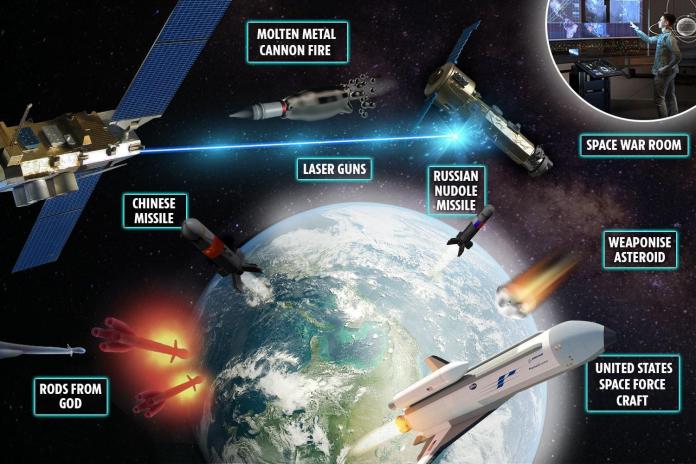
April 9, 2024, Sandra Erwin. https://spacenews.com/u-s-space-command-adopts-multipronged-approach-to-prepare-for-a-conflict-that-has-never-happened/
COLORADO SPRINGS – U.S. Space Command seeks to expand international collaboration by inviting Germany, France and New Zealand to join Operation Olympic Defender. Olympic Defender, a U.S.-led initiative to jointly strengthen defenses and deter hostility, already includes England, Australia and Canada.
“We share intelligence, we plan together and work to ensure space is safe for all,” Gen. Stephen Whiting, commander of U.S. Space Command, said April 9 at the 39th Space Symposium here. “We’re working to even improve our integration through improved command and control and planning. I’ve been proud to work alongside Germany, France and New Zealand for many years, and I look forward to their consideration of our invitation to join Operation Olympic Defender.”
Preparing for military operations with U.S. allies and partners is one of U.S. Space Command’s top priorities.
Other priorities for the Colorado-based organization are making its constellations more resilient, defending them against a growing array of threats, protecting the joint force from space-enabled attack, and conducting tests and training “that convinces us that these capabilities will work in a conflict which has never happened,” Whiting said.
Strategic Competition
As the combatant command responsible for military operations in outer space, U.S. Space Command is closely tracking military moves by China and Russia.
China is rapidly expanding space-based intelligence, reconnaissance and surveillance capabilities, and building a “range of counterspace weapons from reversible jamming all the way up to kinetic hit-to-kill direct-ascent and co-orbital” anti-satellite weapons, Whiting said.
Russia, meanwhile, “continues to invest in counterspace weapons,” Whiting said. “Russia appears more and more to be relying on asymmetric capabilities like space, cyber and nuclear.”
2027 Deadline
U.S. Space Command is focused on maximizing combat readiness by 2027.
“All of us at U.S. Space Command are laser-focused on improving all of our existing forces and capabilities, so that we can stitch them together seamlessly when called upon,” Whiting said.
U.S. Space Command also intends to draw on commercial space technology.
“Our commercial industry will deliver innovative state-of-the-art capabilities,” Whiting said. “We have to modernize our legacy systems, ensure they all work together seamlessly and deliver new capabilities by 2027 to counter the threats that we now see.”
Beyond 2027
At the same time, U.S. Space Command is eager to adopt technology that is likely to pay off in the longer term.
“It’s time to bring dynamic space operations and on-orbit logistics and infrastructure to the space domain,” Whiting said. “Sustained space maneuver will change how we operate, opening up new tactics, techniques, procedures and operating concepts, and allowing operations until the mission is complete, not until the fuel we launched with runs out.”
With an eye toward future conflict, U.S. Space Command also is expanding its reliance on modeling and simulation.
Whiting announced that Space Command’s Capability Assessment and Validation Environment, a modeling and simulation laboratory known as CAVE, has achieved minimum viable capability.
CAVE “enables us to perform analysis on warfighting, on plans, on campaigning,” Whiting said. Space Command will rely on CAVE to help plan “operations for a war that’s never happened and a war we don’t want to happen. We’ll also use it to figure out our combatant command requirements and gain insights into multi-domain joint-warfighting concepts.”
Swiss women win landmark climate victory at European Court of Human Rights
Swiss women win landmark climate victory at European Court of Human
Rights. Court finds in favour of group of older Swiss women who claimed
inaction on the climate crisis by their government put them at greater risk
of death from heatwaves.
Independent 9th April 2024
BBC 9th April 2024
UN nuclear watchdog’s board sets emergency meeting after Zaporizhzhia attacks

The U.N. nuclear watchdog’s Board of Governors will hold an emergency
meeting on Thursday at the request of both Ukraine and Russia to discuss
attacks on the Zaporizhzhia Nuclear Power Plant, after the enemies accused
each other of drone attacks. The International Atomic Energy Agency has
said drones struck the Russian-held facility in southern Ukraine on Sunday,
hitting one reactor building. It has not ascribed blame but has demanded
such attacks stop.
Reuters 10th April 2024
1 This Month
23-25 October – on Zoom – World BEYOND War’s annual global conferenc


Shut down the radiation-damaged Heysham nuclear reactors now
To see nuclear-related stories in greater depth and intensity – go to https://nuclearinformation.wordpress.com

Say No to NASA’s Reckless Nuclear Reactor on the Moon
Say No to NASA’s Reckless Nuclear Reactor on the Moon

-
Archives
- October 2026 (209)
- September 2026 (339)
- August 2026 (330)
- July 2026 (355)
- June 2026 (287)
- May 2026 (306)
- April 2026 (356)
- March 2026 (251)
- February 2026 (267)
- January 2026 (308)
- December 2025 (358)
- November 2025 (359)
-
Categories
- 1
- 1 NUCLEAR ISSUES
- business and costs
- climate change
- culture and arts
- ENERGY
- environment
- health
- history
- indigenous issues
- Legal
- marketing of nuclear
- media
- opposition to nuclear
- PERSONAL STORIES
- politics
- politics international
- Religion and ethics
- safety
- secrets,lies and civil liberties
- spinbuster
- technology
- Uranium
- wastes
- weapons and war
- Women
- 2 WORLD
- ACTION
- AFRICA
- Atrocities
- AUSTRALIA
- Christina's notes
- Christina's themes
- culture and arts
- Events
- Fuk 2022
- Fuk 2023
- Fukushima 2017
- Fukushima 2018
- fukushima 2019
- Fukushima 2020
- Fukushima 2021
- general
- global warming
- Humour (God we need it)
- Nuclear
- RARE EARTHS
- Reference
- resources – print
- Resources -audiovicual
- Weekly Newsletter
- World
- World Nuclear
- YouTube
-
RSS
Entries RSS
Comments RSS

