State Dept. Plans New $7 Billion Arms Sale to Israel

This comes as President Trump talks up an ethnic cleansing plan for the Gaza Strip
by Connor Freeman February 8, 2025, https://news.antiwar.com/2025/02/08/state-dept-plans-new-7-billion-arms-sale-to-israel/
The State Department has formally notified Congress of its plans for a massive arms sale to Israel worth over $7 billion, including thousands of missiles and bombs, the Associated Press reported on Friday. This follows Prime Minister Benjamin Netanyahu’s visit to Washington DC this week and Donald Trump’s announcement that the US will “own” Gaza after it is ethnically cleansed of its indigenous Palestinian population.
Per the State Department, Congress was notified of two separate sales, one is worth $6.75 billion. This first sale includes 2,800 500-pound bombs and 166 small-diameter bombs, along with thousands of guidance kits, fuses, bomb components, and other equipment. Deliveries of these bombs would begin later this year. The other package, worth $660 million, includes 3,000 Hellfire missiles and related equipment. Deliveries for this second arms sale are expected to take place by 2028. According to the AP, the use of these missiles will require the IDF to receive supplemental training by the US military.
Officials from the Joe Biden administration informally made Congress aware of the sale last month, at the time they said some of the weapons could be sent from current Pentagon stockpiles but most of the arms would take at least a year, or more likely several years, to deliver.
This comes as a fragile ceasefire in Gaza is still holding, despite the IDF killing dozens of Palestinians in Gaza since it was implemented and amid hostage exchanges on both sides. Israeli officials indicate that the increased military aid and arms sales are meant to compel Netanyahu to see the ceasefire deal through to its second and third phases, following the current 42-day truce. Last month, Trump released a shipment of 2,000-pound bombs that the previous administration had paused over a dispute regarding the Israeli invasion of Rafah last year.
Earlier this week, Trump asked leaders in Congress to approve another $1 billion arms transfer, financed with US military aid, that includes 4,700 1,000-pound bombs worth over $700 million and $300 million worth of armored bulldozers. The bulldozers are infamously used to carry out violent assaults and home demolitions in the occupied West Bank.
The news of the additional arms sales comes as Trump is talking up his plan for Gaza to be ethnically cleansed before the US takes over the Strip and begins a huge real estate development project there. Israeli Defense Minister Israel Katz ordered the IDF to prepare for the “voluntary departure” of the Palestinians from Gaza in accordance with Trump’s plan. He said the Palestinians should be sent to Western countries like Ireland, Norway, and Spain which have recognized the state of Palestine and been highly critical of Tel Aviv’s genocidal onslaught.
Initially, Trump had insisted that nearly 2 million Palestinians living in Gaza could be sent to Egypt and Jordan but the proposal was sharply rejected by Cairo and Amman along with the Palestinians themselves.
Therefore, in order to pursue this forced displacement plan, the Israelis will have to restart their genocidal campaign in Gaza where, according to a recent study in the British medical journal The Lancet, approximately 70,000 people have been killed as result of Israeli military action.
Scores of American doctors, nurses, and surgeons, who have spent hundreds of weeks combined volunteering in Gaza, wrote in an open letter to the White House last fall that tens of thousands more Palestinians had been starved to death as a result of the US-backed siege and Israel’s consistent blocking of vital humanitarian aid.
Connor Freeman is the assistant editor and a writer at the Libertarian Institute, primarily covering foreign policy. He is a co-host on the Conflicts of Interest podcast. His writing has been featured in media outlets such as Antiwar.com, Counterpunch, and the Ron Paul Institute for Peace and Prosperity. He has also appeared on Liberty Weekly, Around the Empire, and Parallax Views. You can follow him on Twitter @FreemansMind96.
Falling space debris is increasingly threatening airplanes, researchers say

Rocket bodies tend to be massive and heat resistant, posing an increased risk.
ByJulia Jacobo, February 7, 2025, https://abcnews.go.com/Technology/falling-space-debris-increasingly-threatening-airplanes-researchers/story?id=118534247
Space debris from rocket bodies orbiting Earth is posing an increased threat to aircraft while falling from space, according to new research.
While the probability of space junk striking an airplane is low, the risk is rising due to increases in both the aviation industry and the space flight industry, according to a paper published in Scientific Reports.
Space junk originates from everything that is launched by human access to outer space — including satellites and equipment for exploration, Aaron Boley, an associate professor of physics and astronomy at the University of British Columbia and co-director of the Outer Space Institute, told ABC News. Rockets are used to insert satellites into orbit, and a lot of material gets left behind.
“Now that we have such growth in our use of outer space, a lot of the problems associated with that are coming to bear,” said Boley, one of the authors of the paper.
There are probably about 50,000 pieces of space junk the size of a softball or larger floating near Earth, Boley said. When considering objects between a centimeter or half a millimeter, the number is likely in the millions, he said.
The objects in orbit are naturally decaying, much of it “uncontrollably,” Boley said.
“When they re-enter, they break apart and they do not demise entirely in the atmosphere,” Boley said.
When those objects re-enter Earth’s atmosphere, they tend to ablate. As the material burns up, it melts and vaporizes — basically turning into fine particulates, Boley said.
The study focused especially on rocket bodies due to their size. Rocket bodies tend to be massive and heat resistant and pose casualty risks for people on the ground, at sea or in the air.
The research broke down the risks depending on regions of airspace by tracking the highest density of air traffic using 2023 data. Places like Vancouver, Seattle and the Eastern seaboard had about a 25% chance each year of being disrupted by re-entry of space debris, the paper found.
Officials will be able to use that data to determine whether closing airspace is prudent, the authors said.
“Someone has to decide whether they’re going to roll the dice and say this is such a low probability that we don’t need to take any action or out of the abundance of cautiont,” Boley said.
Conversely, taking action and closing down airspace could cause economic disruption and possibly cause other safety issues by diverting flights, Boley added.
Ensuring aviation safety in context of a potential space junk strike was not taken into consideration until the 2003 Columbia space shuttle disaster, in which the spacecraft broke apart while re-entering the atmosphere.
“Aircraft were flying through that debris after it had broken apart,” Boley said. “…After the fact, when there was the post-analysis, they realized that that was actually a big safety issue for the aircraft in flight.”
The aviation industry is taking space debris into more consideration when making decisions to close airspace. In 2022, Spain and France closed some of the countries’ airspace when a 20-ton rocket body was about to reenter the atmosphere, according to the paper.
The rocket body ended up plummeting into the Pacific Ocean, the researchers said. The closure delayed 645 aircraft for about 30 minutes and diverted some of the planes that were already in the air.
“This disruption is definitely happening, and it’s going to be happening more,” Boley said.
Requiem for the trees
Earlier this week, Sizewell C admitted to a Community Forum that they have
felled a staggering 21,675 trees! The photo above shows local resident
David Grant seated on the remains of a 300 year-old oak tree on the
boundary between his land and what was compulsorily purchased for the
Sizewell Link Road. He was being interviewed by BBC Look East, for
broadcast next Tuesday (11th, 6.30pm) about the devastation. But we are
still not being told who will pay for Sizewell C and what it will cost.
Stop Sizewell C 7th Feb 2025 https://mailchi.mp/stopsizewellc/en7?e=326ee81c22
A former Miss America takes her nuclear sales pitch to audiences in Australia

By Hilary Whiteman, CNN, February 6, 2025, Brisbane, Australia,
Nuclear engineer and former Miss America Grace Stanke has entered the fierce debate in Australia over its future energy policy with a 10-day national tour extolling the benefits of nuclear power in a country where it’s been banned for almost 30 years.
The speaking tour is familiar territory for the 22-year-old former beauty queen, who said she studied nuclear engineering as a “flex,” but now works for US energy giant Constellation as a spokesperson and as an engineer on its nuclear team.
Her recent arrival comes at a delicate time in Australia, months before a national election that could put the opposition Liberal Party in power, along with its promises to build seven nuclear power stations – upending the current Labor government’s plan to rely on renewable energy and gas.
For several days, Stanke has been speaking to hundreds of Australians, in events organized by Nuclear for Australia (NFA), a charity founded by 18-year-old Will Shackel, who has received backing from a wealthy Australian pro-nuclear entrepreneur.
Most talks were well-attended by attentive crowds, but not all audience members were impressed by Stanke’s message.
As she started to speak in Brisbane last Friday, a woman in the audience began shouting, becoming the first of several people to be ejected from the room as other attendees booed and jeered. One woman who was physically pushed from the premises by a security guard has since filed a formal complaint.
……………Those against nuclear power say it’s too expensive, too unsafe and too slow to replace Australia’s coal-fired power stations that would need to keep burning for several more years until nuclear plants came online.
………………….A numbers game
Australia banned nuclear energy in 1998 as part of a political deal to win approval for the country’s first and only nuclear research facility that’s still operating in southern Sydney.
A change in government in an election, to be held before mid-May, would see seven nuclear reactors built in five states to provide power alongside renewable energy – a bold shift in direction that would not only require changes to federal law, but amendments to laws in states where premiers oppose nuclear power.
According to the plan proposed by Liberal Party leader Peter Dutton, the nuclear reactors would be funded by 331 billion Australian dollars ($206 billion) in public money and the first could be working by 2035.
Both forecasts are disputed as underestimates by the government acting on the advice of the country’s independent science agency – the Commonwealth Scientific and Industrial Research Organisation (CSIRO) – which says renewables are still the cheapest and the most efficient way for Australia to reach net zero by 2050.
…………………..“I do believe that a strong grid requires both renewables and nuclear energy combined,” Ms Stanke said, referring to the argument for a “baseload” energy source that doesn’t rely on unpredictable weather.
That argument is challenged by experts worldwide, who say the need for “baseload” energy is an outdated concept, and that stability can be achieved by other means, including batteries.
……………………………………………..Advance, a conservative campaign group that says it works to counter “woke politicians and elitist activist groups” is promoting a 48-minute documentary it claims tells the “untold stories” of farmers whose “lives have been upended by the rapid rollout of wind and solar projects.”
………………………………….Rural areas where opposition is building to renewable projects are fertile ground for Shackel and his nuclear campaign. He’s already visited some areas earmarked for power stations under the Liberal proposal. And while he says NFA isn’t politically aligned with either of the major parties, he accepts he’s doing some of the groundwork to bring the community on side………………………….
Nuclear ‘foolishness’
Bringing a former Miss America to Australia was part of a plan to raise support for nuclear power among Australian women, who according to one survey are far less enthusiastic than men about the proposal.
According to several people who attended sessions in various states, the audience was dominated by older men, many of whom didn’t seem to need convincing.
Jane McNicol, the first protester escorted from the room in Brisbane, told CNN she’s been an anti-nuclear campaigner since the 1980s. She said she stood up to “ensure that this foolishness does not take off.”
“It’s just a way of spinning the fossil fuel industry out for a bit longer, and we cannot afford to do that,” she said. “You can see how the climate is collapsing around us. Look at Los Angeles. Those poor people over there lost everything.”
Others said the panel – which included local nuclear experts – made generalizations and didn’t get to the nub of issues specific to their area, like the potential strain they say a nuclear power station could have on resources in Victoria’s Latrobe Valley.
“There is literally no water for a nuclear power station. The existing allocation is already committed to mine repair,” said Adrian Cosgriff, a member of community advocacy group Voices of the Valley, who attended the Melbourne talk.
“Australians know nuclear power exists. That’s fine. It’s just not suitable for here. That’s kind of the argument,” he said.
David Hood, a civil and environmental engineer who attended the Brisbane talk, said: “Renewables are working right now. We can’t wait 10 to 20 years for higher cost and risky nuclear energy.”
Stanke and Shackel delivered a parliamentary briefing in Parliament House, Canberra on Wednesday, to politicians and aides across the political spectrum.
Prime Minister Anthony Albanese was unsurprisingly not in attendance, having already labelled his political rival’s nuclear proposal as “madness” and a “fantasy, dreamed-up to delay real action on climate change.”……………. https://edition.cnn.com/2025/02/06/australia/australia-nuclear-debate-grace-stanke-intl-hnk-dst/index.html
North Korean leader Kim Jong Un vows to further develop nuclear forces
Alarabiya, 9 Jan 25
North Korean leader Kim Jong Un criticized trilateral military cooperation among the United States, Japan and South Korea for raising tensions in the region and vowed countermeasures, including the further development of nuclear forces.
Kim said US deployments of nuclear strategic assets, war exercises and military cooperation with Japan and South Korea were inviting military imbalance in the region and raising a grave challenge to the security environment, state media KCNA reported on Sunday.
“The DPRK does not want unnecessary tension of the regional situation but will take sustained countermeasures to ensure the regional military balance,” Kim said during a visit to the defense ministry on Saturday to commemorate the founding day of its Army.
DPRK stands for the Democratic People’s Republic of Korea, North Korea’s official name.
US President Donald Trump, after a meeting on Friday with Japanese Prime Minister Shigeru Ishiba, said he would have relations with North Korea, as they expressed concern over its nuclear program.
But during the visit, Kim “clarified once again the unshakable policy of more highly developing the nuclear forces,” according to the report……………………………….
In a separate commentary released later on Sunday, North Korea’s KCNA again criticized South Korea’s military activity with the United States this year and warned that aggressive actions would be met by undesired consequences.
“Anyone could easily guess how we would take the fact that they carried out war exercises that were more intense than ever before at a time when diplomacy schedules were being canceled due to political turmoil,” KCNA said. https://english.alarabiya.net/News/world/2025/02/09/north-korean-leader-kim-jong-un-vows-to-further-develop-nuclear-forces
Planners recommended against nuclear plant in 2019 citing fears for Welsh language
the inspectors’ report concluded that “the matters weighing against the proposed development outweigh the matters weighing in favour of it” and that despite planned mitigations the project could “adversely affect tourism, the local economy, health and wellbeing and Welsh language and culture”
Industry figures say fate of Anglesey facility to have been built by Hitachi shows problems with planning system
Guardian, Eleni Courea 7 Feb 25
Planning inspectors recommended against a Hitachi-built nuclear power plant in Anglesey on the basis that it could dilute the island’s Welsh language and culture, it has emerged.
Hitachi scrapped plans to build a £20bn nuclear power plant at Wylfa in 2020 over cost concerns after failing to reach a funding agreement with UK ministers.
Keir Starmer’s government has vowed to make it easier to build major infrastructure projects by reforming the planning system and stopping campaigners from launching “excessive” legal challenges.
The prime minister unveiled plans for a historic expansion in nuclear power this week, vowing to “push past nimbyism” and make sites across the country available for new power stations.
Nuclear industry figures believe that the fate of Hitachi’s proposed plant at Wylfa demonstrates the problems with the UK’s planning system.
Planning inspectors appointed by the UK government recommended that the project be rejected in 2019, warning of its impact on biodiversity, the local economy, housing stock and the Welsh language.
The inspectors’ 906-page report said the additional workers required by the project would put pressure on local housing and schools and that “given the number of Welsh-speaking residents, this could adversely affect Welsh language and culture”.
Hitachi carried out a Welsh language impact assessment as part of its application, which found that the project would need to bring 7,500 workers from outside the area. Anglesey has 70,000 residents and one of the highest concentrations of Welsh speakers in the country.
The impact assessment concluded the extra workers “could have a major adverse effect on the balance of Welsh and non-Welsh speakers” in the area and “could adversely affect the use and prominence of the Welsh language within communities”.
But the assessment also found that by creating high-skilled jobs for young people, the project would help preserve the Welsh language on the island. It would have created more than 2,000 local construction jobs for nine years, and about 85% of the plant’s workforce would be local under the plans.
Nevertheless, the inspectors’ report concluded that “the matters weighing against the proposed development outweigh the matters weighing in favour of it” and that despite planned mitigations the project could “adversely affect tourism, the local economy, health and wellbeing and Welsh language and culture”
It also found that the developers had not put forward enough evidence to demonstrate that the arctic and sandwich tern populations around the Cemlyn Bay area, where the plant was going to be built, would not be disturbed by construction. There were fears that the birds would abandon the area as a result.
The last Conservative government revived plans for a large-scale nuclear power station at Wylfa and bought the site from Hitachi for £160m. In its election manifesto, Labour pledged to “explore the opportunities for new nuclear at Wylfa”………………………………..
Linda Rogers of the campaign group People Against Wylfa B said Hitachi withdrew “because the government wasn’t able to provide adequate funding as far as they were concerned”.
She added: “[The plans] broke environmental regulations – which this present government is laughing at, at a time when we need to increase biodiversity – and affected very much the local wildlife, particularly terns. And it was bad for the Welsh language. There were a lot of issues why it was not appropriate to build at Wylfa.” https://www.theguardian.com/politics/2025/feb/07/planners-recommended-against-nuclear-plant-in-2019-over-welsh-language-and-cultural-concerns-hitachi
Council votes to end Holderness nuclear waste talks
22 February 2024, Richard Madden & David McKenna, BBC News
Councillors have voted to immediately pull out of talks over the siting of a nuclear waste disposal facility in East Yorkshire.
Nuclear Waste Services (NWS) had identified South Holderness as a potential area for a Geological Disposal Facility (GDF).
East Riding of Yorkshire Council said it had listened to the public and decided to withdraw.
NWS said it would now “wind down” the South Holderness proposal.
The proposal to pull out of the talks had been put forward by two Conservative councillors, Lyn Healing and Sean McMaster, and was voted through almost unanimously at a full council meeting on Wednesday.
Beverley and Holderness MP, Graham Stuart, said he was “delighted” at the result of the vote.
‘Hare-brained idea’
Ms Healing told the meeting she was concerned about safety and the impact on tourism and farming due to the area becoming industrialised.
She said both she and Mr McMaster had received hundreds of messages from concerned residents.
Speaking ahead of the vote, Councillor Denis Healy, Liberal Democrats, said local residents had “unequivocally” rejected the idea.
“So, let’s just show our residents the respect they deserve and give them our verdict on this hare-brained idea right now,” he added.
A GDF consists of a series of vaults and tunnels deep underground, or under the sea, where the material would be buried.
NWS, which had claimed a GDF would create thousands of jobs and opportunities for investment in infrastructure, said it “fully respected” any decision taken by the authority…………………………………… https://bbc.com/news/uk-england-humber-68350061
Concern UK’s AI ambitions could lead to water shortages

Zoe Kleinman, Technology editor•@zskm Brian Wheeler, Senior political reporter.
BBC 7th Feb 2025, https://www.bbc.co.uk/news/articles/ce85wx9jjndo
Sir Keir Starmer’s plan to make the UK a “world leader” in Artificial Intelligence (AI) could put already stretched supplies of drinking water under strain, industry sources have told the BBC.
The giant data centres needed to power AI can require large quantities of water to prevent them from overheating.
The tech industry says it is developing more efficient cooling systems that use less water.
But the department for science, innovation and technology said in a statement it recognised the plants “face sustainability challenges”. The government has committed to the construction of multiple data centres around the country in an effort to kick start economic growth.
Ministers insist the notoriously power-hungry server farms will be given priority access to the electricity grid.
Questions have been raised about the impact this might have on the government’s plans for clean energy production by 2030.
But less attention has been given to the impact data centres could have on the supply of fresh, drinkable water to homes and businesses.
Parts of the UK, in the south especially, are already under threat of water shortages because of climate change and population growth.
The government is backing plans for nine new reservoirs to ease the risk of rationing and hosepipe bans during droughts.
But some of these are in areas where new data centres are set to be built.
The first of the government’s “AI growth zones” will be in Culham, Oxfordshire, at the UK Atomic Energy Authority’s campus – seven miles from the site of a planned new reservoir at Abingdon.
The 4.5 sq mile (7 sq km) reservoir will supply customers in the Thames Valley, London and Hampshire. It is not known how much water the massive new data centres now planned nearby could take from it.
The BBC understands Thames Water has been talking to the government about the challenge of water demand in relation to data centres and how it can be mitigated.
In a new report, the Royal Academy of Engineering calls on the government to ensure tech companies accurately report how much energy and water their data centres are using.
It also calls for environmental sustainability requirements for all data centres, including reducing the use of drinking water, moving to zero use for cooling.
Without such action, warns one of the report’s authors, Prof Tom Rodden, “we face a real risk that our development, deployment and use of AI could do irreparable damage to the environment”.
Elon Musk On The Future Of Warfare

7 Feb 25 This is an edit of the full interview, which was recorded in August 2024 and published February 2025: https://www.youtube.com/watch?v=cfs11RIKtI8
Doomsday Clock Needs Adjusting

The roles of U.S. and NATO personnel in targeting, planning, surveillance, intelligence and secret “special operations” involving Western weapons have escalated into the very war between the United States and Russia that Biden promised to avoid.
By Medea Benjamin and Nicolas J. S. Davies, World BEYOND War, February 6, 2025
This year’s Doomsday Clock Statement landed like a damp squib in a Trump-swamped corporate news cycle on January 28th. The Bulletin of the Atomic Scientists only moved the hands of the Clock forward by one second, from 90 seconds up to 89 seconds to midnight, which must have come as a relief to the few members of the public who heard about it.
But this minimal advance in the hands of the Clock was a strange and misleading top-line for the Bulletin’s actual Doomsday Clock Statement, which was brimming with extremely dire warnings that deserve far greater official and public attention.
This disconnect between the movements of the hands of the Doomsday Clock and Bulletin’s underlying threat assessments is deeply troubling. If the positioning of the hands of the Clock does not accurately reflect the seriousness of the dangers it represents, then the powerful symbolism of the Doomsday Clock is lost, undermining the very purpose for which Albert Einstein, J. Robert Oppenheimer and their colleagues invented it.
The new Clock Statement began, “In 2024, humanity edged ever closer to catastrophe. Trends that have deeply concerned (us) continued, and despite unmistakable signs of danger, national leaders and their societies have failed to do what is needed to change course.”
The original atomic scientists created the Doomsday Clock to symbolize humanity’s suicidal march toward annihilation by nuclear war, and that is still the greatest danger that midnight on the Clock represents, even as it now incorporates the added dangers of climate change, biological threats and disruptive technologies.
The threat assessments in the 2025 Clock statement begin with the warning that the war in Ukraine “still looms over the world,” and that it “could become nuclear at any moment because of a rash decision or through accident or miscalculation.”
It was this danger of escalation to nuclear war over Ukraine that led the Bulletin to move the hands of the Clock forward by 10 seconds in January 2023, from 100 to 90 seconds to midnight.
Since then, despite President Biden’s warning in 2022 that war between Russia and the United States would be the suicidal Third World War that we must avoid at all costs, the U.S. and NATO have blasted through every self-imposed “red line” designed to prevent that, providing Ukraine with tanks, F-16 warplanes, long-range missiles, and approval to use them inside Russia as well as in Ukraine.
The roles of U.S. and NATO personnel in targeting, planning, surveillance, intelligence and secret “special operations” involving Western weapons have escalated into the very war between the United States and Russia that Biden promised to avoid.
So we cannot understand the Bulletin’s decision to move the hands of the Doomsday Clock only one second closer to the global mass suicide it symbolizes, as if these developments in the war between NATO and Russia have not brought us significantly closer to self-destruction than we were two years ago.
The Clock Statement then addresses the crisis in the Middle East. In January 2023, when the Bulletin last moved the hands of the clock forward, the U.S. and Israel were enjoying a false sense of security and normalcy in that region, believing that they had suppressed and tamed armed resistance to Israel’s illegal occupation of Palestine.
Now, since the Palestinian breakout in October 2023 and Israel’s genocide in Gaza, the new Doomsday Clock statement warns that, “Conflict in the Middle East threatens to spiral out of control into a wider war without warning.”
With nuclear-armed Israel threatening to launch a major war on Iran and ready to use its nuclear weapons before it would accept an existential defeat in such a war, and with no real limits to U.S. support for Israeli war-making and genocide, the Bulletin of the Atomic Scientists is right to warn that this could spiral out of control at any moment. Yet it seems to have ignored this danger too in its one-second tick forward of the Doomsday Clock.
While these raging conflicts involving nuclear weapons states may be the most dangerous current flashpoints for a nuclear war, nothing reflects the relentless nature of our accelerating march toward Armageddon more clearly than the determination with which the nuclear weapons powers, led by the United States, are expanding and “modernizing” their nuclear arsenals, even as they complete the dismantling of all Cold War-era arms control treaties and nuclear safeguards.
The 2025 Doomsday Clock Statement makes it clear that the Bulletin’s analysts understand this only too well:
“The countries that possess nuclear weapons are increasing the size and role of their arsenals, investing hundreds of billions of dollars in weapons that can destroy civilization. The nuclear arms control process is collapsing, and high-level contacts among nuclear powers are totally inadequate given the danger at hand.”
And yet they insist that the inexorable advance of these Doomsday plans over the past two years has only brought us one second closer to Doomsday. How can that be?
The next and final sentence in the paragraph on nuclear weapons addresses the dangers of nuclear proliferation, which is the widely predicted result of the failure of the nuclear powers to pursue genuine nuclear disarmament:
“Alarmingly, it is no longer unusual for countries without nuclear weapons to consider developing arsenals of their own—actions that would undermine long-standing nonproliferation efforts and increase the ways in which nuclear war could start.”
The next paragraph in the Doomsday Clock Statement addresses the dangers of the Climate Crisis. It explains that global greenhouse gas emissions are still increasing and global temperatures are still rising, causing extreme weather, floods, tropical cyclones, heat waves, droughts and wildfires on every continent.
“The long-term prognosis for the world’s attempts to deal with climate change remains poor,” it reads, “as most governments fail to enact the financing and policy initiatives necessary to halt global warming.”
But this is just one more dire warning that is not reflected in the hands of the Doomsday Clock………………………………………………………………………………………..
n abdicating its responsibility to warn us of the gravity of these dangers, the Bulletin of the Atomic Scientists risks turning Einstein and Oppenheimer’s call for sanity into yet another mechanism to normalize the suicidal insanity of our 21st century rulers………………………………………………………………………………………………………….
https://worldbeyondwar.org/doomsday-clock-needs-adjusting/
Top Pentagon contractors poised for gains as Trump pushes missile shield expansion

The proposed “Iron Dome for America” system is heavily reliant on space-based sensors and potentially controversial space-based interceptors
Space News, by Sandra Erwin, February 3, 2025
WASHINGTON — The nation’s top defense contractors are positioning themselves to capitalize on a new missile defense initiative announced by the Trump administration. Executives from Lockheed Martin, Northrop Grumman, and L3Harris told Wall Street analysts last week that they are well-equipped to support the administration’s push for a “next-generation missile defense shield.”
President Donald Trump’s executive order, titled “The Iron Dome for America,” directs the Department of Defense to accelerate the development and deployment of an advanced missile defense system. The order calls for a multi-layered approach capable of countering a range of threats, including ballistic, hypersonic, and cruise missiles, with a heavy reliance on space-based sensors and potentially controversial space-based interceptors.
“We welcome the urgency that the Trump administration is placing on protecting the homeland from escalating global missile threats,” said Northrop Grumman CEO Kathy Warden during a fourth-quarter earnings call. The company has contracts for satellite-based missile detection and hypersonic weapon interceptors under development.
………..Lockheed Martin, Northrop Grumman and L3Harris are prime contractors in key missile defense programs that could expand under the initiative. L3Harris CEO Christopher Kubasik highlighted his company’s role in producing missile-defense tracking satellites for the Space Development Agency’s Tracking Layer program, a network of satellites designed to detect and track hypersonic threats from low Earth orbit………………………………………………………………………………………..
The administration has yet to provide a cost estimate for the ambitious Iron Dome initiative. The Pentagon’s missile defense efforts are currently funded through a complex web of programs. The Missile Defense Agency receives approximately $10 billion annually, while the Space Development Agency operates with a budget of about $4 billion. The U.S. Space Force maintains additional multi-billion dollar funding streams for missile-warning and missile-detection satellites. https://spacenews.com/top-pentagon-contractors-poised-for-gains-as-trump-pushes-missile-shield-expansion/?utm_source=ActiveCampaign&utm_medium=email&utm_content=Contractors%20prep%20for%20%20Iron%20Dome%20for%20America&utm_campaign=FIRST%20UP%202025-02-04
The twelve ideal sites for mini nuclear reactors, according to an expert.
The Government might be pushing SMRs hard and they may be based on existing technology but they are still unproven.
A new generation of smaller nuclear reactors could be based on
decommissioned sites, speeding up the process considerably, a Government
adviser argues. The first generation of new mini nuclear reactors planned
by the government could be built on the sites of previous decommissioned
nuclear power stations, a leading expert has said.
The stations include 12
of the earliest nuclear sites in the UK, some of which date back to the
1960s and were much smaller than later nuclear power stations. Using a type
of reactor called Magnox, these first-generation nuclear sites were found
in counties such Gloucestershire, Essex, Kent, Oxfordshire, Dumfriesshire
in Scotland and Snowdonia in Wales – and are well placed to be used again
for so-called small modular reactors (SMRs), according to Dr Simon
Harrison, a member of the Government’s new advisory commission on hitting
its net zero target.
SMRs, or small nuclear reactors, are typically about a
tenth or a quarter of the size of a traditional nuclear power plant –
roughly the size of a school bus but six stories high.
The Government might be pushing SMRs hard and they may be based on existing technology but they are still unproven. While they are being promoted as quick and cheap there
is a risk that they could end up running over time and budget.
There are also questions over how SMRS could be financed, given that SMR projects
around the world need financial support from governments. The UK is
expected to use a ‘funding framework’, known as a regulated asset base
(RAB) model, which puts part of the upfront cost on to household energy
bills before the plants start generating electricity, effectively putting
households on the hook for any delays.

The Government is to loosen planning
regulations to allow SMRs to be built in the countryside, with Starmer
insisting he would use Labour’s massive majority to push through the
changes. Dr Harrison, of the Mott MacDonald engineering consultancy, told
The i Paper: “To get the first small modular reactors deployed quickly I
would expect there to be a focus on the old Magnox sites in the first
instance. Dr Harrison said the amount of space available on some of these
Magnox could limit the size of the SMR deployed. And he pointed out
“there has also been interest in old coal power station sites”, meaning
the list can’t be taken to represent the 12 best options. Which sites are
ideally suited to small nuclear reactors. Berkeley, Bradwell, Chapelcross
Dungeness, Harwell, Hinkley Point A, Hunterston A, Oldbury, Sizewell,
Trawsfynydd, Winfrith and Wylfa.
iNews 6th Feb 2025 https://inews.co.uk/news/environment/sites-mini-nuclear-reactors-experts-3522717
Swallow the nuclear spin, baby, swallow the spin!
February 8, 2025, https://theaimn.net/swallow-the-nuclear-spin-baby-swallow-the-spin/
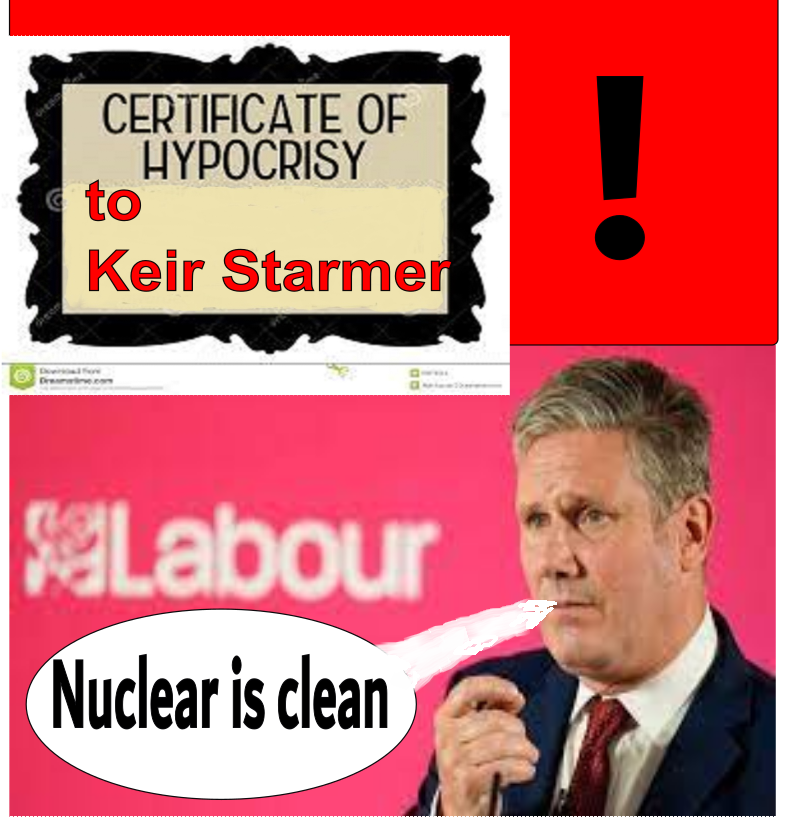
The world gasps at the Americans swallowing lie after lie from the superb dissimulator Donald Trump, but it might not notice Britain’s worthy, virtuous, man of the working people, Keir Starmer, also proclaiming a set of lies. Starmer has got into a super-confident sort of Trumpian mode as he pronounces ‘Build baby build’.
Yes, Sir Keir is “taking on the blockers” to bring the UK back to a leadership position on building nuclear power. The “blockers” are safety and environmental regulators. A new Nuclear Regulatory Taskforce will be established to speed up and streamline the approval of new reactors. This will report directly to the PM.
For the first time, mini-nuclear power stations will be included in planning rules. Nuclear sites could now be built anywhere across England and Wales, as a list restricting the sites for new reactors will be scrapped. The expiry date on planning rules will be scrapped. A specialist taskforce will lead on making sure nuclear regulation incentivises investment, to deliver new projects more quickly. It will all apply to both the civil and the military nuclear industry.
This has been greeted with joy by X-Energy, EDF, Microsoft, Great British NUclear, the Nuclear Industry Association, Prospect, the Institute of Directors, Laing O’Rourke, Nuclear EMEA at AtkinsRéali, GCHQ, tech UK, newcleo – indeed, all the people who hope to make a financial killing from the UK tax-payer.
Others are less enthused.
“The Labour government has swallowed [the] nuclear industry spin whole,”………. “They present as fact things which are merely optimistic conjecture on small nuclear reactor cost, speed of delivery and safety.” – Doug Parr, policy director of Greenpeace UK
We must keep in mind, that with all this enthusiasm, these new small nuclear reactors do not actually exist. They are only designs on the computers of a multitude of companies vying for the contracts to build their prototype, and with the history of failures so far, -USA’s NuScale and France’s Nuward small nuclear reactors.
The other side of the hoped-for resuscitation of the nuclear industry is the maintenance and life-extension of Britain’s aging nuclear fleet of big Advanced Gas-cooled Reactors (AGRs) and one big Pressurised Water Reactor. With a mean age of 37.1 years they are all due to be decommissioned before long. With exposure to radiation, high temperatures, their components become more brittle, susceptible to cracking, less able to cope with temperature extremes.

It’s as if Sir Keir Starmer had waved his magic wand over the realities of the situation – as Doug Parr pointed out – over the cost, and time of delivery for small nuclear reactors.
Other spin matters happily regurgitated by Starmer are the idea of new nuclear power not only as “cheap” but as providing thousands of “clean” healthy and safe jobs. The fact that the UK is already in a horrible mess with its unsolved problem of plutonium waste, – is just ignored, – yet the new small nuclear designs would produce even more toxic plutonium wastes.

Recent research has backed up many previous studies that prove that workers in the nuclear industry are at higher risk of radiation-induced illness, especially cancer. So – theyr’e not “clean” jobs, and it’s clear now that the new smrs+AI are intimately connected with military applications – not jobs where one could feel safe and proud of doing really beneficial work.
Starmer blames all the opposition, delay on building nuclear power on Vladimir Putin, “holding Britain hostage”. Now it seems, the nuclear history of environmental damage, cancer, accidents, intractable waste problems, and stupendous costs, all mean nothing. Those who oppose new nuclear power in the UK are just tools of pro-Russian propaganda.
Indeed, it is Spin Baby, Nuclear Spin!
As China and the U.S. Race Toward A.I. Armageddon, Does It Matter Who Wins?

it doesn’t matter if the U.S. has no real enemies. The military industrial complex must continue to unceasingly grow, according to the logic of the Megamachine. It will invent enemies in order to justify that growth. That’s why we now have thousands of nuclear bombs and a sprawling, AI-driven, globally networked satellite and base infrastructure that encases the Earth like an iron maiden.
Koohan Paik-Mander CounterPunch , 7 Feb 25
A longstanding Sinophobia in the U.S. goes back to the 19th century, with the Chinese Exclusion Act, the tax on Chinese miners during the Gold Rush, and the exclusion from being able to testify in court.
Evidence of this entrenched history lingers today, in the trade sanctions against China, belligerent rhetoric from both Republicans and Democrats that led to a rash of violence against elderly Asian-Americans on American streets, as well as billions of dollars spent to fortify overseas bases in preparation for a U.S.-China war.
And the refusal to cooperate meaningfully with China on anything. As a result, the U.S. is thick in the midst of an AI arms race with China that is predicated on both nations’ dangerous faith in techno-salvation.
Thanks to the legacy of Sinophobia, it takes a whole lot to elicit an overwhelming embrace of China from average Americans, even if temporarily. But that’s what’s happened twice in the last month. The first time was the TikTok fiasco, when millions of distraught TikTok users had had their favorite platform snatched from them like a pacifier from a baby’s mouth. They found solace not in Meta nor X (as had been the plan), but rather, in the Chinese social media platform, Xiaohongshu, also known as “RedNote.”
The second instance was the debut of DeepSeek AI, which came on the heels of one of the most pompous pageants of delusional grandeur ever seen. It was Trump’s inauguration ceremony for his second term. Shortly thereafter, a press conference was held. Three tech oligarchs and the president bloviated about their Stargate AI project. It would cost $500 billion. That’s what they say is needed to stay ahead of the Chinese. (For some reason, the excuse of “staying ahead of the Chinese” seems to justify any astronomical expense.)
In the mean time, thousands of people have been left homeless due to wild fires in L.A., flooding in North Carolina, and even to this day, people from Lahaina, Maui are still without a place to call home. But none of these Americans got a press conference.
Instead, it was the oligarchs who took the stage. Oracle’s Larry Ellison, Masayoshi Son of Starbank, and Open AI founder Sam Altman described Stargate’s plans to build clusters of gigantic data centers across the country from sea to shining sea, each one bigger than any Walmart Superstore. It’s Manifest Destiny for data.
No one at the press conference mentioned that many of the data centers would be built on federal lands, would collectively use as much power as small European nations, require massive volumes of water, or would require a network of nuclear reactors. They did make the dubious promise their AI would cure cancer and heart disease. I think the guys who got wampum for Manhattan got a better deal.
A few days afterward, as if on cue, a Chinese company called DeepSeek that no one had ever heard of dropped their bombshell. The Chinese firm had released its own AI that was open-source, used fifty times less energy, performed on par with all the American AIs, and cost a gazillion times less to produce. Suddenly, the mirage of Silicon Valley’s invincibility faded away to reveal an overvalued industry that had gotten too fat, lazy and full of itself to innovate anything except marketing promises to investors. The very next day, a veritable trillion dollars peeled like a banana off the U.S. stock exchange tech sector. The story everywhere was that Chinese AI had officially “caught up” with the U.S.
When people cheered the scrappy Chinese underdog, it was as much a middle finger to the overblown hubris of the tech oligarchs as it was an embrace of Chinese innovation. It was motivated largely by the same class anger that rose up to lionize Luigi Mangione for killing a health insurance CEO with three inscribed bullets. People had been galled by the consolidated display of the broligarchy on the dais at the Trump inauguration, similar to the royals waving at the minions from the balcony at Buckingham Palace. Their message was unequivocal: We own you.
DeepSeek has been described as a Robin Hood of tech, taking from the rich to give AI to the poor. Sentiments of class anger buoyed admiration for the unknown company from China. They disregarded, for once, the stubborn stains of Sinophobia.
What was also overlooked in the midst of DeepSeek’s dazzling display of stock market disruption was responsible restraint around technology. As both China and the U.S. go hurtling ever faster toward Armageddon in the race to dominate in AI, they have both bought into techno-utopian ideologies, lock, stock and barrel………………………………………………………………….
China and the U.S. are entangled in a geopolitical rivalry, with existential stakes. Sure, it’s satisfying to enjoy the smarting blow that newcomer DeepSeek landed to the capitalist Goliath — China one, U.S. zero. But it’s not a boxing match. Such narrow framing loses sight of the fact that the race for accessible AI is a race for Mutually Assured Destruction (MAD).
………………………………………………………………………………………………………………The weapons industry wouldn’t tolerate the thought of degrowth, just like Microsoft, Google, Meta, Amazon et al. can’t bear it today. The war industry dealt with it by instead aggressively manufacturing enemies and reasons for war faster than it could manufacture more weapons. Now, forty years after the end of the Cold War with Russia, the war budget has increased every year and is now up to one trillion dollars, Los Alamos has begun manufacturing nukes for the first time in decades last year, we’ve got 800 bases around the world, rocket launchpads in wilderness areas, and thousands of satellites in the heavens.
It’s hard to get one’s bearings, especially in the midst of the engineered political maelstrom of the current moment. Fortunately, the books haven’t been burned (yet), so we can turn to the thinkers of the recent past for guidance.
The technology critics of the 20th century, such as Jacques Ellul, Lewis Mumford and Chellis Glendinning, urged us to conceptualize technology not just as a single artifact, such as a laptop, or just AI, or just a satellite, or just a nuclear weapon, but rather, as a whole way of thinking, a way of organizing society, our institutions, a way of being. Technology is not a one-off. It is systemic. Lewis Mumford called all of our technological society the Megamachine.
Every project, technology, organization, and endeavor is an expression of the Megamachine where the economic-growth imperative reigns supreme. It is all of a piece. It doesn’t matter if DeepSeek uses less energy. The growth imperative must be met……
Likewise, it doesn’t matter if the U.S. has no real enemies. The military industrial complex must continue to unceasingly grow, according to the logic of the Megamachine. It will invent enemies in order to justify that growth. That’s why we now have thousands of nuclear bombs and a sprawling, AI-driven, globally networked satellite and base infrastructure that encases the Earth like an iron maiden.
The poster child for the Megamachine in the digital age is Amazon. Former chair of the Federal Trade Commission Lina Khan’s seminal essay “Amazon’s Anti-trust Paradox,” tracks the logic of the behemoth’s growth over its history. She brilliantly unravels how Amazon decisively prioritized sheer growth over profit for its first eight years. The goal was to entrench a broad-spanning networked infrastructure that would guarantee a monopoly and continue to consolidate market dominion. They forwent profits for almost a decade expressly in order to monopolize the market. Again, the imperative for growth and global domination trumps decent common sense.
Former chair of the Federal Trade Commission Lina Khan’s seminal essay “Amazon’s Anti-trust Paradox,” tracks the logic of the behemoth’s growth over its history. She brilliantly unravels how Amazon decisively prioritized sheer growth over profit for its first eight years. The goal was to entrench a broad-spanning networked infrastructure that would guarantee a monopoly and continue to consolidate market dominion. They forwent profits for almost a decade expressly in order to monopolize the market. Again, the imperative for growth and global domination trumps decent common sense.
……………………………………………………………The sooner that the U.S. and China treat one another as fellow members of humankind, rather than adversaries, the real work of cooperation can begin. Both nations are home to millions of indigenous peoples who carry the know-how for surviving and thriving for generations into the future. Their wisdom is more precious than any AI. There’s no shortage of problems that our combined brilliance can improve if not solve: climate, nuclear weapons, species extinction, toxic waste clean-up, housing, microplastics, and last but not least, dangerous unregulated technologies. None of these colossal crises can be addressed as long as we are pointing fingers while locked in the downward spiral of a competition for global hegemony that the U.S. can never win.
Some of us remember the shining moment in history when the U.S. and Soviet Union built trust and signed a raft of nuclear arms control agreements. They modeled what ratcheting down tensions and the path to peace looks like. It would behoove the U.S. and China to follow their lead today, not only with nukes but also with AI and other emerging technologies. https://www.counterpunch.org/2025/02/07/as-china-and-the-u-s-race-toward-a-i-armageddon-does-it-matter-who-wins/
-
Archives
- October 2026 (120)
- September 2026 (339)
- August 2026 (330)
- July 2026 (355)
- June 2026 (287)
- May 2026 (306)
- April 2026 (356)
- March 2026 (251)
- February 2026 (267)
- January 2026 (308)
- December 2025 (358)
- November 2025 (359)
-
Categories
- 1
- 1 NUCLEAR ISSUES
- business and costs
- climate change
- culture and arts
- ENERGY
- environment
- health
- history
- indigenous issues
- Legal
- marketing of nuclear
- media
- opposition to nuclear
- PERSONAL STORIES
- politics
- politics international
- Religion and ethics
- safety
- secrets,lies and civil liberties
- spinbuster
- technology
- Uranium
- wastes
- weapons and war
- Women
- 2 WORLD
- ACTION
- AFRICA
- Atrocities
- AUSTRALIA
- Christina's notes
- Christina's themes
- culture and arts
- Events
- Fuk 2022
- Fuk 2023
- Fukushima 2017
- Fukushima 2018
- fukushima 2019
- Fukushima 2020
- Fukushima 2021
- general
- global warming
- Humour (God we need it)
- Nuclear
- RARE EARTHS
- Reference
- resources – print
- Resources -audiovicual
- Weekly Newsletter
- World
- World Nuclear
- YouTube
-
RSS
Entries RSS
Comments RSS

