Archbishop Gallagher: Nuclear weapons pose existential threat
As Pope Francis strongly affirms, Archbishop Gallagher insisted, it is necessary “to overcome the logic of confrontation and embrace instead the logic of encounter.”
The Vatican’s Secretary for Relations with States, Archbishop Paul Richard Gallagher, expresses the Holy See’s “deep concern” over the existential threat posed by nuclear weapons, in his remarks to the High-Level Segment of the UN’s 2025 Session of the Conference on Disarmament.
By Deborah Castellano Lubov, https://www.vaticannews.va/en/vatican-city/news/2025-02/gallagher-addresses-2025-session-of-conference-on-disarmament.html
“Immense military expenditures, that often go far beyond what is necessary to ensure legitimate defense, foment the vicious circle of an exhausting arms race that diverts vital resources away from poverty eradication, justice, education, and healthcare.”
Archbishop Paul Richard Gallagher, the Vatican’s Secretary for Relations with States and International Organizations, stressed this on Wednesday in a statement to the UN’s High-Level Segment of the 2025 Session of the Conference on Disarmament taking place in Geneva on February 24-28.
Offering the participants the Pope’s cordial greetings, he said, “Today we stand at a turning point.”
“Together, as a family of nations,” he encouraged, “we can take just and courageous actions for a general, balanced, and complete disarmamentunder effective international control.”
Otherwise, he warned, the alternative “is the perpetuation of conflicts, violence, increasing inequalities, and environmental degradation, from which ultimately benefits no one but the arms lobby.”
‘Hostage to a stalemate’
Archbishop Gallagher said the Conference on Disarmament “has been held hostage to a stalemate” that has continued year after year “without the adoption of a proper negotiating mandate.”
The raison d’être of this body, he recalled, is to negotiate multilateral disarmament instruments and to deliver concrete results.
In this regard, he said, it must be recalled that all peoples of the world have a vital interest in the success of the disarmament negotiations.
Duty and right to participate in negotiations
“Consequently,” he underscored, “all States have the duty—as well as the right—to contribute and to participate in such negotiations.”
“Massive and competitive arms accumulation,” Archbishop Gallagher observed, “seems to contradict the provisions of the Charter of the United Nations, in which States resolve “to take effective collective measures for the prevention and removal of threats to the peace.”
The Vatican’s Secretary for Relations with States recalled Pope Francis’ recent appeal to “reduce military expenditures on weapons” and to “use at least a fixed percentage of the money earmarked for armaments to establish a global Fund to eradicate hunger and facilitate in the poorer countries educational activities aimed at promoting sustainable development and combating climate change.”
Before it is too late
As Pope Francis strongly affirms, Archbishop Gallagher insisted, it is necessary “to overcome the logic of confrontation and embrace instead the logic of encounter.”
Therefore, he said, the Holy See encourages the conference to adopt a renewed sense of urgency and commitment to reach concrete and lasting agreements for the sake of the common good, “before it may be too late.”
Archbishop Gallagher said the Holy See remains “deeply concerned” about the existential threat posed by nuclear weapons and their proliferation.
“Peace and international stability,” he observed, “are incompatible with attempts to build upon the fear of mutual destruction or the threat of total annihilation.”
Serious negotations required
He expressed concern over the “continuous expansion and modernization of nuclear arsenals, accompanied by escalating rhetoric and threats concerning their deployment.” The means to promote peace and stability today, he insisted, should not be of those that would reignite or fuel the dangerous pursuit of nuclear weapons.
“Moreover,” he appealed, “it is urgent that nuclear weapons states engage in serious negotiations to reduce and eventually eliminate their stockpiles in accordance with their obligations under Art. VI of the Treaty on the Non-Proliferation of Nuclear Weapons.”
Concerns for weaponization of artificial intelligence
He also discussed the weaponization of Artificial Intelligence (AI), observing “the ability to conduct military operations through remote control systems has led to a lessened perception of the devastation caused by those weapon systems and the burden of responsibility for their use, resulting in an even more cold and detached approach to the immense tragedy of war.”
In particular, Archbishop Gallagher reminded the participants that Lethal Autonomous Weapon Systems (LAWS), which are capable of identifying and striking targets without direct human intervention and control, “are a cause for grave ethical concern’ because they lack the ‘unique human capacity for moral judgment and ethical decision-making.”
We can’t afford Doug Ford’s nuclear fantasy

When it comes to energy, any economic strategy for Ontario has to focus on controlling energy costs and improving energy productivity, not energy production.
Feb. 26, 2025, By Mark Winfield. Mark Winfield is a professor of environmental and urban change at York University, co-chair of the faculty’s Sustainable Energy Initiative, and co-editor of Sustainable Energy Transitions in Canada (UBC Press 2023). https://www.thespec.com/opinion/contributors/we-cant-afford-doug-ford-s-nuclear-fantasy/article_818e4f2d-0f80-50bf-a4c4-7abaf277ebb1.html
Doug Ford’s proposal to bury Highway 401 lanes from Brampton or Mississauga in the west to Scarborough or Markham in the east, with an estimated price tag of at least $100 billion, has been described as being a “fantasy that would bankrupt” the province.
Although the 401 proposal has drawn the most attention among the Ford government’s increasingly grandiose infrastructure proposals, it actually isn’t the largest.
That status goes to the government’s plans to dramatically expand the province’s now aging fleet of nuclear reactors. A 10,000-megawatt (MW) facility proposed just before the election call for Wesleyville, Ont., between Coburg and Kingston, could break the $200-billion mark in capital costs alone.
That estimate is based on the actual costs of the most recently completed nuclear construction project in North American, the Vogtle plant in Georgia. That facility, completed last summer, came in at $50 billion (Canadian) for 2,200 MW capacity. A simple extrapolation of those costs to the Wesleyville project would give a figure of over $200 billion.
But there is even more to the Ford government’s nuclear plan.
A proposed new 4,800-MW facility at the Bruce nuclear site, would come in around $100 billion on the same basis. New estimates by the U.S. Tennessee Valley Authority on the costs of the type of the four 300-MW reactors proposed for the Darlington site suggests costs in the range of $25 billion.
To this has to be added the costs of the refurbishments of the existing reactors at Bruce, Darlington and potentially, the Pickering B site, with potential costs of between $35 billion and $50 billion.
For context, the scale of Ontario’s nuclear proposals, relative to provincial GDP, would be comparable to that of the Muskrat Falls hydro project in Labrador. That project really did push the Province of Newfoundland and Labrador to the brink of bankruptcy, save for a massive federal bailout.
At least the Muskrat Falls project was subject to external economic and environmental reviews. Unfortunately, the warnings flowing from those reviews about the project’s risks were ignored. In contrast, none of Ontario’s proposals have been subject to any form of meaningful external review in terms of their economic, technological or environmental rationality.
The Ford government’s nuclear heavy strategy appears to be premised on an assumption that a massive nuclear expansion program will turn Ontario into an electricity production and export “superpower.”
The fundamental problem with strategy is that Ontario has no comparative advantage in electricity production.
Comparative advantage in energy tends to be a product of accidents of geography. Ontario was the beneficiary of such an accident through the first half of the 20th century, where hydro-electricity, principally from Niagara Falls, provided the foundation of the industrial base that was built through the Golden Horseshoe around the western end of Lake Ontario, from Niagara to Oshawa.
But that advantage was lost from the early 1960s onward when the province ceased to be a hydro-dominated system, turning first to the construction of coal-fired plants, and then a massive nuclear construction program from the 1960s to the 1990s.
Ontario turned out to be no better at building and operating these types of plants than anyone else in North America.
The province therefore lost its comparative advantage in electricity production. The recent experience with attempts at constructing new nuclear facilities in the U.S. and Europe, like the Vogtle project, suggest such advantage cannot be restored through a nuclear expansion program. Renewable energy sources, combined with energy storage offer much more cost-effective, lower-impact and lower-risk options.
Instead, when it comes to energy, any economic strategy for Ontario has to focus on controlling energy costs and improving energy productivity, not energy production. The province is already taking $7.3 billion a year from general revenues, funds that otherwise would be spent, for example, on schools and hospitals, to artificially lower hydro costs for industrial and residential consumers.
The Ford government has given no indication of what its nuclear expansion program will cost or how it will be financed. Past experience tells us it will be Ontario electricity ratepayers and taxpayers who are likely to be ultimately stuck with the bills.
Ontario needs to engage in a serious debate about the future of its energy systems. But it needs to look to pathways to decarbonize the province without risking bankrupting it in the process.
Election candidates should face nuclear waste questions: group

THE CHRONICLE-JOURNAL, Feb 25, 2025, https://www.chroniclejournal.com/news/local/election-candidates-should-face-nuclear-waste-questions-group/article_e5e12318-f322-11ef-aede-0bca88dc7589.htm
With just two days to go before the provincial election, two citizen watchdog groups are urging voters to grill candidates over where they stand regarding alternatives to nuclear power, and what to do with the nuclear waste that exists now.
In particular, the We The Nuclear Free North and Northwatch groups want candidates to commit to giving first responders notice before nuclear waste is transported through areas in which they provide emergency services.
The groups maintain that question is crucial in the Thunder Bay district, since the Nuclear Waste Management Organization is proposing to build an underground storage site for spent nuclear fuel rods at a remote location between Ignace and Dryden.
The two groups have set up an online tool that can be used to put questions to provincial-election candidates about the project and request a response. The link to the tool is: tinyurl.com/2x9uct7a.
Radioactive fuel rods are to be shipped to the storage site by truck or rail in specialized containers designed to withstand fiery crashes, hard impacts and immersion in water, according to the Nuclear Waste Management Organization.
The storage site is expected to take 20 years to build once all approvals have been obtained.
SCOTUS goes nuclear: Justices’ decision could seal spent fuel storage options for decades.

Ultimately, the Supreme Court will not be hearing technical, economic, or social arguments in this case; the matters of interest are purely legal. These legal interpretations, however, will have profound implications for how commercial spent nuclear fuel is handled until plans for permanent repositories are developed.
Bulleting of Atomic Scientists, By Riley Fisher, Muhammad Abdussami, Aditi Verma | February 20, 2025
US nuclear waste policy is at a critical turning point. Mired in decades of disappointments and shortcomings, the monkey on nuclear power’s back is just weeks away from being freed—or being strapped in place. The issue at hand: whether the Nuclear Regulatory Commission (NRC) had the legal authority to grant a permit for the construction and operation of a privately-owned temporary spent nuclear fuel storage facility in Texas.
On March 5, 2025, representatives from the NRC and the state of Texas will convene in Washington, D.C., to argue this issue in front of the United States Supreme Court. The NRC v. Texas case will end a battle of nearly three and a half years over the legality of privately-owned interim nuclear waste storage in the United States. However, while the Supreme Court’s ruling will settle the battle, it will resolve only one aspect of the US nuclear waste management problem.
A ruling favoring the NRC would help the nuclear waste problem in the short term but might harm the long-term management situation, allowing the consolidation of spent nuclear fuel at interim storage facilities—a state of affairs that could place new constraints on the permanent solution of geological disposal. Conversely, a ruling against the NRC would hurt the waste problem short-term by halting interim storage plans—including those of Interim Storage Partners in Texas and Holtec International in New Mexico—but it would leave future permanent storage options unconstrained.
Temporary storage. For more than 40 years, temporary, consolidated nuclear waste storage has been a hot-button issue. The Nuclear Waste Policy Act of 1982 tasked the president and the Energy Department with identifying, constructing, and operating nuclear waste storage facilities in underground repositories. With this act, Congress intended to create a program that permanently stowed away the hazardous waste produced by nuclear power operations.
The original provisions of the Nuclear Waste Policy Act gave the president four years to start the construction of a geologic repository site following congressional approval. During this process, nuclear power plants were still operating and producing spent nuclear fuel, and Congress clarified that plant operators were primarily responsible for waste management while the executive branch did their repository siting and construction work. Under exceptional circumstances, however, the federal government was allowed to provide a limited amount of “interim” storage before the waste was transferred to a permanent facility. The federal interim storage program would temporarily consolidate spent fuel away from reactor sites that have limited capacity.
But when efforts for a permanent repository at Yucca Mountain in Nevada stalled, the role of consolidated interim storage was put in a precarious position. Spent fuel continued to accumulate at nuclear power plants across the country, the federal government could not provide more temporary storage because it would violate the Nuclear Waste Policy Act, and the NRC did not have explicit authority to license an external body to create temporary storage. This tension is the impetus for NRC v. Texas case now at the Supreme Court.
There are a variety of arguments both for and against temporary storage of commercial spent nuclear fuel in the United States. Proponents cite that reactor host communities should not be subjected to living near radioactive waste for more time than they initially consented; interim storage, they say, would increase safety and economic efficiency through consolidation. Critics, in contrast, argue that a community near an interim facility risks the same fate of non-consent in the event of further delay in creating a permanent waste repository and that the safety risks from additional transportation and shuffling outweigh the benefits of consolidation.
Ultimately, the Supreme Court will not be hearing technical, economic, or social arguments in this case; the matters of interest are purely legal. These legal interpretations, however, will have profound implications for how commercial spent nuclear fuel is handled until plans for permanent repositories are developed.
Lower court’s contradictory ruling. Two main questions will be argued in NRC v. Texas. The first is a matter of administrative process and pertains to whether Texas had the legal right to challenge the NRC in the first place. Texas first challenged the commission under the 1950 Hobbs Act (which is not the Hobbs Act used in criminal prosecutions of organized crime), an administrative law statute that gives “aggrieved parties” the right to challenge federal agency actions. The NRC claims Texas did not follow proper procedure to be considered an aggrieved party and, therefore, did not have authority to challenge the license.
The second question is a matter of the function and authority of the NRC and is rooted in the language of the Atomic Energy Act of 1954. Texas argues that the NRC only has authority to grant temporary spent nuclear fuel storage licenses on the site of the reactor from which the waste originated. Therefore, Texas claims, the commission had no right to grant the license for a temporary storage facility in the state. The NRC, however, cites multiple previous court decisions that uphold this authorization. These federal-state disputes make a case like this ripe for Supreme Court intervention.
Like most other Supreme Court cases, NRC v. Texas is an appeal of a previously decided case in a lower court: Texas v. NRC. …………………………………………………………………………………………………………
NRC’s appeal. The Supreme Court may decide in a variety of ways concerning Texas’ authority under the Hobbs Act and the NRC’s authority under the Atomic Energy Act and the Nuclear Waste Policy Act. While clarification as to whether Texas was a proper “party aggrieved” is certainly important, it is likely the Supreme Court will take the opportunity to define the scope of the NRC’s abilities regardless of the interpretation of the Hobbs Act. Even if the Supreme Court finds that Texas was not a proper “party aggrieved,” the Court will still have the ability to hold the issued license void despite improper administrative procedures taken by Texas.
………………………………………………………. Because there is no explicit authorization in either act, the Supreme Court will likely rule that the NRC lacks clear congressional approval. If this is the case, then the Supreme Court will have to decide whether private, off-reactor spent fuel storage is a matter of major national significance— also known as a “major question.” While the Supreme Court has yet to hear arguments on this specific issue, there are reasonable explanations for either ruling.
……………………………………Some legal experts argue that private off-reactor waste is not a major question. Because on-site storage is exorbitantly expensive, a consolidated interim facility operated by a private entity will likely alleviate taxpayers’ burden. The West Virginia case was decided partially on its nationwide economic implications, but such implications are not present in this case. Another argument is that the NRC issued its regulations for private off-reactor storage two years before the Nuclear Waste Policy Act was passed. The fact that Congress did not revoke this authority from the NRC when passing the act could be interpreted as implicit approval. If the Supreme Court agrees with this perspective, it will likely allow Interim Storage Partners’ license to stand, even if the NRC did not have the explicit authority to issue that license.
Other arguments exist for this issue being a major question……………………………………
No perfect ruling. Either ruling will no doubt have vast consequences on the US nuclear waste management problem. A ruling in favor of the NRC would provide support for the nuclear industry’s ability to manage spent fuel, particularly during the continuous delays in permanent repository development. This result could also encourage private investment in nuclear energy by providing clearer pathways for managing waste, potentially revitalizing confidence in the industry’s long-term viability. However, a decision in NRC’s favor would not resolve all concerns with nuclear waste management. Many communities oppose the siting of temporary storage facilities, citing safety risks and the lack of a permanent solution. Resistance will continue to grow at local and state levels if these broader concerns go unaddressed. Congress will need to continue developing directives that strengthen and complement private solutions to waste management. A ruling in favor of the NRC would undoubtedly be a win for the nuclear industry, the federal government, and reactor host communities, as short-term pressures caused by on-site waste storage can finally be addressed. In the long term, this ruling will do little to permanently solve the waste problem and may place the nuclear industry into a false sense of security amidst concerns of interim facilities becoming de facto repositories.
If the Supreme Court rules against the NRC, it will create substantial uncertainty for the nuclear industry by rejecting the NRC’s authority to license private off-site storage facilities. Other corporations that currently plan to construct such facilities, such as Holtec International in New Mexico, will risk the revocation of their licenses. Decommissioned reactors with on-site storage may face danger to their storage license renewals, which will force active reactor sites to take in external waste while still generating their own. Situations like these can heighten safety and security risks, as many sites lack the infrastructure or oversight necessary for long-term storage and management.
However, a ruling against the NRC may bring increased attention to the issue and compel Congress to act decisively. ……………………………………… . A ruling against the NRC will likely be to the immediate detriment of the nuclear industry, the federal government, and reactor host communities. These pressures, however, may urge lawmakers to develop a new, permanent solution once and for all.
In the context of the nuclear waste problem, a ruling in favor of the NRC will be a short-term benefit but bring long-term risks. A ruling against the NRC will be a short-term detriment but may spur renewed action for long-term solutions. Regardless of the Supreme Court’s decision, Congress must dictate a permanent solution, which will be less likely to occur if short-term pressures are alleviated by ruling in favor of the NRC. In the absence of immediate Congressional intervention, the nuclear industry and the Energy Department must still work closely and in good faith with host communities. Anything else will result in complete failure of fair and democratic planning—as has been observed time and time again.
Editor’s note: Arguments on the NRC v. Texas case will be held before the Supreme Court on March 5, 2025. Summaries, audio files, and opinions will be accessible here after the hearing. The Supreme Court will issue its opinion before recess in late June 2025. Proceedings and orders will be made available as they come here. https://thebulletin.org/2025/02/scotus-goes-nuclear-justices-decision-could-seal-spent-fuel-storage-options-for-decades/
Public concern increasing about nuclear waste shipments west of Sudbury
Northern Ontario News, By Ian Campbell, February 24, 2025
Officials in Nairn & Hyman Township say they are encouraged by the turnout at last week’s public information meeting as they continue to oppose the shipment of nuclear materials near Agnew Lake.
The Township of Nairn and Hyman and the Township of Baldwin held a joint emergency council meeting this week to discuss a plan to move radioactive material from the former Beaucage Mine. (Photo from video)
The township, along with the neighbouring community of Baldwin, has been vocal in its opposition to plans that would see nuclear waste transported to a nearby tailings management area west of Sudbury.
While the shipment plan is currently on hold, concerns remain about the potential environmental and health impacts of the proposal.
Nairn & Hyman Mayor Amy Mazey said the municipalities have been told not to expect answers to their questions until March 15.
In the meantime, Mazey and the township’s chief administrative officer said studies conducted by the municipality suggest the shipments could pose a risk to the local drinking water supply.
“When we get answers to our questions, we’re hoping to do another town hall meeting and show the town residents what we have received,” Mazey said.
“I’m pretty sure they’ll still be pretty negative towards it, but [we’ll] give them that update and then go to council and make a decision on how to move forward from there.”
The townships have garnered support from several political figures, including Nickel Belt’s Member of Parliament, a former Member of Provincial Parliament and the current candidate for the Algoma-Manitoulin riding.
Neighbouring communities along the North Shore have also joined the effort to oppose the shipments.The issue has sparked significant public interest, with residents expressing concerns about the long-term implications of storing nuclear materials in the area.
Mazey emphasized the importance of keeping the community informed and involved as the situation develops, when speaking with CTV News.
For now, the townships await further information and continue to prepare for next steps, including potential council decisions and further public engagement.
93% say NO: latest polls in Lincolnshire condemn nuke dump plan

In yet another demonstration that the people of East Lincolnshire are a far from ‘willing community’, recent polling at public events hosted by Nuclear Waste Services and amongst the parishioners of Gayton-le-Marsh have delivered a resounding NO vote to any plans to bring a nuclear waste dump to the area.
Nuclear Waste Service have recently resolved to move its Area of Focus in the Theddlethorpe GDF Search Area from the former Conoco gas terminal inland to 1,000 acres of prime farmland between the villages of Great Carlton and Gayton-le-Marsh.
NWS has held a series of information meetings to explain their decision. Theddlethorpe and Withern Councillor Travis Hesketh and activists from the Guardians of the East Coast established a polling booth outside events held in Gayton-le-Marsh, Strubby, Beesby, Maltby-le-Marsh, Great Carlton, Little Carlton, Withern, Theddlethorpe, Legbourne, Grimoldby, Manby and Saltfleetby, and invited members of the public to cast their secret ballot on the latest iteration of NWS’s plans to bring a Geological Disposal Facility to the area.
Of the 535 residents attending the events, 93% voted in the secret ballot; of these 93% voted for the process to be ended or for a Test of Public Support to be held now.
24th February 2025
93% say NO: latest polls in Lincolnshire condemn nuke dump plan
In yet another demonstration that the people of East Lincolnshire are a far from ‘willing community’, recent polling at public events hosted by Nuclear Waste Services and amongst the parishioners of Gayton-le-Marsh have delivered a resounding NO vote to any plans to bring a nuclear waste dump to the area.
Nuclear Waste Service have recently resolved to move its Area of Focus in the Theddlethorpe GDF Search Area from the former Conoco gas terminal inland to 1,000 acres of prime farmland between the villages of Great Carlton and Gayton-le-Marsh.
NWS has held a series of information meetings to explain their decision. Theddlethorpe and Withern Councillor Travis Hesketh and activists from the Guardians of the East Coast established a polling booth outside events held in Gayton-le-Marsh, Strubby, Beesby, Maltby-le-Marsh, Great Carlton, Little Carlton, Withern, Theddlethorpe, Legbourne, Grimoldby, Manby and Saltfleetby, and invited members of the public to cast their secret ballot on the latest iteration of NWS’s plans to bring a Geological Disposal Facility to the area.
Of the 535 residents attending the events, 93% voted in the secret ballot; of these 93% voted for the process to be ended or for a Test of Public Support to be held now.
Carlton Parish Council has previously passed a resolution calling for an immediate Test of Public Support, and the villagers of Gayton-le-Marsh made a similar resolution in a parish poll. 80% of parishioners participated, with 106 residents or 91% calling for the proposal to be withdrawn and 108 or 93% seeking a Test of Public Support.
These are the two latest blows in a whole series showered on Nuclear Waste Services, who must by now be punch-drunk, with most local Parish and Town Councils also passing resolutions calling for an immediate withdrawal or Test of Public Support.
In the last local elections held in 2023, a slate of anti-dump candidates was elected in wards within the Theddlethorpe GDF Search Area to East Lindsey District Council, Mablethorpe and Sutton Town Council, and local parish councils.
Surveys carried out by Guardians of the East Coast have previously indicated at least 85% are opposed to the nuclear waste dump plan.
The local Conservative MP for Louth and Horncastle Victoria Atkins has expressed her opposition to the plan and even the Leader of East Lindsey District Council Councillor Craig Leyland has had a change of heart indicating that he shall now be recommending to his Executive that the Council withdraw from the process.
To the NFLAs, Nuclear Waste Services continued efforts to pursue a GDF in East Lincolnshire represents the ultimate exercise in futility, for there are NO conceivable circumstances in which this will ever be a ‘willing community’.
A Lawsuit Against Greenpeace Is Meant to Bankrupt It and Deter Public Protests, Environmental Groups Warn

.“This case and its outcome should be
the concern of every American,” a legal expert says as the Dakota Access
Pipeline trial is set to begin. Next week, not far from where thousands of
Indigenous and environmental activists gathered in North Dakota nine years
ago in opposition to the Dakota Access Pipeline, one of the most
consequential trials to emerge from that conflict is set to begin. The
case, filed by pipeline developer Energy Transfer, accuses Greenpeace of
defaming the company while funding and supporting some protesters who
damaged its property. On its face, the trial is an attempt to seek millions
of dollars in damages from an environmental group for campaigning against a
pipeline project. At its heart, however, many activists, legal experts and
even the company’s chief executive say the case is about much more.
“It’s about really the silencing of the Greenpeace entities,” said
Sushma Raman, interim executive director of Greenpeace USA, during a press
call Thursday, referring to how both the organization’s U.S. arm and its
international parent are named. “It’s about trying to bankrupt some of
the entities, and more importantly it’s silencing and sending a message
to broader civil society.”
Inside Climate News 21st Feb 2025, https://insideclimatenews.org/news/21022025/greenpeace-lawsuit-meant-to-deter-public-protests/
German election results tilt EU back toward nuclear energy
Pro-atomic countries are optimistic that center-right winner Friedrich Merz can help ease the EU’s never-ending nuclear spat.
They might not know it yet, but
Germans helped put one of the European Union’s oldest and most polarizing
debates to bed when they voted this past weekend. At least that’s the
hope from the EU’s pro-nuclear countries. That cabal of around a dozen
capitals is looking expectantly at Friedrich Merz, the center-right leader
who has vowed to ease the taboo on atomic power. Merz is in line to become
chancellor after his party won the most votes in Sunday’s election. That
could, in turn, ease a perpetual Brussels logjam blocking pro-nuclear
policy.
Politico 24th Feb 2025 https://www.politico.eu/article/germany-election-eu-nuclear-power-energy/
Nuclear site warns £2.8bn budget is ‘not enough’

BBC 24th Feb 2025
Planned work to decommission the UK’s largest nuclear site could have to be slowed down or paused due to insufficient funding, managers have warned.
Sellafield Ltd, which manages the site near Seascale in Cumbria, said its £2.8bn funding for the 2025-26 financial year would “not be enough” for the planned operations.
The GMB union urged Sellafield to be transparent about the impact of the budget restraints on workers.
The Department for Energy Security and Net Zero said Sellafield’s safety and security was their “top priority”.
In October the spending watchdog, the National Audit Office, said the site was not “value for money” and it had spent £1.9bn more than it earned in 2023-2024.
It is understood that while the funding for the 2025-26 financial year is similar to the one for the 2024-25, it does not take into account inflation and rise in energy prices.
Employee fears
The funding is indicative and is expected to be confirmed soon, but Sellafield said the forecast budget would impact its supply chain.
A spokesman added: “Critical work will continue but some projects will need to be slowed down, paused, or stopped.”…………………………..
https://www.bbc.co.uk/news/articles/cm2yvpx8xp1o
1 March -Remembering All Nuclear Victims.

The commemoration started as a way to remember the victims of the Castle Bravo test of March 1, 1954 which exposed much of the Marshall Islands to radioactive fallout. This was the largest nuclear weapon that the U.S. ever tested, with over twice the designed yield, and the wind blew the fallout over populated areas.
Now we also commemorate other nuclear victims – from Hiroshima and Nagasaki bombings, nuclear testing, nuclear waste cleanup, human radiation experiments, depleted uranium weapons and uranium mining and processing.
| Nuclear Victims CommemorationWharfinger Building, 1 Marina Way, Eureka, CAAt balcony overlooking the Golden Rule on the Marina’s A Dockor if too wet/cold, in the Humboldt Yacht Club – Wharfinger building 10:00 am Commemoration Speaker Boat visits and sailingEureka Public Marina, A Dock11:00 am Boat Visits12:00 pm Sailing* (Weather Permitting)1:30 pm Boat Visits3:00 pm Sailing* (Weather Permitting)4:30 pm Boat Visits5:00 pm Be our guest at the Humboldt Yacht Club cocktail hour! *To request a chance to sail on March 1-2 or some other day, please visit vfpgoldenruleproject.org/guest-crew/ or call Michelle Marsonette at 541-971-9077. |
| Sunday, March 2: Boat Visits, Sailingand Golden Rule Film Festival! |
| Join us for boat visits and sailing, then meet film producers, project managers and crew for films and story telling! Boat Visits, SailingEureka Public Marina, 1 Marina Way, A Dock (near the Wharfinger Building)10:00 am Sailing* (Weather Permitting)11:30 am Boat Visits1:00 pm Sailing* (Weather Permitting)*To request a chance to sail on March 1-2 or some other day, please visit vfpgoldenruleproject.org/guest-crew/ or call Michelle Marsonette at 541-971-9077. |

The VFP Golden Rule Project is co-sponsoring this webinar of the VFP Nuclear Abolition Working Group:
Arming for Armageddon: How US Militarism could lead to Nuclear War
Dangerous and deadly developments in Ukraine, Palestine, the Koreas, and China
featuring…
K. J. NOH is a Korean journalist, political analyst, and educator specializing in the geopolitics and political economy of the Asia-Pacific region. He is a member of Veterans for Peace, a co-founder of Pivot to Peace. and co-host of The China Report on the Breakthrough News Network.
ANN WRIGHT, author and international peace activist, will moderate. Ann is a former U.S. Army colonel and State Dept. official who resigned in protest of the U.S. war on Iraq.
NORMAN SOLOMON is a journalist, media critic, activist with Roots Action and Institute for Public Accuracy, and friend of Daniel Ellsberg
Thursday, March 6, 2025
7 pm Eastern, 6 pm Central, 4 pm Pacific
Global security arrangements “unravelling”, UN chief warns nuclear disarmament conference.

OLIVIA LE POIDEVIN David Adams, , https://sightmagazine.com.au/news/global-security-arrangements-unravelling-un-chief-warns-nuclear-disarmament-conference/
Security arrangements that have supported global peace for decades are unravelling, the head of the United Nations warned on Monday as he urged countries to work together towards a nuclear free world.
“The bilateral and regional security arrangements that underwrote global peace and stability for decades are unravelling before our eyes,” UN Secretary General Antonio Guterres told the Conference on Disarmament that gathered in Geneva.
“Trust is sinking, while uncertainty, insecurity, impunity and military spending are all rising,” Guterres added.
Such factors were weakening the spirit of “mutual restraint”, he said, as he called on countries to implement nuclear disarmament and non-proliferation commitments agreed at a summit in New York last September.
Sixty-five states, including the United States, China and Russia, are members of the Conference which was established in 1979 and is overseen by the United Nations Office for Disarmament Affairs.
It focuses on negotiating deals to end the nuclear arms race and stop countries building up weapons in space, on top of pursuing general disarmament.
Artificial Intelligence was becoming weaponised at an alarming pace and there were signs of new arms races, including in outer space, Guterres warned.
He condemned countries that “outrageously rattle the nuclear sabre as a means of coercion”.
In September last year Russian President Vladimir Putin told the United States and its allies that Moscow could respond with nuclear weapons if they allowed Ukraine to strike deep inside Russia with long-range Western missiles.
Earlier this month Moscow said the outlook for extending the New Strategic Arms Reduction agreement with the US did not look promising.
The agreement, which caps the number of strategic nuclear warheads that the two biggest nuclear superpowers can deploy, is due to expire on February 5, 2026.
Sellafield nuclear site plans cuts as chief says £2.8bn funding ‘not enough’
Union concerned over safety as site’s bosses say budget does not cover work planned.
Alex Lawson and Anna Isaac, Guardian, 25 Feb 25
Sellafield has said nearly £3bn in new funding is “not enough” and bosses are now examining swingeing cuts, prompting fears over jobs and safety at the vast nuclear waste dump.
The Cumbrian nuclear site, which is home to the world’s largest store of plutonium, was last week awarded £2.8bn for the next financial year, the bulk of the total of just over £4bn funds allotted to the Nuclear Decommissioning Authority, a taxpayer-owned and funded quango.
Sellafield’s chief executive, Euan Hutton, has told staff that the funding was “not enough” to carry out planned works, leaving bosses to make “difficult decisions” over spending, sources told the Guardian.
A spokesperson for Sellafield said: “While this is significant funding, it will not be enough for all our planned activities. Critical work will continue but some projects will need to be slowed down, paused, or stopped. This will impact parts of our supply chain.”
Hutton told employees at the site – which employs more than 10,000 people – that all areas of the business will be affected and spending reviewed.
It is understood that internal calculations had forecast that at least £3.1bn would be needed to meet Sellafield’s spending requirements next year, when accounting for rising costs. The site was awarded £2.8bn for the current financial year.
The public spending watchdog has said the ultimate cost of cleaning up Sellafield is expected to rise to £136bn, causing tensions with the Treasury as the chancellor, Rachel Reeves, attempts to tighten public spending and spur growth.
In 2023, the Guardian’s Nuclear Leaks investigation revealed a string of safety concerns at the site – from issues with alarm systems to problems staffing safety roles at its toxic ponds – as well as cybersecurity failings, radioactive contamination and allegations of a toxic workplace culture.
Hutton has not told staff which projects could be paused or stopped at the site, which covers two square miles and hundreds of buildings. Staff carry out a range of work from painstakingly emptying the toxic ponds to building new facilities to house nuclear waste.
Hutton said that safety and security would be prioritised and the site would adhere to legal and regulatory rules, sources said.
However, staff at the hazardous toxic site in north-west England remain concerned that cuts to spending could affect safety and jobs.
Dan Gow, a senior organiser at the GMB union, said: “GMB calls on Sellafield to be fully transparent about any cost-saving measures and to engage with us to ensure the workforce is protected.
“No worker should ever have to fear that budget cuts will put their safety at risk.
“GMB is urging all workers to stand together, stay informed, and ensure their voices are heard. Now more than ever, being part of a strong, organised union is the best way to protect jobs, rights and safety.”
The Office for Nuclear Regulation last week took Sellafield out of special measures for its physical security – but said concerns remained over its cybersecurity……………………………https://www.theguardian.com/environment/2025/feb/24/sellafield-nuclear-site-cuts-funding-union-spending
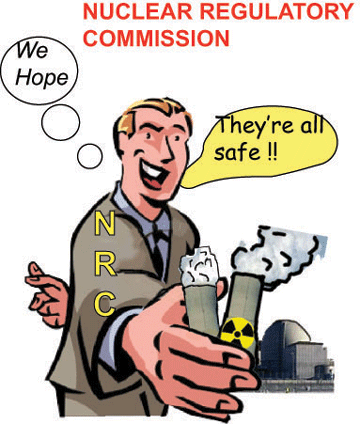
United States: White House Threatens Nuclear Regulatory Commission’s Independence
Energy Intelligence Group, Jessica Sondgeroth, Washington, 21 Feb 25,
The Trump administration’s expansive assertion of presidential power now threatens the independence of the US Nuclear Regulatory Commission (NRC) after the White House this week issued an executive order (EO) claiming control over federal agencies that were established to be independent of politics. The Feb. 18 EO tasks the White House’s Office of Management and Budget (OMB) with the authority to manage independent agencies’ obligations and spending to ensure they align with “the President’s policies and priorities.” These agencies will also have to submit for review to an OMB office “all proposed and final significant regulatory actions.” The extent to which this erodes the NRC’s independence may vary depending on how NRC responds and on OMB actions taken, but nuclear energy sector veterans, critics and advocates are nonetheless waving red flags.
The White House decision “to meddle in safety regulation” is “devastating,” former NRC chair Allison Macfarlane, now a policy professor at the University of British Columbia, told Energy Intelligence. “The US NRC used to be referred to as the ‘gold standard’ for nuclear regulators. No longer. Now other countries can take that mantle.” Macfarlane said that as NRC chair, she spent years championing regulatory independence “to ensure national security and economic security. A nuclear accident, as happened in Japan, can devastate a country’s economy, not to mention its nuclear industry. I guess the folks at the White House have never learned this lesson?”
The EO, titled “Ensuring Accountability for All Agencies”, is only the latest White House challenge to the independence of various executive agencies and to Congressional lawmaking, from science and health research to environmental oversight to public education. This particular EO seeks to broaden the White House’s authority over independent regulatory agencies, including the Federal Trade Commission, Federal Energy Regulatory Commission, Federal Communications Commission and Securities and Exchange Commission. The EO does make some exceptions, but the NRC is not among them.
……………………………………………Given “the blatant and unmitigated conflicts of interest in the White House, and the newfound love among Trump and Elon [Musk]’s tech bro friends for nuclear power,” Ed Lyman, a nuclear regulatory watchdog at the Union of Concerned Scientists, warned in an email that the agency “could be turned into a mere rubber stamp for whatever projects are favored by the President at the moment.” This could override the NRC’s “public health and safety mandate in the name of ‘consistency with the President’s policies and priorities.'”
The NRC was established as an independent agency by Congress in the Energy Reorganization Act of 1974. That law took the NRC’s predecessor, the Atomic Energy Commission, and split its regulatory and promotional roles into the NRC and what is today the US Department of Energy (DOE), respectively. “The NRC was explicitly created to be independent of energy system policy goals under the Atomic Energy Commission that Congress perceived as too political and influenced by the industry,” Adam Stein, nuclear energy innovation director, noted. “Shifting from an independent agency to an agency under direct control of one party under the President creates the same problem from a different influence.”
……………………The nuclear industry lobbies Congress for favorable policies but also communicates directly with the NRC through filings and public meetings to advocate for its interpretation of Congressionally-mandated regulatory reforms.
…………………….For agencies as specialized as the NRC, mass layoffs or buyouts threaten to undermine core competencies and training activities — particularly given the recent hiring of 600 staff, a growing workload of new reactor licensing activities and concerns over the aging workforce.
https://www.energyintel.com/00000195-25b1-ddbd-a9dd-3ff520010000
Opposition to new small nuclear power plants in south Wales

There are plans for four “micro” nuclear reactors in the Llynfi Valley, Bridgend.
WalesLOnline, By Lewis Smith, Local Democracy Reporter, 21 FEB 2025Green Party members in Bridgend have said they are opposed to plans for a nuclear power plant project in the Llynfi Valley describing it as “unnecessary, unwanted and unsafe”.
The multi-million proposals could eventually see the creation of a facility with four micro modular nuclear power plants on the site of the former coal-powered Llynfi Power Station, if given the go-ahead……………
the Bridgend branch of the Green Party have now issued a statement opposing the potential power station, raising concerns over safety with what they say is an “untested” design planned for the site.
……………… Part of the statement added: “This is a new design which if built will be the first of its kind. So the design is untested in the real world. Locals, including local Green Party members have several credible reasons for concern.
“The Green Party questions the need for a nuclear power plant, when Wales has the natural resources required to produce all its energy from a mixture of solar power, onshore and off-shore wind generation.”
“The risk of nuclear leaks, from the on-site nuclear waste storage is not acceptable. Who will pay for future nuclear waste storage? There is a risk that no other region of the UK will be willing to store the nuclear waste, and that this area will become a long term nuclear waste storage site. The consequences of accidental leakage and terrorist targeting has not been fully considered………………… https://www.walesonline.co.uk/news/wales-news/opposition-new-small-nuclear-power-31047639
-
Archives
- October 2026 (120)
- September 2026 (339)
- August 2026 (330)
- July 2026 (355)
- June 2026 (287)
- May 2026 (306)
- April 2026 (356)
- March 2026 (251)
- February 2026 (267)
- January 2026 (308)
- December 2025 (358)
- November 2025 (359)
-
Categories
- 1
- 1 NUCLEAR ISSUES
- business and costs
- climate change
- culture and arts
- ENERGY
- environment
- health
- history
- indigenous issues
- Legal
- marketing of nuclear
- media
- opposition to nuclear
- PERSONAL STORIES
- politics
- politics international
- Religion and ethics
- safety
- secrets,lies and civil liberties
- spinbuster
- technology
- Uranium
- wastes
- weapons and war
- Women
- 2 WORLD
- ACTION
- AFRICA
- Atrocities
- AUSTRALIA
- Christina's notes
- Christina's themes
- culture and arts
- Events
- Fuk 2022
- Fuk 2023
- Fukushima 2017
- Fukushima 2018
- fukushima 2019
- Fukushima 2020
- Fukushima 2021
- general
- global warming
- Humour (God we need it)
- Nuclear
- RARE EARTHS
- Reference
- resources – print
- Resources -audiovicual
- Weekly Newsletter
- World
- World Nuclear
- YouTube
-
RSS
Entries RSS
Comments RSS

