http://www.folkestoneherald.co.uk/Dungeness-B-nuclear-reactor-shut/story-20620448-detail/story.html
A REACTOR at Dungeness B has been taken offline following a fault.
Reactor 21 was taken offline at 5.20pm on Wednesday following a problem on a conventional steam valve, EDF Energy said.
A spokesman said: “Safety systems operated as they should and we took the conservative decision to bring the unit offline.”
February 14, 2014
Posted by arclight2011part2 |
Uncategorized |
Leave a comment
The total study area, according to the report, is 80km around the site comprising four districts — Karachi, Dadu, Thatta and Lasbela. Here, too, the report uses population data of the 1998 census for the present and projected estimates.
(It is important to recall here the use of old population data in the plants’ site evaluation report has evoked a lot of concern from experts who believe that the use of old data would lead to gross underestimation of the risk in case of a disaster, and render emergency plans flawed.)
The report makes no mention of the quantity of effluent discharge or emissions from the reactors. It also leaves unanswered the question of how much seawater would be pumped into the system daily. The reason, perhaps, is that reactors, according to the report, are to be designed.
https://www.dawn.com/news/1086581/paec-report-says-twin-nuclear-power-plants-safe-enough
Faiza Ilyas
2014-02-13
KARACHI: The protection cover of the reactors is designed to endure the impact of a plane crash and there will be no significant adverse effect on the surrounding environment or aquatic marine life during construction or operation of the nuclear power plants, says an Environment Impact Assessment (EIA) report on the Karachi Nuclear Power Project-2.
The report was submitted by the Pakistan Atomic Energy Commission (PAEC) to the Sindh Environment Protection Agency (Sepa), which held a hearing by an expert committee on the project last year.
According to the report, the twin nuclear power plants to be installed at the Paradise Point near Karachi are of the pressurised water reactor type, having a production capacity of 1,000-megawatt each. They are expected to be connected with the national grid in 2019/2020.
The project site is located near the western border of Sindh with Balochistan. It’s about 1.5 kilometre north-west of the existing unit (Kaupp-1). The elevation of the site spread over 585 acres is about 38 feet from the sea level. Additionally, some unused land of K-1 has also been utilised.
Continue reading →
February 14, 2014
Posted by arclight2011part2 |
Uncategorized |
Leave a comment
BRUNEI’S strategic location in Borneo could leave the country open to nuclear material smuggling and therefore accidents or criminal incidents, said a visiting expert on nuclear security.
Andrea Cavina said this threat existed even though Brunei did not conduct nuclear research or dispose of radioactive waste.
Cavina is one of three speakers from the United Nations Inter-Regional Crime and Justice Research Institute (UNICRI) invited to speak at the two-day National Action Plan workshop, which started yesterday.
The workshop, organised by the Brunei National CBRN (chemical, biological, radioactive and nuclear) Team, aims to come up with a united approach to risk mitigation and emergency response to natural, accidental or criminal incidents by incorporating various practices from related government agencies.
It also seeks to list potential risks to be included in the National Action Plan, and also prepare steps for remediation that will be coordinated with international organisations such as ASEAN and the European Union.
Deputy Permanent Secretary (Security and Enforcement) at the Prime Minister’s Department Dato Paduka Hj Mohammad Juanda Hj Rashid, the guest of honour at the workshop’s launch, said: “Alhamdulillah, Brunei has never experienced any major incident involving CBRN, but nevertheless, this should not mean that we are not at risk of it happening in the future.”
He added that the risk of CBRN misuse or mishap would always be present because the era of globalisation had brought about a high degree of movement of people and goods.
“With the creation of the National Action Plan, it will help to mitigate, prevent and minimise potential threats of incidents involving CBRN,” he said.
Dato Hj Mohammad Juanda added that strengthening national CBRN capacities for prevention and detection had become increasingly important.
Continue reading →
February 14, 2014
Posted by arclight2011part2 |
Uncategorized |
Leave a comment
By Yvonne Zipp
February 13, 2014
http://www.mlive.com/news/kalamazoo/index.ssf/2014/02/anti-nuclear_activist_to_speak.html
KALAMAZOO, MI – Calling nuclear energy “clean energy” is a misnomer, said Alfred Meyer, a member of the board of directors of Physicians for Social Responsibility.
 Alfred Meyer
“We have great objections to portraying nuclear as a clean energy source,” said Meyer, co-chairman of PSR’s radiation and health committee. “It’s our opinion that nuclear reactors cannot be used to solve climate change.”
Supporters of nuclear energy point to it as a source of energy that does not generate greenhouse gases. While that may be true inside the reactor chamber, Meyer said, he believes that leaves out many steps in the process.
“Let’s talk about uranium mining, refining, enrichment, fuel-fabrication and then, how do you take care of the waste for those millions of years?” he asked during an interview Thursday afternoon. “These are verifiable greenhouse gas emissions. There is less than coal, but it’s not carbon-neutral. To call it clean energy, I would have great objections to. Every step of the way, there’s pollution.”
Meyer was scheduled to deliver the talk, “Nuclear Power: What You Need to Know About Price, Pollution and Proliferation” Thursday evening at 7 p.m. at Western Michigan University’s Sangren Hall, in Room 1910. His WMU talk was part of a five-day tour across Michigan. On Friday, he will be appearing at Lake Michigan College, Room 141, 125 Veterans Blvd. in South Haven.
PSR, which formed in the 1960s out of concern for atmospheric testing, is opposed to all use of nuclear energy, Meyer said. The group has more than 50,000 members and 30 state and local chapters.
“The point of a reactor is to boil water. Isn’t it a bit arrogant that, in exchange for the privilege of boiling water for 40 to 60 years, to leave behind some of the most dangerous elements known to man?” he asked.
Meyer pointed to Palisades Nuclear Power Plant in Covert Township as “a poster child for some of the issues. With Palisades, the issue is really safety and the potential danger for, if you will, polluting the community here.”
The tour is cosponsored by Beyond Nuclear and WMU Lee Honors College, WMU Environmental Studies program, WMU Institute of Government and Politics, Michigan Safe Energy Future, Don’t Waste Michigan, PSR Michigan Chapter, Alliance to Halt Fermi 3 and a Coalition for a Nuclear-Free Great Lakes.
“There are many other, better options for us to have electricity. This is not our only choice,” Meyer said. “There are other options that are much healthier, much safer and don’t have the long-term implications.”
February 14, 2014
Posted by arclight2011part2 |
Uncategorized |
Leave a comment
…USEC, which has been heavily subsidized by the U.S. government, was financially troubled at the time of the deal and subsequently announced a plan to enter bankruptcy. Its Paducah plant uses a 1950s era process called gaseous diffusion to enrich uranium. The process requires 20 times as much energy as modern centrifuge technologies, which has caused a dramatic drop in nuclear fuel prices and forced the closure of most plants using the old technology….
By Ted Sickinger
February 13, 2014
http://www.oregonlive.com/business/index.ssf/2014/02/nuclear_fuel_deal_has_northwes.html
A report released last week suggests that public power customers in the Northwest could end up on the losing end of a speculative and politically motivated deal to subsidize an outdated and financially troubled nuclear fuel processing plant in Paducah Kentucky.
The report, authored by the Portland-based energy consultant Robert McCullough, describes a complex transaction in which the operator of the Northwest’s sole nuclear plant, Energy Northwest, bought $687 million worth of nuclear fuel components, most of which it will never need.
The plan is to sell most of that stockpile to the Tennessee Valley Authority in a series of transactions that begin in 2015 and run until 2022. It will use the rest to fuel its own plant, the Columbia Generating Station near Richland, Wash., until 2028.
It’s a convoluted deal, and its value depends on the economic beholder.
McCullough, for one, insists this is no deal at all for customers of the Bonneville Power Administration, who buy the plant’s output and financially backstopped the fuel purchase. He says it didn’t come through the normal channels, it doesn’t fit Energy Northwest’s typical fueling plans and it didn’t receive adequate vetting for a project of its size. At its most basic level, he says, its commodity speculation.
Moreover, McCullough says Energy Northwest and BPA have been cherry picking their accounting assumptions, first to make a questionable transaction look like a winner, and now to minimize the ongoing risks. His analysis suggests that it could ultimately cost BPA customers – 140 publicly owned utilities in the region – an extra $206 million over the life of the transaction.
“We have a federal agency speculating in a risky commodity,” he said. “Its dicey.”
Energy Northwest and Bonneville, meanwhile, say they’ve engineered a financial home run, or at least a triple, for ratepayers. They’ve locked in a fuel supply for the next two decades with limited downside risk, providing price certainty that’s highly valuable to ratepayers. When all is said and done, they say the deal will leave them with nine years of fuel to use in the reactor worth $236 million. According to their latest accounting methodology, they will have spent $65 million to buy it.
“Energy Northwest has a history of strategic fuel purchases that have resulted in some of the lowest fuel costs in the nation for Columbia Generating Station,” said Dale Atkinson, a vice president at Energy Northwest. “In the end, ratepayers are saving millions of dollars in the Northwest – and these savings will be reflected over the next two BPA rate cases.”
 Robert McCullough
McCullough has spent the good part of the last year analyzing the economics of the Colombia Generating Station. The plant is the lone holdover from the financial fiasco that was the Washington Public Power Supply System, which attempted to build five nuclear plans in the 70s and 80s.
In December, McCullough released a study funded by an anti nuclear group, Physicians For Social Responsibility, concluding that Bonneville could save its ratepayers $1.7 billion over the next 17 years simply by closing the remaining nuke and purchasing power on the open market.
Energy Northwest has released its own study – and a special website – extolling the plant’s virtues. It maintains the plant is a key piece of the power reliability equation in the Northwest and will save ratepayers $1.6 billion if operated until 2043.
Both studies are heavily dependent on underlying assumptions about future natural gas prices and the resource mix that would be used to replace the output of the nuclear plant if it was shuttered. In the meantime, McCullough said he decided to have a closer look at the fuel purchase after a January meeting to discuss his initial findings with BPA Administrator Elliot Mainzer and his lieutenant, Greg Delwiche.
Continue reading →
February 14, 2014
Posted by arclight2011part2 |
Uncategorized |
Leave a comment
13/02/2014
http://www.utilityweek.co.uk/news/edf-energy-reports-863m-profit-on-high-nuclear-output/977312#.Uv2XLZjbBol
EDF Energy made an operating profit of £863 million in 2013 and invested over £1.1 billion, according to annual results published on Thursday.
Underlying profitability was down 12.9 per cent on 2012, with adjustments to the value of gas generation assets outweighing an increase in nuclear output.
However, earnings before interest, tax, depreciation and amortisation (Ebitda) rose 1.4 per cent to £1,689 million.
The company’s eight nuclear power stations generated 60.5TWh of electricity, the highest output in eight years.
Dungeness B is set to be kept open until 2028, with a 10-year life extension likely to be announced in 2014. That means seven stations will still be running in 2023, when new plant Hinkley Point C is due to come online.
On the supply side, EDF Energy made a net gain of quarter of a million household customers. It boasted the cheapest standard variable tariff of the major suppliers for 95 weeks out of 104 in 2012 and 2013.
EDF Energy chief executive Vincent de Rivaz said: “Our financial performance means we can make the big investments the country needs to give it the reliable low carbon energy it needs now and in the future. It also means we can invest in jobs and skills for the long term.
“The investment we are making in our existing nuclear power stations has resulted in their best performance for eight years. We believe that their operating lives can be safely extended and we expect to be able to announce a 10 year life extension for Dungeness B before the end of 2014. This means existing nuclear can hand over directly to the next generation of nuclear power stations without the need for more fossil fuel generation.
“Our customer numbers also continue to grow. We took early action to limit price rises and will continue to work closely with policy-makers to bear down on rising costs for consumers. We will listen to our customers and their concerns and take action on their behalf wherever we can.”
Author: Megan Darby,
February 14, 2014
Posted by arclight2011part2 |
Uncategorized |
Leave a comment
Thursday, 13th Feb 2014
http://www.newburytoday.co.uk/2014/awe-burghfield-and-aldermaston-shortlisted-as-nuclear-submarine-waste-dumps
Reporter: Jane Meredith
THE ATOMIC Weapons Establishment (AWE) sites in Aldermaston and Burghfield have today (Thursday) been listed by the MOD among potential sites to store waste from decommissioned nuclear submarines for the next 26 years – with a public consultation to take place later this year on this.
In a statement today (February 13), the MOD shortlisted five possible sites to store waste from nuclear-powered submarines that have left naval service, as part of the MOD’s Submarine Dismantling Project (SDP).
These include: both AWE sites at Aldermaston and Burghfield, owned by the MOD and run by AWE Plc; Sellafield in West Cumbria, owned by the Nuclear Decommissioning Authority (NDA); Chapelcross in Dumfriesshire, also owned by the NDA; and Capenhurst in Cheshire, which is run by Capenhurst Nuclear Services.
Continue reading →
February 14, 2014
Posted by arclight2011part2 |
Uncategorized |
Leave a comment
…Tobey said the nuclear trafficking threat today is a lot different than it was 30 to 40 years ago.
Now there are terrorists bent on wholesale destruction – as much as they can – and there is widespread dissemination of basic nuclear-weapons-related knowledge via the Internet, he said. You no longer have to go to a library and check out a book, he said…..
http://knoxblogs.com/atomiccity/2014/02/13/illicit-nuclear-trade-worsening-problem/#more-11618
The trafficking of nuclear materials and technologies related to nuclear weapons is a growing threat, experts said Thursday at the 6th annual Nuclear Deterrence Summit, but they said there are numerous ways to try to mitigate — if not eliminate — the problem.
David Albright, president of the Institute for Science and International Security, and Will Tobey, senior fellow at the Belfer Center for Science & International Affairs, identified some of the supply chains for illicit trafficking that could lead to proliferation of nuclear weapons in countries such as Iran and among terrorists and “non-state actors.”
“I think it’s a worsening problem,” said Albright, whose institute released a report in October that addressed the future concerns.
Over the next 5 to 10 years, black market trading is likely to be conducted by several nations seeking nuclear weapons or wanting to maintain existing weapon arsenals or capabilities, Albright said.
Tobey said there have been about 20 known thefts of highly enriched uranium or plutonium, the nuclear materials that can be used to make a nuclear weapon. The good news is that those materials were later seized by authorities, but the bad news is that the places from which they were stolen – mostly bulk-processing facilities – didn’t know the nuclear materials were gone until after they’d been recovered.
Continue reading →
February 14, 2014
Posted by arclight2011part2 |
Uncategorized |
Leave a comment
….“All of the potential sites have a proven track record in handling radioactive material in a safe and secure way…. 
http://www.westernmorningnews.co.uk/Devonport-nuclear-waste-shortlist/story-20620919-detail/story.html
By WMNAGreenwood | Posted: February 13, 2014
The Westcountry will not be used as a holding site for nuclear waste from the country’s redundant submarine fleet, the Ministry of Defence (MoD) has confirmed.
Campaigners had feared that Devonport Naval Base in Plymouth could have been used to store radioactive material with submarines due to be dismantled on site in future.
However, the MoD has now published its shortlist of five sites from which one will be chosen as the place that radioactive waste from decommissioned submarines is stored until the 2040s, when a planned permanent disposal facility is up and running.
It includes the Atomic Weapons Establishment sites at Aldermaston and Burghfield in Berkshire, Sellafield in West Cumbria, Chapelcross in Dumfriesshire, and Capenhurst in Cheshire.
Until a permanent site is established. the MoD is looking for sites to store the reactor components – categorised as radioactive waste – from its submarines that are no longer in service.
Continue reading →
February 14, 2014
Posted by arclight2011part2 |
Uncategorized |
Leave a comment
…But we’re a long way from that. Until we get there, oil and gas are our cheapest sources of energy. It’s going to be tough to shake the world off of fossil fuels. Just how tough is it? Tougher than splitting the atom. It’s as tough as fusing two atoms together…..
http://www.wealthdaily.com/articles/dont-get-excited-about-nuclear-fusion-yet/5029
Significant new findings a long way from viable
By Joseph Cafariello
Thursday, February 13th, 2014
In romance, they say that breaking up is hard to do. But in nuclear energy, getting together is even harder.
Ever since scientists successfully harnessed the immense energy released by splitting the atom, (known as nuclear fission – such as takes place inside a nuclear bomb), they have been hard at work trying to harness the greater amounts of energy released from binding atoms together (known as nuclear fusion – such as takes place inside the sun).
After more than 60 years of trying, finally we have a breakthrough. The scientific journal Nature reported yesterday that scientists at the Lawrence Livermore National Laboratory near San Francisco “have successfully triggered significant amounts of fusion by zapping a target with their laser”.
The research could one day bestow upon humankind not only the most powerful source of energy we know of, but one of the safest and cleanest too.
Since the fusion process combines two hydrogen atoms into one helium atom, its fuel source (water) is abundant and cheap, while its waste bi-product (helium) can be combusted to generate more electricity by powering steam turbines.
By contrast, the fission process used in nuclear power plants today requires mining uranium, a limited resource, and produces toxic waste that remains radioactive for hundreds of thousands of years.
The challenge for scientists, however, is that fusing has always consumed more energy than was harnessed out. If they could just develop a fusion process that is economically feasible, the world could benefit from the ultimate source of power.
This is why yesterday’s announcement is so promising. For the first time in fusion research, “We’ve gotten more energy out of the fusion fuel than we put into the fusion fuel,” LLNL lead scientist Omar Hurricane proudly announced.
The Force Behind Fusion
Continue reading →
February 14, 2014
Posted by arclight2011part2 |
Uncategorized |
Leave a comment
By Global Security Newswire Staff
February 12, 2014
The world’s recognized nuclear powers are expected to skip a meeting this week on the humanitarian consequences of potential nuclear strikes, Kyodo News reports.
“No nuclear weapon state, permanent member of the U.N. Security Council … will participate,” Mexican Ambassador to Japan Claude Heller said on Wednesday, one day before the scheduled start of the Second Conference on the Humanitarian Impact of Nuclear Weapons in Nayarit, Mexico. “The information that we have received is that there is right now no registration [of delegates] by the nuclear-weapons states.”
The Nuclear Nonproliferation Treaty acknowledges the atomic arsenals of five countries, none of which took part in a similarly focused meeting held last year in Oslo, Norway. Representatives from 127 countries joined that conference, and even wider participation is anticipated at this week’s two-day gathering.
A rebuff from the recognized nuclear-armed nations — China, France, Russia, the United Kingdom and the United States — could heighten tensions between those countries and non-nuclear weapons states, according to Kyodo. Members of the latter group have led calls to move toward eliminating atomic arms, and the nuclear powers may fear the humanitarian conferences could foment discussion of potentially abolishing their stockpiles, the news agency said.
The nonproliferation accord calls for “good faith” efforts by its signatories to pursue eventual nuclear disarmament.
February 14, 2014
Posted by arclight2011part2 |
Uncategorized |
Leave a comment
http://ex-skf.blogspot.co.uk/2014/02/now-they-tell-us-highly-radioactive.html
14 February 2014
(UPDATE-2) Of all news outlets, it was Yomiuri who reported the news (two days late) and mentioned the last remaining potential route for the debris pieces – Reactor 3 explosion. From Yomiuri Shinbun (2/24/2014) (2014年2月14日 読売新聞): [This date is wrong but i think it should be the 14 February 2014? – Arclight2011 ]
原子炉建屋の水素爆発で飛び散ったのか、海から流されてきたのかなど、理由は不明という。
The reason [why the debris pieces were there] is unknown; they could have been scattered by the hydrogen explosion in the reactor building, or they could have come from the ocean.
This news continues to be mostly ignored by both the mainstream media and the alternative net media. Very strange.
==========================
(UPDATE 2/13/2014) The only news I’ve found so far about these debris pieces in Naraha-machi is from FNN local Fukushima news. Even that news hides the fact that the radioactivity of maximum 2.92 million becquerels of radioactive cesium IS PER 0.4 GRAM SAMPLE.
==========================
Specifically, four small pieces of debris found at the river mouth in Naraha-machi 15 kilometers from the plant may have come from Reactor 3.
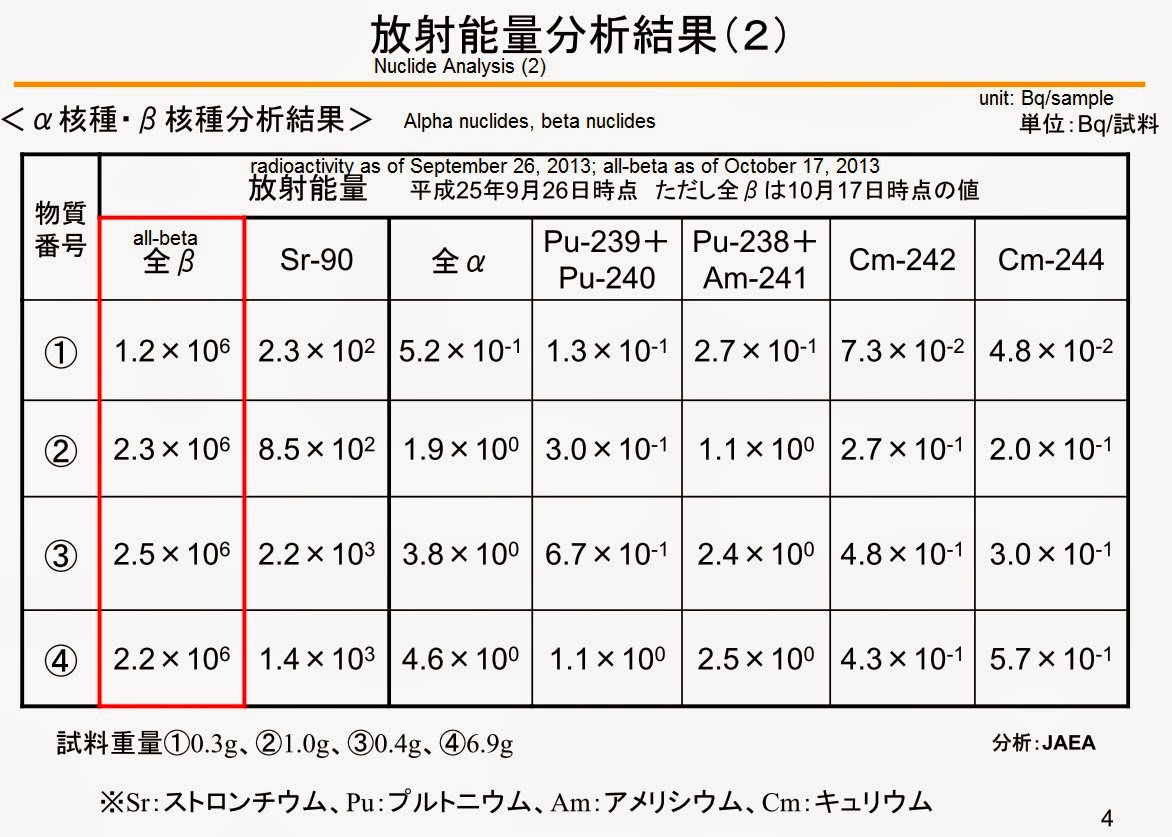
The first piece of debris were found in June 2013, but TEPCO didn’t mention the discovery until July after three more such high-radiation pieces were found. Even then, they published a half-baked result of the analysis, which was nothing more than the measurement of gamma radiation and beta radiation in microsieverts per hour. (See my post on July 2, 2013 for the first discovery.)
TEPCO disclosed the result of the analysis of the debris done by Japan Atomic Energy Agency (of Monju fame) during the regular February 12, 2014 press conference, and no major news outlet has reported the news so far. Only bloggers took note. (I suppose the mainstream media is busy educating themselves on the intricacies of the State Secrecy Protection Law, even though it hasn’t gone into effect yet.)
According to TEPCO, the pieces of debris were not only highly contaminated with radioactive materials released from Fukushima I Nuclear Power Plant but they actually, most likely came from the plant. The degree of contamination from radioactive materials found on the small pieces of debris is similar to that on the debris found around the Reactor 3 building.
From TEPCO’s handout for the press, 2/12/2014 (in Japanese):
Very high contamination from cesium-134, cesium-137, and presence of cobalt-60 (in blue rectangle, added by me). Note the unit is Bq per sample, not kilogram. For example, Sample No.3 (0.4 gram) has 2.0 x 10^6 Bq, or 2 million becquerels of cesium-137:
Very high all-beta:
But the composition of radioactive materials (ratio) on the debris pieces shows almost all radioactivity comes from cesium-134 and cesium-137:
Radioactivity of the debris pieces, compared to those of the debris around the Reactor 3 building and of the soil in Naraha-machi and neighboring Hirono-machi. The debris pieces have about the same order of magnitude of contamination as the debris around Reactor 3 for cesium-137, and one to three orders of magnitude higher contamination for cobalt-60. Unit is Bq per gram:
Continue reading →
February 14, 2014
Posted by arclight2011part2 |
Uncategorized |
Leave a comment
10:50 10 February 2014 by Stuart Parkinson
http://actionawe.org/nukes-over-wind-turbines-uk-rd-policies-are-warped/
Weapons of mass destruction get five times as much public research cash in the UK as renewable energy. Time for a rethink, says Stuart Parkinson
The scale of a nation’s public spending on different areas of research and development can be very revealing. For example, what sort of a nation would spend five times as much on developing weapons of mass destruction – including delivery systems – than on the R&D for renewable energy that is so central to tackling climate change? Figures just published reveal one such nation to be the UK.
Using data from freedom of information requests, campaign group Scientists for Global Responsibility (SGR), of which I am executive director, has pieced together recent R&D spending by the UK government on a series of major weapons systems and compared them with public R&D spending on measures to tackle major drivers of armed conflict, such as resource depletion, social and economic injustice, and climate change. This is the first time such an analysis has been carried out – for the UK or indeed anywhere else. What we have uncovered is deeply disturbing.
During the three financial years spanning 2008 to 2011, annual R&D spending on all aspects of UK nuclear weapons systems was over £320 million per year. This included: over £100m a year on warheads; over £120m a year on early development work for new submarines planned to carry the nuclear-armed Trident missiles; and over £90m a year on R&D for new nuclear reactors to propel those submarines.
Only about £12m a year of the total was focused on nuclear disarmament. Since the end of this period, the Ministry of Defence (MoD) has moved on to the next stage of developing these new submarines, so more recent spending, which is not yet publicly available, is likely to have risen significantly.
Grim background
This is against a background of real-term cuts across UK universities and other publicly funded R&D. And it is in stark relief to spending in areas such as renewable energy – crucial to help tackle climate change and resource depletion. Figures reported to the International Energy Agencyput the UK’s public R&D spending on renewable energy at only £60m a year over the same three-year period – less than 20 per cent of the nuclear weapons spend. And, unlike nuclear weapons, public spending on renewable energy R&D has fallen since 2011 due to government budget cuts.
Continue reading →
February 14, 2014
Posted by arclight2011part2 |
Uncategorized |
2 Comments

U.S. Rep David Price, initiator of the pro-diplomacy letter to President Obama
http://www.abolition2000.org/?p=3194#more-3194
13 february 2014
With talks on a permanent agreement between P5+1 countries and Iran set to begin in Vienna in a few days, 104 Members of the US House of Representatives sent President Obama a bipartisan letter initiated by Congressman David Price (Democrat, North Carolina), supporting continued diplomatic engagement with Iran.
The letter counters efforts in the U.S. Senate, in particular through the draft Nuclear Weapons Free Iran Act (S 1881), to undermine the talks by placing additional sanctions on Iran.
A grass-roots campaign in the US, led by United for Peace and Justice and the Campaign for a Nuclear Weapons Free World, has helped limit the support for the Senate Bill and build support for the Bi-partisan letter supporting diplomacy.
In a press release on the pro-diplomacy letter, Representative David Price (D-NC) said, “I believe that we must take advantage of the opportunity before us to pursue a peaceful, diplomatic resolution to Iran’s nuclear program, and that we must resist calls by some in Congress to prematurely enact a bill or resolution that risks inadvertently derailing or impeding our ongoing negotiations.”
“While difficult and uncertain, diplomacy represents our best hope to prevent nuclear weapons in Iran and ensure the safety of our families and others around the world. Congress should not undermine diplomacy by giving the Iranian hardliners an excuse to scuttle the negotiations. So many of our colleagues have expressed their determination for diplomacy, and so many more share the same view,” added Representative Lloyd Doggett (D-TX), a senior member of the Ways and Means Committee.
The text of the letter and the list of signers in alphabetical order are included below.
***
Dear Mr. President,
As Members of Congress—and as Americans—we are united in our unequivocal commitment to prevent Iran from obtaining a nuclear weapon. The proliferation of nuclear weapons in the Middle East would threaten the security of the United States and our allies in the region, particularly Israel.
The ongoing implementation of the Joint Plan of Action agreed to by Iran and the “P5+1” nations last November increases the possibility of a comprehensive and verifiable international agreement. We understand that there is no assurance of success and that, if talks break down or Iran reneges on pledges it made in the interim agreement, Congress may be compelled to act as it has in the past by enacting additional sanctions legislation. At present, however, we believe that Congress must give diplomacy a chance. A bill or resolution that risks fracturing our international coalition or, worse yet, undermining our credibility in future negotiations and jeopardizing hard-won progress toward a verifiable final agreement, must be avoided.
We remain wary of the Iranian regime. But we believe that robust diplomacy remains our best possible strategic option, and we commend you and your designees for the developments in Geneva. Should negotiations fail or falter, nothing precludes a change in strategy. But we must not imperil the possibility of a diplomatic success before we even have a chance to pursue it.
Sincerely,
List of 104 congressmen here
Continue reading →
February 14, 2014
Posted by arclight2011part2 |
Uncategorized |
Leave a comment
http://www.psr.org/nuclear-weapons/blog/this-week-in-mexico.html
Posted by Ira Helfand, MD on February 11, 2014
The preliminaries to the Second International Conference on the Humanitarian Impacts of Nuclear Weapons got under way today in Nayarit, Mexico. I am here representing both PSR and as Co-President, International Physicians for the Prevention of Nuclear War (IPPNW).
Red Cross Societies from across Latin America and the Caribbean convened for a two day Regional Meeting to discuss implementation of the Red Cross’ 4 year action plan to work for the elimination of nuclear weapons. The meeting was also attended by representatives from the Red Cross in Canada, Australia, Nigeria, Lebanon, New Zealand, Norway and Austria.
Masao Tomanaga from JPPNW, PSR’s sister IPPNW affiliate in Japan, addressed the meeting this morning on the effects of the nuclear attack on Nagasaki, and I made a presentation on the nuclear famine following limited nuclear war and the medical consequences of large scale nuclear war.
At the same time, 130 energetic campaigners from the International Campaign to Abolish Nuclear Weapons (ICAN) met just down the street to plan strategy for moving ICAN forward in the next few months. Both the Red Cross members and many of the ICAN campaigners will be attending the formal government conference–hosted by the government of Mexico–which opens Thursday morning.
February 14, 2014
Posted by arclight2011part2 |
Uncategorized |
Leave a comment





 nuclear-news