Preparing for nuclear power plant licensing beyond 60 years
It was agreed that EDF NDL would stay flexible and adapt to any unforseen situations and any future planning or research in this area could be avoided (likely as to keep the costs down). Though they did admit this;
“for example it has been identified that the extreme maximum ambient air temperature is likely to be beyond the current design basis within the lifetime of some stations. Suitable safety case amendments are being prepared.”
[…]
“….. there is little quantified information currently available. ONR acknowledges that generation of this information was not practicable within the timescales of producing the stress tests reports. Significant work is required, particularly to evaluate margins to equipment failure against extreme wind and temperature” http://www.oecd-nea.org/nsd/fukushima/documents/UK_ST_Final_National_Report.pdf
Preparing for licensing beyond 60 years
http://www.world-nuclear-news.org/RS-Preparing-for-licensing-beyond-60-years-2402144.html
24 February 2014
….Licence extensions to 60 years mean that major mid-life refurbishing, such as replacement of steam generators and upgrades of instrument and control systems, can be justified….
US nuclear utilities could start applying to the regulator from 2017 for operating licence extensions beyond 60 years. Staff at the Nuclear Regulatory Commission (NRC) say they are preparing for this.
Under the Atomic Energy Act of 1954, as amended, the NRC is allowed to issue licences for nuclear power reactors to operate for up to 40 years. The original 40-year period was more to do with amortisation of capital than implying that reactors were designed for only that lifespan. Regulations allow the NRC to extend licences for additional 20-year periods provided the reactor is deemed safe to continue operating. There is no restrictions on how many times a licence can be extended.
First licence renewal extending operation beyond the original 40 years was issued to the two-unit Calvert Cliffs nuclear power plant in March 2000. Of the USA’s 100 operating nuclear power reactors, the NRC has so far renewed 72 of their operating licences and is currently reviewing a further 18. As of the end of last year, 20 reactors had entered the period of extended operation between 40 and 60 years.
In a paper to the commission, NRC staff said, “Based on discussions with the nuclear industry, the staff believes the first application for subsequent licence renewal may be submitted as early as 2017.”
Vessel checks for more Swedish reactors but WENRA wants all European reactors reviewed!
In 2013 the Western European Nuclear Regulators Association (WENRA) recommended that standardized reviews should be carried out at all European reactor pressure vessels, regardless of manufacturer, to verify materials quality and structural integrity.
24 February 2014
http://www.world-nuclear-news.org/RS-Vessel-checks-for-more-Swedish-reactors-2402147.html
Sweden’s nuclear regulator has instructed the operators of two more of the country’s reactors to review the conditions of the units’ pressure vessels to check for defects that may have been introduced in the manufacturing process.
The Swedish Radiation Safety Authority (Strålsäkerhetsmyndigheten, or SSM) wants the operators of Oskarshamn 3 and Forsmark 3 to review and analyse documentation from the manufacture of the units’ pressure vessels to see whether similar flaws to those discovered in two Belgian units are likely to be present. The operators must then decide whether the vessels need to undergo further tests. The review – and any decision on the need for further tests – must be completed by 30 June 2015.
UK – Nuclear bomb plant facing crackdown for failing to make radioactive waste safe
…Aldermaston plant that makes enriched uranium components for nuclear warheads and fuel for nuclear submarines closed because of corrosion in structural steelwork….
24 February 2014
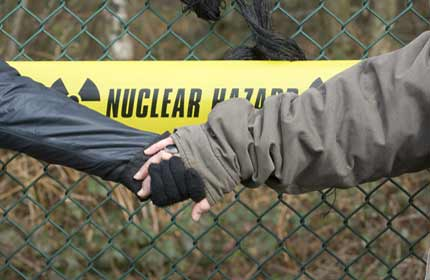 The government’s nuclear safety watchdog is threatening to crack down on the Atomic Weapons Establishment (AWE) at Aldermaston for failing to make 1,000 drums of its most dangerous radioactive waste safe.
The Office for Nuclear Regulation (ONR) is considering enforcement action against AWE, which designs and makes Britain’s nuclear bombs at its site in Berkshire, because it missed a legally-binding deadline set seven years ago. The action could range from a formal warning letter to a prosecution and a fine.
ONR issued a licence instrument in March 2007 ordering AWE to repackage and reduce the volume of “higher activity” wastes by February 2014. According to ONR, the aim was to ensure that 1,000 drums of the “hazardous material” ended up being stored in “a passively safe form”.
“The licence instrument has now expired without its requirements being met,” said a statement posted online by ONR. “ONR will investigate the licensee’s failure to meet the requirements of the licence instrument and will consider enforcement action.”
ONR described the current storage of the wastes as “acceptable in the short term”, but made clear that it was concerned about their medium and long term management. The wastes will have to be stored above ground for at least the next 50 years while the government tries to find a site for an underground repository.
Corroded storage barrels found at nuclear power plant in Germany
02/24/2014
A quarter of the barrels holding radioactive materials at Vattenfall’s nuclear power plant in Germany are showing signs of rust or corrosion, according to The Local.
A thorough inspection of the store rooms at the Brunsbüttel nuclear power plant revealed that 18 of the 70 barrels were affected by corrosion, the article said. Inspectors had previously found a rusted nuclear waste barrel at the plant in 2011.
The barrels are stored underground surrounded by thick concrete walls. The article said the moisture inside of the containers themselves may have caused the rusting. The state Environment Ministry said the rust did not pose a threat to the public, the article said.
LA Times: Top NRC official in Japan compared Fukushima to ‘never-never land’ — At same time, US warned France about publishing ‘extremely high’ radiation doses for infants in Tokyo
Published: February 23rd, 2014 at 11:14 pm ET
By ENENews
Los Angeles Times, Feb. 20, 2014: On March 18, 2011, an official from the U.S. Nuclear Regulatory Commission named Chuck Casto called together the NRC delegation on assignment with him in Tokyo. “We’re in never-never land,” he told them. […] “Never-never land” barely did justice to the situation. Casto and his team had been flown to Japan to help deal with the crisis, but all that they knew was that the Japanese government and [Tepco], were at an almost complete loss about how to deal with the catastrophe […] These events and more are meticulously reconstructed in “Fukushima: The Story of a Nuclear Disaster” […]
Here’s what was also going on behind the scenes at nearly the same time as Casto was comparing the situation to ‘never-never land’:
Conference call with HSE (UK), CNSC (Canada), IRSN (France), ASN (France) & NRC (pdf), March 17, 2011: […] IRSN stated that they plan to put this entire simulation […] on their IRSN website (publically available) in the next 6-12 hours […] IRSN stated that this simulated data shows that for a 1-yr child, the estimated thyroid dose in Tokyo would be between 0.1-1 mSv [millisievert] thyroid uptake (inhalation only) […] (US, Canada, and UK) stressed to the French that these estimates appeared to be extremely high for a child inhalation dose. We stressed to the IRSN that great care should be given in providing the assumptions […]
Thyroid doses for a 1-yr child in Tokyo would end up being many times the French estimate:
Radiation Dose Estimate Report Tokyo, Japan for Child between the ages of 1 and 2 years (pdf): [US] Department of Defense estimated whole-body and thyroid radiation doses […] over the period from March 12, 2011 to May 11, 2011. […] Tokyo, Japan; Child between the ages of 1 and 2 years, your radiation dose estimates for the 60-day period are: […] Thyroid Radiation Dose Estimate: 1.40 rem (≒ 14 millisieverts)
Asahi Shimbun, May 24, 2012: The WHO […] thyroid gland dose estimates for 1-year-old infants were […] 10-100 millisieverts in Tokyo and Osaka. Tokyo sent health ministry officials to the WHO headquarters and went through diplomatic channels to call for revisions. “The figures are just impossibly high,” a government official said at the time. “If they are released, that will not only arouse unnecessary anxiety among the Japanese public but also serve as negative publicity.”
EDF to repair French nuclear reactor fuel rods after corrosion found
“Mediapart said the problem would impact production levels due to the high number of reactors involved, and the corrosion could require EDF to replace the nuclear fuel more frequently”
“EDF has already estimated that some Eur55 billion ($75.0 billion) of investment is required to extend the lifespans of its entire fleet for a further 10 years, including around Eur10 billion to cover further safety demands from the ASN following the Fukushima disaster in 2011”
“EDF’s nuclear fleet produced 403.7 TWh of power in 2013, down 0.3% on the year and below the reduced 405-410 TWh target for 2013 announced by the company in early November.”
“EDF has said it also plans seven, ten-yearly outages in 2014”
“This will be more of a challenge in 2016, when six, 10-yearly outages are planned.”
London (Platts)–10Feb2014/749 am EST/1249 GMT
EDF will have to carry out maintenance to fix excess corrosion on fuel rods in 25 of its 58 French nuclear reactors, a spokeswoman for ASN, the nuclear watchdog, said Monday.
Tests have shown that “unacceptable” levels of corrosion have been found on the fuel rods, which hang into reactor pools and power the nuclear reaction, the spokeswoman said.
State-controlled EDF’s 58 nuclear power reactors provide three quarters of France’s power.
“At this stage, there is no consequence in terms of operations,” an EDF spokesman said. “Normal improvement procedures are scheduled, with notably a program for replacing certain rods from 2015.”
The Nuclear graveyard: To ‘light up’ our homes, some lives are falling into ‘darkness’
The main problem, Shukla believes, is the careless
transportation and disposal of the radioactive waste.



Pictures by Photojournalist Chinky Shukla
Poulomi Banerjee , Hindustan Times Jadugoda, February 22, 2014
By 2032, India hopes to generate 63 gigawatts of nuclear power that will reduce its dependence on energy and make it self-reliant. Jadugoda, a small township in Jharkhand, where the Uranium Corporation of India Ltd (UCIL) is mining uranium, may be paying the price for that ambition.
Photojournalist Chinky Shukla, 27, found her interest piqued by newspaper articles on the effects of uranium mining on the Jadugoda population.
“I read reports by scientists and environmentalists who had been tracking the Jadugoda issue.
I also read about the increasing number of deaths among nuclear scientists in India.
The authorities were dismissing them as suicides,” Shukla recalls.
She decided to follow the Jadugoda story and went there in 2012.
The project that took three weeks, yielded the photofeature, ‘Jadugoda: The Nuclear Graveyard’ that won the Picture of the Year award in the National Press Photo contest of the Media Foundation of India, 2013.
It also won first prize in the All India Environmental Journalism Contest that year.

Right : Lung cancer
Mohan, 19, has six toe-fingers. His father, a miner in the uranium mines at Jadugoda, died of lung cancer
Left : Radioactive waste
The pipe that the little girls are sitting on carries radioactive waste from the mines to the tailing pond. UCIL has erected signboards to warn people
Awards, however, didn’t allow Shukla to forget the horror. She remembers taking pictures of a toddler’s burial in Jadugoda.
“The mother kept saying that unlike other children, he had no physical or mental deformity. But sudden death is also caused by continued exposure to radioactive substances,” says Shukla.
“The government is in denial. It is citing poverty and malnutrition as reasons for the tribals’ health issues,” she says.
Shukla also got in touch with an NGO, JOAR, that has been working to build awareness about the plight of the people in Jadugoda.
“The UCIL has been smart. It has built roads, the mine-workers are paid well. They know what the uranium mine is doing to themselves and their children.
But without alternative sources of income, they choose to remain quiet,” says the photojournalist.
The houses are equipped with dosimeters to measure the level of radioactivity in the area.
But the readings are never shared with the residents.
The main problem, Shukla believes, is the careless
transportation and disposal of the radioactive waste.
“The government must wake up to the threat,” she says.
Japan to Lift Part of Fukushima Evacuation Order – 30,000 to return
Sunday, 23 Feb 2014
http://www.newsmaxworld.com/GlobalTalk/Japan-nuclear-disaster/2014/02/23/id/554280
Japan will lift an exclusion order on an area around the crippled Fukushima nuclear plant, allowing some residents to return to live for the first time since the disaster, officials said Monday.
“The formal lifting of the evacuation order will come on April 1, affecting around 300 people” whose homes are in part of Tamura city, around 20 kilometres (12 miles) west of the wreaked plant, a Cabinet Office official told AFP.
Over the next two years, up to 30,000 people will be allowed to return to their homes in the original exclusion zone, thrown up in a bid to protect people from the harmful effects of leaking radiation, he added.
The decision comes despite sharp divisions among residents over whether or not they should return, with many still concerned over the persistent presence of low-level radiation, despite decontamination efforts.
Under government guidelines, areas are declared suitable for habitation if someone living there is exposed to a maximum of 20 millisieverts of radiation per year.
Officials have said they would like to get radiation exposure down to one millisievert a year.
The International Commission on Radiological Protection recommends a dosage limit of one millisievert per year from all sources of radiation, but says exposure to less than 100 millisieverts per year presents no statistically significant increase in cancer risk.
A single CT hospital scan delivers around 10 millisieverts, according to the National Institute of Radiological Sciences in Japan.
Once the evacuation order is lifted, people will be free to choose whether or not to return home, the official said.
“Compensation (paid by the government and Fukushima operator Tokyo Electric Power) will continue, in terms of properties and the disaster-led joblessness,” he said.
“But the monthly pay of 100,000 yen ($980) to address emotional distress caused by the accident will end if residents decide to return home,” he said.
Nearly three years after the massive tsunami slammed into Japan, killing more than 18,000 and setting off the worst nuclear accident in a generation, around 100,000 people remain displaced because of evacuation orders, according to Japan’s Reconstruction Agency.
Read Compelling Stories of Shameful Treatment of Fukushima Victims
http://ecowatch.com/2014/02/22/witnesses-fukushima-victims-stories/
By Brian Blomme
When most of us think of the ongoing Fukushima nuclear disaster we think about leaks of contaminated water, criminal gangs hiring ill-trained workers to work on cleaning up radioactive materials on the site, ice-dams to stop water flowing, or government announcements that never improve anything.

Six anti-nuclear activists from India, Korea, Poland, and Germany and the Greenpeace France executive director met victims in the Fukushima area this week. Photo credit: Greenpeace
What we often don’t think about are the victims. More than 150,000 people were made victims by this disaster, most are still victims. But these days there is little coverage of their daily lives and the problems they continue to face.
They have compelling stories to tell. To learn about the stories, and to expose the shameful neglect of victims, Greenpeace Japan brought six international witnesses to tour the Fukushima area this week and to meet five victims.
The witnesses heard about the victims’ exposure to high doses of radiation in the early days of the disaster and the government misinformation about the risks. They heard about worries over long-term effects and about children—many still play where there is too much radiation. They heard about abandoned farms, where edible food may never grow again, or the pain farmers felt when they had to kill off their dairy cows. The heard about the strong yearning for lost family life, and for communities and important traditions now lost.

Victims shared their personal stories on how the Fukushima disaster affected them. Photo credit: Greenpeace
The spin from the Japanese government these days is that the Fukushima disaster is over. This spin allows it to abandon the victims. Instead of helping people, the government is spending more time planning the Olympics for 2020 and trying to sell nuclear technology to other countries.
The victims on the tour are doing what they can to fight back. Kenichi Hasegawa, a farmer, and Katsutaka Idogawa, former mayor of an evacuated town, have both travelled to other countries to talk about the poor treatment of victims. All speak out.
The story of shameful treatment is about more than five people; it’s about the tens of thousands who still haven’t been able to rebuild their lives, as David McNeill writes for us.
Around 100,000 people from the Fukushima area are still living in two-room temporary living quarters. They had to flee a world they loved to live crammed together in buildings that are already falling apart.

Katsutaka Idogawa, former mayor of Futaba, presents his his family tree going back hundreds of years to the Greenpeace witnesses. Photo credit: Greenpeace
Fukushima: Don’t Forget—that is the goal of the witness tour. The witnesses committed to telling the stories in their home countries so this tragedy and the impact on people won’t be forgotten. They will talk about the Fukushima stories to enhance their own anti-nuclear work. People everywhere need to know that the shameful treatment of Fukushima victims is what will happen anywhere there is another nuclear disaster.
“I will be there for you David Cameron” love from the nuclear loving Arnold Schwarzenneger
Published on 23 Feb 2014
Arnold Schwarzenneger’s message for leadership in the field of Energy Efficiency
Sunday, March 16, 2008
“I think nuclear power has a great future, and we should look at it again,” California Gov. Arnold Schwarzenegger said, closing The Wall Street Journal’s “ECO:nomics” conference. While he understands some people might still be afraid of the nuclear option, most Three Mile Island analogies are “environmentalist scare tactics.
The technology has advanced so much ,” he said.
http://neinuclearnotes.blogspot.co.uk/2008/03/schwarzenegger-on-nuclear-power.html

Cut the green crap! Cameron reveals his private view of energy taxation and orders ministers to dump the eco-charges adding £110-a-year to bills
David Cameron hails nuclear power plant deal as big day for Britain
http://www.theguardian.com/environment/2013/oct/21/britain-nuclear-power-station-hinkley-edf
Mordechai Vanunu’s Case in the Court of Public Opinion By Eileen Fleming
Mordechai Vanunu’s Case in the Court of Public Opinion
By Eileen Fleming
EXCLUSIVE to The Arab Daily News
http://thearabdailynews.com/2014/02/23/mordechai-vanunus-case-court-public-opinion/
I have never been Israel’s nuclear whistleblower’s spokesperson, but ever since I first met him in June 2005, I have spoken online to end US collusion in Israel’s nuclear deceptions and in support of Mordechai Vanunu’s inalienable human right to leave Israel.
On February 5th I emailed the Chairman, Publisher and Copyright Editor at I.B. Tauris:


Last week Mordechai Vanunu wrote me regarding Frank Barnaby’s The Invisible Bomb, “the chapter about Dimona facilities, all these details need to be sent to Israel’s Shaback/Mossad and to President Obama and Congress to prove that all I knew about Israel’s nuclear secrets were published in 1989.”
Yesterday I wrote for the US based TheArabDailyNews:Message from Israel’s Nuclear Whistleblower Vanunu TO: Mossad and Obama
At the time I was willing to risk a lawsuit from I.B.Tauris for reproducing and publishing more than “brief quotations” from The Invisible Bomb: The Nuclear Arms Race in the Middle East without permission for many reasons, but I will cite two:
In 2005 I met Vanunu and we began a series of interviews that culminated in my self-published Beyond Nuclear: Mordechai Vanunu’s Freedom of Speech Trial and My Life as a Muckraker 2005-2010
I am the leader of the Cause TNT/FREE VANUNU with over 21,000 international members who are gearing up for this April 21st which marks 10 years since Vanunu emerged from 18 years behind bars to 24/7 surveillance; denied the right to leave Israel as the American Government and Media ignore Israel’s nukes, etc.
May I please have permission from I.B.Tauris to republish the INTRODUCTION and 15 pages from Chapter 3?
Thank you,
Eileen Fleming,
Author, Reporter
TNT
Instead of waiting any longer for permission –or risking a lawsuit- I will instead briefly quote Barnaby:
I spent two days in September 1986 cross-examining Vanunu. I found his story totally convincing…Vanunu’s evidence, backed up by his photographs; there can no longer be any reasonable doubt about Israel’s nuclear capability…
After the Sunday Times article appeared, Shimon Peres, the then Prime Minister of Israel, repeated ‘Israel would not become the first country to introduce nuclear weapons in the Middle East’
Together with Ben-Gurion, Peres who had been Director-General of Ministry of Defense in the early 1960’s is regarded as the architect of Israel’s WMD program.
Barnaby argues Vanunu may have been an unwitting tool of the Mossad.
I have argued that besides America’s collusion in Israel’s nuclear deceptions it is SECURITY’S: Mossad/Shabak’s Vendetta against Vanunu that has kept him captive going on 10 years after emerging from 18 years behind bars.
Barnaby also hits a few nail on their heads:
Other governments, particularly the US Government are able to maintain the myth that Israel does not have nuclear weapons. This is important for Israel because the US Government cannot under US law, continue to give economic aid to Israel if it acknowledges that Israel has nuclear weapons.
Barnaby wrote that in 1989 and the US Government continues sending more US tax-dollars to Israel than to any other nation.
San Francisco, – Showing “311: Surviving Japan” Presented by Christopher Noland – Trailer
The Event Program
311: Surviving Japan
Presented by Christopher Noland
http://www.tugg.com/events/8114
Tuesday, March 11 7:30PM – 9:30PM
in San Francisco, CA at AMC Van Ness 14 $10.00

-
- Movie presentation of 311: Surviving Japan
-
Inside story of 2011 Japanese Tsunami relief & Fukushima nuclear disaster. A critical look at how the authorities handled the nuclear crisis and Tsunami relief by an American who volunteered in the clean-up. It is in short, a documentary of the devastating events in Japan and 6 months of the after-math that followed. It features true stories from those affected by the disaster, the government and even TEPCO. It highlights the struggle in dealing with: The Tsunami clean-up, Government response to the disaster, radiation plus the future of nuclear power after the accident.
-
- Q&A
-
A Q&A with director Christopher Noland will follow the film.
Fukushima Diary talks in English about the recent 100m3 leakage – Video
Published on 23 Feb 2014
Related articles of Fukushima Diary..
http://fukushima-diary.com/2014/02/10…
http://fukushima-diary.com/2014/02/10…
http://fukushima-diary.com/2014/02/10…
You can find the donation buttons on the side bar and the bottom of every article in the website linked.
Sorry, I’m do not mean to bother you with this request. Iori
ExxonMobil CEO sues to block fracking project near his home!
By CleanTechnica
Saturday, February 22, 2014
By Rebecca Leber
http://www.rawstory.com/rs/2014/02/22/exxonmobil-ceo-sues-to-block-fracking-project-near-his-home/
As ExxonMobil’s CEO, it’s Rex Tillerson’s job to promote the hydraulic fracturing enabling the recent oil and gas boom, and fight regulatory oversight. The oil company is the biggest natural gas producer in the U.S., relying on the controversial drilling technology to extract it.
The exception is when Tillerson’s $5 million property value might be harmed. Tillerson has joined a lawsuit that cites fracking’s consequences in order to block the construction of a 160-foot water tower next to his and his wife’s Texas home.
The Wall Street Journal reports the tower would supply water to a nearby fracking site, and the plaintiffs argue the project would cause too much noise and traffic from hauling the water from the tower to the drilling site. The water tower, owned by Cross Timbers Water Supply Corporation, “will sell water to oil and gas explorers for fracing [sic] shale formations leading to traffic with heavy trucks on FM 407, creating a noise nuisance and traffic hazards,” the suit says.
Though Tillerson’s name is on the lawsuit, a lawyer representing him said his concern is about the devaluation of his property, not fracking specifically.
When he is acting as Exxon CEO, not a homeowner, Tillerson has lashed out at fracking critics and proponents of regulation. “This type of dysfunctional regulation is holding back the American economic recovery, growth, and global competitiveness,” he said in 2012. Natural gas production “is an old technology just being applied, integrated with some new technologies,” he said in another interview. “So the risks are very manageable.”
In shale regions, less wealthy residents have protested fracking development for impacts more consequential than noise, including water contamination and cancer risk. Exxon’s oil and gas operations and the resulting spills not only sinks property values, but the spills have leveled homes and destroyed regions.
Exxon, which pays Tillerson a total $40.3 million, is staying out of the legal tangle. A spokesperson told the WSJ it “has no involvement in the legal matter.”
Labour vows not to renegotiate EDF nuclear power station deal
h/t http://election.democraticunderground.com/112764750
She went on: “It’s not, I think, helpful for governments coming in, if you like, to say ‘we’re going to renegotiate all contracts’. I don’t think that’s right.
“Down the road, obviously, the public accounts committee will look at the details of this, but I do believe nuclear is right and I do think it’s important to get the price right.
“Actually, going back to our reforms, an electricity pool will actually give governments of the future, hopefully a Labour one, much clearer ideas about what the reference price should be.”
1 This Month
Chernobyl: The Lost Tapes – A good documentary on Chernobyl on SBS available On Demand for the next 3 weeks– https://www.sbs.com.au/ondemand/tv-program/chernobyl-the-lost-tapes/2352741955560

of the week–London Campaign for Nuclear Disarmament

Tell the Ukrainian Government to Drop Prosecution of Peace Activist Yurii Sheliazhenko
To see nuclear-related stories in greater depth and intensity – go to https://nuclearinformation.wordpress.com
-
Archives
- April 2026 (126)
- March 2026 (251)
- February 2026 (268)
- January 2026 (308)
- December 2025 (358)
- November 2025 (359)
- October 2025 (376)
- September 2025 (257)
- August 2025 (319)
- July 2025 (230)
- June 2025 (348)
- May 2025 (261)
-
Categories
- 1
- 1 NUCLEAR ISSUES
- business and costs
- climate change
- culture and arts
- ENERGY
- environment
- health
- history
- indigenous issues
- Legal
- marketing of nuclear
- media
- opposition to nuclear
- PERSONAL STORIES
- politics
- politics international
- Religion and ethics
- safety
- secrets,lies and civil liberties
- spinbuster
- technology
- Uranium
- wastes
- weapons and war
- Women
- 2 WORLD
- ACTION
- AFRICA
- Atrocities
- AUSTRALIA
- Christina's notes
- Christina's themes
- culture and arts
- Events
- Fuk 2022
- Fuk 2023
- Fukushima 2017
- Fukushima 2018
- fukushima 2019
- Fukushima 2020
- Fukushima 2021
- general
- global warming
- Humour (God we need it)
- Nuclear
- RARE EARTHS
- Reference
- resources – print
- Resources -audiovicual
- Weekly Newsletter
- World
- World Nuclear
- YouTube
-
RSS
Entries RSS
Comments RSS
 nuclear-news