Hibakusha is the Japanese term for people who were exposed to radiation from the atomic bombings of Hiroshima and Nagasaki.
Report: Radiation Still Present in USA Former Naval Nuclear Arms Site
By Global Security Newswire Staff
February 25, 2014

The secrecy behind an ex-Navy nuclear arms training program in California likely contributed to the faulty environmental cleanup of the site, says a new report.
The man-made landform Treasure Island was used for nearly 50 years as a base for training military personnel in nuclear war tactics. A number of radioactive materials were used there including plutonium, radium and cesium 137. However, when the Navy decommissioned the San Francisco-area site in the 1990s and began restoring it for eventual civilian use, a significant amount of radioactive waste remained behind, unknown to some of the San Franciscans who moved into new townhouses on the island, according to a Tuesday expose by the Center for Investigative Reporting.
The Navy was aware that radioactive materials at the Treasure Island Naval Station were not always properly handled, according to the report. However, because the service did not go public with the installation’s nuclear weapons background, the environmental remediation personnel and other workers tasked with preparing the base for civilian use could have accidentally disseminated poisonous substances around Treasure Island, the report concludes.
In 2007, Robert McLean was assigned by New World Environmental — a Navy contractor — to carry out an initial study of the presence of radiation on the island. A report ordered by the Navy the year before had indicated there was a low probability that any notable radioactive sources would be found so McLean said he was not expecting much when he began his survey.
But that was not the case.
“We picked up readings from inside the truck, without even getting out of the vehicle,” he said.
“We found radiation, contaminated materials, in playgrounds and in areas that had previously been playgrounds,” McLean said. “We found it in front yards. We found it underneath sidewalks and along the roadways.”
Japan drafts revision of arms exports ban -source
By Nobuhiro Kubo
http://www.reuters.com/article/2014/02/24/japan-defence-idUSL3N0LT02V20140224
Feb 23 (Reuters) –
Japan has drafted new guidelines that would reverse a decades-old ban on weapons exports, a source with knowledge of the matter said on Sunday, a move that could further strain ties with neighbours China and South Korea.
Tokyo has been reviewing the self-imposed ban under Prime Minister Shinzo Abe’s new security strategy, aimed at bolstering the self-reliance of the military.
Serving as prime minister for a rare second time and enjoying solid public approval, Abe says Japan needs a stronger military to cope with what he calls an increasingly threatening security environment, with a more militarily assertive China and unpredictable North Korea.
The proposed revision could draw criticism from China and South Korea, where resentment over Japan’s wartime aggression still runs deep. Beijing and Seoul also have long-running territorial disputes with Tokyo over different sets of islets.
Japan drew up the “three principles” on arms exports in 1967, banning sales to countries with communist governments or those involved in international conflicts or subject to United Nations sanctions.
But the rules over time became tantamount to a blanket ban on exports – with some exceptions – and on the development and production of weapons with countries other than the United States.
Under the new guidelines, arms exports would be approved upon “rigorous review” if they were to serve peaceful missions or if joint development of a weapon was deemed to enhance national security, the source told Reuters.
Japan to continue its nuclear fuel recycling policy
Japan unveiled its first draft energy policy since the Fukushima meltdowns three years ago
Japan has tons of spent fuel and a stockpile of extracted plutonium, causing international concerns about nuclear proliferation. Officials have said the most realistic way to consume and reduce the plutonium is to restart the reactors to burn it.
February 25, 2014
Japan unveiled its first draft energy policy since the Fukushima meltdowns three years ago, saying nuclear power remains an important source of electricity for the country.
The draft presented Tuesday to the Cabinet for approval expected in March, said Japan’s nuclear energy dependency will be reduced as much as possible, but that reactors meeting new safety standards set after the 2011 nuclear crisis should be restarted.
Japan has 48 commercial reactors, but all are offline until and unless they pass the new safety requirements.
The draft of the Basic Energy Plan said that a mix of nuclear, renewables and fossil fuel will be the most reliable and stable source of electricity to meet Japan’s energy needs. It did not specify the exact mix, citing uncertain factors such as the number of reactor restarts and the pace of renewable energy development.
Moderator says no to Concerned Neighbors of Pilgrim’s town meeting
Efforts to put restrictions on the storage of spent nuclear fuel at Pilgrim Nuclear Power Station have suffered a setback.
Heather Lightner of Concerned Neighbors of Pilgrim told the Nuclear Matters Committee that Town Moderator Steve Triffletti told her he wouldn’t allow their article calling on Entergy to speed up the transfer of spent fuel at the plant from the pool inside the building into dry storage outside it. According to Lightner, Triffletti told her the town didn’t have the authority to take that action. She added that the moderator has a policy against non-binding articles like the ones her group proposed.
“We vigorously disagree with the decision,” attorney Meg Sheehan of EcoLaw said. According to her, Triffletti based his decision on the legal opinion of Kopleman and Paige attorney Elizabeth Lane, who holds that the Nuclear Regulatory Commission has sole jurisdiction over atomic energy regulations. The NRC, Sheehan said, is only responsible for the safety of the plant. The town, she said, can regulate other matters there. Town meeting “should have the power to voice an opinion,” she said.
Lightner told the board her group had withdrawn article 32, which would have restricted the storage of spent nuclear fuel at Pilgrim to what was created there.
The Advisory and Finance Committee, and the Board of Selectmen, had supported both articles.
Sheehan said that Concerned Neighbors of Pilgrim is considering its options. Both articles are on the agenda for Tuesday’s selectmen’s meeting and Wednesday’s finance committee meeting. In an e-mail, Lightner said she plans on making a statement before the selectmen.
Nuclear power in Poland will only be possible “if the funds are available”
Nuclear Power in Poland

Power to the People
http://newzar.wordpress.com/2014/02/26/nuclear-power-in-poland/
26 February 2014
Preparations to build a nuclear power station in Poland may cost as much as PLN 2 billion. It is still unknown where the money will come from. The Polish Nuclear Power Programme (PPEJ) has finally been accepted by the government which officially confirms that Poland wants to build a nuclear power station. The decision mean a huge investment in the energy sector. The Nuclear Power Station 1 (EJ1) project, which is controlled by the state-owned Polish Energy Group (PGE), was given the green light to spend PLN 1.3 billion. That is the preliminary cost of giving so-called integrated permission to an external company. The funds are needed for choosing the appropriate technology, equipment and fuel supplier and deciding who will finance the most expensive construction project in history of Poland. Before any of this can happen, EJ1 will need to spend at least a PLN 250,000 assessing the environmental effects of the project and where it will be built (most probably in the vicinity of Żywiec). Considering other expenses, such as the purchase of 640 hectares of land and high corporate costs (some of which are being checked by the public prosecutor’s office), PLN 2 billion will be spent before any construction actually gets under way. Everyone involved (all of Poland’s largest electrical energy companies are participating) still cannot be sure that another ‘Żarnowiec’ will not happen again. Construction of a nuclear station in Żarnowiec came to an abrupt stop following the catastrophe in Chernobyl and a lack of money. Several weeks ago Prime Minister Donald Tusk intimated on Twitter that shale gas is the priority, coal is a must and nuclear power will only be possible if the funds are available.
opinie.newsweek.pl
Fukushima students visit Marshall Islands
http://www.houseofjapan.com/local/fukushima-students-visit-marshall-islands
Wednesday, 26 February 2014

Four university students from Japan are undertaking a weeklong tour of the Marshall Islands to share their experience about the nuclear disaster in Fukushima and learn about the Marshallese struggle in the aftermath of U.S. nuclear testing there 60 years ago.
“I try to establish this kind of connection among global hibakusha. Marshallese people are also hibakusha, being exposed to radiation from the U.S. nuclear testing,” said Seiichiro Takemine, a professor at Meisei University in Tokyo, who organized the trip for the university students.
Read more here
Guns-on-campus bill could endanger ISU’s nuclear research program
Idaho State University could lose its license to conduct nuclear research from the Nuclear Regulatory Commission if a bill to allow concealed weapons on college campuses becomes law, Gov. Butch Otter said Friday, according to the AP and the Idaho State Journal. Otter, in a meeting with about 30 ISU College Republicans, said ISU President Arthur Vailas told him Thursday that the commission has a zero-tolerance policy regarding weapons at licensed nuclear research facilities, putting the school’s nuclear research efforts at risk if the bill becomes law. “I had never heard that before,” Otter said.
Legislation to allow concealed guns on Idaho’s public college and university campuses passed the Senate 25-10 last week, over the objections of all of Idaho’s public colleges and its state Board of Education; the House State Affairs Committee is scheduled to hold a hearing on the bill on Thursday. Otter, who had previously said he supported the bill, said, “I think there’s going to be some additional consideration given,” and declined to say whether he would sign or veto the bill should it arrive on his desk. The measure, SB 1254, is scheduled for a House committee hearing on Thursday. Click below for a full report from the AP and State Journal.
Guns on campus could end nuke research at ISU
POCATELLO, Idaho (AP) — Idaho State University could lose its license to conduct nuclear research from the Nuclear Regulatory Commission if a bill to allow concealed weapons on college campuses becomes law, Idaho Gov. C.L. “Butch” Otter said.
The Idaho State Journal reported (http://bit.ly/1e3nJrk) that Otter made the comments Friday to about 30 people attending a meeting with ISU’s College Republicans.
Otter said ISU President Arthur Vailas told him Thursday that the commission has a zero-tolerance policy regarding weapons at licensed nuclear research facilities, putting the school’s nuclear research efforts at risk if the bill becomes law.
“I had never heard that before,” Otter said.
A bill allowing concealed weapons on Idaho’s college campuses passed the Senate 25-10 Tuesday. The House State Affairs Committee is scheduled to hold a hearing on the bill on Thursday.
Support Mari Takenouchi and Radiation Protection – The first “casualty” of Japans new war on freedom?
Office of the Prosecutor, Iwaki Branch, Fukushima Japan:
Support Mari Takenouchi and Radiation Protection
“Perhaps because everyone believes people telling them on television that everything is fine, they don’t seem so worried,” 281 Antinuke told Reuters.“I hope by leaving my art I can remind people that we’re not safe at all … and that they will do something to protect themselves.”
“We don’t know what will happen in the future, whether children will get cancer or leukemia,” he said. “So I want to keep making noise and making a fuss.”
“The nuclear accident allowed us to realize that Japan had hidden a lot of things,” he said. “I want to make images that express doubts about what’s going on in politics – like a label that says ‘This is happening, pay attention’!” http://www.dailykos.com/story/2013/11/30/1259294/-Masked-Artist-Forces-Japanese-to-Think-About-Fukushima

Why this is important!!

Mari is facing charges stemming from speaking out on radiation in Japan and advocacy for families relocating children out of the areas contaminated by radioactivity from the damaged Fukushima Daiichi reactor site, operated by TEPCO. Radioactivity continues to leave that site. It is well established that while lower levels of exposure to radioactivity lowers risk, the greatest hazard from radiation comes when children are exposed, raising the risk of cancer manifold over their entire lives.
The group ETHOS in Japan supports the decision by some to stay and live in contaminated areas. Sadly, some of these families feel they have no choice due to economics and other factors. Certainly young children have no choice. ETHOS advocates monitoring radioactivity, but well established science supports Mari’s views that there is no safe dose of radiation and that children need to be protected. We support open discussion, access to information and free choice. We ask the Prosecutor to agree that writing and speaking about these issues are not a crime.
Please Stand With Mari as she stands for precaution, protection and the rights of children to a healthy future. THANK YOU.
3 Years On: Hirono Eyeing Coexistence of Residents, N-Plant Workers
http://jen.jiji.com/jc/i?g=eco&k=2014022400311
Fukushima, Feb. 25 (Jiji Press)–
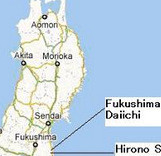 The town of Hirono, located about 30 kilometers south of Tokyo Electric Power Co.’s <9501> Fukushima No. 1 nuclear plant, is exploring a possibility of becoming a community for both residents and workers at the plant knocked out by the March 2011 earthquake and tsunami.
Many residents who left the town after the nuclear accident have yet to come back although the designation of an evacuation preparation area there was lifted six months after the accident.
Of some 5,000 people registered as residents of Hirono, only 1,352 actually lived in the town as of Monday. Many supermarkets went out of business while restaurants remain closed.
Meanwhile, men in work clothes can be seen often. According to a survey by the town government, the number of workers at the plant who live in dormitories or other accommodations in the town in Fukushima Prefecture, northeastern Japan, came to some 2,500 in October 2013, up sharply from around 1,000 in June 2012.
A convenience store owner said that the number of shoppers per day is up 500 from the predisaster level and that daily sales have risen 1.5-fold.
(2014/02/25-10:30)
Gordon Edwards on Fukushima and nuclear basics to a Kids radio show – recommended podcast

Posted on February 23, 2014 by nataliemarie
Gordon Edwards was born in Canada in 1940, and graduated from the University of Toronto in 1961 with a gold medal in Mathematics and Physics and a Woodrow Wilson Fellowship. In 1972, he obtained a Ph.D. in Mathematics from Queen’s University.
http://www.crystalkidsradio.com/mp3/Gordon%20Edwards.mp3 right click and “save as…”
From 1970 to 1974, he was the editor of Survival magazine and in 1975 he co-founded the Canadian Coalition for Nuclear Responsibility, and has been its president since 1978. Edwards has worked widely as a consultant on nuclear issues and has been qualified as a nuclear expert by courts in Canada and elsewhere.
Dr. Edwards has written articles and reports on radiation standards, radioactive wastes, uranium mining, nuclear proliferation, the economics of nuclear power, non-nuclear energy strategies. He has been featured on radio and television programs including David Suzuki’s The Nature of Things, Pierre Berton’s The Great Debate, and many others.
He has worked as consultant for governmental bodies such as the Auditor General of Canada, the Select Committee on Ontario Hydro Affairs, and the Ontario Royal Commission on Electric Power Planning. In 2006, Edwards received the Nuclear-Free Future Award. He is a teacher of mathematics at Vanier College in Montreal. http://www.ccnr.org/
Read more at: http://www.crystalkidsradio.com/radio-archives/natalie-marie-hart-interviews-dr-gordon-edwards-about-fukushima/ |
Over 260 Copies Of Ann Frank Diary Destroyed Clearly by Fasicst Right Wing in Tokyo Libraries
Published on 24 Feb 2014
The fascist in Japan was becoming more and more brazen as Japan falls deeper into fascism.
References:
265 copies of Anne Frank’s diary vandalized in Tokyo libraries
http://www.japantoday.com/category/cr…
Makoto Saurai blog(Japanese langauge only)
http://ameblo.jp/doronpa01/
Hiroyuki Seto blog(Japanese language only)
http://blog.livedoor.jp/the_radical_r…
List of events and actions of Zaitokukai(English Translated)
http://translate.google.com/translate…
Living Near Fukushima Daiichi In The US (Arnie Gundersen)
Published on 23 Feb 2014
http://fairewinds.org/media/fairewind…
Maggie and Arnie speak at The Green Mountain Global Forum about the risks of living near one of the twenty-three US nuclear reactors that are identical to the four that exploded at Fukushima Daiichi (Mark 1 Boiling Water Reactors). The “Lake Wobegone” effect (where each community thinks their nuclear plant is better than average) convinces the 23 local communities in which there is a Mark 1 BWR that a nuclear accident couldn’t possibly happen at their nuclear reactor. The experiences at Fukushima Daiichi, Chernobyl and Three Mile Island, prove that faith in nuclear safety is unfounded.
Arnie Gundersen/Fairewinds Energy Education:
http://www.fairewinds.com/
http://fairewinds.org/
http://www.youtube.com/user/fairewind…
in Japanese: http://www.fairewinds.com/ja
Maggie Gundersen http://tinyurl.com/ms8ufgp
http://www.fairewinds.org/donations
Japanese post secresy law version of “Radiation dose rates now and in the future for residents neighboring restricted areas of the Fukushima Daiichi Nuclear Power Plant ”
DO NOT SHOOT THE MESSENGER! – ARCLIGHT2011 
….This assessment was derived from short-term observation with uncertainties and
did not evaluate the first-year dose and radioiodine exposure.[?????WTF? ARCLIGHT2011]
Nevertheless, this estimate PRovides PeRspective [PR for short] on the long-term radiation exposure levels in the three regions……
Footnotes
- 1To whom correspondence should be addressed. E-mail: koizumi.akio.5v@kyoto-u.ac.jp.
-
Author contributions: K.H.H. and A.K. designed research; K.H.H., T. Niisoe, M.I., K.A., Y.F., M. Kanameishi, K.O., Y.N., T. Nishikawa, Y.S., H. Sakamoto, K.U., K.H., E.O., T.I., K.Y., Y. Matsuoka, H.O., K.T., A. Okada, H. Sato, T.K., H.T., R.S., M. Kashikura, M.N., Y. Miyachi, F.A., M. Kuwamori, S.H., A. Ohmori, and A.K. performed research; K.H.H., T. Niisoe, Y.F., M. Kanameishi, and A.K. analyzed data; and K.H.H., T. Niisoe, M.I., T.T., K.A., H.I., and A.K. wrote the paper.
-
The authors declare no conflict of interest [AND ARE TRYING TO AVOID A 5 YEAR PRISON SENTENCE! – ARCLIGHT2011]
-
This article is a PNAS Direct Submission.
-
This article contains supporting information online at www.pnas.org/lookup/suppl/doi:10.1073/pnas.1315684111/-/DCSupplemental.
Freely available online through the PNAS open access option.
- Kouji H. Haradaa,
- Tamon Niisoeb,
- Mie Imanakac,
- Tomoyuki Takahashid,
- Katsumi Amakoe,
- Yukiko Fujiia,
- Masatoshi Kanameishia,
- Kenji Ohsef,
- Yasumichi Nakaif,
- Tamami Nishikawaf,
- Yuuichi Saitof,
- Hiroko Sakamotog,
- Keiko Ueyamah,
- Kumiko Hisakii,
- Eiji Oharai,
- Tokiko Inouej,
- Kanako Yamamotok,
- Yukiyo Matsuokal,
- Hitomi Ohatae,
- Kazue Toshimam,
- Ayumi Okadan,
- Hitomi Satoo,
- Toyomi Kuwamorip,
- Hiroko Tanip,
- Reiko Suzukiq,
- Mai Kashikuraq,
- Michiko Nezur,
- Yoko Miyachis,
- Fusako Arait,
- Masanori Kuwamoriu,
- Sumiko Haradav,
- Akira Ohmoriv,
- Hirohiko Ishikawab, and
- Akio Koizumia,1
Noam Chomsky: Talking About Iran Sanctions Is ’Surreal’ – Video
publish date : 24 Monday February 2014
Iran and six world leaders agreed to a plan Thursday for negotiating an agreement to freeze Iran’s nuclear program in exchange for eased economic sanctions. But author and activist Noam Chomsky isn’t convinced the United States has the right to impose sanctions at all.
“My feeling is that the entire discussion is kind of surreal,” Chomsky said last month during an interview with HuffPost Live. “There are more fundamental questions to ask. What justification does the United States have to impose sanctions in the first place?”
<div style=’text-align:center’>
<script type=’text/javascript’ src=’http://pshared.5min.com/Scripts/PlayerSeed.js?sid=281&width=560&height=450&playList=518088050′></script>
<br/>
</div>
WATCH Chomsky’s comments in the video above.
or here… http://www.huffingtonpost.com/2014/02/23/noam-chomsky-iran_n_4833461.html?utm_hp_ref=politics
The United States, Britain and the United Nations Security Council have already levied significant economic sanctions against Iran in an attempt to persuade the nation to abandon what the U.S. believes could be a potential nuclear weapons program. President Hassan Rouhani, who replaced hard-liner Mahmoud Ahmadinejad last year, forged an agreement in November with the U.S. and several other countries to help boost the struggling Iranian economy.
Chomsky argued that reports from U.S. intelligence agencies have not confirmed Iran is developing nuclear weapons.
“As far as U.S. intelligence knows, Iran is developing nuclear capacities, but they don’t know if they are trying to develop nuclear weapons or not,” Chomsky told HuffPost Live. “Chances are they’re developing what’s called ‘nuclear capability,’ which many states have. That is the ability to have nuclear weapons if they decide to do it. That’s not a crime.”
The Inconceivable Atomic Legacy of New Mexico – Vice
…..As Jennifer Richter told me, “That eternal legacy is thought-provoking, in a way that we are not trained to provoke our thoughts.”
I suppose it’s only fitting that New Mexico, where the atomic age began, is also the primary resting place of its excess. And at the WIPP site, New Mexico’s atomic legacy will outlive us all……
http://www.vice.com/en_ca/read/the-atomic-legacy-of-new-mexico
By Sam Gilbert
24 February 2014
In 1945, the world’s first nuclear weapon was detonated at the Trinity site in the Chihuahuan Desert in New Mexico. The massive blast pulled the white desert sand up into an atomic fireball, the heat transforming the granules into green glass that fell back to the desert floor.
Days before and a few hundreds miles north, the world’s first ever nuclear weapons scientists mused over whether or not the atmosphere above the test site would be incinerated by the atomic reaction, ushering in a new age of apocalyptic fear that would define the next couple of generations.

A replica of the Fat Man bomb dropped over Nagasaki at the Trinity site (photo via)
Growing up in New Mexico, this history surrounds you. We had family trips to the Trinity site and school visits to the Bradbury Museum In Los Alamos, where we were thrust in front of full-sized replicas of the bombs that leveled Hiroshima and Nagasaki, before being subjected to goofy museum movies about the wonders of atomic energy.
My childhood home was situated almost directly between the two primary nuclear research and development sites in the country, Sandia and Los Alamos national labs. My university sat just a few miles from the single largest nuclear weapons cache in the world.
“In New Mexico, we live in a radioactive web,” said Jennifer Richter, former University of New Mexico professor.
1 This Month
Chernobyl: The Lost Tapes – A good documentary on Chernobyl on SBS available On Demand for the next 3 weeks– https://www.sbs.com.au/ondemand/tv-program/chernobyl-the-lost-tapes/2352741955560

of the week–London Campaign for Nuclear Disarmament

Tell the Ukrainian Government to Drop Prosecution of Peace Activist Yurii Sheliazhenko
To see nuclear-related stories in greater depth and intensity – go to https://nuclearinformation.wordpress.com
-
Archives
- April 2026 (126)
- March 2026 (251)
- February 2026 (268)
- January 2026 (308)
- December 2025 (358)
- November 2025 (359)
- October 2025 (376)
- September 2025 (257)
- August 2025 (319)
- July 2025 (230)
- June 2025 (348)
- May 2025 (261)
-
Categories
- 1
- 1 NUCLEAR ISSUES
- business and costs
- climate change
- culture and arts
- ENERGY
- environment
- health
- history
- indigenous issues
- Legal
- marketing of nuclear
- media
- opposition to nuclear
- PERSONAL STORIES
- politics
- politics international
- Religion and ethics
- safety
- secrets,lies and civil liberties
- spinbuster
- technology
- Uranium
- wastes
- weapons and war
- Women
- 2 WORLD
- ACTION
- AFRICA
- Atrocities
- AUSTRALIA
- Christina's notes
- Christina's themes
- culture and arts
- Events
- Fuk 2022
- Fuk 2023
- Fukushima 2017
- Fukushima 2018
- fukushima 2019
- Fukushima 2020
- Fukushima 2021
- general
- global warming
- Humour (God we need it)
- Nuclear
- RARE EARTHS
- Reference
- resources – print
- Resources -audiovicual
- Weekly Newsletter
- World
- World Nuclear
- YouTube
-
RSS
Entries RSS
Comments RSS
 nuclear-news