Abby Martin takes a look at the state of the Fukushima nuclear power plant three years after the massive earth quake and subsequent tsunami that led to the meltdown; discussing the long term impacts of continued radiation leaks with Kevin Kamps, radioactive waste watchdog of BeyondNuclear.org, and Tim Judson, executive director at the Nuclear Information and Resource Center.
“Tony Benn had died. He is one of my favourite politicians if not my favourite, for the way he steadfastly spoke his mind with honesty, clarity and passion throughout 50 years as an MP.
He was of aristocratic blood but turned down his peerage (that would have made him a Lord) so that he could carry on serving in the House of Commons.
One of my ambitions in life was to have a cup of tea with Tony Benn and now, I never will.”
Dan Bull 14 March 2014
In 2009, Iain Dale spent two hours, over several mugs of tea, quizzing Tony Benn.
Tony Benn, the longest-serving Labour MP in history, raised a few wry smiles when he resigned from 50 years in the House of Commons “to devote more time to politics”.
Question ; Keynes once said, when the facts change, I change my mind. What have you changed your mind on?
Tony Benn answers “Many things. Nuclear power, for example. In 1955 when Eisenhower said he was going for ‘Atoms for Peace’ I became a passionate supporter of it. Having been brought up on the Bible I liked the idea of swords into ploughshares. I advocated nuclear power as Minister of Technology. I was told, and believed, that nuclear power was cheap, safe and peaceful. Having been in charge of nuclear power I discovered it wasn’t cheap, wasn’t safe and when I left office I was told that during my period as Secretary of State for Energy, plutonium from our nuclear power stations went to the Pentagon to make nuclear weapons. So every nuclear power station in Britain is a bomb factory for America. I was utterly shaken by that. Nothing in the world would now induce me to support nuclear power. It was a mistake. Israel is another one. I was rowing on the Sea of Galilee in May 1945 when the war ended. I was all in favour of a Jewish homeland, but now I see what has happened and it was absolutely wrong.” http://www.totalpolitics.com/print/1288/in-conversation-tony-benn.thtml
Former Labour MP Tony Benn on how Britain Secretly Helped Israel Build Its Nuclear Arsenal
TONYBENN: Well, of course, Mordechai Vanunu, who was arrested by — he was kidnapped in London by the Israelis — he was telling the Sunday Times what was going on — in prison, much of it in solitary confinement, recently released with restrictions. But he warned us about Dimona. And I did know later about Dimona, as an Israeli military establishment, but I never knew until yesterday, or until it came out a few days ago, that we had helped to assist the Israelis in building it.
AMYGOODMAN: And you, as technology minister, would have had to sign off on this if you had known, is this right?
TONYBENN: Well, it wasn’t put to me at all. It wasn’t put to ministers. I mean, this is the trouble with the nuclear industry, I came not to believe what I was told, and that throws a doubt on more than nuclear power: the question of democracy, if officials can operate as a state within a state. Where is the democratic control of policy? So it was a very, very serious thing to happen. And, of course, it also comes up at a time when, as you’ve been pointing out, there’s a lot of pressure now on Iran not to develop nuclear technology in any form.
Former British energy minister Tony Benn discusses his time in charge of the nuclear industryand why he changed his views about the controversial energy source.
Part of Tenner Films’ project ’13 Short Films About Atomic Power’
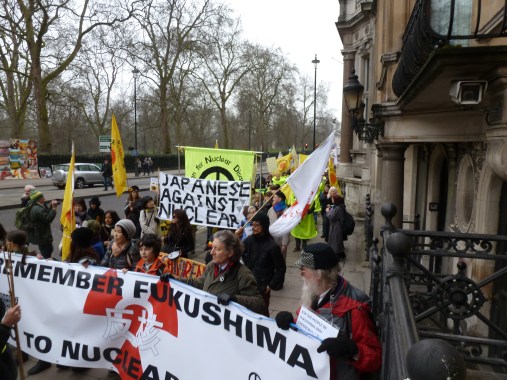
THE Green Party will join British and Japanese anti-nuclear campaigners tomorrow to commemorate the third anniversary of the Fukushima nuclear disaster in Japan. Full details below.
The demonstration, organised by CND, Kick Nuclear and Jan UK, will coincide with events taking place around the world to highlight the legacy of the meltdown at the Fukushima Daiichi nuclear plant and to call for an end to nuclear power.
Natalie Bennett, Green Party leader, said:
“This anniversary is another reminder about the grave safety concerns presented by nuclear power, and the fact that no solution to the problem of long-term storage of nuclear waste has been found.
“The British government, in thrall as it is to giant multinational energy interests, is clinging to a failed 20th-century technology.
“This is not only taking a dangerous path, but is a significant distraction from the need to invest in renewable energy and energy conservation which we need for a stable, secure, affordable energy future.”
Event Details
March on Parliament and Rally
12:30pm, Saturday 15th March
Hyde Park Corner to Parliament
Meet: 12:30pm by Hyde Park Corner tube station, near the ‘Hyde Park’ exit.
March via Japanese Embassy and offices of Tokyo Electric Power Company (TEPCO – the owners of Fukushima) to Parliament.
Rally: 3:00–4:30pm at Old Palace Yard, opposite House of Lords. Attendees include Green Party leader Natalie Bennett, fashion designer Katharine Hamnett and Fukushima evacuees.
Summary of Speakers comments at the Houses of Parliament Fukushima debate on the 10 March 2014
“there is a need for Japan to allow psychological therapeutic treatments available more widely and I hope that the UN and International community might help with this” said Geoff
“The next industrial revolution will be renewable”
“we cant evacuate children and we cant certify the safety for their return so we will not move children” Prefectoral official
Chantelle said that “Swiss energy policy hopes to see smaller decentralised methods of electricity production that would be safer and more efficient.”
Kyushu Electric’s Sendai reactors are located about 980 kms (600 miles) southwest of Tokyo. The utility is one of the most reliant of Japan’s regional electricity monopolies that provide nuclear power, supplying about a third of Japan’s energy needs before Fukushima.
TOKYO (Reuters) – Japan put two reactors on a shortlist for a final round of safety checks on Thursday, moving a step closer to reviving the country’s nuclear industry, three years after the Fukushima disaster that led to the shutdown of all plants.
Two days after the third anniversary of the meltdowns at the Fukushima nuclear station, Japan’s nuclear regulator placed two reactors operated by Kyushu Electric Power Co on a list for priority screening at a meeting of officials reviewing restart applications.
No timing for a potential restart was decided at the meeting and the next stage of checks incorporates a period of public hearings, which may be a fraught process given widespread scepticism about a return to nuclear power.
*Just In* Scientists Raise Alarm: “Radioactive metal from Fukushima” detected in Pacific Northwest — Concern for impact on humans, west coast ecosystems — Continuing contamination crossing ocean, not going away soon — “A surprise… This is an international issue… Gov’t should be doing something” http://enenews.com/scientists-raise-a…
Radiation surge detailed in 2011 accident
Data recorded by radiation monitoring posts near the Fukushima Daiichi nuclear power plant show the environmental radiation level rose sharply 1 hour before a hydrogen explosion took place at the plant.
14 monitoring posts around the plant recorded the radiation level every 20 seconds after the plant was damaged by the earthquake and tsunami on March 11th of 2011.
Data recorded by one of the monitoring posts, located 5.6 kilometers northwest of the plant, show that the radiation level began surging after 2:10 PM on March 12th.
At 2:40 and 40 seconds, the post measured 4.6 millisieverts per hour, the highest level of the day. That was about 1 hour before a hydrogen explosion occurred at the No.1 reactor of the plant.
The data suggest the accumulated doses of radiation would have reached 1 millisievert in about 20 minutes. 1 millisievert is the annual exposure limit for ordinary people.
Masamichi Chino, senior researcher at the Japan Atomic Energy Agency, says the rise in the environmental radiation level may have been caused by an emergency operation to protect the No.1 reactor by reducing pressure within the containment vessel. Tokyo Electric Power officials began the so-called vent work at around 2:00 PM.
The vented air was released after going through water to reduce the amount of radioactive cesium. The step is intended to reduce the substance to 1 thousandth of its original level. But the measure may not have been effective.
Chino says the data can help researchers investigate how radioactive substances were released into the atmosphere and study the effectiveness of the venting process.
US nuclear expert calls for strict safety measures
A US nuclear expert has stressed the need to prepare for accidents at nuclear power plants, saying there is no way to completely prevent them.
A former chairman of the US Nuclear Regulatory Commission, Gregory Jaczko, spoke to NHK in Tokyo on Tuesday, the 3rd anniversary of the accident at the Fukushima Daiichi nuclear plant.
Jaczko noted that the plant is still releasing radioactive materials through contaminated water.
He said someone who is considerate of people’s health and the environment should lead the workers at the plant. He also called for thorough explanations to be given to the people who had to leave their homes.
Jaczko said nuclear plants in Japan are less likely to have accidents thanks to the new safety measures that were introduced after the Fukushima disaster.
Official: Japan will be ruined if public doesn’t realize they’re being exposed to Fukushima radiation — “99.99% of the people are being sacrificed” — Rest of world will be taken down too (AUDIO) http://enenews.com/lawmaker-if-japane…
A nuclear reactor designed to burn up surplus Cold War plutonium has been closed by the US Department of Energy. Initially it was meant to cost $1bn. So far it has cost $4bn. To complete and operate would cost $25-34bn. http://www.theecologist.org/News/news…
All WIPP employees will help in cleanup of nuclear site
Dept. of Energy approves recovery plan for site of nuclear waste repository http://www.currentargus.com/carlsbad-…
Earlier today, Sir Tim Berners-Lee, the creator of the world wide web, made an unprecedented call. Speaking on the 25th anniversary of his creation, Sir Tim said there needed to be a “Magna Carta”-style bill of rights to protect web users — otherwise the online community could end up just continuing down a road towards more and more government surveillance. While all this sounds great however, we’re sceptical that governments would ever agree to such a bill. Here’s just a few reasons why.
The six-place fall of the past year is partly attributable to the Japanese Diet’s adoption of a special intelligence protection bill on 26 November that will allow the government to classify any sensitive information as a “state secret.”
March 12, 2014
Reporters Without Borders deplores the climate of censorship and self-censorship that continues to prevail in discussion of nuclear energy in Japan three years after the disaster at the Fukushima Daiichi nuclear power plant, 250 km north of Tokyo.
In particular, Reporters Without Borders condemns the treatment of independent journalists and bloggers who are critical of the government and the nuclear energy lobby, dubbed the “nuclear village” by its detractors.
The latest example is a “criminal contempt” complaint against freelance journalist and blogger Mari Takenouchi for a tweet about a project by an NGO called Ethos for encouraging the population to keep living in areas contaminated with radioactivity, which she described as “human experiments.”
“The complaint brought against Mari Takenouchi is yet another example of the way groups linked to the nuclear energy lobby are trying to gag opposing views,” said Benjamin Ismaïl, the head of the Reporters Without Borders Asia-Pacific desk.
“By criticizing the programme to encourage inhabitants to keep living in still radioactive areas, this journalist is just documenting a legitimate and well-substantiated concern about the health risks linked to radiation. We urge the head of Ethos, Ryoko Ando, to withdraw her complaint against Takenouchi, which acts as a deterrent to all independent news providers.
“As we feared in 2012, the freedom to inform and be informed continues to be restricted by the ‘nuclear village’ and government, which are trying to control coverage of their handling of the aftermath of this disaster. Its long-term consequences are only now beginning to emerge and coverage of the health risks and public health issues is more important than ever.”
“there is a need for Japan to allow psychological therapeutic treatments available more widely and I hope that the UN and International community might help with this” said Geoff
“The next industrial revolution will be renewable”
“we cant evacuate children and we cant certify the safety for their return so we will not move children” Prefectoral official
Chantelle said that “Swiss energy policy hopes to see smaller decentralised methods of electricity production that would be safer and more efficient.”
Reported by Arclight2011
12 March 2014
posted to nuclear-news.net
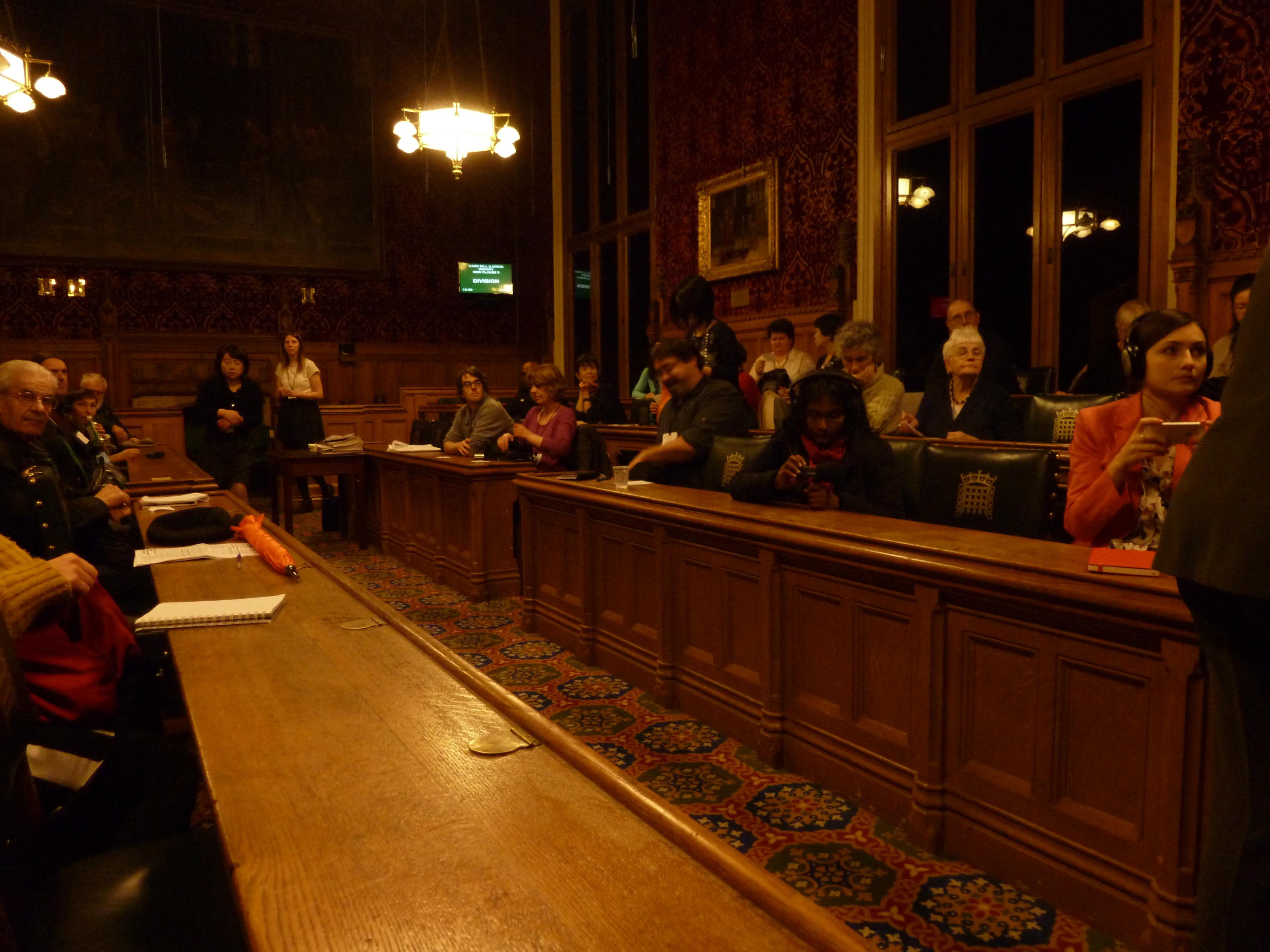
The Meeting was at the houses of Parliament in London on the 10 March 2014 and there were 6 speakers covering a range of topics as outlined below. An Audio file of the event has been uploaded by Fatima and can be accessed here; https://www.dropbox.com/sh/xgvnka0nj50hzof/QczME2MYJI A video should be available soon.
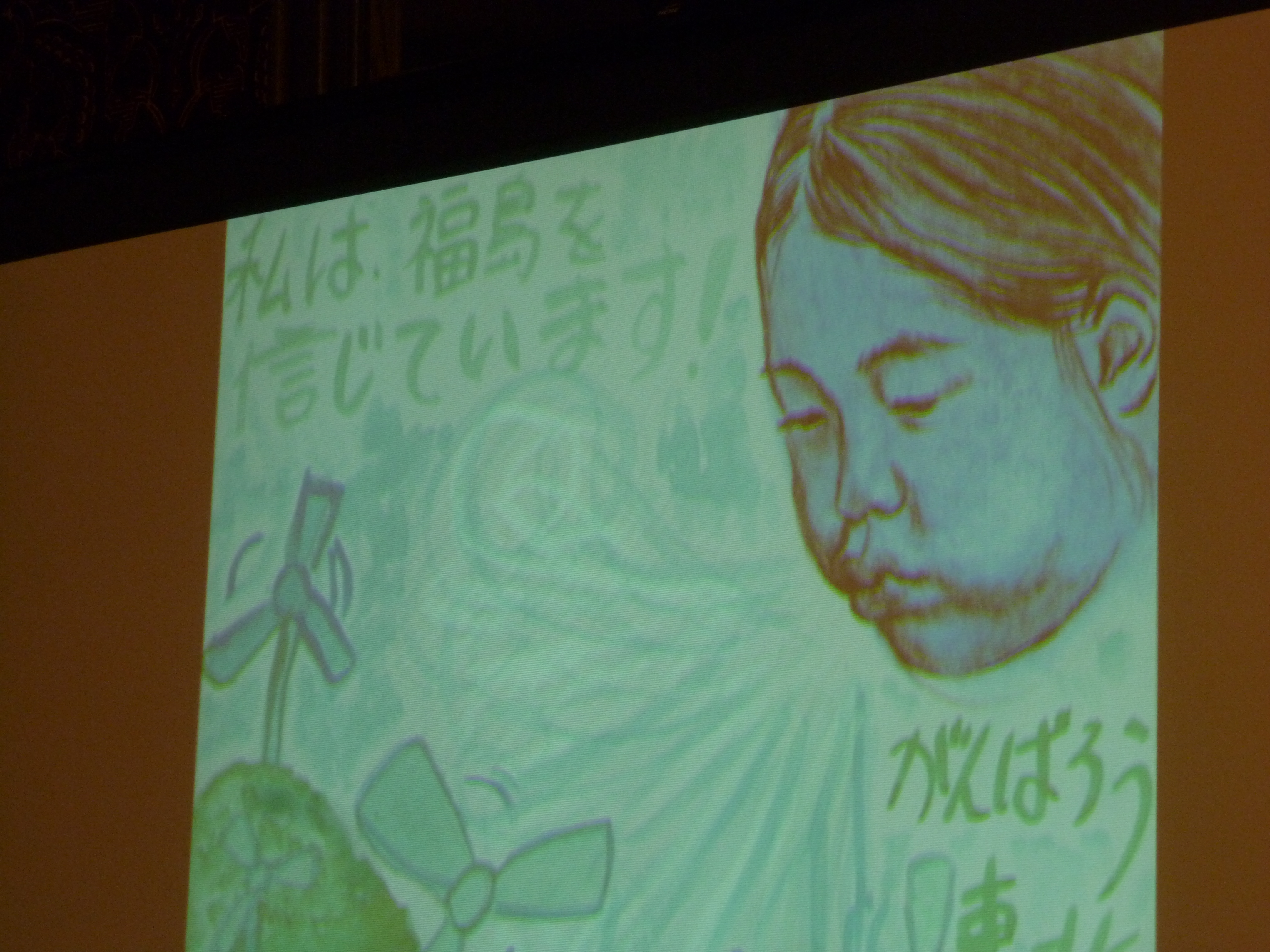
Image courtesy of the Childrens Psychotherapeutic Art Project Japan
The first part of the session was presented by Rik from Kick Nuclear He began by highlighting the difference in explosions at reactor 3 and the other explosions at the Daichi Nuclear power plant site.
Rik then discussed the levles of contamination and showed that a much larger area should be evacuated especially as the term “cold shutdown” that TEPCO and the Japanese Government were claiming and which was even verified by the International Atomic and Energy Association (IAEA) in 2011. This points to collusion between the IAEA and the Japanese nuclear lobby.
Rik also mentioned at this point that the Earthquake was the cause and showed photographic evidence and early measurements of Xenon near the Daichi site perimeter fence before the Tsunami hit.
Rik then went on to discuss the issue of reactor design pointing to the pipes at the bottom of the reactor containment vessel being a serious defect in safety design. He then went on to explain the possible flow of the corium (melted fuel rod bundles) from this chamber making its way through the suppression chamber located to the side of the reactor containment vessel.
Also, the topic of actual measurements on the site were mentioned, specifically, that up to 70 Sieverts per hour had been measured at the meltdown sites and this would make clean up and decommissioning very difficult. Only 6 Sieverts an hour can kill quickly.
“This shows that TEPCO are prevaricating” Riksaid.
Touching on groundwater issues being of concern it was mentioned that the reactor site is above a water course and on land that is prone to subsidence and that this causes worries concerning the Spent fuel pools that are atop the reactor vessels and a possible future threat to anyone downwind of this nuclear disaster site.
Next to speak was Dr Paul Dorfmann
First Dr Dorfmann talked of the difficulties in moving the nuclear fuel from the site.
He said “A huge amount of radiation has been found”.
He then mentioned that health effects can not be assessed owing to the lack of data and information coming from official sources in Japan. However, he points out that the official allowable radiation limit of 20 mSv/y, is not taking into account children and pregnant women and is actually designed for Adult male nuclear workers.
Dr Dorfman also points out that although Thyroid cancer is treatable other effects post operation should not be dismissed as readily as some in the health profession dismisses them.
“The treatable effects on life should not be ignored” said Dr Dorfmann
Dr Dorfmann then went on to discuss nuclear costs as a major downside of the nuclear industry citing that the cost of the Fukushima cleanup has been estimated to cost more than1.5 billion in future years whilst the insurance cover is a mere 169 million Euro. He said that if nuclear was fully insured to cover these accidents that the costs of nuclear energy from this single issue, would increase the cost of nuclear by some 60 percent. He also stated that this would increase domestic bills by some 25 percent.
“nuclear is simply not insurable” Dr Dorfmann stated
World-renowned political dissident, linguist, author and MIT Professor Noam Chomsky traveled to Japan last week ahead of the three-year anniversary of the Fukushima crisis. Chomsky, now 85 years old, met with Fukushima survivors, including families who evacuated the area after the meltdown. “[It’s] particularly horrifying that this is happening in Japan with its unique, horrendous experiences with the impact of nuclear explosions, which we don’t have to discuss,” Chomsky says. “And it’s particularly horrifying when happening to children — but unfortunately, this is what happens all the time.”………..
Please check back later for full transcript. Here;
They now are telling us it will take 30 to 40 years to fix it: Liars!
They lied to us before, they lied to us after and they still lie to us now!
“I am now a cesium man. I know since I did a whole body counter spectrometry in October 2011.
I am a hibakusha, an irradiated. I piss and shit cesium. I sleep and eat in radioactivity”
A parallel between TEPCO and EDF/AREVA
And the farmer, who now lives alone with his animals, to warn the French:
“I think that EDF/AREVA also think the French nuclear power plants are safe and that the French technology is good and superior to others.
Tepco, it was the same. They told us that there was no danger, it was safe … “.
The man from Fukushima predicts another disaster to come in Japan or in France !
This Japanese farmer now lives alone with his animals near the city of Tomioka, located in the « no man’s zone », a quarantine forbidden zone with a radius of 20 km around the Fukushima Daiichi Nuclear Power Plant.. Continue reading →
Three years ago today, Japan saw a trifecta of catastrophes beginning with the Tohoku earthquake, then a devastating tsunami, and finally the second-worst nuclear accident in history.
Families still fearful of radiation exposure have kept their children indoors for much of their short lives. One mother at an indoor Koriyama playground was overheard telling her child, “try to avoid touching the outside air,” Reuters reports.
Light a candle this coming March 11 and join the Beautiful Energy – Global Candles Chain in memory of the triple disaster of March 11, 2011 and in solidarity with the global stand for a nuclear-free world.
March 11 it will be 3 years since the Northeastern Earthquake and Tsunami hit Japan, killing over 15,000 people, destroying numerous villages along the Tohoku coast and disrupting the lives of millions.
On that same day the Fukushima Nuclear Plant disaster also put an end to the peaceful lives of many people living in the vicinity of the plant.
Helps us create a global chain of light to honor those who lost their lives or loved ones.
You can join from anywhere in the world. Anytime on March 11 between 2.46pm Japan time (the time the earthquake first struck ) and midnight in your country light a candle and stand one minute (or more) in silence.
Send us a photo of your candle, if you will. Upload to this page or send by email to globalcandlechain@gmail.com.
Or post on twitter or instagram with hashtag #candlesforpeace
And spread the word! Share this event page with your friends. The more people and countries join, the more powerful our chain will be!
Here are the global starting times of the chain:
イベント開始時刻 / Start time
グローバル・キャンドルチェーンの開始は、3月11日、東北地方太平洋沖地震発生時刻の14:46から同日深夜まで行う予定です。
各国の現地時間は下記リストからご確認ください。
6.46pm New Zealand (Auckland)
4.46pm Australia (Sydney)
2.46pm Japan, South Korea
1.46pm China & Hong Kong, Mongolia, Singapore, Malaysia, Philippines
12.46pm Thailand, Indonesia, Vietnam
11.16am India, Sri Lanka
9.16am Iran
9.46am Russia (Moscow)
7.46am Finland, Estonia, Israel, Greece, Rwanda, South-Africa
6.46am Europe: Netherlands, France, Germany, Sweden, Italy, Spain, Austria, Switzerland
5.46am Europe (UK & Scotland)
2.46am Brazil, Argentina, Trinidad, Chile
1.46am USA (Washington, New York, EST)
1.46am Canada (Toronto)
00.46am Peru
10.46pm Canada (Vancouver) (March 10)
> 10.46pm USA: (Los Angeles) (March 10)
> 7.46pm Hawaii (March 10)
When Social Democratic Party member Mizuho Fukushima asked lawmakers in the ruling party to explain the definition of “secret”, the reply she received alarmed her. “What is considered secret,” she was told, “is secret”.
“But information,” Fukushima insisted to the crowd of journalists attending the press conference, “is the currency of democracy.” [ Japans new secrecy bill was announced in October 2013 around the same time as this conference in the UK – Arclight2011 ]
As it is well known, the U.K. and Japan enjoy a relationship in which we continually exchange and enhance information on a mutual basis as the interpretation and operation of the Law of the Sea evolves and develops.
I believe we are able to do this because the U.K. and Japan have, over a great many years, shared such fundamentals sustaining the law of the sea as the respect for freedom of navigation and public goods, in a way that is both profound and unshakeable.
In light of this, then, it must be said that great things are expected of the Japan-U.K. partnership also in the Northern Sea Route that is about to newly open up.
Rejuvenating UK-Japan Relations for the 21st Century
09:00, 30 Sep – 1 Oct 2013
Hotel Okura Tokyo, South Wing 2F, 2-10-4 Toranomon, Minato-ku, Tokyo, 105-0001, Japan
The Japanese Prime Minister, Shinzo Abe, delivered the keynote speech on UK -Japan Relations in a conference organised in Tokyo by RUSI and the Sasakawa Peace Foundation.
Shinzo Abe delivering the speech with Professor Michael Clarke, RUSI, Director -General looking on.
I am very grateful to have been invited to this splendid gathering to consider the history of Japan-U.K. bilateral relations and its future path.
I would like to express my respect to Dr. Chiaki Akimoto, Director of RUSI Japan as well as the many others at both RUSI and the Sasakawa Peace Foundation for their great efforts in convening this meeting.
We are very honoured to welcome His Royal Highness Prince Andrews, Duke of York today. I find his attendance here exceptionally gratifying as we advance the development of Japan-U.K. bilateral relations.
This year, the First Sea Lord of the Royal Navy is scheduled to visit Japan soon. As if to coincide with it, visiting Japan also is HMS Daring, one of the most advanced ships of the Royal Navy. It is very regrettable that Prince Andrew will not be able to view the joint activities that might be taking place between Daring and the JMSDF.
He could see how masterfully members of the JMSDF use semaphore, for example. I suppose that Prince Andrew, as a naval officer himself, could easily gain insight into the proficiency of the MSDF by simply viewing that, or other signalling actions such as lamps and mast flags.
Japan learned the A to Z of modern navy entirely from the U.K., and so there is no question that the members of the MSDF themselves should feel very much honoured and accomplished to conduct the joint exercise with the Royal Navy. An anniversary year
This year marks the 400th year since the U.K. and Japan first encountered each other via the seas. It was the summer of 1613 when an East India Company ship arrived in Nagasaki and delivered to the retired shogun Tokugawa Ieyasu and the second-generation shogun Hidetada gifts and formal correspondence from King James the First. Ieyasu received a telescope at this time, as I know it.
Kikuji Enomoto wanted to live his retirement in peace while helping to beautify his neighborhood, but he is now stuck residing near more than 500 tons of radioactive waste.
The waste, consisting of incinerator ash, is being stored at the Teganuma disposal site, about 800 meters from Enomoto’s home in Abiko, Chiba Prefecture. It is part of the thousands of tons of radioactive waste that remain in temporary storage in the Tokyo area nearly three years after the triple meltdown at the Fukushima No. 1 nuclear power plant.
Enomoto, 73, has run out of patience waiting for the prefecture to decide on a final disposal site for the waste.
He heads a group of 32 residents who filed a lawsuit in January against the Chiba prefectural government, demanding that the radioactive waste temporarily stored in their neighborhood be removed immediately.
“A major problem would arise if the incinerator ash leaked out due to the effects of a natural disaster and contaminated the surrounding rice fields,” Enomoto said.
The temporarily stored waste contains more than 8,000 becquerels of radioactive cesium per kilogram and has been designated for special processing.
At the end of last year, 12 prefectures were storing a total of 140,843 tons of the waste. The basic rule is to have each prefectural government find a final disposal site for radioactive waste produced within its jurisdiction through garbage incineration or sewage treatment.
The central government plans to build final disposal sites in five prefectures–including Chiba–that have a dearth of storage sites, but no significant progress has been made. The other seven prefectures have still not decided how to handle radioactive waste within their boundaries.







 nuclear-news