Plutonium 239 is a major safety concern because of its high radiation levels and long half-life—24,100 years. About 200,000 times more radioactive than the commonest naturally occurring uranium, plutonium 239 emits alpha particles as its principal form of radiation. Plutonium inhalation can cause permanent lung damage and even death. When taken in the body, microscopic amounts can penetrate deep into the lungs and deposit, via the bloodstream, in the liver, bones, and other organs.
“It’s a surprise when there are no surprises,” a cleanup worker told me a few years ago at the Hanford site in Washington state, once the world’s largest producer of plutonium for nuclear weapons and now home to a massive effort to stop leaking nuclear waste tanks from poisoning the Columbia River. This maxim can hold painfully true for a variety of events assigned an extremely small chance of happening. On February 4, 2014, assumptions of very low probability crumbled at the Energy Department’s Waste Isolation Pilot Plant (WIPP) near Carlsbad, New Mexico, when a fire in a large salt truck raged for hours, deep underground.
Ten days later, an even more unlikely accident happened: Wastes containing plutonium blew through the WIPP ventilation system, traveling 2,150 feet to the surface, contaminating at least 17 workers, and spreading small amounts of radioactive material into the environment.
More than a month after the fire, WIPP remains closed, and what happened underground remains unclear. It is not known whether the leak and the truck fire are connected; a waste-drum explosion or the collapse of a roof of one of the facility’s storage chambers could be to blame for the radiation event. As Energy Department contractors send robots to explore WIPP’s caverns, the future of the world’s only operating high-hazard radioactive waste repository is uncertain. “Events like this simply should never occur. One event is far too many,” Ryan Flynn, New Mexico’s environment secretary, said immediately after the accident. The US Energy Department, which oversees WIPP, views the fire and leak as simply small bumps in the long road of running a long-term waste repository. “Without question, there is absolutely not an iota of doubt …. We will re-open,” David Klaus, the Energy Department deputy undersecretary, told the public in Carlsbad on March 8. But less than two weeks later, New Mexico seemed to have the last word on the immediate response to the accident, when it cancelled its permit for additional disposal at WIPP.
Media reports this week said targets for renewable energy had been inserted into the plan at the insistence of New Komeito, which is opposed to nuclear power.
[…]
Under industry ministry rules in force since 2012, the main monopolies are in general required to hold competitive auctions for any new plants that start operations from April 2019 to reduce costs.
The monopolies can bid for the plants themselves or in alliance with other companies. In some cases, the monopolies can bypass the auctions but will need to pass government screening to ensure costs have been kept at a minimum. Last year’s auction for 2.6 gigawatts of coal-fired plants only attracted bids for 680 MW.
Japan’s utilities are again stepping up plans to increase electricity output from coal and natural gas to replace lost nuclear power, with a prolonged shutdown of reactors continuing and a rising prospect that many units may not come back online.
This week Tokyo Electric Power Co, operator of the wrecked Fukushima nuclear plant, and other regional monopolies are planning to add 11,000 megawatts (MW) of gas- and coal-fired electrical capacity, according to company announcements and media reports.
The difference this time is that the utilities will seek to contract the building of generators to other companies because their finances have been strained by the high-cost fossil fuels needed to replace nuclear units.
Three years after the Fukushima nuclear crisis all of Japan’s 48 operable reactors remain shut, with no restarts scheduled.
“Given the current unwillingness of the government to have stronger support for nuclear power they have to be prepared for the future replacement,” said Tatsujiro Suzuki, a vice chairman of the Japan Atomic Energy Commision, who is stepping down on Monday.
Opposition within the ranks of the ruling Liberal Democratic Party and its coalition partner New Komeito has held up approval of a basic energy framework draft that defines nuclear power as an important source of energy.
Employees of the Fukushima nuclear plant demonstrated outside the headquarters of the operator Tepco Tokyo March 14, 2014 (Photo Toru Yamanaka. AFP)
Workers Fukushima accident have expressed their anger after the death on Friday of one of them, blaming the lack of rescue services to come to the aid of injured.
One of them, who calls himself TS-san, got angry on the internet as soon as he learned of the death of his colleague at the nuclear plant site.
“This is unbearable, how many times will this have to happen?” He has written.
“What is most tragic, it is not as expensive as decommissioning, the work hardly advances, there is contaminated water, no, what is the most tragic, ” is that we do not try harder to save the lives of those who work there””he added.
A worker died Friday afternoon at Fukushima Daiichi after the fall of earth and concrete into the hole to a depth of two meters in which he was to build the foundations of a building.
“He was taken unconscious to hospital where his death was confirmed,” said Tepco.
But for TS-san and others, rescue vehicles that are supplied are insufficient. And they need to have the use of a medical helicopter.
During the accident on Friday, the wounded, in his fifties, was transported by ambulance to a hospital more than 40 miles from the secluded nuclear disaster plant. It took over an hour to drive to the facility where his death was then confirmed. It had then been over three hours since the accident.
“When this kind of fatal accident happens, what to say? Sadness, anger, depression “, as evidenced by Happy, a veteran who worked in Fukushima since before the tsunami of March 11, 2011.
Other workers deaths had occurred before, but not necessarily on the site and not because of issues related to their activity during this time.
Some 3,000 people from hundreds of companies working every day at the Fukushima Daiichi ravaged March 11, 2011 by a massive tsunami.
Working conditions are often harsh, especially because of the compulsory wearing of masks and suits and because of the deplorable state of the destroyed site.
See also;
Japanese government covers up TEPCO workers deaths and intimidates journalists who speak out! – Mako Oshidori
The death of many Fukushima workers who die from radiation exposure is covered-up by Fukushima Daiichi power plant operator TEPCO and the Japanese government, said a Japanese journalist who investigated the unreported deaths, adding that she found a TEPCO memo instructing officials to “cut her questions short appropriately”, and that police is following her around in an intimidating manner.
TEPCO -Workers deaths are not reported 報道されない原発作業員の死亡について
…“She said that there have been so many workers dead without being reported. Some died during the 2 days break, some didn’t turn up the next morning and were found dead…. Those who died haven’t been measured for how much exposure they got. Tepco doesn’t count and report the dead unless they die during their work hours.” …
Thomas Pilkinton was a five-year old boy in Ely, NV, when the first nuclear test took place in the Nevada desert. Like many who lived in the small town nestled in the Nevada mountains, he gave little thought to the tests that would ultimately turn him, and the majority of his family, into what became known as Downwinders. While Pilkinton would not feel the effects of Downwinder Syndrome for many years, the devastating results of the testing on his relatives were almost immediate. Thomas Henry “Daddy Tom” O’Neil, Pilkinton’s great-grandfather and namesake, had always been known for his bad temper and robust health, but suddenly became ill in March 1952. On April 22 of that same year, Daddy Tom died of a rare, aggressive form of cancer. Pilkinton’s grandmother, Ethel Fields, died less than a month later, at 52, from an unknown blood infection. Prior to their deaths, Daddy Tom’s wife, Alice “Mumsey” O’Neil, lost her battle with “black lung,” now known as emphysema, in 1951.
While some may argue that the deaths of these three may not be related to the nuclear testing, the fact remains that none of the three was ever seriously ill until that testing took place.
Soon, more evidence of Downwinder Syndrome began to materialize in Pilkinton’s family and friends. His mother, Evelyn Pilkinton, became seriously ill with a thyroid disorder, another common manifestation of the syndrome, which required lifelong medication. His father, Ray Pilkinton, suffered from emphysema and Chronic Obstructive Pulmonary Disease (COPD). Ray died in 1991, and Evelyn died in 1996; neither lived to see 72. Pilkinton’s sister, Gail Pilkinton, died from lung cancer in 2005, at age 55.
Again, it could be debatable whether their deaths were directly related to Downwinders; both of the senior Pilkintons had been smokers, although neither had smoked for nearly 20 years prior to their deaths. They had both worked as welders in the shipyards during World War II. Pilkinton’s sister had fought a lifelong battle with drug and alcohol addiction, and she did not die from the lung cancer, but from a massive drug overdose.
However, in his early 60s, Pilkinton began to suffer from severe lethargy and unexplained weight gain, which began a downhill slide. This was a man who had never smoked, never done anything that would be considered a cancer risk. He was a Vietnam War veteran and successful businessman who enjoyed a wide range of friendships and travels. He lived his life and raised his niece, whom he had adopted, and then later became a surrogate grandfather to his grand nieces. Unlike his parents and sister, the reasons behind his health issues were not readily apparent, nor easily explained.
He began to suffer debilitating headaches, which led to the discovery of a brain aneurysm. But this did not explain the weight gain. His thyroid was tested, and found to be defective, which meant a regimen of medicine similar to that of his mother’s. However, no amount of maintenance or lifestyle changes could alter his ballooning weight or blood pressure, and his health steadily declined. In 2009, a bout of swine flu triggered an autoimmune disorder called Guillain Barre Syndrome. It took a CAT scan to determine the cause of the continuing weakness after the diagnosis of Guillain Barre that led to another disheartening discovery: thyroid cancer. Pilkinton had surgery to remove the right lobe of his thyroid in 2010, but almost died from that surgery due to a sudden upshot in his blood pressure. His health would not allow for further treatment beyond the surgery. When cancer was discovered in the left lobe, it was determined nothing more could be done. He died in July 2011, with his partner of 16 years, Frank Dominguez, by his side. His fight ended just 20 days after his 66th birthday.
Air Force scandal: More than 90 nuclear missile launch officers cheated on a proficiency test that required perfect scores for advancement. Now, nine Air Force officers have been demoted and one has resigned.
The Air Force will spend $19 million this fiscal year to refurbish the launch control center and repair infrastructure across the missile wing, James said. Another $3 million will go for “quality of life requirements” at the missile bases, which are in remote areas of the country where weather is often harsh.
By David Alexander and Phil Stewart, Reuters / March 29, 2014
Washington
The head of the nuclear missile wing at a base in Montana resigned on Thursday and nine officers were removed from their jobs over a test-cheating scandal that involved 91 missile launch officers, the Air Force said.
Lieutenant General Stephen Wilson, head of the Air Force’s Global Strike Command, said Colonel Robert Stanley, commander of the 341st Missile Wing at Malmstrom Air Force Base, had resigned on Thursday and would retire from the service.
The nine other officers, mainly colonels and lieutenant colonels, were removed from their positions of command at the Montana base that is home to a third of the nation’s nearly 450 intercontinental ballistic missiles. They will be reassigned to staff jobs and face administrative punishment, such as formal reprimands or letters of counseling.
Wilson said the root of the problem was the emphasis on perfection in the nuclear mission at the Montana base and throughout the missile force, which led to cheating on exams in an effort to achieve the sort of perfect scores perceived to be required for advancement and promotion.
The exams were classroom tests to check staff knowledge of how to carry out the nuclear mission and security procedures.
“Leadership’s focus on perfection led commanders to micro-manage their people. They sought to ensure that the zero defect standard was met by personally monitoring and directing daily operations, imposing unrelenting testing and inspections with the goal of eliminating all human error,” Wilson told a Pentagon news conference.
He and Air Force Secretary Deborah James said the evaluation and assessment of missile launch officers would be radically overhauled in an effort to change the culture and behavior that has developed in the missile wing.
The Ministry of Defence (MoD) has apologised for upsetting local residents by detonating 23 loud blasts at the UK nuclear bomb store at Coulport in Argyll last week.
People living in Ardentinny, a small village on the opposite shore of Loch Long a mile from Coulport, say they have been “traumatised” by the continual explosions, which made it feel like they were living in a “war zone”. They are furious that the MoD failed to forewarn them.
The MoD says the blasts were part of a staff training exercise, but has refused to elaborate. It told residents that they were “nothing to worry about”.
The Argyll and Bute MSP, Michael Russell, who is also the Scottish government’s education minister, yesterday wrote to the UK defence secretary, Philip Hammond, after being contacted by residents. “Coulport has been a bad neighbour and it needs to apologise and mend its ways,” he told the Sunday Herald.
“Many residents were very worried by the blasts which were at times intense enough to shake houses. The fact that no warning was given and that there has still been no adequate explanation makes the situation even worse – and there is a fear that explosions may start again at any time.”
The blasts started on Monday without any warning. On Wednesday, after being asked by residents, the MoD said they were finished for the week but then let off a further 11 explosions on Thursday and Friday.
“We have been told that further exercises may take place next Tuesday or Wednesday, however we have no way of knowing if this is correct,” said David McDowall from the community website ardentinny.org.
“Most people would be surprised to know that even a very small regional nuclear war on the other side of the planet could disrupt global climate for at least a decade and wipe out the ozone layer for a decade,”
Even a relatively small regional nuclear war could trigger global cooling, damage the ozone layer and cause droughts for more than a decade, researchers say.
These findings should further spur the elimination of the more than 17,000 nuclear weapons that exist today, scientists added.
During the Cold War, a nuclear exchange between superpowers was feared for years. One potential consequence of such a global nuclear war was “nuclear winter,” wherein nuclear explosions sparked huge fires whose smoke, dust and ash blotted out the sun, resulting in a “twilight at noon” for weeks. Much of humanity might eventually die from the resulting crop failures and starvation. [Doomsday: 9 Real Ways the Earth Could End]
Today, with the United States the only standing superpower, nuclear winter might seem a distant threat. Still, nuclear war remains a very real threat; for instance, between developing-world nuclear powers such as India and Pakistan.
To see what effects such a regional nuclear conflict might have on climate, scientists modeled a war between India and Pakistan involving 100 Hiroshima-level bombs, each packing the equivalent of 15,000 tons of TNT — just a small fraction of the world’s current nuclear arsenal. They simulated interactions within and between the atmosphere, ocean, land and sea ice components of the Earth’s climate system.
Scientists found the effects of such a war could be catastrophic.
The future of the world remains hostage not merely to one act of terrorism but to a larger degree, to one accident or one strategic miscalculation. In that sense, nuclear dangers abound on many fronts. All told, there are currently nuclear weapons materials in more than 40 countries, some “secured by nothing more than a chain-link fence”.
[…]
No wonder, the Seoul Summit communiqué could not go beyond reiterating a joint call to “secure all vulnerable nuclear material in four years” and backing the IAEA’s “essential role” in “facilitating international cooperation”. There was nothing binding other than “baskets” of voluntary commitments. Now the outcome at The Hague Summit 2014 seems to have further shrunk to just anodyne statements of participants’ “commitment” to nuclear disarmament, nuclear non-proliferation and the use of nuclear energy only for peaceful purposes. Again, there were no binding joint commitments, other than in a separate joint initiative of the US, the Netherlands and South Korea, signed only by 35 out of 53 participating states.
At the Third Nuclear Security Summit (NSS) in The Hague earlier this week, Prime Minister Nawaz Sharif made a strong case for Pakistan’s non-discriminatory access to nuclear technology for peaceful uses, including nuclear power generation, to meet our growing civilian programme – the lynchpin of its strategy to overcome chronic energy shortages. His predecessor Yousaf Raza Gilani, too, had made similar presentations at the last two summits held in Washington, DC (2010) and Seoul (2012).
In presenting Pakistan’s case at three consecutive summits, Pakistani leaders spared no effort in seeking to alleviate the unfounded fears about Pakistan’s nuclear security by citing its decades-long experience of safe and secure operations of nuclear power plants, a highly trained manpower and a well-established safety and security culture.
They also apprised the world leaders of the measures Pakistan had taken like any other nuclear weapons-state to strengthen the safety and security of its nuclear installations and materials.
Nawaz Sharif further reinforced the case by informing the conference of Pakistan’s five pillar-nuclear security regime encompassing a strong command and control system; an integrated intelligence system; a rigorous regulatory regime; a comprehensive export control regime; and active international cooperation. Pakistan’s nuclear security regime covers physical protection, material control and accounting, border controls and radiological emergencies. By all objective yardsticks, Pakistan meets every criteria-based benchmark to become a member of the Nuclear Suppliers Group (NSG) and other export control regimes on a non-discriminatory basis.
But this reality is not what the world’s nuclear arbiters holding the reins of the newly instituted NSS process are interested in.
Across the United States there exist numerous facilities at which nuclear fuel is manufactured and stored, including highly enriched uranium (HEU). According to experts, even someone with rudimentary skills could utilize this HEU fuel to create a nuclear weapon capable of leveling a major U.S. city.
You would think that after the destruction of the world trade center, thousands of deaths and hundreds of billions of dollars spent that the Department of Homeland Security would have made securing these facilities a top priority.
But you’d be wrong.
A new report from Harvard University underscores just how ripe with security holes and ineptitude these facilities really are. So much so that recently an 82 year-old nun and two of her cohorts compromised one of these locations with tools as simple as a pair of bolt cutters and a couple of hammers. What’s more is that the facility cited in the report is one that nuclear security experts refer to as the “Fort Knox of Highly Enriched Uranium” – the Y-12 Oak Ridge, Tennessee National Security Complex.
In the early morning hours of July 28, 2012, an 82 year-old nun and two other protesters broke into the Y-12 nuclear weapons production facility—sometimes referred to as the Fort Knox of HEU—in Oak Ridge, Tennessee. Equipped with hammers, paint, blood, and a pair of bolt cutters, they cut through four fences—three of them with intrusion detectors—setting off alarms, and traversed a 600-meter semi-wooded area until they arrived at the wall of a building housing hundreds of tons of HEU, enough for thousands of nuclear weapons. They painted blood on the walls, sang songs, and pounded on the building with their hammers, before finally being accosted by a single guard. Fortunately, they were not terrorists armed with explosives and did not mean any harm (and the building has specially designed walls that would be very difficult for terrorists to penetrate, along with extensive interior protections). But later investigations revealed a security culture failure of epic proportions, not only in the intrusion but also in the response.
How could this happen? The subsequent investigation of the incident by the Department of Energy (DOE) Inspector General revealed “multiple system failures on several levels” and “troubling displays of ineptitude” in Y-12’s security practices. For example, it turned out the site had a new intrusion detection system, which was setting off ten times as many false alarms as usual. Normally, the guard at the central alarm station could check if an alarm was caused by a real intruder using cameras along the fence—but the cameras had been broken for months. They had not been put on the priority list to be fixed, on the assumption that guards could always check out the alarms; but it appears that with so many false alarms, the guards had grown weary of investigating. For whatever reason, even a series of alarms on a path leading directly to the HEU building was not enough to prompt the guard at the central alarm station to take more serious action. The heavily armed guards inside the facility heard the hammering and thought it might be construction they had not been told about, even though it was before dawn, and did not bother to check.
In short, there was a profound breakdown in security culture—among those who tolerated an intrusion system setting off ten times as many false alarms as usual, among those who did not bother to fix the cameras, among the guards who did not react to the alarms or the hammering, and eventually in the armed response to the intrusion.
Perhaps even more troubling, prior to the intrusion, officials at DOE headquarters thought of Y-12 as one of their most secure sites, and had no idea such a serious erosion of security practices had occurred. Tom D’Agostino, then-administrator of the National Nuclear Security Administration (NNSA), warned that “this incident raises important questions about the security of Category I materials [those requiring the highest level of security] throughout the DOE complex.”
The Department of Homeland Security insists that it is a necessary component of the national security apparatus.
They’ve certainly found time to weave a massive surveillance web across this country to record the digital interactions of every single American. They’ve highlighted the existence of serious threats emerging from domestic lone wolves who engage in activities such as making cash purchases, storing emergency supplies, or purchasing bulk ammunition. And these days everyone from a guy producing his own silver coins to kids making gun gestures with their fingers is accused of engaging in terrorist activity.
But when it comes to weapons of mass destruction it seems like no one in government really cares.
This report, yet again, brings to question the purpose of all the added security measures being forced upon the American people.
If national security is such a top priority of DHS and other agencies, then why is it that our Southern border remains so porous that individuals from countries like Iran and Afghanistan, some of them with possible ties to mid-east terrorist organisations, have been nabbed over the last several years trying to make their way into the United States?
And how, in a world where terrorism and improvised weapons are the typical method of attack, can supposedly highly secured nuclear facilities be broken into by a nun with bolt cutters?
An objective observer would have to conclude that protecting the United States from terrorists of the al-Queda Jihadi influence is not at all what these initiatives are all about.
Seriously, is anyone at DHS or the rest of our federal agencies paying attention to the real threats to our national security?
Jonathan Schell, the author, journalist and activist who wrote passionately and cogently about war and politics for more than 40 years, condemning conflicts from Vietnam to Iraq and galvanizing the anti-nuclear movement with his horrifyingly detailed bestseller, “The Fate of the Earth,” died Tuesday at his home in New York City. He was 70.
The cause was cancer, according to Schell’s companion, Irena Gross.
With unrelenting rage and idealism, Schell focused on the consequences of violence in essays and books that conveyed a hatred of war rooted in part in his firsthand observations of American military operations in Vietnam.
He was only 24 when he published his first book, “The Village of Ben Suc” (1967), a graphic account of the American assault on a small village northeast of Saigon in 1967. Schell, then a graduate student returning from studies in Japan, wangled a press pass and swooped into the hamlet with the first wave of U.S. military helicopters, then chronicled its obliteration in quiet but forceful prose.
“It was a remarkable piece of reporting and writing, particularly for one so young and so modestly experienced,” New Yorker editor David Remnick wrote in a tribute Wednesday that described Schell as “an invaluable voice” of moral conscience.
As gentle in person as he was impassioned on paper, Schell was a reporter and columnist for such publications as The New Yorker, Newsday and most recently The Nation.
Among his books, “The Fate of the Earth” (1982) was his mostly widely praised. Originally published as a four-part series in the New Yorker, it opened with a detailed description of how atom bombs are made and the annihilation they would cause before proceeding to analyze the problems with deterrence theory and discourse on humanity’s obligation to future generations. It appeared at an especially tense moment of the Cold War, with public sentiment for a nuclear weapons freeze growing.
“We will need to go through a number of approval processes and engage in consultation with local people before anything can happen as there are sensitive issues to consider before work can begin.”
“Our study is complementary to that earlier work but tests feathers instead of the birds themselves,” Dr Krofcheck said.
Scientists are to check whether New Zealand muttonbirds that spend the winter off the coast of Japan have been exposed to radiation from the damaged Fukushima nuclear power plant.
In a new pilot study, University of Auckland scientists will investigate whether radioactive cesium has entered the New Zealand ecosystem or food chain via the birds.
The wrecked plant and its trapped contents have loomed over Japan since floodwaters from the March 2011 tsunami knocked out the plant’s back-up generators that were supposed to keep cooling its nuclear fuel.
The over-heating sparked meltdowns in three reactors and forced 150,000 to flee, and tens of thousands have been unable to return home to areas contaminated by radiation.
In the study, researchers will test the birds’ feathers for gamma rays that indicate the presence of the radioactive isotope cesium-134.
Feathers will be collected from prime muttonbird sites in the South Island, particularly Stewart Island.
New Zealand sooty shearwaters or titi migrate annually, spending the summer mating and raising their chicks in New Zealand before over-wintering off the coast of Japan.
Dr David Krofcheck, of the university’s department of physics, said the research was “very much about taking a precautionary approach”as there was no evidence to indicate that the birds had been vectors of radioactivity.
“But detection of gamma rays would tell us whether the birds spend sufficient time near Fukushima to accumulate cesium-134 from nuclear fission,” he said.
“Obviously the issue would then become whether that radioactivity is being absorbed into local ecosystems or the food chain.”
Pacific Bluefin tuna caught off the west coast of the United States showed only a minute trace of cesium-134 from Fukushima, 100 times less than normal radioactive elements found in fish.
The sooty shearwater was of cultural and economic value to Maori, who sustainably harvested the nearly fledged chicks during the annual muttonbird season.
The season runs from April to May and was restricted to Maori and their whanau who use the birds for food, oil and feather down.
Dr Krofcheck said consultation with Maori, the Rakiura Titi Islands Administering Body, about the research would begin as soon as possible.
“We will need to go through a number of approval processes and engage in consultation with local people before anything can happen as there are sensitive issues to consider before work can begin.”
The research is being done in collaboration with the Department of Zoology, University of Otago.
Previous tests on muttonbird exposure to radiation from Fukushima found no evidence of cesium being passed from parents to chicks.
“Our study is complementary to that earlier work but tests feathers instead of the birds themselves,” Dr Krofcheck said.
“Obviously what we are hoping to find in this latest research is that cesium levels in muttonbirds do not exceed exposure levels you would expect from natural sources.”
Thirty-six talks are tagged “energy” and among these only a few are primarily about nuclear energy while a few others cover it as a sub-topic. This is a reflection of the TED’s bias, but also of those searching for the best way to respond to global warming. Some of them are pro-nuclear, while others believe either that nuclear is so irrelevant that it’s not worth discussing, or they just want to make it a one-front war against the fossil fuel industry. The bias in the TED talks is also a reflection of society’s lack of concern about nuclear energy. Nuclear energy and nuclear weapons are no longer novelties that strike fear in our hearts, even though the risks haven’t changed at all.
TED talks gone nuclear: how neoliberal proselytizing goes hand in hand with the promotion of nuclear energy
The TED talks became popular about ten years ago once broadband video had become widely available. At first, the videos seemed like a valuable educational resource and a compelling alternative in a post-literate world to reading magazine articles. Few people would read, or even find, a report about the eradication of smallpox, but many more would find and listen to a twenty-minute personal narrative by the man who led the UN program which successfully eradicated smallpox. What’s not to like here? But over time I noticed that more and more of the talks ended with the speaker saying something to the live audience like “go out and change the world,” and it was clear that the message was directed at the wealthy, important people in attendance, not at the masses watching the recordings. It had become clear that TED reflected a particular belief system about how to improve the world, and that the conference had a missionary purpose which left people watching at home as mere spectators. Critical voices started to grumble about a vaguely sensed banality that arises from the missionary aura of the event. For a while, no one was quite able to define the problem, and it was difficult to find fault with a forum that presented so many interesting speakers and was apparently devoted to changing the world for the better. It wasn’t until 2012 that critical reviews seemed to be getting close to articulating what is wrong with TED. Martin Robbins wrote in “The Trouble with TED Talks” in New Statesman in September, 2012. He noted that the TED slogan “ideas worth spreading” indicates that TED is essentially concerned with proselytizing. A significant flaw in the structure of TED is that participation in the conference is accessible only to people who can pay thousands of dollars to attend for a few days. Robbins asks, “What better crowd could there be than social elites who’ve invested thousands of dollars for the opportunity to bask in the warm glow of someone else’s intellectual aura?” For Robbins, the major flaw is that ideas worth spreading are never challenged or peer reviewed. There is no question period after the talks, no debate, no transparency about the way speakers are selected. He concludes:
TED Talks are designed to make people feel good about themselves; to flatter them and make them feel clever and knowledgeable; to give them the impression that they’re part of an elite group making the world a better place. People join for much the same reason they join societies like Mensa: it gives them a chance to label themselves part of an intellectual elite. That intelligence is optional, and you need to be rich and well-connected to get into the conferences and the exclusive fringe parties and events that accompany them, simply adds to the irresistible allure. TED’s slogan shouldn’t be ‘Ideas worth spreading’, it should be: ‘Ego worth paying for’.
In December 2013, Benjamin Bratton wrote “We Need to Talk about TED” for The Guardian. He stated his opinion that “TED actually stands for: middlebrow megachurch infotainment.” He noted an implicit requirement that talks be based on “epiphany and personal testimony” in order to be considered worthy. He asked, “What is it that the TED audience hopes to get from this? A vicarious insight, a fleeting moment of wonder, an inkling that maybe it’s all going to work out after all? A spiritual buzz?” Bratton noted that TED management demanded that its various satellite conference organizers (TEDx events) refrain from featuring speakers whose topics include the paranormal, the conspiratorial and new agey. The goal was to have TEDx present talks that are imaginative yet grounded in reality. Bratton gives TED some credit for trying to maintain its reliability, but he noted:
“the corollaries of placebo science and placebo medicine are placebo politics and placebo innovation. On this point, TED has a long way to go… If we really want transformation, we have to slog through the hard stuff (history, economics, philosophy, art, ambiguities, contradictions). Bracketing it off to the side to focus just on technology, or just on innovation, actually prevents transformation… Keep calm and carry on “innovating” … is that the real message of TED? To me that’s not inspirational, it’s cynical. In the US the rightwing has certain media channels that allow it to bracket reality… other constituencies have TED.
In spite of what TED claims in its response to such criticisms, I think there is nonetheless an ideological bias in the TED conference, and this is incompatible with the objective of conducting an open search for innovative solutions to global problems. The problem can be understood by asking what is absent as opposed to what is present. Because it was established by and for technology millionaires, content has been consciously or unconsciously selected to reflect their world view. Prominent intellectuals, such as Noam Chomsky and Ralph Nader, for example, have never appeared on the TED stage. In TEDworld, solutions come in the form of small-scale initiatives by selected innovators that can be scaled up, if they receive support from wealthy donors during networking sessions at the conference. Someone who has developed an inexpensive water filter might get private funding to launch a large-scale deployment in an African country, but this is as far as problem-solving goes. The TED stage does not welcome discussion of the big questions about resource exploitation and the geopolitical goals of Western powers that perpetuate numerous African conflicts. No one on the TED stage talks about solving complex social problems through government policy, taxes on the wealthy, or electoral reform. Many TED speakers beseech the TED audience to take action because they see government and private enterprise as incapable of doing the right thing. Bill Gates said in his talk about his charitable foundation, “Governments don’t naturally pick these things [philanthropic initiatives] in the right way. The private sector doesn’t naturally put its resources into these things. So it’s going to take brilliant people like you… [special people in the TED audience]” Somehow, this depressing lack of faith in democratic institutions and traditions isn’t seen as detracting from the optimism and inspiration of the event. An excellent example of ideological filtering can be seen in the way TED has set the parameters of its discussion of nuclear energy. In the list below, I briefly comment on the few talks that have mentioned nuclear energy, and what emerges from this review is a bias that promotes nuclear energy as a solution to global warming yet avoids all mention of its historical failures, the health and environmental hazards, and the intractable problem of waste disposal. There is a long list of qualified and respectable nuclear scientists who lost their funding when they began to report findings unfavorable to national energy policy goals, but they have continued to do good research with funds they raise privately. These people have never been invited to the TED stage because it seems they have been categorized among those who do “placebo science,” science which is “not grounded in reality.” Other people who will never be invited are representatives of ethnic groups such as the Navajo, Dene and Marshallese who have been victimized by nuclear weapons testing and uranium mining. What follows is a brief summary and critique of the short list of TED talks that are concerned with nuclear energy.
1. Debate: Does the world need nuclear energy? (2010) This is perhaps the only instance of a TED talk presented as a multi-faceted discussion in which ideas are challenged by the debaters, the moderator and members of the audience. However, the debate parameters are stacked in favor of nuclear energy. The “No” answer is framed as needing to prove that renewable energy could provide enough baseload energy to replace both carbon and nuclear sources. The speaker, Mark Jacobson, is a specialist in atmospheric research and renewable energy, so he isn’t the best person to speak of the negative aspects of nuclear energy. The “anti-nuclear” argument is allotted little opportunity to discuss environmental impacts, health impacts, proliferation risks, the risk of catastrophic failures (this was one year before Fuskushima) and the questionable values of a society that leaves the nuclear waste legacy to future generations. Nonetheless, Jacobson manages to cover some of these topics while spending most of his time explaining the potential of renewables. The pro-nuclear argument is presented by the famous apostate of traditional environmentalism, Stewart Brand.
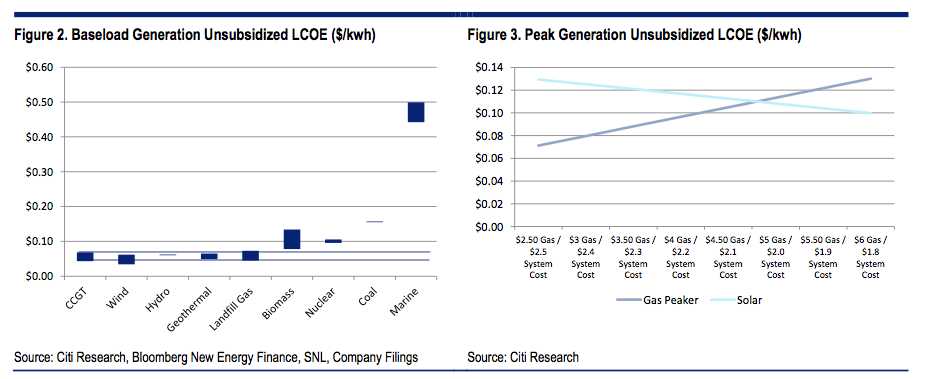
Coal, it says, is basically priced out of the market. Environmental regulations means that the LCOE for new coal is around 15.6c/kWh, and it notes that coal only accounts for 2 per cent of the generation projects under development.
On nuclear, Citi says cost over-runs at the Vogtle plant under construction in Georgia – now slated to cost $15 billion, way above expectations – mean that nuclear is pricing itself out of the market. Citi puts its LCOE at 11c/kWh), which it said is relatively expensive, vs combined cycle gas plants and solar and wind. And it notes that while financing costs are inexpensive in the current monetary environment, this situation will not last.
“Financing cost are likely to rise which would hurt the LCOE attractiveness of a high construction cost generating source like nuclear,” Citi says. “As a result, we do not expect nuclear to effectively compete on economic merits. Despite this LCOE dynamic, there is merit to increasing fuel diversity and supporting lower carbon generation. “
Investment banking giant Citigroup has hailed the start of the “age of renewables” in the United States, the world’s biggest electricity market, saying that solar and wind energy are getting competitive with natural gas peaking and baseload plants – even in the US where gas prices are said to be low.
In a major new analysis released this week, Citi says the big decision makers within the US power industry are focused on securing low cost power, fuel diversity and stable cash flows, and this is drawing them increasingly to the “economics” of solar and wind, and how they compare with other technologies.
Much of the mainstream media – in the US and abroad – has been swallowing the fossil fuel Kool-Aid and hailing the arrival of cheap gas, through the fracking boom, as a new energy “revolution”, as if this would be a permanent state of affairs. But as we wrote last week, solar costs continue to fall even as gas prices double.
Citi’s report echoes that conclusion. Gas prices, it notes, are rising and becoming more volatile. This has made wind and solar and other renewable energy sources more attractive because they are not sensitive to fuel price volatility.
Citi says solar is already becoming more attractive than gas-fired peaking plants, both from a cost and fuel diversity perspective. And in baseload generation, wind, biomass, geothermal, and hydro are becoming more economically attractive than baseload gas.
It notes that nuclear and coal are structurally disadvantaged because both technologies are viewed as uncompetitive on cost. Environmental regulations are making coal even pricier, and the ageing nuclear fleet in the US is facing plant shutdowns due to the challenging economics.
“We predict that solar, wind, and biomass to continue to gain market share from coal and nuclear into the future,” the Citi analysts write.
Citi says the key metric in comparing power sources will be the levellised cost of energy (LCOE). “As solar, wind, biomass, and other power sources gain market share from coal, nukes, and gas, the LCOE metric increasingly becomes important to the new build power generation decision making,” it says.
(Citi defines LCOE as the average cost of producing a unit of electricity over the lifetime of the generating source. It takes into account the amount produced by the source, the costs that went into establishing the source over its lifetime, including the original capital expenditure, ongoing maintenance costs, the cost of fuel and any carbon costs. It also includes financing costs and ensuring that the project generates a reasonable internal rate of return (IRR) for the equity providers).
Here is the key graph on the current state of play, baseload generation and their renewable competitors to the left, and peaking gas and solar to the right.
On baseload, all renewables except marine beat coal and nuclear. Combined cycle gas just hangs on.
As for peaking plant, it depends on the gas prices, but these are rising and in some regions it is now back above its pre-GFC and fracking boom levels. The move to export LNG will likely cause a further increase in prices.
And here (below) is more on those gas prices. As can be seen, natural gas prices have nearly doubled in the past two years, and these have a direct correlation to the price of gas-fired electricity.
At a natural gas price of $US4.00/mmbtu, the LCOE of a gas peaker is $US0.10/kwh and a CCGT (combined cycle or baseload plant) is $US0.06/kwh. If Citi’s commodities team’s long-term gas price forecast of $5.50 is used, the implied LCOE is $0.12/kwh for natural gas peaker or $0.07/kwh for a CCGT plant.
“These numbers,” Citi says, “set the bar for alternative energy.
“Given the large expected increase in demand for gas, offset by production gains, gas prices are expected to rise over the long term. As a result, the bar for renewables and other fuel sources to cross continues to rise, thus making it easier for alternatives to gain market share.”
nsnbc :The death of many Fukushima workers who die from radiation exposure is covered-up by Fukushima Daiichi power plant operator TEPCO and the Japanese government, said a Japanese journalist who investigated the unreported deaths, adding that she found a TEPCO memo instructing officials to “cut her questions short appropriately”, and that police is following her around in an intimidating manner.
The alarming disclosure came at an international conference on the “Effects of Nuclear Disasters on Natural Environment and Human Health” outside the German financial capital Frankfurt. The conference was co-organized by the German chapter of International Physicians for Prevention of Nuclear War (IPPNW) and the Protestant Church in Hesse Nassau, on March 6, 2014, reports Energy News.
Mako Oshidori, a Japanese freelance journalist and commedian, who was present at the conference and the subsequent press conference (recorded on video). Mako reported that she discovered a TEPCO memo, in which the Fukushima Daiichi operator TEPCO instructs officials to “cut Mako-chan’s (questions) short, appropriately”. Mako Oshidori was enrolled in the School of Life Sciences at Tottori University Faculty of Medicine for three years.
Mako revealed that TEPCO and the government cover-up the death of Fukusjima workers and that government agents began following her around after she began investigating the cover-up. Mako said:
“I heard about it from researchers who were my friends as well as some government officials. I will show you a photo I secretly took of the agent, so you know what kind of surveillance I mean. When I would talk to someone, a surveillance agent from the central government’s public police force would come very close, trying to eavesdrop on the conversation….
“I would like to talk about my interview of a nurse who used to work at (the) Fukushima Daiichi nuclear power plant (NPP) after the accident. .. He was a nurse at Fukushima Daiichi NPP in 2012. He quit his job with TEPCO in 2013, and that’s when I interviewed him. …
“As of now of now, there are multiple NPP workers who have died, but only the ones who died on the job are reported publicly. Some of them have died suddenly while off work, for instance, during the weekend or in their sleep, but none of their deaths are reported. …
“Not only that, they are not included in the worker death count. For example, there are some workers who quit the job after a lot of radiation exposure, such as 50, 60 to 70 mili Sieverts, and end up dying a month later, but none of these deaths are either reported, or included in the death toll. This is the reality of the NPP workers”.
Mako Oshidori’s shocking revelation at the IPPNW press conference substantiates previous reports about TEPCO’s criminal disregard for safety and human lives.
One of the most important special qualifications for employment at the Fukushima Daiichi NPP is, according to many other reports, is to be stricken by unemployment and poverty, and in a situation where one has little other choice than to take an under-paid, high-risk job.
In late 2013, the Japanese parliament adopted new legislation to penalize the unauthorized publication of information about the crippled nuclear power plant with up to ten-years-long imprisonment. Mako Oshidori’s testimony about intimidating surveillance adds an alarming perspective to this legislation with regard to the freedom of press and the safety of Japanese journalists.
…“She said that there have been so many workers dead without being reported. Some died during the 2 days break, some didn’t turn up the next morning and were found dead…. Those who died haven’t been measured for how much exposure they got. Tepco doesn’t count and report the dead unless they die during their work hours.” …
This is version 2.1, the most current and up to date version. It’s been tightened up with some important new facts, plus enhanced audio & visuals!
Summary: Following the unprecedented triple meltdown at the Fukushima Daiichi nuclear power plant after Japan’s 3/11 earthquake and tsunami, a myriad of far reaching questions has arisen…
What’s the current state of the Fukushima nuclear reactors? How much radiation have they already released? What type of health impacts can we expect? Is our seafood supply safe? And what about the other 435 nuclear reactors around the world, 104 in the US alone – 22 of them the same exact design as those that exploded and melted down in Fukushima, are they safe?
Yet these are not easy questions to get answers to. The mainstream media and the internet are full of conflicting viewpoints & information. For example, UN scientists have already claimed that the health impacts of Fukushima will be negligible and statistically insignificant, which is parroted in CNN’s documentary “Pandora’s Promise”. However independent scientists tell a very different story; they project on the order of a million cancers within the next few decades in Japan alone.
So how does such a massive scientific discrepancy occur?
Nuclear Exodus explores the ties that inexorably bind the nuclear power industry to the military industrial complex, and how the lust for nuclear weapons causes governments to push nuclear power on their citizens, while covering up the true health effects of radiation exposure. It delves deep into the legacy & lessons of Chernobyl, nuclear waste management, nuclear terrorism, & solar flares which could potentially trigger hundreds of nuclear meltdowns across the world – threatening life on Earth as we know it.
But can human civilization truly generate the electricity it needs without nuclear power, especially while reducing our energy dependence on fossil fuels? How far have renewable technologies come in 2014 exactly? And if some cataclysmic disaster did threaten the world, would there be anyway to realistically protect life on Earth? Could Mars actually be a feasible back up planet anytime soon?
These questions and more are explored in great depth during Nuclear Exodus: Pandora’s Promise Was A Lie
**This documentary is for educational purposes only. Contains scenes which some viewers may find very disturbing. Viewer discretion is advised. SpaceX, SolarCity, and Tesla Motors were not involved with the production of this documentary. This documentary was produced in accordance with fair use copyright law under US legal code Title 17 Chapter 1 §107 for educational, news, & non-profit purposes in order to promote the progress of science & useful arts. All rights reserved for the respective copyright holders.*








 nuclear-news