Why were Ignite Energy so desparate to dissociate their director Dr John White from both the nuclear industry and the Liberal Party? Deputy editor Sandi Keane investigates.
IS THE nuclear fantasy that has taken hold in South Australia poised to slip under Victoria’s ‘no nukes‘ radar?
More to the point, is the iconic Ninety Mile Beach region of Gippsland being eyed off as a future source of thorium – uranium’s young sister – the substance hailed by nuclear proponents as the green energy source of the future?
The story begins back in August last year, when Independent Australia managing editor David Donovan received a surprising complaint from the Minerals Council of Australia (MCA):
A reference is made to Dr John White from Ignite Energy as being the same person as the Dr John White formerly of the Uranium Industry Framework under the former Howard Government and indeed casting aspersions on the former John.
The John from Ignite is not the same person.
I would be grateful if you correct this error in the article.
Regards
Megan Davison
Executive Director – Victorian Division
David duly passed the complaint on to me as the co-author of the article.
I responded with some incredulity:
Dear Megan
I refer you to Ignite Energy’s own website which lists Dr. John White as former chairman of the Uranium Industry Framework.
I’m rather surprised that you failed to check his credentials and background before writing to us. Here’s the link to Ignite Energy’s key people:
The article describes him as having Liberal party connections. No-one can dispute this. Apart from heading up John Howard’s Uranium Industry Framework, he also travelled with John Howard to Washington to help set up the Global Nuclear Energy Partnership. I’m happy to supply full details.
Regards,
Sandi Keane | deputy editor
Independent Australia
It beggars belief that the powerful peak mining industry body could screw up so spectacularly. As the investigative journalist who documented former Prime Minister John Howard’s and John White’s plans to turn Australia into a nuclear waste dump, the last organisation I’d expect a tip-off on another potential nuclear controversy is the Minerals Council, but my interest was piqued.
The first thing I noticed after the Minerals Council’s complaint was the removal of all reference to John White on Ignite Energy Resources’ website — not just the Uranium Industry Framework reference but any association with Ignite.
Enquiries to both the Sydney and Melbourne offices of Ignite confirmed that, yes, Dr White was still one of its key people — manager, government and community liaison. Less than five months ago, he was introduced as Ignite’s “executive director” in an interview with the ABC’s The World Today on 17 October 2013. Indeed, the receptionist at Ignite thought that the ‘executive director’ title was still listed on Dr White’s CV.
So, why delete it from the website and have conniptions over us publishing his connections to the Uranium Industry Framework? Also, what did Megan Davison mean by ‘casting aspersions’? Was it the reference to his being ‘a key Liberal Party adviser in the Howard-era’?
Is this a reaction to the claims by members of the Gippsland community that Ignite is getting favourable treatment because of John White’s special relationship with the Liberal Party?
ELA4968’s thorium prospects
Further cross-referencing of Ignite’s website with pages downloaded months earlier provided further clues.
The details of one of IER’s leases, ELA4968 – which covers the iconic Ninety Mile Beach, Maffra, Sale, Bairnsdale and Orbost – had also disappeared.
The old website listed this exploration licence as including
[Arclight note] Evidence of mutation in bees when given 30 Gray dose. This experiment was done in Japan to stop the bees stinging! But it shows radiation effects on Bees when hit with a dose slightly less than cancer treatment patients get. I would also point out that bee death in the USA and France occurred first. Both countries have many nuclear reactors and regular emissions of radionuclides. Of course it looks like big pharma has had an impact as well but the odd story of this farmer losing the queens leaving the hive in distress is interesting. Here is the link to the Bee experiment: http://lib.icimod.org/record/22885/files/c_attachment_201_2621.pdf
Monday, March 26, 2012
http://modernmarketingjapan.blogspot.co.uk/2012/03/are-bees-really-dying-out-strange.html
Yesterday I wrote about going to pick strawberries at a farm in Isehara about one hour out from Tokyo.
While I was there, I was anxious to ask the farmer about the story going on concerning the dying out of the bees that we so often read about.I became interested in the bees and honey story because my wife and son have allergies this time of year and one well reviewed natural remedy for allergies is locally produced honey. The rationale for using honey to treat allergies is that bees process the same pollen that causes the allergies in making the honey. So, by eating the honey, one can build up a resistance to the pollen – somewhat like immunizations use dead viruses to create. (Also add loads of vitamin C and vitamin D3!) It seems to work well for my wife and son.
My wife’s uncle is a farmer in Isehara and he grows rice and tangerines. Since he has tangerines, he also produces honey from bee hives he keeps and sells it as “Tangerine honey.” It does have a different tangerine flavor (or so people tell me. I can’t tell the difference!)
(L to R) Shigeru Yamada and Mr. Tsuzuki, rice and strawberry farmer
Over these last few years, there is much talk about the bees disappearing and or dying off. In the photos above, you can see two large jars of locally produced honey. The jar on the left sold for ¥2,000 (about $24.18 USD) two years ago. My wife and son just discovered the wonderful relief that honey gives to serious allergy sufferers and they went through (actually my wife) went through a jar that was 1/2 that size in three years. Now we are back to buy a new jar of locally produced honey and the jar on the right, when you can get them, sell for ¥5,500 yen (about $66.50 USD) today. So the price has gone up a lot… I am told that the price increase is due to problems with the bees.Well, we’ve all heard that the bees are dying off, right? Well, according to my wife’s uncle and another farmer, Mr. Tsuzuki (farms strawberries and rice) the bees are not dying off per se. They are, are you sitting down? (cue Twilight Zone music) “disappearing.”
I wasn’t sure what they meant and asked for clarification. I asked Mr. Tsuzuki at his farm,
“Did you find and dead bees around the hives or lots of dead bees in the fields?”
“No,” came the answer. He continued,
“It wasn’t the bees dying as such. They would fly away and disappear.”
Fly away and disappear!!?? Wait! What?
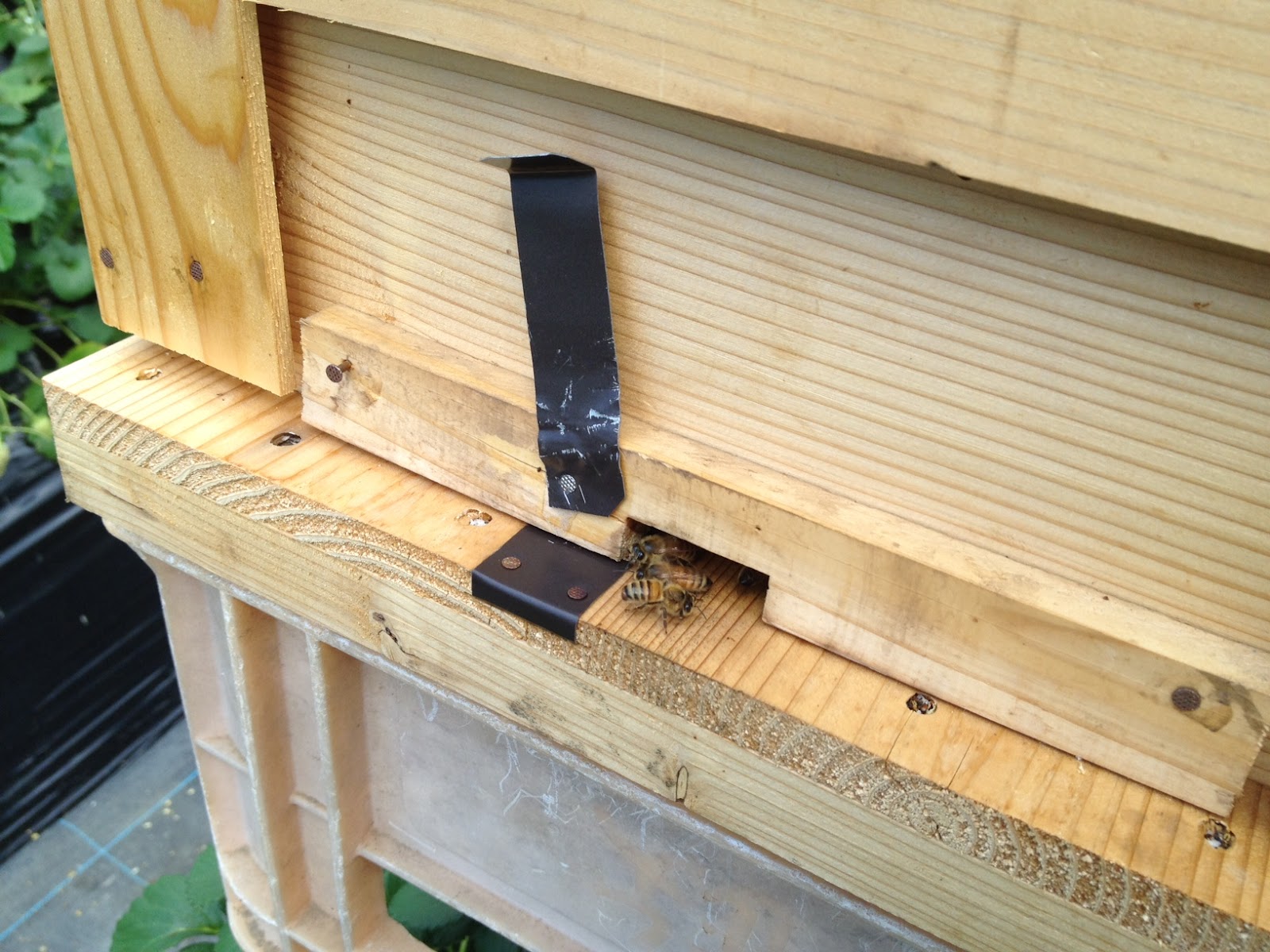
There were dozens of bee hives just like this at Tsuzuki strawberry farm
That’s right. According to these farmers the bees weren’t dying off, they were disappearing. This is a quote, “The queen bee would fly away from the hive and then they wouldn’t come back. I think, perhaps, they flew around above the hive for so long that the birds would come and eat them.”
Now, before you panic and think that this could be the end of civilization, Mr. Tsuzuki told me that he knows all about the bees dying off in America – everyone does. But he said that while they had a similar problem in Japan for a few years, the local farmers switched back to fertilizers, insecticides and herbicides that they were using before the problem started and now the bees are coming back. He said that they’ve had no problems this year at all.
Fact of the matter is that, Mr. Tsuzuki rents his bees from another farmer named Mr. Aigara to pollinate his strawberries during season. He gives them back after strawberry season ends.
The world must be prevented by all available means from hearing, from the lips of a credible witness, that the Americans are full partners in Israel’s nuclear arms program, while pretending to be the world’s sheriff for the prevention of nuclear proliferation
Secretary of State John Kerry said Friday the U.S. is questioning its role in the Israeli-Palestine peace talks, noting it was “reality-check time” for negotiators from both parties.
In the past week, Israel cancelled the planned release of a group of Palestinian prisoners and Palestine applied to the United Nations to join 15 international conventions and treaties.
Kerry said that the U.S.’s role in the peace process is not “open-ended,” the AP reports, and that the U.S. will “evaluate very carefully exactly where this is and where it might possibly be able to go.”
Kerry is heading back to D.C. today after working in Europe and the Middle East “to bolster peace in the region.”
The Way ends this article:
The news regarding Jonathon Pollard’s connection to extending the “peace talks” thus furthering pieces of Palestine being ‘wiped off the map’ prompted, Mordechai Vanunu’s US adoptive parents, Nick and Mary Eoloff to email me that they, “Will be writing to our Zionist reps in the senate and house to ask that they free Mordechai and allow him to join his new family in Minnesota. Perhaps, you could ask your constituency to write or contact Kerry to ask the Israelis to free Mordechai.”
The Eoloff’s learned about Vanunu in a 1995 edition of The Progressive.
In a 2003 interview the Eoloff’s explained how they came to be Vanunu’s new family
I read his story, and I thought it was out of the Dark Ages. I mean, to keep someone in this day of age in a six-foot by nine-foot cell. It’s unreal.
He’s been in isolation longer than any person in the western world. Just the brutality of that is very moving. He told us, ‘You can’t imagine what it’s like to see grass after ten years.’
The Eoloffs began writing to Vanunu and joined the US Campaign to free Vanunu united by their mutual anti-nuclear views.
Mary noted the obvious; “Here we have this beautiful world [and] the idea of destroying it in an afternoon is insane.”
The reactor may be disappearing from sight under a high-tech dome, the buildings in Pripyat will collapse, the elderly returnees will have passed away, but I am afraid the story of Chernobyl will continue way beyond our lifetime. A scientist in Chernobyl told me, “We could erect fences in certain areas here stating: Not meant for human habitation for 24,000 years to come. And this is only the half-life of plutonium 239.”
For a quarter of a century a systematic crime against humanity has been perpetrated by people in senior positions at the heart of Europe. The people living in Western Europe, so advanced technologically, remain indifferent and largely disinformed. In order to preserve the consensus around the military and civilian nuclear industry, the nuclear lobby and the official medical establishment have, for the past 26 years, knowingly condemned millions of human guinea pigs to an experiment on their bodies with new diseases in the vast laboratory provided by the territories contaminated by Chernobyl. Children are being treated like laboratory animals, under observation from French and German scientists, and French NGO’s like the CEPN, Mutadis Consultants, ETHOS and CORE, who must take their share of the responsibility. (Translator’s note: CEPN is the Centre d’étude sur l’Evaluation de la Protection dans le domaine Nucléaire ; Mutadis, ETHOS and CORE are all offshoots of the French nuclear industry, financed either through Electricité de France or the Autorité de Sureté Nucléaire.)
The same fate awaits the Japanese people and their children living in areas contaminated by the Fukushima disaster because the same strategy is being put in place in Japan with the same players, the same pseudo-scientific justifications and under the aegis of the same authorities.
In this article I will detail the actions taken by representatives of the international scientific and political community at different levels of involvement that have harmed the children of Belarus around Chernobyl. First, we need to examine the management of the consequences of the disaster by the United Nations (UN) agencies responsible for nuclear power and health: the International Atomic Energy Agency (IAEA), promoter of nuclear power, and the World Health Organisation (WHO) whose goal is “to bring all people to the highest attainable level of health.” Both agencies undertake and endorse, from their position of authority within the scientific and medical domains, the criminal policy imposed by the five member states of the UN Security Council in the area of nuclear power in general and in the contaminated territories around Chernobyl and Fukushima in particular. This policy, while giving the appearance of being scientific, is based on a strategy of ignorance that is anything but scientific. The sleight of hand employed by the nuclear lobby is to use the experience of the bombs used at Hiroshima and Nagasaki to explain Chernobyl. The nuclear lobby compares the very high levels of radiation released in the initial flash when the bombs in Japan exploded with the very low levels of radiation around Chernobyl and claims a priori that these low levels cannot be the cause of the pathologies that have appeared since the Chernobyl accident. But the two events and the mechanisms by which they damage health are not the same. One does not explain the other. No atomic bomb exploded at Chernobyl.
There were two explosions of an atomic nature (power excursions) and a fire that lasted 10 days. Today the ambient and surface background radiation around the power station is low. But huge amounts of artificial radioactive elements were ejected during the thermal explosions and while the fire raged for ten days, these elements were dispersed over great distances by the winds and rains. These long-lived elements contaminate the environment, plants, animals and humans. They have destroyed the health and the lives of hundreds of thousands of young liquidators who ingested and inhaled radioactive particles while working around the plant, and they will continue to contaminate future generations. Genetic and perigenetic damage will appear in the liquidators’ children and then be transmitted to subsequent generations, causing suffering that the first generation will not have known. (1).
WHO and IAEA recognise only the deaths of around fifty liquidators who worked at the plant in the first few days, and about 9000 additional cancers up to 2056, while in 2001, official data from the Ukraine and the Russian Federation claimed that 10% of the liquidators had already died and 30% of them were disabled (there were more than 800,000 from across the USSR). The 2 million farmers and more than 250,000 children from Belarus who live in radioactive areas, were, according to the IAEA and WHO, unharmed by the Chernobyl accident. The large number of illnesses, which are increasing and getting worse every year in Belarus, are attributed officially to stress, “radiophobia” or to parental alcoholism.
Abel Gonzales, Director of Radiation Transport and Waste Safety at the IAEA, Vice President of the International Commission on Radiological Protection (ICRP), director of the Radioprotection Agency in Argentina, Argentina’s delegate to the IAEA and to UNSCEAR (United Nations Scientific Committee on the Effects of Atomic Radiation), and adviser to the WHO, told the Kiev conference, (4-8 June 2001) that was filmed by Swiss television, that it was impossible, given the low levels of radioactivity to prove a correlation between the radioactivity and illness – that it was “an insoluble epistemological problem.” He used these words: “there are no grounds for direct knowledge at this stage. We do not know! “.
Don Hancock of Southwest Research and Information Center provides the latest information on the radiation leak at the Waste Isolation Project Plant (WIPP) in Carlsbad, New Mexico;
Gene Stone, founder of Residents Organized for a Safe Environment, lets us know what the post-reactor decommissioning and clean-up process looks like, based on his recent appearance as the only anti-nuclear voice on Southern California Edison’s commmunity panel on decommissioning. Gene provides lots of wise suggestions for local activists in the US;
Voices of Japan, the feature that allows people in Japan impacted by Fukushima to directly tell the world the truth of their experience. This week: Katsumi Hasegawa provides a father’s perspective on voluntary evacuation from Fukushima for his family, including two small children; and Toshio Yanagihara, the attorney who filed the Collective Evacuation Lawsuit on behalf of the children of Fukushima shares his frustrations and fears. Powerful stuff. (Links in progress)
NUMNUTZ OF THE WEEK:
Fukushima Prefecture’s Fishermen’s Union approves TEPCO scheme to fool people into thinking they’re really doing something about the radioactive water pouring into the Pacific… because of an image problem?!?!???
PLUS:
Mimi German with RadCast – The Radiation Weather Report
A highly radioactive particle of suspected Fukushima core material was found in house dust in Nagoya, Japan. This home is 460 kilometers (300 miles) from the accident site. This one microscopic dust particle has enough radioactivity to be a real health hazard.
Synopsis:“Radiophobia” examines the Chernobyl disaster and its consequences 20 years later. The film is told from the perspective of a group of survivors, and people who were on duty at the reactor during that fateful night. This is the first time that these people have returned to the “Zone”, to reconcile their past within the ruins of the present….
Chernobyl London meeting (27 April 2013) Speech by Tamara Krasitskava from Zemlyaki
On Sunday the 27 April 2013 in a little room somewhere off Grays Inn road London, a meeting took place. In this meeting was Ms Tamara Krasitskava of the Ukrainian NGO “Zemlyaki”.
In this meeting she quoted that only 40 percent of the evacuees that moved to Kiev after the disaster are alive today! And lets leave the statistics out of it for a moment and we find out of 44,000 evacuated to Kiev only 19,000 are left alive. None made it much passed 40 years old
…..3.2 million with health effects and this includes 1 million children…
T .Kraisitskava
“….I was told to not talk of the results from Belarus as the UK public were not allowed to know the results we were finding!….”
* A draft movie report from Chernobyl Day meeting is now ready. It’s a speech by Tamara Krasitskava from Ukraine. She is a chairperson of Zemlyaki, Ukraine NGO in Kiev to represent evacuees from Pripyat city.
Uploaded on 1 May 2013
* Tamara Krasitskava is a chairperson of Zemlyaki, Ukraine NGO in Kiev to represent those who had to collectively evacuate from Pripyat
* Speech was done by Russian, and interpreted into English.
* Chernobyl Day London Public Meeting was organized by “JAN UK” on Sat 27 April 2013. http://www.JANUK.org http://twitter.com/JAgainstNukesUK http://www.facebook.com/JapaneseAgain…
* The nuclear accident happened on Saturday 26 April 1986, 1:23am. It was, for the most of he residents, midnight of Friday 25 April.
Slight change of plan on this article (see the comments)
Extract from article (full article to be posted later in the month)
“Yes, dose is very important. Very often the initial dose measurements are totally inadequate and must be reconstructed years later. Usually these dose reconstructions under value the contribution of internalised radioactive dust. [49] The dual concepts and labels of “non-stochastic” and “Stochastic” under the broad headings encompass the Western view of the health effects of radiation exposure. The headings themselves give no hint of the existence of a health syndrome caused by chronic exposure to environmental radiological contamination.”
Victors write the history books. The thrust of the official view washes over individual experience and memory, threatening to submerge it. The vitality of insight memory brings is lost if one stops swimming against the tide. The counter current of the official view bends the wind and it whips the face of the solitary witness with the cold cutting chill of denial.
He had seen the Black Rain. Living in Hiroshima he suffered as many did in those suburbs, washed by the tar like liquid that fell from the bomb cloud in 1945. That Black Rain fell far more widely than admitted at that time or since. Now even his own government doubted that his suffering was real. Bent and weakened, often bed ridden, the years had been an ordeal. Bura Bura disease. Ha. Too much worrying about nothing, the nations’ experts had said recently. His skin had borne witness to the truth.
The day the smoke went up at Fukushima Diiachi, the old man’s children remembered, and knew that their own “Black Rain” was on it’s way. They knew what they had to do, for it would last a long time. First: Remember. Don’t let there be forgetfulness. Build a living library of facts sufficient to silence the voices of denial. The nation’s memory extends beyond the horizon. It will always be August 1945. It will always be March 2011. Few remain with recollection of the Black Rain as we watch Fukushima unfold.
The children stood ready to demolish the cruel official claim that they were nothing but fearful worriers. They held their courage high. With calm resolution they formed a blockade against the official attempt to impose old lies onto the latest disaster.
………………………………………………………………………………………………
On the 15th of March 2011, the words of the Chief Scientist of Britain, Lord Beddington, were transmitted and streamed around the world by the BBC. I watched him speak on local TV in Adelaide. If there were a meltdown, he said, “you would get an explosion and radioactive material would be emitted. But it would be emitted to about 500 meters and it would be a relatively short duration of the order of an hour or so. Compare that with Chernobyl…” [1]
Not long after Beddington spoke, the Prime Minister of Japan, dressed in his blue overalls, appeared at the rostrum in Japan. He pleaded for calm. The situation was urgent. He and his Cabinet Secretary, Mr. Edano, told Japan and the world that radiation from the reactor plant was “now high enough to endanger health”. People up to 10km outside of the 20km evacuation zone were told to stay indoors with doors and windows shut. Their homes became their “containment domes”. 250km to the south, Tokyo was receiving far higher levels of radiation than normal. The people there were told they were perfectly safe. China responded by evacuating its citizens from Japan. [2]
[…]
I have reason to think that the threat to the ocean and to the fisheries off the Japanese coast has long been known to the nuclear industry in the event of major accident occur at any Japanese reactor site. I also wonder whether Mr. Ergen and his consulting companies, General Electric and Westinghouse, considered wet sand advantageous in the attempt to mitigate meltdown consequences.
[…]
The venting into air and emissions into water lasted longer than Beddington’s magic hour. It is still going on, and will continue for more years to come. Ergen, 1967, study shows that at 100,000 hours after meltdown, the fuel is still molten. [3]
[…]
Above: “The frantically scribbled log the engineers kept on a whiteboard in the control room as the nuclear plant slid towards disaster. “15:42, nuclear emergency declared. 15:50, loss of water level readings. 16:36, emergency core cooling system malfunction. No water can be injected.” [9]
[…]
One of the failures of the nuclear industry and mass media narrative since the March 2011 disaster has been its enforced amnesia in regard to the warnings the industry and regulators have had since the probability of core melt in the event of cooling system and emergency cooling system failure was first recognised in the 1960s. It has been over 40 years since these warnings were issued and ignored. Nothing has changed. The fact is the enormity of the natural disaster did not cause the inadequacy of the Fukushima Diiachi emergency cooling systems. The designed in inadequacy of reactor ECCS have been known by many industry experts for decades. While these issues do relate specifically to the Fukushima Diiachi General Electric type reactors in this instance, they also relate to ALL types of commercial power reactors designed and produced by the United States at that time and since.
[…]
Whatever the actual motivation for placing the Fukushima Diiachi over such an aquifer, Tepco and the rest of the Japanese and world nuclear industry has had since 1967 to consider and design a system for catching, holding and decontaminating the contaminated water caused by melt downs at the plant. The Ergen Report of 1967 shows that nuclear authorities have considered meltdown a possibility, from whatever cause, in any multi megawatt reactor built since that time.
The constant denials by nuclear authorities in regard to the constant emissions by the failed Fukushima reactors came in spite of the routine findings to the contrary by those independent researchers who persisted despite the flood of industry propaganda. Ken Buesseler, a senior scientist with the Woods Hole Oceanographic Institution, has monitored thousands of fish taken from the ocean off Fukushima and has found continuing highly levels of short lived Cesium 134 in the ocean life. Buesseler stated “It’s getting into the ocean, no doubt about it,” he said. “The only news was that they finally admitted to this.” [17]
[..]
In those early days, the world was awash with the voices of an army of nuclear King Canutes, attempting, it seems, to hold back the flood of nuclear pollution from the public awareness. They failed to hold back the tide of truth as experienced by the people of Japan. It is no longer 1945, there is no legitimate basis for censorship, the people will be heard.
Hiroshi Sano spoke of his family’s ordeal in Iitate village, 20kms outside of the evacuation zone. The village was subject to heavy fallout from the reactors, but for an entire month no official told the village. The farmland lies ruined by fallout from the nuclear plant. The people have become scattered nuclear refugees: “I remember a stream of evacuees coming from the direction of the disaster. I never imagined that I myself would have to evacuate.” Sano says Iitate’s residents were becoming more fearful even before the evacuation order, as bulletins from the International Atomic Energy Agency and rumours on the Internet (which turned out to be correct) suggested the town had been showered with wind borne fallout.” [22] The withholding of computer generated fallout prediction information from the nation’s “SPEEDI” system is now infamous world wide. Japan gave the US military the data, and with held it from its own embattled and struggling people. Major newspapers in Japan describe the details of the “SPEEDI Deception”. The instruments of government are so controlled by the vested interests of nuclear industry that a public fallout prediction system is now known around the world by name as one of means by the people who paid for it were deceived. Nuclear authorities are not the only ones with a right to know. [23]
Greenpeace Map of Japan showing location of Iitate village in relation to the nuclear fallout of March 2011. [24]
In the end, the IAEA heard the month long pleadings from the independent monitors from Greenpeace. The Japanese government was forced, by international pressure, into evacuating a village it knew all along to be dangerously contaminated by nuclear fallout. [25] [26]
Woes continue to mount around the construction of Finland’s Olkiluoto 3, the new generation European Pressurized Reactor (EPR), as new cost estimates for its completion have reached new heights, hitting the $11 billion dollar mark, Hesingen Sanomat reported, outpacing expenditures on ultra-luxury hotels and paying for the reconstruction of the World Trade Center three times over.
Woes continue to mount around the construction of Finland’s Olkiluoto 3, the new generation European Pressurized Reactor (EPR), as new cost estimates for its completion have reached new heights, hitting the $11 billion dollar mark, Hesingen Sanomat reported, outpacing expenditures on ultra-luxury hotels and paying for the reconstruction of the World Trade Center three times over.
The project, which as of last year this time was already running $7 billion, or €5 billion, over its originally estimated price tag of €3 billion, sheds a dim light on the practicality and expense of the first-of-its kind reactor, which has been touted as a revolution in nuclear power production.
Nils Bøhmer, Bellona’s general director and nuclear physicist called the new round of cost overruns “absolutely insane” and questioned why such lavish sums could not be expended in the field of far cheaper renewable and alternative energy sources.
The coverage of the newly announced bill for the reactor in Helsingen Sanomat, Finland’s usually staid and respected daily paper of record, took a positively jeering parry at the cost overrun, and summoned comparisons to the world’s most expensive casinos, luxury hotels and even the Pyramids and the Taj Mahal to make its point.
The paper drew on the cost of Singapore’s ultra-luxury Marina Bay Sands Hotel and casino, the world’s most expensive building, which, on its completion, weighed in at €5.2 billion.
But as time has shown, the building of any nuclear power plant is always a gamble, making the newspaper’s comparison quite apt.
The original contract between Finland’s Teollisuuden Voima (TVO) and Areva-Siemens signed in 2003 envisioned the plant would cost € 3.2 billion, with a completion date of 2009. TVO announced in December 2011 that it anticipated the 1600 MWe plant to begin commercial operation in August 2014, some five years later than originally planned. By that same year, the ancitipated costs of the plant had balloned to €8.5 billion, according to data released by Areva.
The giant facility, which is under construction on an island in the Baltic Sea, is forecasted to be large enough to supply 10 percent of Finland’s electricity needs.
Though Hesingen Sanomat’s Tuesday report did not report any further delays to the beginning of commercial operation of Olkiluoto 3, it was quick to point out that the reactor’s cost would equal that of three new skyscrapers of the type that are being reconstructed at New York City’s World Trade Center One.
In fairness, the paper pointed out that Canada’s Darlington Nuclear Generating Station located on the northern shore of Lake Ontario and running 4 CANDU reactors, similarly ran into insatiable cost overruns. By its completion the plant had cost €13.8 billion do built.
But this is arguably a slightly better deal: Darlington kicks out 3,512 MWe of energy to Olkiluoto 3’s projected 1600 MWe. Roughly, each of Darlington’s reactors cost some €3.5 billion and produce 878 MWe of energy a piece, according to Ontario Power Generation, the plant’s owner.
This means they two reactors at Darlington can produce the slightly more power than Olkiluoto 3 for a discount of a billion Euro.
Furthermore, Darlington only blew its original budget parameters by twice its initially announced cost, according to the March 4, 1993 edition of The Toronto Star, where Olkiluoto 3 has surpassed that to almost three times its originally planned cost.
Bøhmer said the tremendous skyrocketing of building nuclear reactors was attributable to the fact that reactors require tons and tons of concrete. But even so, he said, the experience of some 60 years of building nuclear power plants worldwide should lead to more accurate cost estimates than the nuclear industry can produce.
What becomes especially troublesome, he added – especially with all that concrete involved – is how much it will cost to dismantle these nuclear facilities, including Olkiluoto 3.
“This is math no one does at the beginning,” he said. “This leads to further uncertainty about the growing costs of the nuclear industry, because there are no cost analyses for dismantlement and safe storage of the resulting nuclear waste.”
For the accountants running the book on Olkiluoto 3, there is bound to be hell to pay eventually. In that case, they can always slip the country to Hong Kong and ease their conscience a bit in the knowledge that the airport there cost a cool $21 billion.
The world’s first nuclear meltdown happened 30 miles from downtown Los Angeles, and released hundreds of times more radiation than Three Mile Island. And I’m betting you’ve never heard of it.
I was at the SMMTC board meeting on Thursday night, and two of the parks representatives were arguing about whether Runkle Canyon was owned by the National Park Service or another agency. I pulled out my iPhone to check it out on Google, but was surprised to see that most of the links mentioned a nuclear disaster. I’ve lived in Simi Valley for 5 years, Runkle Canyon is only a few miles from my house, and that was news to me.
Digging in deeper, I discovered that the world’s first commercial nuclear reactor was opened at Rocketdyne’s Santa Susana Laboratory in 1957, powering 1100 homes in nearby Moorpark. As an experimental facility, it had no concrete containment shell, and it was using the highly reactive element sodium as a cooling agent, rather than water. In 1959, the cooling system failed, 13 out of 43 fuel rods melted, and a large amount of radioactive gas was leaked into the air. No measurements were taken at the time, but the Santa Susana Field Laboratory Advisory Panelreport estimates that the total radiation released could have been up to 500 times that of Three Mile Island.
For 20 years the accident was kept secret, with a small report stating that only one fuel rod had melted and no radiation was released. In 1979 a UCLA professor uncovered documents showing the true extent of the accident, and since then there’s been a struggle to reconstruct exactly how much contamination there was, and how to clean it up. Home developers have recently been pushing to buy the site from Boeing and build a …! Luckily there was a recent agreement to keep the area an open space as a new state park.
I’m still happy here in Simi Valley, but now I’ll be keeping a careful count to catch any newly sprouted fingers or toes. For more information on the accident itself, check out this History Channel excerpt:
This is either the first or the second worst atomic disaster in history. Maybe it is the first or second worst environmental disaster in history. This is not a small leak. So, we should be very cautious in allowing people to return to an area so close to these huge amounts of radiation.
Residents of a small district around 12 miles from the Fukushima plant are allowed to return home – for the first time since the nuclear disaster that took place more than three years ago. The decision, which took effect on Tuesday, applies to 357 people in 117 households from a district of Tamura city after the government determined that radiation levels are low enough for habitation. The Miyakoji area of the north-eastern city of Tamura has been a no-go zone for most residents since March 2011.
The government ordered evacuation after a devastating earthquake and tsunami caused a triple meltdown at the Fukushima plant. But many of the evacuees are still undecided about going back because of fears about radiation levels, and especially its effect on children. The Voice of Russia talked to Joseph Mangano, epidemiologist, and Executive Director of Radiation and Public Health Project research group.
From the point of view of an epidimiologist, how safe is the Miyakoji area?
It is not safe. First of all, any level of radiation has a health risk, has a safety risk to it but especially in an area that is only 20 km away from Fukushima, that is very close, we know that there are high levels of radiation in the air, in the water and in the food. And anybody who returns will be breathing and drinking and eating this radiation which creates a health hazard and a special hazard for certain groups such as unborn babies, young children and pregnant women.
I was talking to Ryugo Hayano, Professor of Physics at the University of Tokyo. He says that the level of radiation right now in this area is somewhere from 1.5 to 2.5 millisieverts. And he says that this is a safe level of radiation. You disagree with that.
I definitely disagree, and not only do I disagree but the blue-ribbon panel called the BEIR committee, on exposure of levels of ionizing radiation, disagrees. They have put out 7 reports in the last 40 years and everyone of them concludes based on hundreds of scientific studies that all levels of radiation are harmful. The higher the radiation, the higher the risk but there is no safe level. That is like saying if you smoked 4 or 5 cigarettes a day, that would be not harmful. It is only a few. First of all, you have to do the studies.
These people are not doing any health studies, and number two, these studies are going to show there is some risk because tobacco is not safe and radiation is not safe, and especially in a case like this. This is either the first or the second worst atomic disaster in history. Maybe it is the first or second worst environmental disaster in history. This is not a small leak. So, we should be very cautious in allowing people to return to an area so close to these huge amounts of radiation.
What do you suggest Tokyo should do?
The government should, especially the government health officials, should do much better job in monitoring the levels of radiation in air, in all the diets, and they should be extra-vigilant in making sure that nobody lives close to the plant like this, 20 km away. That is what a health department does, it protects people.
Why do you think they are doing the exact opposite right now providing incentives for people to actually come back to that zone?
They are doing it for reasons other than health reasons, I can tell you that. Any good health official, any good health department is going to be cautious especially when you had such a massive meltdown with such high radiation which by the way is not over. Unlike even Chernobyl which was over in just a few weeks and months, 3 years later radiation is still being released from Fukushima, every single day, large amounts are going into the air and into the Pacific Ocean. So, it is not the time to be telling people to return to areas so close to this terrible disaster.
LOS ALAMOS, N.M. — Los Alamos National Laboratory, under a tight deadline to get nuclear waste off its northern New Mexico campus before wildfire season peaks, has begun trucking containers to temporary storage in west Texas while the government’s only permanent nuclear dump remains shuttered by a radiation leak.
The first shipments arrived at a commercial nuclear waste dump in Andrews County on Tuesday, more than a month after the nation’s only permanent repository for the waste in southeastern New Mexico was closed by back-to-back accidents, Los Alamos and U.S. Department of Energy officials said.
Shipments to the Waste Isolation Pilot Plant near Carlsbad were halted Feb. 5 after a truck hauling salt in the half-mile deep mine and repository caught fire. Nine days later, radiation leaked above ground at the facility, contaminating at least 21 workers and sending toxins into the air around the dump. Officials insist all the levels were way below those deemed unsafe.
A series of shortcomings were cited two weeks ago by a team that investigated the truck fire. Officials hope to get underground this week to begin investigating what caused the radiation release.
The dump’s closure left federal officials scrambling to find an alternative for the last of nearly 4,000 barrels of plutonium-contaminated tools and protective gear from decades of nuclear bomb-building at Los Alamos. The lab has promised to have all the waste, which is stored outside on a mesa, removed by the end of June.
The state of New Mexico pressured Los Alamos to speed up removal of the waste after a massive wildfire in 2011 that lapped at the edges of lab property. Los Alamos said about 100 shipments remain, and it hopes to send about 10 a week until the waste is cleared.
Published: April 2nd, 2014 at 6:32 pm ET
By ENENews
Metro News, Mar. 24, 2014: Alberta student’s science project finds high radiation levels in grocery-store seafood […] Bronwyn Delacruz […] said she was shocked to discover that, in the wake of the 2011 Fukushima nuclear disaster in Japan, the Canadian Food Inspection Agency (CFIA) stopped testing imported foods for radiation in 2012. […] Delacruz studied a variety of seafoods – particularly seaweeds – as part of an award-winning science project that she will take to a national fair next month. […] Her results caught the attention of judges at the Peace River Regional Science Fair, who moved her project along to the Canada-Wide Science Fair […]
Daily Herald Tribune, Mar. 25, 2014: Local science project finds high levels of radiation in seaweed — When Bronwyn Delacruz started testing seaweed in her living room last August, she made an incredible discovery: Something unexpected may be lurking in Canadian waters. [Delacruz] found disconcerting radiation levels in seaweed products from local grocery stores and is concerned for the health of families who may be consuming them. Her research on the subject recently earned gold at the regional Canada-Wide Science Fair […] Delacruz tested more than 300 individual seaweed samples, with 15 brands exported from New Brunswick, British Columbia, California, Washington, China and Japan. Each was purchased in an Alberta grocery […] 0.5 Bq per square centimetre is widely considered an actionable level of contamination […] many of her samples tested well over this amount. […] Delacruz believes the current has carried dangerous radiation from Japan’s east coast to Canada’s portion of the Pacific Ocean. […] and believes dangerous radiation may only have reached the Canadian coastline recently. […] Delacruz is a CWSF Physical Award of Excellence in Physical Earth and Chemical Sciences-winner […]
Bronwyn Delacruz, Mar. 24, 2014: “Some of the kelp that I found was higher than what the International Atomic Energy Agency sets as radioactive contamination, which is 1,450 counts over a 10-minute period […] Some of my samples came up as 1,700 or 1,800.”
Bronwyn Delacruz, Mar. 25, 2014: “I think any dose of radiation can be harmful […] Any dose can cause negative health effects […] I’m kind of concerned that this is landing in our grocery stores and that if you aren’t measuring it, you could just be eating this and bringing home to your family. […] Kelp was higher than what was considered dangerous […] Some of them came up to 1,700, 1,800 (counts). […] The way the currents and the radiation would arrive in Canada, it wouldn’t arrive until now […] My pre-Fukushima (nori) measured about 400 (counts) […] post-Fukushima measured around 500 to 600, which also not dangerous, but it’s considerably higher and statistically significantly higher too. […] I eat a lot of seaweed in almost everything […] I would like the government to test before they ‘OK’ imports from other countries […] they’re just relying on other countries to do it for us. […] I hope people will open their eyes to this.”
How You Can Help: Delacruz is fundraising to purchase a $15,000 germanium spectrometer for the High School science department that can detect radiation in fish and other complex foods. To donate, call Grande Prairie Public School District Education Foundation at 780-532-4491.
The NNSA is responsible for the management and security of the United States’ nuclear weapons, nuclear nonproliferation and naval reactor programs, and responds to nuclear and radiological emergencies around the world, but it has recently come under fire for failing to keep complete and accurate information on nuclear weapons in the U.S. stockpile.
aw360, Washington (April 02, 2014, 7:15 PM ET) — The U.S. Department of Energy has awarded a $25 million grant to the University of Michigan to research and develop nuclear arms control verification technologies, the department said on Monday.
Under the terms of the National Nuclear Security Administration‘s five-year grant, the University of Michigan will lead a consortium to support and improve the federal government’s nuclear safeguards and improve its efforts to monitor countries who don’t follow the international nuclear nonproliferation treaty.
The University of Michigan will be joined by 13 other institutions, including the Massachusetts Institute of Technology, Princeton University and Columbia University, as well as eight national laboratories including Lawrence Livermore and Los Alamos. In addition to their research and development efforts, the consortium will train new nonproliferation experts, the University of Michigan said.
“Developing the R&D expertise of tomorrow can take years to cultivate,” NNSA Deputy Administrator for Defense Nuclear Nonproliferation Anne Harrington said in a statement. “But we are linking national laboratories and academia by funding the next generation of researchers to perform complex research and gain an understanding of technical challenges in areas of major importance for the nuclear nonproliferation mission that can only be garnered first-hand at the national laboratories.”
The consortium will be divided into different groups working on monitoring, disarmament and other nuclear safeguard goals, and they hope they will be able to streamline nuclear monitoring processes, which can be costly and time-consuming. Rather than requiring inspectors to open and measure nuclear materials from individual storage containers and verify them against reactor and fuel processing facility records, the group will research neutron detectors and other solutions.
According to a DOE Office of Inspector General report issued last week, NNSA has incomplete product definitions and ineffective management of classified nuclear weapons drawings, which could lead to the unauthorized changes to the drawings.
The OIG audit also found that NNSA sites could not always locate “as-built” product definitions and drawings for nuclear weapons and components in their official records, according to the report. Friedman’s team also found the sites could not always confirm that parts not conforming to specifications were actually built for use in nuclear weapons.
The report issued several recommendations to the NNSA, including that it “prioritize, collect and digitize the original as-built nuclear weapons product definition information” and implement a system to match this information with weapons systems and components. The NNSA concurred with OIG’s recommendations.
–Additional reporting by Zachary Zagger. Editing by Philip Shea.










 nuclear-news