Fourman FilmsPublished on 18 Apr 2014
A core part of the Bank’s mandate in Belarus is to increase competition and promote the growth of the private sector.
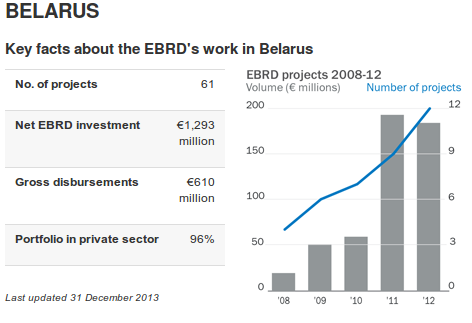
Therefore, it is fitting that the Bank’s first investment in the fuel sector in Belarus was a long-term loan of US$ 10 million to A-100 Group, a medium-sized, privately-owned chain of Belarus petrol stations. The project will help A-100 to increase its share of the country’s fuel distribution market and challenge the state-owned and Russian energy majors that dominate the sector. http://www.ebrd.com/downloads/research/factsheets/belarus.pdfThe EBRD and Belarus The current political, economic and structural reform environment in Belarus warrants the continued application of a calibrated strategic approach, incorporating both political and economic benchmarks to gauge the country’s progress or regress against its key Article 1 commitments and adjusting the Bank’s operational response accordingly. In keeping with the calibrated strategic approach, the Bank’s overall engagement in Belarus will continue to be modulated to reflect the country’s progress against annually updated political and economic benchmarks. In light of recent political and economic developments, while continuing its policy of constructive engagement to promote reform, the Bank will further calibrate its engagement in Belarus to limit its involvement with state-owned enterprises in the areas of trade finance, energy efficiency credit lines and private equity funds.
Last updated 13 March 2013
http://www.ebrd.com/pages/country/belarus/strategy.shtmlhttp://www.ebrd.com/pages/country/belarus.shtml
UKRAINE
The Bank continued supporting the Ukrainian banking sector. Under the conditions of limited access to international financial markets, EBRD client-banks made active use of the Trade Facilitation Programme, which recorded exceptionally high volumes. A large energy efficiency lending facility of US$ 50 million was signed with UkrEximBank. The EBRD also participated in the capital increase of Ukrsibbank (BNP Paribas Group).
Finally, a major step towards overcoming the legacy of the Chernobyl accident and ensuring long-term safety at the Chernobyl Nuclear Power Plant was achieved in 2012 with the successful completion of the first lifting stage of
the New Safe Confinement. This project is implemented under the financial supervision and the support of the EBRD
Turkey, Eastern Europe, Caucasus and Central Asia
Managing Director: Olivier Descamps (based in London)
EBRD Headquarters
One Exchange Square London EC2A 2JN
United Kingdom
EBRD Belarus office
34A Engelsa Street, building 2
220030 Minsk
Belarus
Head of Office: Francis Delaey
The Caucasus, Moldova and Belarus
Director: Bruno Balvanera, as of 1 June 2013
(Tbilisi office)
A-100 enters into the 100 most expensive Byelorussian brands
MPP Consulting Agency (Ukraine) conducted an assessment of the Belarusian brands. The main aim of that research was the identification of one hundred most famous and valuable brands in our country. It is rating of brands created exclusively in the territory of Belarus, only Belarusian goods and services. MPP Consulting examined all industries.
During the research, evaluation of national brands «TOP National Brands» and rating “BelBrend 2011 — TOP 100 Belarusian brands,” Company A-100 took 90th in the overall ranking and first in its industry. Brand value has been estimated at 1.75 million dollars.
And the first line this year is a brand of “Santa Bremor”, valued at $ 72.5 million
The main objective of “BelBrend 2011” was to determine the 100 most valuable brands in Belarus, as well as their current market value, based on the performance of companies that use these brands, the positions of each company in the market and perspectives for their development.
The main feature of the methodology for assessing agency MPP Consulting is that the brand value includes only the cost of the brand-name, without regard to production capacity, infrastructure, patents, inventions and other tangible or intellectual property.
The western powers are in no position to lecture Putin, whose actions in Crimea look like a Gandhian direct action when compared to the normal US-UK mode of operation. From 28 February to 18 March, Russian forces captured over a dozen Ukrainian bases or military posts without the loss of a single life.
[…]
NATO is a machine for facilitating or imposing western domination on the rest of the world. Dismantling it would be a valuable step towards a more peaceful world, and a valuable de-escalatory move in the current crisis.
In this wide-ranging essay (a greatly extended version of the editorial in the current print edition), PN co-editor Milan Rai analyses Ukraine, western hypocrisy, the role (not) played by nuclear weapons in the ongoing crisis, claims that the US organised a “fascist coup” in Ukraine, the “referendum” in Crimea, and the path away from war.
It is difficult to see the Crimea crisis clearly through the choking fog of western hypocrisy that surrounds it. Before trying to do so, there is one factor that we should deal with straightforwardly. When Ukraine became independent (after the collapse of the Soviet Union in 1991), it inherited 1,900 strategic nuclear warheads, more nuclear weapons than China, France and Britain held – combined.
If, instead of repatriating these weapons to Russia in the mid-1990s, Ukraine held those weapons today, it is extremely unlikely that Russia would have invaded the Crimea. This may be an uncomfortable truth, but we think it must be faced by those who want to advance nonviolence.
If we want to persuade smaller nations to remain free of nuclear weapons, as we should, as they should, we have to have answers to the questions that arise.
Abandoned nuclear bomb plant in Crimea. Photo: Victor Korniyenko
Ukraine gave up its weapons in return for a promise that its territorial integrity would be protected by the USA, Russia and the UK, under the 1994 Budapest Memorandum on Security Assurances. This agreement has manifestly not been honoured by ANY of the parties.
Strictly speaking, as Steven Pifer, former US ambassador to Ukraine, points out, the Budapest Memorandum ‘bundled together a set of assurances that Ukraine already held from the Conference on Security and Cooperation in Europe (CSCE) Final Act, United Nations Charter and Non-Proliferation Treaty’. Pifer observes: ‘The Ukrainian government nevertheless found it politically valuable to have these assurances in a Ukraine-specific document.’
The specific ‘security assurance’ given in the memorandum (not a treaty) was that ‘if Ukraine should become a victim of an act of aggression or an object of a threat of aggression in which nuclear weapons are used’ (emphasis added), Russia, the UK and/or the US would take steps.
Well, actually, just one step. The one action specified, in the case of a nuclear weapons-related security issue, was that they would ‘seek immediate United Nations Security Council action to provide assistance to Ukraine, as a non-nuclear-weapon State party to the Treaty on the Non-Proliferation of Nuclear Weapons’.
In any non-nuclear-weapon-related situation, Russia, Britain and the US promised only to ‘consult in the event a situation arises that raises a question concerning these commitments’.
The US and Britain have lived up to the words of the Budapest Memorandum (calling a ‘consultation’ meeting on 5 March which Russia refused to attend), while violating its spirit.
Former foreign minister of Australia Gareth Evans has argued that nuclear weapons would not have prevented the Russian invasion of Crimea: ‘weapons that would be manifestly suicidal to use are not ultimately a very credible deterrent’. In his view, Russian president Vladimir Putin would have known that Ukraine would not ‘nuke Moscow for sending tanks into Crimea, or even Dnipropetrovsk’. Yet at the same time, Evans himself points out that Ukraine’s possession of nuclear weapons would have added ‘another huge layer of potential hazard, owing to the risk of stumbling into a catastrophe through accident, miscalculation, system error, or sabotage.’
Evans is absolutely right to stress the terrifying risks and instability of ‘nuclear deterrence’, but it does no good for us advocates of disarmament to deny that invading a country that possesses nuclear weapons is a frightening prospect that no rational leadership would undertake.
This simple truth does not justify the possession of nuclear weapons, which remain immoral and illegal and dangerous to the survival of civilisation, if not humanity as a species.
An equally simple truth is that if Ukraine had retained its nuclear weapons in 1991, it might not have been invaded by Russia in 2014, because there is a good chance that in the intervening years an accidental or mistaken nuclear launch would have led to the devastation of both nations, along with neighbouring countries.
Setting Crimea in context
Map of Ukraine, showing the geographical position of Crimea. Image: Sven Teschke
On 2 March, US secretary of state John Kerry reacted to the Russian invasion of Crimea by saying: ‘You just don’t in the 21st century behave in 19th century fashion by invading another country on completely trumped up pretext.’
Since Vladimir Putin’s first ascendancy to the Russian presidency in 2000, the Russian state has used its armed forces against other countries twice: against Georgia, in 2008; and now against Ukraine.
In the same time period, Britain has used its military forces without UN authorisation against four countries: Sierra Leone (2000), Afghanistan (2001-present); Iraq (2003-2008, officially); and Libya (2011). (In Libya, there was a UN-approved ‘no-fly zone’, but NATO forces exceeded this mandate). During these same years, France has attacked several African countries, some repeatedly, including: Côte d’Ivoire (2002, 2004, 2011); Zaire (now the Democratic Republic of Congo) (2003); Chad (2006, 2008); Libya (2011); Mali (2013); Somalia (2013); Central African Republic (2006, 2013-present).
The US has used its armed forces in a criminal fashion against a number of countries, including: Afghanistan (2001-present); Yemen (drone attacks, 2002-present); Iraq (2003-present); Pakistan (drone attacks, 2004-present); Libya (2011); Somalia (2011-present).
Some of these attacks may be classed as state terrorism, many amount to the crime of aggression.
The modern classic example of a ‘trumped-up pretext’ is, of course, the weapons of mass destruction alleged to exist in Iraq in 2003.
The 19th century is not over for these leaders of the free world.
Lawyer Yoshiro Yabe’s tweets persistently slandering others including me after ETHOS leader’s criminal accusation. He is a supporter of ETHOS leader Ms. Ryoko Ando and implies further accusation against me including imposing me to pay considerable amount of compensation fees.
“The Lawyer Yuichi Kaido, the former Secretary General of Japan Federation of Bar Associations, who made Monju Nishimura Case as a civil case though Nishimura’s medical record shows that he was killed instead of committing suicide as the police report said.”
********************** On March 26, I got a swift reply from Japan Federation of Bar Association, only one day after I gave them my open questions.
As I suspected, JFBA didn’t answer my question in their e-mail which is strangely unreliable situation. The e-mail is below.
Dear Ms. Takenouchi
I read your e-mail.
JFBA cannot express our views on individual issues or individual lawyers’ activities. We would appreciate your understanding.
Japan Federation of Bar Associations
********** Takenouchi’s mail to JFBA
Please excuse me for writing this so suddenly.
My name is Mari Takenouchi, I am a freelance journalist/translator who has a 4 year old boy, I am a single mother who investigates anti-nuke/anti-radiation exposure issues.
At the end of January 2014, I was notified by Fukushima Prefectural police that I was being accused for “criminal contempt” by the leader of the Fukushima ETHOS group, Ms. Ryoko Ando. In February, 3 policemen flew to Okinawa from Fukushima, and made some investigations at my house and questioned me at the police station.
Concerning this news, Reporters Without Boarders covered the article as an international news item on March 11, 2014, some three years after the Fukushima nuclear accident.
Also, I have been harassed and intimidated on the internet by many people before and after the criminal accusation.
I have the following 3 questions for both the Japan Federation of Bar Associations and Kyoto Lawyers’ Society. I would be very appreciative if you could reply back to me at mariscontact@gmail.com by Friday, April 4th, 2014.
Best regards,
Mari Takenouchi, freelance journalist, translator 1: Persistant harrassement by Lawyer Yoshiro Yabe
I have been harassed by lawyer Yoshiro Yabe @motoken_tw in various ways in a quite persist way on the internet. When I collected the petition not to indict me and presented it to the Fukushima Local Prosecutors’ Office, Mr. Yabe insisted the petition was not valid and disseminated his statement a number of times. Recently, when I put my mother’s letter on my blog http://savekidsjapan.blogspot.jp/2014/03/further-legal-case-against-takenouchi.html, he said,
Takenouchi’s mother who said, “Can you take responsibility if something happened to my only daugthter and my only grandson? could be regarded as a threat”
As a matter of fact, Mr. Yabe’s remark seems to a threat against my mother.
When I said so on my twitter, surprisingly, Mr. Yabe said, “That is a defamation against me. Why don’t we accuse each other one time?” He is disseminating such a threatening tweet against me!!
Furthermore, though I have repeatedly asked him not to obstruct me since his deeds have been inflicting tremendous hurt for me, he never stopped and continued his harassment.
On the other hand, Mr. Yabe is an obvious supporter of Ms. Ryoko Ando, who raised the controversy by saying, “Why don’t we drop the argument saying, “Life is important”? Mr. Yabe protected her controversial statement in the following.
As Japan Federation of Bar Associations, and Kyoto Lawyers’ Society, what do you think of the attitudes of Lawyer Yoshiro Yabe?
As a single mother who is under criminal accusation, his remarks themselves sound like threats to me. He has been imposing tremendous mental hurt if he was to actually file a lawsuit against me, my life and my 4 year old boy’s life could be devastated.
I would be very appreciative if Japan Federation of Bar Associations and Kyoto Lawyers’ Society could give Mr. Yoshiro Yabe some recommendation.
Please let me know if that is possible or not.
PS. After I put up this blog page, Mr. Yoshiro Yabe tweeted the following, implying that he will make tremendous amount of compensation money from me.
The title speaks for itself! and the screenshots speak volumes. Also Peace News is being blocked – please like Peace News on Facebook to overcome the censorship – here is there link for a beleagured Peace news ; https://www.facebook.com/pages/Peace-News/278904385459229?fref=ts , also, Google in Ireland is filtered to stop bad news for the nuclear industry, so use meta crawler or Start Page
Vote with your feet – And let google know you are not happy!
Torbrowser is worth the effort as well (I will post instructions as i get more familiar with it)
Fukushima accident mentioned in only 1 elementary school science textbook
Only one of the six science textbooks approved for use at elementary schools from the next academic year covers the issue of the Fukushima nuclear accident triggered by the 2011 earthquake and tsunami disaster.
The textbooks are the first to be screened and approved by the education ministry since the triple meltdown at the Fukushima No. 1 nuclear power plant. The results of the screening were announced April 4.
Five of the six publishers considered taking up the topic, but four eventually gave up. This was mainly because the word “atom” is not included in the education ministry’s curriculum guidelines for science in elementary school, making teaching how a nuclear plant works even harder than it is.
An editor at one publisher also said, “We could not deal with the issue negatively when our textbook is used in some municipalities hosting a nuclear plant.”
Even the science textbook from Dainippon Tosho Publishing Co., the only one that covers the accident, simply wrote: “The earthquake off the Pacific coast of the Tohoku region triggered an accident at a nuclear power plant.” The textbook mentioned effective use of resources as a lesson from the accident.
One publisher, though, tried hard to include an analysis of radiation in its science textbook for sixth graders.
“(Radiation) is an issue we will face for years,” said Takahiro Yano, editor in chief of the elementary school science textbooks division at Gakko Tosho Co. “We thought that if it is a science textbook, the issue should be included.”
But as the word “radiation” is also not included in the guidelines, publishers cannot take up the issue directly.
Under the circumstances, Gakko Tosho tried to include an explanation of radiation at the bottom of a one-page column on the life of Marie Curie, a Polish-born physicist and chemist who conducted pioneering research on radiation.
The publisher tried to relate the column with the guidelines and included two lines on a water solution–which is taught under the guidelines for sixth-graders–because Curie used a water solution in her study.
However, the textbook failed to pass the ministry’s screening.
“There is no appropriate relation with the curriculum guidelines,” the education ministry’s comment said.
The publisher finally gave up on including the column after repeated discussions did not change the ministry’s view.
Our doctors are worried about your health―in fact, about your very survival.
No, they’re not necessarily your own personal physicians, but, rather, medical doctors around the world, represented by groups like International Physicians for the Prevention of Nuclear War (IPPNW). As you might recall, that organization, composed of many thousands of medical professionals from all across the globe, won the Nobel Peace Prize in 1985 for exposing the catastrophic effects of nuclear weapons.
The problem, as a new IPPNW report indicates, is that the world is showing growing symptoms of a terminal illness. In a nuclear war involving as few as 100 weapons anywhere in the world, the report noted, the global climate and agricultural production would be affected so severely that the lives of more than 2 billion people would be in jeopardy. Even the use of the relatively small nuclear arsenals of India and Pakistan could cause terrible, long lasting damage to the Earth’s ecosystems. The ensuing economic collapse and massive starvation would throw the world into chaos.
And this is just a small portion of the looming nuclear catastrophe.
Today, some 17,300 nuclear weapons remain in the arsenals of nine nations, and their use would not only dramatically exacerbate climate disruption, but would create almost unbelievable horrors caused by their enormous blast, immense firestorms, and radioactive contamination.
The International Campaign to Abolish Nuclear Weapons (ICAN), founded by IPPNW in 2007, reports that a single nuclear weapon, detonated over a large city, “could kill millions of people in an instant.” Subsequently, many additional people would die of burns and other injuries, disease, and cancer.
Residents of the United States and Russia, two nations currently engaged in an international brawl, might be particularly interested in the fact that their countries possess over 16,000 nuclear weapons. About 2,000 of them on hair-trigger alert, ready for use within minutes. According to the ICAN report, if only 500 of these weapons were to hit major U.S. and Russian cities, “100 million people would die in the first half an hour, and tens of millions would be fatally injured. Huge swaths of both countries would be blanketed by radioactive fallout.” Furthermore, “most Americans and Russians would die in the following months from radiation sickness and disease epidemics.”
Letter from Sir Tony Cunningham MP for Workington following over 100 letters from constituents.
“Thank you for your letter dated 26th march together with letters from constituents and visitors to Workington regarding the non prosecution of landfill operators FCC following the prosecution of Sellafield for “illegally dumping three bags of low level and one bag of intermediate level waste into Lillyhall landfill”.
I have written to the Secretary of State for Energy and Climate Change on this issue and will be back in touch once a reply is received.
Jon Doe Our man in Japan breaks down the abuses of the homeless, disabled, drug addicts and the financially desperate working at the Fukushima Daichi nuclear disaster site.
Published on 16 Apr 2014
TEPCO`s shady firing practices and lack of willingness to do anything in a proper manner strikes again.
He’s recklessly stepping up the UK’s investment in it, by giving tax breaks to fracking companies and buying off councils. [2] He’s even trying to change trespass laws so it’s harder to oppose fracking near you.
But it’s not working. And that’s because of people power. Public support is at a low, local councils are refusing to be bought off and local opposition is making it tough for fracking companies to start drilling. [3]
The momentum is with us now. So let’s get ahead of it and unite the tidal wave of opposition from across the UK. How? Let’s start with a petition – we need to show in numbers how many people want a frack free future – to ramp up the pressure David Cameron is feeling right now.
In this dash for shale gas and dirty oil, David Cameron is ignoring the real threats of climate change: its impact on the world’s poorest people, our wildlife and our natural environment.
And the claims Cameron and the fracking industry are making about the benefits of fracking are being torn apart. As for Cameron’s argument that fracking will make us better off, the government’s own energy advisor says it’ll do nothing to reduce our energy bills. [4]
A huge petition signed by thousands of people is exactly what we need to demonstrate that people simply don’t want fracking in the UK. [5] But that’s just the first step. Together we can deliver the petition to every MP, and make sure fracking is a top priority for every one of them in the run up to the election.
We’ve joined forces with our friends at Greenpeace and Friends of the Earth to build a huge people powered petition that no one can ignore. It’s already got more than 100,000 signatures. Can we make it 200,000 today?
(site still hacked but you can get the show by direct link below)
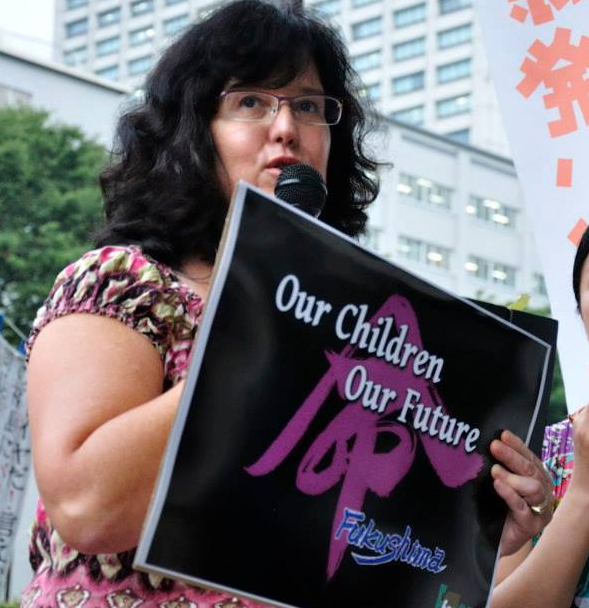
Beverly Findlay-Kaneko is at a Demonstration in 2013
Beverly Findlay-Kaneko on the April 27 SoCal event, “Childhood in Fukushima: Finding Hope in Adversity,” with former Fukushima elementary school principal Sensuke Shishido.
BREAKING: ASLB approves new Texas nukes with foreign backing!
Texas environmental watchdog SEED Coalition’s Karen Hadden provides the information.
PLUS: Interview with Italy’s anti-nuclear bulldog Massimo Greco on where Italian nuke waste ends up and his pending lawsuit;
Abby Martin discusses the drone issues here @7 mins in with Manuel Rapalo
I recently highlighted issues in Ireland with Google search blocking independent voices on nuclear issues. And pointed out that Yahoo moved its servers to Dublin from the UK because of spying in the UK (TEMPORA).
GOOGLE IS BEING SNEAKY ..
Time for people to vote with their feet and leave Google behind!
Drones Kill and they spy!
Which search engine is upholding YOUR freedoms of expression!!
NOT GOOGLE OBVIOUSLY!
GOOGLE SHOULD GET OUT OF IRELAND AND TAKE THE US MILITARY BASE NEAR THE SHANNON WITH IT (PRISM)
Over the last few months, there has been a bit of a selling spree of Entergy stock. But this sell-off isn’t coming from just anybody: these sales are by some of the corporation’s top executives. Between December and early April, five Entergy execs sold off large portions of stock they hold in their employer. On December 3, 2013, Entergy CEO Leo Denault sold more than half of his Entergy stock (55.7%, or 33,949 shares valued at $2,103,480). On February 20, the Chief Financial Officer, Andrew Marsh, sold 20.7% of his stock (2,808 shares valued at $181,902). On February 27, Senior Vice President for Federal Government, Regulatory, and Policy Affairs Kimberly Despeaux sold 20.8% of her stock (3,024 shares valued at $193,113). And most recently, on April 9, Chief Accounting Officer Alyson Mount sold 45.9% of her stock (4,929 shares valued at $347,495). Also, on December 16 and October 16, Senior VP of Human Resources and Chief Diversity Officer Donald Vinci twice sold more than 16% of his Entergy holdings.
There was nothing illegal about any of this, they are all above-board transactions properly reported to the Securities and Exchange Commission and covered in the investment press. But if the three people who know most about Entergy’s finances (the CEO, CFO and CAO) and the person in charge of the company’s government and regulatory affairs—which are central to the company’s economic future (see below)—don’t feel that Entergy stock is a better long-term investment, you have to wonder whether there’s some big news on the horizon.
We have posted a lot recently about economic troubles in the nuclear garden, and the industry’s gambit to rescue itself from financial collapse (see here and here, for instance). The two largest players in this are Exelon and Entergy, the #1 and #2 nuclear operators in the country. As Wall Street has become aware of the serious problems facing the nuclear energy business over the last year, Entergy and Exelon have increasingly been named among the riskiest investments among major energy companies. In terms of gross numbers, Exelon has the greatest exposure to the economic crisis facing “merchant” nuclear reactors – that is, those operating in deregulated energy markets, where power plants sell electricity on a wholesale market rather than as part of a utility company with ratepayers. All of Exelon’s 22 reactors operate in deregulated markets, and more than 25% of them have been listed as at risk of closure.
But in some ways, Entergy may be even more at risk than Exelon, If insiders voting with their portfolios is any indication. After all, no one is reporting on Exelon executives selling stock like their counterparts at Entergy. Entergy currently owns 11 reactors, six of which are part of the corporation’s merchant power division, Entergy Wholesale Commodities (EWC); five are part of Entergy’s utility business in Arkansas, Louisiana, and Mississippi. Nearly all of the merchant reactors face some imminent threat of closure—that is, all but Vermont Yankee, which Entergy already has announced will close in 2014.
Among the others, FitzPatrick (NY) and Pilgrim (MA) have been singled out by industry analysts as two of the most economically troubled plants. Palisades (MI) is only profitable now because of a sweetheart contract with the reactor’s former owner, but has a growing list of major maintenance issues, including an embrittled reactor vessel. Indian Point’s two reactors near New York City are Entergy’s only currently profitable merchant nuclear “assets,” but are still considered vulnerable to closure due to major public and political opposition and legal challenges to their relicensing. That means within the next couple years, literally every reactor and the entirety of Entergy’s merchant power division could go belly-up.
That has investor analysts concerned. Of the thirteen investment firms “following” Entergy’s stock, two recommend investors sell their Entergy stock, eight are “neutral,” five firms have downgraded Entergy in the last year,* and only one has “upgraded” their rating. So that’s reason enough to be worried if you own Entergy stock. Entergy has had other problems recently, not least of which is the failure of a major deal to sell off the company’s electricity transmission infrastructure in the south, rejected by Mississippi regulators.
This is a defect in the heart of children caused by radiation from Chernobyl, and it causes physical holes in the heart of the child, along with a host of other issues.
In an attempt to work out the possible figures of children that will be born annually in Japan with birth defects, I have used the figures below to make an estimation of the likely impact. Based on figures from Chernobyl from Yablakov (2010) of 8, 300, 000 against a similar area in Fukushima Prefecture and the NW Myiagi prefecture (ACRO France) with a population living in contaminated areas of under 2, 500, 000. The figures seem to point to 1,500 children a year are likely to be born in future years with birth defects.
There is obviously some dispute as to the figures and areas of contamination. Also, the contamination in the mountains is likely to hit cities like Koriyama that are downhill of this unknown and untested for contamination. there are also some small issues with the population statistics though they seem about right to me.
Japan has no free health services and I would recommend that people not conceive in such a a place and subject their unborn Fetus to the high levels of Gamma radiation. Thanks to local initiatives food contamination is presently being contained mainly but as time goes on, like in Belarus etc, testing becomes lax. So evacuation is a good idea for young people wanting to raise a family. The issue of contaminated food is an international one that needs independent analysis to ascertain the depths of the problem and the IAEA and WHO are not up to the job because they have a nuclear bias. The quotes and links follow for you to decide if I am right or not;
From Chernobyl Children International
Today in Belarus, over 7000 children await treatment for cardiac conditions that would be practically routine matters in the United States or Europe. The country’s health services are already stretched to the breaking point, and the waiting list grows by an estimated 800 to 1000 children every year.
[..]
Since its establishment, Chernobyl Children’s Project International has built and maintained a fleet of over 140 ambulances in Belarus and Western Russian
Quote from the Irish Independent newspaper – April 2014
“The €3m spent so far on establishing and maintaining the program has been raised entirely in Ireland by CCI donors and volunteer fund raising activities.
[..]
For the past 10 years, the program has been treating a significant portion of the 6,000 Ukrainian children born with genetic heart diseases every year. Many of these conditions, known as the ‘Chernobyl heart’, have been linked to the radiation leaks from the Chernobyl nuclear plant accident in 1986.”
[..]
Quotes from Chernobyl Children International CEO Adi Roche 2014
According to reports from Soviet scientists, 28,000 square kilometers (km ², or 10,800 square miles, mi²) were contaminated by caesium-137 to levels greater than 185 kBq per square meter. Roughly 830,000 people lived in this area. About 10,500 km ² (4,000 mi²) were contaminated by caesium-137 to levels greater than 555 kBq/m². Of this total, roughly 7,000 km² (2,700 mi²) lie in Belarus, 2,000 km² (800 mi²) in the Russian Federation and 1,500 km² (580 mi²) in Ukraine. About 250,000 people lived in this area. These reported data were corroborated by the International Chernobyl Project.[13]
Seawater has been leaking into the nuclear condenser at the Olkiluoto 1 nuclear power plant in Eurajoki, western Finland. The plant’s output is limited as Voima undergoes fault identification and repair.
Energy production at Eurajoki’s Olkiluoto 1 reactor has fallen due to small volumes of seawater leaking into the nuclear condenser. The plant’s owner, Teollisuuden Voima Oyj (TVO), says that it is working to locate the fault.
The task of locating the leak and initiating subsequent troubleshooting and repair means that the plant’s output is limited to 300 megawatts. The plant is estimated to return to full production by Tuesday morning. Not a safety risk
The leakage was found when the nuclear reactor’s electrical conductivity was measured. The leaky condenser block has already been separated from the production process. The leak is said to be quite small, letting in a trickle of some two litres per hour.
The role of the condenser is to cool the steam generated in the nuclear reactor, a process which involves the use of seawater.
It’s expected to take around 8 hours to repair the fault. According to TVO the leak does not pose a safety risk.













 nuclear-news