Tehran :Germany and China have reiterated that they are committed to the 2015 nuclear deal between Iran and the P5+1 group of countries following the United States’ withdrawal.
Speaking alongside visiting China’s Premier Li Keqiang , Chancellor Angela Merkel said the nuclear accord, officially known as the Joint Comprehensive Plan of Action (JCPOA), was well-negotiated. The Chinese premier also warned against the unforeseeable consequences if the deal falls apart.
“We remain committed to the nuclear agreement. We think it was well negotiated,” Merkel said. “There is more that needs to be negotiated with Iran, but we think it is better to stay in the agreement.”
However, Merkel implied that Berlin could do little to protect international companies against punitive US measures, adding that it is up to individual firms to decide if they want to invest in Iran.
Earlier in the day, a spokeswoman for the Chinese Ministry of Foreign Affairs, Hua Chunying, expressed Beijing’s resolve to continue efforts to safeguard the achievements of a 2015 nuclear agreement, putting forward a five-point proposal.
“Facing the complicated and stern situation at present, China clearly put up a five-point proposal emphasizing in particular that international rules should be observed, major countries should show their due integrity and sense of responsibility, unilateral sanctions can only run counter to one’s desire and should be abandoned, and dialogs and consultations should adhered to a constructive approach in discussions about issues of common concerns,” Hua said.
MoD: US Violates INF Treaty by Deploying MK-41 Launchers for Tomahawks in Europe
11.07.2018
In an interview with Il Giornale newspaper, Russian Defense Minister Sergei Shoigu commented on the issues of US strategy in Iraq and Libya, the US violating the INF Treaty, Russia-US relations, the Ukrainian crisis and war in Syria.
MOSCOW (Sputnik) — The United States is violating the Intermediate-Range Nuclear Forces Treaty (INF Treaty) by deploying in Europe missile defense system, whose launchers might be used for firing Tomahawk cruise missiles at the European part of Russia’s territory, Russian Defense Minister Sergei Shoigu said in an interview released on Wednesday.
“We have repeatedly and publicly made it clear in all major international fora that it is the United States that is directly violating the INF Treaty, having installed, during the deployment of a missile shield in Europe, its MK-41 vertical launching systems, which might be used for the launch of Tomahawk cruise missiles. The destructive radius of these missiles covers almost all the European part of Russia’s territory,” Shoigu told Italy’s Il Giornale newspaper.
Shoigu added that, at the same time, it was Russia that was accused of alleged violations of the treaty.
“The US party is currently preparing its withdrawal from the INF treaty. The reason for such a step is the alleged violations of the treaty by Russia. But there are no facts, only claims,” Shoigu said.
US Strategy in Iraq, Libya
The United States is implementing the strategy of neocolonialism, which has already been tested in Iraq and Libya, Shoigu said.
“It is about the neocolonialism strategy, which has already been tested by the United States in Iraq and Libya and which consists in supporting any, even the most barbarous ideologies in order to weaken legitimate governments,” Shoigu told Italy’s Il Giornale newspaper.
According to the minister, the United States also stages attacks with the use of weapons of mass destruction or humanitarian disasters and, at the final stages, uses military force to create “manageable chaos,” which enables the transnational corporations to extract the existing assets to the US economy.
“Russia, which advocates the equal and mutually beneficial cooperation with all the countries within the concept of multipolar world, will always be an obstacle for such strategies’ implementation,” Shoigu stressed.
“I am convinced that any issues can and should be settled without the use of military force. I have repeatedly invited the Pentagon’s head to discuss the existing problems of the global and regional security, including the fight against terrorism. But the United States is not ready for such a dialogue,” Shoigu told Italy’s Il Giornale newspaper.
“There is only one communication channel between our general staffs now, which is used in negotiations, including at the level of the chiefs of general staff, aimed, first of all, at preventing the military activities of Russia and the United States from turning into a military conflict between our nuclear powers,” Shoigu said.
Recuperating Russia Viewed by West as Threat to US Dominance
Western countries view recuperating Russia not as an ally but as a threat to the dominance of the United States, Sergei Shoigu stressed.
“Today recuperating Russia is being viewed not as an ally but as a threat to the US dominance. We are being accused of some aggressive plans with regard to the West, which, in turn, continues to deploy new forces near our borders,” Shoigu told Italy’s Il Giornale newspaper.
Among such unfriendly steps of the West Shoigu mentioned the recent decision of NATO to establish two new commands, responsible for the protection of maritime communication and the prompt movement of the US troops to Europe, and the increase of the alliance’s contingents in the Baltic states, Bulgaria, Poland and Romania from 2,000 soldiers to 15,000.
Russia-US Tensions
“We often hear from the US that the crisis in bilateral relations has been provoked by Russia’s alleged aggressive actions on the international arena. However, we are firmly convinced that tensions in our relations have been artificially fueled all this time by those US elites, who believe that the world is divided into the US [part] and the wrong [one],” Shoigu told newspaper.
Shoigu added that it was the United States that in recent years had unilaterally broke key agreements, which formed the backbone of the global security. The defense minister pointed to Washington-initiated NATO expansion toward Russian borders, despite the promises that were given to the Soviet leadership during Germany’s reunification.
“For over 25 years we have been deluded by [claims saying] that there have been no promises, until the National Security Agency declassified archives with the documents of that period, in which it has been set out literally,” Shoigu said.
Shoigu has called on the United States, in particular, to explain why US military bases were edging closer to Russia.
“I, as president of the Russian Geographical Society, have for a long time wanted to present the US colleagues with a globe so that they would look at it and explain to us, why the ‘US adversaries’ designated by them are located in the Middle East and East Asia, while all their military bases and groups are nearing Russia’s borders,” the minister told the newspaper.
Russian officials have repeatedly expressed concern over NATO’s move closer to Russian borders. In May, Kremlin spokesman Dmitry Peskov said, regarding Poland’s wish to have a permanent US military base in the country, that NATO’s advance toward Russian borders did not contribute to the overall stability and security. Peskov added, however, that the decision to host a NATO base was for a hosting country to make.
Syrian Settlement
Iran and Turkey are playing key roles in stabilization of the situation in Syria, Russian Defense Minister Sergei Shoigu said in an interview released on Wednesday.
“Iran, along with Turkey, has historically been one of the main actors in the region and plays a key role in stabilization of the situation in the Syrian Arab Republic,” Shoigu stated.
The United States has not allocated any funds to support civilians in Syria affected by the war, Shoigu said.
“Affirming its ‘noble’ objectives and ‘good’ will, the United States has not allocated a cent to provide real assistance to Syrian civilians devastated by long years of war,” Shoigu added.
According to the minister, dozens of civilians continue to be killed by munition and mortars left in liberated Raqqa after massive bombings by the US-led international coalition.
Crisis in Ukraine
The armed rebellion in Ukraine in February 2014 were preceded by all signs of the United States waging a “hybrid war,” Russian Defense Minister stated.
According to Shoigu, the “hybrid actions” refer to various forms of pressure, short of military force, employed by one state against another one, including control over mass media, economic sanctions, the activities in cyberspace, fostering domestic unrest, and the use of specialized groups and specialists to carry out terrorist attacks, subversion and sabotage acts.
“Since the 1990s, these methods have been actively used by the United States in former Yugoslavia, Libya, [Russia’s] Chechen Republic and, most recently, in Syria. All the signs of the ‘hybrid war’ were apparent in Ukraine ahead of the armed rebellion in February 2014, with the European countries’ passive participation in these ‘hybrid actions,’” Shoigu stressed.
The necessary prerequisites for carrying out such campaigns include control of media with a global reach, possessing superior telecommunications and information technologies, a firm hold on global financial systems and an experience in deploying special forces in other countries, according to the Russian defense minister.
“What countries, other than the United States and the United Kingdom, have this kind of potential?” Shoigu said.
The defense minister added that London and Washington tested these methods in Iraq during the 1990-1991 Gulf War.
“This is an important detail, because there had been the necessary technologies when the Soviet Union and a bipolar world existed, but there had been no opportunities. And, by the way, the US president at the time [of the Gulf War] was none other than George H. W. Bush, former director of the CIA,” Shoigu said.
In February 2014, following months of protests over President Viktor Yanukovych’s refusal to sign an EU association agreement, the Ukrainian government was toppled. Two regions in the southeast of Ukraine refused to recognize the new government, which they believed had come to power as a result of the coup. The central authorities and the southeast of Ukraine have been locked in conflict ever since.
CC: Flinders Ranges Council, Kimba District Council, SA Government
I write in opposition to the Federal Government’s nuclear waste plans in South Australia.
We don’t want to risk the regions’ rich heritage or industries like tourism and farming. SA has laws that make the development of a nuclear waste dump and store illegal and it has not been proven that this plan is needed.
This process has caused great divisions in the affected communities.
I urge your government to take an evidence-based approach to the management of Australia’s nuclear waste. Please stop the current plan and start an open assessment of the full range of future options.
I say no to the federal plan to dump and store nuclear waste in SA.
TOKYO (Kyodo) — Tokyo Olympic organizers said Thursday the torch relay for the 2020 Games will start on March 26 that year in Fukushima Prefecture, which was heavily hit by the 2011 earthquake-tsunami-nuclear disaster.
The plan was approved in a meeting attended by top metropolitan government officials after a proposal to start the torch tour in the northeastern Japan prefecture.
“With Fukushima named the starting point of the torch relay, (the relay) will be a symbol of the Olympics of recovery,” said reconstruction minister Masayoshi Yoshino.
“We want to use this as a global showcase for Japan’s recovery from the Great East Japan Earthquake. In order to restore livelihoods in the disaster-struck areas, we hope that victims take part (in the relay) as torch runners,” he said.
Tokyo Olympic organizing committee President Yoshiro Mori stressed that the committee had tried to formulate the torch relay plan by listening to various ideas.
“It’s not possible to figure out the plan which would absolutely be the best. We agreed to do it with the disaster-hit areas and their recovery in mind,” he said.
Organizers were considering starting the sacred flame relay, which is expected to run for 121 days, in either the disaster-affected areas or in Okinawa Prefecture, the starting point of the torch relay for the 1964 Tokyo Olympics.
People in Fukushima Prefecture welcomed the torch relay plan, which the prefecture sees as a good chance to raise the profile of its recovery all over the world.
“We are grateful that they have considered the feelings of the disaster victims,” said Jun Suzuki, an official of the prefecture’s Olympic and Paralympic Games promotion office, adding, “I believe it will be an opportunity to encourage Fukushima people.”
Masamichi Matsumoto, a storekeeper who was evacuated from the town of Futaba, near the crippled Fukushima Daiichi nuclear power plant, to Iwaki city in the prefecture, rejoiced at the announcement, saying, “Memories of the disaster are wearing thin as more than seven years have passed, but it is the utmost delight for us to have an occasion to attract (worldwide) attention.”
“We expect the (torch) relay will bring about great excitement in the devastated areas,” Chief Cabinet Secretary Yoshihide Suga told a press conference.
The torch relay will visit all of Japan’s 47 prefectures and end on July 24, 2020, with the lighting of the Olympic cauldron during the Games’ opening ceremony at the National Stadium in Tokyo.
Is nuclear power going to help the United States decarbonize its energy supply and fight climate change?
Probably not.
That is the conclusion of a remarkable new study published in the Proceedings of the National Academy of Sciences in early July — remarkable because it is not written by opponents of nuclear power, as one might expect given the conclusion. The authors are in fact extremely supportive of nuclear and view its loss as a matter of “profound concern”:
Achieving deep decarbonization of the energy system will require a portfolio of every available technology and strategy we can muster. It should be a source of profound concern for all who care about climate change that, for entirely predictable and resolvable reasons, the United States appears set to virtually lose nuclear power, and thus a wedge of reliable and low-carbon energy, over the next few decades.
Still, despite their evident belief in the need for nuclear power, the researchers are unable to construct a plausible scenario in which it thrives. And it’s not for lack of looking — the paper is a methodical walk through the possibilities for both existing and new nuclear technology. The researchers really want it to work. They just can’t see it happening.
It’s a relatively short paper; let’s quickly hit the important takeaways.
The existing nuclear fleet is shrinking
Existing nuclear plants in the US are having a rough time, getting undercut on energy markets by cheaper natural gas and renewables. A wave of retirements is underway that is probably going to take around 10 GW of nuclear capacity offline.
A handful of states have taken measures to keep nuclear plants open (see this post), but doing so requires “expensive refurbishment and careful regulatory consideration,” the authors write, and will only “slow, not reverse, the losses.”
So then what about new plants?
Existing nuclear plant technology is a dead end
Existing nuclear plants are light-water reactors (LWRs), which were always intended to be the first generation of nuclear plants. But subsequent generations have not materialized, and we’re still mostly dealing with LWRs.
The researchers are blunt about the prospects for new plants based on existing technology:
There is no reason to believe that any utility in the United States will build a new large reactor in the foreseeable future. These reactors have proven unaffordable and economically uncompetitive. In the few markets with the will to build them, they have proven to be unconstructible. The combination of political instruments and market developments that would render them attractive, such as investment and production credits, robust carbon pricing, and high natural gas costs, is unlikely to materialize soon.
And it’s worth noting that those political instruments and market developments, if they did manifest, would also benefit nuclear’s low-carbon competitors, which are already kicking its ass.
What about advanced, non-LWR designs?
Advanced nuclear plant designs are not happening
The agency responsible for shepherding advanced nuclear designs to commercial viability is the Department of Energy’s (DOE) Office of Nuclear Energy (NE).
The researchers did a close analysis of NE’s efforts, “using budget data acquired through the Freedom of Information Act and semistructured interviews with 30 senior nuclear energy experts.”
What they found is that NE has spent about $2 billion pursuing advanced designs since the late 1990s, with “very little to show for it.” Funding is inadequate, half of it goes to maintain existing testing infrastructure, it varies from year to year, and it’s spread shallowly across several technologies and research labs.
“In interviews with leaders across the enterprise,” they write, “those associated with the DOE and the national laboratories expressed either alarm or despair at the trajectory of advanced fission innovation in the United States.”
Theoretically, this decade-plus record of dysfunction could be turned around with “more competent stewardship of nuclear innovation, substantially greater appropriations, and a change in energy markets,” but all those, they note, are “very heavy lifts.”
The one bright spot in the advanced-nuclear area is TerraPower (Bill Gates’s nuclear startup), which has had some limited success getting licenses and testing from the feds, but in general “has found it remarkably challenging to build or secure access to the range of equipment, materials, and technology required to successfully commercialize its innovative design” — so challenging, in fact, that it’s now partnering with China.
The authors conclude that advanced fission designs have no hope at all of commercializing in the US by mid-century, which is when the US economy needs to be decarbonized.
Small modular reactors to the rescue? Maybe not.
The other great hope of the industry is factory-built small modular reactors (SMRs), which are — or will be, it is hoped — faster and cheaper to build than giant plants because they are smaller and built from standardized parts. They can be deployed incrementally, matched to energy demand in particular times and places, and are meltdown-proof without human intervention.
Several companies, most notably NuScale (which has already submitted its design to the feds), are trying to develop light-water SMRs. NuScale wants to build a test reactor on the grounds of the Idaho National Laboratories and more than a dozen companies have inquired about doing the same.
So, with already-proven technology and lower construction costs, are SMRs the key to saving nuclear in the US?
Using “a combination of engineering economic analysis and the use of structured procedures to elicit expert judgments,” the researchers took a close look at SMRs. Indeed, they “expended much effort in developing plausible scenarios of how an SMR domestic market might develop.”
The results? Grim. Under every plausible scenario, power from SMRs is (and remains, even with subsequent generations of the tech) substantially more expensive than power from competitors. So they probably can’t compete directly in power markets.
The researchers also examine four indirect ways that SMRs could build a market:
Industrial process heat: One alternative is to use SMRs to generate heat rather than power, for use in industrial applications that require high temperatures. The researchers find a substantial market exists for such heat, but when the costs of SMRs are compared to the cost of alternative heat sources (like natural gas), “the number of potential customers falls precipitously.”
Also, private companies (unlike utilities) can’t pass costs on to customers, so they’re less likely to take a chance constructing unfamiliar tech that still faces unresolved siting and regulatory issues. “When it comes time to sign contracts and pour concrete,” they conclude, “it is highly unlikely that any industrial customer would opt for a light water SMR.”
Power + desalination: Another frequently discussed alternative is to use SMRs as a kind of hybrid. The thing about nuclear plants is that they need to run more-or-less constantly; it’s expensive and inefficient to turn them on and off. But on-and-off power is what’s needed to flexibly complement variable renewable energy.
So the idea is to run SMRs constantly; when power is needed, they would provide power, and when it’s not, they would desalinate water. But after a close examination of the water situation in the US, the researchers found that there are only a few niche markets where desalination might be needed in the next few decades. And where they exist, desalinating with natural gas is much, much cheaper. This is likely another dead end, at least in the relevant time frame.
Military bases: Another thought is that SMRs might be used to power military bases — that the US military might serve as a kind first customer, helping SMRs scale up. The authors deem this “both unwise and unlikely to succeed.”
It is unlikely to succeed because the unique design requirements for the military are likely to yield an SMR too expensive for commercial viability. It is unwise because using the military as a tool to revive a particular industry is a Pandora’s box of political and ethical issues.
Plus, as they note, defaulting to the military to save nuclear is tantamount to admitting commercial defeat — not something likely to inspire market confidence.
SMRs for export: The final idea tossed around to jumpstart SMRs is building them for export. The idea is that other countries will have political and energy systems more amenable to nuclear. And the authors’ analysis supports the notion that there’s a global market for “many hundreds of light water SMRs.”
But there are substantial barriers. For one thing, many of the potential customers face “economic, political, and institutional realities” that render them unprepared to handle nuclear power at scale, and likely unwilling to accept close oversight by the US.
Aside from that, most decarbonization in the world will need to come from a select few big countries, and most of those countries are already nuclear-capable and unlikely to import hundreds of power plants from a geopolitical rival. “We remain skeptical that a US industry of factory-manufactured SMRs could be built primarily on the basis of exports,” they conclude.
In short, there don’t seem to be any viable markets to scale SMRs up. Consequently, “several hundred billion dollars of direct and indirect subsidies would be needed to support their development and deployment over the next several decades.”
On top of that, the US Nuclear Regulatory Commission would need to radically update and revise its regulatory review process. On top of that, the US would need to commit to total decarbonization, clearly and unequivocally enough to give markets confidence that carbon prices will reach and exceed $100/ton. And this would all have to happen soon, in the next few years.
“All these developments are possible,” they note, “but we believe they are most unlikely.”
There’s probably not going to be a nuclear wedge
So let’s review. Current, giant LMR reactors aren’t going to get built in the US — they have proven economic and political suicide. Even keeping current plants open will require extraordinary interventions. Advanced fission is unlikely to commercialize in the next few decades. And SMRs currently face grim market prospects. They are unlikely to mature and scale up without hundreds of billions in subsidies, substantial reform at NE and NRC, and a high, secure national carbon price.
It’s not impossible to imagine a high carbon price in coming decades, or natural gas prices rising, and SMRs finding success in niche markets. And it’s certainly possible to imagine failing to fully decarbonize by mid-century and needing nuclear to finish the job. The researchers are blunt about what would be needed for nuclear to be ready by then.
To assure that we have safe and affordable advanced reactor designs that can be deployed at scale by midcentury, the United States will need to dramatically increase and refocus the budget of the DOE’s NE toward advanced reactor development. Perceptive and ruthlessly pragmatic program officers will need to be recruited: ones with a sense of the mission’s urgency. The government would have to sustain that higher level of support in the face of constant short-term political pressures and, undoubtedly, organized opposition from advocates of other generating sources. Part of that increased budget would have to be dedicated to building new infrastructure, such as fast-flux test facilities and other system test beds. Even with a higher budget, surge funding may be needed in some years to support demonstration reactor development and program leadership would eventually have to focus on moving two or three systematically chosen designs to the point of commercialization.
“Perhaps these things can happen; the United States is no stranger to ambitious undertakings,” they conclude, “but it will take both vision and a level of commitment that are sorely lacking today.”
Nuclear proponents might reasonably respond that, yes, nuclear cannot contribute to decarbonization without substantial policy help. But decarbonization by mid-century will be impossible without substantial policy, period. No combination of technologies can scale up fast enough without help.
But renewable energy technologies seem to be on a trajectory toward subsidy independence (though plenty of policy and regulatory barriers to advanced energy tech remain). They are falling in cost at ridiculous rates — not just wind and solar, but storage, EVs, and other grid-edge technologies as well. Policy can accelerate their progress, or impede it, but at this point it cannot stop them. They have a momentum of their own, purely on economics.
Nuclear is in a different situation. Its current trajectory is decline; it needs lots and lots of new policy and public money to reverse that trajectory. That is a much more difficult political lift. And like the authors of the PNAS paper, I don’t have much faith that it will get done. For better or worse, renewable energy is the name of the game for the next few decades.
Source: Institute for Energy Economics and Financial Analysis
Policy muddle as one big EU economy hits pause on reactor buildout, another moves toward shutdown, a third plans expansion
LONDON — Europe’s three leading economies are taking three radically different approaches to nuclear power, reflecting contrasting national public priorities in a transition from fossil fuels, and showing the scale of government intervention in energy policy.
France, Germany and the U.K. are all global top-20 generators of nuclear power by market share. France is No. 1 worldwide, with nuclear reactors supplying 71% of generation last year, while the U.K. and Germany were 14th and 19th, at 21% and 12% respectively, according to data from the energy company BP.
But the three have significantly different goals for the technology going forward, despite some consensus over critical considerations of cost and carbon emissions.
Nuclear power is very low carbon-emitting. Partly as a result, France has barely half the per capita carbon emissions of Germany, at 4.9 tonnes of carbon dioxide (CO2) per person versus 9.3 tonnes. Britain is in the middle, at 6 tonnes (according to United Nations population and BP’s CO2 data for 2017).
But nuclear is also one of the most expensive sources of new generation. The U.K. government has contracted to buy electricity from the new Hinkley Point C power plant at a rate of £92.50 per megawatt hour (2012 prices) for 35 years. Long-term nuclear waste disposal liabilities will add to this cost, while there is some risk around the numbers: the 3.2-gigawatt (GW) plant will take at least nine years to build—and has already seen cost overruns.
By way of cost comparison, most renewable power is now unsubsidised in the U.K., with the exception of offshore wind, where the latest power purchase contracts auctioned last year settled at £57.50 per MWh (2012 prices) for 15 years. The 2.3 GW wind farms would take five years to build, coming online in 2022/23.
Low-carbon emissions and high new-build costs might be expected to support a strategy to extend the life of existing nuclear power plants as long as possible, while halting new-build programmes.
The high cost alone of new nuclear plants makes the case for cheaper renewable generation.
Existing, fully depreciated nuclear power plants, some built in the 1970s and 1980s in response to the 1974 oil shock, can be repurposed and run for as long as possible as a source of low-carbon, baseload generation to bridge the phaseout of high-carbon coal and lignite. The high costs of new nuclear, however, make the case for building cheaper renewable generation instead, backed up by more flexible technologies than nuclear, including hydro, gas, batteries, other forms of storage, wider interconnection and demand-response.
FRANCE HAS NO FIRM PLANS TO ADD TO AN AGEING NUCLEAR FLEET beyond the construction of an expensive reactor at Flamanville. But it is planning to extend the life of some nuclear power plants to help it meet goals to reduce carbon emissions, while retiring others.
As President Emmanuel Macron said at the end of 2017: “I don’t idolize nuclear energy at all. But I think you have to pick your battle. My priority in France, Europe and internationally is CO2 emissions and global warming. We’ll have to shut some nuclear plants. Maybe we’ll have to modernize others.”
Germany, meanwhile, is retiring its entire nuclear fleet by 2022, including power plants previously slated for closure in the 2030s, in response to the 2011 Fukushima nuclear disaster in Japan and domestic public opposition to nuclear power. Premature retirements may create difficulties for the country’s carbon-emissions targets if it plugs any short-term supply gap with its dirtiest, most carbon-emitting lignite power plants.
The U.K is moving in entirely the opposite direction, planning a 19 GW nuclear new-build programme that would be unprecedented in the western world.
Gerard Wynn is a London-based IEEFA energy finance analyst.
“…...I am really pleased to see the potential for better collaboration between nuclear defence and nuclear civil, and many references to apprenticeships. It is a rare document, which both excites and instils pride, as this industry, which is equal to the automotive industry in economic output, is quite rightly recognised.
Moving to the content of the deal, the optimism for research and development across the industrial strategy is welcomed. The National Nuclear Laboratory is a world-leading centre in my Copeland constituency, based near Sellafield, where scientists, in collaboration with the University of Glasgow and Lynkeos Technology, have developed an innovation that uses cosmic particles to detect nuclear materials, which could revolutionise nuclear decommissioning and the storing of historic waste. It is being used to investigate the location of molten fuel within the Fukushima Daiichi plant in Japan. The technology is now being commercialised and is just one example of how Innovate UK R&D funding is being used to create commercially marketable, globally required products.
Recognition for better routes to market, retaining intellectual property and support for export and decommissioning, is long overdue. The techniques and skills for and innovative solutions to incredibly complex legacy challenges in difficult or impossible to work in environments are being met daily in and around Sellafield and the low-level waste repository. Being the world’s first to design, commission and operate, and then being the world’s first to decommission, brings unprecedented opportunities for UK plc…..”
HOPE, REDUCTION AND GREED
“…..To secure the future of the third large-scale reactor in the Generation III programme, Moorside requires the regulated asset base to be implemented as soon as possible to give certainty to investors. The sector deal aims for a 30% reduction in the cost of new build projects by 2030, alongside promoting a more competitive supply chain, with more UK companies using advanced manufacturing methods and entering domestic and export markets for nuclear goods and services than ever before.
The global nuclear new build economy is worth around £1.2 trillion. Harnessing the scientific and industrial capability within Britain across the sector while recognising the wider opportunities in the UK’s financial services and regulatory frameworks would mean that this country was geared up to take full advantage of such a huge international market……”
A SERIOUS EDUCATION SHORTFALL
“…The many references to people in both the industrial strategy and the nuclear sector deal signifies the huge importance of continuing to develop world-class skills. With an attrition rate of around 7,000 people each year and an anticipated requirement for 100,000 nuclear workers by 2021, it is essential to deliver on the proposed investment in maths, digital and technical education….”
BRIBING THE LOCAL POPULATION ( FUTURE WORKERS)
“….“Cumbria, a great place to work…an even better place to live”.
Delivering on the intentions in the deal, legislating for the regulated asset-base model, expanding the role of the NDA and taking a long-term approach to the industry will put us in the best position to create maximum economic impact with job and energy security for future generations……”
Luke Pollard (Plymouth Sutton and Devonport Lab/CoOp)
“….I believe in a mixed energy policy with a greater focus on renewables and carbon-minimising generation from nuclear…..”
“….I am a fan of new nuclear, but my constituency is home not to civil nuclear jobs but to defence jobs. Our dockyard is the sole nuclear repair and refuelling facility for the Royal Navy….”
IGNORING THE COSTS
“……Nuclear jobs are not in the heart of the capital like financial services jobs. They are in the regions—the north-west and the south-west—and rightly so. Although I do not always agree with the high strike price for new civil nuclear, there is no doubt in my mind that civil nuclear has a bright future…..”
TAX PAYER HANDOUTS
“….Military nuclear matters. I welcome the, albeit brief, mention in the nuclear sector deal of greater co-operation between civil and defence nuclear. I believe we need to do much more to enhance collaboration and co-operation between those two sectors—not just in research, but in jobs, skills, training and, importantly, decommissioning. The civil nuclear decommissioning programme rightly enjoys cross-party support. The taxpayer has unlimited liability to clean up the nation’s civil nuclear legacy and the sites contaminated by our country’s exploration of civil nuclear and its mastery of nuclear energy…..”
OLD NUCLEAR SUBMARINES ARE PILING UP
“….Although there has been progress on the civil side of nuclear decommissioning, that has not been the case with defence nuclear. Hon. Members may not know that the UK still has every single nuclear submarine we have ever had. It is time that the legacy of old submarines was dealt with. Devonport dockyard in my constituency has 13 laid-up nuclear submarines awaiting recycling. Rosyth in Scotland has seven, and there are more to come. In Devonport, the oldest sub in storage is HMS Valiant. She is 54 years old, and was launched in 1963 at the height of the cold war. Many have been stored for decades, including the HMS Conqueror, which famously sank the Belgrano in the Falklands war.
As a proud janner and a Plymouth lad, I have grown up knowing about those subs, but far too many people do not know about them. “Don’t they just go away?” was how one person responded when I told them about the old subs. Well, no, they do not. Those nuclear submarines get stored because the UK has no funded programme to recycle them. Eight in Devonport still have nuclear fuel rods and have not been defueled yet…..”
UK MILITARY STILL IGNORING THE PROBLEM AND PASSING THE BUCK?
“….Members for Copeland and for Dunfermline and West Fife (Douglas Chapman) to deal with our nation’s military nuclear legacy. We sent a joint letter to the Prime Minister and other party leaders asking them to commit to fund a proper programme of recycling the UK’s legacy and retired Royal Navy submarines. Successive Governments have refused to act, but that is not an option anymore.
Recycling old submarines is not cost-free, and given the Ministry of Defence’s current battle with the Treasury, there seem to be more pressing priorities for the limited funding. We cannot wait any longer, so I am looking to Ministers in the Department for Business, Energy and Industrial Strategy, in particular, and the civil side to help us solve this urgent problem…..”
THE PROBLEM THE MOD “FORGOT”
“…..The taxpayer is rightly paying to clean up old nuclear power stations around the nation, but at the moment the same funding streams and principles—the unlimited liability, set out in law—have not been extended to old nuclear submarines, and they need to be……”
THE NEED FOR NUCLEAR POWER BECAUSE OF MOD FORGETFULNESS
“….I welcome the nuclear sector deal. Clearly, it is not a panacea, but it is an important and significant deal which will undoubtedly help the sector—in many respects it is a signpost for the industry. The implications will not only be positive and raise the profile of the sector, but demonstrate to a wider audience the worth of the nuclear industry and its significance
A key part of the Government’s industrial strategy has, without doubt, to relate to energy: energy is vital to ensure that the industrial strategy works for the country. It also relates to energy security, and importantly, to ensuring that we have a proper base supply of nuclear energy, but with the right price so that the industry can be competitive and residential users can benefit…..”
MONEY MONEY MONEY
“…..I have some direct questions for the Minister. Will he confirm his support for NuGen and the development of a new build in Cumbria? Will he indicate when legislation on the RAB will be introduced?…..”
Drew Hendry Scottish National Party
Commons, Inverness, Nairn, Badenoch and Strathspey
THE SPANNER IN THE WORKS
“…..We have heard a lot of enthusiasm for new nuclear, but I will change that, because I do not share that enthusiasm. In fact, the Government have many questions to answer on their path towards new nuclear, in particular on new developments.
The disastrous Hinkley Point C project exemplifies the Government’s regressive energy strategy and lack of a long-term plan that could cost taxpayers billions. The project at Wylfa is no different: total project costs are unclear, but have been trailed to be about £20 billion—more expensive than Hinkley’s £19.6 billion—a figure that could rise with inevitable delays. The direct investment represents a reversal of decades of opposition to investing taxpayer money in new nuclear.
The Government must fulfil the Public Accounts Committee’s recommendation of a full value-for-money assessment before signing any deals, and they must consider the National Audit Office’s report on Hinckley Point C. Consumers already face the impact of a bad deal made by the Government. Hinkley Point is set to cost consumers a fortune because of the appalling strike price deal that the UK Government made with EDF. As a result of the bad deal, consumers are set to pay at least £30 billion over the 35-year contract through their electricity bills…..”
ANOTHER SPANNER IN THE WORKS
“……My second question concerns financial liability for nuclear power station safety. Liability for nuclear developers is capped at €1.3 billion in the event of a nuclear incident, as agreed in the Brussels and Paris conventions. An event such as the one at Fukushima, however, would cost hundreds of billions of pounds. Moreover, The Times reported that Hitachi “won’t pay” for nuclear accidents at Wylfa and that, according to Nikkei reports, some of Hitachi’s directors want
“safeguards that reduce or eliminate Hitachi’s financial responsibility for accidents at the plant”.
Hitachi has already had two serious safety breaches at its nuclear developments, one of which resulted in a $2.7 million fine by the US Government.
Decommissioning costs ate up around half the budget of the now disbanded Department of Energy and Climate Change after the liabilities for cleaning up old nuclear plants were in effect nationalised in 2004 and 2005, when British Nuclear Fuels Ltd and British Energy faced financial problems. At the moment Hinkley C’s decommissioning costs are estimated at between £5.9 billion to £7.2 billion. Dr Paul Dorfman notes that given that decommissioning costs have been consistently underrated, and the precedent set by the Government’s taking ownership of liabilities of these companies more than a decade ago, it is highly likely that the Government will be forced to shoulder further costs if Hinkley developers have a shortfall. Again, will the Minster give an urgent assurance that taxpayers will not be left liable for safety failures at the Wylfa nuclear plant? That is wrong headed, especially for Scotland.
The announcement comes at a time when the prices of offshore wind, other renewables and storage solutions have dropped dramatically. Let us remember that the UK Government made the shameful decision to pull the rug out from under their long-term carbon capture and storage scheme in Peterhead. By cancelling the £1 billion competition just six months before it was due to be awarded, after spending £100 million on it, they broke their own election manifesto promise and left Peterhead—a key candidate for support—behind. The decision left a huge and damaging legacy to investment incentives and consumer confidence in the UK……”
Alan Brown Scottish National Party
Commons, Kilmarnock and Loudoun
TAX PAYER SCRUTINY REARS ITS UGLY HEAD
“…..The nuclear sector deal, at £200 million as well as the £32 million kick-start for research and development, is small beer in terms of overall Government expenditure. Hon. Members have said how good that funding is, but it is really just a signal of intent, rather than absolute hard cash. Indeed, compare that funding with the £586 million in sunk costs of three major contracts that have been cancelled at Sellafield since 2012, because the Nuclear Decommissioning Authority found more cost-effective strategies. The real hidden cost of nuclear power is the cost of decommissioning.
A National Audit Office report states that the cost of decommissioning will be £121 billion, and £6 billion is the total expected spend on major projects that are currently in design or under construction at Sellafield. Sellafield Ltd’s spend on major projects in 2017-18 was £483 million. I understand why constituency MPs welcome that spend and the jobs in their constituencies, but taxpayers across the UK are picking up the bill to support those local jobs, and we need to take a closer look at the issue. I will conclude my remarks by urging the Government to end the folly of their nuclear obsession, start reinvesting in renewables, and allow onshore wind and solar to bid for future contract for difference options. That is the future, not nuclear……”
Dr Alan Whitehead Labour
Commons, Southampton, Test
CONFUSING COSTINGS AND THE SMALL NUCLEAR REACTOR BOONDOGLE
“…..Inevitably, documents have strengths and weaknesses. The weakness of the sector deal document is two-fold. Perhaps the first part of that is not a weakness but a recognition of what needs to be done in the nuclear sector in the next period. I note from the executive summary that there is to be, by agreement,
“a 30% reduction in the cost of new build projects by 2030”
and
“savings of 20% in the cost of decommissioning compared with current estimates by 2030”.
That reflects the fact that as things stand a lot of nuclear activity is just too expensive. Hon. Members have mentioned that the costs of new nuclear build and perhaps the process of bringing new builds into operation are still apparently far too high. Indeed, the national infrastructure assessment for 2018 has recently come out, and it suggests that only one new nuclear build should be signed up to before 2025, because of its analysis of the current relative costs of new nuclear and new renewables. It also suggests that, even with arrangements such as the regulated asset base that the Government are looking at in relation to new nuclear build, costs would be transferred rather than reduced. Certainly if that arrangement meant that consumers bore the same costs, but in advance of the plants coming into operation, which appears to be one mechanism of the regulated asset base arrangement, it would be an evasion of the task ahead, rather than implementation. It seems to me that the commitment in the nuclear sector deal to bring those costs down is important, and that it is an essential element of the way nuclear build would compete in the future with other forms of energy production. That is an important component of the nuclear sector deal.
Finally I want briefly to draw attention to the advanced nuclear reactors that have been discussed here this morning—small modular nuclear reactors. There is a cost element problem attached to them, too, but they have substantial advocates, for a variety of reasons. There is a suggestion that their modular nature could bring down costs considerably. The document includes a commitment to £44 million, as the hon. Member for Copeland and others have mentioned, to underpin developments on small modular nuclear reactors. That is a bit of a surprise to me, as I recall hearing a suggestion in the 2016 Budget that there should be £250 million of support for them and, indeed, a competition to sort out the best designs. I also recall that in the following two years I did not hear any news about the competition or its outcomes, or about the expenditure of the £250 million, other than a statement by the Minister at the end of 2017 that there might be up to £100 million, not for a competition but for the development of small modular nuclear reactors. As it turned out, the Minister then made a statement that £56 million would be available.
Now, in the nuclear sector deal, the figure is £44 million. That is not to my mind exactly a great deal, from the Government end, for small modular nuclear reactors in the future, bearing in mind what was previously promised and what is in place now. I wonder if the Minister would comment on whether that is because of efficiency gains or the allocation of the money for other purposes—or perhaps because the Government are simply cooling towards the idea of supporting small modular nuclear reactors and have put a reduced sum in the nuclear sector deal. Whatever the reason, Government support for a promising and interesting development seems to have been substantially downgraded…..”
Richard Harrington Conservative
Commons, Watford
THE MINISTER RESPONDS (VERY SHORT VERSION)
“…..I will finish my comments now, Mr Owen, because you have asked me to leave time for my hon. Friend to make a few winding-up comments. I thank everybody; I am sorry I have not had time to go into more detail on some points, but I am always available to talk about them with any hon. Member here…..”
TOKYO — Japan will launch a public-private initiative to develop next-generation nuclear reactors that are safer and less expensive, hoping to spur a renewal of aging plants and keep atomic power as a viable energy source.
The Ministry of Economy, Trade and Industry is in talks to create a forum within fiscal 2018 that will include power companies and reactor builders to kick off the project.
The government’s new energy plan, issued on July 3, positions nuclear energy as a crucial part of the nation’s energy mix but does not spell out specifics as to how that can be achieved. By bringing together the expertise of various players, the government hopes to come up with a new technology that encourages construction and upgrades.
After the 2011 Fukushima meltdown, all of Japan’s reactors were suspended for safety inspections, and only nine, including those operated by Kansai Electric Power and Kyushu Electric Power, have restarted since. The government aims to have nuclear power make up 20% to 22% of the energy mix by 2030, a goal that would require having around 30 reactors running.
Japan’s large reactors — some with a capacity of around 1 gigawatt — require huge investment for construction and safety measures. Along with improving such large facilities, the public-private initiative will consider developing smaller reactors that generate around 100,000 to 300,000 kilowatts. Such reactors would cost several hundred billion yen (100 billion yen currently equals $898 million) to build — significantly less than the roughly 1 trillion yen price tag for larger models.
High temperature gas-cooled reactors are one option being considered. This type of reactor poses no danger of steam explosions during emergencies, unlike the water-cooled type that composes Japan’s stock. Many of Japan’s reactors have been running for decades, and new ones would feature new control technology and measures to contain the damage in a crisis.
The economy ministry will recruit the country’s big energy providers for the consultation body. Tokyo Electric Power Co. Holdings andKansai Electricwill consider taking part if invited by the government. Mitsubishi Heavy Industries, Hitachi and other reactor makers will also be asked to join, as will the general contractors that would build the enclosing facilities.
As Japan’s nuclear reactors sit idle, decommissioning costs are growing as well. Even if new reactors are commercialized, companies will still bear the burden of dealing with their spent fuel — a problem some see as too tough for the country’s nine big power providers to handle separately.
The economy ministry will also seek to have the public and private sectors work on hydrogen power, high-performance storage batteries, distributed generation and other technologies, aiming to develop a range of options for a stable energy supply to satisfy a public deeply skeptical of nuclear energy safety.
Ms. Sonoda was living in Fukushima, Japan, with her husband and their child in a beautiful natural environment and with a strong local community. The day of the nuclear disaster, 11 March 2011, they felt an enormous earthquake and unrelenting aftershocks. They later saw the explosion of reactor one, live on television.
“It was a massive shock. We began preparing in case we needed to move quickly and two days later reactor three exploded,” she recalls. “We decided to evacuate because we knew reactor three used mops fuel which contains plutonium. It was a nightmare. Suddenly the nuclear disaster destroyed our lives in Fukushima.”
With the Mayor and the local school, Ms. Sonoda tried to arrange the evacuation of children but she says the local Government stopped them. Because of the damage caused by the earthquake, roads were blocked; the provision of food and fuel started to dwindle. They could not save the children from the early stages of radiation exposure.
“The declaration of a nuclear emergency continues but last year the Government lifted most evacuation zones, even though many are still highly contaminated, and they stopped housing support. This pressures the citizens to return to Fukushima,” Ms. Sonoda points out.
According to Ms. Sonoda, the Government of Japan does not recognise those uprooted by the Fukushima accident as internally displaced persons, although 20 years ago the Guiding Principles on Internal Displacement acknowledged human-made disasters. Further, they have not been allowed to participate in the Government’s decisions that affect them.
“We don’t want to return with children and stay in radioactive and contaminated areas. We can’t see radiation, we can’t smell radiation,” Ms. Sonoda says. “We really need the Government to check the children’s health. They only scanned for thyroid cancer but no other health checks were made. We don’t know how [radiation] will affect children in the future.”
“Many people also struggle financially so we need basic housing support to stay evacuate,” she adds.
Over 40 million people around the world are currently internally displaced because of conflict and violence in the world, and an average of 25 million people is displaced each year due to natural disasters. Millions of other displacements are not systematically captured including those caused by land grabs, slow-onset disasters such as drought, and criminal violence.
It was that type of violence that uprooted Gildo Garza Herrera from his native state of Tamaulipas, northern Mexico.
Garza Herrera has been working as a journalist for the past 20 years. In 2017, he was forced to flee with his family to the capital Mexico City following several attempts against their lives by narcotraffickers. They left behind their livelihood.
“[Mexico is] the most dangerous country in the world to practice journalism,” he says. “They kill you; if you manage to survive, they condemn you to exile with your family, a desperate decision that by June 2018 at least 70 journalists have had to make to protect themselves.”
Garza Herrera says that of the 329,000 internally displaced persons in Mexico, 70 are journalists. He points out, however, that the Government does not recognize displacement and that there is no legal framework to create a comprehensive response to the problem.
“The forced displacement of journalists has several impacts: economic, labour, social and especially on freedom of expression. The communities these journalists have left are running out of information,” Garza Herrera stresses. “Tamaulipas, Veracruz, Guerrero, Sinaloa, Chiapas, Chihuahua and other states in Mexico are recognized by the Inter American Commission on Human Rights as “silenced zones” for freedom of expression.”
In April, the National Human Rights Commission of Mexico and other civil society organizations presented to Congress a draft law for the recognition of forced displacement. However, because of the recent electoral period, discussions around the law came to a halt.
Because of the current status quo, Garza Herrera and his fellow displaced journalists have decided to organize through the creation of an association. They are looking for support from international donors to build a shelter for newly displaced journalists and provide access to education to their children.
“It is important that discussions resume when we have a new Senate and other authorities in place, so the issue can be acknowledged and a response based on that law can be organized around it,” Garza Herrera says.
World projections indicate that climate change alone could uproot over 143 million people by 2050. The expected upward trend in displacement may accelerate global urbanization and thus put additional pressure on urban host communities, which may exacerbate criminal violence in cities.
No region or country is immune to internal displacement, and States must fulfil their responsibilities toward internally displaced people. This requires involving the displaced themselves in discussions to find durable solutions to mitigate the risks of long-term social, political and economic marginalisation, as endured by the survivors of dramatic man-made disasters such as the Fukushima accident.
The Climate Action Fund is one of four such funds established under the National Development Plan 2018-2027 as part of Project Ireland 2040. The fund will support initiatives that contribute to the achievement of Ireland’s climate and energy targets.
The Department of Communications, Climate Action and Environment has responsibility for implementing the fund, which will have an allocation of at least €500 million over the period to 2027.
The first call for applications by the Climate Action Fund, which will be open to applications from the public and private sector, has been published. As the Climate Action Fund develops, further calls will be made.
This call for applications will provide grant funding to larger scale projects – seeking total support in excess of €1m – that are scheduled to commence development in 2019 or 2020.
The focus of the Climate Fund will be to support a broad range of projects that, in the absence of support from the Climate Action Fund, would not otherwise be developed. This will include projects that demonstrate innovation and capacity building.
Some examples of the types of projects that may be supported include:
Renewable energy projects;
Energy efficiency projects;
District heating projects;
Local infrastructure projects (including electric vehicle charging networks); and
Projects that enhance the standards of environmental protection.
The deadline for applications is 5pm on 1 October 2018.
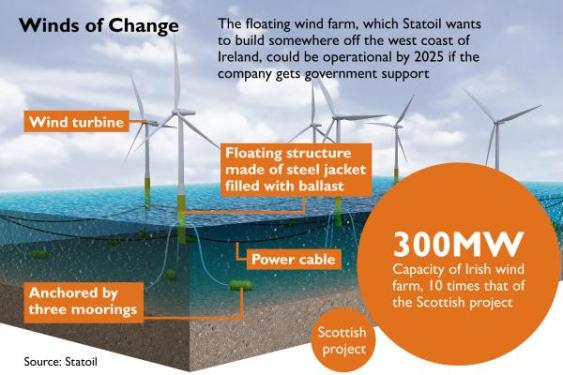
Note to Statoil via clickback 😉 ; https://www.equinor.com/en(click this link to let Statoil know about the proposal from the Irish Government for funding applications)
That world leaders are recognising climate change and have responded with a move towards renewable energy sources should be viewed as positive.
A reduction in carbon emissions, to meet the Paris agreement’s goals, by relying on the nuclear industry, is an abysmal trade-off, considering its disastrous environmental record.
Radioactive waste is a byproduct of the nuclear industry. As you correctly indicate, (Wade Allison, Irish Examiner, June 25) nuclear processes are part of nature, but these natural processes resist being hurried.
Waste takes years to decay. Plutonium has a half-life of about 24,000 years. Where does this not-so-natural waste go?
Low-level waste from hospitals is incinerated before land burial. Waste from reactor decommissioning is deposited in geological repositories.
Waste from nuclear reactors is highly radioactive, often hot, and must be stored in a controlled environment.
At the Sellafield site in the UK, where the stockpiling of nuclear waste has been plagued with leaks, spent nuclear fuel is imported and reprocessed (recycled).
Waste arising from this is highly radioactive, must be encased in glass, and be regularly monitored.
Even with best practice management, monitoring this waste will continue for indefinite years and costs will rise as the stockpiles grow.
A common practice in the nuclear industry is the dumping of low-level nuclear waste into the sea. It is claimed by Greenpeace that the spent-fuel reprocessing plant at La Hague, in northern France, dumps “1m litres of liquid radioactive waste per day” into the ocean. The long-term impact of such dumping remains to be seen.
While population displacement to facilitate hydroelectric schemes is unfortunate, relocation because of radioactive fallout is a tragedy.
The Chernobyl nuclear accident in 1986 scattered 400 times more radioactive material into the Earth’s atmosphere than did the atomic bomb dropped on Hiroshima in 1945. The Chernobyl exclusion zone, measuring 2,600sq km (1,004sq miles), is one of the most contaminated areas in the world.
It is larger than Co Wexford, where, in the late 1970s, the Irish government abandoned plans to develop a nuclear plant at Carnsore Point, following opposition and the Three Mile Island nuclear accident in the US, in 1979. The latter’s clean-up operation lasted 12 years and cost $1bn. By 2014, the price for decommissioning at Sellafield had reached £70bn.
However, a nuclear waste clean-up is a contradiction in terms. Contaminated material is simply moved to someone else’s backyard.
The Fukushima nuclear power plant accident in Japan, in 2011, is an ongoing disaster. In February, 2017, six years post-nuclear meltdown, it was reported that radiation levels at the plant were at “unimaginable levels”, following the discovery of new fuel leaks.
Professor Allison asserts that “Nuclear is for life”. Yes, it is. As he is so keen to embrace it, would he be happy take home a share of the industry’s waste?
Allison’s argument that we “must move beyond radiation phobia and accept more relaxed, evidence-based nuclear regulations” is a tall order, considering industry revelations, like the falsification of quality assurance data at Sellafield’s Mox Demonstration facility in 1999.
Undeniably, energy security comes at a cost. For nuclear energy, this is a very long-term mortgage, as both fuel and waste stockpiles create their own health-and-security risks.
There is no denying the contribution that radiation has made to medicine, but physicist Marie Curie, who did pioneering work on radioactivity, died from prolonged exposure to it.
Nuclear energy may look clean, but it is not. The spectre of artificial radioactivity from the nuclear industry looms large in our atmosphere.
Ireland has no room for stockpiles of nuclear waste, nor for the mishaps that have plagued the nuclear industry. Why jeopardise a lucrative tourism industry (€5bn a year) or our food-and-drinks industry (€12bn a year) by poisoning our landscape?
It’s not surprising that countries are refusing to invest in new nuclear plants, apart from those kowtowing to lobbyists with vested interests. Contrary to Wade Allison’s report, nuclear power seems unlikely to be popular tomorrow, given the legacy of waste it bestows on future generations.
The Economist: Oxford Professor Says OK to Raise Annual Dose Limit by 1000 Times for the Japanese, But the Reporter Reluctant to Inhale
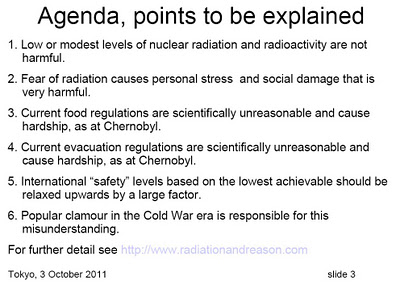
Dr. Wade Allison is professor emeritus of physics (particle physics) at Oxford University. The event that the Economist’s reporter refers to in the article must be the talk given at American Chamber of Commerce in Japan (ACCJ) on October 3, where the professor, along with another researcher, presented the strong case that the radiation exposure below 100 millisieverts per year was not a problem, if one only gets rid of the unreasonable fear of radiation. He also says the current food regulation, evacuation regulation are “unreasonable” and should be relaxed significantly.
Here’s the screen capture of a page from his presentation slides he used in the ACCJ talk:
Arevamirpal wrote: “Why did the American Chamber of Commerce in Japan invite Professor Allison? What was the purpose? Does anyone know?”
That’s the good question!
I did look in this Allison’s biography.
He’s not a genetician, didn’t work on DNA, he is not a physician either, nor a statistician… His research field is neutrinos (what are these particules?, where are they coming from the sun?, how fast they are, etc.) It’s very theorical physic. Nothing to do with radiations and their effect on human health.
So, this so-called “expert” in nothing of an expert when it’s come to radiations and human health.
So why did he take an interest for this topic?
If you have a look on this page, where he presents his firsts results on neutrinos, you can see who are his sponsors (because you can’t work on neutrinos with only a computer, a microscope and a few tests tubes; it’s costs a lot of big money):
Atomic Energy of Canada Limited, Ontario Power Generation, Agra-Monenco/Canatom Limited, CVD Manufacturing Inc.
All these companies are in nuclear power.
So, you take the money, and you have to be grateful. You come in Japan (interesting that it’s the chamber of commerce who organized the conference) and you say what your sponsors want you to say. (may be they did the slides).
As you are a scientist, in physics, and from Oxford on top of that, your titles will impress M. Everyman, and the lie has a chance to be swallowed.
But if Mr Allison is an expert in neutrinos, he is nothing but a fraud when discussing human health and radiations.
The question is: has this man something like a conscience, or neutrinos and money did eat all was left of it?
POINT LEPREAU, N.B. — New Brunswick’s energy minister says he’d like to see another nuclear reactor built in the Maritime province.
Canada and New Brunswick have an opportunity to become world leaders in the SMR technology and into bringing a clean, new and reliable source of ultra-low carbon power to the forefront of global climate change,” Doucet said Monday.
“The long-term vision is to build a commercial demonstration SMR plant at the Point Lepreau nuclear generating station,” Doucet said. “Construction of an SMR would be a major undertaking, which would see thousands of workers hired for construction.”
The company wants to build small, 100-megawatt reactors that it describes as inherently safe. A prototype operated for 30 years in the United States but the technology was never developed.
“We intend to demonstrate that the inherent safety features of our reactor enable a simple and cost effective design which will be competitive with all other forms of electricity generation,” said Don Wolf, chairman of Advanced Reactor Concepts.
Their ARC-100 reactor uses a technology that Wolf says doesn’t require the costly safety measures required by other nuclear reactors.
“The fuel is not an oxide of uranium, it’s a metal. The combination of the sodium as a coolant (rather than water) the metal fuel and the proprietary core design of the ARC reactor gives it inherent safety,” Wolf said.
Gaetan Thomas, president of Crown utility NB Power, said such reactors can be cost efficient.
“When you put all those factors together, it’s an ideal solution for the future,” Thomas said.
The New Brunswick government recently announced it will spend $10 million to create a nuclear research cluster.
New Brunswick’s 660-megawatt Candu-6 reactor at Point Lepreau is the only nuclear power plant in Atlantic Canada.
It underwent a $2.4 billion refurbishment between 2008 and 2012. The refurbishment was plagued by repeated delays and cost overruns.
Wolf said his company could start building ARC-100 reactors as early as 2030, and he said New Brunswick would be an ideal place to do it.
“I think you have an ideal situation here with respect to the trained workforce, the enthusiasm about nuclear power, and all the ingredients to have this be a world export hub,” he said. “There’s no reason why it shouldn’t be built here.”
Robert Blakely, a director with Canada’s Building Trades Unions, called Monday’s announcement significant.
He said while it doesn’t mean shovels in the ground in the near future, it provides hope for the years to come.
“This provides an opportunity to get young New Brunswickers into great trades, high-skilled, high-paying, rewarding careers,” Blakely said.
New proposals on the detail of a new UK nuclear safeguards regime to replace the current regime provided by Euratom, have been set out in a consultation.
government sets out the details of new nuclear safeguards regime
nuclear safeguards legislation receives Royal Assent – UK on track to be able to meet international commitments once Euratom arrangements cease to apply in the UK
progress provides certainty to the civil nuclear industry and international partners as the UK prepares for Euratom exit
New proposals on the detail of a new UK nuclear safeguards regime to replace the current regime provided by Euratom, have been set out in a consultation launched today (Monday 9 July 2018).
The consultation sets out nuclear safeguards regulations that would be made using the powers granted by the Nuclear Safeguards Act, which last month became one of the first pieces of EU Exit legislation to complete its passage through Parliament and receive Royal Assent.
Business and Industry Minister, Richard Harrington said:
The Nuclear Safeguards Act is one of the first pieces of legislation to go through Parliament in preparation for EU Exit and is yet another major milestone in our work to prepare the civil nuclear industry for Euratom exit, ensuring continuity from day 1.
We are setting out proposals for the detail of our own UK framework for safeguards, demonstrating our readiness for EU Exit.
The Nuclear Safeguards Act addresses the United Kingdom’s departure from the European Atomic Energy Community (Euratom), an international organisation that governs the peaceful use of nuclear energy within the EU. The passing of the Act and today’s consultation on a new safeguards regime provide a clear signal to the public, industry and international partners that the UK is on track to meet its international commitments from day one of exit.
Nuclear safeguards are important processes through which the UK demonstrates to the international community that civil nuclear material is not diverted into military or weapons programs.
Today’s announcement comes just weeks after the UK’s commitment to international safeguards and nuclear non-proliferation was reaffirmed in Vienna, with the signing of 2 new safeguards agreements with the International Atomic Energy Agency (IAEA).
These key agreements with the IAEA – of which the UK is a founding member – are another major milestone in Euratom exit preparations and provide the basis for civil nuclear trading arrangements. This step will be welcomed by the industry in the UK and trading partners around the world.
Further progress towards Euratom Exit has been set out in a Quarterly update to Parliament published on 28 June, which outlines several key achievements, including the Office for Nuclear Regulation’s good progress on preparations for implementing the UK’s safeguards regime and the confirmation that all Euratom specific text in the Withdrawal Agreement has now been agreed.
The UK signed a new Nuclear Cooperation Agreement (NCA) with the United States of America in May, which will allow the UK and US to continue their mutually beneficial civil nuclear cooperation when the current Euratomarrangements cease to apply to the UK.
This US-UK NCA is expected to be the first in a series of new international agreements ensuring uninterrupted cooperation and trade following the UK’s exit from Euratom.
Details on how to respond to the consultation and to register interest for the workshops, can be found on the consultation web page.


 Climate Action Fund Call for Applications








 nuclear-news