Remember: The modern hydrogen-bomb technology of Russia, China and the United States makes such weapons as those possessed by India and Pakistan seem antique.
An exchange between these big players would likely produce far worse effects.
The scientists are confident in the accuracy of their assessment.
IT’S a horrifying scene burned into our collective conscious: A flash of light, a blast of hot air — and a ballooning mushroom cloud. But there’s much more to a nuclear war, as a new study reveals.
Filmmakers and novelists have been tackling the subject for decades. Some have been somewhat sanitised in their approach (Jericho, 2006). Others have been brutally confronting (Threads, 1984, and The Road, 2009).
All have simply speculated about the fate of life on Earth after an apocalyptic nuclear exchange.
Specifically, they ran computer models on a fight between Pakistan and India through advanced climate predicting software developed to study pollution-based climate change.
The outcome?
It’s bad.
Even for this “limited, regional nuclear war”, it means a one-to-two degree plunge in global temperatures and a nine-per cent cut in worldwide rainfall.
In practical terms, that equates to worldwide crop failures and famine.
A separate study last year matched similar conditions to a projected death toll: We’re talking 2 billion lives lost.
And that’s the result of a little nuclear spat.
Not a big one between the likes of China and Russia.
The researchers based their calculations upon the detonation of 100 nuclear warheads. These were set at roughly the size of the atomic bomb dropped on Hiroshima.
Lockheed’s new Chinese nuclear division is lodged between a Subway restaurant and a construction contractor. The office has been designated part of the People’s Republic of China — as a sign in the spartan lobby reads.
FORT WORTH — In a nondescript strip mall across town from the heavy security of its fighter jet operations, defense contractor Lockheed Martin opens its doors each day to a rotating crew of Chinese engineers.
While the U.S. and Chinese governments spar over the theft of classified military data, Lockheed has entered into a deal with China’s State Nuclear Power Technology Corp. to help build that country’s next generation of nuclear plants.
The only hitch is that the Chinese want their own engineers working on the project. As a military contractor, Lockheed has to be sensitive about employing foreign nationals anywhere where classified military technology is being developed. So it found alternative digs near Dallas/Fort Worth International Airport.
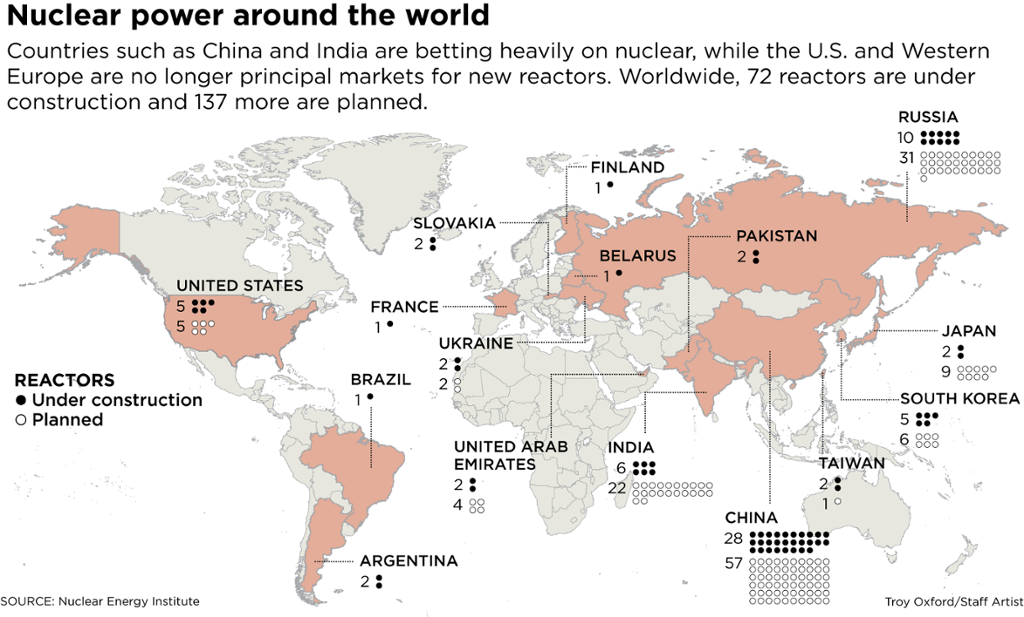
Nowhere is the outlook for nuclear powerbrighter than in China, where the government is on a campaign to clean up the country’s air. Most of China’s electricity is generated by burning coal, which casts a lung-wrenching haze over its major cities. One of China’s goals is to add to its existing fleet of around 15 nuclear power plants. Analysts believe China will build between 60 and 100 more nuclear plants over the next four decades.
Right now Lockheed has a contract to engineer its reactor control system for China through 2017. But Michael Syring, director of nuclear systems for Lockheed, says the company believes the project will lead to a longer-term relationship helping China develop its nuclear sector.
Lockheed and other U.S. nuclear technology companies are looking for new markets in the wake of 2011’s Fukushima meltdown in Japan. The United States and most Western European countries are backing away from nuclear power. That means Lockheed and other companies worldwide that build nuclear plantsare scrambling to court power companies in Asia and Eastern Europe.
Kaiseiazan-park in Koriyama is the most popular park in the city.
Masa in Koriyama visited the park with a radiation counter and made a short film about the visit.
Three and a half years have passed since the nuclear disaster and the park has been decontaminated and a monitor at the park now shows less than 0.3 μSv.
However, Masa’s own counter showed higher values in various spots in the park, and seriously high values were found in the sludge accumulated on the ground. These “micro hotspots” are everywhere in the park.
“…I do not like the idea of taking a walk in a place where I can measure more than 1μSv/h. This is a dose rate where I literally should be running away from.
So on May 11th I was irradiated. These days, every time I go out to the countryside I get irradiated. I am starting to have the feeling that I cannot live near Tokyo any more….”
On May 11th in the afternoon, I went for a walk for some exercise. This time I just took my Air Counter with me and left my heavy survey meter at home.
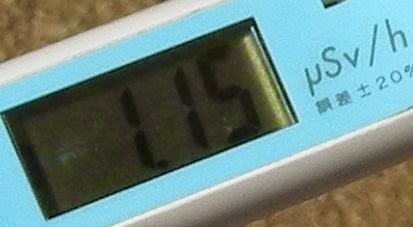
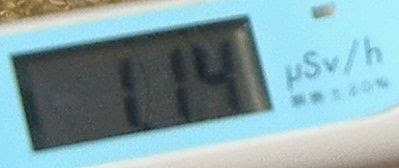
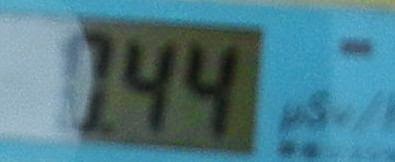
At around 2.30 pm, my reading went up to 1.15μSv/h in the middle of a vegetable field. It is more or less the same as the 1.1μSv/h measured at the Okumamachi Fureai Park (only 4 km away from The Fukushima Daiichi plant) on the same day! Now this was a shock.
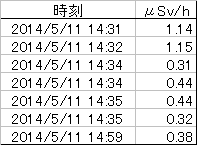
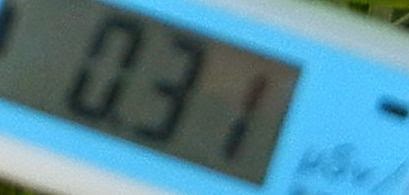
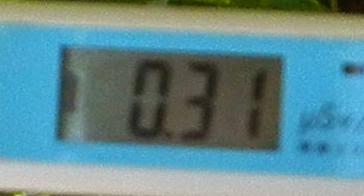
The following is the record on the dosimeter. I had started to measure the air dose rate from about 1 pm and at 2 pm had measured around 0.3μSv/h.
(時刻 time)
1.15μSv/h is the highest reading that I had had during the 1 1/2 years of use of this dosimeter.
As you can see it was just for a short while that I measured such a high dose rate. As I moved about I still had high readings. I presume that there was an air current that carried radioactive substances near the ground. 1.15μSv/h is the equivalent of 300.000 Bq/m2 of cesium in the soil.
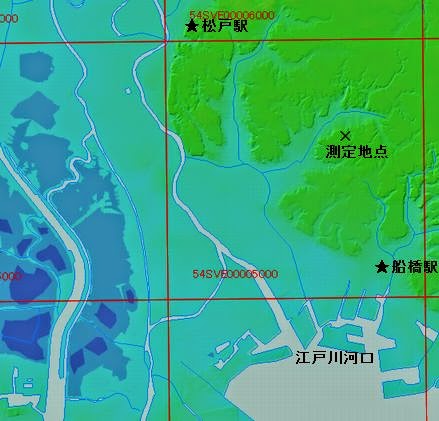
According to the following map the spot was at altitude 25.5m, in an area with mostly vegetable patches where urbanization is restricted.
松戸駅 Matsudo station
測定地点 location of measurement
船橋駅 Funabashi station
江戸川河口 mouth of Edogawa river
They were burning something in a home-use incineration unit nearby but the wind wasn’t coming from there. The wind was coming from the south and wasn’t strong.
The following spot was quite far away from the previous one. The altitude is about 14m lower. The readings are not much different.
Where do the radioactive substances come from? It could be radon but would it rise so much on a plateau? There are incineration plants and waste recycling centres of Funabashi city in Sanbanse near the mouth of the Edogawa River. They are 8 km south of where I measured. If the chimneys of these plants are high then I guess the emission could travel quite far. It wouldn’t be unnatural to think that the emissions would have an impact on the surrounding environment in a radius of 8-10 km. I shudder to think that there are plants that release radioactive gas of 1μSv/h everywhere though.
I do not like the idea of taking a walk in a place where I can measure more than 1μSv/h. This is a dose rate where I literally should be running away from.
So on May 11th I was irradiated. These days, every time I go out to the countryside I get irradiated. I am starting to have the feeling that I cannot live near Tokyo any more.
Under the new policy, however, the government will determine decontamination needs by using radiation exposure data collected from individual dosimeters, which tend to be lower than the estimated dose, thus reducing the areas subject to government-mandated decontamination.
[…]
“Many residents of Fukushima have deliberately stayed indoors since the nuclear disaster. If they start to go out like they used to before the quake, the individual radiation doses might go up and will not necessarily fall below the 1 millisievert threshold,” Ishii said. “As such, we should aim for continued use of aerial figures for decontamination.”
Confusion is spreading among towns and cities tasked with radiation cleanup in the face of a new decontamination policy to be released by the Environment Ministry as early as this month.
The government has been decontaminating areas whose aerial radiation reading is 0.23 microsievert per hour or more, based on its policy of keeping annual radiation exposure for individuals at 1 millisievert or less. It arrived at the estimated dose of 0.23 microsievert per hour by assuming that an individual spends eight hours outdoors and 16 hours indoors.
Under the new policy, however, the government will determine decontamination needs by using radiation exposure data collected from individual dosimeters, which tend to be lower than the estimated dose, thus reducing the areas subject to government-mandated decontamination.
While some municipalities welcome the move, saying it will allow them to scale down decontamination efforts in areas where radiation levels are unlikely to go down significantly, others are worried that residents will be confused.
The Environment Ministry unveiled its plan to use the individual dosimeter data last month at its meetings with officials from the cities of Fukushima, Koriyama, Soma and Date. According to Date officials, the city measured the radiation exposure of its 52,000 citizens wearing dosimeters from July 2012 through June 2013. The results showed that per-year exposure levels for nearly 70 percent of residents, even in areas where aerial radiation levels exceeded 0.23 microsievert per hour, was less than 1 millisievert in total.
“We should break the spell of aerial radiation soon,” said a Date official, pinning hopes on the ministry plan.
An official of the city of Tamura, on the other hand, expressed shock, saying the city has been cleaning up contaminated areas based on aerial readings, and if the cleanup projects are scaled back as a result of a policy change, it would cause anxiety among residents. Tamura, therefore, will not change its decontamination plan, the official said.
Experts are similarly divided. Junichiro Tada, a member of the board of directors at nonprofit organization Radiation Safety Forum, said he agrees with the ministry. “We should change the way radiation doses are managed from an aerial radiation basis to an individual exposure basis,” he said. “That way, we will do away with ineffective decontamination work.”
But Keizo Ishii, director of the Research Center for Remediation Engineering of Living Environments Contaminated with Radioisotopes at Tohoku University, remains cautious.
“Many residents of Fukushima have deliberately stayed indoors since the nuclear disaster. If they start to go out like they used to before the quake, the individual radiation doses might go up and will not necessarily fall below the 1 millisievert threshold,” Ishii said. “As such, we should aim for continued use of aerial figures for decontamination.”
Sanae Sato, a 54-year-old homemaker from the city of Fukushima, said she wants standards that are easy to understand. “I hope the national, prefectural, municipal governments, as well as experts, will come to a consensus and create the same standards,” she said.
This section, appearing every third Monday, focuses on topics and issues covered by the Fukushima Minpo, the largest newspaper in Fukushima Prefecture. The original article was published on June 22.
WIPP ACCIDENT – Don Hancock, Director of Southwest Research and Information Center in Albuquerque, NM, brings us up to date again about the February 14 underground explosion and radiation leak at the Waste Isolation Pilot Plant (WIPP) site in Carlsbad, NM.LINK TO WIPP TOWN HALL MEETING LIVESTREAM: http://new.livestream.com/rrv/Thursday, July 24 from 5:30 to 6:30 Mountain Time
First and third Thursdays of the month. WIPP TOWN HALL MEETING ARCHIVES: http://www.wipp.energy.gov/wipprecovery/photo_video.html
VOICES FROM JAPAN – Filmmaker Yumiko Hayakawa on TEPCO’s subtle censorship of her film about Fukushima refugee and anti-nuclear activist Setsuko Kida, “A Woman from Fukushima.” The film was recently a selection at the Uranium Film Festival in Rio De Janiero.
SOARCA – State of the Art Reactor Consequence Analyses – the NRC’s flawed computer program for calculating the risks of nuclear accidents, explained by Scott Portzline of Three Mile Island Alert. LINK: http://www.efmr.org/files/2012/SOARCA-2-22-2012.pdf
NUMNUTZ OF THE WEEK:
Party, anyone? The pro-nuclear International Atomic Energy Agency (IAEA) plighted the troth of the Food and Agriculture Organization of the United Nations 50 years ago and they want everyone to know! They work together on issues of food safety, animal production and insect pest control. If you can’t see what’s wrong with this picture, check out Fukushima’s radioactive rice, the Pacific’s marine animals in species collapse, and, oh well, what’s wrong with nuking mosquitos? And we wonder why the world’s in such a mess…
Host Kate Zickel talks with Aileen Mioko Smith about the current state of affairs in Japan regarding the Fukushima clean up.
Two years after the Fukushima nuclear power plant meltdown, the disaster is still causing problems, and the Japanese government is looking at new ways to address the issue. Fukushima may be eclipsing Chernobyl as the greatest nuclear disaster in history. Public sentiment appears to be against the continuing reliance on nuclear power in Japan, but the government has been slow to move in that direction.
We found that most organisms show significantly increase rates of genetic damage where it’s radioactive, no surprise there. Most, many of the organisms show increased rates of deformities and other kinds of developmental abnormalities again in proportion to the contamination levels, reduced fertilities, shortened lifespans.
[…]
Starting first with Three Mile Island in 1979. Most of us in the room are familiar with that one. And Chernobyl, 1986, 28 years ago and of course Fukushima 2011. So that’s three out of 600. It’s kind of a, I don’t know, any statisticians in the room? What, what’s the probability there? I don’t know if any of you would get on an airplane if there was a 1 in 200 chance of it crashing.
[…]
So, nobody really cared too much when the tritium was contained within the borders of the power plant. But when it, once it starts getting offsite, the potential for it to get into the ground water and to effect drinking water is significant. And there’s also the fact that we know very little about what the potential ecological and environmental health consequences of tritium leaks might be.
[…]
Of course we have no idea what the impacts will be on the marine side. Again very little research is being done there other than to catch a few fish now and then and see how radioactive they are. And a little bit of modeling going on to see where these contaminants might end up. But not a whole lot of investment really.
[…]
Maybe you’ve seen, you know, the video, Radioactive Wolves and, you know, Disney Channel has these kind of Cinderella stories for Chernobyl on a regular basis. And we, but there, when we went to look for it there wasn’t any quantitative scientific data published.
[…]
We’re not so interested in dose because of the way we do our studies but we are interested in knowing if it’s a high, medium or low dose. And so we’ve actually made a lot of progress in this area.
[…]
And the basic answer is that overwhelmingly from, you know, the 50 plus studies that happened on genetic damage is associated with radiation exposure in Chernobyl. It’s, you know, the question is answered. All right, so now that we know that there’s increase mutation rates
[…]
And then
last year they actually were fairly methodical and found 15 cases of these partial albinos in about 70 or 80 barn swallows. So about the same frequency as we see in Chernobyl in the radioactive areas. Fairly strong evidence that, that this is good biomarker for radiation exposure.
[…]
But nobody, it had been lost to the world until my colleague Anders discovered it and started applying it to our birds. And sure enough it allows us to get tiny, tiny minute amounts of the material. And we can actually look at the morphology of the sperm. We can look at the behavior of the sperm. And there are large effects on both
[…]
And when we did this we realized again in these Chernobyl areas, dramatically higher levels of tumors. Many of them on the head and around the eyes but also on the chin, here’s another example here. Some strange developmental abnormalities as well again often where the birds are being exposed I suspect. But just strange kinds of growths that are almost never seen in normal populations.
[…]
And found again very striking significant relationship between the frequency of cataracts, the degree of cataract and background radiation but only for females, not in males in this case.
[…]
It turns out neurological tissue is well known to be quite sensitive to the effects of radiation, more sensitive than most other tissues. It had been observed in children in Belarus as well but of course nobody wanted to ascribe radiation as the source of that. But, just
to skip over the statistics. The other thing we learned though is that for a bird, 5 percent decrease in brain size is important.
[..]
turns out that in the hotter parts of Chernobyl abundance is depressed by 2/3. There’s on 1/3 as many birds as there should be living in these hot areas. So if you went there you’d still see a few birds. And you might go oh, looks kind of normal. But when you go and count them and you relate this to the radiation and everything else that’s important, very, very strong signal, only 1/3 as many birds, about 1/2 as many species of birds in the area. So big effects on the abundance of biodiversity of birds. But it’s not just birds. Spiders, again very few in the hot areas. Grasshoppers, fewer in the hot
areas. Dragonflies, fewer in the hot areas. Bumblebees are quite sensitive it turns out and missing from the hot areas. Butterflies missing from the hot areas.
[…]
Look at the size of this thing. It’s huge. There are wolves inside the zone. But when you look at the entire assemblage of mammals using this technique, many fewer mammals especially the smaller mammals in the hot areas.
[….]
And when we compare the relationship between decline in abundance versus radiation the effect is about twice as strong in Fukushima as we currently see in Chernobyl. And this lead somebody, some journalist who suggests, I didn’t say this but the journalist came up with this all on his own. Good journalist. He’s provided a lot of inspiration. Suggested that maybe this difference was because of adaptation going on in Chernobyl where there’s been, you know, more than 20 generations.
[….]
We found that most organisms show significantly increase rates of genetic damage where it’s radioactive, no surprise there. Most, many of the organisms show increased rates of deformities and other kinds of developmental abnormalities again in proportion to the contamination levels, reduced fertilities, shortened lifespans. I didn’t talk about that but we have data on this. Reduced population sizes and reduced biodiversity in many of these hot areas. Some other more interesting speculative suggestions are that there may be in some groups, there’s some evidence of sort of amplification, magnification of genetic damage because of chronic multigenerational exposure to the radiation.
[…]
We have very little information, almost no information concerning developmental genetic effects in Fukushima. That’s just starting. We have some of the ecological observations, the population sizes but the genetic stuff is just coming in. So we don’t know what’s going on at that level very well. But all of our data is consistent with, it may not be a linear response but there’s certainly no evidence of a threshold response. There’s no evidence that the effect disappears below a certain level. It disappears but it disappears into the noise as it becomes harder and harder to detect any kind of signal given the noise that exists at these lower levels. So sample sizes would need to be larger if we were to really just, you know, attempt to figure out whether that was a some kind of gradual linear response or a threshold response.
But there’s no evidence of a threshold. Certainly we see strong statistically significant signals at the levels of, you know, half a microsievert per hour which was set 4, 5 millisieverts per year. So that’s not really, that’s a pretty low level and we still see detectable effects on most of these things.
[…]
And we have an interest in fire issues in this zone, especially with climate change. Because litter has, is where most of the radioactive contaminants are located. And we noticed that the litter area was getting thicker, was quite thick in some of these areas. So we did the experiment. Basically we went and put out our fresh clean dead plant material in little bags, you can see these little bags filled with plant material that we scattered throughout the zone, left for almost a year and then retrieved them after a year of decomposition. And low and behold decomposition rates presumably reflecting the microbial community primarily, also some invertebrates, but mostly the microbial community were dramatically effected and much lower in the hottest parts. Again we weren’t the first to notice this but we were first to do the experiment to demonstrate experimentally in this case, not just a correlation, this was an experimental
manipulation that the microbial community was affected
[…]
Published on 17 Jul 2014
Timothy Mousseau discusses the impact of radioactive fallout from the Chernobyl disaster on natural populations and the impact of high radiation levels on the Fukushima, Japan, area. One aim of his research is to determine whether or not organisms can adapt to radioactive environments.
Speaker Biography: Timothy Mousseau is a professor of Biological Sciences at the University of South Carolina. He recently served on the National Academy of Sciences committee to examine the incidence of cancer near nuclear power plants.
TITLE: Biological Consequences of Nuclear Disasters: From Chernobyl to Fukushima
SPEAKER: Timothy Mousseau EVENT DATE: 2014/05/15 FORMAT: Video + Captions RUNNING TIME: 63 minutes TRANSCRIPT:View Transcript (link will open in a new window)
DESCRIPTION:
Timothy Mousseau discusses the impact of radioactive fallout from the Chernobyl disaster on natural populations and the impact of high radiation levels on the Fukushima, Japan, area. One aim of his research is to determine whether or not organisms can adapt to radioactive environments.
Speaker Biography: Timothy Mousseau is a professor of Biological Sciences at the University of South Carolina. He recently served on the National Academy of Sciences committee to examine the incidence of cancer near nuclear power plants.
Full transcript also here ;
>> From the Library of Congress in Washington, DC.
^M00:00:05
[ Silence ]
^M00:00:24
>> Today's event is organized by Science Technology and Business Division of this Library of Congress.
I'm Tomoko Steen, research specialist here at the Library of Congress.  Today's speaker, Tim Mousseau,
maybe I say Professor Tim Mousseau, currently professor at the Department of Biological Sciences,
University of South Carolina.  He has Ph.D. from McGill University in Canada.  And he had served as the Dean
of the Graduate School, Associate Vice President for Research and the Graduate Education at the University of
South Carolina.  And he also was in the Washington area. He was a Program Officer at NSF, National Science
Foundation.  He serves for the many editorial boards for both domestic and international scientific journals.
 And he was also on the advisory panel for NSF, USGS and the many other variety of agencies.
And also international grant foundations. He has over 160 publications, probably a lot more now but also 2 published edited books published from the Oxford University Press. And he’s also co-editor of the annual review series, The Year in Evolutionary Biology. I have one copy on Chernobyl in the back there and picture was taken by Professor Mousseau. And that was published from New York Academy of Sciences. Since 1999,
Professor Mousseau has been collaborating with colleagues from CNRS and the University of Paris working on these cases of Chernobyl, especially focusing on the biological effects of radiation, various species, birds, insects and people. And now his focus is Fukushima and comparing his data with Chernobyl to Fukushima. So before further adieu and the all interesting stories waiting for you. And please join me welcoming Professor Mousseau.
During the shutdown we asked the NRC if they would ever see the reopening of the plant, and they said they have never done it,” Tadisch said. “But the plant is in good shape, and they saw no problem with seeing it run for those 20 years or longer.”
CARLTON — Community action is the next step in RGA Labs’ pursuit of the Kewaunee Nuclear Plant.
Alyssa Bloechl, Kewaunee County Star-News 5:21 a.m. CDT July 18, 2014
The Chicago-based engineering and technology firm presented its case for taking on ownership of the plant, which is just over a year into the decommissioning process.
Robert G. Abboud, president of RGA, said his company approached current owner Dominion Resources Inc. of Richmond, Va., in November 2012 about buying the plant. Abboud and company vice president Ron Chin presented their case Thursday night to 110 community members and elected officials at the Carlton Town Hall.
Dominion has shown no interest in selling the facility. Abboud urged community members to contact legislators and share their views of what they want to see happen with the plant.
“The real power is in the community and the elected officials,” Abboud said. “If it is going to happen, it will because the community demands Dominion relook at this issue, and I think Dominion owes it to them.”
Town of Carlton Supervisor Steve Tadisch said the town is looking into alternatives to shutting the plant down, including the best case scenario of facilitating a sale and generating power again.
The power loss at the Fukushima Daiichi nuclear plant’s No. 1 reactor in March 2011 was triggered by tsunami, Japan’s nuclear regulator said Friday, denying the possibility raised by the Diet’s investigation commission that it could have been caused by the powerful earthquake.
The Nuclear Regulation Authority’s interim report on the 2011 nuclear disaster said the power loss — which led to the failure to cool the reactor and resulted in a meltdown — and damage to equipment occurred as tsunami waves flooded the plant, citing results of its on-site probe.
Panels of the Diet, the government, plant operator Tokyo Electric Power Co. and the private sector have separately released investigation reports so far, but they differ regarding some issues…. Rest of article behind firewall http://english.kyodonews.jp/news/2014/07/302889.html
More proof that nukes don’t stop global warming, but global warming stops nukes.
Two Turkey Point reactors owned by Florida Power & Light are cooled by water from 168 miles of canals. Due to global warming, and exacerbated by discharge from the reactors, the canals are now overheated, and one degree from the maximum temperature allowed by the NRC. Arnie Gundersen was interviewed by Miami News Radio, which has a news brief.
The reactor could shut down or reduce power, but demand for air conditioning is high. Rather than shutting down, FPL wants to draw 30 million gallons of water a day from an underground aquifer.
In 2011, Arnie talked about another challenge facing Turkey Point due to global warning: sea level rise. Some of Miami is expected be under water before Turkey Point’s licenses expire. “”If tidal waves knock out the water pumps” — as they did at the Fukushima reactor in Japan earlier this year — “you can have a meltdown.”
The project not only involved Pokemon, but also Tsutaya and Yahoo! Japan. Thanks to this collaborative project, an indoor park has been constructed for the kids who have suffered various traumas during the disaster to forget their worries and play. A large Pokemon-themed sandbox can be seen inside the facility for these kids to play in. Pikachu was even present for the facility’s opening.
In 2011, the entire world witnessed the tragedy which befell Japan as a series of powerful earthquakes and tsunamis rock the country between March and April.
Three years after the tragedy, Nintendo’s popular Pokemon franchise has built the “Playground for All” in one of the worst-hit areas of the disaster, Fukushima, which not only suffered yet another strong earthquake in April 2011, but also experienced one of the worst nuclear disasters in history which has been dubbed the Fukushima Daiichi nuclear incident.
The project not only involved Pokemon, but also Tsutaya and Yahoo! Japan. Thanks to this collaborative project, an indoor park has been constructed for the kids who have suffered various traumas during the disaster to forget their worries and play. A large Pokemon-themed sandbox can be seen inside the facility for these kids to play in. Pikachu was even present for the facility’s opening.
Tsutaya meanwhile has released a special Pokemon T Card which will help give funds to the area and Yahoo! Japan is currently doing an internet fundraising drive to gather funds for the Playground for All Project. The Pokemon With You project, which has helped much in the reconstruction of Iwaki City, Fukushima has visited a temporary housing project for the victims and entertained the kids who have experienced the disaster first hand.
The Playground for All Project aims to not only the children who will be the future of Fukushima prefecture, but also the community which has suffered so much this past few years thanks to the series of disasters they have experienced.
Exelon has filed a proposal to New York’s Public Service Commission for a power purchase agreement with a New York utility to keep its R.E. Ginna nuclear plant, which provides up to 581 MW of electricity to New York, running for four more years.
The plant’s last agreement, with Rochester Gas & Electric Corp, ran out at the end of June of this year.The ten-year contract was not renewed.
Since 2011, the plant has lost more than $100 million, mainly to operating costs and poor performance in the state’s wholesale power markets. Currently the plant is entirely dependent on wholesale market performance.
Dive Insight:
R.E. Ginna does not suffer from the same issues some other plants do: It has license to keep running until 2029, which means it has yet to age out of operation. Further, the New York Independent System Operator has calculated that the plant needs to stay open and running for at least three years, until October 2018. Planned construction of new transmission lines and a new substation in the Rochester area of the state should be completed by then, which will guarantee a reliable supply of electricity to the region.
If the plant closes, the state could have another problem. New York belongs to the Northeast Greenhouse Gas Market, which follows a cap-and-trade protocol allowing states to pay to buy and sell each others’ carbon emissions in order to bring them down overall. If the plant closes, then prices of carbon emissions from New York will rise as more carbon, produced from natural gas generation that would need to replace the plant’s output, will be emitted. That could have a knock-on effect for rate payers.
In Illinois, three of Exelon’s six nuclear plants are in danger of closing for much the same reasons as R.E. Ginna: A lack of money to keep operating. However, last week Exelon said it had “no plans” to close the plants any time soon, seeing the Environmental Protection Agency’s plans to reduce carbon emissions as a possible advantage.
The Oxford Analytica Daily Brief ® – Friday, July 18 2014
Nuclear weapons are complex devices with enormous explosive force. The means by which nuclear weapons can be delivered — aircraft and long-range missiles — are also highly complex feats of engineering and require sophisticated maintenance to keep in working order. Invented 70 years ago, nuclear weapons are now in the possession of at least nine countries (United States, Russia, United Kingdom, France, China, Israel, India, Pakistan and North Korea). During the height of the Cold War, the United States and Soviet Union possessed over 70,000 nuclear weapons; many of them now pose significant accident risks.
The Sendai plant is surrounded by at least five active volcanos. Commissioner Kunihiko Shimazaki, a seismologist, said it’s impossible to accurately predict eruptions, although the current assessment suggests a catastrophic eruption is extremely unlikely.










 nuclear-news