IN international relations there are no permanent friends or foes. To further the national aims and objectives countries keep changing their alliances to best suit their national interests. The history of Pak-US relations is no different. Since its infancy Pakistan opted for the US bloc preferring it over the then second superpower Soviet Union. In the hindsight it will not be unrealistic to conclude that Pakistan has paid a heavy price for this strategic decision. Being member of SEATO and CENTO Pakistan extended full support to the US against the USSR by providing its airbases to US Air Force; U-2 flight from Badaber in 1960 is a case in point.
However, when India was in the process of helping Mukti Bahini to create Bangladesh and Pakistan Army got stranded in Dhaka, the promised 7th Fleet never came to its rescue. Again in early 70s, Pakistan played a pivotal role in bringing China and the US together and in late 70s Pakistan became a frontline state to counter the Russian invasion of Afghanistan, which ultimately led to the disintegration of Soviet Empire. While Pakistan had to pay a heavy price in terms of accommodating over 4 million Afghan refugees who brought along Kalashnikov and drugs culture, sectarianism and other social evils besides handling of Mujahideen created and funded by the US.
Surprisingly, the US reward came in the form of Pressler Amendment and resultant sanctions against Pakistan. While Russia always took side with India on Kashmir issue and vetoed almost all the resolutions at UN forum, the US has been advising Pakistan to settle the dispute through bilateral talks. When India went nuclear and Pakistan responded in quid pro quo, it again had to face a lot of sanctions by the US and its allies. Contrarily, the US has been supporting India become member of the prestigious Nuclear Suppliers Group while Pakistan is always advised to cap its nuclear programme.
In the aftermath of 9/11 and the US invasion of Afghanistan, Pakistan was again forced to support the US in overthrowing the Taliban government in Afghanistan by paying an overwhelmingly higher price by fighting the War on Terror in its Tribal Areas bordering Afghanistan till today. In the process, thousands of Pakistani soldiers and civilians fell prey to the menace of terrorism besides billions of dollars loss to its economy. The reward as usual is no different; ie drone attacks killing hundreds of innocent civilians in the so-called collateral damage, maligning Pakistan of harbouring terrorists in safe havens, rhetoric of do more, Operation Neptune Spear on 2 May 2011 inside Pakistan against Osama bin Laden, limiting role of Pakistan in reconstruction process of Afghanistan after drawdown and giving a bigger piece of pie to India.
Meanwhile, the Obama administration eagerly concluded strategic bilateral pacts with India to include Defence Technology and Trade Initiative, India designated as’ major defence partner’ to facilitate defence technology, combat exercises and war games, joint projects to include Aircraft Carrier technologies and jet engines, futuristic helicopters, infantry combat vehicles, F-16/ F-18 fighter production line and billions of dollars arms deals to include C-17 globe master, Poseidon-8, C-130 Super Hercules, Apache attack helicopters and Chinook heavy lift helicopters while denying the same to Pakistan which has created a state of strategic imbalance in the nuclear South Asian region. So much for the past.
For now, the Donald Trump syndrome has created an entirely new situation for the whole world. He has openly declared Islam/ Muslims as enemy and banned entry of citizens of seven Islamic countries in the US. Muslims are being harassed in the US and there are widespread demonstrations across US and EU condemning the policies of Donald Trump. For Pakistan his views are no different; in an interview, he didn’t mince his words by declaring nuclear Pakistan as most dangerous country next to Iran and was openly planning to counter Pakistan by strengthening India by equipping its already strong conventional forces. Considering the prevailing environment and taking history as a guide, one doesn’t have to be a strategist or political analyst to predict future of Pak-US relations.
In this backdrop, Pakistan should remain ready to face coercive actions by India to possibly include activation of LoC, misadventure of precision strikes/ conduct hot pursuit operations across the LOC to discredit Pakistan Army, terrorist activities on soft targets, sectarian killings, creating law and order situation in economic hub of Pakistan; Karachi through ethnic/ linguistic groups, destabilizing Balochistan by funding, training and arming separatists, cross border actions in FATA from Afghanistan and denying Pakistan of its due water share according to Indus Water Treaty etc, and there could be a long list on how an Indo-US nexus can coerce Pakistan by creating a situation of civil war in the country to disarm Pakistan of its nuclear weapons through an International Peace Keeping Force.
Now what should Pakistan do to counter the emerging scenario? Pakistan should immediately appoint a dynamic foreign minister capable of leading the team of foreign missions to create a positive perception about Pakistan in the US and EU. CPEC could serve as a game changer for Pakistan; potential beneficiaries of CPEC should be brought together to counter any threat to destabilize Pakistan. We should also endeavour to make a strategic alliance with Russia and China to counter the impending threat. On the home front, Pakistan should speed up the process of reforms in FATA and bring it under a mutually agreed political umbrella to free its forces from Western front. Dissident Baloch leaders be brought into political mainstream. Simultaneously, Baloch youth may be harnessed ad engaged in economic activity generated by CPEC to dispel feelings of deprivation.
National Action Plan should be taken to its logical conclusion to clear the menace of terrorism from the Pakistani soil once and for all. Speedy justice is the key to the success of National Action Plan. Stable Karachi and Pakistan Stock Market can also attract a lot of Direct Foreign Investment thereby broadening international stakes for Pakistan. All elements of national power need to work hand in to build a stable Pakistan, which is mutually beneficial to all nations across the globe.
—The writer is a defence analyst based in Islamabad.
Russian Foreign Minister Sergei Lavrov said Saturday that he discussed a number of issues, including the ones related to Iran, with US State Secretary Rex Tillerson during their bilateral meeting in Germany’s Bonn.
MUNICH (Sputnik) — On Thursday, Lavrov and Tillerson held the first meeting after the appointment of the top US diplomat in the German city of Bonn.
“Yes, we have discussed Iran, as well as other key issues of international agenda. We proceed from the premise that the Joint Comprehensive Plan of Action, which has settled the problem of the Iranian nuclear program, will remain in place. The US side continues to participate in monitoring of the implementation of the document along with other participants of these accord,” Lavrov told reporters.
Lavrov emphasized that all countries should abide by the 2015 Iran nuclear agreement, including lifting the ban on economic ties with Tehran.
Earlier in the day, Lavrov held a meeting with International Atomic Energy Agency (IAEA) Director General Yukiya Amano in Munich and discussed the implementation of the Joint Comprehensive Plan of Action and monitoring activities of such implementation.
“[Amano] has confirmed that monitoring of this program’s implementation shows that Iran fulfills its obligations and we assume that it will continue. But other parties to the agreement should also fulfill their obligations. I mean full lifting of restrictions on economic cooperation and other ties with Iran,” Lavrov said.
Iran, five permanent UN Security Council members, Germany and the European Union signed the Joint Comprehensive Plan of Action (JCPOA) in July 2015 to ensure the peaceful nature of Iran’s nuclear program. Under the agreement, Iran pledged to refrain from developing or acquiring nuclear weapons in exchange for the lifting of sanctions imposed against Iran. A UN resolution was passed shortly afterwards, reaffirming the nuclear agreement.
US President Donald Trump has repeatedly criticized the Iranian nuclear agreement during his election campaign and after winning the race.
This was supposed to be America’s nuclear century.
he Three Mile Island meltdown was two generations ago. Since then, engineers had developed innovative designs to avoid the kinds of failures that devastated Fukushima in Japan. The United States government was earmarking billions of dollars for a new atomic age, in part to help tame a warming global climate.
But a remarkable confluence of events is bringing that to an end, capped in recent days by Toshiba’s decision to take a $6 billion loss and pull Westinghouse, its American nuclear power subsidiary, out of the construction business.
The reasons are wide-ranging. Against expectations, demand for electricity has slowed. Natural-gas prices have tumbled, eroding nuclear power’s economic rationale. Alternative-energy sources like wind and solar power have come into their own.
And, perhaps most significantly, attempts to square two often-conflicting forces — the desire for greater safety, and the need to contain costs — while bringing to life complex new designs have blocked or delayed nearly all of the projects planned in the United States.
“You can make it go fast, and you can make it be cheap — but not if you adhere to the standard of care that we do,” said Mark Cooper of the Institute for Energy and the Environment at Vermont Law School, referring to the United States regulatory body, which is considered one of the most meticulous in the world. “Nuclear safety always undermines nuclear economics. Inherently, it’s a technology whose time never comes.”
In the process, the United States could lose considerable influence over standards governing safety and waste management, nuclear experts say. And the world may show less willingness to move toward potentially safer designs.
“I’m concerned that if the U.S. is not seen as a big player, and doesn’t have that kind of market presence, that we won’t be in a competitive position to bring those standards back up,” said Richard Nephew, a senior research scholar at the Center on Global Energy Policy at Columbia. “If you’ve got more lax safety standards worldwide, I think that’s a problem from an industry perspective as well as just a human standard.”
This may be an advantage for state-owned nuclear industries worldwide. Often they benefit from long-term national policies in places like Eastern Europe, Asia and the Middle East.
By contrast, the Toshiba-Westinghouse withdrawal from nuclear construction shows how daunting it can be for the private sector to build these plants, even with generous government subsidies like loan guarantees and tax credits. Projects take decades to complete. Safety concerns change along the way, leading to new regulations, thousands of design alterations, delays and spiraling costs for every element.
In one case, even the dirt used to backfill excavated holes at the Westinghouse project in Georgia became a point of contention when it did not measure up to Nuclear Regulatory Commission standards, leading to increased costs and a lawsuit.
Thus far in the United States, only the Tennessee Valley Authority, itself a government corporation, has been able to bring a new nuclear reactor into operation in the last 20 years.
Of the dozens of new reactors once up for licensing with the Nuclear Regulatory Commission, only four are actively under construction. Two are at the Alvin W. Vogtle generating station in Georgia, and two at the Virgil C. Summer plant in South Carolina. Both projects, which plan to use a novel reactor from Westinghouse, have been plagued by delays and cost overruns, some stemming, paradoxically, from an untested regulatory system intended to simplify and accelerate their development.
The projects, more than three years late and billions over budget, are what pushed Westinghouse — one of the last private companies building nuclear reactors — and its parent, Toshiba, to the brink of financial ruin, resulting in Toshiba’s chairman stepping down.
The company has said that Westinghouse will complete the reactors for the projects it already has underway, including two in China. But the fate of other projects in the United States and abroad that plan to use the Westinghouse reactor, known as the AP1000, are in doubt, along with the role of the United States in the future of nuclear energy. It is also unclear how President Trump will approach nuclear energy development, which has broad and overlapping implications for tax and trade policies, economic development and national security.
The AP1000 is considered one of the world’s most advanced reactors, with simplified structures and safety equipment which were intended to make it easier and less expensive to install, operate and maintain. It has been designed with an improved ability to withstand earthquakes and plane crashes and is less vulnerable to a cutoff of electricity, which is what set off the triple meltdown at Fukushima.
The industry has lurched through boom and bust cycles before.
Nuclear construction had all but disappeared in the United States, particularly after the partial meltdown at Three Mile Island in Pennsylvania in 1979. Concerns over climate change led to renewed interest in building new plants under the administration of George W. Bush, however. The Bush-era energy policy acts authorized $18.5 billion in loan guarantees, plus tax credits like those available for wind and solar
Determined to avoid the delays and ballooning costs that were common as plants were built in the 1970s and ’80s, federal regulators had devised a new licensing process.
Under the old system, companies received construction permits based on incomplete plans and then applied for an operating license, often leading to rebuilding and lengthy delays. The idea for the new system was that companies would submit much more complete design plans for approval, and then receive their operating licenses as construction started. That way, as long as they built exactly what they said they would, the process could move more quickly.
In the meantime, companies like Westinghouse and General Electric were developing a new generation of reactors intended to operate more safely. With the AP1000, for instance, emergency cooling for the reactor mainly relies on natural forces, like gravity, to propel the coolant, rather than relying on mechanical pumps powered by electricity. The problem is that electricity can fail, as it did at Fukushima, which can lead to disastrous overheating in a damaged reactor of an older design.
In addition, Westinghouse was engineering its equipment so that large components of the plants could be made in sections at factories, then welded together and lifted into place with cranes at the construction site. In theory, this approach would save money and time, requiring far less skilled labor than the old, bespoke approach, in which workers assembled more parts onsite.
By 2008, Westinghouse had deals to expand two existing plants with the electric utilities Georgia Power and South Carolina Electric & Gas. Little went as hoped.
Because nuclear construction had been dormant for so long, American companies lacked the equipment and expertise needed to make some of the biggest components, like the 300-ton reactor vessels. Instead, they were manufactured overseas, adding to expense and delays.
One reactor vessel, headed for Georgia Power’s Vogtle plant from the Port of Savannah, almost slipped off a specialized rail car. That led to a weekslong delay before a second attempt was made to deliver it.
And, in a separate snafu, while working on the plant’s basement contractors installed 1,200 tons of steel reinforcing bar in a way that differed from the approved design. That triggered a seven-and-a-half month delay to get a license amendment.
To some extent, the unexpected delays were to be, well, expected, given the novelty of the design and the fact that builders were decades out of practice. Any large undertaking involving so many first-of-a-kind complexities would be likely get tripped up somewhere, said Daniel S. Lipman, vice president of supplier and international programs at the Nuclear Energy Institute, which represents the industry.
“Whether you’re building a nuclear power plant or providing a new locomotive or a new fighter jet complex for the Defense Department, the first of a kind almost always takes longer to be deployed,” he said.
And then there was Fukushima, when an earthquake and tsunami knocked out both grid and backup emergency power at the plant, disabling its cooling systems and leading to the meltdown of three reactors. The plant remains shut down, and the decommissioning and cleanup process is projected to take as long as 40 years.
The Japan disaster prompted regulators to revisit safety standards, slowing approval of the Westinghouse designs and resulting in new requirements even after the Nuclear Regulatory Commission gave the go-ahead for the Georgia and South Carolina projects. That led to more costly delays as manufacturing orders had to be changed.
As all of that unfolded, Westinghouse was having troubles with the contractor it chose to complete the projects, a company that struggled to meet the strict demands of nuclear construction and was undergoing its own internal difficulties after a merger. As part of an effort to get the delays and escalating costs under control, Westinghouse acquired part of the construction company, which set off a series of still-unresolved disputes over who should absorb the cost overruns and how Westinghouse accounted for and reported values in the transaction.
Toshiba, which would like to sell all or part of its controlling interest in Westinghouse, has said it will continue to look into Westinghouse’s handling of the purchase.
“Certainly they underestimated the amount of liability or cost overruns that these projects were in,” Robert Norfleet, a managing director at Alembic Global Advisors who has followed the machinations, said of Westinghouse. “I don’t really know how they can’t take the blame for that. That’s something within their own due diligence that they needed to do.”
In the meantime, the main stage for nuclear development will move overseas to places like China, Russia, India, Korea and a handful of countries in the Middle East, where Westinghouse will have to find partners to build its designs.
In China, plants using an earlier model of the AP1000 are moving toward completion. If they are successful, that may stir up more interest in the technology, and future installations may go more smoothly. But Toshiba’s ambitions of installing 45 new reactors worldwide by 2030 no longer look feasible.
Indeed, despite the much-ballyhooed ingenuity of a new generation of reactors designed by the likes of Westinghouse and G.E., countries may stick with older technologies that they can produce and install more quickly and cheaply. “Until several of these new designs — including the AP1000 from Westinghouse — come online on time and on budget,” said Brent Wanner, an analyst at the International Energy Agency, “it will be an uphill battle.”
The company said those projects will continue, but many energy experts believe Toshiba’s decision to cease building new reactors spells the end of any nuclear construction in the United States for the foreseeable future. Analysts doubt Toshiba will find a buyer for its Westinghouse stake, or any willing construction partners to move ahead with dozens of additional plants it had once planned.
The collapse of the Tokyo company’s nuclear development arm puts a likely end to new U.S. plants
Toshiba’s dramatic exit from the business of building nuclear power plants lands another blow to a beleaguered sector, undermining new development and research on advanced reactor designs.
After acquiring a majority stake in Pittsburgh-based Westinghouse Electric in 2006 for $5.4 billion, the Tokyo technology conglomerate had high hopes for rolling out a new generation of safer, smaller, cheaper power plants, as well as a series of streamlined full-scale reactors. Four of the latter are under construction in the United States, representing the only new reactors currently being built in the country. But the company was bedeviled by cost overruns, technical problems, conflicts with contractors, and regulatory challenges that set those projects back by years.
On Tuesday, Toshiba projected a $6.3 billion write-down for its nuclear unit and said it was looking to unload its stake. “It looked like a big deal at the time, but it’s turned into a mess,” says Michael Golay, a professor of nuclear science and engineering at MIT. “And it’s likely to have a very chilling effect.”
Toshiba’s four massive nuclear plants now under construction in the southern United States are AP1000 pressurized-water reactors, which use a simplified design that was supposed to accelerate construction. But the Vogtle project in Georgia and the V.C. Summer project in South Carolina are both around three years behind schedule and, together, billions of dollars over budget.
The company said those projects will continue, but many energy experts believe Toshiba’s decision to cease building new reactors spells the end of any nuclear construction in the United States for the foreseeable future. Analysts doubt Toshiba will find a buyer for its Westinghouse stake, or any willing construction partners to move ahead with dozens of additional plants it had once planned.
Toshiba’s struggles reflect the slow demise of nuclear power in much of the world (see “Giant Holes in the Ground”). The industry has been plagued by the rising cost of construction, the low price of natural gas, the Fukushima disaster in 2011, and the stricter regulations and souring public perceptions that followed. Germany is scaling down its nuclear program, engineering powerhouses like GE and Siemens have pulled back from the market, and France recently engineered the takeover of the nuclear giant Areva to rescue it after a series of stumbles.
Many fear the slowdown will prevent nations from building enough capacity to avoid the growing risks of climate change. The International Energy Agency estimates that nuclear energy capacity needs to double by 2050 to keep worldwide temperatures from rising more than 2 °C. Absent a carbon-capture breakthrough or a miracle battery, there’s no realistic plan for cutting greenhouse-gas emissions fast enough without far more use of nuclear, says Steven Chu, the former secretary of energy and a professor of physics at Stanford.
There is, however, something of a nuclear power renaissance under way in some parts of the world, including South Korea, Russia, India, and China. Worldwide, about 60 reactors are under construction and 160 are planned—enough to add almost half again today’s capacity, according to the World Nuclear Association. China alone is building dozens of conventional nuclear plants and forging ahead with advanced reactor designs in hopes of becoming the world’s leader in nuclear power.
Westinghouse’s 1,100-megawatt AP1000 pressurized-water reactors were specifically designed to be safer and easier to build than traditional nuclear plants, in part by utilizing standardized components. But plant construction has been plagued by engineering setbacks as well as design revisions required by the Nuclear Regulatory Commission.
Some issues probably stemmed from mismanagement. But MIT’s Golay says Westinghouse’s problems underscore intrinsic challenges for any company attempting to develop nuclear power in the United States, including a lack of institutional expertise after decades of little construction, rigid regulatory oversight, and shrinking appetites among investors.
Getting nuclear projects moving forward again in the United States is likely to require some combination of supportive government policies and improved construction and deployment methods, says Mike Ford, a researcher at Carnegie Mellon who focuses on nuclear energy development.
Twenty-seven years after the last Soviet nuclear test in the barren steppes of Kazakhstan, in an area known as The Polygon, the BBC has been to explore the terrible legacy.
There we met Karipbek Kuyukov, an extraordinary survivor, a celebrated artist and anti-nuclear campaigner. Follow link for video news segment ;
And a quick summary of the Q&A panel held after premier screening of ‘After the Apocalypse’. The panel included Baroness Helena Kennedy. Geraldine Thomas (oncology), Steve Wilkinson,
Prof Thomas says that genetic science is not accurate anyway?
Prof Thomas says the doctors in the film are trying to source funding by highlighting deformity etc
Prof Thomas doesn’t comment on the enforced genetic passports?? Everyone else on the panel does.
Prof Thomas says the incidence is of small incremental amounts but doesnt give a percentage..
Any percentage of millions/billions of people are huge numbers of personal distress and loss!!
The director looks harassed.. the film has been taken off You Tube.. Prof Thomas blames alcoholism for the gross defects of bibgul and her mother..
And here is the original list of speakers, no Prof Thomas on this link as she replaced the genetisist!
[…]
May 5 ’11 After the Apocalypse Premiere
Good Pitch UK 2009 Alumnus After the Apocalypse,
A film about aftermath of soviet era nuclear experiments, is set to premiere in the UK on May 11th at Princes Charles Cinema.
Screening followed by a Q&A with key Genetic and Ethical specialists – Baroness Helena
Kennedy, the former Head of the Human Genetics Commission; Professor Yuri Dubrova –
Professor of Genetics at the University of Leicester and Steve Wilkinson – Professor of Medical
and the missing scientist has shown studies that prove genetic damage. So Prof Yuri Dubrovna, the only person that could have argued against the idea that alcohol caused most deformities in babies was hastily replaced by a very pro nuclear industry supporter with proven deceptive qualities (see below). His absence was odd as he actually had on the ground experience in Khazakstan and would have countered many of the generalities that were talked about. Here is some of his work findings.
[…]
Exposure to ionising radiation results in elevated mutation rates in the non-exposed offspring of irradiated male mice
Radiation-induced transgenerational instability results in elevated mortality & cancer incidence among the offspring of irradiated male mice
Dr. Boris Gusev, Semipalatinsk Institute of Radiation Medicine:
“Over the last 15 years we have thoroughly analysed all the material in these archives.”
“We have made our conclusions and published our research, and at the same time we have continued our planned research of the population.”
“Now a huge new group has appeared of 250,000-270,000 people.”
“These are the children of parents who have been irradiated.”
“We thought that everything would go smoothly, that chromosonal damage and genetic effects would be confined to the generation of people who were irradiated and they could not be inherited by future generations.”
so proving that the video of the question and answer session was staged like the BBC video means that there must be a reason..
I think it is to cover up what is to come in Kazakhstan. Eradication of imperfection. And the Rich and famous that support the regime need protecting from bad PR moments, like evidence of nuclear damage to humans. Might call into question the great green hope, nuclear.
Lots of money was invested in nuclear as the markets crashed in 2008 and lots of money carried on being invested for another 3 years. Nuclear was the only sure investment for the corporations money and your pensions.
After the nuclear tragedy in Fukushima Japan shares plummeted 40 percent in nuclear and I don’t think they are recovering. Only tax payer money is bailing the nuclear companies out.
This video is a damming indictment of nuclear and its effects and as you can see it has been targeted by the Nuclear industry and their PR buddies WPP (Ogilvy and Mather etc)
And this extract to help connect some dots…
[…]
“Tony Blair secured a deal to represent Kazakhstan after meeting billionaire Labour donor Lakshmi Mittal in the corruption-plagued country, The Mail on Sunday can reveal.
Steel magnate Mittal –who has given more than £4 million to Labour – sat next to Mr Blair at a meeting of powerful international businessmen in the Kazakh capital Astana in May.
The former Labour Prime Minister’s meeting with Mr Mittal will inevitably raise fresh claims that he has cashed in on his decade in power at Downing Street.”
[…]
Last week a senior adviser to the Kazakh president said that Mr Blair had opened an office in the capital.Presidential adviser Yermukhamet Yertysbayev said: ‘A large working group is here and, to my knowledge, it has already opened Tony Blair’s permanent office in Astana.’
It was reported last week that Mr Blair had secured an £8 million deal to clean up the image of Kazakhstan.
[…]
Mr Blair also visited Kazakhstan in 2008, and in 2003 Lord Levy went there to help UK firms win contracts.
A spokesman for Mr Blair said last night: ‘Tony Blair has helped put together a team of international advisers and consultants to set up an advisory group for the Kazakhs, with a team of people working on the ground.
“In April 2007, 150 Japanese government and private sector representatives visited Astana, the Kazakh capital, and signed 24 bilateral trade deals, including the purchase of a stake in a Kazatomprom uranium mine by Marubeni Corporation. In addition, Toshiba pledged to help Kazakhstan build nuclear power plants, and the Japanese delegation agreed to provide Kazakhstan with technological assistance for processing uranium fuel and building reactors.4”
[…]
“Kazatomprom’s goal is to collaborate with Russia to export nuclear reactors to third-party countries. It has already established Atomnye Stantsii, a joint venture with Russia that will design, build, and sell small- and medium-sized reactors.
“First and foremost, Kazakhstan responsibly defends nonproliferation and export controls. It is a member of the Nuclear Non-Proliferation Treaty and the Nuclear Suppliers Group. And in addition to its general IAEA membership, Kazakhstan has signed the IAEA Safeguards Protocol and signed and ratified the IAEA’s Additional Protocol. Adherence to the Additional Protocol subjects all of Kazakhstan’s nuclear facilities to stringent IAEA oversight, including comprehensive declarations, reporting, and site-access obligations.”
Tony Blair: ‘People need solutions that are realistic and practical’ By Julian Ryall in Tokyo
5:30PM BST 27 Jun 2008
“One area that Blair conceded would be controversial is his support for investment, both financially and technologically, in the nuclear power sector.
To rule out nuclear power “would be a big mistake,” he said, suggesting that the world needs a “substantial renaissance of nuclear power” to reduce emissions.”
And this to show how close these countries are. The UK wants to use kazahkstan to bury the Waste of the UK very likely too.
[…]
Political relations
For years of independence the countries have established and consistently develop constructive political dialogue. Republic Kazakhstan and United Kingdom positions coincide on the majority of issue of the world politics. Forward development of bilateral political and economic cooperation between two countries is maintained by summit meeting talks.
The President of the Republic of Kazakhstan N.Nazarbaev has visited the United Kingdom visits on four occasions. Queen Elizabeth II has awarded the President N.Nazarbaev with the Most Distinguished Order of Saint Michael and Saint George in acknowledgement of his merits for ensuring political and economic stability, setting law and democracy in Kazakhstan, non-proliferation of the nuclear weapons, and also for achievement of considerable progress in mutual relations.
The following members of the royal family called on Kazakhstan with visits – the successor of the British throne Prince Charles of Wales (1996), Princess Anna (1993), the Duke of Gloucester (2000), Prince Andrew – the Duke of York, the special representative of Great Britain on trade and investments (2003 and 2006-2007), and also Prince Michael in September, 2009.
On January 27-28, 2010 State Secretary-Minister of Foreign Affairs of Kazakhstan Kanat Saudabayev took part in International Conference on Afghanistan in London and delivered the speech as a Chairman in Office of OSCE at the Royal Institute of International Affairs “Chatham House”.
On February 25-26, 2010 as part of Kazakhstan’s chairmanship in OSCE the Embassy of Kazakhstan in London organized at Cambridge University a briefing “Foreign Policy of Kazakhstan”.
On July 16-17, 2010 Deputy Foreign Minister of the United Kingdom of Great Britain David Lidington took part in the informal meeting of the OSCE Ministerial Council in Almaty.
On December 1-2, 2010 Deputy Prime-Minister of the United Kingdom of Great Britain Nick Clegg took part in the OSCE Summit in Astana.
On November 29 – December 12, 2010 Embassy of Kazakhstan held a seminar “The new architecture of European security in the frame work of OSCE” at the Central Asia Forum at the Cambridge University in connection with the completion of Kazakhstan’s OSCE chairmanship.
[…]
Inter-parliamentary relations
Cooperation between legislative bodies is important part of the bilateral strategic partnership of Kazakhstan and Great Britain. 2010 has been noted by the further activization of inter-parliamentary contacts. Since 2001 all-party group on cooperation with Kazakhstan officially operates in the Parliament of Great Britain. It is headed by a member of Chamber of Lords of Viscount Waverley since 2009.
On February 8, 2010 there were hearings of deputies in support of presidency of Kazakhstan in OSCE. They noted high achievements of Kazakhstan in realization of economic and democratic reforms.
On February 21-23, 2010 parliamentary delegation headed by Lord Waverley paid working visit Kazakhstan for signing the memorandum of understanding. Delegation had the meeting with Mr K.Tokaev Chairman of the Senate of Parliament, Mr K.Zhigalov Deputy Minister of foreign affairs and Mr S.Temirbolatov head of inter-parliamentary group of the Parliament.
On May 3-11, 2010 parliamentary delegation of Kazakhstan headed by Mr A.K.Ahmetov chairman of the Committee on the international relations, defence and security of the Senate of the Parliament paid visit to Great Britain. In July 2010 Ambassador K.Abuseitov had the meeting with inter-parliamentary group of British Parliament.
On July 22-26, 2010 Lord Waverley paid an official visit to Kazakhstan within the framework of realization of the signed memorandum. Members of British Parliament had the meeting with prominent representatives of political and business circles of Kazakhstan.
Wilkinson SD. 2011. Selective reproduction, eugenics, and public health. In Public Health Ethics Key Concepts and Issues in Policy and Practice. Cambridge: Cambridge University Press. link>
Wilkinson SD and Wilkinson, TM. 2011. The Donation of Human Organs. link>
Wilkinson SD. 2011. The Sale of Human Organs. link>
Wilkinson S. 2010. Choosing Tomorrow’s Children: The Ethics of Selective Reproduction (Issues in Biomedical Ethics). OUP Oxford..
There is more Manchester connections on the link below connecting nuclear funding and research, scroll down the comments for UK university complicity in not trying to find the cause but just concentrating on a cure that corporations can make lots of money on.
The corporations have upped the radiation dose allowable and plan on making money on the extra cancers caused while ignoring the causes of the cancers. Also, they ignore any other effects claiming that people only have psychological problems.
So, to recap. We have the BBC trying to bring the “acceptable” face of eugenics into the public domain. The reason for this is generally unclear to most people. I believe that the cover up of the gulf disaster in the usa, the ongoing Fukushima nuclear tragedy in japan and the genetic passports and all that entails in Khazakstan have forced the corporations hands. They have brought out the “acceptable” face of the nuclear industry (Prof Thomas) usurping a balanced view from Professor Yuri Dubrova. Both events were overseen by Ogilvy and Mather PR and associates as in the USA and Japan and the connection and direction of all the media outlets comes from this huge marketing company. After the Apocolypse has the caught the corporations off guard and the reason for the eugenics debate is to smooth over the damage caused by the release of this information in this video.
Some evidence of the heavy connections between politicians and big corporations is found on the above links. You will not have to look far to find more of the same.
The alternative media is the only way to properly disseminate these issues in a fair and balanced way
The UK university and health services should be ashamed of their support of bad science in favour of the huge funding increases. All independent research on the cause of cancer has been stifled at the same time. They want to treat everyone with radiation to make money not stop the cancers by finding the cause.
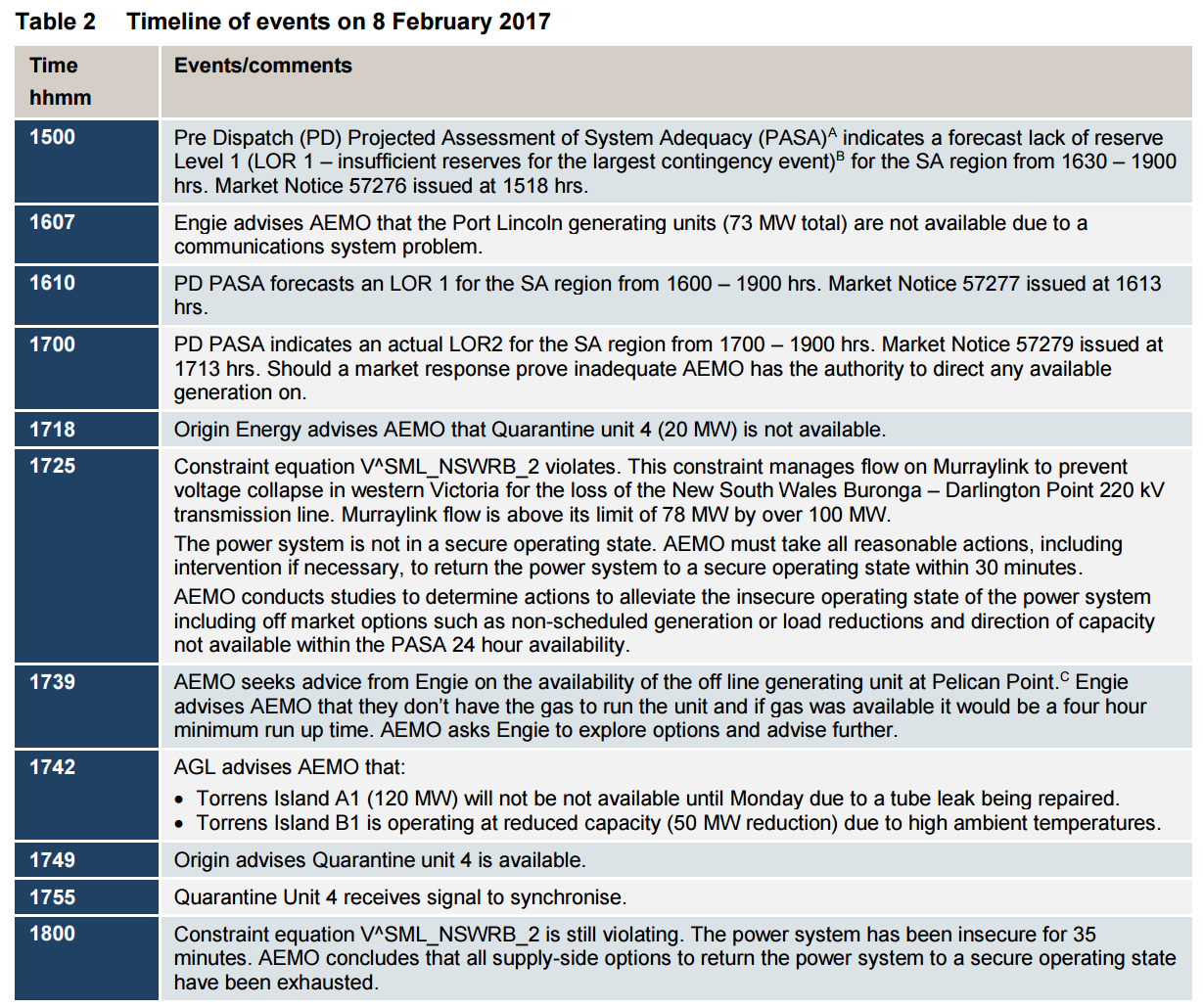
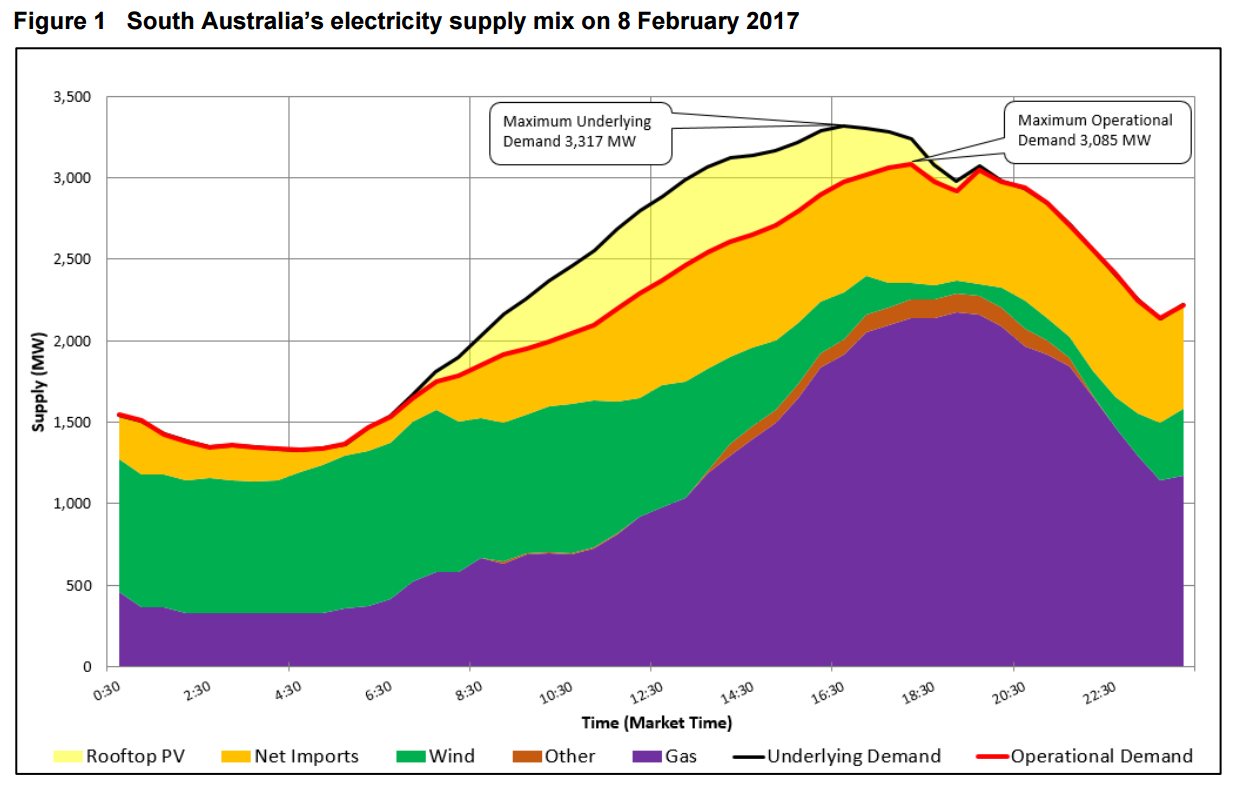
The nation’s energy market operator is under pressure to fix its operations after revealing the key failures that triggered blackouts for 90,000 customers last week, during a heatwave that has escalated a political dispute over energy security.
A report into the February 8 outages raises more questions about the rules applied to managing the nation’s electricity grid, including the challenge of making reliable forecasts for wind power generation.
The Australian Energy Market Operator yesterday admitted outages across South Australia could have been prevented by faster action to bring on a gas-fired power station, calling into question the current financial incentives for conventional generation.
Politicians responded to the AEMO report by laying blame on the competing power sources, but the findings also deepen concerns about the way the network is run and how it can be overhauled to prevent a repeat of the outages.
when it did finally get around to Pelican Point, why did Engie say it would take four hours to light its second turbine? Gas turbines are usually only used as “peaking power plants” and can be switched on and off in minutes. That’s the point.
another interconnector may solve the issues short term but you’re still exposed to the dodgy gas suppliers so how much storage is needed?
Iranian Foreign Ministry Spokesman Bahram Qassemi reiterated that Zionist regime’s nuclear arsenal is the biggest threat for regional and international peace and security.
His remarks came after baseless allegations of the new US President and Israeli Prime Minister Benjamin Netanyahu in a press conference in Washington.
“The remarks included nothing but repeating futile and worthless claims on peaceful Iranian nuclear program. The remarks are being made, whereas the IAEA’s reports have frequently approved peacefulness of Iranian nuclear program. This reality has also been confirmed by various countries across the world.”
He said that there are hundreds of warheads kept in Israeli nuclear arsenals which are the biggest threat to regional and international peace and security.
Qassemi continued that Iran believes that nuclear weapon is religiously forbidden in terms of religious viewpoint and Supreme Leader’s ‘Fatwa’, and that nuclear weapons have no place in Iranian military doctrine.
The Islamic Republic of Iran would press ahead with its peaceful nuclear program under the JCPOA which has been approved by the UN Security Council, Qassemi added.
Israeli nuclear arsenal biggest threat to int’l peace, says Iran 2013
Nasrallah on Thursday called on Israel to “dismantle the Dimona nuclear reactor,” warning that it poses a threat to Israel’s existence if hit by Hezbollah ‘s missiles in any confrontation.
Israel warned Lebanon’s Hezbollah on Thursday against attacking the Jewish state after the leader of the Iranian-backed militant group threatened to strike its nuclear reactor.
The comments by Hezbollah leader Hassan Nasrallah marked the first time his group explicitly threatened to target the reactor in the southern Israeli town of Dimona.
Israel and Hezbollah battled to a stalemate during a monthlong war in the summer of 2006. The war broke out after Hezbollah gunmen crossed into Israel and captured two Israeli soldiers. The ensuing conflict killed about 1,200 Lebanese and 160 Israelis before ending in a United Nations-brokered cease-fire.
“If Nasrallah dares to fire at the Israel homefront or at its national infrastructure, all of Lebanon will be hit,” Yisrael Katz, Israel’s Minister of Intelligence, said in response to Nasrallah’s threats.
The Israel-Lebanon border has remained mostly quiet since the 2006 war but there have been sporadic outbursts of violence.
Dimona nuclear reactor
Nasrallah on Thursday called on Israel to “dismantle the Dimona nuclear reactor,” warning that it poses a threat to Israel’s existence if hit by Hezbollah ‘s missiles in any confrontation.
“Israel is continuing to launch threats against Lebanon and speak of the third Lebanon war and of what it will do during this third war… This intimidation is not new and it seems that there is a permanent Israeli objective to pressure the resistance community in Lebanon, and after (Donald) Trump was elected U.S. president, this intimidation has returned,” said Nasrallah in a televised speech commemorating Hezbollah ‘s slain leaders.
“We’ve been hearing these threats since the end of the July 2006 war. Every other day we hear statements about the third Lebanon war and about the coming vengeance. The new threats are based on the election of Trump, but the policy of the new American administration in the region is not clear,” Nasrallah added.
“Trump’s election does not scare us, even if claims that he will give (Israeli Prime Minister Benjamin) Netanyahu the green light to wage a war on Lebanon turn out to be true, seeing as the issue of war on Lebanon is not hinging on the American permission,” Hezbollah ‘s chief noted.
He also noted that the alleged “Arab cover” that “allowed Israel to attack Lebanon in 2006 is also still present.”
“The issue is not about the U.S. permission or the Arab cover but rather whether or not they will be able to achieve a victory. This is the main question,” Nasrallah pointed out.
Commenting on an Israeli court’s order that an ammonia tank in the northern city of Haifa be emptied of its toxic content, Nasrallah also advised Israel to “dismantle the Dimona nuclear reactor,” warning that it poses a threat to Israel’s very existence if hit by his group’s missiles.
And questioning Israel’s ability to send ground troops into Lebanon in any future war, Nasrallah stressed that “aerial war alone cannot decide the fate of the battle and cannot achieve victory.”
“Had it not been for the Syrian army’s fighting on the ground in Syria, it would not have been able to achieve decisive victory,” he noted.
“I tell the enemy’s leaders that they would be mistaken if they think that they have enough information about the resistance, seeing as we always have hidden surprises, which is part of our strategy and military creed,” Nasrallah warned.
The Environmental Protection Administration (EPA) said Thursday that sea walls will be built to protect the country’s No. 3 nuclear power plant from tsunamis. The move is part of the plan to eventually decommission the No. 1 plant in New Taipei City.
The No. 3 plant is located on Taiwan’s southern coast in Pingtung County. The Atomic Energy Council (AEC) is also evaluating whether to build sea walls around the No. 1 and No. 2 nuclear plants. Both plants are on the country’s northern coast.
In related news, the AEC announced on Wednesday the results of an evaluation of how to deal with 100,000 containers of nuclear waste on the offshore Lanyu Island, also known as Orchid Island. The AEC said it will take a minimum of nine years to remove the waste. The council has asked the state-run Taiwan Power Company to communicate with local residents on the matter.
…….. after another grim week for the nuclear industry, it seems those stickers may have been right after all. …….. Even the eye-watering guarantee from the UK taxpayer for Hinkley Point C is not enough to cover the risk that building it will bankrupt EDF. Toshiba’s woes have claimed the scalp of its president. ……… but the combination of ever-rising safety demands and cheap hydrocarbons has destroyed its economics. Appealing for fresh state aid looks like a desperate last throw of the nuclear dice. If an industry cannot finance its own projects after half a century of development, it may be time to try another industry. Fortunately, other industries are available. The cheapest and quickest fix is to build gas-fired power stations, …….Unfortunately, the artificial barriers imposed by today’s energy policy are preventing this subsidy-free solution. For the longer term, the price of solar energy continues to fall and smart meters that really are smart will start managing the demand side of the equation. Even offshore wind looks a better bet than nuclear as battery technology evolves. Instead, we have a cat’s cradle of subsidies to generate electricity and, through grants for electric cars, subsidies to use more of it. This was self-evidently stupid, even before the impact of the seismic changes across the Atlantic, ……… Abandoning nuclear means facing reality on the likely path of future carbon dioxide emissions……………….
Quite right, quite meaningless
So, Rolls-Royce. A £4.6bn loss and an unchanged dividend. Something wrong here, surely? Aren’t dividends supposed to reflect what the company earns, rather than some sort of semi-obligation? Ah well, you see, £4.4bn of the loss is a writedown of currency hedging, not cash at all, merely a bookkeeping exercise to trim the hedges to their market height after the fall in sterling. It’s as if you had to set a fall in the value of your house against your income. The accounting rules oblige Rolls to do this and thus, as the profit and loss account becomes more and more accurate, it means less and less.
Herve discusses how Japanese scientists are manipulated to not report on radiation problems in Japan. Herve also mentions the connection between the civil nuclear and military programs. Lonnie mentions how the new USA administration is lining up with Japan for nuclear and military business.
Posted to nuclear-news.net
16 February 2017
Transcribed by Shaun McGee
Our very own contributor to Nuclear-news.net Herve Courtois makes a rare interview with Lonnie Clark. He is our Fukushima correspondent who has family in Fukushima.
He is based in France. Known as a balanced news source for Fukushima information he created Fukushima 311 Watchdogs and Rainbow Warriors on Facebook. He has a WordPress blog called Fukushima 311 Watchdogs, and is one of the 3 co-editors on Nuclear News.
Herve talks about the need for caution on reporting on Fukushima and nuclear stories that might damage a bloggers credibility in the long run. He explains this by mentioning how the main stream corrupts news and how some of the new media creates fake activists and destroys activists groups networks.
Also, Fukushima victims have been unduly stressed by sensationalist and incorrect information including Herves family and Friends in Japan. Herve explains how he contacted local activists to confirm no radiation spikes after a hoax thereby reassuring people in Japan and worldwide. The Main stream media then used the hoax against the credibility of the wider anti nuclear community.
He discusses his Return from Japan and Philippines to France, his circumstances and his life in Fukushima. His blogging as a way of repaying his good fortune in life style over the years.
Herve then goes on to talk about how the International Atomic Energy Agency nuclear lobby tries to soften the image of contaminated food consumption after accidents. He then mentions that the Japanese are going to lower the testing on radiation testing on food.Moving on to France he said the French government denied contamination from Chernobyl reaching France, unlike the German Government. France got a higher rate of Thyroid cancer because of that.
Herve goes onto discusses CRIIRAD and ACRO independent radiation monitoring that was set up because of the failures of the French Government and nuclear lobby to advise French citizens. He then discusses other issues about French and UK nuclear pollution releases and sea food contamination resulting because of it.
Herve then points out that the majority of the public are unaware of the contamination issues but that bloggers are trying to get the information out there against the massive PR campaigns by the nuclear lobby. Herve mentions that Greenpeace could have done more in Japan to set up labs to measure radiation. In fact ACRO were the ones that did set up the radiation labs. hey discuss how Greenpeace claimed some of the claim but it was actually ACRO who helped some equipmentsto the Mothers’ Radiation lab in Iwaki City and the CRIIRAD to the CRMS in Fukushima city.
Lonnie and Herve discuss how many people have been shocked by the manipulation of the science and facts concerning the radiation pollution. They mention George Monbiot and how he does good information but has a huge bias against adding the nuclear cover up that weakens his Climate change and energy articles. Herve then goes onto discuss Independent scientists like Chris Busby, Tim Mousseau Arnie Gundersen etc. Lonnie mentions how money is used to coerce environmental groups in the USA.
Herve discusses how Japanese scientists are manipulated to not report on radiation problems in Japan. Herve also mentions the connection between the civil nuclear and military programs. Lonnie mentions how the new USA administration is lining up with Japan for nuclear and military business.
Herve says that a citizen network needs to measure contamination to combat the pro corporate lobbies. This is the way that the public can be made aware and to grow the movements. Herve says that in France French wine could be a way to make people aware. So, if wine could be proved to be contaminated that this sort of project could be heighten peoples awareness and increase funding to such movements.
Safe, reliable and affordable low-carbon electricity, helping the UK deliver on its 2050 decarbonisation commitments
Reduced reliance on foreign gas imports and ‘intermittent generation’ technologies, strengthening the country’s energy security
40,000 skilled jobs
£100bn boost to the UK economy (2030-2050) through development, manufacture, operation, exports and decommissioning
A reinvigorated UK nuclear certified supply chain, providing everything from research and raw materials to high-tech manufacturing and services
Access to a £400bn global export opportunity
Development of a UK SMR plant promises to be one of the largest national engineering collaborations ever undertaken and Rolls-Royce is ideally placed to champion a British consortium.
The firm, which is Derby’s largest private-sector employer with around 14,000 people working across its civil nuclear divisions in the city, has had a tough time of it of late. Last month, it agreed to pay £671 million in penalties to settle allegations of bribery and corruption. The company is also having to deal with the fallout of Brexit on its business.
This may be the most dangerous time in human history.
In a dramatic recent decision, the Bulletin of the Atomic Scientists has moved its iconic Doomsday Clock ahead from three minutes to only two-and-a-half minutes to midnight.
Humankind faces two existential challenges of global and potentially apocalyptic scope: nuclear weapons and climate change. Our focus here is on nuclear dangers, but we strongly encourage you, Presidents Trump and Putin, to undertake in a spirit of urgency all necessary steps to avert further global warming.
As the leaders of the United States and Russia, the two countries with the largest nuclear arsenals, you have the grave responsibility of assuring that nuclear weapons are not used — or their use overtly threatened — during your period of leadership.
The most certain and reliable way to fulfill this responsibility is to negotiate with each other, and the other governments of nuclear-armed states, for their total elimination.
The U.S. and Russia are both obligated under Article VI of the Nuclear Non-Proliferation Treaty to engage in such negotiations in good faith for an end to the nuclear arms race and for complete nuclear disarmament. Your success in this endeavor would make you heroes of the Nuclear Age.
Initiating a nuclear war, any nuclear war, would be an act of insanity. Between nuclear weapons states, it would lead to the destruction of the attacking nation as well as the nation attacked. Between the U.S. and Russia, it would also destroy civilization and threaten the survival of humanity.
There are still nearly 15,000 nuclear weapons in the world, of which the United States and Russia each possess some 7,000. Approximately 1,000 of these weapons in each country remain on hair-trigger alert — a catastrophe waiting to happen that could be prevented with the stroke of a pen.
If nuclear weapons are not used intentionally, they could be used inadvertently by accident or miscalculation. Nuclear weapons and human fallibility are an explosive combination, which could at any moment bring dire consequences to the U.S., Russia and the rest of humanity. The world would be far safer by negotiating an end to policies of nuclear first-use, hair-trigger alert and launch-on-warning. Further, negotiations need to be commenced on the phased, verifiable and irreversible elimination of nuclear weapons.
Nuclear deterrence presupposes an unrealistic view of human behavior if projected over time. It depends on the willingness and ability of political leaders to act with total rationality in the most extreme circumstances of stress and provocation. It provides no guarantees of sustained security or physical protection. It could fail, spectacularly and tragically, at any moment.
The further development and modernization of nuclear weapons by the U.S., Russia and others, and the proliferation of nuclear weapons to other countries, would make for an even more dangerous world. It is important for the sake of regional peace and the avoidance of future nuclear confrontations to uphold the international agreement that places appropriate limitations on Iran’s nuclear program, an agreement that has the support of the five permanent members of the United Nations Security Council plus Germany.
Your nuclear arsenals give each of you the power to end civilization. You also have the historic opportunity, should you choose, to become the leaders of the most momentous international collaboration of all time, dedicated to ending the nuclear weapons era over the course of a decade or so. This great goal of Nuclear Zero can be achieved by negotiating, as a matter of priority, a treaty to ban and eliminate nuclear weapons.
We, the undersigned, implore you to commence negotiations to reduce the dangers of a nuclear war, by mistake or malice, and immediately commit your respective governments to the realizable objective of a nuclear weapons-free world. It would be the greatest possible gift to the whole of humanity and to all future generations, as well as of enduring benefit to the national and human security of Russia and the United States.
Image source; “July 20, 2016 = The first indication that something was amiss came at 9 a.m. on Saturday, January 25, 2003. Workers at the Davis-Besse nuclear power plant, in Ohio, noticed a slowdown in applications on the corporate WAN. Little did they know a worm called SQL Slammer was hammering the network. And things were about to get worse. By 4 p.m. the malware had gotten into the systems used to control the reactor. The Safety Parameter Display System, which tells operators about the state of the plant, blinked off at 4:50 p.m. Twenty-three minutes later the Davis-Besse Plant Process Computer crashed. Fortunately, the reactor itself was offline for repairs. It took several hours to restore the systems. An isolated case? Sadly not. Davis-Besse was one of the first cyber-related events suffered by a nuclear power plant, but is not the only one.” https://newsroom.cisco.com/feature-content?articleId=1774597&type=webcontent
Opinions Differ On Whether Nuclear Industry Is Ready For Cyber-Challenges
16 Feb 2017
The nuclear industry says “extensive regulations” against potential cyber-attacks are in place that are closely monitored and regularly inspected. But not all experts agree, with some arguing that the “static” cybersecurity architecture at today’s nuclear facilities is not effective enough on its own to prevent a breach by a determined adversary. In this special report, NucNet editor-in-chief David Dalton takes a look at the case for both sides and at the conclusions of a major report which argued there is a “culture of denial” in the industry when it comes to the risks posed by hackers. The full report is online for subscribers: http://bit.ly/2jCi012
Shutting down Germany’s nuclear power plants is going to be atrociously expensive. Experts also doubt the funds set aside will be enough to cover the costs of scrapping the plants and their radioactive waste.
Dismantling Germany’s nuclear power plants will devour billions – quite possibly many more than previously estimated. And the question remains: Who will ultimately foot the bill?
The decision to move away from nuclear energy is a done deal in Germany, where all nuclear power plants are intended to be offline by 2022. It’s a political decision that will cost billions of euros, while the expansion of renewable energy is already pushing up electricity rates.
It also remains unclear exactly how much it will cost to dismantle the power plants after they’ve been mothballed. Experts are certain that the 34 billion euros set aside by plant operators for this purpose will not be enough to do the job.
The government officially lists nine nuclear plants as providing electricity for Germany’s power grid. Eight additional reactors were already switched off in the wake of the Fukushima disaster in Japan. There are also 16 power stations currently undergoing the long shut-down process.
In total, there are at least 33 facilities that will need to be dismantled and whose contaminated scrap will have to be disposed of.
Aside from the costs involved, there is also the question of where to store the spent nuclear fuel. The federal government calculated in April 2013 that the selection of a site for this purpose over the next 15 years would cost two billion euros.
Irretrievable reserves
Even before Fukushima, Germany’s nuclear operators were building reserves to finance the dismantling of their reactors. However, they were planning for the reactors to remain in operation for longer, leaving more time for the entire process.
The German Atomic Forum (DAtF) estimates that the reserves total around 34 billion euros. Reports indicate that 18 billion lie with the provider Eon, 10 billion with RWE and 3.6 billion with Vattenfall.
Since the dismantling process is now set to begin earlier and be carried out faster, it’s questionable whether these reserves will be sufficient.
Energy experts say the true figure needs to be much higher. RWE calculates that closing a single nuclear plant in Mülheim-Kärlich in the state of Rhineland-Palatinate will cost 750 million euros. Even the anti-nuclear Green party in Germany’s parliament has acknowledged that a much higher sum will be needed to decommission the plants.
Problems also emerge when it comes to the availability of the 34 billion euros that have accumulated. This capital is not sitting in a bank, ready to be accessed. The plant operators have mostly invested it. In RWE’s case, for example, the money has largely been put toward plants in the Netherlands and in Great Britain.
Who will pay?
Furthermore, RWE is understandably not willing to lose any money in the nuclear energy sector, as the energy company’s lawsuit in the case of a temporary decommissioning of its Biblis nuclear power plant showed. In a final appeal, RWE won the case, opening the possibility for the company to file for compensation. Industry insiders say damages could total 187 million euros.
Thanks to Germany’s shift on energy policy, the country’s nuclear providers, who were counting on longer life spans for their reactors, suddenly find themselves with thinner financial reserves. Some politicians suspect that if a provider were to go bankrupt, it might be able to use the money it has set aside for purposes other than disposing of its facilities.
Setting up a public fund is seen as one option for ensuring that money is available to decommission the remaining plants, but it’s a move that could bring further difficulties for the companies involved. As things stand now, RWE would have to take on additional debt in order to afford the payments into a fund of this sort.
Dismantling Germany’s nuclear power plants will devour billions – quite possibly many more than previously estimated. And the question remains: Who will ultimately foot the bill?



 His remarks came after baseless allegations of the new US President and Israeli Prime Minister Benjamin Netanyahu in a press conference in Washington.






 nuclear-news