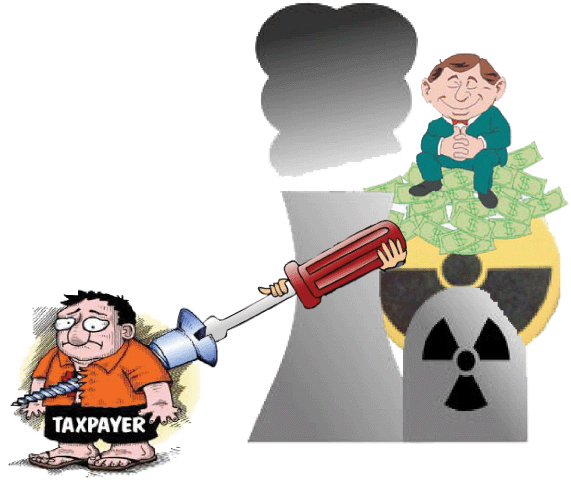
THE WASTE disposal contract with Russia published first in a local daily on August 27 is an unwise (and potentially fatal) decision taken by our government for the 2,400MW Nuclear Power Plant at a staggering cost of US $11.385 billion. This writer is not sure, if this also includes the cost of sending our personnel for training in Russia, and the cost of Russian personnel running the plant for sometime. I think if we needed a nuclear power plant, we should have gone for a radiation-safe U-238-fuelled nuclear power plant.
We could have had a nuclear power plant of higher capacity and totally radiation-free conventional thermal power plants for this amount of money. Feed back from our power plant procurement personnel on this important matter would be most welcome. The report also does not specify two very important issues, like, the costs involved in shipping and safe dumping of nuclear waste, including as well as the regularly disposing of all used electrodes of the nuclear power plant that needs to be changed regularly. Naturally the contract time-frame for disposal of nuclear waste and electrodes should be made for the entire life span of the plant. If it is for a limited period we shall be compelled to go to the Russians for disposal of this dangerous nuclear waste and spent electrodes.
Therefore, in all likelihood, the cost of waste disposal will be getting higher and higher; from term to term as long as the nuclear power plant is kept running. This could be around 20 to 25 years at least and all these expenses will have to be paid in foreign exchange. Since just waste disposal involves huge amount of public money, in hard earned foreign exchange, it should be publicly reported, and should not remain as a secret. Considering the overall high interest rate being charged by the Russians, the additional cost in foreign exchange for disposal of nuclear waste and spent electrodes are likely to be quite high including the cost of transporting it all to Russia. What will be the actual cost of power generation per KWh which is definitely going to be far higher than any conventional thermal power plant where the capital cost is lower. Also these plants will normally be operated by local personnel.
To sum it up, it will be one of the most expensive power plants that involves among other things the possibility of fatal and dangerous radiation in a poor country like ours. Engr. S. A. Mansoor Gulshan, Dhaka-1212
Sixty holes violating the Building Standards Act were found recently in firewalls at the Kashiwazaki-Kariwa nuclear plant in Niigata Prefecture, in addition to two similar holes found in July this year, plant operator Tokyo Electric Power Co. (TEPCO) announced Nov. 22.
Of the 60 holes, 49 date back to the 1980s when the No. 1 reactor building was built, revealing administrative agencies’ lack of consideration for proper construction management.
Reactor buildings have several thousand holes in them for pipes. Of these holes, those going through firewalls are required to have any gaps filled in with mortar caulk or other nonflammable material. In July, TEPCO found two holes in a firewall in the No. 2 reactor building that had not been properly filled in. A subsequent inspection of the entire plant found that 60 holes had not been filled in — a building code violation — of which 41 were in radiation-control areas.
The power company will begin taking countermeasures, such as filling the holes in, as early as the beginning of the New Year. “At the time the reactor buildings were built, our awareness of the risks was insufficient,” TEPCO spokesperson Yoshimi Hitosugi said.
By Judith MohlingRocky Mountain Peace and Justice Center
Posted: 11/23/2017 11:41:26 AM MST
The country is reeling with the daily blows of a sexual counter-revolution. With accusations of sexual assaults that are finally out in the open and being believed, the careers and reputations of accused men are in jeopardy. Can there be a parallel nuclear/sexual counter-revolution?
Stanley Kubrick’s 1964 film “Dr. Strangelove (or How I Learned to Stop Worrying and Love the Bomb)” is filled with sexual innuendo. “The erect warheads and the cascading mushroom clouds are perceived to signify male penetration and ejaculation,” according to Dr. Kathleen Sullivan, nuclear academic.
Tony Macklin wrote in Film Comment that “the picture opens with two planes refueling in the sky in great metal coitus as the sound track croons ‘Try A Little Tenderness.’ The film ends with the mushroom clouds of orgiastic world destruction as the track croons, ‘We’ll Meet Again.’ The purgation is thorough and devastating.”
Eighty-two percent of American women oppose the design and development of new nuclear weapons (61 percent strongly oppose) according to a poll by Lake Sosin Snell & Associates for Abolition 2000. When it comes to actual use of nuclear weapons, we are all women being harmed against our will. In the event of a nuclear war, the Earth itself would be a woman being penetrated and harmed against her will.
Beyond Nuclear has joined Physicians for Social Responsibility, the Union of Concerned Scientists and other national, regional, and faith-based peace and disarmament organizations including the Rocky Mountain Peace and Justice Center right here in Boulder, asking the United States to make nuclear disarmament the centerpiece of national security policy. In a joint resolution — Back from the Brink: A Call to Prevent Nuclear War — the groups call on the United States to lead a global effort to prevent nuclear war by:
• renouncing the option of using nuclear weapons first
• ending the president’s sole, unchecked authority to launch a nuclear attack
• taking U.S. nuclear weapons off hair-trigger alert
• cancelling the plan to replace its entire arsenal with enhanced weapons;
• actively pursuing a verifiable agreement among nuclear-armed states to eliminate their nuclear arsenals.
Additionally, the world now has a treaty being signed and ratified at the United Nations by a majority of the world’s nations — with the sad exception of nuclear weapons states — banning nuclear weapons, and when 50 nations have ratified the treaty it will be international law. Spread the word.
The Rocky Mountain Peace and Justice Center’s “Peace Train” runs every Friday in the Colorado Daily.
No national decision is as consequential, irreversible and fateful as the decision to use nuclear weapons. In the United States the president, and only the president, has the authority to order the unleashing of nuclear weapons. This power is not given by the Constitution, nor any specific law. It results from a series of Cold War-era decisions made secretly by the executive branch and the U.S. military.
Which means recent statements by current and former four-star commanders of the Strategic Command — the branch of the military that would launch nuclear weapons were such a thing to happen — that the military would only carry out “legal” presidential orders to use nukes shouldn’t be particularly reassuring.
News coverage of these comments seemed to convey the idea that the military could be a fail-safe to prevent a nuclear launch, but the opposite remains true. Instead, they revealed what many of us outside the system have suspected for a long time: There are no “checks and balances” on nuclear launch decisions in any formal sense. There is no need for congressional authorization; there is no “two-man rule” for the decision to use the bomb; and although the process for initiating a nuclear attack spells out the need for “consultation” with officials such as the secretary of defense, they have no power to veto the order, and ultimately, their consent is not required. If President Trump wants to use one of the thousands of nuclear weapons in the U.S. military’s arsenal, the chance of anyone stopping him appears to be very low.
Both Gen. John Hyten, the head of U.S. Strategic Command, and retired Gen. C. Robert Kehler, the commander from 2011 to 2013, have spoken recently about not following “illegal” orders to use nukes. Speaking at the Halifax International Security Forum last weekend, Hyten said he’d push back: “I provide advice to the president, he will tell me what to do,” he said. “And if it’s illegal, guess what’s going to happen? I’m going to say, ‘Mr. President, that’s illegal.’ And guess what he’s going to do? He’s going to say, ‘What would be legal?’ And we’ll come up with options, with a mix of capabilities to respond to whatever the situation is, and that’s the way it works. It’s not that complicated.”
Hyten meant this to calm alarm, but it shouldn’t. If anything, it reaffirms our belief that “legality” is the wrong issue altogether. For a general to affirm that he would not obey an “illegal” order is not a strong stance — it’s a simple refusal to willingly commit a war crime, the bare minimum we should expect from a high-ranking American officer. The rest of Hyten’s statement makes clear that he sees his role as a bargainer who would advise the president how to accomplish his desired ends by facilitating a legal alternative.
In other words, this is not a principled form of resistance. It is, in the end, “not that complicated”: The president, one way or another, will probably get what he wants.
Hyten’s remarks came just a few weeks after Sen. Bob Corker (R-Tenn.), chair of the Senate Committee on Foreign Relations, held the first hearings since 1976 on presidential nuclear authority. The hearings in the 1970s featured the looming specter of Richard Nixon as the “mad man” to be feared. The recent hearings took place amid concerns about trusting Trump with the most awesome presidential decision: to release the ultimate “fire and fury.”
Kehler attempted to reassure senators that rash use — or abuse — of nuclear weapons was unlikely under the current system. An unexpected order from the president, he explained, would end up on his desk, and he wouldn’t just execute it unthinkingly like a robot. Rather, he and his legal staff would evaluate it as they would any other order. And if it was an “illegal” order, he wouldn’t follow it.
Having spent years investigating some of the wealthiest people on the planet, journalist and broadcaster Jacques Peretti joins me to discuss the secret billion dollar deals that we never hear about but which are changing our world and revolutionising everything we do.
Published on 21 Nov 2017
Under The Skin #36
Beyond Conspiracy – The Terrifying Truth Of Corporate Power
The radiation effects of the Fukushima Daiichi Nuclear Power Plant triple meltdowns are felt worldwide, whether lodged in sea life or in humans, it cumulates over time. The impact is now slowly grinding away only to show its true colors at some unpredictable date in the future. That’s how radiation works, slow but assuredly destructive, which serves to identify its risks, meaning, one nuke meltdown has the impact, over decades, of a 1,000 regular industrial accidents, maybe more.
It’s been six years since the triple 100% nuke meltdowns occurred at Fukushima Daiichi (March 11th, 2011), nowadays referred to as “311”. Over time, it’s easy for the world at large to lose track of the serious implications of the world’s largest-ever industrial disaster; out of sight out of mind works that way.
According to Japanese government and TEPCO (Tokyo Electric Power Company) estimates, decommissioning is a decade-by-decade work-in-progress, most likely four decades at a cost of up to ¥21 trillion ($189B). However, that’s the simple part to understanding the Fukushima nuclear disaster story. The difficult painful part is largely hidden from pubic view via a highly restrictive harsh national secrecy law (Act on the Protection of Specially Designated Secrets, Act No. 108/2013), political pressure galore, and fear of exposing the truth about the inherent dangers of nuclear reactor meltdowns. Powerful vested interests want it concealed.
Following passage of the 2013 government secrecy act, which says that civil servants or others who “leak secrets” will face up to 10 years in prison, and those who “instigate leaks,” especially journalists, will be subject to a prison term of up to 5 years, Japan fell below Serbia and Botswana in the Reporters Without Borders 2014 World Press Freedom Index. The secrecy act, sharply criticized by the Japanese Federation of Bar Associations, is a shameless act of buttoned-up totalitarianism at the very moment when citizens need and, in fact, require transparency.
The current status, according to Mr. Okamura, a TEPCO manager, as of November 2017:
We’re struggling with four problems: (1) reducing the radiation at the site (2) stopping the influx of groundwater (3) retrieving the spent fuel rods and (4) removing the molten nuclear fuel.1
In short, nothing much has changed in nearly seven years at the plant facilities, even though tens of thousands of workers have combed the Fukushima countryside, washing down structures, removing topsoil and storing it in large black plastic bags, which end-to-end would extend from Tokyo to Denver and back.
As it happens, sorrowfully, complete nuclear meltdowns are nearly impossible to fix because, in part, nobody knows what to do next. That’s why Chernobyl sealed off the greater area surrounding its meltdown of 1986. Along those same lines, according to Fukushima Daiichi plant manager Shunji Uchida:
Robots and cameras have already provided us with valuable pictures. But it is still unclear what is really going on inside.2
Seven years and they do not know what’s going on inside. Is it the China Syndrome dilemma of molten hot radioactive corium burrowing into Earth? Is it contaminating aquifers? Nobody knows, nobody can possibly know, which is one of the major risks of nuclear meltdowns. Nobody knows what to do. There is no playbook for 100% meltdowns. Fukushima Daiichi proves the point.
When a major radiological disaster happens and impacts vast tracts of land, it cannot be ‘cleaned up’ or ‘fixed’.3
Meanwhile, the world nuclear industry has ambitious growth plans, 50-60 reactors currently under construction, mostly in Asia, with up to 400 more on drawing boards. Nuke advocates claim Fukushima is well along in the cleanup phase so not to worry as the Olympics are coming in a couple of years, including events held smack dab in the heart of Fukushima, where the agricultural economy will provide fresh foodstuff.
The Olympics are PM Abe’s major PR punch to prove to the world that all-is-well at the world’s most dangerous, and out of control, industrial accident site. And, yes, it is still out of control. Nevertheless, the Abe government is not concerned. Be that as it may, the risks are multi-fold and likely not well understood. For example, what if another earthquake causes further damage to already-damaged nuclear facilities that are precariously held together with hopes and prayers, subject to massive radiation explosions? Then what? After all, Japan is earthquake country, which defines the boundaries of the country. Japan typically has 400-500 earthquakes in 365 days, or nearly 1.5 quakes per day.
According to Dr. Shuzo Takemoto, professor, Department of Geophysics, Graduate School of Science, Kyoto University:
The problem of Unit 2… If it should encounter a big earth tremor, it will be destroyed and scatter the remaining nuclear fuel and its debris, making the Tokyo metropolitan area uninhabitable. The Tokyo Olympics in 2020 will then be utterly out of the question.4
Since the Olympics will be held not far from the Fukushima Daiichi nuclear accident site, it’s worthwhile knowing what to expect; i.e., repercussions hidden from public view. After all, it’s highly improbable that the Japan Olympic Committee will address the radiation-risk factors for upcoming athletes and spectators. Which prompts a question: What criteria did the International Olympic Committee (IOC) follow in selecting Japan for the 2020 Summer Olympics in the face of three 100% nuclear meltdowns totally out of control? On its face, it seems reckless.
This article, in part, is based upon an academic study that brings to light serious concerns about overall transparency, TEPCO workforce health and sudden deaths, as well as upcoming Olympians, bringing to mind the proposition: Is the decision to hold the Olympics in Japan in 2020 a foolish act of insanity and a crude attempt to help cover up the ravages of radiation?
Thus therefore, a preview of what’s happening behind, as well as within, the scenes researched by Adam Broinowski, PhD (author of 25 major academic publications and Post Doctoral Research Fellow, Australian National University):5
The title of Dr. Broinowski’s study provides a hint of the inherent conflict, as well as opportunism, that arises with neoliberal capitalism applied to “disaster management” principles. (Naomi Klein explored a similar concept in The Shock Doctrine: The Rise of Disaster Capitalism, Knopf Canada, 2007).
Dr. Broinowski’s research is detailed, thorough, and complex. His study begins by delving into the impact of neoliberal capitalism, bringing to the fore an equivalence of slave labor to the Japanese economy, especially in regards to what he references as “informal labour.” He preeminently describes the onslaught of supply side/neoliberal tendencies throughout the economy of Japan. The Fukushima nuke meltdowns simply bring to surface all of the warts and blemishes endemic to the neoliberal brand of capitalism.
According to Professor Broinowski:
The ongoing disaster at the Fukushima Daiichi nuclear power station (FDNPS), operated by Tokyo Electric Power Company (TEPCO), since 11 March 2011 can be recognised as part of a global phenomenon that has been in development over some time. This disaster occurred within a social and political shift that began in the mid-1970s (ed. supply-side economics, which is strongly reflected in America’s current tax bill under consideration) and that became more acute in the early 1990s in Japan with the downturn of economic growth and greater deregulation and financialisation in the global economy. After 40 years of corporate fealty in return for lifetime contracts guaranteed by corporate unions, as tariff protections were lifted further and the workforce was increasingly casualised, those most acutely affected by a weakening welfare regime were irregular day labourers, or what we might call ‘informal labour’.
In short, the 45,000-60,000 workers recruited to deconstruct decontaminate Fukushima Daiichi and the surrounding prefecture mostly came off the streets, castoffs of neoliberalism’s impact on
… independent unions, rendered powerless, growing numbers of unemployed, unskilled and precarious youths (freeters) alongside older, vulnerable and homeless day labourers (these groups together comprising roughly 38 per cent of the workforce in 2015) found themselves not only (a) lacking insurance or (b) industrial protection but also in many cases (c) basic living needs. With increasing deindustrialisation and capital flight, regular public outbursts of frustration and anger from these groups have manifested since the Osaka riots of 1992. (Broinowski)
A film tracing the origin of uranium, which is used in the production of nuclear energy, focusing on Australia and the largest Uranium mine in the world at Olympic Dam in southern Australia.
The film interviews people from both sides of the argument, but it’s focus is definitely on the environmental damage done with both the production and use of nuclear power.
There is an enormous amount of water used in the production of the uranium, and the tailings (leftovers) from the extraction are highly contaminated and for 1000s of years.
Even though the mining companies contract to care for the waste, no company ever lasted the length of time needed to ensure safety, even if they could do so.
Once extracted the ore is sent all over the world as local deposits are either finished or non-existent, and that also has environmental effects, and entails the transportation of radioactive materials through populated areas.
This film should be seen in conjunction with another I posted earlier, Dumped Nuclear Waste in European Seas, about the disposal of radioactive waste in Europe.
Nuclear Hotseat , a nuclear awareness podcast, has cautioned about a burial plan for burial of highly radioactive waste near the high tide location of the Pacific Ocean.
This Week’s Featured Interview:
Donna Gilmore of SanOnofreSafety.org reports on Southern California Edison’s plans to bury 1,800 tons – that’s 3,600,000 pounds <!>of high-level radioactive waste on the Pacific Ocean a mere 36 yards from high tide in canisters that are known to crack and leak. Each one contains a Chernobyl’s worth of radiation less than 70 miles from Los Angeles!
Numnutz of the Week (For Nuclear Boneheadedness):
“Shelter in place” after a nuclear accident… and stay there? New study provides a great way to keep the bodies out of the streets and the clean-up to a minimum! Beware of “*NEW IMPROVED*” methods of measuring radioactive risk… and always check out who’s behind the funding for this kind of bogus pro-nuclear “research.”
WASHINGTON (Reuters) – Imagine it is 3 a.m., and the president of the United States is asleep in the White House master bedroom. A military officer stationed in an office nearby retrieves an aluminum suitcase – the “football” containing the launch codes for the U.S. nuclear arsenal – and rushes to wake the commander in chief.
An unarmed Minuteman III intercontinental ballistic missile launches during an operational test at 2:10 a.m. Pacific Daylight Time at Vandenberg Air Force Base, California, U.S., August 2, 2017. Picture taken August 2, 2017. U.S. Air Force/Senior Airman Ian Dudley/Handout via REUTERS
Early warning systems show that Russia has just launched 100 intercontinental ballistic missiles (ICBMs) at the United States, the officer informs the president. The nuclear weapons will reach U.S. targets in 30 minutes or less.
Bruce Blair, a Princeton specialist on nuclear disarmament who once served as an ICBM launch control officer, says the president would have at most 10 minutes to decide whether to fire America’s own land-based ICBMs at Russia.
“It is a case of use or lose them,” Blair says.
A snap decision is necessary, current doctrine holds, because U.S. missile silos have well-known, fixed locations. American strategists assume Russia would try to knock the missiles out in a first strike before they could be used for retaliation.
Of all weapons in the U.S. nuclear arsenal, the ICBM is the one most likely to cause accidental nuclear war, arms-control specialists say. It is for this reason that a growing number of former defense officials, scholars of military strategy and some members of Congress have begun calling for the elimination of ICBMs.
They say that in the event of an apparent enemy attack, a president’s decision to launch must be made so fast that there would not be time to verify the threat. False warnings could arise from human error, malfunctioning early warning satellites or hacking by third parties.
Once launched, America’s current generation of ICBM missiles, the Minuteman III, cannot be recalled: They have no communication equipment because the United States fears on-board gear would be vulnerable to electronic interference by an enemy.
These critics recommend relying instead on the other two legs of the U.S. nuclear “triad”: submarine-launched ballistic missiles, and heavy bombers armed with hydrogen bombs or nuclear-warhead cruise missiles. The president would have more time to decide whether to use subs or bombers.
Bombers take longer to reach their targets than ICBMs and can be recalled if a threat turns out to be a false alarm. Nuclear missile subs can be stationed closer to their targets, and are undetectable, so their locations are unknown to U.S. adversaries. There is virtually no danger the subs could be knocked out before launching their missiles.
“ANTIQUATED” ARSENAL
Among the advocates of dismantling the ICBM force is William Perry, defense secretary under President Bill Clinton. In a recent interview, Perry said the U.S. should get rid of its ICBMs because “responding to a false alarm is only too easy.” An erroneous decision would be apocalyptic, he said. “I don’t think any person should have to make that decision in seven or eight minutes.”
Leon Panetta, who served as defense secretary during the Barack Obamaadministration, defended the triad while in office. But in a recent interview he said he has reconsidered.
“There is no question that out of the three elements of the triad, the Minuteman missiles are at a stage now where they’re probably the most antiquated of the triad,” he said.
The risk of launch error is even greater in Russia, several arms control experts said. The United States has about 30 minutes from the time of warning to assess the threat and launch its ICBMs. Russia for now has less, by some estimates only 15 minutes.
That is because after the Cold War, Russia didn’t replace its early warning satellites, which by 2014 had worn out. Moscow now is only beginning to replace them. Meanwhile it relies mainly on ground-based radar, which can detect missiles only once they appear over the horizon.
In contrast, the United States has a comprehensive, fully functioning fleet of early warning satellites. These orbiters can detect a Russian missile from the moment of launch.
The doubts about the ICBM force are circulating as the world faces its most serious nuclear standoff in years: the heated war of words over Pyongyang’s growing atomic weapons program between Trump and North Korean leader Kim Jong-Un. U.S.-Russian nuclear tensions have increased as well.
The questioning of the missile fleet also comes as the United States pursues a massive, multi-year modernization of its nuclear arsenal that is making its weapons more accurate and deadly. Some strategists decry the U.S. upgrade – and similar moves by Moscow – as dangerously destabilizing.
Skeptics of the modernization program also have cited the new U.S. president’s impulsiveness as further reason for opposing the hair-trigger ICBM fleet. The enormously consequential decision to launch, said Perry, requires a president with a cool and rational personality. “I’m particularly concerned if the person lacks experience, background, knowledge and temperament” to make the decision, he said.
This month, the Senate Foreign Relations Committee held a hearing to discuss the president’s authority to launch a first-strike nuclear attack. Democratic Sen. Ed Markey of Massachusetts has called for that authority to be curbed, though such a break with decades of practice doesn’t have broad support.
“Donald Trump can launch nuclear codes just as easily as he can use his Twitter account,” said Markey. “I don’t think we should be trusting the generals to be a check on the president.”
FILE PHOTO: A U.S. Air Force missile maintenance team removes the upper section of an intercontinental ballistic missile with a nuclear warhead in an undated USAF photo at Malmstrom Air Force Base, Montana, U.S.. U.S. Air Force/Airman John Parie/Handout via REUTERS
THE NORTH KOREAN THREAT
A spokesperson for the White HouseNational Security Council dismissed any suggestion that Trump lacks the skills to handle the arsenal. “The president is pre-eminently prepared to make all decisions regarding the employment of our nuclear forces,” she said.
Doubts about ICBMs predated the change of administrations in Washington.
ICBMs, detractors say, are largely useless as a deterrent against threats such as North Korea. They argue the land-based missiles can be fired only at one conceivable U.S. adversary: Russia.
That’s because, to reach an adversary such as North Korea, China or Iran from North America, the ICBMs would have to overfly Russia – thus risking an intentional or accidental nuclear response by Moscow. (A small number of U.S. ICBMs are aimed at China, in case Washington finds itself at war with both Moscow and Beijing.)
Despite the rising criticism, for now there is little chance America will retire its ICBM fleet. To supporters, eliminating that part of the triad would be like sawing one leg off a three-legged stool.
Presidents Obama and now Donald Trump have stood by them. There is little interest in Congress to consider dismantlement.
Well before Trump picked him to be defense secretary, General James Mattis raised questions about keeping the U.S. ICBM force, in part because of dangers of accidental launch. In 2015 he told the Senate Armed Services Committee: “You should ask, ‘Is it time to reduce the triad to a dyad removing the land-based missiles?’”
In his Senate confirmation hearing as defense secretary, Mattis said he now supports keeping ICBMs. They provide an extra layer of deterrence, he said, in hardened silos.
The National Security Council spokesperson said no decision had been made on keeping ICBMs. She noted that the president has ordered a review by the end of this year of U.S. nuclear policy, and no decision will be made until then.
ICBMs are part of the overall U.S. nuclear modernization program, which is expected to cost at least $1.25 trillion over 30 years. The missiles are being refurbished and upgraded to make them more accurate and lethal. And the United States is building a new class of ICBMs to be fielded around 2030.
The Air Force has confirmed that the current refurbished Minuteman IIIs have improved guidance systems and a bigger third-stage engine, which make them more precise and able to carry bigger payloads.
BRUSHES WITH ARMAGEDDON
The U.S. nuclear missile force dates back to the 1950s. Lacking expertise in making rockets, the United States after World War II scoured Germany for the scientists who had built the V2 rockets Germany fired on England. Under a secret plan, Washington spirited scientists such as Wernher von Braun, later considered the father of American rocketry, out of Germany, away from possible war crimes prosecution, in exchange for helping the United States.
By 1947 the Cold War was on. The former Nazi rocket designers would help America build super-fast, long-range missiles that could rain nuclear warheads on the Soviet population.
The program began slowly. That changed on October 4, 1957. The Soviet Union launched Sputnik, a small satellite, into Earth orbit, beating the United States into space. For the Pentagon, the most significant fact was that Sputnik had been launched by an ICBM capable of reaching the U.S. homeland. The United States put its missile program into overdrive, launching its own ICBM in November 1959.
The ICBMs’ advantage over bombers was that they could reach their targets in 30 minutes. Even bombers taking off from European bases could take hours to reach their ground zeroes.
By 1966, once an order was given to missile crews, pre-launch time was minimized to five minutes. This resulted from a change in fuel. Before, liquid fuel powered ICBMs. In a lengthy process, it had to be loaded immediately before launch. The invention of solid fuel solved the problem. It was installed when the missile was built, and remained viable for decades.
One reason arms specialists worry about the ICBM force is that the United States and Russia have come close to committing potentially catastrophic errors multiple times.
In 1985, for example, a full nuclear alert went out when a U.S. Strategic Command computer showed that the Soviet Union had launched 200 ICBMs at the United States. Fortunately, Perry recounts in his book, “My Journey at the Nuclear Brink,” the officer in charge realized there was a fault in the computer and that no missiles had been launched. The problem was traced to a faulty circuit board, but not before the same mistake happened two weeks later.
In 1995, then-Russian president Boris Yeltsin had his finger on the button, because the Russians had detected a missile launched from Norway, which they assumed to be American. Russian officials determined just in time that it was not a nuclear missile.
They later learned it was a harmless scientific-research rocket. Norway had warned Russia well in advance of the launch – but the information was never passed on to radar technicians.
Reported by Scot Paltrow; edited by Michael Williams
The Treasury decision will deal a blow to companies hoping to build new windfarms, solar plants and tidal lagoons.Photograph: Murdo Macleod for the Guardian
Adam Vaughan
Companies hoping to build new windfarms, solar plants and tidal lagoons, have been dealt a blow after the government said there would be no new subsidies for clean power projects until 2025 at the earliest.
The Treasury said it had taken the decision to “protect” consumers, because households and businesses were facing an annual cost of about £9bn on their energy bills to pay for wind, solar and nuclear subsidies to which it had already committed.
The revelation that there will be no more money for projects before 2025 could dash hopes for pioneering projects such as the proposed £1.3bn tidal lagoon in Swansea, which has a mooted launch date of 2022.
In a Treasury document on carbon levies published on Wednesday, officials said: “On the basis of the current forecast, there will be no new low-carbon electricity levies until 2025.”
Environmental groups criticised the Treasury move. The WWF said it was a huge disappointment, while Greenpeace claimed Wednesday’s budget was one of the least green ever.
Business groups also reacted with dismay. The pro-environment Aldersgate Group, whose members include BT, Ikea and Marks & Spencer, said the lack of clarity on low-carbon power investments was disappointing.
James Court, head of policy at the Renewable Energy Association, said: “The UK government seem to be turning their back on renewables by announcing no new support for projects post-2020 and a freeze on carbon taxes.”
It is understood the policy will only affect projects generating electricity before 2025, so would not stop firms signing contracts for power stations coming online after 2025. That means the backers of new nuclear power stations are unlikely to be affected by the decision, because none was expected to be built by then. But it could be a blow for the companies wanting to build solar farms, onshore windfarms and other clean power plants at an earlier date.
The government confirmed that it would honour an existing pledge to auction £557m of renewable energy subsidies, beginning next year. But most of that pot is expected to be taken by giant offshore windfarms, likely crowding out other technologies such as tidal.
John Sauven, chief executive of Greenpeace, said: “Despite the chancellor’s pride in the UK’s climate leadership, hidden away in the unannounced text of the budget, he quietly revealed this was one of the least green budgets ever because there will be no new money for renewables until at least 2025.”
Gareth Redmond-King, head of energy and climate at WWF, said: “It is a huge disappointment that there will be no new investment in UK renewables.”
The government also announced that until 2025 it was freezing a carbon tax on dirty energy generators. Big energy firms, including SSE, have been calling for the tax, the carbon price floor, to be strengthened to encourage new investment in greener energy.
One expert said the decision to freeze rather than increase the tax meant the UK’s climate change target for 2030 was being put at risk.
“It is disappointing that the Treasury is continuing its indefinite freeze of the carbon price support rate, a move that could endanger the achievement of the UK’s emissions target for 2030,” said Bob Ward, policy and communications director at the Grantham Research Institute on Climate Change and the Environment.
He added that the current price of around £24.50 a tonne of CO2 was likely to be too weak to drive the energy market to shift from gas power stations to renewables and nuclear.
This article titled “No subsidies for green power projects before 2025, says UK Treasury” was written by Adam Vaughan, for theguardian.com on Wednesday 22 November 2017 04.48pm
New nuclear power stations in the UK can no longer compete with windfarms on price, according to the boss of a German energy company’s green power arm.
Hans Bunting, the chief operating officer of renewables at Innogy SE, part of the company that owns the UK energy supplier npower, said offshore windfarms had become mainstream and were destined to become even cheaper because of new, bigger turbines.
Asked whether nuclear groups that want to build new reactors in the UK could compete with windfarms on cost, even when their intermittency was taken into account, Bunting replied: “Obviously they can’t.”
“What we see now [with prices] is with today’s technology. It’s not about tomorrow’s technology, which is about [to come in] 2025, 2027, when Hinkley will most likely come to the grid … and then it [windfarms] will be even cheaper.”
While the company is planning to use the most powerful turbines in the world today for the Lincolnshire windfarm, Bunting said even bigger ones in development would drive costs down further.
“A few years ago everyone thought 10MW [turbines] was the maximum, now we’re talking about 15[MW]. It seems the sky is the limit,” he said. “[It] means less turbines for the same capacity, less steel in the ground, less cables, even bigger rotors catching more wind, so it will become cheaper.”
However, EDF argued that nuclear was also on a path to lower costs.
“Early offshore wind projects started at around £150 per MW/h and developers have shown they can offer lower prices by repeating projects with an established supply chain – the same is true for nuclear,” an EDF spokesman said.
“EDF Energy’s follow-on nuclear projects at Sizewell and Bradwell will remain competitive with other low-carbon options and we are confident they can be developed at a significantly lower price than Hinkley Point C.”
In an interview with the Guardian, Bunting said Innogy was strongly committed to the UK despite its subsidiary npower merging with the big-six supplier SSE. A third of the group’s staff are based in the UK.
“The npower and SSE merger does not for us mean we are going to leave the UK. No way. We’re going to stay here, and grow here,” he said.
He argued the new supplier would be good for billpayers, contrary to consumer groups’ fears. “There is an industrial logic in it. I think at the end of the day it will help competition because then you have two large players on the market, and they will be more efficient.”
Bunting said he would like to build onshore windfarms in the UK too, if the government rethought its ban on subsidies for them.
He said the political argument against them – public opposition in Tory shires – no longer stood because potential windfarms in Scotland and Wales were more likely to win subsidies.
“England shouldn’t worry because England doesn’t have such good wind conditions … in an auction [for subsidies] the English sites would anyway struggle to qualify against Welsh and Scottish sites.”
Innogy would also take a close interest in building large solar power plants, if ministers reopened support for them, he added.
Bunting rejected the idea that the subsidy costs of paying for clean power should be shifted off energy bills and into general taxation, as British Gas’s boss has argued for.
Such a change would make the cost of clean power less transparent and deter households and businesses from taking steps to save energy, he said. “If part of the energy [costs] is tax-financed it will become completely intransparent,” he said.
A spokesman for the Department for Business, Energy and Industrial Strategy said: “We need a diverse energy mix to ensure that demand for energy can always be met, and both nuclear and renewables will play an important role in this for many years to come.”
Kumar Sunderam of DiaNuke.org, India, launches his book, “Not in the Name of Climate, Not in Our Name! India’s Poor Resist Nuclear Power,” and leads the following discussion: India is one of the very few countries that are expanding atomic power in the post-Fukushima world, providing a lucrative market for the global nuclear lobbies.
In doing so, the government is overlooking safety and environmental norms and also brutally repressing grassroots protests. All this is being justified in the name of providing electricity to the poor and responding to climate change. What is the truth?
Perhaps a normalised Korean peninsula which would benefit China’s economic plans, are what the U.S. and its allies fear most, and so they are starting fires to revivify a military containment policy.
North Korea is often righteously condemned for being the only nation to have conducted five nuclear tests and a barrage of missile tests in the 21st century. Led by a young chubby dictator with a bad haircut, we have long been told that the paranoid hermit kingdom known for its undeniably bombastic, intensely patriotic and anachronistic rhetoric is evil, unhinged and dangerous.
“If either one of those [conversion] facilities were to go down, even though the conversion markets are on aggregate oversupplied, it would have a tremendous impact,”
Honeywell is temporarily to suspend uranium hexafluoride (UF6) production at its Metropolis, Illinois plant pending an improvement in business conditions, the company announced yesterday. The USA’s only uranium conversion plant has been in a scheduled outage since October.
The company said its decision to suspend production was a result of “significant challenges” faced by the nuclear industry, including a situation with a current worldwide oversupply of UF6. In particular, it said, the decrease in demand from Japan and Germany following the Fukushima accident of 2011 has had a significant impact, and continues to create an oversupplied market for the uranium fuel cycle and a downward trend in uranium markets.
The company cited analysis from Energy Resources International, which found that, since Fukushima, global demand for nuclear fuel has dropped 15%. It is not anticipated to rise before 2020.
“As a result of this business outlook, Honeywell plans to temporarily idle production of UF6 at its Metropolis site, while maintaining minimal operations to support a future restart as business conditions improve,” a company spokesman said. “Honeywell intends to restart once business conditions improve and will keep the plant in a state of readiness and continue to support minimal on-site operations to ensure a successful restart. In the interim, the company has made alternative plans to meet all customer contractual commitments.”
The plant has been in a routine annual outage since October. “This action means we will not restart production as originally scheduled,” Honeywell told World Nuclear News.
The maximum output of the Metropolis plant had already been reduced to align with demand.
Uranium must be converted from uranium oxide – the “yellowcake” that is shipped from uranium mines and mills – to gaseous UF6 before it can be enriched in fissile uranium-235 for use in nuclear fuel. In addition to Metropolis, commercial conversion plants are also in operation in Canada, China, France and Russia. According to the latest edition of World Nuclear Association’s biennial report on the nuclear fuel market, The Nuclear Fuel Report: Global Scenarios for Demand and Supply Availability 2017-2035, published in September, conversion and enrichment capacity should be sufficient to meet demand under Reference scenario assumptions until 2030.
Speaking at the Association’s annual symposium in September, Tenam Corporation President Fletcher Newton, who chaired the working group responsible for drafting the report, said the segmented nature of the markets, with production centred on a limited number of plants, presented a challenge.
“If either one of those [conversion] facilities were to go down, even though the conversion markets are on aggregate oversupplied, it would have a tremendous impact,” he said at that time.
Metropolis was built in the 1950s to meet military conversion requirements, and began providing UF6 for civilian use in the late 1960s. The plant’s output is exclusively marketed by ConverDyn.
Manfred Fischedick highlights the importance of energy efficiency in transformation of global energy system in a speech in Taipei on Tuesday; photo courtesy of CNA
Taipei, Nov. 21 (CNA) A visiting German energy expert on Tuesday stressed the importance of energy efficiency in the transformation of energy systems, adding that about two-thirds of primary energy is wasted globally.
Energy efficiency plays a very important role in energy transition strategy, Manfred Fischedick, vice president and director of Future Energy and Mobility Structures at German’s Wuppertal Institute for Climate, Environment, Energy told a forum hosed by the Chinese-language Economic Daily News.
The potential of energy efficiency is largely ignored as the global primary energy system works “a little bit like a bathtub with a leak,” Fischedick said.
“We put a lot of energy into the bathtub and at the end there are a lot of losses. We can use one third of the energy but two-thirds is lost,” he added.
In a keynote speech entitled “Current status and challenges of global energy development,” Fischedick said that moving towards sustainable energy is “a complex but promising task” and he proposed two major solutions — renewable energies and energy efficiency.
Faced with growing energy demand and dependency on the use of fossil fuels that contribute to climate change, many counties have begun the energy transition process.
Germany and Taiwan have a responsibility to start the energy transition process as they have comparably high per capita energy consumption, Fischedick said.
In that context, Fischedick said he found Taiwan’s plan for a future energy industry “very impressive,” referring to the government’s proposal to eliminate nuclear power generation by 2025 and switch to 50 percent natural gas, 30 percent coal and 20 percent renewable energy resources.
Interviewed by CNA after his speech, Fischedick said he was impressed with the plan because Taiwan knows where its business opportunities are and how to use technology and market deployment strategies to transform its energy system in line with the targets it has set to phase out nuclear power in a very short time period.
Germany also decided to shut down its nuclear power plants by 2022 in the wake of the Fukushima nuclear power plant accident in Japan in 2011.
Fischedick pointed out in his speech that there are many similarities between Germany and Taiwan. Both are highly dependent on imported energy and look for more green industry while ensuring that renewable projects do not harm ecosystems and create business opportunities, he said.
On renewable energies, Fischedick said that there is not much difference between what Germany and Taiwan have been doing.
Asked by CNA how Taiwan can learn from Germany’s experience, Fischedick said that one area of difference is that Germany highlights not only renewable energy but also “energy efficiency.”
“Because we do have so many efficient technologies available that can help reduce energy consumption and save money at the same time,” he said.
When presenting Germany’s case in energy transition to the audience, Fischedick said it’s very important to note that Germany was able to “decouple economic growth and primary energy consumption.”
“In the last couple of decades, we have seen slightly decreasing primary energy demand over time starting in 1990, while at the same time the economy grew substantially. Decoupling energy consumption and economic growth was a very important development in the last decade in Germany,” he said.
Looking to the future, he said the major challenges regarding the implementation of a complex transition strategy are the technological and societal aspects of the process.
On societal challenges, Fischedick said that public perception and societal acceptance of renewable energies are very important because energy transformation can take as long as 30 years.
Fischedick suggested that public participation can be fostered by inviting people to invest money in renewable energy or creating associations so more people can take part in changing the energy system.
More discussions can also be held to increase the number of people taking part in the debate on how to shape sustainable energy in the future, Fischedick said.










 nuclear-news