GLOBAL Uranium companies to cut production to increase the value of uranium post FUKUSHIMA

Kazatomprom Announced Production Cuts to Address Uranium Oversupply
Dec 04, 2017
OTC Disclosure & News Service
–
TORONTO and NUCLA, Colo., Dec. 04, 2017 (GLOBE NEWSWIRE) — Western Uranium Corporation (CSE:WUC) (OTCQX:WSTRF) (“Western”) wishes to highlight the positive uranium news released out of Kazakhstan this morning. Subsequent to the 2008 Global Financial Crisis and 2011 Fukushima nuclear accident, global uranium demand has stagnated causing oversupply which has depressed market prices. Uranium production cuts have been anticipated and in this fourth quarter these have been put in place by a number of major uranium producers for 2018.
Today Kazatomprom, the world’s largest uranium producer announced its intention to reduce planned production by 20%. According to the Kazatomprom announcement, this action will remove over 8 million pounds from the market in 2018 and approximately 24 million pounds of uranium over a three year period. In making this announcement, Kazatomprom cited the goal of better aligning their production levels with market demand.
This follows the Honeywell announcement on November 20th that its ConverDyn conversion facility would be immediately idled. The diminished production of uranium hexafluoride (UF6) from this last operating conversion facility in the United States removes approximately 15 million pounds of uranium from the market. Honeywell put forth similar rationale noting that the current oversupply has caused a downward trend in uranium markets.
Furthermore, on November 8th in a Cameco announcement production was suspended at McArthur River Mine and the Key Lake Mill. It was stated that this would start January 2018 and remove approximately 1.2 million pounds per month of uranium production from the global uranium supply. Cameco, North America’s largest uranium producer, took these actions in response to uranium price weakness.
In total as a result of these major announcements, approximately 37 million pounds in aggregate can be calculated to be removed from 2018 uranium supply. Consequently, the aggregate effect of these production cuts, if implemented as announced, will eliminate a large portion of oversupply.
About Western Uranium Corporation
Western Uranium Corporation is a Colorado based uranium and vanadium conventional mining company focused on low cost near-term production of uranium and vanadium in the western United States and development and application of ablation mining technology.
The Japanese Government Is Lying to the International Community: the Radiological Situation in and around Fukushima is NOT Safe
“Perinatal mortality in not only Fukushima prefecture but also neighboring prefectures rose 15.6% just 10 months after the accidents. This clearly indicates the existence of some kind of human health damage from radiation.”
The Japanese Government Is Lying to the International Community: the Radiological Situation in and around Fukushima is NOT Safe
Appeal from a Japanese Anti-nuclear Activist
Etsuji Watanabe
Nov.29 2017 Revised (Oct.12 2017)
Source fro article; http://blog.torikaesu.net/?eid=69
〖Please download the following link.〗
The Japanese Government Is Lying to the International Community: the Radiological Situation in and around Fukushima is NOT Safe(pdf,15pages,2250KB)
Etsuji Watanabe: Member of the Japanese anti-radiation citizen-scientist group ACSIR (Association for Citizens and Scientists Concerned about Internal Radiation Exposures)
Special thanks to Mrs Yuko Kato, Mr Ruiwen Song, Ms Nozomi Ishizu, Mrs Kurly Burch, Ms Jennifer Alpern, and Mark Bennett
Yuko Kato: Evacuee from Fukushima, member of the Kansai plaintiff group for compensation against TEPCO and government
Ruiwen Song: Taiwanese freelance journalist
The Japanese government has created foreign language websites which provide the information about radiology in general and the radiological situation in Fukushima. Journalists around the world, our friends and acquaintances living abroad are continually asking us whether the information that these Japanese central and local government websites present to the international community is correct or not. The following is our answer.
[Question 1]
The stories uploaded on these websites give people the impression that worrying about radiation is unnecessary. As for this impression, has Fukushima now really become a safe place to live or visit?
[Answer]
First of all, Japanese anti-nuclear activists and evacuees from contaminated areas in Fukushima and Kanto, have been warning people all over the world NEVER to trust what the Japanese government is saying about both radiology in general and the specific radiological health effects caused by the Fukushima Dai-ichi nuclear power plant disaster (hereafter Fukushima accident) following the Great East Japan Earthquake and Tsunami on March 11th, 2011.
Prime-minister Shinzo Abe and the Japanese government as a whole including Fukushima prefectural government have repeatedly declared that “with regard to health-related problems (of the Fukushima accident), I (Abe) will state in the most emphatic and unequivocal terms that there have been no problems until now, nor are there any at present, nor will there be in the future.” (Abe’s statement at a news conference). See the Japanese government website below.
http://japan.kantei.go.jp/96_abe/statement/201309/07argentine_naigai_e.html
This claim is completely fabricated and false. In making these claims, the Japanese government is blatantly ignoring the vast number of studies in radiological sciences and epidemiology that have been accumulating historically. By engaging in this behavior, the Japanese government has been systematically deceiving the public, both nationally and internationally.
Just think of the amount of radioactivity released during the Fukushima accident. As you know, one of the standards used to assess the extent of radioactive releases and longtime human health effects is the levels of cesium 137 (Cs137) released into the environment. Based on the Japanese government data (which is an underestimate), the Fukushima accident released 168 times the Cs137 discharged by the atomic bomb dropped on Hiroshima. This amount is almost the equivalent to the total atmospheric nuclear explosions conducted by the United States on the Nevada test ground. The Nevada desert is not designated as a residential area, but the Japanese government has recommended evacuated residents return to live in areas with radiation levels of up to 20 mSv/year. By removing economic support for evacuees, the Japanese government has forced many people who had evacuated from these areas to return.
We estimate that in the Fukushima accident approximately 400-600 times the Cs137 were released into the atmosphere by the atomic bomb blast in Hiroshima. Roughly 20% of the Cs137, or 80-120 Hiroshima-equivalents, were deposited on Japan. Of this, the decontamination efforts have only been able to retrieve five Hiroshima-equivalents. The waste from decontamination efforts is typically stored all over Fukushima mostly in mountainous heaps of large plastic bags. This means that 75-115 Hiroshima-equivalents of Cs137 still remain in Fukushima, surrounding prefectures, and all over Japan.


In addition, the Japanese government is now planning to reuse the retrieved contaminated soil under 8000Bq/kg in public works projects all over Japan. This self-destructive program has now been partially started without any announcements as to where the contaminated soil are and will be reused, under the pretext of “avoiding damage caused by harmful rumors”. This project is tantamount to scattering lethal fallout of Cs137 equivalent to about 5 times that of Hiroshima bomb all over Japan. The Japanese government is literally behaving like a nuclear terrorist.
Do you really imagine that Fukushima prefecture and surrounding areas, contaminated as they are to levels similar to the Nevada test site, is really a safe place for people to permanently live, or for foreign tourists to visit and go sightseeing?
Regrettably, we must conclude that it is not, for either residents or tourists the situation in Fukushima is not safe.
[Question 2]
These websites also point out that the international annual dose limit for the public is at 1mSv, but this level is easily exceeded by only one CT-scan, insinuating that this 1mSv standard is set too low and thus not a useful indicator.
[Answer]
CT-Scans are often cited as if they had no radiation risks, But this is not true. A recent study clearly shows that every CT-scan (about 4.5mSv irradiation) increases the risk of cancers in children by 24%. See the website below.
http://www.bmj.com/content/346/bmj.f2360
In Fukushima the allowable level of radiation per year for residents is now 20mSv. Can you imagine having 4-5 CT-scans every year?
[Question 3]
One of the websites states: “In Fukushima, the indoor radiation doses are now so reduced that no radioactive cesium can be found in the air. Therefore, no radioactive particles can invade the human body during breathing.” What do you think of this statement?
[Answer]
The Japanese government also ignores the long term peril caused by “hot particles” ――micron-and- nano-sized radioactive particulates――which, if inhaled or absorbed into the human body, may lead to many kinds of cancers and other diseases including cardiac failure. We should consider internal irradiation to the cells near the radiation sources to be 500 times more dangerous than external irradiation because particles inside the body radiates very near or even inside cells, causing intensive damage to DNAs and other cell organs such as mitochondria.
[Question 4]
These websites explain that there exists not only artificial but also natural radioactivity, thus people are living in an environment surrounded by radiation all the time in everyday life.
[Answer]
One of the main tactics that the Japanese government often uses to propagate the “safety of low level irradiation” is to compare artificial radioactivity with natural radioactivity. But this logic is a methodological sleight of hand. It is crystal-clear that even exposure to natural radioactivity has its own health risks. Cancers sickened and killed people long before artificial radioactivity was used. For example, Seishu Hanaoka, one of the founders of Japan’s medicine, carried out 152 breast cancer surgeries from 1804 to 1836.
Both kinds of radioactivity have their own health risks. Risks caused by artificial radioactivity should not be compared but be added to the natural radioactivity risks as they both lead to the accumulation of exposure.
For example, potassium 40 (K40) is a typical natural radioactive nuclide. According to the Japanese government, the average internal exposure dose for adults from K40 is about 4,000Bq/year or 0.17mSv/year. See the website below (in Japanese).
http://www.kantei.go.jp/saigai/pdf/g31_siryou5.pdf
The ICRP risk model (2007) allows us to estimate the approximate risk posed by K40. The calculation shows that K40 is responsible for approximately 4,000 cancer cases and 1,000 deaths every year. If the same amount of radiation was added to that of K40 in the human body by artificial sources, the cancers and mortalities would be doubled to 8,000 and 2,000 a year, respectively. Based on the ECRR (2010) model, which criticizes the ICRP risk model as a severe underestimate, these figures should be multiplied by 40, reaching 320,000 and 80,000, respectively.
The extract you cite from the Fukushima government website is completely fake: “In Fukushima, the indoor radiation doses are now so reduced that no radioactive cesium can be found in the air. Therefore, no radioactive particles can invade the human body during respiration”. Reports from civic radiation measurement stations refute this claim. For example, dust collecting paper packs of vacuum cleaners used in Iwaki City, Fukushima prefecture, are radiologically measured and 4,800-53,900Bq/kg radioactive cesium was detected in Oct-Dec 2015. See the website below (in Japanese).
http://www.iwakisokuteishitu.com/pdf/tsushin011.pdf
[Question 5]
One of the websites says that the Fukushima prefecture has conducted whole-body counter screenings of the 170,000 local population so far but cesium was rarely detected.” Does this mean that we can safely consume food from Fukushima, and Fukushima residents are no longer being exposed internally to radiation?
[Answer]
This is a typical example of demagogy by the Japanese government: vague expressions lacking specific data, using the words “safe and secure” without clear explanation. In reality, the government has not publicized any data indicating serious irradiation of the population. For example, you mentioned the Fukushima prefectural government website saying that whole-body counter screenings of 170,000 members of the local population have found radioactive Cs only in very few cases. However, the fact that no specific number is given makes the statement suspicious.
These statistics, more than likely, exclude many firefighters or other municipal employees who, at the time of accident, helped local residents evacuate from a lot of contaminated areas surrounding the defunct Fukushima plant. These people were subjected to serious radiation doses.
Civic groups’ efforts for the disclosure of information has recently prompted city officials near the defunct plant to disclose the fact that it conducted whole-body counter check-ups on about 180 firefighters, nurses and municipal employees. According to Koichi Ohyama, a member of the municipal assembly of Minami Soma, the screening conducted in July, 2011, showed almost all of these people tested positive in Cs. The maximum Cs137 dose among the firefighters was as high as 140,000 Bq. This data reveals a part of the reality of irradiation but it is only a tiny part.
[Question 6]
The government websites suggest that no health effects from irradiation have been reported in Fukushima. Is this true? Or have any symptoms appeared that indicate an increase in radiation-induced diseases in Fukushima?
[Answer]
One example is the outbreak of child thyroid cancer, but the Japanese government has been denying the relationship with irradiation from radioactive iodine released from the Fukushima disaster.
Japan’s population statistics reflect the health effects from the Fukushima disaster radioactivity. The following data clearly show that diseases increasing in Fukushima are highly likely to have been radiation-induced.


[Question 7]
The Fukushima prefecture website says, “After the Fukushima accident, the Japanese government has introduced the provisional standards for radioactive iodine and cesium. The Fukushima prefectural government subsequently strictly regulated distribution and consumption of food with levels of radioactivity exceeding the provisional standards. Now we have had this new much stricter standard. The distribution and consumption of food exceeding this new standard has been continuously regulated; therefore any food on the market is safe to consume.” Is it true?
[Answer]
As for food contamination, the Japanese government has also tried to cover up the real picture. First, the current government standard for radioactivity in food, 100Bq/kg, is dangerously high for human health, especially for fetuses, infants, children and pregnant women. Even six and a half years after the accident, the Agriculture Ministry of Japan as well as many civic radioactivity measurement stations all over the country have reported many food contamination cases, although the frequency is evidently reduced. See the website below.
http://en.minnanods.net/
The Japanese government has underestimated the danger presented by internal irradiation. But, we must consider two important factors. (1) The wide range of difference in personal radio-sensitivity. According to Professor Tadashi Hongyo (Osaka University Medical Faculty), the maximum difference is as wide as 100 times in terms of biological half-life of Cs137. (2) Recent studies denying that the so-called biological half-life decrease curve actually exists. According to the new model, daily food contamination can cause concentrations to accumulate as time passes. Even a daily 1Bq internal radiation dose from food cannot be safe for human health (details below).
Our recommendation is to be cautious of food or produce from Fukushima and the surrounding areas, and, even if contamination levels are said to have now generally decreased, to avoid jumping to the conclusion that all the food is fit to eat.
[Question 8]
We would like to ask about the situations in prefectures surrounding Fukushima. A television program once reported, “As for the safety of Tochigi and Gunma prefectures, few people are raising concern about health effects of radiation.” Is it true that the prefectures somewhat distant from the Fukushima Daiichi plant are now safe with no human risk?
[Answer]
Regarding the radioactive contamination in prefectures surrounding Fukushima, you can refer to the following website.
http://www.gowest-comewest.net/statement/20170825english.html
This article examines the contamination in the Tokyo metropolitan area, but conditions are the same or more serious in Tochigi or other prefectures north of Tokyo, nearer to the defunct Fukushima Daiichi plant.
Another example is the statistics of stillbirth and neonatal mortality in Fukushima and the surrounding five prefectures (Tochigi, Gunma, Ibaragi, Miyagi, Iwate) shown below.
 https://www.ncbi.nlm.nih.gov/pmc/articles/PMC5044925/
Perinatal mortality in not only Fukushima prefecture but also neighboring prefectures rose 15.6% just 10 months after the accidents. This clearly indicates the existence of some kind of human health damage from radiation.
[Question 9]
We would like to ask about the decontamination efforts by famers living in Fukushima and neighboring prefectures. Should we think highly of the farmers measuring the amount of radiation deposited on the surface of soil to create radiation maps for farms, or washing the radiation from the surface of every single tree off the radiation with high-pressure washers? The farmers said that while these methods have been shown to be radiologically effective, their produce did not sell well, because consumers are still feeling anxious about health risks. Does the problem of radioactive food contamination in Japan just end up in whether each consumer personally believes it safe or not?
[Answer]
We must raise a question that, despite the government’s decontamination efforts, a huge amount of radioactive materials deposited in mountainous areas remain untouched. Now they are re-dispersing and re-depositing over wide areas of Fukushima and surrounding prefectures via winds, cars, trains, river water, pollen, spores, emissions from incinerators, in the form of radioactive dusts and particulates, among many others. For an example, see the following website.
http://www2.jpgu.org/meeting/2015/PDF2015/M-AG38_all_e.pdf
So I regret to say that, although these farmers’ endeavors you mentioned are very precious and respectable, they are not sufficient to completely eliminate the risk of radiation exposure from food. The problem exists objectively in the nuclear materials deposited on and in soil, algae, plants, houses, buildings, forests, animal and human bodies, not subjectively in the consumers’ sentiment or psychology.
[Question 10]
Japanese experts have recently pitched a cultivation method that can remove cesium by intensive use of potassium fertilizer. Is this method effective at all? Do you have any doubt about their claims?
[Answer]
They seem to be among those experts who have been criticizing the general public’s tendency to demand “zero irradiation risk” as an obstacle to Fukushima reconstruction.
As you know, cesium (Cs) has chemically similar characteristics to potassium (K). So it is true that higher levels of application of potassium fertilizer lowers the plant’s absorption, and therefore concentration, of radioactive Cs, decreasing Cs137/134 concentrations in produce, often to below the government standard of 100Bq/kg. But the following problems remain: (1) This procedure can prevent Cs transfer from the soil to produce only partly, not completely; (2) This process raises the potassium concentration in the produce and therefore heightens the burdens on certain human organs such as kidneys, the heart and the nervous system, causing new health risks; (3) Heightened concentration of potassium also leads to the heightened concentration of radioactive K40, so the reduced risk of radioactive Cs lead to an increased risk of internal irradiation by K40.
[Question 11]
Even if cesium concentration was reduced by applying more potassium fertilizer than usual, strontium contamination would remain. In Japanese government’s international press campaign as to the Fukushima accident, almost nothing has been said about strontium. If you have any information on strontium contamination, let us know.
[Answer]
We regret that the information about strontium that you are asking for is very limited and searching for it is also a challenge for us. The Japanese government and research institutes under the government have reported very limited data regarding strontium contamination. But it is important that the Japanese government admits the fact of strontium contamination within 80km from the defunct Fukushima plant. See the website below.
http://radioactivity.nsr.go.jp/ja/contents/6000/5048/24/5600_110930_rev130701.pdf
Did you know that the US Department of Energy data on the strontium contamination of soil in Japan and its visualization (in Japanese) can be seen on the websites below?
https://energy.gov/downloads/us-doennsa-response-2011-fukushima-incident-data-and-documentation
https://news.whitefood.co.jp/%E6%94%BE%E5%B0%84%E8%83%BD%E3%81%A8%E3%81%9F%E3%81%9F%E3%81%8B%E3%81%86%E3%83%96%E3%83%AD%E3%82%B0/1861/
[Question 12]
Some Japanese experts say, “the Japanese government has declared that no health effects from irradiation below 100mSv (or 100mSv/year) have been confirmed.” Some farmers have established a private food standard of 20Bq/kg, much lower than the Japanese government standard of 100Bq/kg. Do you think that doses under 100mSv or under 20Bq/kg are safe and secure?
[Answer]
As you mentioned, the Japanese government claims that no scientific studies verify that irradiation of 100mSv or less poses a threat to human health, suggesting that irradiation under 100mSv has no risk. This, however, is false. The government is fabricating this information. In fact, very many scientific studies have already confirmed and proven health effects induced by irradiation under 100mSv. For example, see the websites below.
https://ehp.niehs.nih.gov/1408548/
https://www.ncbi.nlm.nih.gov/pubmed/24198200
http://www.bmj.com/content/346/bmj.f2360
https://www.ncbi.nlm.nih.gov/pubmed/22766784
https://www.ncbi.nlm.nih.gov/pmc/articles/PMC3050947/
https://www.ncbi.nlm.nih.gov/pmc/articles/PMC2696975/
The Japanese government is using the term “100mSv” in a deliberately ambiguous and confusing manner. The expression 100mSv can have three meanings: (1) a one-time irradiation dose, (2) cumulative irradiation doses, or (3) annual irradiation doses. So 100mSv is not the same as, nor equal to the 100mSv/year that you mentioned in parenthesis. The latter amounts to a 1Sv in cumulative dose over 10 years (which is an up to 10% lethal dose), and 5Sv over 50 years (which is a 50% lethal dose). The present government standard for evacuees to return, 20mSv/year, means that living there for 5 years leads to a cumulative dose of 100mSv, at which the Japanese government admits clear health risks.
Regarding 20Bq/kg as some farmers’ private food standard, it is critical to pay serious attention to the extraction process of Cs from tissues. Japanese-Canadian non-organic biochemist Eiichiro Ochiai points out in his book “Hiroshima to Fukushima, Biohazards of Radiation” (2014) that, based on the Leggett model, the Cs concentration injected in tissues at one time diminishes relatively quickly for about 10 days in most tissues. After that, processes slow down, tending to become steady. He writes: the decrease of the overall Cs level in the body does not follow an exponential decay curve (p.83). This means that consecutive intake of Cs, even in very low levels, results in the accumulation of Cs in the body. (Incidentally, Ochiai’s book can be downloaded for free from the website below.)
https://archive.org/details/HiroshimaToFukushima
Regarding the Leggett model, see the website below.
https://www.ncbi.nlm.nih.gov/pubmed/14630424
Yuri Bandazhevsky considers over 10Bq/kg of radioactive Cs concentrations in the body to be unsafe because even this low level can possibly cause abnormal electrocardiographic pattern in babies, metabolic disorders, high blood pressure, cataracts, and so on.
Therefore, we can conclude unequivocally that neither the irradiation under 100mSv nor the privately set 20Bq/kg food standard are safe and secure.
- 論考
- 2017.11.29 Wednesday
- 11:29
- by torikaesu01
The potential health effects to coastal populations of the dumping of 330,000 tons of radioactively contaminated mud on the coast of Wales, 2.8km from Cardiff.

Dr Busby was asked by individuals in Wales to comment on the proposals by the French nuclear company to dredge up 300,000 tons of radioactive mud from the sea bed near Hinkley Point nuclear power station in Somerset, England, and dump it in the Bristol Channel 2.8km from the Welsh Capital, Cardiff.
Dr Busby has carried out many studies of the cancer and infant mortality effects of living near the contaminated coast near Hinkley Point and the Bristol Channel, including the Welsh coast since 2000. In a new report [link] he shows that if this proposal is allowed by the Welsh Assembly government, the result will be a measurable increase in cancer and ill health in Cardiff and other communities of Wales living near the coast and the tidal rivers Taff and Usk.
He points out that there is no valid reason to dump this material near Wales except to keep it from the holiday beaches in England. He recommends that the dredging is not permitted to go ahead as it will increase cancer rates on both sides of the Bristol Channel, as is shown by the epidemiological cancer mortality studies his group carried out from 1999 to the present day.
SNIP
END SNIP
Report source; http://www.greenaudit.org/wp-content/uploads/2017/12/Dumping-radioactive-mud-near-Cardiff.pdf
North Korean nuclear tests sickening residents with ‘ghost disease,’ defectors say
North Koreans who defected but once lived near a nuclear testing site in the rogue nation now believe they are experiencing the dangerous effects of exposure to harmful radiation — and it’s triggered severe health problems, according to a report published Sunday.
“So many people died we began calling it ‘ghost disease,'” Lee Jeong Hwa, who in 2010 escaped her home in Kilju County where the nuclear testing site Punggye-ri is located, told NBC News. “We thought we were dying because we were poor and we ate badly. Now we know it was the radiation.”
Lee isn’t the only defector who believes the radiation is taking its toll people who lived there.
South Korean newspaper Chosun Ilbo reported in November that close to two dozen defectors said the area surrounding Punggye-ri is turning into a “wasteland” where vegetation is dying and babies are born with deformities.
NORTH KOREA’S NUCLEAR TEST SITE CAUSING ‘DEFORMED BABIES,’ KILLING VEGETATION, DEFECTORS SAY
The defectors said drinking water in the area came from Mount Mantap, where nuclear tests reportedly were conducted underground.
Rhee Yeong Sil told NBC News that before she defected in 2013, a neighbor of hers gave birth to a baby so deformed that nobody could determine its gender.
“It didn’t have any genitals,” Rhee said. “In North Korea, deformed babies are usually killed. So the parents killed the baby.”
Lee told NBC News that South Korea’s Ministry of Unification has tested her, along with other defectors, and has found no signs of contamination due to radiation from nuclear tests.
It’s “assumed” that cancer or other diseases found in North Korean defectors are due to nuclear testing, but it’s hard to confirm, the Korea Institute of Nuclear Safety told the network.
There is also concern that strong winds could blow lingering radiation to Japan across the Sea of Japan.
Less than a week ago, the regime launched what it called its “greatest” intercontinental ballistic missile which, according to South Korean officials, could have the capability to hit targets as far as 8,100 miles away — putting Washington, D.C., within reach.
The missile, launched on Nov. 28 around 1:30 p.m. ET, was the first the regime conducted since its Sept. 15 test when it fired an intermediate-range missile that flew over Japan’s Hokkaido Island.
October marked the first month the regime didn’t test a missile since January. Between February and September, North Korea launched a missile an average of every two weeks.
Are nuclear reactor risks from terrorrorist being played down?
Thanks to Greenpeace France we are able to see how vulnerable nuclear power stations are even when there is still a state of national emergency currently in France.
Nuclear sites like Sellafield in the UK are also at risk from Terrorist attack and the reports concerning accident damage to these sites and pollution damage is not even being assessed properly (report from Irish EPA on accident at Sellafield ignores the most dangerous scenario, a concerted attack on the spent fuel pools by determined terrorists with the fires lasting more than a day)
Thanks to EDF for this magnificent infographie on the classification of safety zones in nuclear power plants, which confirms that Greenpeace activists were in the hot ‘nuclear zone’.
The Director of EDF has therefore lied.
Only added on the drawing, only the position of militants (only blue colour). No changes to original infographie. h/t Yannick Rousselet

UAE approaches generating electricity from nuclear energy

Dubai – Mubasher: The Emirates Nuclear Energy Corporation (ENEC) on Sunday received the first nuclear fuel shipment to operate the first plant of the UAE’s peaceful nuclear programme, and stored it safely according to security requirements.
The UAE’s nuclear programme is about to produce the first megawatt of nuclear energy, as the UAE built four nuclear plants in 2017, according to the Emirates News Agency (WAM).
The UAE completed the construction of the first nuclear power plant and assigned its operations to the Korea Hydro and Nuclear Power, WAM reported.
https://www.dotemirates.com/en/details/4266527?from=dot

Further info;
ICAN official urges Japan to join anti-nuke weapons treaty

THE ASAHI SHIMBUN
December 3, 2017 at 18:05 JS
GENEVA–An executive of the international nongovernmental organization that won this year’s Nobel Peace Prize vowed to strengthen the campaign to ask Japan and other countries to sign and ratify the Treaty on the Prohibition of Nuclear Weapons.
Beatrice Fihn, 35, executive director of the International Campaign to Abolish Nuclear Weapons (ICAN), also said that her group will use the Nobel Peace Prize award money to establish a new fund to promote its activities.
She made those remarks in an interview with The Asahi Shimbun here on Dec. 1 ahead of the awards ceremony to be held Dec. 10 in Oslo.
ICAN, based in Geneva, was awarded the Nobel Peace Prize in October on the grounds that it advocated the inhumanity of nuclear weapons and contributed to the adoption of the treaty in July.
In the interview, Fihn pointed out that the Japanese government’s stance of relying on the U.S. nuclear umbrella means that it supports the idea of threatening other countries with nuclear weapons.
She cast doubts on that stance, saying ICAN will ask Japanese politicians and people the serious question of whether Japan is accepting the idea of threatening to do the same thing to others as what happened to Hiroshima and Nagasaki at the end of World War II.
Amid North Korea’s ongoing development of nuclear weapons and missiles, Fihn said, “With the threats, we no longer have to convince people that the threat is real. People are feeling it. They know it’s real. So I think we have a unique opportunity now to really make progress.
“I think when we’re thinking about the humans or putting humans first, that’s when we make progress … Not ‘America First,’ (but) humans first.”
The signing of the treaty started in September but only three countries have ratified it. Ratification of 50 countries is necessary for the treaty to take effect, which ICAN is aiming to realize within two years. For that purpose, it plans to set up a new fund within ICAN.
The group named it the “1,000-day fund” so that it can achieve the ratification of 50 countries within 1,000 days from Dec. 10, the day of the awards ceremony.
In addition to the prize money of 9 million Swedish kronor (about 120 million yen, or $1.1 million), ICAN will collect donations for the fund.
The fund will be used to support activities of cooperating groups throughout the world so that they can promote their campaigns to urge the governments and the people of their countries to sign and ratify the treaty.
Fihn harbors strong doubts on the “nuclear deterrence” that Japan is relying on, saying that it will be unable to stop accidents from occurring due to misunderstandings, cyberattacks or individuals that aren’t rational.
“Nuclear deterrence isn’t flawless. Even if it does work to some extent, it can still fail and the consequences would be devastating,” she said.
As Foreign Minister Taro Kono says, the Japanese government asserts that nuclear weapons are necessary to deter North Korea.
However, Fihn said that the mechanism to create peace and stability based on fear of nuclear weapons is not working and, on the contrary, is creating an unstable situation.
“Introducing nuclear weapons in a conflict situation makes it more tense and increases the risk of an accident where these weapons will actually be used,” she said.
(This article was written by correspondents Tsutomu Ishiai and Ichiro Matsuo.)
http://www.asahi.com/ajw/articles/AJ201712030021.html
Further info;
Yemen’s Houthi group says fires missile toward Abu Dhabi nuclear reactor

DUBAI (Reuters) – Yemen’s Houthi group has fired a cruise missile towards a nuclear power plant in Abu Dhabi in the United Arab Emirates, the group’s television service said on its website on Sunday, without providing any evidence.
“The missile force announces the launching of a winged cruise missile … towards the al-Barakah nuclear reactor in Abu Dhabi,” the website said. It gave no further details.
(Reporting by Sami Aboudi; Editing by Mark Potter)
http://www.journalistbook.com/2017/12/03/yemens-houthi-group-says/
Earthquake detected near North Korea nuclear site
Earthquake detected near North Korea nuclear site
A 2.5-magnitude earthquake has been detected in North Korea near where the country recently conducted a nuclear test, Seoul’s weather agency said.
The tremor occurred at 7.45am on Saturday in Kilju, North Hamgyeong Province, around 2.7 kilometres away from the Punggye-ri nuclear site, according to the Korea Meteorological Administration (KMA).
Kim Jong-Un‘s regime conducted its sixth and most powerful nuclear test at the site on 3 September, damaging geological structures in the area, the agency said. Four tremors have been detected there since.
“The quake is a natural one and it is believed to have occurred in the aftermath of the sixth nuclear test,” the KMA said.
The September atomic explosion triggered an artificial 6.3-magnitude earthquake at the test site, monitors at the time said. It was almost 10 times more powerful than the 10-kiloton test carried out by the North last year, according to South Korean experts.
North Korean monitoring group 38 North said the tremors could be an indication of “Tired Mountain Syndrome” — a condition where rock becomes increasingly permeable following a below-ground nuclear blast.
Reports have speculated the nuclear test site will have to close because of the tremors, but 38 North said “complete abandonment of the test site as a whole remains unlikely”.
The isolationist state recently tested a new intercontinental ballistic missile that, it claimed, could reach anywhere on the US mainland.
Experts said the Hwasong-15 appeared capable of transporting a nuclear warhead, although it is unclear whether the isolated state is yet capable of making a weapon small enough to be fitted to the missile.
At the end of November the US unveiled fresh sanctions against the North, which it said were designed to stop its funding of nuclear and ballistic missile programmes.
Donald Trump has also redesignated North Korea as a state sponsor of terrorism.
On Friday the US state of Hawaii tested a nuclear attack warning siren for the first time since the Cold War. Some experts believe a North Korean missile could take just 20 minutes to reach the state.
Although Hawaii is protected by US anti-missile systems, local people are being told to have an emergency plan if alarms warn a strike is imminent.
The independent UK
Pope says world has reached moral limit on nuclear deterrence

By Cindy Wooden
ABOARD THE PAPAL FLIGHT FROM BANGLADESH (CNS) — The Cold War policy of nuclear deterrence appears morally unacceptable today, Pope Francis said.
St. John Paul II, in a 1982 message to the U.N. General Assembly, said deterrence “may still be judged morally acceptable” as a stage in the process of ridding the world of nuclear weapons.
But Pope Francis, in a message in early November to a Vatican conference, said “the very possession” of nuclear weapons “is to be firmly condemned.”
During a news conference Dec. 2 on his flight back to Rome from Dhaka, Bangladesh, Pope Francis was asked what had changed since St. John Paul wrote to the United Nations and whether the war of words between U.S. President Donald Trump and North Korea’s Kim Jong Un influenced his position.
“What has changed?” the pope responded. “The irrationality has changed.”
Pope Francis said his position is open to debate, but “I’m convinced that we are at the limit of licitly having and using nuclear weapons.”
The world’s nuclear arsenals, he said, “are so sophisticated that you risk the destruction of humanity or a great part of humanity.”
Even nuclear power plants raise questions, the pope said, because it seems that preventing accidents and cleaning up after them is almost impossible.
Pope Francis said he was not dictating “papal magisterium,” or formal church teaching, but was raising a question that a pope should raise: “Today is it licit to maintain the nuclear arsenals as they are or, to save creation and to save humanity, isn’t it necessary to turn back?”
The weapons are designed to bring one side victory by destroying the other, he said, “and we are at the limit of what is licit.”
Pope says world has reached moral limit on nuclear deterrence
More info
For info
For actions
Vietnam ditched nuclear power plans over local concerns: ex-leader
(Mainichi Japan)
HO CHI MINH CITY (Kyodo) — Vietnam last year abandoned plans to build the country’s first nuclear power plants with Japanese and Russian assistance due to heightened concern over nuclear energy in the wake of events such as the Fukushima nuclear disaster, according to former President Truong Tan Sang.
In an interview in Ho Chi Minh City on Thursday, Sang, 68, said, “The situation in the world had changed. Due to the fluctuations of the world situation, the Vietnamese people were very worried, especially the people in the area where the nuclear power plants were to be located. They had reactions. Therefore, we had to temporarily halt (the plans).”
The interview was his first with a foreign news media outlet since stepping down from power in April last year.
In scrapping the plans to build two multi-billion-dollar nuclear power plants in November last year, the government cited the country’s tight financial situation, saying safety was not an issue.
On Vietnam’s territorial conflict with China in the South China Sea, Sang said his country welcomes the concerns of countries in and outside the region to contribute to ensuring peace and stability in the South China Sea.
“We protect our interests on the basis of international law, and at the same time we also respect the interests of the countries concerned on the basis of international law,” he said.
“Japan is very close to Vietnam’s view,” he added, expressing hope for Tokyo’s continued support for its stance in the dispute.
On the economic front, he praised Japan for its active promotion of globalization, especially after U.S. President Donald Trump withdrew from the Trans-Pacific Partnership, a free trade agreement signed by 12 nations including Vietnam and Japan.
“(Japanese Prime Minister) Shinzo Abe was one of the first leaders to promote and connect remaining countries together. As a result, at the APEC meeting in Danang recently, the TPP 11 meeting successfully took place,” he said.
On bilateral relations, he said the relationship between the two countries is “very good. There is no obstacle.”
“The extensive strategic partnership in all areas has been strengthened, bringing clear benefits,” he said.
By taking advantage of Japan’s advanced technology and Vietnam’s abundant natural and human resources, he expressed hope for greater cooperation in areas such as high-quality infrastructure, high-tech agriculture and renewable energy.
“Vietnam learns from the experience and realities of countries around the world to perfect the organizational model of our political system,” he said, indicating the necessity of reform of Vietnam’s ruling Communist Party and government based on global trends and the domestic situation.
https://mainichi.jp/english/articles/20171203/p2g/00m/0in/062000c
Morningstar’s Sunny Outlook For Nuclear Power Suddenly Clouds Over
Morningstar analysts broke with the pessimistic consensus on nuclear power this fall when they predicted the industry would not just hold its own against renewables and cheap natural gas, it might even grow up to 5 percent.
But that prediction, which appeared in the October/November issue of Morningstar magazine, has already fallen flat.
“At the time we were developing the forecasts, we were assuming the two new units at the VC Summer (SC) plant would go forward, totaling 2.2 GW of new capacity. But as you probably know, Scana and partner Santee Cooper decided to cancel the project in late July,” said Travis Miller, an equity strategist with Morningstar Research Services LLC.
“The VC Summer plant is key. If indeed it never goes into service, you would have to remove that 2.2 GW from our forecast, thus our base estimate would go from flat to down 2.2 GW. Other than that, the status of the Exelon plants are the primary difference from our high- and low-end estimates.”
Exelon operates five nuclear plants in Illinois and New York that it has threatened to close. Both states passed subsidies to keep the plants open, but those subsidies are being challenged in the courts.
“If courts strike down those subsidies, we expect those plants to close, absent other power market reforms,” Miller said.
In their original forecast, the analysts suggested pessimism about nuclear power was short-sighted and overlooked nuclear’s “more favorable” environmental profile, given political pressure to reduce emissions. They argued that nuclear capacity could grow through uprates—a process in which the Nuclear Regulatory Commission grants permission to operate plants “hotter” than is typically allowed.
Competition from cheap natural gas generation and renewable energy are pinching profits now, but we think a long-term perspective is important… Our forecast for flat or growing U.S. nuclear capacity is more bullish than most forecasts. In particular, we disagree with the U.S. Energy Information Administration’s prediction that nuclear capacity will fall 11% by 2040. We think the U.S. could add as much as 5% net new nuclear capacity by 2040.”
In addition to Exelon and Scana, the analysts profiled the “actionable” stocks of Dominion Energy, Southern Company, and FirstEnergy.
The nuclear technology was born 75 years ago yesterday when a team of physicists led by Enrico Fermi successfully triggered the first manmade nuclear reaction at the University of Chicago.
Stalkers in Chernobyl: Radioactive exclusion zone plagued by thrill-seekers & looters
The latest group of Chernobyl trespassers was busted on Saturday. A trio aged between 18 and 23 was caught by a patrol after crossing into the expulsion zone, the police reported, describing them as “extreme tourists.” In mid-November a 21-year-old man from Ukraine and a 20-year-old woman from Russia were likewise caught sneaking in. Three separate groups of thrill-seekers had been busted in mid-October.
Chernobyl, once a byword for the terror experienced millions of people following the 1986 nuclear power plant explosion, has by now become a magnet for the curious. Access to the exclusion zone remains restricted, but most of it has long been safe for brief visits. The exception is the ruin of the plant itself, which is to be covered by a new shelter construction commissioned last year and expected to be finished in the first half of 2018.
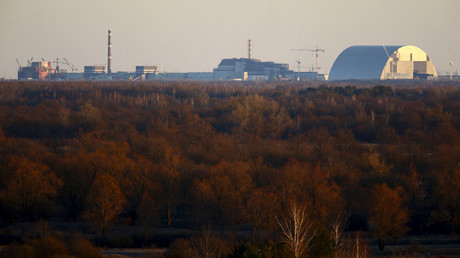
The zone is a destination for scientists studying the effects of long-term radiation exposure on wildlife, as well as for documentary film crews and curious tourists. But some people don’t want to deal with the red tape and prefer to simply trespass, sometimes with the help of local guides, knowing that the only thing they risk if caught is a fine. The experience however may be far more dangerous than expected even for seasoned extreme travelers.
On Tuesday, a 33-year-old father of three died in the Chernobyl exclusion zone after a 15-meter fall. Dmitry Shkinder from Belarus went inside to climb the abandoned Soviet missile silo via the receiving antenna of early warning radar Duga, located a dozen kilometers from the destroyed nuclear power plant. Judging by his social media accounts, he had climbed the massive construction in the past, but the latest selfie quest proved to be fatal.
“That object has seen no maintenance for three decades. Its rusty, some ladders are loose. On that day it was really wet and cold and there was thick fog,” his friend Roman, who was with Dmitry when he died, told a Belarusian TV station.
While most of the trespassers come to Chernobyl for the thrill, other visits have a more practical purpose. Occasionally Ukrainian police report catching somebody trying to smuggle scrap metal, which can be later sold for recycling. A man carrying about 200 kg of rusty metal in his motorcycle sidecar was caught last week. In September, a man tried to carry out 15kg of lead pellets from Chernobyl, but was busted at a checkpoint. Metal hunters are typically unconcerned that their loot may be radioactive.
Arguably an even more irresponsible way to make money on Chernobyl is picking mushrooms and wild berries in the exclusion zone, where competition for the foodstuffs is virtually non-existent. In September, the police reported intercepting two villagers leaving the restricted area carrying 40kg of mushrooms, which they claimed were for their personal consumption. The report said Geiger meters proved that this was not the best idea: the mushroom radiation levels were some 30 times higher than what is considered safe.
https://www.rt.com/news/411729-chernobyl-thrill-seekers-looters/
Other resources; https://nuclear-news.net/?s=timothy+mousseau+chernobyl+fukushima
Life after Fukushima and Chernobyl nuclear disasters with Prof. T. Mousseau
Comparing Fukushima and Chernobyl concerning radionuclide distribution and Isotopic variations on Land and effects on the environment. New studies by Timothy Mousseu and his team. Tim was interviewed and he gave us an overall look at the situation and compares the 2 nuclear disasters for us. Link to Timothy Mousseau cricket.biol.sc.edu/Mousseau/Mousseau.html Link to podcast here; … Continue reading
EDF says individuals detained after breaking into Cruas nuclear plant
“All you need to do is make a hole (in the building) to start a fire,” Yannick Rousselet, Greenpeace France’s chief anti-nuclear campaigner told AFP.

November 28, 2017
A group of Greenpeace activists broke into a French nuclear plant on Tuesday and scaled the walls of a building containing spent nuclear fuel to highlight security shortcomings at the facility.
Around 20 activists took part in the latest stunt by the environmental campaign group aimed at showing that France’s 58 nuclear reactors are vulnerable to attack.
The group said the protest at Cruas-Meysse plant in the southeastern Ardeche region, which has four reactors, proved that security around spent nuclear fuel pools was particularly lacking.
Four activists scaled one of the buildings containing pools used to cool highly radioactive spent fuel rods and set off flares.
“All you need to do is make a hole (in the building) to start a fire,” Yannick Rousselet, Greenpeace France’s chief anti-nuclear campaigner told AFP.
France’s state-owned energy giant EDF which operates the plant confirmed the intrusion but said that the plant’s safety was never in danger.
Regional security officials said 22 people were arrested, adding they had posed no threat.
The incident is the second of its kind in as many months.
In October, Greenpeace activists got inside a nuclear plant in Cattenom, near the border with Luxembourg, and set off fireworks at the foot of a spent fuel pool.
France is the world’s most nuclear-dependent country, with atomic plants providing 75 percent of the country’s electricity.
Around a third of all reactors in the country are set to be closed by 2025 under a government plan to boost renewables.
In a report in October Greenpeace noted that most of France’s nuclear plants were built before the rise of threats from non-state terror groups such as the Islamic State group and Al-Qaeda and claimed that their defences were weak.
Read more at: https://phys.org/news/2017-11-greenpeace-alarm-nuclear-safety-break-in.html#jCp
Search of Areva’s headquarters in connection with a sale of Nigerian uranium in 2011

Paris (AFP)– The headquarters of Areva, former French flagship of nuclear already in the heart of the scandal Uramin, was the subject of a search Tuesday as part of an investigation into an allegedly dubious sale of Nigerian uranium in 2011.
The search, which began in the morning at the headquarters of the company in the Paris business district of La Defense, ended around 21H00, according to a source familiar with the matter.
Areva “confirms a search” and “collaborates closely with justice,” said the group in the day, without giving further details.
This operation, carried out by the investigators of the financial brigade of the judicial police, relates to a Nigerian uranium brokerage case that had resulted in significant losses for Areva, told AFP sources close to the case .
The case, dubbed “Uraniumgate”, is the subject of a preliminary investigation opened by the National Public Prosecutor’s Office in 2015.
It broke out in February 2015 with the publication, in the Nigerian weekly Le Courrier, of documents relating to the sale in the fall of 2011 of a large quantity of uranium for $ 320 million.
The stock was initially sold by Areva to a Russian company, Energo Alyans, which later sold it to Optima Energy Offshore in Lebanon.
A few days later, Optima sold the uranium to Niger’s state-owned Niger Mines Corporation (Sopamin). Areva then bought this stock from Sopamin at a price much higher than the price at which it initially sold it.
Retrocommissions?
“It was a trading operation as part of an integrated offer,” said spokesman Areva Christophe Neugnot in April. Clearly, the French group was in contact with an operator interested in buying nuclear power plants who also wanted, in order to secure its supply, to obtain uranium.
“Finally, the sale of the reactor was not made, we bought the uranium”, with ultimately “a loss of 18 million dollars,” added Mr. Neugnot.
Investigators question the capital gains pocketed by intermediaries, including “$ 82 million for Energo Alyans (…), unknown to traders (and) who would have disappeared completely shortly after the facts”, d ‘ after the newspaper Jeune Afrique.
“They want to know if, in general, this montage could have been used to hide commissions or retrocommissions”, according to one of the sources close to the file.
The group is at the center of another investigation into the acquisition of a Canadian mining company, Uramin, which owns three uranium deposits in Africa, for which it paid 1.8 billion euros in 2007.
The operation had turned into a fiasco: after the departure of his boss Anne Lauvergeon, Areva had divided by five the value of the company and passed, at the end of 2011, a heavy provision of 1.5 billion euros.
This controversial buyout is at the heart of two judicial information. One relates to suspicions of fraud and corruption during the acquisition of Uramin, the other concerns the provisions inscribed by Areva, magistrates suspecting group officials for presenting inaccurate accounts to hide the collapse in the value of Canadian society.
Under the leadership of the French state, Areva is engaged in a vast restructuring. Its reactors business should notably come under the control of EDF by the end of the year.
These measures should enable it to recover from heavy setbacks attributable to the setbacks of the construction of its EPR reactor in Finland, the financial fiasco of the acquisition of Uramin and the sluggishness of the atom sector since the Fukushima accident. (Japan) in 2011.
Source French only
1 This Month

of the week – Shut Down Drone Warfare!


Tell the Ukrainian Government to Drop Prosecution of Peace Activist Yurii Sheliazhenko

Petition to revoke the licensing of the Near Surface Nuclear Disposal Facility (NSDF) at Chalk River. https://www.ourcommons.ca/petitions/en/Petition/Details?Petition=e-7247
To see nuclear-related stories in greater depth and intensity – go to https://nuclearinformation.wordpress.com
-
Archives
- March 2026 (237)
- February 2026 (268)
- January 2026 (308)
- December 2025 (358)
- November 2025 (359)
- October 2025 (376)
- September 2025 (257)
- August 2025 (319)
- July 2025 (230)
- June 2025 (348)
- May 2025 (261)
- April 2025 (305)
-
Categories
- 1
- 1 NUCLEAR ISSUES
- business and costs
- climate change
- culture and arts
- ENERGY
- environment
- health
- history
- indigenous issues
- Legal
- marketing of nuclear
- media
- opposition to nuclear
- PERSONAL STORIES
- politics
- politics international
- Religion and ethics
- safety
- secrets,lies and civil liberties
- spinbuster
- technology
- Uranium
- wastes
- weapons and war
- Women
- 2 WORLD
- ACTION
- AFRICA
- Atrocities
- AUSTRALIA
- Christina's notes
- Christina's themes
- culture and arts
- Events
- Fuk 2022
- Fuk 2023
- Fukushima 2017
- Fukushima 2018
- fukushima 2019
- Fukushima 2020
- Fukushima 2021
- general
- global warming
- Humour (God we need it)
- Nuclear
- RARE EARTHS
- Reference
- resources – print
- Resources -audiovicual
- Weekly Newsletter
- World
- World Nuclear
- YouTube
-
RSS
Entries RSS
Comments RSS
 nuclear-news