The seaside nuclear reactors at the San Onofre Nuclear Generating Station in San Clemente were permanently shut down in 2013 following steam generator malfunction. What to do with the 3.6 million pounds of highly radioactive waste remains an epic problem, however, pitting concerned citizens against Southern California Edison, the California Coastal Commission and the Nuclear Regulatory Commission (NRC). Edison operates San Onofre, the Coastal Commission is charged with protecting the coastline, and the NRC is responsible for long-term storage of spent nuclear fuel and protecting the public.
The Problem
San Onofre Nuclear Generating Stations (SONGS) abuts I-5 Fwy and ocean. Photo: Jelson25, Wikimedia Commons.
A reactor’s spent nuclear fuel must be stored safely for 250,000 years to allow the radioactivity to dissipate. San Onofre’s nuclear waste has been stored in containers 20 feet under water in cooling pools for at least five years, the standard procedure for on-site temporary storage. Long-term storage necessitates transfer to fortified dry-storage canisters for eventual transportation to a permanent national storage site which, under the Nuclear Waste Policy Act of 1982, the federal government is under obligation to construct.
However, the plan to build an underground repository at Yucca Mountain in the Nevadan desert was ditched in 2011 out of concern that deep groundwater could destabilize the canisters, leaving the United States with literally no plan on the horizon for permanent storage of nuclear waste from San Onofre or any other of the country’s nuclear power plants. In fact, under the NRC’s newest plan – the so-called Generic Environmental Impact Statement – nuclear power plant waste might be stored on-site forever.
Given this, informed southern Californians are up in arms about the 2015 permit by the Coastal Commission allowing Edison to build a dry-storage bunker right at San Onofre – near major metropolitan areas and within a few hundred feet of both the I-5 Freeway and the shoreline in a known earthquake zone – using thin-wall canisters never proven safe for storage or transport (Coastal Development Permit No. 9-15-0228). Most other countries, including Germany, France, Japan, Russia and Australia, utilize thick-wall canisters with time proven safety technology.
The Current Plan
The dry-storage plan OK’ed by the Coastal Commission is the Holtec Hi-Storm system: cheaper canisters with 5/8-inch thick stainless steel walls, wildly short of the 10 to 20-inch thick-walled ones used in other countries. Each of 72 remaining canisters slated to be converted from wet to dry storage will contain about 50,000 pounds of nuclear waste and as much radiation as was released from Chernobyl.
At the controversy’s core is the susceptibility of Holtec canisters to cracking, which could leak radiation into the environment, both land and sea. Seawater seepage into canisters can produce explosive substances.
Holtec canisters have no seismic rating, are not proven safe for transport, and there is no means to even inspect them for cracks or for existing cracks to be repaired in a safe manner. A crack can’t even be detected until after a radiation leak has occurred.
The Coastal Commission acknowledges these issues but is allowing Edison 20 years to hopefully come up with a solution.
In the meanwhile, loading into dry-canisters already began in December, 2017 and is scheduled to be completed by 2019. Furthermore, Edison plans to empty the cooling pools once the dry transfer is completed, eliminating the only approved method to replace a defective canister.
A highly disturbing report from Sandia National Laboratories states that a crack in a hot canister can penetrate the wall in under 5 years. Notwithstanding, Holtec’s 25-year warranty of their canisters is an absurdity given that nuclear waste radiation takes thousands of years to reach safe levels.
There is also no community evacuation plan in place in the event of radiation leakage at San Onofre. The fear is that failure of even one canister could leave Orange and San Diego counties an uninhabitable wasteland for eons, with exposed humans suffering permanent genetic damage. And, home and business insurance doesn’t cover losses due to radiation contamination.
The very real specter of radiation havoc from a terrorist bomb attack launched from an offshore boat or a truck on the I-5 Freeway looms as well.
In the minds of many, the reckless plan allowed by the NRC and endorsed by the Coastal Commission and Edison creates imminent risk of a “Fukushima” in South Orange County.
The Solution
A lawsuit filed by the San Diego watchdog organization Citizens Oversight in 2015 asserted that the Coastal Commission failed to adequately consider both the special risks of on-site storage in an earthquake zone next to the ocean and the shortcomings of the Holtec system. In a court settlement just reached on Aug. 25, 2017, Edison agreed to hire a team of experts in hopes of locating an alternative temporary storage site. Edison also agreed to develop a plan for dealing with cracked canisters, though there is no assurance that such a plan is feasible for Holtec canisters.
Though the settlement plan appears a first step toward a saner solution to San Onofre’s nuclear waste problem, the obligations in the plan are far too vague to assuage the concerns of local residents. Their main points are threefold: There are other safer temporary storage sites inland that can be considered; maintaining the cooling pools is imperative until all nuclear waste has been moved off-site; and Holtec canisters should be abandoned in favor of thick-wall options that already have a 40-year track record of safety during both transport and storage in countries across the globe.
Case in point, the thick-wall canisters in place at Fukushima survived both the earthquake and the tsunami.
Take action to protect yourself and your family by signing on to a petition from PublicWatchdogs.org to revoke the Coastal Commission’s permit to turn San Onofre into a nuclear waste dump.
Are northern San Diego County and southern Orange County headed for another Fukushima Daiichi–like nuclear disaster? Possibly, but not necessarily in our lifetimes. The economic severity of such a disaster could destroy the California economy, flatten the United States economy, and severely harm the world economy while killing and maiming many people, says Carlsbad scientist Tom English.
Southern California Edison
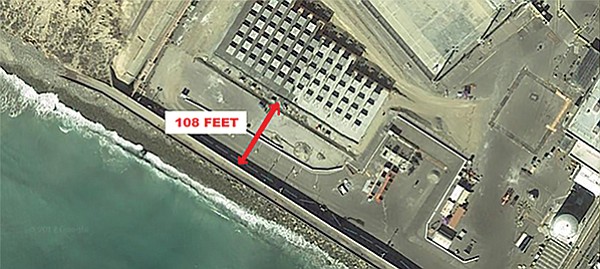
English got a PhD in electrical engineering at Carnegie Mellon and did postdoctoral work in environmental engineering at Vanderbilt. He has lectured at more than 100 universities and given eight presentations at the White House. Now he is giving lectures about the greed and stupidity behind the decision to bury nuclear waste 108 feet from the ocean at the shuttered San Onofre nuclear plant.
Major owner Southern California Edison has quietly completed construction of its beach-front nuclear waste dump despite promises to look elsewhere.
Why is Japan’s Fukushima disaster of 2011 a possible model for what could happen in Southern California? Japan’s Fukushima Nuclear Accident Independent Investigation Commission concluded that people should not blame the tsunami for the disaster. Fukushima “cannot be regarded as a natural disaster,” said the panel’s chairman. “It was a profoundly man-made disaster…governments, regulatory authorities and Tokyo Electric Power lacked a sense of responsibility to protect people’s lives.”
The radioactive material would be 108 feet from the ocean, but rising oceans will put it under water eventually.
Google Earth
Edison’s scheme to pawn the cost of the decommissioning onto ratepayers and to bury 3.6 million pounds of nuclear waste next to the ocean displays the same greed and incompetence as Tokyo Electric and its regulators. As Californians have learned, Edison’s corporate duplicity knows no bounds. The California Public Utilities Commission is a classic case of “regulatory capture,” or regulators run by the utilities. The federal Nuclear Regulatory Commission also bows to utilities, and the California Coastal Commission thinks spent nuclear fuel should be stored where it originated (in our case, at San Onofre) because the federal government hasn’t developed any options for either temporary or permanent storage of this extremely deadly waste, says English.
On nuclear issues, the coastal commission believes that its mandate to include environmental, health, and safety issues has been preempted by federal law, says English. Therefore, the commission has made a point of deliberately excluding these crucial considerations from their licensing hearings, even though they are well aware of their critical importance. That is a fatal weakness in the commission’s nuclear permitting process.
The regulators practice the malodorous “revolving door” policy — employees stay awhile at the regulator and then go work at a utility at a high salary. This is practiced at other so-called regulators such as the Securities and Exchange Commission. In effect, regulators are temps until they can get that fat job at a company.
Fukushima showed that storage of the dangerous spent fuel in pools of water has dangers, so now utilities put the spent fuel into dry storage, slipped into canisters that are surrounded by concrete. “You create a problem worse than the problem you were trying to solve,” says English. To bury the canisters 108 feet from the ocean is “absolutely stupid.” Canisters should be “as far away from water as possible.” Reason: global warming is melting the earth’s polar ice caps, causing massive sea-level rise. According to James Hansen, one of the world’s leading climate-change experts, by the year 2050 the sea level could rise by ten feet. If this happens, the canisters holding the deadly spent fuel will be one-third under water.
English speaks of the “washing machine effect”: the water level where the canisters will repose will vary with the tides, and salt water going up-down, up-down will cause erosion. English thinks the canisters are too thin and not fully protected. “If a crack is developing, they won’t know it,” he says. The San Onofre crew should have studied the old technique adopted years ago when gasoline tanks were leaking. “They tore out the old tanks and put in double-wall tanks. A leak in an inner tank can be detected right away, and no poisons are released into the environment. There is no protection like that with the proposed Edison canisters.”
Edison’s strategy “was driven by economics instead of safety,” says English. “They have chosen both a bad location and containers that are not very good. The dry-storage canisters must be able to be monitored, inspected — inside and out for radiation leaks — and repaired. Edison came up with a plan with completely unacceptable risks.”
It’s that old mentality of “not on my watch,” says English. Executives cut corners, getting bloated paychecks as profits rise, knowing they will be retired or deceased when despair sets in.
English is particularly concerned about terrorism. “If you store the nuclear waste canisters on the beach, there is no existing adequate defense on the ocean side. A small group of motivated terrorists could attack the interim storage site and spread radioactive materials all over the place,” he says. People within 50 miles would be evacuated — about 8.5 million persons. Abandonment of the region could cost $1 trillion to $2 trillion. Industrial output would plunge, severely damaging the California economy.
“Since California is the sixth-largest economy on Earth, this kind of event could be devastating to both the U.S. and world economy.”
The 1986 Chernobyl accident was in Ukraine, then part of the Soviet Union. “The attitude was that it happened in the Soviet Union because the Russians weren’t qualified,” says English. Japan was considered near-perfect industrially and technically. “But they screwed up at Fukushima,” says English. The Japanese prime minister Naoto Kan came within an hour of evacuating 80 million people in the Tokyo area. The Fukushima disaster almost destroyed the Japanese economy. Dislocated people are still ailing physically and psychologically because of Fukushima.
In common with several other activists, English believes that a mesa across I-5 from San Onofre might accommodate the temporary storage of spent fuel.
“It’s limited space that [Edison] has in its lease with the Navy. It’s maybe 50 to 80 feet higher than the beach storage site. That mesa is the only place that would not be totally stupid. This location would at least eliminate the near-term climate-change threat to canisters.” There is also some space on the ocean side that might work, but Charles Langley of Public Watchdogs believes that Edison has dumped toxic (non-nuclear) waste on that site and wouldn’t permit dumping of nuclear waste there.
Three lawsuits filed in Ventura County Superior Court allege that Southern California Edison negligently started the Thomas Fire, the largest wildfire in modern California history.
“Plaintiffs believe that SCE’s employees’ and/or contractors’ construction activities caused the ignition of dry vegetation at (a) construction site, which set off the massive wildfire” about 6:20 p.m. Dec. 4, one of the suits alleges.
The construction site was in the canyon behind the Ventura Ranch KOA Holiday campground near Steckel Park in Santa Paula, the suit, filed Dec. 15, states.
Los Angeles County-based Edison declined repeated requests for comment on the lawsuits.
The Dec. 15 suit was filed by Westlake Village attorney Alexander Robertson on behalf of nine residents whose homes in Ventura, Santa Paula and Ojai were either destroyed or damaged in the fire.
The suit also names as defendants the city of Ventura and the Casitas Municipal Water District because of what it alleges was a lack of water pressure to fire hydrants in Ventura and Ojai to enable firefighters to battle the blaze and save the homes.
Ventura City Attorney Gregory Diaz said Tuesday the city hadn’t been served with the lawsuit yet, and thus he was declining to comment.
Casitas General Manager Steve Wickstrom said that because “it’s pending litigation, there’s no comment coming from the district. Nothing to say at this moment.”
Another lawsuit filed Dec. 13 by four other Ventura residents whose homes were damaged in the fire also alleges Edison negligently started the blaze.
“Defendants’ electrical lines and/or equipment caused the Thomas Fire,” states the suit, filed on behalf of the plaintiffs by the Ventura law firms of Weilbacher & Weilbacher and the Law Office of Ball & Yorke. The second suit does not name Ventura or Casitas as defendants.
Most recently, on Dec. 22, Robertson filed another suit against Edison on behalf of an Upper Ojai couple, Mark and Debra Scantlin. The suit alleges a pole-mounted Edison transformer on Koenigstein Road adjacent to the Scantlin’s property exploded about 7 p.m. Dec. 4 around 30 to 45 minutes after the Thomas Fire initially broke out near Steckel Park about five miles away. The resulting fire destroyed the couple’s home, the suit says. Mark Scantlin is a veteran firefighter now with Federal Fire Ventura County.
“The Koenigstein (Road) fire was caused by SCE’s negligence,” the suit alleges. “Defendants failed to properly inspect and maintain electrical infrastructure and equipment which they knew, given the existing Santa Ana wind and Red Flag warning conditions, posed a risk of harm to the plaintiffs and to their … property.
“Defendants were aware that if the transformer on Koenigstein Road exploded and/or caught fire, the likely result would be a catastrophic wildfire,” the suit alleges.
All three suits seek unspecified monetary damages to be determined at trial.
Capt. Stan Ziegler, a spokesman for the Ventura County Fire Department, said Wednesday the cause of the Thomas Fire remains under investigation. He said firefighters initially responded to the Steckel Park area at 6:26 p.m. Dec. 4. He confirmed that a second fire broke out in Upper Ojai and eventually merged with the fire that erupted near the park.
“They’re the same fire — the Thomas Fire,” Ziegler said. “The exact details (of the Upper Ojai fire) I don’t have and that’s still under investigation, as far as the time frame and the cause and the exact location. Those are all details that will be announced when the investigation is concluded.”
According to plaintiff KerryTormey, for several weeks before the Dec. 4 start of the fire, Edison employees and contractors had been working in the canyon behind the Ventura Ranch KOA Holiday campground near the Comcast satellite facility off Pine Grove Road. Tormey is an assistant manager at the campground.
An Edison representative met with campground managers weeks before the fire started, gave them his business card and explained that the utility would be working on a “big project” in the canyon behind the campground for the next month, according to Tormey, a plaintiff in the Dec. 15 suit.
The canyon is the approximate location where campground employees say they first observed the fire about 6:20 p.m. Dec. 4, the suit states.
“Plaintiffs are informed and believe that SCE’s employees and contractors were working on this ‘big project’ only hours before the Thomas Fire broke out,” the suit states. “The Thomas Fire was caused by SCE’s negligence. …
The four-plaintiff lawsuit filed by the Ventura law firms also uses similar language in accusing Edison of starting the fire.
The nine-plaintiff suit accuses Ventura and Casitas of damaging or destroying the plaintiffs’ properties because of the alleged lack of water pressure to fire hydrants.
The suit states that as the fire approached Ventura in the late-night hours of Dec. 4 and the predawn hours of Dec. 5, water pumping stations owned and operated by the city lost electrical power. It also alleges pumping stations owned and operated by Casitas Municipal Water District in the Ojai area also lost power and backup generators did not work.
Other plaintiffs in the suit are George and Cheryl Lewis, Alton and Mary Louise Gebhart, Geoffrey Marcus, Katherine Conner and Kevin and Katy Vanderwyck.
The four-plaintiff suit was brought by Lance and Janet Melring, Braun Centinio and Julie Moreno.
Robertson predicted that the lawsuits, and more that he plans to file against Edison, will get consolidated before a single judge, who will order Edison, Ventura and Casitas to file responses as the litigation progresses.
The Thomas Fire has burned 281,893 acres in Ventura and Santa Barbara counties, making it the largest wildfire in modern California history. It destroyed more than 1,000 structures, including 775 houses. Two deaths are linked to the blaze, which as of Wednesday, remains 92 percent contained.
“The International Atomic Agency (IAEA) in Vienna says it has no mandate to certify the safety of nuclear plants as far as the risk of tremors is concerned but has established guidelines to deal with such eventualities. The IAEA does not carry out regular inspections of the Hellieh plant which is not included in the list of 32 nuclear sites it seeks to “keep under observation” in accordance with the controversial nuclear “deal” worked out by former US President Barack Obama.” 16th Nov 2017
5.1-magnitude earthquake strikes Iran region hit by deadly quake in Nov – state media
A magnitude 5.1 earthquake rocked western Iran on Saturday in the same area as a deadly November quake which left more than 600 people dead.
According to Iranian state television, there have been no immediate reports of casualties or damage.
The quake struck 21 kilometers from Sarpol-e Zahab in western Iran at a depth of 10 kilometers, according to the USGS.
On November 13 a powerful magnitude 7.3 quake devastated the northern border region between Iran and Iraq, making it the deadliest quake of 2017.
And a report from the last eartquake that mentions the nuclear plant;
Iran Earthquake Raises Concern over Nuclear Plant
Thursday, 16 November, 2017 – 06:30
London – Amir Taheri
As Iran mobilizes to deal with the aftermath of the strongest earthquake it has suffered since 2003, concern is rising about the safety of its only nuclear power station located in the Bushehr Peninsula on the Arabian Gulf.
The power plant was designed by the German company Siemens in 1971, bombed and partly destroyed by Saddam Hussein in 1981-82, and completed by a Russian company over a decade of on-and-off operations.The plant’s location on the site of old Hellieh village is one of the most earthquake-prone parts of the Iranian Plateau, upland of three parallel mountain ranges stretching from the Caucasus to Central Asia.
According to official records, the area where the station is located has suffered earthquakes in 1853, 1960,1972, 2013 and 2017. A 7.3-magnitude quake could plunge the whole Gulf into nuclear pollution.
In 1971, the Tehran University Geophysics Center warned against building a nuclear power station in Hellieh, Bushehr Peninsula on the Arabian Gulf, citing risk of earthquakes. Now the plant is there and deadly danger on the horizon. The Russian company that built the plant and continues to co-manage it claims that it can resist a tremor of up to 7 magnitude. However, there is no guarantee that the location will not be hit by a tremor of higher intensity on the Richter Scale.
“Assurances that the Hellieh plant can withstand a 7-magnitude tremor on the Richter Scale represent little more than semantics,” says Bahram Davami, one of the scientists who wrote the initial report, presented to the Shah, in 1971. “We have experienced many tremors of above 7 on Richter scale in Iran and there is no guarantee that the place where the nuclear station is built would not experience one.”
Because of direction of winds in the Gulf, damage to Iran’s Hellieh nuclear station in an earthquake above magnitude 7 would immediately affect Kuwait, Bahrain, Qatar and eastern Saudi Arabia and pollute shallow waters of the Gulf.
Leakage of nuclear material into the waters of the Gulf could do extensive environmental damage to the waterway and its ecosystems and fish resources. The Gulf is nowhere deeper than 90 metres and its average depth close to the nuclear power plant is 55 metres.
According to experts, an additional problem is that it takes 15 years for the waters of the Gulf to be renewed, making the dissipation of any nuclear pollution a mid-term affair.
In 2008 Kuwaiti Foreign Minister Sheikh Mohammed Sabah al-Salem al-Sabah raised his country’s concerns with then Iran’s President Mahmoud Ahmadinejad and was given “firm reassurances” that the Hellieh plant would withstand a strong earthquake. However Ahmadinejad never delivered on his promise to allow an international team of scientists acceptable to the Gulf Cooperation Council (GCC) members to study the project and prepare a report.
Historic records and accounts maintained in literature show that Iran has suffered more than 130 earthquakes since the 9th century AD. Some tremors claimed up to 200,000 lives and a number of Iranian cities never recovered from their effect. The destruction of Tabriz, now capital of East Azerbaijan province, in the 11th century has remained in Iranian historic memory as one of the greatest catastrophes of all times.
The earthquake in Ardabil claimed 150,000 lives and in Shamakhi, now in the Republic of Azerbaijan, 80,000. More recently the Torud quake caused over 50,000 deaths. The quake in Bam, southeast Iran, claimed 35,000 lives and that of Qir-and-Karzin, not far from the location of the nuclear plant, over 25,000.
The International Atomic Agency (IAEA) in Vienna says it has no mandate to certify the safety of nuclear plants as far as the risk of tremors is concerned but has established guidelines to deal with such eventualities. The IAEA does not carry out regular inspections of the Hellieh plant which is not included in the list of 32 nuclear sites it seeks to “keep under observation” in accordance with the controversial nuclear “deal” worked out by former US President Barack Obama.
On the unfortunate news that the court case for the US nuclear victims from the USS Ronald Reagan which was contaminated by a radioactive plume from the Fukushima Daichi nuclear disaster in 2011 has been rejected in the USA, I decided to look into the finances of the presiding judge (Judge Janis L Sammartino) who was overseeing the case in the courts on Friday 5 Jan 2018.
The latest financial disclosure I could find was from 2010;
MiTek is comprised of more than 40 companies operating in nearly 100 countries globally, providing a broad array of products and services. Together, we deliver a powerful combination of engineered products and technologies to customers in the ever-evolving building industry. https://www.mii.com/Our-Business/
Secondly, I looked at Fiserv, an investment company and I found a link to Fiserv`s technology officer;
In 1999, Jim was asked to join GE as their first e-commerce attorney. Jack Welch had just announced that the “E in GE stands for E-commerce” and Jim thought that it would be a great challenge to participate in the “digital transformation” of the large multinational company. While at GE, he managed the legal and compliance aspects of over 500 “business digitization” projects, and took advantage of GE leadership and quality training courses. In 2003, with privacy issues becoming more prominent, Jim was named “Chief Privacy Leader” for GE, and led GE’s pioneering initiative to implement Binding Corporate Rules for the transfer of personal data from Europe, personally meeting with dozens of European data protection officials. Eventually, though, it became apparent that Jim would have to move his family away from Atlanta to continue with GE, and he began searching for opportunities closer to home.
In 2005, Atlanta’s CheckFree was looking for a Chief Privacy Officer and decided that Jim would be the perfect person for the role. In December 2007, CheckFree was acquired by Fiserv, Inc. and Jim became the Chief Privacy Officer of the combined organization. Among other duties, Jim provides privacy and regulatory compliance guidance for the Fiserv Enterprise Risk and Resilience program. Founded in 1984, Fiserv (NASDAQ: FISV ) is a leading global technology provider serving the financial services industry , with over 500 products and service offerings. Fiserv had 2012 revenue of $4.48 Billion, has over 20,000 employees, and has over 16,000 clients in 106 countries, including relationships with all 100 of the top 100 U.S. banking institutions. http://www.atlantatrend.org/news/99-news-april-2013/611-atlanta-spotlight-jim-jordan
And TEVA pharamaceutical industries which makes resin for nuclear waste containers. This company is in the process of being bought out because of financial difficulties.
Returning to Judge Janis L Sammartino and her 4 other 2010 investments which were from the financial and Insurance industries which have been known to invest in the nuclear energy and weapons development and sales (However, after 2011 these types of instutions rapidly divested from nuclear associated industries after the financial fallout from the Fukushima disaster, leaving TAX payers worldwide left holding the financial burden of the losses).
It would be interesting to get an updated version of Judge Sammatino`s financial disclosures to confirm these connections still exist or when she divested from these companies. I leave the links and extracts above for any discerning journalist researcher or blogger to look into.
SAN DIEGO (CN) – A federal judge on Friday dismissed without prejudice the latest class action filed by hundreds of U.S. sailors exposed to radiation in the Fukushima, Japan, nuclear disaster, finding a San Diego courtroom isn’t the right place for the case.
U.S. District Judge Janis Sammartino issued a 15-page order dismissing the class action against Tokyo Electric Power Co. (TepCo) and General Electric, finding the service members who were stationed aboard the USS Ronald Reagan in San Diego have failed to establish how the Japanese utility’s acts were directed at California.
“There is no targeting here. Plaintiffs’ allegations that the effects of TepCo’s conduct were felt by American citizens while on U.S. ships, one of which with a home port of San Diego, are too attenuated to establish purposeful direction,” Sammartino wrote.
Sammartino added the sailors “have provided no information to support an assertion that TepCo knew its actions would cause harm likely to be suffered in California.”
In an email, class attorney Cate Edwards said, “We appreciate the time and attention that Judge Sammartino gave our arguments. Per her order, we intend to refile the case on behalf of the Bartel Plaintiffs and continue to fight for the justice these sailors deserve. We will also be moving forward with the Cooper case in due course, and look forward to reaching the merits in that case.”
The judge’s order dismisses the most recent class action filed in San Diego Federal Court last August. It follows another class action filed by an initial group of sailors in 2012, a year after they were sent to render aid after the March 11, 2011 tsunami and earthquake which caused the Fukushima Daiichi nuclear plant to meltdown and release radiation. That case has survived dismissal and an appeal to the Ninth Circuit.
More than 420 U.S. service members in the two cases seek compensation and medical monitoring, testing and health care costs for exposure to radiation. Some sailors have died from complications of radiation exposure since the cases were filed, and more than 20 are living with cancer, according to the lawsuits.
In a court hearing Thursday, Sammartino considered the motions to dismiss from TepCo and GE. They argued California courts have no jurisdiction over events in Japan. Sammartino also considered a choice-of-law motion from General Electric, which wants to apply Japanese law to the case or have it transferred to Japan.
TepCo operated the Fukushima nuclear plant, and GE designed its reactors.
TepCo attorney Gregory Stone, with Munger, Tolles & Olson in Los Angeles, said at the Thursday hearing all claims brought in the United States could be brought in Japan and that the statute of limitations has not run out there.
GE attorney Michael Schissel, with Arnold & Porter in New York, also said the case belongs in Japan, where the facts originated and the witnesses are. Schissel said the Japanese government declared the nuclear meltdown was not a natural disaster, so TepCo could be held liable for damages.
But Edwards, of the firm Edwards Kirby in North Carolina, said it’s important to look at the situation “from altitude,” to see things from the sailors’ perspective.
“These are American sailors, American employees serving their country, who were sent on American ships on international waters at the request of the Japanese government … their ally, which owns the majority of stock in defendant TepCo,” Edwards said.
“Being on an American ship in international waters puts you on American soil.”
Edwards said that since the vast majority of the sailor-plaintiffs were stationed in San Diego and GE designed the nuclear reactors at its San Jose headquarters, the case belongs in California.
“They want the case in Japan because they know it goes away; that’s clearly their strategy,” Edwards said.
He added: “This case screams federal jurisdiction; this case screams United States of America. The underlying concept of this whole thing is fundamental and basic notions of fairness being met.”
Edwards’ co-counsel Charles Bonner, with Bonner & Bonner in Sausalito, said if the case were transferred to Japan, where GE could be dismissed as a defendant, GE could “continue building their defective reactors with impunity.”
Bonner added that California has a vested interest in applying its own laws, including strict liability for defective products, and punitive damages to deter companies from selling defective products. He pointed out that one-sixth of the U.S. Navy is based in San Diego, with 69 Navy ships in San Diego Harbor.
“(Japan’s) compensation act has not been applied to their own citizens, only businesses. Why should we speculate their compensation act will help our sailors? It will not,” Bonner said.
Stone countered that Bonner was “simply wrong” in claiming that the Japanese nuclear damage compensation act had not benefited individual Japanese citizens. He said it is the conduct of defendants TepCo and GE – which occurred in Japan – and not the plaintiffs’ place of residence that should determine jurisdiction over the case.
The sailors’ attorneys indicated Thursday if Sammartino dismissed the class action, they would seek leave to amend their first case, Cooper v. TepCo, to add additional plaintiffs who were dismissed from the second case, Bartel v. TepCo. The defendants are expected to oppose the motion.
Stone and Schissel did not immediately return phone and email requests for comment Friday.
A California federal judge on Friday dumped a $5 billion suit against Tokyo Electric Power Co. and General Electric Co. over alleged radiation risks to U.S. Navy members responding to the 2011 Fukushima nuclear disaster, saying her court lacked jurisdiction over the sailors’ claims.
More than 150 California-based U.S. Navy first responders claimed that Tepco knew there were problems at the Fukushima Daiichi Nuclear Power Station as soon as five hours after a March 11, 2011, earthquake and tsunami but didn’t warn the U.S. responders who…
Dominion Energy, the Virginia utility seeking to buy Cayce-based SCANA, has hired former S.C. Gov. Jim Hodges to lobby state lawmakers as they prepare to debate legislation that could scuttle the proposed $14.6 billion buyout.
Hodges is among nine lobbyists that Dominion has retained to represent its interests in legislative fights, records show. Since Dominion announced the blockbuster deal Wednesday, Hodges and three others have been added to a team of five S.C. lobbyists that Dominion previously employed.
Dominion spokesman Chet Wade said Hodges and the three additional lobbyists were needed to help explain the utility’s point of view to S.C. lawmakers.
Some legislators have expressed skepticism about the SCANA buyout proposal and are pushing bills that, Dominion says, could kill the deal.
“This has drawn a lot of interest in the Legislature,’’ Dominion’s Wade said. “He (Hodges) is a well-known and well-respected individual. He understands even better than we do the issues that are important to the state.’’
Hodges could not be reached for comment Friday. But his entry as a lobbyist could carry weight in the Legislature, where he has many contacts.
Hodges served a single four-year term as governor that ended in 2003. Prior to that, he was a longtime state representative and Democratic House leader.
Wade said Dominion retained the former governor as a consultant long before he registered as a lobbyist this week. Dominion moved into South Carolina about three years ago, buying SCANA’s natural gas pipeline network.
Now, the company is trying to buy SCANA, reeling from a nuclear construction fiasco that has halved its stock price and raised a chorus of criticism from customers and legislators.
SCANA, the parent corporation of SCE&G, abandoned building two nuclear reactors in Fairfield County last July after the utility and its junior partner, the state-owned Santee Cooper utility, had spent $9 billion on the effort. The joint decision left more than 5,000 people out of work and SCE&G customers asking why they had been billed almost $2 billion for reactors that would not be built.
A key concern for Dominion is whether the Legislature will kill portions of a 2007 law, the Base Load Review Act, that made it easier for SCE&G to charge its customers for the nuclear project before it was finished. The law also allows the utility to keep charging for the plant, even though it won’t be built.
As part of the proposed SCANA deal, Dominion offered to pay rebates of about $1,000, on average, to SCE&G’s residential customers, while cutting monthly power bills by $7. But Dominion insists it must continue to charge some nuclear-related costs to SCE&G customers over the next 20 years.
Critics say the rebate and lower rates are not enough to offset the almost $2 billion that SCE&G customers already have paid for the abandoned project.
Dominion’s nine-person lobbying team joins an already established team of lobbyists that SCANA employs to influence legislators, according to State Ethics Commission records. Those records show SCANA has eight legislative lobbyists, including long-time lobbyist Charlie Rountree.
In addition to Hodges, the lobbyists who registered to help Dominion this week are: Benjamin Homeyer, a former director of legislation for the S.C. House budget committee; John DeWorken, a lobbyist who represents the influential state Manufacturers Alliance; and Sunnie Harmon, who also represents the Manufacturers Alliance.
They join Dominion’s existing team of S.C. lobbyists, including former state Rep. Billy Boan, who served in the Hodges administration.
Many of the lobbyists, including Hodges and Boan, work for the McGuireWoods firm, which has represented Dominion on legislative matters in Virginia. Hodges is chief executive of the firm.
John Crangle, a government watchdog with the S.C. Progressive Network, was skeptical Hodges would carry any particular weight in the Legislature, noting he has been out of office for 15 years.
But, Crangle added, it’s clear why Dominion is beefing up its lobbying team.
“You know what Dominion is trying to do,’’ Crangle said. “They are trying to keep provisions of the Base Load Review Act that allow them to impose charges on people for that moribund nuclear reactor project.’’
A small group of Greenpeace supporters are on trial for breaking into a nuclear power station in eastern France in order to highlight its vulnerability. If convicted, they could face up to five years in jail.
Eight activists and the head of Greenpeace in France were in court on Wednesday for forcefully entering a nuclear power station in the village of Cattenom last October.
A court in the eastern town of Thionville accuses the eight defendants of committing willful damage to property. If convicted, they could each face up to five years in prison and fines of up to €75,000 ($90,125)
The environmental activists had reportedly broken through two security barriers to reach the inner perimeter of the nuclear facility.
The Greenpeace supporters then filmed themselves while setting off fireworks at the plant to protest France’s heavy dependence on nuclear energy. Greenpeace spokesman Yannick Rousselet said the activists had managed to get within 100 meters (109 yards) of open pools of nuclear waste.
The group said it staged the divisive stunt in order to highlight to highlight the facility’s vulnerability to attacks in addition to calls for better protection against nuclear waste.
Known for its daring and often provocative publicity stunts, Greenpeace is lobbying for France to create bunkers for these spent-fuel waste pools.
The Cattenom power plant is located about 35 kilometers (20 miles) north of the city of Metz and less than 20 kilometers south of the border with Germany and Luxembourg, resulting in the security breach causing concern in the neighboring countries as well.
EDF: stunt proves strength of security detail
France’s state-owned energy giant EDF, which operates the Cattenom nuclear power station, said that the Greenpeace effort had failed to flag any shortcomings in safety issues, stressing that the environmental activists had been detained eight minutes after entering the site, ensuring the security of the power station as well as their own.
Olivier Lamarre, deputy head of EDF’s French nuclear division, said that the Greenpeace activists were cooperative and did not resist arrest.
“Had they been ill-intentioned people, or had there been a doubt about that, things would have happened differently and within a different timeframe,” Lamarre stressed at the time of the security breach. Lamarre added that the activists had “proved nothing, other than that the security detail worked perfectly.”
In a tweet, EDF also highlighted that the activists had failed to reach Cattenom’s so-called “nuclear zone,” located behind a third barrier.
Greenpeace had published a report ahead of the stunt saying the spent-fuel pools of EDF’s nuclear reactors were highly vulnerable as their confinement walls were not designed with malicious attacks in mind. EDF, however, denied that there were any such risks, stressing that the pools with nuclear waste had been designed to withstand earthquakes and flooding as well as terror attacks.
Changing attitudes towards nuclear power
The arrests and potential legal consequences after the security breach at Cattenom did not deter Greenpeace from staging a similar publicity stunt just weeks later: police arrested 22 activists on November 28 after entering the Cruas-Meysse nuclear plant in France’s southeastern Ardeche region, which is also operated by EDF. Greenpeace said that the activists were once again trying to point out a lack of safety precautions around spent nuclear fuel pools.
France is one of the world’s most nuclear-dependent country, with 58 reactors providing 75 percent of the country’s electricity. The country hosts a total of 63 spent-fuel pools. Environmentalists have long questioned the safety of France’s vast nuclear network, but around a third of all reactors in the country are set to be closed by 2025 under current government plans.
Public support of nuclear power has fallen in line with other European countries the nuclear disaster at Japan’s Fukushima plant in 2011.
Germany decided to completely phase out its nuclear power program by 2022 following the events at Fukushima.
…..For the UK to fulfill international standards on nuclear safeguards and non-proliferation once it leaves the EU, the existing legislative framework must be amended, with a new regime set out in new secondary legislation, it says. In the absence of amending frameworks and work to implement new safeguards measures, the UK would be without an effective nuclear safeguards regime, it adds.
“This scenario is the relevant counter-factual for policy appraisal given the decision to leave Euratom has already been taken and domestic safeguards appraised here are not dependent on the future relationship with the EU. However, we have also included a counter-factual of ’current Euratom regime’ to compare impacts relative to the current regime under Euratom. The UK’s withdrawal from Euratom has already been triggered so this is only included as baseline for consistency with other EU exit related measures where legislation may be dependent on the negotiated outcomes on future relationship with the EU,” it says.
Two options
Two core options have been considered.
The first is to adopt domestic standards of nuclear safeguards of broad equivalence to those adopted by Euratom, which BEIS says would ensure that sites to which safeguards apply remain subject to detailed oversight and that the UK continues to maintain the highest standards of nuclear safeguards.
“This is the preferred option as it best retains industry, public and international confidence in a robust safeguard regime,” it says. The Nuclear Safeguards Bill, and the regime that we propose to implement through it, will work to deliver this option.”
On the second option, which fulfils nuclear safeguards standards, without replicating Euratom’s standards, BEIS says that all civil nuclear facilities to which safeguards apply would remain subject to a robust safeguards regime.
“This option would however entail a reduction in the frequency and intensity of inspection at UK nuclear facilities, while still maintaining compatibility with IAEA [International Atomic Energy Agency] standards,” it says.
David Wagstaff, deputy director of the Euratom exit at BEIS, told a conference last month that the “parliamentary balance” on the Bill’s passage through Parliament is “quite a delicate one at the moment”. If all goes to plan, however, the Bill will receive Royal Assent early this year, he added.
The ONR and BEIS are working “hand-in-hand” and this project is “going at pace”, with recruitment and IT procurement in process…..
Not since the Cuban Missile Crisis in 1962 has the United States threatened a nuclear attack against a nuclear-armed country as flatly as Donald Trump is doing now, says Daniel Ellsberg, the man who orchestrated the release of the the Pentagon Papers in 1971.
This prognostication from the long-time peace activist and long-ago military analyst comes a few minutes into a wide-ranging conversation about The Post, a film about the Pentagon Papers and The Doomsday Machine, his most recent book, about America’s nuclear arsenal.
“We may very well be in the first … two-sided nuclear war any day: Tomorrow, or next week,” Mr. Ellsberg tells The Globe and Mail over the phone from his Berkeley, Calif., home.
Referencing The Post’s British release date, he adds: “I hope we’re not at war by Jan. 19. We very well could be. I would say it’s 50-50, at least, that we’ll be at war before that.”
While the particularly bellicose temperaments of Mr. Trump and North Korean dictator Kim Jong-un are popularly blamed for this bleak state of affairs, Mr. Ellsberg sees a historic context for them. The policies of Mr. Trump and Mr. Kim may be mad, but they are no more so than NATO’s approach to the Cold War – which would have seen nuclear attacks on the Soviet Union and China rather than let Europe fall to the communist hordes – or Fidel Castro’s approach during the Cuban Missile Crisis, when he told his Soviet patrons a pre-emptive attack on the United States would be a good idea.
“Some people would say, ‘Well, the difference is that Trump is really mad.’ I don’t know if that’s true. I think the policy is mad; I don’t know whether he’s crazy or not,” Mr. Ellsberg says. “He’s acting unusually stupidly and recklessly, but not off the scale of his predecessors.”
It’s the coincidence of timing that makes The Doomsday Machine so prescient: As Mr. Ellsberg reveals in the book, the Pentagon Papers on the Vietnam War were not the only documents he copied and secreted out of the U.S. Department of Defense.
He also took a massive cache of information related to the U.S. nuclear program but opted not to leak it immediately so as not to distract from the Vietnam revelations. Mr. Ellsberg gave the nuclear documents to his brother, Harry, who hid them in an upstate New York garbage dump, whence they were washed away by a tropical storm.
Only decades later – following a trial, years of anti-nuclear activism and a memoir about the Pentagon Papers – did Mr. Ellsberg return to the project that would become The Doomsday Machine.
As chance would have it, The Post, too, lands at a time when its decades-old story about a newspaper battling a press-hating White House to publish leaked inside information is as relevant as ever. He particularly fears that the Trump administration will start indicting reporters. Mr. Ellsberg also sees an ever-relevant theme in Katharine Graham, The Washington Post’s then-publisher, battling sexism as she stares down the Nixon administration.
“Trump is continuing Obama’s war with the press, and I’m sure will surpass Obama,” says Mr. Ellsberg, referring to the former president’s sustained campaign to hunt down leakers and evicerate protections for anonymous sources through the court system. “There’s an additional dimension [in The Post] of the sexism … Here you have a woman who is coming into her own and speaks with her own voice at the end.”
As its Dr. Strangelove-inspired title suggests, The Doomsday Machine‘s premise is that the United States’ nuclear arsenal is so extensive and so quickly launchable that using much of it would guarantee the end of life on Earth. Even a “limited” nuclear confrontation with North Korea would still leave millions dead within days, a level of carnage without precedent.
More alarming still, Mr. Ellsberg discovered while a Pentagon contractor in the 1960s that the ability to order a nuclear strike was delegated to a surprisingly large number of military personnel – on the theory that someone would have to be able to retaliate in the event Washington was obliterated by America’s enemies. The Soviets had a similar system, known as “the Dead Hand.” Ellsberg contends this state of affairs hasn’t changed, and must be the same in Pyongyang.
“[Ordering a nuclear attack] can’t be limited to the command posts that they can easily target. So it has to be held by more people than that, or they could easily paralyze us,” he says. “I feel sure it is also true in North Korea. The notion that you can decapitate the Kim Jong-un regime, I’m sure, is as false as it was to believe that we could decapitate Russia.”
The way out of the impasse, he contends, is what it has always been: Negotiations with Pyongyang that would offer trade and normalized relations for a freeze on the development of intercontinental ballistic missiles and hydrogen bombs. If that doesn’t work, the United States would have to live with Mr. Kim as it lived with previous nuclear-armed dictators.
“To think that Kim Jong-un is crazier or more ruthless than Stalin or Mao, there’s no basis for that. … There’s no indication he can’t be deterred from using [the bomb] unless he’s about to be attacked,” he says.
In his book, Mr. Ellsberg documents how – from Robert McNamara, the defense secretary under whom Mr. Ellsberg worked, to Mr. Obama – generations of politicians have tried and largely failed to decrease the risk posed by the country’s nuclear arsenal. Among the problems, he argues, is that the military is so tightly enmeshed with the economy that any attempt to dial it back faces resistance from Congress.
“People wanted the jobs and the votes in their states,” he says. “It is quite urgent to change this, and it will take more than a new president. It will take, at the very least, a Congress that we’ve never seen yet.”
While the topicality of book and film make Mr. Ellsberg, at 86, as relevant a figure as ever, surely it must be aggravating that the battles he fought more than 40 years ago remain unresolved.
“That is very dismaying to me,” he says, chuckling a little at the understatement. “Chances are against us. But they’re not impossible.”
The head of the Ecolo-Groen faction in the House of Representatives of the Belgian Parliament, Jean-Marc Nollé, claims that Belgium holds the world record for the time of inactivity of nuclear reactors at its nuclear power plants, newspaper Le Soir reports.
The parliamentarian reacted very emotionally to the halt during the whole winter of one of the reactors of the Dul nuclear power plant. According to him, Belgium has a sad world record for unscheduled stops of nuclear power plants – 25%.
According to Nolle, Belgium is ahead of this indicator by Iran and the Czech Republic, where the figures are respectively 13.5% and 8.8%.
He accused the operator of Belgian nuclear power plants, Electrabel company in disregard for the security of citizens and adherence to outdated and dangerous technologies.
He got rid of him and local politicians who shy away from answering these questions.
The leader of the Greens urged to quickly get rid of Belgium from nuclear power plants, noting that the problem with the Dul nuclear power plant could drag on for a long time.
The third reactor of the Belgian nuclear power plant “Dul” was stopped from September 2017 – first for preventive works.
Then it turned out that the concrete of the bunker located in the non-nuclear zone of the nuclear power plant is crumbling, where emergency pumps and diesel generators are located.
After the nuclear accident in 2011, Daisuke Shimizu began documenting scenes in Fukushima Prefecture, the place where he was born, using time-lapse photography. Shimizu visits locations on the coast, including communities to which evacuated residents have recently been given permission to return and rebuild their lives. In short videos that combine many photographs, Shimizu documents change in a unique way. What glimmers of hope does he reveal in the poignant beauty of the Fukushima landscape?
Ambitious transition to renewables comes despite supply shortages and nuclear phase-out
2 Jan 2018
……Edward White in Taipei January 2, 2018 6 Taiwan is forging ahead with an ambitious plan to revamp its electricity mix despite fears about energy security, as pressure builds on the government to tackle worsening air pollution. The government has faced growing calls to tackle the toxic smog that blights many parts of Taiwan — thousands took to the streets last month to protest against coal-fired power.
President Tsai Ing-wen and her Democratic Progressive party are pushing ahead with a proposal to cut coal use and boost renewable generation. But cost uncertainties, Taiwan’s acute energy supply problems and a pledge to phase out nuclear power on the earthquake-prone island threaten to complicate the plan. “We do see it as ambitious,” said Jennifer Morgan, Greenpeace executive director. “It is pretty unique that they are trying to deal with both [nuclear and climate change risks] at the same time.”
The government aims to lift renewables’ share of Taiwan’s power mix from 6 per cent to 20 per cent over the next seven years via construction of offshore wind farms and solar installations, and to reduce carbon emissions to 20 per cent of 2005 levels by 2030…..
………..Developers are confident the plan can be realised and international companies are flocking to Taiwan to bid for new projects after legislation was passed to end Taipower’s monopoly by opening renewable projects to private companies. “There is a very good wind resource in this region and the government is pushing this industry, giving some very favourable feed-in-tariffs for the developers,” said Mr Probst. “It seems very likely that a large capacity will be installed between 2020 and 2025.” There are, however, also questions about future power price increases. Early estimates put the investment in wind power, alone, at $19.2bn, but government agencies remain unclear on the total costs of the transition……
The Japanese government is poised to guarantee the full amount of loans that three megabanks will extend for a nuclear plant construction project in Britain by Hitachi Ltd., sources familiar with the project said.
A group of banks, including the three megabanks and the government-affiliated Japan Bank for International Cooperation (JBIC), will extend approximately 1.5 trillion yen in loans to Hitachi’s atomic power station project.
Of the amount, the government will fully guarantee loans to be extended by the megabanks, while the governmental Development Bank of Japan (DBJ) will support the project by making capital investments. Chubu Electric Power Co. and other utilities are also considering investing in the project.
The state will thus join hands with the private sector in extending all-out support for the project to export a nuclear plant worth some 3 trillion yen.
However, concerns have been raised that if the project were to run into the red, taxpayers could be forced to shoulder the burden.
The project to be covered with loans and investments is an atomic power station that a Hitachi subsidiary in Britain is aiming to build in Anglesey, Britain. The firm hopes to start operations at the plant in the mid-2020s.
Hitachi Ltd. is poised to make a final decision on whether to invest in the project by the end of fiscal 2019. However, Hitachi is consulting with the Japanese and British governments and financial institutions over loans, their guarantees and investment on the grounds that the electronics giant alone cannot take risks.
Japanese financial institutions and the governmental Nippon Export and Investment Insurance (NEXI) offered in December last year to extend financial assistance for the project.
According to the sources, Hitachi estimates the total cost of the project at about 3 trillion yen. Hitachi aims to obtain about 1.5 trillion yen in loans to cover half of the amount while raising another 1.5 trillion yen through investments.
Each of the three megabanks — the Bank of Tokyo-Mitsubishi UFJ, Ltd., Sumitomo Mitsui Banking Corp. and Mizuho Bank, Ltd. — intend to extend loans of more than 100 billion yen, totaling some 500 billion yen. NEXI will guarantee the loans. Hitachi intends to obtain the reminder of the loans from the JBIC and commercial financial institutions in Britain.
The DBJ has notified Hitachi of its intention to make capital investments in the atomic power station project, while Chubu Electric Power and Japan Atomic Power Co. are also considering investing in the venture.
Hitachi has also asked other utilities including Tokyo Electric Power Co. and trading houses to invest in the project in a bid to disperse risks involving the project.
The British government, which is speeding up the construction of nuclear plants, also intends to invest in the project, and Japanese and British Cabinet ministers in charge of energy policy exchanged a memorandum on cooperation in December last year.
The profitability of nuclear plant construction has been worsening all over the world due to an increase in the costs of ensuring safety since the outbreak of the Fukushima nuclear crisis in March 2011, contributing to the financial crisis of Toshiba Corp., another electronics giant.
Nevertheless, the government intends to extend all-out support for the project.
“It’s essential to win a contract on the British project in order to maintain Japan’s nuclear technology,” said a high-ranking official of the Economy, Trade and Industry.








 nuclear-news