….“Potential lifting of K-159 or other objects in the Arctic is a Russian responsibility,” says Ingar Amundsen. “We have informed the Russian party that the marine resources in the North is of great interest to us, and that we continue to gain knowledge about status of contamination and potential risks in the future, he says…..
K-159, the rust bucket of a nuclear powered submarine that sank off the coast of Russia’s Kola Peninsula on August 30, 2003, remains on the seabed in one of the best fishing areas for cod.
photo: This is how K-159 was looking when she was fastened to the pontoons supposed to keep the submarine floating while being towed from Gremikha on August 28, 2003. On the night to August 30, K-159 sank.(Photo: Courtesy of Bellona Foundation.)
There are still no definite plans to lift the rusty November-class submarine from the depth of 238 meters in the Barents Sea. K-159 sank during towing from Gremikha naval base towards Polyarny shipyard northwest of Murmansk. The initial plan was to lift the submarine in autumn 2004.
In 2007, the St. Petersburg based design and engineering company Malakhit got the order to prepare a lifting plan. A decision would be taken in the beginning of 2008. That is five years ago. Nothing has happened since and no one is longer talking loudly about concrete steps on how to lift the submarine.
Nine of K-159’s crew members went down with the submarine after one of the pontoons that kept her floating was ripped away. Onboard, the two nuclear reactors still contain 800 kilograms of spent nuclear fuel with an estimated amount of radioactivity of some 600,000 Curie.
The waters outside the Kildin island, where K-159 sank, is one of the best joint fishing areas for Norwegian, Russian trawlers and consequently possible leakages of radioactivity concerns both countries. Ingar Amundsen is head of section for international nuclear safety with the Norwegian Radiation Protection Authority.
“It is reported that no serious leakage from the submarine is observed so far and that measurements close to the sub indicate only background activity levels. Our bilateral marine monitoring program does not show elevated levels of radioactivity in the water,” says Ingar Amundsen to BarentsObserver.
The dangers presented by fires at French nuclear power stations must be “taken very seriously” after a report showed there were around 100 fire incidents at nuclear sites in 2011, Jean-Christophe Niel, managing director of national nuclear safety regulator ASN, said in an interview published Wednesday.
Earlier this month, ASN published a report which said that around 40% of the 100 fire incidents reported in 2011 at French nuclear sites — which includes power plants as well as fuel reprocessing and research sites — were caused by electrical faults.
“Out of the hundred fire incidents in 2011, around 10 were considered significant in terms of nuclear safety,” Jean-Christophe Niel told Le Parisien newspaper in an interview.
State-controlled power firm EDF operates all 58 of France’s nuclear power reactors, which typically provide around three-quarters of the nation’s power.
EDF estimates that some Eur55 billion ($73.5 billion) of investment is required to extend the lifespans of its entire fleet for a further 10 years, including around Eur10 billion to cover further safety demands from the ASN following the Fukushima disaster in 2011.
Fires are a particular concern for nuclear power plants as they can can damage generators used for shutdown procedures as well as lead to emissions of radioactive substances, Niel told Le Parisien.
“We are putting pressure on operators to improve fire safety. EDF has made progress, particularly in the design of buildings and the isolation of different parts within a site… Further efforts must be made concerning the management of flammable materials at the sites to avoid further spreading. EDF must increase fire safety exercises,” Niel said.
In its report, ASN said that fire safety could be “broadly improved” in areas such as the protocol for handling materials flammable under extreme heat as well as the containment of fires and the procedure for dealing with them.
Around 80% of the fire incidents reported in 2011 were resolved by fire extinctions or “simple maneuvers,” the watchdog said.
ASN wants to further strengthen safety guidelines through distribution of “fire permits” for areas of nuclear sites in which flammable material or components are used.
The lessons from the Fukushima disaster in 2011 continue to impact the French nuclear sector, which remains dominated by state controlled firms such as EDF and Areva, the nuclear plant and fuel supplier.
As well as commitments made by EDF to improve the safety of its plants, the French government pledged in May to invest Eur50 million in research projects focusing on the impacts of power plant accidents.
The government wants to improve the “management of such accidents [as Fukushima] by operators and public authorities, better understand the consequences of these accidents regarding the release of radioactive materials, and quantify their impact on safety and the environment,” it said.
The safety projects are to include studies on the impact of extreme weather conditions including heatwaves, droughts and tidal surges, government documents showed.
The government is also planning to tighten security against terrorist threats at nuclear installations including fuel sites, and is to propose new laws in the autumn which will hike the financial liability of nuclear power operator EDF in the case of accident from Eur92 billion to Eur700 billion.
These laws are to include new areas of liability for the operator, including non-material damages from accidents, costs from unusable natural resources, as well as emergency procedure costs.
Looming over the nuclear sector is the prospect of downsizing the power plant fleet, as President Francois Hollande has pledged to reduce the share of nuclear power from 75% of generation to 50% by 2025.
However, legislation which puts into practice the multi-year legal process for shutting nuclear power plants is yet to be presented to parliament, and the only closure announced by the government is the shutdown at the end of 2016 of the two oldest operational reactors at the Fessenheim site.
The government is expected to announce this autumn initial proposals for its long-term energy policy, which should include further details on its plan to gradually shut down nuclear plants.
During the early hours on Aug. 28, a WC-135C was spotted just to the South of the UK.
The aircraft was being refueled by a KC-135 tanker launched from RAF Mildenhall which met the “Sniffer” maybe out in the Atlantic.
The two WC-135 Constant Phoenix operated by the 45th Reconnaissance Squadron from Offutt Air Force Base, are an atmospheric collections aircraft used to detect the radioactive particles that result from a nuclear detonation.
The WC-135C Constant Phoenix is used to take air samples from possible nuclear explosions. The question is can it do the same for Chemical Weapons?
Someone speculates the aircraft carries sensor even capable to detect chemical substances down wind from the attack area days, or week after they were dispersed.
Another possibility is that the aircraft was either coming or going to monitor Fukushima radioactive leak.
But if it were to be on its way to either Japan or North Korea then it would be expected to route via Hawaii and fly over the Pacific rather than head east over the Atlantic.
Here’s the audio file of the aircraft arranging refueling with its tanker near Malta during its eastbound flight (you can download and hear the whole file on the LiveATC website where we downloaded the raw one).
Richard Clements for TheAviationist.com
[Arclight2011 says they are likely monitoring the nuclear releases happening IN Europe See video below for info (may be a couple of hours before it is uploaded, so bookmark if you want to see info on European nuclear releases including Penly NPP France..]
EURDEP is back on and it is showing VERY high peakd in Greece and moderately high peaks in the north western sections of Europe.. Multiple hits over the past few weeks.. And all covered up by EURDEP Germany? (I stand to be corrected.) And the Italian Eurdep has switched it back on (as usual)..
Greece showing a MASSIVE spike as does some surrounding countries monitoring sites including Austria. I cant rule out Turkey but the winds can travel from hungary to greece via the coastal medittereanian route like it did in 2011 after the Hungarian Budapeast Medical Isotope Institutes HUGE releases just AFTER the Fukushima Daichi triple meltdowns. The IAEA even tried to blame the Japanese instead of the Hungarians the medical disaster.. The IAEA is respponsible for that reactor anyway.. Go figure….
Plenty of monitoring “gaps” at the Penly radiation monitoring stations..
Recent strikes can be seen too! Last time i checked yesterday night..
Watch the rain as we dont exactly know whats in it.. There could be many isotopes but my initial findings point to largely Radon.. which could be hiding other alpha and beta energy isotopes? .. concerning the uk
3 and a half hours to upload this video 😦 blimey.. i better put the kettle on then.. 🙂
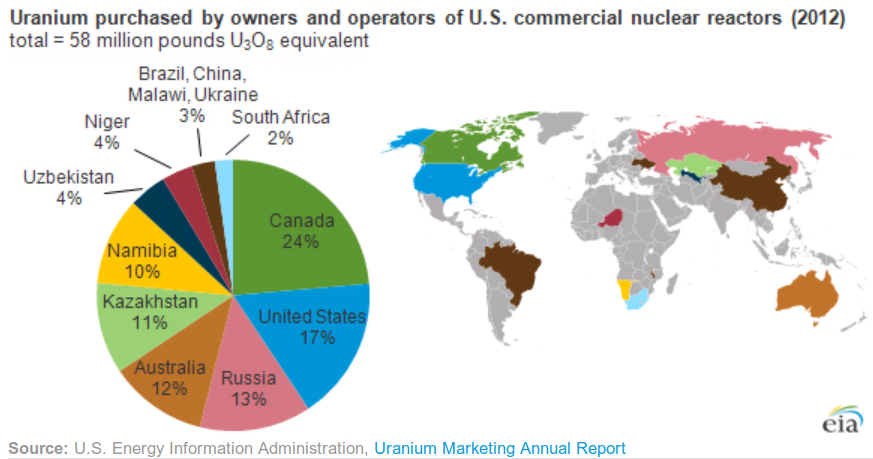
Owners and operators of U.S. commercial nuclear power reactors buy uranium in various forms as well as enrichment services from other countries. U.S. nuclear plants purchased 58 million pounds of uranium in 2012 from both domestic and foreign suppliers; 83% of this total was of foreign origin. About 38% of the enriched uranium needed to fabricate fuel for U.S. reactors was supplied by foreign enrichers.
Owners and operators of commercial nuclear power reactors buy uranium in the form of uranium concentrate, uranium hexafluoride, and/or enriched uranium. If uranium is purchased after the enrichment process, the only step remaining is the fabrication into nuclear fuel. Historically, U.S. owners and operators have purchased most of their uranium from foreign countries. In 2012, 84% of foreign-supplied uranium came from Canada, Russia, Australia, Kazakhstan, and Namibia. The rest came from Uzbekistan, Niger, South Africa, Brazil, China, Malawi, and Ukraine.
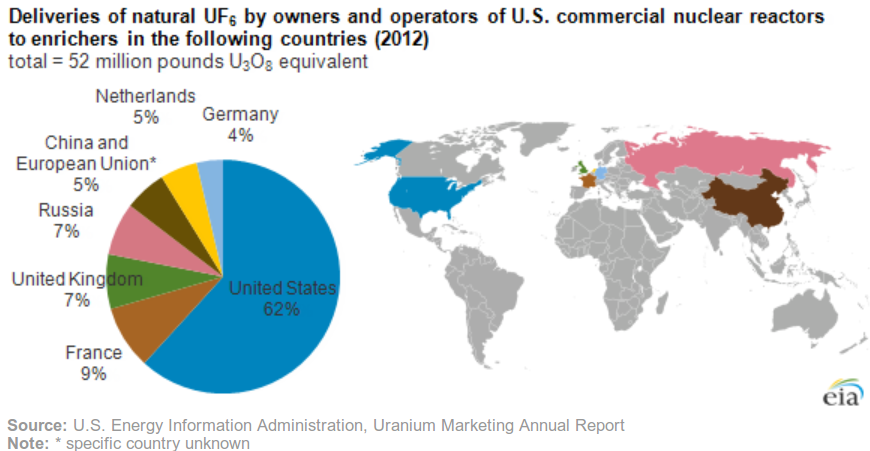
Uranium purchased earlier in the nuclear fuel cycle, such as the purchase of uranium concentrate, must be converted to natural uranium hexafluoride and enriched before reactor fuel can be fabricated. The owners and operators of U.S. commercial nuclear power reactors pay for conversion, enrichment, and fabrication. During 2012, a total of 52 million pounds of uranium hexafluoride (UF6) was delivered to enrichers in China, France, Germany, Netherlands, Russia, United Kingdom, and the United States. Enrichers in the United States received 62% of the deliveries, and the remaining 38% went to foreign enrichers.
…
What is the nuclear fuel cycle?
The nuclear fuel cycle is a multi-step process. Beginning with exploration and mining of uranium, it is then processed into uranium concentrate (U3O8, often called yellowcake). This concentrate is then converted into natural uranium hexafluoride (UF6) gas, enriched, fabricated into nuclear fuel, and sent to reactors. These steps often take place at different facilities…..
The capacity of enrichment plants is measured in terms of separative work units (SWU). SWU is a measure of how much work it takes to enrich uranium. In 2012, the average price per SWU was $141.36, and owners and operators of U.S. commercial nuclear power reactors purchased enrichment services totaling 16 million SWU. This represents a total cost to the owners and operators of U.S. commercial nuclear power reactors of about $2.3 billion.
…Again and again, these agencies and their spokespersons have denied what was in front of their very eyes. Billions of dollars are poured into cancer research, research on radiation, but any attempt to carry out epidemiological studies of those exposed to internal radiation, from depleted uranium in Iraq, to Chernobyl contamination, to the shores of the massively-contaminated Baltic Sea have been turned down for funding. I know. I applied with colleagues from Latvia Technical University and from the Karolinska Institute to look at cancer on the shores of the Baltic; no way were we going to be allowed to even get the data, let alone be funded….
I recently pointed out, this operation has to go on forever – a long sickness, but at least not a sudden death. However, this week begins a new development in the potential sudden death department.
There is a curious and bizarre reversal of the natural at Fukushima: a looking-glass world inversion. Unlike the standard marine catastrophe, for example the Titanic, where the need is to manically pump water out of the ship to stop it sinking, at Fukushima the game is to madly pump water in, in order to stop it melting down and exploding.
Probably because it is now clear that the saturation of the ground from all the pumping water for cooling the several reactors and spent fuel pools has destabilized the foundations of the buildings, TEPCO is bringing forward its operation to try and deal with what is perhaps the most dangerous of the four sites, the spent fuel pond of Reactor 4. For this pond contains a truly enormous amount of radioactive material: 1,331 spent fuel grids amounting to 228.3 tons of Uranium and Plutonium buried inside a swimming pool which has already dried out once and exploded. That explosion blasted a significant, but unknown, quantity of lethally radioactive bits and pieces of fuel element around the site (where I heard they were bulldozed into the ground – who knows?), but it also blew the top off the building, covered the fuel elements under the water with rubble and pieces of crane machinery, and no doubt twisted and melted a large proportion of the remaining spent fuel.
The operation involves the kind of game that we are all familiar with in those machines in penny arcades. You know the ones. You stick in some coins. You have levers which manipulate a claw which you position over a teddy bear or a doll and then you let this down, pick the item up and drop it down a chute to win it. In the TEPCO version of this game, you build a crane over the spent fuel tank (or what’s left of it) and manoeuver a grab down into the rubble to deftly pick out a spent fuel assembly, like a 4.5meter long and 24cm square birdcage containing the zirconium metal clad fuel elements, each unit weighing about one third of a ton.
Of course, to make the game more interesting, they are not just sitting there like they were when the tank was being used. They are under water (sea water), covered in debris, corroded, busted, twisted, intertwined and generally impossible to deal with. And here is the really scary thing: if you manage to bust a fuel element, the best outcome is that huge amounts of radioactivity escape into the air and blow over Japan, just like before. The worst outcome is when two of these things get too close, perhaps because in pulling one out it breaks and falls against another one in the tank. Because then you suddenly have lots of fission, a lot of heat, a meltdown, possibly a big blast like before, and the destruction of the entire cooling pond. Or else the water boils off and the whole thing catches fire.
OSAKA–Residents of Fukushima Prefecture and other areas who evacuated after the onset of the nuclear accident at the Fukushima No. 1 nuclear power plant are planning to file lawsuits in district courts in the Kansai region against the central government and Tokyo Electric Power Co., the plant operator.
About 140 plaintiffs will seek a total of about 1 billion yen ($10 million) as compensation for psychological stress suffered due to the nuclear accident and for the upending of their daily lives.
These will be the first lawsuits to be filed in western Japan. On March 11, 2013, the second anniversary of the Great East Japan Earthquake, 1,650 residents and evacuees filed lawsuits in district courts in eastern Japan.
According to lawyers for the plaintiffs, those who will join in the lawsuit will be 12 residents of Minami-Soma, Namie and Tomioka of Fukushima Prefecture where evacuation instructions were issued after the nuclear accident, as well as about 130 other residents of Fukushima, Miyagi and Ibaraki prefectures.
Lawsuits will be submitted to the district courts in Osaka and Kyoto on Sept. 17, and to Kobe District Court in late September.
The lawyers will argue that the central government failed to take necessary safety measures, even though it recognized the danger of an accident at the Fukushima No. 1 nuclear plant. The compensation will be for being forced to evacuate, as well as expenses incurred in the process of leading lives as evacuees and leaving some family members behind in Fukushima.
Some plaintiffs also plan to seek compensation for damage to their homes.
According to officials of the Reconstruction Agency, as of Aug. 12, there were a total of 61,355 residents of Fukushima, Miyagi and Iwate who fled their prefectures after the natural disasters and nuclear accident.
A number of prospective plaintiffs met with the media on Aug. 26 to explain their decision to sue the government and TEPCO.
Katsutoshi Sato, 52, had a home in Soma, Fukushima Prefecture, that was 45 kilometers from the Fukushima No. 1 nuclear plant. However, due to health concerns, Sato evacuated with his 76-year-old mother, 52-year-old wife and 17-year-old daughter to Ritto, Shiga Prefecture, where his younger brother lives. March 11, 2011, when the Great East Japan Earthquake hit, was the date for his daughter’s graduation ceremony at her junior high school.
After the nuclear accident, Sato made round trips between Fukushima and Shiga on a weekly basis to try to maintain the equipment company that he owned. However, sales dropped by about 70 percent and his wife was hospitalized with post-traumatic stress disorder.
In spring 2012, Sato decided to abandon plans to rebuild his company and shifted his residence to Ritto. Although he now works as a temporary worker at a citizens’ activity center in neighboring Otsu, his income has decreased sharply.
“My life was destroyed by the accident,” Sato said at the Aug. 26 news conference. “I want to pursue the responsibility of the central government and TEPCO through the lawsuit.”
Akiko Morimatsu, 39, who will head the plaintiffs’ group, evacuated from Koriyama, Fukushima Prefecture, to Osaka with her 5-year-old son and 2-year-old daughter.
“I want the case to serve as a way to protect the health and future of my children,” Morimatsu said.
Video of our rather hilarious hijack of Sunday’s Shell-sponsored Formula 1 ceremony has been pulled by YouTube following a “Copyright” (AKA “Embarrassment”) complaint. While the take down appears to have been ordered by the Formula 1 organisers, we suspect Shell is pleased. They may even be behind it. Now, why would we think that?
Well, it wouldn’t be the first time that a corporation has tried to silence a Greenpeace parody or critical piece by claiming they own their name and therefore any content mentioning them.
Before being pulled, the Formula 1 video had earned nearly a quarter of a million views in just over 36 hours. If you’re curious why, you can see it here:
So far, nobody has contacted us about a copyright violation for THIS copy of the video. We must warn you, however, that you should not share or link this video: millions of us may be held liable for copyright infringement, and Shell has made enough money destroying our planet that they could, conceivably, go after us all. So be a good internet and do as the coporate petroleum giant says, will you? (We’re kidding. Please download and share!)
But Shell may want to note that in court case after court case, our legal right to free speech has triumphed every single time it’s been tested against a corporate giant who thinks they can silence criticism with trademark law. Thankfully, that’s not the way the world works — in part thanks to the vigilance of internet freedom fighters against laws like SOPA. This is another example of why we must continue to defend our rights to free expression on the internet over the intellectual property rights of would-be corporate censors.
COVERT TOWNSHIP, MI – Some 17 employees at 11 U.S. nuclear reactors have tested positive for alcohol or illegal drugs while at work in 2013, according to the Nuclear Regulatory Commission’s Event Notification Reports.
“It’s not an everyday occurrence. Incidents like that do happen,” said Viktoria Mitlyng, spokeswoman for the NRC’s Region III, which oversees Palisades.
Hence, she said, the random drug and alcohol testing.
“This is exactly what the random drug and alcohol testing is supposed to do,” said Mitlyng.
Before being hired, employees at nuclear power plants have to undergo criminal and financial background checks, as well as psychological assessments, Mitlyng said. In addition to the random drug and alcohol testing, there is also an employee observation program – similar to mandated reporting – where employees are required to report any aberrant behavior they witness to a supervisor. That can include psychological issues, as well as substance abuse, said Mitlyng.
So far in 2013, there have been 23 Fitness For Duty reports logged on the Nuclear Regulatory Commission’s website, an analysis by the Kalamazoo Gazette found.
,,,“Yesterday at the Chernobyl nuclear power plant (it was impressed upon me) the fact that even after 27 years since the accident Ukraine still continues to struggle with the consequences of the disaster,” Japan’s minister told journalists, as translated into Ukrainian.,,,
Clean-up after the disaster is expected to take around four decades.???????
Ukraine and Japan have agreed to launch a joint satellite project to track the state of crippled Chernobyl and Fukushima nuclear plants, sites of the world’s greatest nuclear disasters.
“We have agreed on co-operation in the space sector to monitor the regions surrounding Chernobyl and Fukushima,” Japan’s Foreign Minister Fumio Kishida told reporters after talks with his Ukrainian counterpart Leonid Kozhara.
The project aims to put into orbit by 2014 eight miniature satellites to gather information on the effects of radioactive fallout on the areas adjacent to the plants.
According to the Japanese foreign ministry, it will be a joint project of Tokyo University and the Ukrainian state space agency with launches of Japanese-developed satellites by Ukrainian carrier rockets.
In March 2011, an earthquake and tsunami caused meltdowns at the Fukushima nuclear plant in northeast Japan. Clean-up after the disaster is expected to take around four decades. While no one is officially recorded as having died as a direct result of the meltdown at the reactors, large areas around the plant had to be evacuated, with tens of thousands of people still unable to return.
Satellites in the joint programme are expected to weigh about 60kg and span 50cm in diameter, the Japanese delegation confirmed yesterday.
They will take satellite images every two hours from an altitude of about 600km.
They will also receive signals from sensors installed on the ground to collect information from areas where radiation levels exceed the norm.
On Sunday Kishida visited Chernobyl, the site of the 1986 tragedy, as part of his trip to Ukraine to compare notes on relief efforts following Japan’s own disaster at Fukushima.
“Yesterday at the Chernobyl nuclear power plant (it was impressed upon me) the fact that even after 27 years since the accident Ukraine still continues to struggle with the consequences of the disaster,” Japan’s minister told journalists, as translated into Ukrainian.
The explosion at reactor number four of the Chernobyl power plant in the early hours of April 26, 1986 sent radioactive fallout into the atmosphere that spread from the Soviet Union across Europe.
According to official Ukrainian figures, more than 25,000 of the clean-up workers from then-Soviet Ukraine, Russia and Belarus have died since the disaster.
The two catastrophes are the world’s only nuclear disasters to have been categorised as level seven on the United Nations’ seven-point International Nuclear Event Scale (INES).
Twelve thousand workers to be employed at the Akkuyu nuclear power plant will be investigated for security purposes by police and the National Intelligence Organization (MIT) in the southern province of Mersin, according to media reports on Monday.
The General Directorate of Security will reportedly investigate 4,000 Turkish citizens, including interns, while MIT will look into 8,000 Russians to be hired to work at the plant, set to be built in Mersin’s Glnar district.
The Energy and Natural Resources Ministry demanded investigations into the Akkuyu power plant staff by the Interior Ministry, which initially rejected the energy ministry’s demand, stating it was against the relevant directives.
Later, the Energy and Natural Resources Ministry demanded a special article be added to a directive that allowed only for the investigation of public servants, seeking the inclusion of employees of the Akkuyu nuclear power plant, stating that the facility has strategic prominence in terms of state security.
The Justice Ministry received the demand and stated its opinion that there should be a special regulation in the directives for issues related to national security, meaning the investigation of the nuclear power plant workers should be made permissible.
Interior Ministry Deputy Undersecretary Mustafa Demirer issued a new directive to the governors of the 81 provinces stating that employees, Turkish interns and subcontractors at facilities with strategic importance such as nuclear power plants require investigation.
Future requests for security checks under the directive will be carried out through the investigation of archives; Turkish employees will be investigated by the General Directorate of Security, while MIT will be in charge of looking into foreign personnel.
So far, the General Directorate of Security and MIT have investigated the records of over 200 Turkish and foreign employees employed for the project. It has been reported that Turkish employees found to have a criminal record that includes such offenses as terrorism and smuggling will be terminated. Russian citizens who work at the Akkuyu nuclear plant will be deported if they are found to have a criminal record.
This is certainly going to help the U.S. as it tries to work with the UN Security Council to find a response to the situation in Syria.
Aug 25 (Reuters) – The U.S. National Security Agency has bugged the United Nations’ New York headquarters, Germany’s Der Spiegel weekly said on Sunday in a report on U.S. spying that could further strain relations between Washington and its allies.Citing secret U.S. documents obtained by fugitive former intelligence contractor Edward Snowden, Der Spiegel said the files showed how the United States systematically spied on other states and institutions.[…]
In the summer of 2012, NSA experts succeeded in getting into the U.N. video conferencing system and cracking its coding system, according one of the documents cited by Der Spiegel.
“The data traffic gives us internal video teleconferences of the United Nations (yay!),” Der Spiegel quoted one document as saying, adding that within three weeks the number of decoded communications rose to 458 from 12.
Yay, indeed.
The files also show that the NSA spied on the European Union’s legation in New York, and included “plans of the EU mission, its IT infrastructure and servers.” In addition, the NSA monitored the U.N.’s nuclear watchdog, the International Atomic Energy Agency (IAEA). The documents also detail bugging programs in more than 80 embassies and consulates called “Special Collection Service.” Der Spiegel writes of the program that the “surveillance is intensive and well organised and has little or nothing to do with warding off terrorists.”
It’s a game. “Let’s see if we can hack into UN video conferences!” “Why?” “To see if we can.” And they do it. They do it because they can and because they keep getting the money do it. And if they expand their programs, they can keep asking for more money to do it and do more. And because no one is keeping tabs, they can cry “terrorism” and freak out the appropriators enough to get that money. Whether it has anything to do with terrorism or not.
Generators using a strong radioactive emitting source were installed in remote located lighthouses all along the Soviet Union’s Arctic coastline in the 70ies. Over the last 10 years, a massive program for collecting and securing the potential lethal radioactive sources has been going on. Norway, for instance, financed removal of 180 so-called radioactive thermal generators (RTGs) along the coast of the Barents-, White- and Pechora Seas during the period from 2001 to 2009.
Those lighthouses are now powered by solar-panels with battery capacity to last year-around.
Funding is already allocated by USA for continuing wast of where Norway’s program stopped. Canada is also discussing a similar removal support program for RTGs in lighthouses further east on Russia’s Arctic coast north of Siberia.
But, for some of the RTGs, the removal program comes too late.
Russia’s hydrographical agency and the Federal agency for sea and river transport have searched for old RTGs in lighthouses and now announce that two of them are missing. The information is made available in a report to the International Atomic Energy Agency (IAEA) by Russia’s Kurchatov Institute.
A 700 IBS (318 kg) nuclear generator is missing from its location on the Lishniy island in the eastern Kara Sea. The island belongs to Severnaya Zemlya archipelago north of the Taimyr Peninsula.
Aleksandr Grigoriev with the Kurchatov Institute in Moscow says to Izvestia that the RTG most likely is washed out to the sea. The coastline where the lighthouse once stood was partly washed away. The amount of radioactivity in that particular RTG is believed to be between 46,000 to 50,000 Curie.
The other missing RTG was located in a lighthouse on the Kamchatka Peninsula in the Far East.
There are currently 56 lighthouses with nuclear generators still operating in western and central part of the Northern Sea Route, from the Yamal Peninsula in the west to the New Siberia Islands in the east.
A date has been set in the Federal Court case of Aboriginal traditional owners fighting plans to use their land as a nuclear waste dump.
The site on Muckaty Station near Tennant Creek in the Northern Territory is the Federal Government’s preferred site for Australia’s first radioactive waste facility.
Beyond Nuclear Initiative spokeswoman Natalie Wasley says the month-long trial has been listed for June 2014.
“After eight years that’s a big relief for traditional owners and the community who have had this nuclear cloud hanging over their heads,” she said.
She says submissions being made this week will determine whether pre-trial evidence needs to be taken.
Ms Wasley says those involved are hoping the trial would be held near the proposed site.
“It’s very important for people that they give the best evidence possible, and of course that it’s close to the site that’s being discussed,” she said.
Plans are underway to construct a tourist attraction on the location that formerly hosted Japan’s Fukushima nuclear plant that was adversely affected by the disastrous tsunami. This is despite the presence of excessive levels of radiation in the area and the waters adjacent to it.
This latest scheme is being proposed by a faction of intellectuals, learners, writers, and designers. Going by the name Fukushima Gate Village, it will be situated 25 miles from the area and will be an isolated region.
Building plans have ensured that those residing in the village hotel are adequately guarded from the hazardous concentration of radiation still present in the area. Other amenities to be built include restaurants, souvenir shops and a museum which will serve as a reminder of the second most horrible nuclear calamity to ever grace the face of the earth. Labs operating on renewable energy resources will also be constructed in the village.
A section dubbed “ground zero” will be constructed inside the nuclear plant’s periphery and is set to become a major attraction. Visitors who will be dressed in protective kits will have the ability to take snapshots of the reactors constructions and the construction team who is at the moment doing the clean out exercise from this section.
The minds behind this scheme stated that the main notion for construction of this village was for it to serve as a reminder of the mishap and also be a place where families affected by the tragedy can meet and grieve over those who lost their lives.
People residing adjacent to this village are still in an unsettled state, but the construction of this village brings a new ray of hope as it promises to create new job opportunities for them. It is predicted by professionals that it might take up thirty years to fully make the region contamination free.
Those involved say that the motivation to put up this high profile attraction was brought about by the existence of other similar attractions including New York’s Ground Zero, Auschwitz concentration camp in Poland and Cambodia’s killing fields.
The world of advertising has seen many innovations in recent years as the media landscape changes. The changes are being driven by digital communications.
One of the companies at the forefront is the Aegis Media Group, a global communication agency established in 2003 (and bought by Dentsu), that operates in over 30 markets with digital at its heart. One of the group’s subsidiary companies is Isobar, a professional full support digital marketing group working on strategic planning, creative system planning, media planning, analytics, consulting and application service, to support clients with technology all over from the world.




 Blog post by: