Now onto more current news, from an Oct. 13, 2017 news item on Nanowerk (Note: A link has been removed),
By combining the same Prussian blue pigment used in the works of popular Edo-period artist Hokusai and cellulose nanofiber, a raw material of paper, a University of Tokyo research team succeeded in synthesizing compound nanoparticles, comprising organic and inorganic substances (Scientific Reports, “Cellulose nanofiber backboned Prussian blue nanoparticles as powerful adsorbents for the selective elimination of radioactive cesium”). This new class of organic/inorganic composite nanoparticles is able to selectively adsorb, or collect on the surface, radioactive cesium.
The team subsequently developed sponges from these nanoparticles that proved highly effective in decontaminating the water and soil in Fukushima Prefecture exposed to radioactivity following the nuclear accident there in March 2011.
I think these are the actual sponges not an artist’s impression,
Removing radioactive materials such as cesium-134 and -137 from contaminated seawater or soil is not an easy job. First of all, a huge amount of similar substances with competing functions has to be removed from the area, an extremely difficult task. Prussian blue (ferric hexacyanoferrate) has a jungle gym-like colloidal structure, and the size of its single cubic orifice, or opening, is a near-perfect match to the size of cesium ions; therefore, it is prescribed as medication for patients exposed to radiation for selectively adsorbing cesium. However, as Prussian blue is highly attracted to water, recovering it becomes highly difficult once it is dissolved into the environment; for this reason, its use in the field for decontamination has been limited.
Taking a hint from the Prussian blue in Hokusai’s woodblock prints not losing their color even when getting wet from rain, the team led by Professor Ichiro Sakata and Project Professor Bunshi Fugetsu at the University of Tokyo’s Nanotechnology Innovation Research Unit at the Policy Alternatives Research Institute, and Project Researcher Adavan Kiliyankil Vipin at the Graduate School of Engineering developed an insoluble nanoparticle obtained from combining cellulose and Prussian blue—Hokusai had in fact formed a chemical bond in his handling of Prussian blue and paper (cellulose).
The scientists created this cellulose-Prussian blue combined nanoparticle by first preparing cellulose nanofibers using a process called TEMPO oxidization and securing ferric ions (III) onto them, then introduced a certain amount of hexacyanoferrate, which adhered to Prussian blue nanoparticles with a diameter ranging from 5–10 nanometers. The nanoparticles obtained in this way were highly resistant to water, and moreover, were capable of adsorbing 139 mg of radioactive cesium ion per gram.
Field studies on soil decontamination in Fukushima have been underway since last year. A highly effective approach has been to sow and allow plant seeds to germinate inside the sponge made from the nanoparticles, then getting the plants’ roots to take up cesium ions from the soil to the sponge. Water can significantly shorten decontamination times compared to soil, which usually requires extracting cesium from it with a solvent.
It has been more than six years since the radioactive fallout from a series of accidents at the Fukushima Daiichi nuclear power plant following the giant earthquake and tsunami in northeastern Japan. Decontamination with the cellulose nanofiber-Prussian blue compound can lead to new solutions for contamination in disaster-stricken areas.
“I was pondering about how Prussian blue immediately gets dissolved in water when I happened upon a Hokusai woodblock print, and how the indigo color remained firmly set in the paper, without bleeding, even after all these years,” reflects Fugetsu. He continues, “That revelation provided a clue for a solution.”
“The amount of research on cesium decontamination increased after the Chernobyl nuclear power plant accident, but a lot of the studies were limited to being academic and insufficient for practical application in Fukushima,” says Vipin. He adds, “Our research offers practical applications and has high potential for decontamination on an industrial scale not only in Fukushima but also in other cesium-contaminated areas.”
The radiation effects of the Fukushima Daiichi Nuclear Power Plant triple meltdowns are felt worldwide, whether lodged in sea life or in humans, it cumulates over time. The impact is now slowly grinding away only to show its true colors at some unpredictable date in the future. That’s how radiation works, slow but assuredly destructive, which serves to identify its risks, meaning, one nuke meltdown has the impact, over decades, of 1,000 regular industrial accidents, maybe more.
It’s been six years since the triple 100% nuke meltdowns occurred at Fukushima Daiichi d/d March 11th, 2011, nowadays referred to as “311”. Over time, it’s easy for the world at large to lose track of the serious implications of the world’s largest-ever industrial disaster; out of sight out of mind works that way.
According to Japanese government and TEPCO (Tokyo Electric Power Company) estimates, decommissioning is a decade-by-decade work-in-progress, most likely four decades at a cost of up to ¥21 trillion ($189B). However, that’s the simple part to understanding the Fukushima nuclear disaster story. The difficult painful part is largely hidden from pubic view via a highly restrictive harsh national secrecy law (Act on the Protection of Specially Designated Secrets, Act No. 108/2013), political pressure galore, and fear of exposing the truth about the inherent dangers of nuclear reactor meltdowns. Powerful vested interests want it concealed.
Following passage of the 2013 government secrecy act, which says that civil servants or others who “leak secrets” will face up to 10 years in prison, and those who “instigate leaks,” especially journalists, will be subject to a prison term of up to 5 years, Japan fell below Serbia and Botswana in the Reporters Without Borders 2014 World Press Freedom Index. The secrecy act, sharply criticized by the Japanese Federation of Bar Associations, is a shameless act of buttoned-up totalitarianism at the very moment when citizens need and in fact require transparency.
The current status, according to Mr. Okamura, a TEPCO manager, as of November 2017:
“We’re struggling with four problems: (1) reducing the radiation at the site (2) stopping the influx of groundwater (3) retrieving the spent fuel rods and (4) removing the molten nuclear fuel.” (Source: Martin Fritz, The Illusion of Normality at Fukushima, Deutsche Welle–Asia, Nov. 3, 2017)
In short, nothing much has changed in nearly seven years at the plant facilities, even though tens of thousands of workers have combed the Fukushima countryside, washing down structures, removing topsoil and storing it in large black plastic bags, which end-to-end would extend from Tokyo to Denver and back.
As it happens, sorrowfully, complete nuclear meltdowns are nearly impossible to fix because, in part, nobody knows what to do next. That’s why Chernobyl sealed off the greater area surrounding its meltdown of 1986. Along those same lines, according to Fukushima Daiichi plant manager Shunji Uchida:
”Robots and cameras have already provided us with valuable pictures. But it is still unclear what is really going on inside,” Ibid.
Seven years and they do not know what’s going on inside. Is it the China Syndrome dilemma of molten hot radioactive corium burrowing into Earth? Is it contaminating aquifers? Nobody knows, nobody can possibly know, which is one of the major risks of nuclear meltdowns, nobody knows what to do. There is no playbook for 100% meltdowns. Fukushima Daiichi proves the point.
“When a major radiological disaster happens and impacts vast tracts of land, it cannot be ‘cleaned up’ or ‘fixed’.” (Source: Hanis Maketab, Environmental Impacts of Fukushima Nuclear Disaster Will Last ‘decades to centuries’ – Greenpeace, Asia Correspondent, March 4, 2016)
Meanwhile, the world nuclear industry has ambitious growth plans, 50-60 reactors currently under construction, mostly in Asia, with up to 400 more on drawing boards. Nuke advocates claim Fukushima is well along in the cleanup phase so not to worry as the Olympics are coming in a couple of years, including events held smack dab in the heart of Fukushima, where the agricultural economy will provide fresh foodstuff.
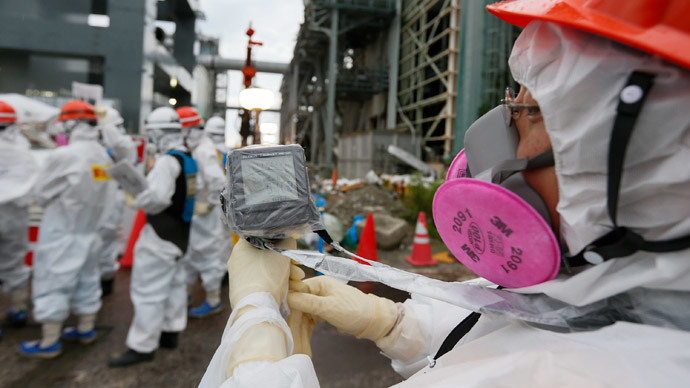
IAEA Experts at Fukushima Daiichi Nuclear Power Plant Unit 4, 2013 (Source: Wikimedia Commons)
The Olympics are PM Abe’s major PR punch to prove to the world that all-is-well at the world’s most dangerous, and out of control, industrial accident site. And, yes it is still out of control. Nevertheless, the Abe government is not concerned. Be that as it may, the risks are multi-fold and likely not well understood. For example, what if another earthquake causes further damage to already-damaged nuclear facilities that are precariously held together with hopes and prayers, subject to massive radiation explosions? Then what? After all, Japan is earthquake country, which defines the boundaries of the country. Japan typically has 400-500 earthquakes in 365 days, or nearly 1.5 quakes per day.
According to Dr. Shuzo Takemoto, professor, Department of Geophysics, Graduate School of Science, Kyoto University:
“The problem of Unit 2… If it should encounter a big earth tremor, it will be destroyed and scatter the remaining nuclear fuel and its debris, making the Tokyo metropolitan area uninhabitable. The Tokyo Olympics in 2020 will then be utterly out of the question,” (Shuzo Takemoto, Potential Global Catastrophe of the Reactor No. 2 at Fukushima Daiichi, February 11, 2017).
Since the Olympics will be held not far from the Fukushima Daiichi nuclear accident site, it’s worthwhile knowing what to expect, i.e., repercussions hidden from public view. After all, it’s highly improbable that the Japan Olympic Committee will address the radiation-risk factors for upcoming athletes and spectators. Which prompts a question: What criteria did the International Olympic Committee (IOC) follow in selecting Japan for the 2020 Summer Olympics in the face of three 100% nuclear meltdowns totally out of control? On its face, it seems reckless.
This article, in part, is based upon an academic study that brings to light serious concerns about overall transparency, TEPCO workforce health & sudden deaths, as well as upcoming Olympians, bringing to mind the proposition: Is the decision to hold the Olympics in Japan in 2020 a foolish act of insanity and a crude attempt to help cover up the ravages of radiation?
The title of Dr. Broinowski’s study provides a hint of the inherent conflict, as well as opportunism, that arises with neoliberal capitalism applied to “disaster management” principles. (Naomi Klein explored a similar concept in The Shock Doctrine: The Rise of Disaster Capitalism, Knopf Canada, 2007).
Dr. Broinowski’s research is detailed, thorough, and complex. His study begins by delving into the impact of neoliberal capitalism, bringing to the fore an equivalence of slave labor to the Japanese economy, especially in regards to what he references as “informal labour.” He preeminently describes the onslaught of supply side/neoliberal tendencies throughout the economy of Japan. The Fukushima nuke meltdowns simply bring to surface all of the warts and blemishes endemic to the neoliberal brand of capitalism.
According to Professor Broinowski:
“The ongoing disaster at the Fukushima Daiichi nuclear power station (FDNPS), operated by Tokyo Electric Power Company (TEPCO), since 11 March 2011 can be recognised as part of a global phenomenon that has been in development over some time. This disaster occurred within a social and political shift that began in the mid-1970s (ed. supply-side economics, which is strongly reflected in America’s current tax bill under consideration) and that became more acute in the early 1990s in Japan with the downturn of economic growth and greater deregulation and financialisation in the global economy. After 40 years of corporate fealty in return for lifetime contracts guaranteed by corporate unions, as tariff protections were lifted further and the workforce was increasingly casualised, those most acutely affected by a weakening welfare regime were irregular day labourers, or what we might call ‘informal labour.”
In short, the 45,000-60,000 workers recruited to deconstruct decontaminate Fukushima Daiichi and the surrounding prefecture mostly came off the streets, castoffs of neoliberalism’s impact on “… independent unions, rendered powerless, growing numbers of unemployed, unskilled and precarious youths (freeters) alongside older, vulnerable and homeless day labourers (these groups together comprising roughly 38 per cent of the workforce in 2015) found themselves not only (a) lacking insurance or (b) industrial protection but also in many cases (c) basic living needs. With increasing deindustrialisation and capital flight, regular public outbursts of frustration and anger from these groups have manifested since the Osaka riots of 1992.” (Broinowski)
The Osaka Riots of 25 years ago depict the breakdown of modern society’s working class, a problem that has spilled over into national political elections worldwide as populism/nationalism dictate winners/losers. In Osaka 1,500 rampaging laborers besieged a police station (somewhat similar to John Carpenter’s 1976 iconic film Assault on Precinct 13) over outrage of interconnecting links between police and Japan’s powerful “Yakuza” or gangsters that bribe police to turn a blind eye to gangster syndicates that get paid to recruit, often forcibly, workers for low-paying manual jobs for industry.
That’s how TEPCO gets workers to work in radiation-sensitive high risks jobs. Along the way, subcontractors rake off most of the money allocated for workers, resulting in a subhuman lifestyle for the riskiest most life-threatening jobs in Japan, maybe the riskiest most life-threatening in the world.
Japan has a long history of assembling and recruiting unskilled labor pools at cheap rates, which is typical of nearly all large-scale modern industrial projects. Labor is simply one more commodity to be used and discarded. Tokyo Electric Power Company (“TEPCO”) of Fukushima Daiichi fame adheres to those long-standing feudalistic employment practices. They hire workers via layers of subcontractors in order to avoid liabilities, i.e. accidents, health insurance, safety standards, by penetrating into the bottom social layers that have no voice in society.
As such, TEPCO is not legally obligated to report industrial accidents when workers are hired through complex webs or networks of subcontractors; there are approximately 733 subcontractors for TEPCO. Here’s the process: TEPCO employs a subcontractor “shita-uke,” which in turn employs another subcontractor “mago-uke” that relies upon labor brokers “tehaishilninpu-dashi.” At the end of the day, who’s responsible for the health and safety of workers? Who’s responsible for reporting cases of radiation sickness and/or death caused by radiation exposure?
Based upon anecdotal evidence from reliable sources in Japan, there is good reason to believe TEPCO, as well as the Japanese government, suppress public knowledge of worker radiation sickness and death, as well as the civilian population of Fukushima. Thereby, essentially hoodwinking worldwide public opinion, for example, pro-nuke enthusiasts/advocates point to the safety of nuclear power generation because of so few reported deaths in Japan. But, then again, who’s responsible for reporting worker deaths? Answer: Other than an occasional token death report by official sources, nobody!
Furthermore, TEPCO does not report worker deaths that occur outside of the workplace even though the death is a direct result of excessive radiation exposure at the workplace. For example, if a worker with radiation sickness becomes too ill to go to work, they’ll obviously die at home and therefore not be reported as a work-related death. As a result, pro-nuke advocates claim Fukushima proves how safe nuclear power is, even when it goes haywire, because there are so few, if any, deaths, as to be inconsequential. That’s a boldfaced lie that is discussed in the sequel: Fukushima Darkness – Part 2.
“As one labourer stated re Fukushima Daiichi: ‘TEPCO is God. The main contractors are kings, and we are slaves’. In short, Fukushima Daiichi clearly illustrates the social reproduction, exploitation and disposability of informal labour, in the state protection of capital, corporations and their assets.” (Broinowski)
Indeed, Japan is a totalitarian corporate state where corporate interests are protected from liability by layers of subcontractors and by vested interests of powerful political bodies and extremely harsh state secrecy laws. As such, it is believed that nuclear safety and health issues, including deaths, are underreported and likely not reported at all in most cases. Therefore, the worldview of nuclear power, as represented in Japan at Fukushima Daiichi, is horribly distorted in favor of nuclear power advocacy.
Fukushima’s Darkness – Part 2 sequel, to be published at a future date, discusses consequences.
WASHINGTON (Sputnik) – The former head of a US transportation company was indicted for allegedly bribing a Russian atomic energy firm official to secure uranium enrichment contracts, the Justice Department said in a press release.
“The charges stem from an alleged scheme to bribe Vadim Mikerin, a Russian official at JSC Techsnabexport (TENEX), a subsidiary of Russia’s State Atomic Energy Corporation and the sole supplier and exporter of Russian Federation uranium and uranium enrichment services to nuclear power companies worldwide, in order to secure contracts with TENEX,” the release said on Friday.
Mark Lambert, 54, a US state of Maryland resident, was charged in an 11-count indictment for the bribery scheme with Mikerin. The charges include violations of the Foreign Corrupt Practices Act, wire fraud and money laundering.In 2015, Mikerin pleaded guilty for attempting to make $2.1 million in illegal wire transfer payments while he served as the head of TENEX’s US operations. He is currently serving a 48-month sentence, according to the Justice Department.
The law enforcement agencies of Switzerland, Latvia and Cyprus assisted in investigating and prosecuting the matter, the release added.
Korea Hydro & Nuclear Power (KHNP) announced on January 11 that it developed the world’s first big data-based system for the purpose of predictive nuclear power plant diagnosis, that is, predictive and pre-malfunctioning monitoring, analysis and assessment of nuclear power generation facilities.
The system is characterized by connecting the monitoring systems of the 24 atomic power stations across the country to each other online and comprehensively controlling equipment like turbines and stator coolant pumps by using the IoT and real-time data transmission and reception. The system is capable of diagnosing 16,000 different equipment units in advance and is expected to contribute significantly to nuclear safety.
KHNP opens an office for integrated predictive diagnosis in Daejeon City within this month so that the utility of the system can be maximized.
In addition, the state-run energy company is planning to unveil its automatic prediction and diagnosis system for 240 out of the 16,000 equipment units in August this year and apply wireless sensors, 3D virtualization and so on to all of the equipment units by May 2020 before completing the expansion of the automatic prediction and diagnosis system and addition of functions like malfunctioning analysis to the system. A total of 40 billion won (US$36 million) is scheduled to be invested in the project.
Dr Helen Caldicott, has devoted the last forty two years to an international campaign to educate the public about the medical hazards of the nuclear age and the necessary changes in human behavior to stop environmental destruction. You can follow Dr Caldicott on Twitter @DrHCaldicott. Click here for Dr Caldicott’s complete curriculum vitae.
Below, she explains recent robot photos taken of Fukushima’s Daiichi nuclear reactors: radiation levels have not peaked, but have continued to spill toxic waste into the Pacific Ocean — but it’s only now the damage has been photographed.
RECENT reporting of a huge radiation measurement at Unit 2 in the Fukushima Daichi reactor complex does not signify that there is a peak in radiation in the reactor building.
All that it indicates is that, for the first time, the Japanese have been able to measure the intense radiation given off by the molten fuel, as each previous attempt has led to failure because the radiation is so intense the robotic parts were functionally destroyed.
The radiation measurement was 530 sieverts, or 53,000 rems (Roentgen Equivalent for Man). The dose at which half an exposed population would die is 250 to 500 rems, so this is a massive measurement. It is quite likely had the robot been able to penetrate deeper into the inner cavern containing the molten corium, the measurement would have been much greater.
These facts illustrate why it will be almost impossible to “decommission” units 1, 2 and 3 as no human could ever be exposed to such extreme radiation. This fact means that Fukushima Daichi will remain a diabolical blot upon Japan and the world for the rest of time, sitting as it does on active earthquake zones.
What the photos taken by the robot did reveal was that some of the structural supports of Unit 2 have been damaged. It is also true that all four buildings were structurally damaged by the original earthquake some five years ago and by the subsequent hydrogen explosions so, should there be an earthquake greater than seven on the Richter scale, it is very possible that one or more of these structures could collapse, leading to a massive release of radiation as the building fell on the molten core beneath. But units 1, 2 and 3 also contain cooling pools with very radioactive fuel rods — numbering 392 in Unit 1, 615 in Unit 2, and 566 in Unit 3; if an earthquake were to breach a pool, the gamma rays would be so intense that the site would have to be permanently evacuated. The fuel from Unit 4 and its cooling pool has been removed.
But there is more to fear.
The reactor complex was built adjacent to a mountain range and millions of gallons of water emanate from the mountains daily beneath the reactor complex, causing some of the earth below the reactor buildings to partially liquefy. As the water flows beneath the damaged reactors, it immerses the three molten cores and becomes extremely radioactive as it continues its journey into the adjacent Pacific Ocean.
Posted: Jan 12, 2018 12:00 AM GMT Updated: Jan 12, 2018 12:00 AM GMT
SAN FRANCISCO (AP) — California utility regulators have approved an agreement to retire the state’s last nuclear power plant.
The California Public Utilities Commission voted unanimously Thursday to ratify a 2016 deal to mothball the Diablo Canyon nuclear plant at San Luis Obispo.
Environmentalists and plant-owner Pacific Gas & Electric Co. have agreed that the state no longer needs the electricity from the nuclear plant. That’s due in part to the growing affordability of solar and wind power, as well as natural gas.
Utilities Commission President Michael Picker says Diablo Canyon no longer makes economic sense.
The deal also allows PG&E to recover $241 million from ratepayers for closing the plant.
In a new open letter to members of Congress, 17 former nuclear launch officers issued a grave warning regarding President Donald Trump’s access to nuclear weapons.
They declared that the current U.S. nuclear launch process “poses a clear and present danger to the country and the world: No one — not the secretary of defense, not the attorney general, not Congress — can veto that order. There are no reliable safeguards in place to contain this power.”
The letter comes on the heels of tweets from the president in which he boasted about having a “much bigger and more powerful” nuclear button on his desk than North Korean leader Kim Jong-un.
The missileers said there are “a number of good proposals before Congress right now that would rein in the president’s power to order the first use of nuclear weapons. Whether it’s assigning the defense secretary and attorney general a role in certifying a launch order, requiring a congressional declaration of war before the first use of nuclear weapons, or ending the policy of nuclear first use entirely, any of these common-sense measures would reduce the risk we now face.”
“We cannot stand idly by as Donald Trump holds us all hostage to his petulant mood swings,” saidBruce Blair, a veteran nuclear launch officer and co-founder of the Global Zero movement to eliminate nuclear weapons. “Donald Trump is the last person who should possess the nuclear codes and the power to start a nuclear conflagration. Our weapons have the power to destroy entire nations, including our own nation if he initiates a nuclear war. As a former steward of the nuclear launch keys, I’ve learned about the stability, competence and temperament it takes to hold such a responsibility, and Donald Trump has shown us all he possesses none of those qualities.”
Canada is set to host a major summit next week aimed at showing international support for a diplomatic solution in North Korea. But a major player won’t be there. Vassy Kapelos reports.
OTTAWA – China is taking aim at an international summit on North Korea in Vancouver next week, saying the event co-hosted by Canada and the United States is likely to do more harm than good.
The Canadian government is keeping a tight lid on which countries have been invited and plan to attend Tuesday’s meeting, which Foreign Affairs Minister Chrystia Freeland is organizing with U.S. Secretary of State Rex Tillerson.
But a senior government source connected to the summit told Global News Tuesday not “to expect to be there.”
A spokesman for the Chinese foreign ministry revealed Wednesday that his country will not be at the table, even as he criticized the meeting and suggested it will set back – rather than advance – peace efforts.
“It will only create divisions within the international community and harm joint efforts to appropriately resolve the Korean peninsula nuclear issue,” spokesman Lu Kang was quoted as telling reporters in Beijing.
Russia is also expected to be absent along with China, meaning two of North Korea’s most important and influential neighbours will be missing when Freeland and Tillerson sit down with other foreign ministers.
The U.S. and Russia have reversed decades of non-proliferation efforts in order to modernize and potentially expand their nuclear weapons arsenals, which both President Donald Trump and his Russian counterpart, Vladimir Putin, have touted as vital to the national security of their respective countries.
Russian Defense Minister Sergey Shoigu said Wednesday that his country’s nuclear stockpile, the largest in the world, should be almost entirely fitted with new, advanced weaponry in the next few years. While the Russian military remains a fraction of its Soviet-era size, Putin’s efforts to revolutionize his armed forces into a leading warfighting power capable of tackling conflicts abroad and defending the massive Eurasian country’s borders have included a renewed focus on weapons of mass destruction.
“The main focus should be made on further bolstering strategic nuclear power. The share of advanced armaments in the Russian nuclear triad should constitute at least 90 percent by 2021,” Shoigu said at a ministry meeting, according to the state-run Tass Russian News Agency.
“The task was set to provide the unconditional fulfillment of the state arms program. The army will be receiving more precision-guided weapons and cutting-edge systems of reconnaissance, communications and electronic warfare, as well as modern military gear,” he added.
Shoigu said back in November that Russia’s non-nuclear strategic forces would become fully capable of defending the country by 2020, but development and additions to Russia’s nuclear triad have persisted. Putin said last month that the nuclear modernization effort had already reached 79 percent and that the 90 percent of advanced arms in 2021 would include “missile systems that are capable of confidently overcoming existing and even projected missile defense systems.”
At sea, Russia was developing new submarines equipped with R-29RM Bulava nuclear-capable intercontinental ballistic missiles (ICBMs) and, on land, it has reportedly improved its nuclear-capable Topol-M ICBM with the ability to penetrate missile defense systems not unlike those deployed by the U.S. in Europe. Despite numerous setbacks, Russia was also expected to soon test its “Satan 2” Sarmat ICBM, said to be capable of wiping out the entire state of Texas. The Tupolev Tu-160M2, Russia’s latest nuclear bomber, was set to make its first test flight next month.
Citing Pentagon officials and nuclear experts, The Washington Free Beacon reported last month that Russia was believed to be expanding its arsenal of nuclear weapons to 8,000 warheads by 2026. These findings were anticipated to be included in the Nuclear Posture Review expected to be released sometime around Trump’s first State of the Union address later this month.
Like Putin, Trump has expressed an eagerness to bolster his nuclear arsenal and made it clear early on in his tenure as president that he wanted a bigger, stronger U.S. force, requesting a tenfold increase in nuclear weapons according to one report. While the Trump administration’s debut Nuclear Posture Review has yet to be released, at least one former official who saw a copy of the document said Tuesday the Pentagon was now looking to develop smaller, more “usable” nuclear weapons and deter other nuclear powers.
“What I’ve been told by the people who wrote the thing was what they were trying to do was to send a clear deterrent message to Russians, the North Korean and the Chinese,” Jon Wolfsthal, who served as an arms control and nuclear nonproliferation adviser to former President Barack Obama, told The Guardian.
Trump’s alleged plan to loosen restrictions on the use of nuclear weapons included a new, low-yield nuclear warhead to be fitted on the U.S.’s submarine-launched Trident II D5 ballistic missile. While both Russia and the U.S. have accused each other of violating the 1987 Intermediate-Range Nuclear Forces Treaty, they have also each flirted with the idea of creating these so-called tactical nuclear weapons that have a smaller impact, but some say increase the likelihood of a conflict going nuclear.
Russia and the U.S. have both adopted forms of a “launch under attack” policy, meaning they would not necessarily be opposed to conducting a pre-emptive strike, but only if an existential threat was detected. In a fact sheet updated earlier this week, the International Campaign to Abolish Nuclear Weapons estimated that Russia possessed 7,000 nuclear warheads and the U.S. had 6,800.
Like the leading two powers, nuclear states China, France and the U.K. were all signatories of the 1970 Nuclear Non-Proliferation Treaty, but India, Pakistan, Israel and North Korea were all believed to also possess nuclear weapons despite not signing the landmark pact.
A decision that could change the way Connecticut’s only nuclear plant sells its power is expected in the coming weeks. Now, dozens of legislators are using the state’s recent cold snap as evidence the Millstone Power Station needs to stay online.
Millstone is looking for approval to sell its power alongside certain renewables like solar and wind.
It says the change is needed to allow the industry to compete against relatively cheap natural gas.
But in a letter to state officials, dozens of legislators cautioned against an overreliance on that fuel. Calling natural gas “volatile,” lawmakers said the recent extreme cold illustrates how demand can congest the pipes moving gas around, and result in “quick and dramatic price spikes.”
Millstone — a baseload generator that’s basically always on — is insulated from such instability, the legislators wrote.
“Cheap natural gas is an attractive option for those seeking to build electric plants in New England since prices have been so low,” the legislators wrote. “While long periods of cheap natural gas appear good for customers, they also have the impact of forcing the premature shutdown of non-gas baseload resources such as nuclear.”
Meanwhile, a preliminary report from state energy officials in December concluded Connecticut’s Millstone is expected to remain profitable through 2035.
In its recent letter, Millstone says that assessment “dramatically” underestimated the station’s real costs.
But environmental groups say letting the station change the way it sells its power could dampen the development of renewable resources like solar and wind.
“Allowing Millsone to compete with up-and-coming renewable technologies like wind and solar power would unfairly force CT ratepayers to foot the bill for an antiquated, and yet highly profitable power source,” wrote Louis Burch with Citizens Campaign for the Environment.
The state is expected to issue its decision by February 1.
Thermal imagery analysis of the Yongbyon Nuclear Scientific Research Center indicates that from September 2016 through June 2017:
* The Radiochemical Laboratory operated intermittently and there have apparently been at least two unreported reprocessing campaigns to produce an undetermined amount of plutonium that can further increase North Korea’s nuclear weapons stockpile. This suggests batch rather than continuous processing of spent fuel rods from the 5 MWe Reactor during the period of analysis.
* Increased thermal activity was noted at the Uranium Enrichment Facility. It is unclear if this was the result of centrifuge operations or maintenance operations. Centrifuge operations would increase the North’s enriched uranium inventory; however, based on imagery alone, it is not possible to conclude whether the plant is producing low or highly enriched uranium.
* The thermal patterns at the probable Isotope/Tritium Production Facility have remained consistent, suggesting that the facility is not operational, or is operating at a very low level. This means, the facility is likely not producing tritium, which is an essential isotope used in the production of boosted yield nuclear weapons and hydrogen bombs.
* From December 2016 through January 2017, the thermal pattern over the Experimental Light Water Reactor (ELWR) was elevated. While that might indicate that the reactor was operational, the likelihood is low since the pattern does not appear in subsequent imagery over the last six months. It is possible that there are alternative explanations for the elevated pattern, for example, short-term activity at the ELWR such as the heating of pipes to prevent freezing. Regardless, any activity at the ELWR is cause for concern and bears continued monitoring.
* The 5 MWe Reactor has either been intermittently operating at a low-level or not operating. The notable exception to this was during December 2016 and January 2017 when thermal patterns suggests a higher level of operations.
Analysis
While commercial satellite imagery is now widely used to analyze important developments overseas, including in North Korea, thermal imagery can provide additional important insights. Landsat 7 imagery from September 2016 through June 2017 was used for this analysis, although heavy cloud cover precluded the use of imagery from last November and no night-time imagery was available for the entire time period of this study. A total of 19 images are available and of these, 10 were chosen with approximately one-month time intervals between them to provide a consistent periodicity for the analysis. Seven images were deemed too cloudy for analysis and thus weren’t considered.
Developments noted at key Yongbyon installations were as follows:
Radiochemical Laboratory
Examination of the thermal patterns associated with the Radiochemical Laboratory (reprocessing facility) show significant deviations from month to month. Concentrated heat patterns were observed with stronger temperature differences from the surrounding area between September to October of last year.
The thermal patterns then returned to lower levels until March 2017, when a distinct increase in thermal activity is observed that has continued through last month. These intermittent surges in thermal activity suggest North Korea has conducted batch rather than continuous processing of spent fuel rods from the 5 MWe Reactor.
It is typical to allow the spent fuel rods to rest for a while in cooling ponds to both cool and allow less stable plutonium isotopes (PU-238, etc.) to bleed off. These reprocessing campaigns do not necessarily occur immediately after spent fuel rods are removed from the 5 MWe reactor.
The June 2017 thermal activity coincides with an increase in activity noted in a March 2017 analysis based upon natural color imagery.
The thermal patterns at the Uranium Enrichment Facility were elevated during September and October 2016, then decreased in November 2016 and remained low until March 2017 when it increased slightly. It is unclear if the period of elevated activity from September through November was related to centrifuge operations or the maintenance activity that was observed during this period.
Experimental Light Water Reactor
The same elevated thermal patterns over the 5 MWe Reactor observed in imagery during December 2016 and January 2017 also extended over the area of the ELWR.
This was likely the result of steam being released into the air when the turbines adjacent to the 5 MWe Reactor were being run, operation of the 5 MWe Reactor itself, mid-winter heating of both structures, prevailing weather patterns, or some combination of the above. We cannot completely, however, eliminate the possibility that this elevated thermal pattern was the result of short-term activity at the ELWR itself—for example, heating the structure to prevent pipes from freezing, allowing ongoing internal construction work, or pre-startup testing. [3] It is important to note that no other significant patterns of thermal activity were observed over the ELWR throughout the study period. Importantly, the ELWR did not operate at all from February through June 2017.
Any activity at the ELWR is cause for concern and its operational status bears continued monitoring as it would be an indicator of North Korean ongoing intentions and capabilities.
5 MWe Reactor
The thermal patterns observed at the 5 MWe Reactor remain relatively consistent with those observed in the previous report indicating either intermittent low-level or no operation of the reactor. There was a notable deviation in the December 2016 and January 2017 images, suggesting a period of higher level reactor operation that lends support to a previous analysis based upon natural color imagery.
Isotope/Tritium Production Facility: The thermal patterns at the probable Isotope/Tritium Production Facility have remained consistently low throughout the period under study, suggesting that the facility is not operational, or is operating at a very low level.
Liberal opposition party signals support for Koizumi’s calls for cooperation
TOKYO — A private group advised by two former Japanese prime ministers on Wednesday unveiled the outline of a bill calling for an immediate shutdown of country’s nuclear power stations in favor of natural energy sources.
Moving Japan away from nuclear power “is difficult under the [Shinzo] Abe administration,” former Prime Minister Junichiro Koizumi told a press conference at the Diet. But that goal, he said, “will absolutely be realized in the near future, with support from a majority of citizens.”
The group would “cooperate with any party that makes serious efforts to advance denuclearization and natural energy,” added Koizumi, who headed Japan’s government from 2001 to 2006.
Fellow adviser Morihiro Hosokawa, who served as prime minister from 1993 to 1994, also attended the press conference. The group called for wide-ranging cooperation among ruling and opposition parties with the aim of submitting a bill to the regular Diet session set to convene Jan. 22.
The leader of the anti-nuclear group later took part in an energy-policy discussion with the Constitutional Democratic Party of Japan. During lower-house elections late last year, the party promised to deliver a bill to wean Japan off nuclear energy.
Bringing Japan’s nuclear power to zero is a “moral responsibility for the future of the people,” said Tetsuro Fukuyama, secretary-general of the Constitutional Democrats.










 nuclear-news
.jpg)