The signed letter says:
IAEA
International Atomic Energy Agency
INCIDENT AND EMERGENCY CENTRE
Subject: Release of radioactivity from Unit 4 of Fukushima Daiichi nuclear power plant
At 04:50 UTC on 15 March 2011 the IAEA was informed by the Japanese authorities that the spent fuel storage pond at Unit 4 of the Daiichi nuclear power plant is on fire and radioactivity is being released directly into the atmosphere. Dose rates up to 400 millisievert per hour have been reported at the site. There is the possibility that the fire has been caused by a hydrogen explosion.
The IAEA has contacted the World Meteorological Organization and has asked that the results of atmospheric models be circulated to all Member States.
The IAEA will issue further information as soon as it becomes available.
Günther Winkler
Emergency Response Manager
15-March-2011 05:10 UTC
IAEA Incident and Emergency Centre
Double defects left vessels without vital sources of coolant for their reactors, despite earlier warnings and incidents
A major nuclear incident was narrowly averted at the heart of Britain’s Royal Navy submarine fleet, The Independent on Sunday can reveal. The failure of both the primary and secondary power sources of coolant for nuclear reactors at the Devonport dockyard in Plymouth on 29 July last year followed warnings in previous years of just such a situation.
Experts yesterday compared the crisis at the naval base, operated by the Ministry of Defence and government engineering contractors Babcock Marine, with the Fukushima Daiichi power-station meltdown in Japan in 2011.
It came just four months after the Defence Secretary, Philip Hammond, announced that the base would “remain vital in the future”.
The failure of the electric-power source for coolant to nuclear reactors and then the diesel back-up generators was revealed in a heavily redacted report from the Ministry of Defence’s Site Event Report Committee (Serc).
Once a submarine arrives at the Devon base’s specially designed Tidal X-Berths, it must be connected to coolant supplies to prevent its nuclear reactor overheating.
But last July a series of what were described as “unidentified defects” triggered the failures which meant that for more than 90 minutes, submarines were left without their main sources of coolant.
The IoS has learnt that there had been two previous electrical failures at Devonport, both formally investigated.
They were the loss of primary and alternative shore supply to the nuclear hunter/killer attack sub HMS Talent in 2009 and the loss of “AC shore supply” to the now decommissioned nuclear sub HMS Trafalgar in 2011, the Serc report said.
John Large, an independent nuclear adviser who led the team that conducted radiation analysis on the Russian Kursk submarine which sank in the Barents Sea in 2000, said: “It is unbelievable that this happened. It could have been very serious. Things like this shouldn’t happen. It is a fundamental that these fail-safe requirements work. It had all the seriousness of a major meltdown – a major radioactive release.”
Mr Large warned that if a submarine had recently entered the base when the failure occurred the situation could have been “dire” because of high heat levels in its reactor.
Babcock launched an internal investigation after the incident; this blamed the complete loss of power on a defect in the central nuclear switchboard. It said the defect had resulted in an “event with potential nuclear implications”.
(Reporting by Fredrik Dahl; Editing by Alistair Lyon)
(Reuters) – The U.N. nuclear agency said on Friday it would send an international team of experts to Japan later this month to look into efforts to clean up affected areas around the crippled Fukushima atomic power plant.
Japan’s nuclear regulator earlier ordered the operator of Fukushima to draft in additional workers if needed to plug leaks of radioactive water from its tanks and report within a week on steps taken to fight the crisis.
The warning was the second in as many months issued to Tokyo Electric Power Co, or Tepco, after the company found a second escape of contaminated liquids that probably entered the Pacific Ocean
In Vienna, the U.N. International Atomic Energy Agency (IAEA) said the October 14-21 mission would “review the implementation of remediation activities in areas affected by the accident … and provide advice to address associated challenges”.
It did not give details and an IAEA spokesperson was not immediately available for comment.
The 16-person mission of IAEA as well as other experts, a follow-up from one carried out in 2011, was sent at the request of Japan’s government (See 2011 link under the IAEA logo Arclight2011), the U.N. agency said in a statement.
In the world’s worst nuclear accident in a quarter of a century, reactor meltdowns at the Fukushima facility after an earthquake and tsunami in March 2011 sent radiation spewing over large areas, forcing more than 160,0000 people to flee.
[Arclight2011 notes : The UNHCR has not released any information about the petition for the children and adults left in the contaminated lands, refugees etc nor did it mention any health effects in children or adults in a specific country based way so far as i can see so far , The report does mention the rights of the child to good health and protection from pollution in a more general way, however, the report is listed here and I am studying it now.. feel free to crack on in case my battery dies.. [i live in a field with no connection to the nuclear powered grid].. heres the link to the latest from the UNHCR September 27 2013 report>>>>
All the information should be there.. Though i heard a rumour that a separate report has been done concerning the children of Fukushima and it will be released at the last minute or during some media excitment but this last comment is hearsay (not proven yet) )
In his new book, “Command and Control,” investigative journalist Eric Schlosser looks at the safety of the U.S. nuclear arsenal, and focuses on one alarming incident in particular: the accidental explosion of a Titan II missile in Arkansas in 1980. How secure are America’s stored nuclear warheads? Schlosser, author of the 2001 bestseller Fast Food Nation, joins us in the studio.feedproxy.google.com/~r/kqedforum/~3/…
Host: Michael Krasny
Duration 52.10 mins
Guests:
Eric Schlosser, author of “Command and Control” and “Fast Food Nation;” and correspondent for the Atlantic Monthly
…The report said its findings mirror quality-assurance problems found in two previous audits of the vitrification plant….
Design changes at a new radioactive waste disposal plant at the country’s most contaminated nuclear site in south-central Washington were not properly verified to ensure safety, the U.S. Department of Energy’s Inspector General concluded in a report issued Thursday.
Design changes at a new radioactive waste disposal plant at the country’s most contaminated nuclear site in south-central Washington were not properly verified to ensure safety, the U.S. Department of Energy’s Inspector General concluded in a report issued Thursday.
The audit was highly critical of the design change process at the Hanford Nuclear Reservation’s $12.2 billion vitrification plant, considered the cornerstone of cleanup at the site. The one-of-a-kind plant is designed to convert about 56 million gallons of dangerous radioactive waste into a glasslike substance for eventual burial.
The audit said contractor Bechtel National Inc. was required to ensure the vitrification process is safe for workers, the public and the environment, but failed to do that in the design change process.
Hanford was created by the Manhattan Project during World War II in the race to build an atomic bomb. The sprawling complex near Washington’s Tri-Cities of Richland, Kennewick and Pasco is involved in a multi-decade cleanup program that already has cost more than $40 billion.
The inspector general’s office said it launched an investigation after receiving a complaint that Bechtel was missing design control documentation on the plant and could not demonstrate that some equipment was properly manufactured.
Fukushima Cover-Up: Extraordinary amount of kids have thyroid cancer — Officials say NOT caused by Fukushima since Chernobyl’s cancers took 4-5 yrs to appear — Yet data shows it started soon after ’86 meltdown… number of cases still rising 25 years later
A Fukushima prefectural government official said, “It is likely (the 44 children) developed tumours or lumps before the nuclear accident.” […] In the case of the Chernobyl disaster in 1986, thyroid cancer cases started to soar four to five years later […] A number of residents have expressed strong dissatisfaction with the Fukushima prefectural government over its interpretation of the effects of radiation exposure, the accuracy of its thyroid testing and the way it discloses information. Wikipedia::
As of August 2013, there have been more than 40 children newly diagnosed with thyroid cancer and other cancers in Fukushima prefecture as a whole, but these cancers are not attributed to radiation from Fukushima […] if Chernobyl is anything to go by the increase in thyroid cancer rates won’t begin until approximately 4–5 years after the accident.
Thyroid cancer found in 18 Fukushima children NHK WORLD English
,, Eiichiro Ochiai (2014 on website but should be 2013):
“12 out of 174.000 children”
[…]
is much higher than that seen in the Chernobyl incident
[…]
If 15 more likely cases were taken account of, the thyroid cancer incident rate among Fukushima children would be about 7.8/100.000/year, extraordinarily a high rate. (Note: this number is still an underestimate. This number would he 21/100,0110/y if the data is more properly analysed).
The authority denies that they were caused by the radiation released from the TEPCO Daichi NPP on the basis that thyroid cancer would emerge only 4-5 years after such an incident.
However, the data on the Chernobyl incident show that thyroid cancer did show up even just one year later (see Fig. 14.4)
Eiichiro Ochiai (2014 on website but should be 2013):
[…]
a few cases of thyroid cancer seem to have occurred almost immediately within 1 year. In children, the incidence
[…]
has kept increasing, even after 25 years. A similar trend has been observed for the groups aged 15 years or more (Ukraine report 2011). This continuous rise suggests that radiation sources other than the short-lived I-131, such as I-129 and Cs-137 may also be involved.
In a highly contaminated area, Gomel in Belarus, the annual incidence of thyroid cancers among children 2-18 years of age in 1998 was 58 times higher than that in 1973
Below is a draft of an article i am working on.. Please feel free to add information or critique this post on the comments below.
My idea is to crowd source this information to develop a better understanding of the politics and processes that are moving behind the scenes, out of the public eye.
My main impression is that all the countries that are involved in the nuclear fuel cycle are pushed into the deals that are already on the table and those that have been agreed.
My thoughts on this as i researched this topic were to remind me of the Trans Pacific Partnership and the USA and European Trade Deal (that has been upset by the NSA hacking European institutions like the IAEA and European Parliament).
Creating more plutonium is a very stupid idea and will allow some psychopath (1 Psychopath to every 100 people) to let of a bomb some day.
My main concern about the PRISM and TEMPORA cyber warriors are able to undermine the democratic process by supporting these secret trade deals. Was the hacking of the European MP`s etc, to be able to use information that was stolen to bribe individuals and organisations to make the “right” decisions? A lack of transparency in this whole corporate campaign to use corporate law to manipulate democratic and other types of government?
I will leave you decide.. the links are not live yet as i wanted to see how the draft will evolve
And after the A2 film premier in London that was not reported widely in the UK i wait with anticipation as to the media’s response to the terribly pro nuclear film “Pandoras Box” that is coincidentally being shown at 2 venues just after A2.. Media manipulation at its finest perhaps? We shall see!
The reasons for reprocessing
Originally it was because it was thought that there was a finite supply of uranium but as new mines open in the third world, causing a uranium glut, Uranium mining in the nuclear powered western countries are shutting down due to the ever dropping spot price of Uranium. This is likely a bid to push the price back up to ensure the MOX fuel process are more affordable.
Then it said that the waste could be handled and made safe within 500 years but the is the pollution from the processing worth it? Indeed will the technology be in place to process it all?
To reduce costs of decommissioning to the Tax Payer by some £300 million pounds sterling. (seems a small saving for such a huge project?)
The UK is now hoping that the new waste processing and fuel fabrication processes will be started at 2 sites one of which is at Bradwell UK
Secret meetings and redacted documents
The UK Government is curretly discussing its future for nuclear reprocessing in secret meetings with NGO`s for a number of years. No information has been released concerning this discussion.
The Low Level Radiation campaigns Richard Bramhall has been the spokesman for UK NGO`s and groups that are concerned about nuclear pollution from these decommissioning and fuel processing programmes. I am awaiting R. Bramhalls update media report explaining the progress made so far and will publish it here when the press release arrives.
The LLRC`s emails have been blocked over the past year (that I am aware of ) and a smear campaign against LLRC member, Prof Chris Busby after his appearences on the main stream media in the first days of the Fukushima tragedy. In fact George Monbiot seemed more worried about Chris Busby than of the 350,000 children and 20.000.000 adults that were under the initial plumes from the Daichi nuclear disaster site in the Miyagi and Fukushima Prefectures.
The problem with TEMPORA
The corporations have been accessing the TEMPORA data and in fact the police held back cases against the corporations for hacking during the Leveson enquiry. Instead the Leveson enquiry was used to dumb down the Fukushima tragedy by stopping independent scientists accessing the main stream media
The role of the Science Media Centres
The Science Media Centre has been used by DECC to get the “right” science to the public. In fact the SMC sent a psychologist to Australia to handle the Fukushima nuclear disaster in Japan. Working with Ogilvey and Maher (WPP group of companies) ensured an effective cover up of the disaster and that propaganda is still ongoing.
So, what is the problem with the discharge pollution?
Rather than remaining stuck with policies popular in the 1960s, Japan needs to reroute its policies away from reprocessing toward more effective spent fuel disposal.
I decided to work full time on expanding the conversation on the Fukushima accident and cleanup process because of one reason: nuclear power plant accidents have the ability to alter our land and society for tens of thousands years. We have seen major conflict over the last centuries, but even in the case of World War II, in which 60 million people died, our societies have proved resilient and recovered in a matter of decades, even if permanently altered. A full fuel pool fire would bring us a catastrophe like we’ve never seen.
The work of Frank von Hippel, a professor at Princeton University and co-founder of the International Panel on Fissile Materials, has brought the issues of reprocessing spent fuel, another aspect of nuclear technology laden with risk, to my attention. Chris Cote, editor and contributor to this blog, summarizes a recent report by Frank von Hippel and Masafumi Takubo and describes the technology’s ability to be a bridge to further risk: the creation of plutonium, a nuclear weapon material. I’d like to thank Dr. von Hippel for his help in reviewing this summary for publication here.
Irradiated water continues to flow into the Pacific Ocean from Fukushima Daiichi, three reactors remain radioactive and unapproachable, and a fourth loaded with spent fuel could collapse under its own weight. Amidst this disorder, Prime Minister Shinzo Abe’s government has shifted attention away from the cleanup and at the same time is planning to expand Japan’s nuclear capabilities by opening the Rokkasho Reprocessing Plant some 270 miles north of the Fukushima power plants.
Rokkasho Reprocessing Plant
As made clear by two members of the International Panel on Fissile Materials in a recent Asahi Shimbun special report, Japan’s reason for pursuing reprocessing (against the urging of the United States) likely has less to do with any fixed goal than it has to do with continuing to follow a tangled web of policies from which they cannot extricate themselves. Pursuing a policy that not only does not solve its targeted problems but leads to nuclear weapons material only because the government lacks an alternative is irresponsible. And now a workable alternative has been identified.
In “Ending Plutonium Separation: An alternative approach to managing Japan’s spent nuclear fuel,” Masafumi Takubo and Frank von Hippel show how utilities, local governments, and relevant federal agencies find themselves trapped in a complicated set of policies committing Japan to reprocessing as its nuclear spent fuel disposal policy, despite it being ineffective, costly, potentially dangerous, and destabilizing the international nuclear nonproliferation regime. Throughout the report they explain how strong central action can lead Japan to a better alternative that uses air-cooled dry casks to store spent nuclear fuel instead of reprocessing, a method that creates similar levels of waste as originally marked for disposal.
What will the Rokkasho Reprocessing Plant do? If it opens in the next few months as planned — after sixteen years of delays — the plant will take spent nuclear fuel and separate out the plutonium that was created when the original uranium was irradiated by neutrons in the reactor.
“Plutonium is a nuclear weapon material and separating it makes no sense economically. In spent fuel, it is virtually inaccessible, but separated plutonium is an attractive target for would-be nuclear terrorists. The 8 tons that Japan plans to separate annually would be sufficient to make one thousand Nagasaki-type bombs.” -in “Ending Plutonium Separation”.Read the whole report.
What uses does plutonium have? Reprocessing technology has had multiple purposes over its lifetime. Nuclear reprocessing was originally used to separate plutonium for use in nuclear weapons (plutonium doesn’t need to be enriched to high levels like uranium-235, the original ingredient in a nuclear reactor, and very small amounts can cause catastrophic damage in a bomb). Countries pursued this path to nuclear weapons following World War II and now there are large separated plutonium stocks worldwide, especially in the United States and Russia. Japan owns 44 tons, a significant amount.
In the late 1960s world uranium reserves were thought to be small and an alternative nuclear fuel was sought. Breeder reactors, so called because they create more plutonium than they use, were developed. Scientists and policy makers thought they had found a cheap, perpetual electricity source. But the reactor technology proved to be unreliable and too expensive to use without heavy government subsidy. As reprocessing became costly, it also became unpopular politically. In 1977 U.S. President Jimmy Carter announced the United States would no longer pursue commercial reprocessing as part of its non-proliferation efforts (specifically to discourage countries such as South Korea). With the failure of commercial breeders, countries decided to use the plutonium in Mixed Oxide (MOX) fuel for ordinary reactors with only a small extension of the fuel resource.
After the successes of the high-level meeting on nuclear disarmament, ask your leaders to take the next step. Ask them to commit to a ban on nuclear weapons and to prevent a nuclear catastrophe from ever happening again. www.goodbyenuk.es
The United States now is counted with 336 deployed nuclear launchers more than Russia.
Russia is already 227 deployed missiles and bombers below the 700 limit established by the treaty for 2018, and might well drop by another 40 by then to about 430 deployed strategic launchers. The United States plans to keep the full 700 launchers.
While arms control opponents in Congress have been busy criticizing the Obama administration’s proposal to reduce nuclear forces further, the latest data from the New START Treaty shows that Russia has reduced its deployed strategic nuclear forces while the United States has increased its force over the past six months.
Yes, you read that right. Over the past six months, the U.S. deployed strategic nuclear forces counted under the New START Treaty have increased by 34 warheads and 17 launchers.
It is the first time since the treaty entered into effect in February 2011 that the United States has been increasing its deployed forces during a six-month counting period.
We will have to wait a few months for the full aggregate data set to be declassified to see the details of what has happened. But it probably reflects fluctuations mainly in the number of missiles onboard ballistic missile submarines at the time of the count.
Slow Implementation
The increase in counted deployed forces does not mean that the United States has begun to build up is nuclear forces; it’s an anomaly. But it helps illustrate how slow the U.S. implementation of the treaty has been so far.
Two and a half years into the New START Treaty, the United States has still not begun reducing its operational nuclear forces. Instead, it has worked on reducing so-called phantom weapons that have been retired from the nuclear mission but are still counted under the treaty.
For reasons that are unclear (but probably have to do with opposition in Congress), the administration has chosen to reduce its operational nuclear forces later rather than sooner. Not until 2015-2016 is the navy scheduled to reduce the number of missiles on its submarines. The air force still hasn’t been told where and when to reduce the ICBM force or which of its B-52 bombers will be denuclearized.
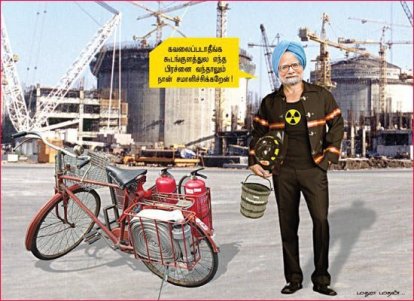
When India’s Prime Minister Manmohan Singh arrived in the U.S. last week, he reportedly carried a generous gift: an unlimited number of free lives. To be precise, Singh was ready to promise President Obama that should any of the nuclear reactors that India is planning to buy from U.S. companies ever suffer an accident, they will not have to pay anything in damages. Whether or not he made this offer is unclear — but the meeting evidently went well. Afterward the two leaders announced a deal between Westinghouse and India’s nuclear operator for building six reactors in Mithi Virdi, Gujarat.
The White House has long demanded such a pledge, and more: that it be written into India’s body of law. In 2008, Singh and President George Bush had finalized a deal enabling India to import reactors and uranium fuel without signing the Non-Proliferation Treaty. “The people of India deeply love you,” a grateful prime minister had gushed to Bush. Indians soon discovered, however, that earning a superpower’s affection takes deep pockets: in lieu of US support Singh had secretly promised to buy at least 10,000 megawatts of nuclear power from Westinghouse and General Electric, at an ballpark cost of about $40 billion. The deal also implied that India would ratify the Convention on Supplementary Compensation for Nuclear Damage.
“….In the film his character tells his enemies: “Pay for your transgression!” Given the ruthlessness with which he dealt with his political opponents, it was a line that probably required no rehearsal….”
“The Japanese are masters at turning a pinch into a new chance.”
TOKYO — Japan’s flagging antinuclear movement received an unexpected new recruit this week when one of the nation’s most popular figures, former Prime Minister Junichiro Koizumi, made a very public about-face from his previous embrace of atomic power.
In a speech to business executives in Nagoya on Tuesday, Mr. Koizumi surprised many in the solidly pro-nuclear audience by saying that Japan should rid itself of its atomic plants and switch to renewable energy sources like solar power. His remarks were reported in the Tokyo Shimbun newspaper on Wednesday.
As a pro-growth prime minister from 2001 to 2006, Mr. Koizumi had backed the business lobby by calling for Japan to become “a nation built on nuclear power,” calling it cheap and clean, and sided with the Tokyo Electric Power Company in deciding to end tax-supported subsidies for solar panels. But he said in Tuesday’s speech that he had reversed his stance after the nuclear accident at Tepco’s Fukushima complex two and a half years ago, which left at least 83,000 people homeless and forced a multibillion-dollar cleanup that has been riddled with mistakes and accidents.
“There is nothing more costly than nuclear power,” Mr. Koizumi, 71, was quoted as saying. “Japan should achieve zero nuclear plants and aim for a more sustainable society.”
Mr. Koizumi spoke on the same day that his son and political successor, Shinjiro Koizumi, 32, was named to a top cabinet post overseeing the recovery of northeastern Japan from the triple disaster that struck in March 2011, when a devastating earthquake and tsunami set off meltdowns at three Fukushima reactors.
Tuesday’s appeal was a rare return to public view by the retired prime minister, who rose to power with his uncanny ability to read the public zeitgeist and inspire voters with calls for radical change. Since retiring from politics four years ago, Mr. Koizumi has remained largely out of sight, refusing interviews or most requests to appear on television.
In the last month, local media reported that Mr. Koizumi had begun saying in private that he now opposed nuclear power, but Tuesday’s speech, before a crowd of 2,500, was one of his first public statements.
“…There is no incentive for politicians to do anything about the evacuees in an abandoned high school building in Saitama. The evacuees don’t complain, and no one complains for them.
They are going to squander a ton of money (maybe literally) on maglev trains and 2020 Olympic, but they can’t even convert this high school building into a more comfortable, habitable living space….”
As Japan celebrates “recovery” (at least in the stock market), 2020 Tokyo Olympic, maglev bullet train that will run under Japan Alps, there are still 100 people from Futaba-machi, Fukushima still living in the abandoned high school building in Saitama Prefecture, more than two and a half years after the earthquake and tsunami and the nuclear accident struck Tohoku and Kanto.
In my August 16, 2012 post, I wrote there were more than 200 Futaba-machi residents living in shelter in the Kisai High School building in Kazo City in Saitama Prefecture, in partitioned classrooms and gyms, getting boxed meals.
Since September 1, 2012, the residents who live in the high school building have had to pay for the boxed meals, 30,000 to 40,000 yen (US$300 to 400) per month, out of their own pockets.
According to a volunteer group who’s been providing the residents, mostly elderly, with hot meals every one to two months since September 2012,
One year since [we started serving hot meals], the number of people living in the shelter have been gradually decreasing. However, there are still about 100 people living here [at the high school], eating three boxed (bento) meals every day.
The plan to close this shelter is rapidly gaining momentum, but there are still many issues to be resolved. Where will the current 100 residents at the shelter go? What about compensations?
It is not a good thing that a shelter continues to exist. But we don’t think it is a good thing if this shelter is closed without consensus from the residents.
The residents at the shelter also tell us that despite bad living conditions they find emotional support through human relationship – that they live together with their friends and acquaintances from the same town [Futaba-machi]. If the shelter is closed, they will have to live apart. They have already lost so much and are forced to live in a harsh condition. It would increase the sense of loneliness in the elderly residents and deprive them of their daily joy and happiness.
Katsutaka Idogawa is no longer the mayor of Futaba-machi; he decided not to fight the recall motion by the town assembly. He was a candidate of the Green Party for the Upper Election in July this year, but his campaign didn’t get any attention and he lost.
There is no incentive for politicians to do anything about the evacuees in an abandoned high school building in Saitama. The evacuees don’t complain, and no one complains for them.
They are going to squander a ton of money (maybe literally) on maglev trains and 2020 Olympic, but they can’t even convert this high school building into a more comfortable, habitable living space.