IAEA – “Great Progress in Fukushima Daiichi Nuclear Accident Remediation Efforts “
….The mission encouraged the Government to strengthen its efforts to explain to the public that an additional individual radiation dose of 1 millisievert per year (mSv/y), which it has announced as a long-term goal, cannot be achieved in a short time by decontamination work alone…
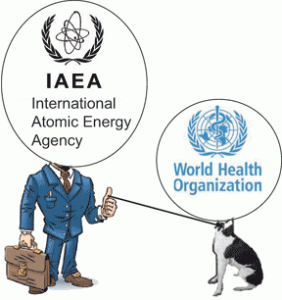
United Nation experts are encouraging the Japanese government to better communicate contamination goals with the public but are otherwise very positive about the progress that has been made in the Fukushima Daiichi nuclear accident remediation efforts in Japan. The experts are from the International Atomic Energy Agency (IAEA) a U.N. task force who oversees and reviews remediation efforts. They have been conducting ongoing reviews of the situation since the 2011 earthquake.
In March 2011, a 9.0-magnitude earthquake created a tsunami that in addition to killing 20,000 people, slammed into the power station, disabling cooling systems and leading to fuel meltdowns in three of the six units. The incident was reported to be the worst nuclear accident since the 1986 Chernobyl disaster.
The mission recognized the “huge effort and enormous resources” that Japan is devoting to its remediation strategies and activities, with the aim of improving living conditions for people affected by the nuclear accident and enabling evacuees to return home, the IAEA said in a news release.
“Japan has done an enormous amount to reduce people’s radiation exposure in the affected areas, to work towards enabling evacuees to go back to their homes and to support local communities in overcoming economic and social disruption,” said team leader Juan Carlos Lentijo, Director of the Division of Fuel Cycle and Waste Technology in the IAEA’s Department of Nuclear Energy.
He added that the team was really impressed by the involvement of a wide range of ministries, agencies and local authorities in driving these crucial remediation efforts.
The 14-21 October mission, which was requested by the Japanese Government, welcomed the extensive provision of individual dosimeters so that residents can monitor their own radiation dose rates, helping to boost public confidence.
“Good progress has been made in the remediation of affected farmland, and comprehensive implementation of food safety measures has protected consumers and improved consumer confidence in farm produce,” the press release noted, adding that a comprehensive programme to monitor fresh water sources such as rivers, lakes and ponds is ongoing, including extensive food monitoring of both wild and cultivated freshwater fish.
The mission encouraged the Government to strengthen its efforts to explain to the public that an additional individual radiation dose of 1 millisievert per year (mSv/y), which it has announced as a long-term goal, cannot be achieved in a short time by decontamination work alone.
Read more at the UN News Centre.
Article appearing courtesy Environmental News Network.
Is Japan Eyeing Nuclear Armament?
October 24, 2013
http://english.chosun.com/site/data/html_dir/2013/10/24/2013102400866.html
Japan is gearing up to build its own nuclear weapons as part of a wider rearmament drive that would allow it to send troops abroad, experts warn. Tokyo is believed to have the technology to build nuclear weapons anytime.
Two leading Japan experts in the U.S., Richard Samuels of the Center for International Studies at the MIT and James Schoff of the Carnegie Endowment for International Peace, sounded the warning in a recent report titled “Asia in the Second Nuclear Age.”
So far, they write, “memories of horrific nuclear attacks on Hiroshima and Nagasaki have sustained anti-nuclear sentiment and helped justify national policies championing nonproliferation and forgoing an indigenous nuclear arsenal.”
They warn that the view no longer holds true that “associated institutional and diplomatic constraints on nuclear breakout” mean that Japan “will find it virtually impossible” to build nuclear weapons.
Instead, they notice signs of a shift, caused by domestic and international factors in public attitudes and political calculation.
About one-third of candidates running in the Japanese general elections last year and this year supported nuclear armament, the report says. This is an all-time high.
Samuels and Schoff cite North Korea and China as external threats which Japan can use as a pretext to develop its own nuclear weapons. The North is the biggest headache to Japan. It could launch a nuclear attack on the island country if it faces regime collapse or an attack from outside, thinking that it has nothing more to lose, they speculated.
“With the U.S. nuclear umbrella shrinking and nuclear threats in Asia becoming greater and more complex, analysts cannot dismiss a nuclear-armed Japan as a purely academic exercise,” they said.
Mobile phone mast radiation, Sweden. Pr. Chris Busby
Published on 23 Oct 2013
Pr. Chris Busby and Ditta Rietuma inspecting the mobile mast radiation at 100 m distance 7th floor in Sweden, Some human experimentation.
IAEA comes to Murmansk to tote up nuclear safety roadblocks passed – and those to come
….“After the [spent nuclear fuel] has been moved into containers, which the British have supplied, it will stay in a storage facility renovated with British funds as well. According to our plans, the dismantlement will begin in late 2014,” Grigoriev said….
http://www.bellona.org/articles/articles_2013/Murmansk_IAEA
MURMANSK—Gathered for a meeting in the Russian polar city of Murmansk, experts from ten countries discussed efforts in assuring global nuclear safety in the past two years: international projects in the management of spent nuclear fuel and radioactive waste, work done in decommissioning nuclear submarines and service vessels, and the need for cross-border cooperation in clearing the Arctic seas from radiation hazards.
The 27th plenary meeting of the Contact Expert Group (CEG) – an international expert body created in 1996 under the auspices of the International Atomic Energy Agency (IAEA) to help safely and securely manage Russia’s Cold War nuclear legacy – was hosted this year in Murmansk, a far northern Russian city on the Kola Peninsula, home to Russia’s Northern Fleet.
The meeting, which took place on October 9 and 10, was gathered to discuss the results of Russia’s work with nuclear and radioactive waste and included a plenary session and visits to two sites of major significance for the international efforts to safeguard the Northern Fleet’s decommissioned nuclear vessels and stockpiles of spent nuclear fuel and radioactive waste: Sayda Bay and Andreyeva Bay.
Both former naval bases, Sayda Bay and Andreyeva Bay now serve as storage sites for the hulls and reactor compartments of old nuclear submarines, and the Russian Navy’s nuclear and radioactive waste, respectively.
Another nuclear legacy site – a former naval base called Gremikha – has been used to store spent nuclear fuel from naval reactors, and progress at this site was also discussed in Murmansk.
Bellona, which has for many years been working extensively with the issues of nuclear and radiation safety in Russia’s north, had been unsuccessful in securing permission to participate in the meeting, with the organizers routinely citing CEG provisions as reason to decline invitation to non-governmental ecological organizations.
Bellona, however, was given permission to be present in journalist capacity for part of the meeting of October 9 and the press conference given afterwards.
“We value greatly the work of the Contact Expert Group, which is a unique example of international partnership geared toward ensuring global nuclear safety. Including – and this is especially important for us – on the territory of Murmansk Region,” Murmansk Region Governor Marina Kovtun said in her welcome speech to the meeting’s participants.
According to Kovtun, the government of Murmansk Region places enormous significance on ensuring nuclear and radiation safety in the region – and save for the international assistance, these projects would be taking much longer to carry out.
“Today we are looking at nuclear safety projects in Russia’s Northwest, in particular, in Murmansk Region,” said Anatoly Zakharchev, who heads the project office for comprehensive decommissioning of nuclear submarines within the Nuclear and Radiation Safety Directorate of the State Atomic Energy Corporation Rosatom.
“Historically, it has come together so that it was in this region that the harnessing of the energy of the atomic nucleus was actively pursued in the last century. Andreyeva Bay and Sayda Bay are telling results of the progress and our joint efforts in [achieving nuclear safety],” Zakharchev said.
Remediating Gremikha
Gremikha – a restricted-access territory on the eastern shore of the Kola Peninsula, 350 kilometers off the entrance to Kola Bay – used to be home to the second largest onshore storage facility for the Northern Fleet’s spent nuclear fuel.
According to Zakharchev, the site is expected to be completely clear of spent nuclear fuel by 2020.
“In Gremikha, we will start dismantling nine more reactor cores and we think that by 2020, we will have completely cleared the base from [spent] nuclear fuel and will then begin creating a ‘brownfield’ [there] and then a ‘greenfield’ after that,” Zakharchev said.
The ‘brownfield’ concept implies cleanup of contaminated territories to a level suitable for reclaiming it for industrial uses, and a ‘greenfield’ site is one that allows the land to be used for agriculture or other non-industrial purposes.
Zakharchev said that the spent fuel from reactors of nuclear submarines laid up in Gremikha is sent to Murmansk for temporary storage at a collection site of Rosatom’s nuclear fleet operator organization, Atomflot. There, it awaits transportation to the Urals, to be reprocessed at the nuclear reprocessing facility Mayak.
Progress in Sayda Bay and Andreyeva Bay
Sayda Bay, which became the first site to accommodate reactor compartments of dismantled nuclear-powered submarines when Russia set about decommissioning its aging nuclear fleet, long remained a severe radiation hazard, with an increasing number of cut-out reactor sections collecting at the pontoon piers in the bay, where they were stored afloat.
In 2003, however, German funding and technology came to the site following an intergovernmental agreement that secured Germany’s cooperation in building an onshore storage facility in Sayda Bay.
Bellona files police report against Statoil over six years of chemicals leaked into Norwegian Sea
http://www.bellona.org/articles/articles_2013/Njord_leak
A disposal well in the Norwegian Sea owned by Norway’s state oil company Statoil leaked 3,428 tons of hazardous chemicals and oil based drilling fluids over six years at the Njord site, Bellona has learned.
Statoil further violated provisons stipulating that it disclose crucial information about the cause of the leak within two years of its discovery to Norwegian environmental authorities. Bellona alleges the oil giant delayed reporting to dodge penalites.
Statoil yesterday admitted to the leakage and issued an apology, but contested that it deliberately put off reporting the incident to Norway’s Environmental Agency.
Bellona has, nonetheless, filed a police report against the state oil company in the hope that corporate penalties will be levied against Statoil.
“We are looking very seriously at the issue and believes it is important that it be reviewed,” said Bellona adviser Karl Kristensen, who prepared the legal action (downloadable in Norwegian to right).
Leaks of so-called ‘black’ and ‘red’ chemicals and other oil-based ‘yellow’ discharges from the injection well located near Statoil’s floating Njord A platform in the Norwegian Sea off the country’s northwest coast are classified as illegal for release into the environment. Kristensen was quick to say that there is no danger that Norway’s northwest coast will be contaminated by the leaks.
The Njord A platform is attached to the injection well through a series of sub-sea pipes.
Kristensen explained that Norway’s color-based system of chemical classifications proceeds from green, which are mainly harmless. Yellow is the widest category, the majority of which constitutes chemicals that are harmful to the environment, such as oil-based drill mud, or slop.
 |
| Bellona’s Karl Kristensen |
| Bellona |
Red and black are chemicals that are highly toxic and can work their way into the food chain, causing cross-generational contamination.
According to Kristensen’s research, the leaks at the Njord injection well “are equal to or greater than the total emissions of hazardous chemicals and oil pollution from the Norwegian Continental Shelf over an entire year.”
Bellona’s police filing reports that “leaks from injection well A-14HX I the Njord Field [has] resulted in illegal discharges totaling 3,428 tons of chemicals.”
Njord production director Arve Rennemo wrote in a letter dated September 2 and quoted by Norwegian daily VG, that, “the guiding assumption is that virtually all the ‘slop’ injected into the well A-14 HX has leaked to the seabed.”
“This assumption is the basis for the estimate that a total of 3,428 tons of chemicals have leaked onto the seabed,” wrote Rennemo.
Two year reporting delay
Bellona maintains that Statoil also has violated the provisions concerning disclosure of the leakage to the pollution contorl supervisory oversight authorities with Norway’s Environmental Agency, and that it withheld crucial information about the cause of the leakage for two years, even thought the reasons were known to the company.
Australia’s nuclear policy is a complex challenge
Posted
http://www.abc.net.au/news/2013-10-23/rovere-nuclear-disarmament/5040484

Australia’s approach to nuclear non-proliferation may seem inconsistent at times, but this doesn’t mean that it’s wrong, writes Crispin Rovere.
Thom Woodroofe has accurately identified some apparent inconsistencies in Australia’s approach to nuclear non-proliferation and disarmament as revealed by the recent freedom of information disclosures made by the departments of foreign affairs and trade, and defence.
But the problem is not the policy, it is that successive governments have failed to communicate the complexity of the challenge to the Australian people.
On one level, there is some bureaucratic tension with regard to Australia’s policy on nuclear disarmament. Some in government, particularly in the diplomatic space, argue that Australia’s credentials on nuclear disarmament would be bolstered internationally if we weren’t viewed as piously lecturing others while being comfortably sheltered ourselves under the US nuclear umbrella.
Conversely, many in the defence and intelligence community emphasise the role of the US nuclear umbrella in not only protecting Australia, but also preventing the spread of nuclear weapons among US allies, many of whom would likely develop nuclear weapons if not for Americas assurances.
Few in government convincingly argue that Australia requires American nuclear assurances to preserve our own sovereignty – the overwhelming strength of America’s conventional military power is more than adequate for deterring threats from abroad. The reality is that Australia does not attach itself to America’s nuclear umbrella for our own sake, but rather to help out our American friends who are trying to keep anxious threshold states non-nuclear, such as Japan.
NZ’s nuclear-free legislation wins top disarmament award
New Zealand’s ground-breaking nuclear-free legislation wins top disarmament award
Hamburg/Geneva/New York – 23 October 2013: In 1987, against the backdrop of rising Cold War tensions between the United States and the Soviet Union, New Zealand passed its ground-breaking Nuclear-Free Act, which banned nuclear weapons and meant US nuclear-armed and nuclear-powered ships were no longer allowed in New Zealand ports.
Today, more than 25 years later, the policy has been announced by the World Future Council as winner of the Silver Future Policy Award. This year’s award seeks to highlight disarmament policies that contribute to the achievement of peace, sustainable development and human security. This evening, a formal awards ceremony will be convened at UN Headquarters.
The horrific health and environmental consequences of nuclear testing in the South Pacific, growing concern about the risks of nuclear war, and government plans to develop nuclear energy led to a surge in anti-nuclear sentiment in New Zealand in the 1970s. Among the campaigns employed by the anti-nuclear movement was the declaration of Nuclear Weapon-Free Zones (NWFZ) in classrooms, work places, towns and cities. By the 1984 general election, over 66 percent of New Zealanders lived in such NWFZs.
Although New Zealand had never possessed nuclear weapons or had an active nuclear weapons programme, it was a member of the ANZUS alliance that effectively provided New Zealand with US extended nuclear deterrence. In addition, until 1984, New Zealand welcomed the visit of nuclear-armed warships into its ports. A critical moment came in 1985, when the New Zealand Government refused a request from the United States to allow the visit of the non-nuclear destroyer USS Buchanan on the grounds that it was potentially capable of carrying nuclear weapons. The US subsequently suspended its obligations to New Zealand under the ANZUS Treaty.
In 1987 the nuclear-free policy was firmly cemented in the New Zealand Nuclear Free Zone, Arms Control, And Disarmament Act, which prohibits the emplacement or transport of nuclear-powered and armed vessels (including aircraft) from New Zealand territory and prohibits the manufacture, acquisition, possession or control over nuclear weapons as well as aiding and abetting any person in doing so by New Zealand citizens or residents.
The policy’s Silver win further reinforces the words of former New Zealand Prime Minister David Lange, who said: “Our nuclear free status is a statement of our belief that we and our fellow human beings can build the institutions which will one day allow us all to renounce the weapons of mass destruction. We are a small country and what we can do is limited. But in this as in every other great issue, we have to start somewhere.”
Former New Zealand Disarmament Minister, Matt Robson, commented on the policy’s win: “It is said that big things from little acorns grow. The former acorn of nuclear free New Zealand is now an oak as the Award recognises and will one day be part of the nuclear free oak forest across the world.”
“New Zealand’s policy started as a radical and utopian gesture, and has become part of our national identity – our DNA,” says New Zealander Alyn Ware, winner of the 2009 Right Livelihood Award for his work on nuclear disarmament, and a participant in the Future Policy Award ceremony at the United Nations on 23 October. “It inspires other countries, and empowers us kiwis to take nuclear abolition global.’
The Treaty for the Prohibition of Nuclear Weapons in Latin America and the Caribbean (Treaty of Tlatelolco) won the 2013 Future Policy Gold Award, while Argentina’s “National Programme for the Voluntary Surrender of Firearms” also received Silver. Four additional disarmament policies from Belgium, Costa Rica, Mongolia and Mozambique/South Africa were recognized as Honourable Mentions.
The Future Policy Award is the only award that honours policies rather than people on an international level. The World Future Council convened this year’s Award in partnership with the UN Office for Disarmament Affairs (UNODA) and the Inter-Parliamentary Union (IPU).
ends
Images show new work at NKorea’s nuclear test site
http://newsinfo.inquirer.net/513223/images-show-new-work-at-nkoreas-nuclear-test-site
Thursday, October 24th, 2013
AP
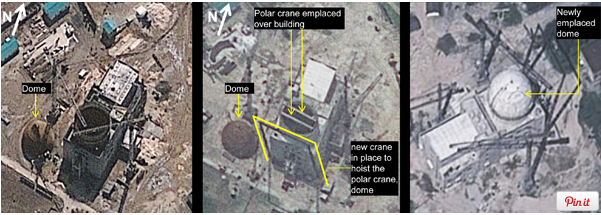
FILE – The combination of these three file satellite images taken, from left, March 20, June 24 and Aug. 6, 2012, by GeoEye-1 satellite, and released by IHS Jane’s Defence Weekly, shows development of a building construction at Yongbyon Nuclear Scientific Research Center in North Korea. AP Photo/GeoEye and IHS Jane’s Defence Weekly, File
WASHINGTON – Satellite imagery shows North Korea has made new tunnel entrances at its nuclear test site in a sign it is preparing to conduct more underground explosions there in the future, a U.S. research institute said Wednesday.
That’s the latest indication that Pyongyang is pressing on with its nuclear weapons program, although the U.S.-Korea Institute at Johns Hopkins School of Advanced International Studies says there’s no sign another test explosion is coming soon.
In February, North Korea conducted its third and most powerful nuclear test since 2006, drawing international condemnation — including from its benefactor China — and tighter U.N. sanctions. The North now says it is willing to resume aid-for-disarmament negotiations without preconditions, but the U.S. remains skeptical of Pyongyang’s intentions.
An analysis of recent commercial satellite imagery being published on the institute’s website, 38 North, concludes there are two new tunnel entrances at the Punggye-ri site in the country’s northeast, suggesting new tunnels are being constructed or new entrances for existing tunnels. There’s also enlarged heaps of soil from excavations and construction probably intended to upgrade support buildings. The latest image is from Sept. 27.
Where’s the Coverage? Many Countries Have Nuclear Power but No Enrichment
http://blog.camera.org/archives/2013/10/wheres_the_coverage_many_count.html
Posted by SC at October 23, 2013 07:47 PM
The “P5+1” talks proceed, meaning Iran is negotiating on the issue of its nuclear program with the five permanent members of the United Nations Security Council (the United States, Great Britain, France, China, Russia) plus Germany. The next round will take place early next month in Geneva and the media are tripping over themselves to cover differences between the United States and Israel on the matter. And there are differences. According to Bloomberg:
In Moscow yesterday, Russia’s chief negotiator at the talks said Iran and world powers may strike an accord allowing the Islamic republic to continue enriching uranium up to 5 percent purity. That level would require more time to turn into weapons-grade material than the 20 percent enriched uranium Iran is also producing.[…]
Netanyahu has urged the U.S. and five other powers taking part in talks with Iran in Geneva to reject any proposal that would not ensure a halt to all uranium enrichment. Iran must also stop building a plutonium-producing reactor and curtail other capabilities to make sure it can’t build a nuclear weapon, the Israeli leader says.
Iran is already in violation of a number of Security Council resolutions demanding it cease all uranium enrichment and heavy water activity – a process used to create weapons-grade plutonium. Furthermore, none of this activity is even remotely necessary if Iran, as it claims, only wants a peaceful nuclear program.
There are many countries that have nuclear power that do not have the capability to enrich their own fuel. They buy it from abroad and that’s what Iran could do. And that’s what the media are neglecting to tell you.
There are over thirty countries around the world that have nuclear power programs but according to the World Nuclear Association, only eleven have the capacity to enrich their own fuel.
Here are some of the countries that have nuclear energy but don’t enrich their own nuclear fuel:
• Argentina
• Armenia
• Belgium
• Bulgaria
• Canada
• Czech Rep
• Finland
• Hungary
• South Korea
• Lithuania
• Mexico
• Romania
• Slovakia
• Slovenia
• South Africa
• Spain
• Sweden
• Switzerland
• Ukraine
The fact is that, of countries that have enrichment capabilities, the majority also possess nuclear weapons. Countries that enrich nuclear materials but do not have nuclear weapons include Germany, Japan and the Netherlands. Countries that enrich and do have nuclear weapons include Pakistan, Russia and China.
When you think of Iran, do you think it fits in with Germany, Japan and the Netherlands? Or, does it fit better with Pakistan, Russia and China?
If that isn’t enough to make you uncomfortable, in a speech to the Supreme Cultural Revolutionary Council in 2005, Rouhani himself said:
A county that could enrich uranium to about 3.5 percent will also have the capability to enrich it to about 90 percent. Having fuel cycle capability virtually means that a country that possesses this capability is able to produce nuclear weapons.
Since Argentina, Armenia, Sweden and Spain can buy nuclear fuel from abroad, why can’t Iran? Since our neighbors Canada and Mexico can pursue this policy, why can’t Iran? And since numerous countries have nuclear energy without any enrichment capabilities, why don’t the media include this in their reporting? Where’s the context? Where’s the background? Where’s the coverage?
Japan hopes UNESCO will help cover up radiation concerns
….The Japanese government made a proposal for UNESCO registration of the country’s food culture in March 2012, backing the campaign initially launched by an incorporated nonprofit organization made up of cooks in the ancient Japanese capital of Kyoto…..

TOKYO, Oct. 23 (Kyodo)
http://www.foodmanufacturing.com/news/2013/10/japan-hopes-unesco-listing-eases-radiation-concerns
— The Japanese government is hoping that UNESCO’s likely registration of Japanese food as cultural heritage will help ease safety concerns over the country’s foodstuffs resulting from the Fukushima nuclear disaster, its top spokesman said Wednesday.
“We will make efforts to win understanding for various foods, including fish caught by people in Fukushima Prefecture, who have been suffering from baseless rumors” as a result of the nuclear crisis, Chief Cabinet Secretary Yoshihide Suga told a press conference.
The comment came as the U.N. Educational, Scientific and Cultural Organization is expected to register “Washoku: Traditional Dietary Cultures of the Japanese” as an intangible cultural heritage asset as early as December.
If it happens, the registration “will contribute to our traditional food culture passing from generation to generation based on the Japanese spirit that attaches importance to nature,” Suga said.
An organization conducting screening of candidates for UNESCO registration, called the Subsidiary Body, issued Monday a recommendation to list Japanese food culture, sources said Tuesday. Such a recommendation has never been rejected.
The registration is expected to be formally approved by the UNESCO intergovernmental committee, scheduled to meet from Dec. 2 to 7 in Baku, Azerbaijan.
Tokyo plans to widely publicize the registration as part of its effort to rebuild Japan’s northeastern region devastated by the March 2011 earthquake and tsunami, which also triggered reactor-core meltdowns at Tokyo Electric Power Co.’s Fukushima Daiichi nuclear power plant.
The development would be more positive news for the country, following the Tokyo’s successful bid to host the 2020 Summer Olympics. But it could also intensify international scrutiny of the way the government of Prime Minister Shinzo Abe is handling the Fukushima crisis.
Attention is currently focused on the massive buildup of radioactive water and spillage into the Pacific Ocean — responsible in part for food safety concerns. Abe has said the situation is “under control.”
Due to radiation fears, South Korea has banned imports of marine products from Fukushima and seven other Japanese prefectures.
Tokyo has brought the case to the World Trade Organization, requiring Seoul to lift the ban. South Korea has demanded scientific data to support Japan’s claim the products are safe.
UNESCO has registered four food cultures as heritage — French, Mexican, Mediterranean and Turkish.
This time, its screening organization made a total of 23 recommendations for the list of intangible cultural heritages, including South Korean-proposed kimchi pickle.
The Japanese government made a proposal for UNESCO registration of the country’s food culture in March 2012, backing the campaign initially launched by an incorporated nonprofit organization made up of cooks in the ancient Japanese capital of Kyoto.
[Editors note ; And do UNESCO care? They did not respond to this deposition.. not even an auto reply…. Arclight2011]
http://fukushimaappeal.blogspot.co.uk/2013/07/deposition-to-unesco-from-nuclear.html
Sorcerer needed for Fukushima- or maybe sorceress?
23 October 2013
The most disturbing sentence in the Oct. 16 Jiji article “Tepco’s toxic water failures pitiful [according to the Nuclear Regulation Authority]” is the last one: “Meanwhile, no community has volunteered to host the ‘final’ storage site.”
What mayor in his right mind would want his city to host a nuclear waste storage facility, one that will remain toxic for “tens of thousands of years”? Five thousand years from now, future archaeologists will be wearing sophisticated biochemical hazard suits whenever they venture out on a dig, thanks to the folly of 20th-century “atomic age man.” Why couldn’t mankind have waited until science developed the far safer nuclear fusion process before venturing into mass production of atomic energy?
The great pyramids of Egypt are only about 4,000 years old. Tokyo Electric Power Co. has proved to be the nuclear age’s “Sorcerer’s Apprentice,” but there’s nothing Mickey Mouse about radioactive contamination inundating the seas around Fukushima. Time for the Sorcerer to reappear and save the day.

Japan Fukushima Radiation Proof Underwear Hits The Market
Published on 23 Oct 2013
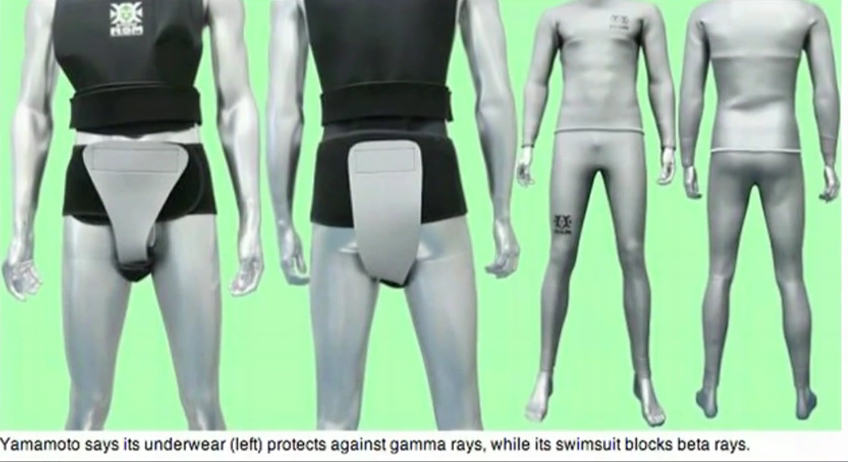
A swimwear company in Japan will soon release radiation-proof underwear and swimsuits. The radiation fallout from Fukushima nuclear power plant in Japan continues to concern local residents. Now, a swimwear company in the country plans to release radiation-proof underwear and swimwear. Priced at about 800 dollars a pair, the undergarments promise added defense against harmful rays. As far as comfort goes, there’s probably none to be had as the carbon-embedded rubber garment weighs over 7 pounds. It’s not very stylish, either, but given that they were designed to protect those working in the contaminated areas near Fukushima, aesthetics aren’t likely high on the list of concerns. Both it and the wetsuit-like swimwear made of the same radiation-blocking material are intended to add an extra layer of protection beneath the standard garb. What most differentiates them from other items on the market is the level of defense they offer. Said the manufacturer, “The clothes which protect from two kinds of radiation – beta and gamma rays – … are the first development of such kind in the world.” The swimwear is said to block nearly 100 percent of the beta variety. Being exposed to radiation can lead to a number of serious health conditions, including cancer.
Civil nuclear energy in Russia – UK Trade and Investment
Market overview
Russian nuclear industry is one of the world’s leaders in terms of level of scientific and technological developments in the area of reactor design, nuclear fuel, experience of nuclear power plant operation, NPP personnel qualification.
Its complex consists of over 250 enterprises and organizations employing over 250 thousand people.
Nuclear industry structure:
-
Companies in nuclear fuel cycle
-
Companies in nuclear power engineering
-
Companies in the sector of nuclear weapons application
-
Research institutes
State Atomic Energy Corporation Rosatom consolidates the enterprises mentioned above. It is the only company in the world that has a complete nuclear power cycle. Its daughter company – JSC Atomenergoprom consolidates the civilian part of the nuclear industry.
At present Russia operates 31 nuclear power reactors in 10 plants, which provide 16% of the country’s electricity and 17% of the world nuclear fuel.
As of beginning of 2013 Rosatom has orders for 80 units for the projects that include construction of nuclear plants in Armenia, Bangladesh, Belarus, Bulgaria, India, Iran, China, Kazakhstan, Russian Federation (10 units under construction , another 14 units operational by 2020), Slovakia, Turkey, Ukraine, Vietnam (source: (www.rosatom.ru).
Above all, there are 154 reactors with 173 GW ordered or planned (mostly expected in operation in 8-10 years) (source: www.rosatom.ru). Additional 341 reactors with 390 GW are proposed (expected operation in 15 years) (www.rosatom.ru)
Rosatom Reactors – distribution by geographical areas (source: www.rosatom.ru):
-
NAFTA: USA – 4 being built, 10 planned/ordered, 32 proposed
-
South America: 2 being built2 planned/ordered, 9proposed
-
Rest of Europe: 2 being built, 5 planned/ordered, 26 proposed
-
Eastern Europe: 2 being built, 17 planned/ordered, 28 proposed
-
Middle East: 12 planned/ordered, 17 proposed
-
Russia& non-EE CIS: 10 being built, 17 planned/ordered, 32 proposed
-
East Asia(excl. China): 7 being built, 16 planned/ordered, 6 proposed
-
China: 27 being built, 51planned/ordered, 120proposed
-
SE Asia: 2 being built, 2planned/ordered, 23proposed
-
Indian subcontinent: 7 being built, 20 planned/ordered, 42 proposed
-
RSA: South Africa – 6 proposed
Since a long time ago Rosatom has expressed particular interest in perspectives to build NPP in UK, where 8 sites have been finally approved as suitable for new build (www.world-nuclear-news.org).
In September 2013 a Memorandum of Understanding was signed between the Russian state atomic energy corporation Rosatom and DECC in the UK. This established a programme of commercial cooperation in civil nuclear energy and was signed by UK Energy Minister Michael Fallon and Rosatom Head Sergei Kiriyenko. It supports cooperation between Rosatom (Russia), Fortum (Finland) and Rolls-Royce (UK) in the process of investigation and implementation of projects to construct Russian-designed VVER pressurized water reactors in the UK. (source: www.gov.uk)
Moreover, in September 2013 Rolls-Royce (UK) signed a business contract with Rosatom to handle engineering and safety evaluation functions on Rosatom’s VVER technology ahead of its potential entry in the Generic Design Assessment process. (source: www.gov.uk)
As a result, UK became one of the most favourable markets for establishment of business relations and outsourcing of Russian nuclear sector.
There are several UK companies that are already active in the Russian Nuclear Energy Sector: Rolls-Royce, Doosan Babcock, ClydeUnion, Norton Rose, Sheffield Forgemasters and Worley Parsons.
Fuel Cycle and Regulatory sub-sector
The University of Missouri gets a big nuclear energy grant
COLUMBIA, Mo. (AP) – The University of Missouri is getting $1.8 million from the federal government to encourage nuclear energy development.
The grants announced Tuesday will help fund the development of a supply chain, logistics, and infrastructure needed to manufacture small modular nuclear reactors.
Modular reactors are smaller than large nuclear power plants. They can be built in factories and shipped where they are needed. The university in July announced a partnership with Westinghouse Electric Co. and Ameren Missouri to work on research related to modular nuclear reactors.
President Barack Obama’s administration said Tuesday that the project also will assess the education and training needed for a workforce to produce the reactors.
Sen. Claire McCaskill said the grant shows Missouri is well situated to lead the nation in developing small modular nuclear reactors.
(Copyright 2013 The Associated Press. All rights reserved. This material may not be published, broadcast, rewritten or redistributed.)
Associated Press
Doctors to Say UN Science Report Systematically Underestimates Health Impact of Fukushima Catastrophe
Concerns to be Outlined in NYC About Conflicting United Nations Fukushima Reports and Their Global Implications
22 October2013
What:
Two conflicting reports on Fukushima – one by the U.N. Human Rights Council Special Rapporteur on the right to health and the other by the U.N. Scientific Committee on the Effects of Atomic Radiation (UNSCEAR) – will be discussed at a public meeting on October 24, prior to the presentation of the reports to the U.N. General Assembly on October 25 at the 3rd and 4th Committees, respectively. Speakers will include: the author of the Human Rights Council report, a co-author of an NGO critique of the UNSCEAR report, and a representative of a Japanese human rights organization.
Since the March 2011 nuclear disaster in Fukushima, individuals and communities in Japan continue to be exposed to dangerous levels of radioactivity. There are serious concerns about consequent health effects for citizens in contaminated areas. Residents have a right to live in a safe and healthy environment, however, sufficient protective measures and support are not being provided. The right of access to medical treatment and the medical data about one’s own body are being seriously denied. Experts will speak about how these two U.N. reports impact policy regarding the lives and health of citizens currently affected after the nuclear disaster, and what should be done to provide immediate relief to protect their fundamental right to health.
When:
Thurs., Oct. 24, 2013, 9:30 a.m.-Noon.
Where:
Baha’i International Community – 866 U.N. Plaza, Suite 120 – New York City. Free and open to public – no UN pass required – 48th Street & First Avenue. Due to limited space, please register (name, contact info, affiliation) by sending an email to HRNNY1024@gmail.com.
Speakers:
- Anand Grover, special rapporteur on the right to health, U.N. Human Rights Council, and visitor to Japan when writing the Human Rights Council report;
- Dr. John Rachow MD, Physicians for Social Responsibility (PSR), and a visitor to Fukushima in 2012; and
- Mari Inoue, Esq, Human Rights Now, a Japanese human rights organization.
Media Contacts:
Alfred Meyer, (202) 215-8208 or alfred.c.meyer@gmail.com (PSR USA); and alexrosen@gmx.net (IPPNW Germany).
Backgrounder:
As physicians concerned with the effects of radioactive fallout on human health and the ecosystem, Physicians for Social Responsibility-USA and International Physicians for the Prevention of Nuclear War-Germany have reviewed the upcoming United Nations Scientific Committee on the Effects of Atomic Radiation (UNSCEAR) report to the U.N. General Assembly. We appreciate the effort made by UNSCEAR committee members to evaluate the extensive and complex data concerning the Fukushima nuclear catastrophe. While parts of the UNSCEAR report will be useful in the future to assess the consequences of the nuclear meltdowns on public health and the environment, we believe the 2013 UNSCEAR report systematically underestimates the true extent of the catastrophe. Many of the assumptions are based on the two WHO/IAEA reports published in May 2012 and February 2013, which did not accurately portray the true extent of radiation exposure, followed faulty assumptions, ignored the ongoing radioactive emissions over the past 2½ years and excluded non-cancer effects of radiation.
HUMAN RIGHTS NOW: Human Rights Now (HRN), an international NGO in consultative status with the ECOSOC, is based in Tokyo with several hundreds of members composed of lawyers, scholars, journalists and concerned citizens. In July 2011, on behalf of a coalition of civil society groups in Japan, Human Rights Now requested the Office of United Nations High Commissioner for Human Rights (OHCHR) for a Special Rapporteur to investigate the human rights situation after the disaster. In response to the request, Anand Grover, the special rapporteur on the right to health, visited Japan in November 2012. In December 2012, HRN submitted a joint statement, endorsed by more than 70 civil societies in Japan and worldwide, urging the IAEA and the Japanese government to take a rights-based approach in response to the nuclear disaster based on the preliminary findings and recommendations issued by Grover in November. To raise awareness of the situation in Fukushima after the nuclear accident, HRN NY has organized human rights seminars and a press conference to inform the international community about the ongoing crisis. (http://hrn.or.jp/eng/)
PHYSICIANS FOR SOCIAL RESPONSIBILITY: Physicians for Social Responsibility (PSR), the U.S. affiliate of International Physicians for the Prevention of Nuclear War (IPPNW) advocates for sound public health policies regarding exposure to radioactive and other toxic materials. PSR is the medical and public health voice working to prevent the use of and to abolish nuclear weapons, to promote safe, non-nuclear energy, and to slow, stop and reverse global warming and the toxic degradation of the environment. Fukushima presents an immediate challenge to protect those individuals most endangered by exposure to dangerous levels of radioactivity, and to adequately and openly track the health consequences of the ongoing irradiation of populations. PSR was founded in 1961 and was instrumental in achieving the Limited Nuclear Test Ban Treaty that ended the global radioactive contamination produced by atmospheric nuclear bomb testing. PSR shared in the 1985 Nobel Peace Prize awarded to International Physicians for the Prevention of Nuclear War (IPPNW), for building public pressure to push their governments to end the nuclear arms race. (http://www.psr.org/)
/PRNewswire-USNewswire — Oct. 22, 2013/
SOURCE Physicians for Social Responsibility and Human Rights Now
 (Source: PR Newswire )
(Source: Quotemedia)
1 This Month





PLEASE OPPOSE HR 8255 AND S.3639 – bills would accelerate satellite deployment, with no environmental review or safeguards – https://ncstd5li.quorum.us/campaign/169331/
To see nuclear-related stories in greater depth and intensity – go to https://nuclearinformation.wordpress.com
-
Archives
- October 2026 (81)
- September 2026 (339)
- August 2026 (330)
- July 2026 (355)
- June 2026 (287)
- May 2026 (306)
- April 2026 (356)
- March 2026 (251)
- February 2026 (267)
- January 2026 (308)
- December 2025 (358)
- November 2025 (359)
-
Categories
- 1
- 1 NUCLEAR ISSUES
- business and costs
- climate change
- culture and arts
- ENERGY
- environment
- health
- history
- indigenous issues
- Legal
- marketing of nuclear
- media
- opposition to nuclear
- PERSONAL STORIES
- politics
- politics international
- Religion and ethics
- safety
- secrets,lies and civil liberties
- spinbuster
- technology
- Uranium
- wastes
- weapons and war
- Women
- 2 WORLD
- ACTION
- AFRICA
- Atrocities
- AUSTRALIA
- Christina's notes
- Christina's themes
- culture and arts
- Events
- Fuk 2022
- Fuk 2023
- Fukushima 2017
- Fukushima 2018
- fukushima 2019
- Fukushima 2020
- Fukushima 2021
- general
- global warming
- Humour (God we need it)
- Nuclear
- RARE EARTHS
- Reference
- resources – print
- Resources -audiovicual
- Weekly Newsletter
- World
- World Nuclear
- YouTube
-
RSS
Entries RSS
Comments RSS

