Aerojet Rocketdyne is heading back to space… with a bullet.
“Yesterday, GenCorp (NYSE: GY) revealed that its Aerojet Rocketdyne subsidiary has been chosen to develop and demo a new rocket engine for the U.S. Air Force. Specifically, GenCorp will build a “Medium Class Stage III motor” to replace the current batch of SR-73 third-stage motors that help lift Minuteman III Intercontinental Ballistic Missiles into space.”
…On China-Europe relations, Li called on France to play a constructive role in the negotiation of China-Europe investment agreement, and urge the EU to uphold free trade and be cautious in taking trade remedy measures, so as to maintain the sound development of China-Europe relations.
“China hopes the EU will not start an investigation into China’s wireless telecom products,” he noted…..
BEIJING, Dec. 6 (Xinhua) — China and France on Friday vowed to expand their three decades of nuclear energy cooperation to target markets in other countries.
Chinese Premier Li Keqiang (R) and French Prime Minister Jean-Marc Ayrault attend a press
conference in Beijing, capital of China, Dec. 6, 2013. (Xinhua/Xie Huanchi)
“We agreed to jointly exploit third-party markets of nuclear energy.China hopes the two countries can find broader space in the markets,” said Chinese Premier Li Keqiang while meeting reporters after his hour-long talks with visiting French Prime Minister Jean-Marc Ayrault. Li described their discussion as “candid and friendly.”
Nuclear energy cooperation between China and France dates back to the early 1990s establishment of the Daya Bay nuclear power plant in south China’s Guangdong Province. It has two 1,000 MW pressurized water reactors introduced from France.
TOKYO — The United States’ top nuclear regulator said Friday that atomic energy users, including Japan, must figure out how to ultimately store radioactive waste.
Allison Macfarlane, head of the Nuclear Regulatory Commission, said in Tokyo that finding an underground repository remains a challenge despite a global consensus on the need for such a facility to deal with waste coming out of nuclear power plants.
Her comment came as Japan finalizes a new energy policy that reverses a phase-out plan set by the previous government after the March 2011 Fukushima disaster.
Japan has no final waste repository, not even a potential site. The U.S. government’s plan for building a repository at Yucca Mountain in Nevada has been halted by strong local opposition due to safety concerns.
“In the nuclear community, we of course have to face the reality of the end product — spent fuel,” Macfarlane told reporters.
She urged countries that are contemplating or embarking on a nuclear power program to formulate back-end plans at an early stage.
The new policy under Prime Minister Shinzo Abe’s pro-nuclear government is pushing to restart as many reactors as possible if deemed safe under the new, stricter safety standards that took effect this past summer. The new policy, whose draft was discussed Friday by a government panel, is also expected to stick to Japan’s shaky fuel cycle program despite international concerns about the country’s massive plutonium stockpile.
Japan is stuck with 44 tons of plutonium at home and overseas after unsuccessfully pushing to establish a fuel cycle, with its fast breeder reactor and a reprocessing plant never fully operated. Experts say Japan’s plutonium stockpile poses a nuclear security threat and raises questions over whether Japan plans to develop a nuclear weapon, which Tokyo denies.
Japan also has more than 14,000 tons of spent fuel in cooling pools at its 50 reactors, all of which are offline. Some pools are expected to be full in several years, and are expected to be moved to a dry cask facility just completed in northern Japan.
Macfarlane said moving them to dry cask storage is a safer option but still only a temporary measure.
This week’s incident in Mexico, in which highly lethal cobalt-60 was stolen in a truck theft and not recovered for two days, may have been unusually disquieting, but it was not unusual. Nuclear material is stolen or lost two to four dozen times a year every year. Sometimes small amounts, sometimes large. It happens an awful lot in Russia and other former Soviet states; it happens in poorer, nuclear-capable countries such as Mexico, India and South Africa; and you’d better believe it happens in rich countries, as well, particularly in France.
That’s according to the International Atomic Energy Agency’s Incident and Trafficking Database, which works with governments around the world to track such incidents. Many of the cases are never publicly reported — the IAEA doesn’t release details so that governments will be more willing to fess up when material goes missing. A group called the Nuclear Threat Initiative tracks open-source reports of these incidents. They don’t catch everything, but they’ve recorded enough to show the alarming frequency with which dangerous nuclear materials are lost or go missing. Some of those cases from the past decade are mapped out below. If you weren’t worried about loose nuclear material before, you will be after reading details of the incidents at the bottom of the map.
or more, read my interview with nuclear policy expert Mark Hibbs on why this happens and what makes it dangerous.
The European Commission is to review its procedures for ensuring nuclear materials in the European Union (EU) are not diverted from peaceful to military uses.
It has released a tender for an expert to check its systems, which are coordinated by its directorate general for energy Directorate E, based in Luxembourg. The EC has 162 nuclear inspectors and a €20.5 million ($28.1 million) budget, conducting 1275 inspections in 2012, assessing 1.6 million records from nuclear operators. The commission said Directorate E is conducting an internal analysis of how it implements these checks, and wants an independent review to “identify, suggest and document any possible improvement.”
The chosen contractor would assess concepts and methodology; internal organisation and procedures; interaction with external stakeholders; and verification evaluation and its effectiveness. The tender documents explain: “In all four aspects, focus is to be put on the efficiency of the use made of human and financial resources, while respecting the existing legal obligations under the Euratom Treaty and while maintaining the credibility and effectiveness of the Euratom safeguards system.”
With regards to concepts and methodology, the consultant would be asked to consider whether the Commission’s work “adequately cover the risk of possible diversion of nuclear material.” The reviewer would assess the added value created by inspections. They will also be asked to propose inspection priorities, comparing assessments of quality of nuclear material; its quantity; and the type of nuclear facility involved, depending on the complexity of the technical process and/or the accessibility of nuclear material for safeguards verifications.
The consultant would also be asked to assess the importance of focusing on strategic installations (enrichment, fuel fabrication and reprocessing plants); those where deficiencies in the nuclear material accountancy and control system have been found; and plants where the risk of theft or loss is considered high. They will be asked to consider sample-taking and analysis; and assessments of how operators’ nuclear material accountancy and measurement systems fit external standards.
Nuclear power plants generates clean, baseline-quality energy, advocates like to claim.
English: Nuclear power plant in Cattenom, France Deutsch: Kernkraftwerk in Cattenom, Frankreich (Photo credit: Wikipedia)
It’s too bad that nuclear is also about the most expensive form of power you can buy.
A recent report and statement from CEZ-AS, the country’s largest utility, once again highlight why the economics of nuclear don’t work. In short, CEZ has been pushing to add two new nuclear reactors to the Temerlin plant that would come online around 2025.
The utility has made the usual argument—that nuclear will create employment, help the country gain energy independence and even let the Czechs export power to neighboring European countries—but it has also said it can’t build the plan without government guarantees on the price of power.
We won’t build without state guarantees,” Pavel Cyrani, chief of strategy at CEZ told Bloomberg in an interview. “It’s simply impossible.”
How high would those guarantees have to be? A pair of studies from Candole Partners predicts that the price would have to be 115 Euros a megawatt hour, or $157 per megawatt hour, in 2013 dollars for the full lifetime operation of the Temerlin reactors for it to break even.
It’s high. Spot prices in the country are now around 40 Euros, or $55, per megawatt hour. Peak prices in New England grazed $230 per megawatt hour during a hot afternoon this past July, but generally the forward process are comfortably below $100. As I write, the wholesale price ticker at PJM pegs U.S. power at $62 per megawatt hour.
The subsidies required to make power from the plant competitive with today’s prices would cost taxpayers around a billion Euros a year, wrote Georgi Vukov at Candole.
In Israel, as in Iran, militant leaders have shown political tenacity and a capacity for survival that dwarfs any perception of sentimentality or principle. For them all means seem to justify their political ends.
The unwritten rule in US and other Western capitals regarding nukes is: Don’t mention Israel’s nuclear programme. Even journalists in the mainstream media don’t, or won’t, ask the Israeli or Western officials simple and direct questions about Israel’s nukes. There seems to be an “unspoken understanding” that Israel’s bombs are best left unmentioned, even when, as Micah Zenko writes in Foreign Policy, “Israeli officials routinely hint at missions where they would be used – specifically for deterrence or to threaten deeply buried targets in Iran.” Ever since it was built with France’s help in the 1950s, Israel has rejected any international inspections or oversight of its reactor in the southern part of the country. Any leaks from this decades-old reactor in Dimona could affect millions of Israelis and Palestinians. Meanwhile, the world’s powers have signed an agreement with Iran, which allows them access to most of the country’s nuclear sites. They also put to rest the possibility that Iranian possession of nuclear weapons would have been a major blow to nuclear non-proliferation and would have had disastrous implications for the region and world security. A balance of nuclear terror between Israel and Iran wouldn’t have necessarily led to the same result as the Cold War between the US and Soviet Union. According to some Western estimates, a worst case scenario of future nuclear confrontation between Israel and Iran would lead to (wild as it may seem) some 27 million Iranian deaths and two million Israeli deaths. But thanks to the recent rounds of negotiations, the Iranian programme is about to be fully transparent, inspected and contained to ensure its use is limited to peaceful purposes. However, the Israeli government and its supporters in Washington contend that Iran cannot be trusted; that it’s dangerous, unpredictable, and is adamant on destroying Israel. To confirm or contradict such assertions, one needs to look at the facts, judge them by studying the historical record, and look at Iran’s behaviour since 1979 and how it contrasts and conflates with Israel’s. Enriching difference The Non-Proliferation Treaty (NPT) that Iran signed in 1968, and ratified in 1970, allows for inspections of its facilities. Israel has refused to sign the NPT and rejects any inspection or oversight by any international body. Iran has made it abundantly clear on countless occasions that it stands against nuclear weapons and considers them un-Islamic. Israel maintains opacity – or “transparent ambiguity” regarding its nuclear status; so transparent, in fact, that anyone in the world is privy to the idea that Israel is committed to its nuclear deterrence. Iran insists on its right to enrich uranium for peaceful purposes under the supervision of the IAEA. Israel insists on its right to enrich weapon-grade plutonium outside the framework of the NPT. Iran has been accused of concealing parts of its programmes and failing to meet its obligation under the NPT treaty. Israel has fully concealed its nuclear weapon programme and rejected any international authority or safeguards of its reactor. Iran has joined 19 rounds of negotiations on its nuclear programme over the last ten years. Israel has rejected negotiations and any mention or discussion about them.
The law mandates prison terms of up to 10 years for government officials who leak secrets. Journalists who get information in an “inappropriate” or “wrong” way could be jailed for up to five years. It bans attempted leaks, inappropriate reporting, complicity and solicitation.
TOKYO — Japan’s parliament approved on Friday a state secrets law that stiffens penalties for leaks by government officials and for journalists who seek such information, overriding criticism that it could be used to cover up government abuses and suppress civil liberties.
The ruling coalition forced a vote on the bill in an upper house committee on Thursday. Despite stalling tactics by opposition parties, the full upper house approved the bill on Friday by 130 to 82.
The more powerful lower house had approved the bill last week.
Prime Minister Shinzo Abe, who is seeking to increase Japan’s global security role and create a more authoritarian government at home, says the law is needed to protect national security and assuage U.S. concerns over the risks of sharing strategically sensitive information with Tokyo.
Critics worry the law could be used to hinder public disclosures, punish whistleblowers or muzzle the media since journalists could be jailed for seeking information they do not know is classified as secret.
The bill allows heads of ministries and agencies to classify 23 vaguely worded types of information related to defense, diplomacy, counterintelligence and counterterrorism, almost indefinitely.
Even some members of Abe’s Liberal Democratic Party complained that the government rushed too quickly to get the bill approved before the end of the current parliamentary session.
“I think there needs to be more explanation,” party member Takashi Uto said during the committee debate. “Naturally people are concerned because they don’t know what will be a secret.”
…During one of a number of testy exchanges between the two, Mr Wolfe, who finished his submission yesterday afternoon, went on: “Fukushima was unlikely to happen, too. We learned the lessons of Fukushima.”…
An Taisce objections not supported by Irish Government, say British
The merits of An Taisce’s challenge to a nuclear power station in Britain is illustrated by the fact that it has not been supported by the Irish Government, a lawyer for the British government argued yesterday.
The way was cleared by British energy secretary Ed Davey last month for the station at Hinkley Point in Somerset – a £14 billion project to be built by French energy company EDF, backed by Chinese money and capable of powering five million homes .
An Taisce has sought a judicial review, arguing that the energy secretary “acted unlawfully” in granting planning permission without carrying out “transboundary consulation” with the Irish, as required under EU rules.
However, Mr Davey has argued in legal papers lodged for the two-day hearing that he is required to consult where there is “a real risk”, or “a serious possibility” of “significant environmental effects”, but not where there is only a bare possibility.
The Irish Government has repeatedly raised questions about the operation of the Sellafield nuclear reprocessing plant in Cumbria, said counsel for Mr Davey, Jonathan Swift, but concerns about Hinkley Point “have never been raised”.
An Taisce, he told Mrs Justice Patterson, has repeatedly said that there is “an obligation” on the secretary of state “to consult the Irish people”, but, he said, it is clear “that no such obligation exists”.
‘Unlawful’
Describing Mr Davey’s conduct as “unlawful”, counsel for An Taisce, David Wolfe QC, said Mr Davey may have acted in accordance with Euratom regulations, but he had not obeyed or abided by EU safety directives.
The energy secretary had not considered the economic impacts of environmental problems caused by even minor leaks from Hinkley Point, though he was pressed by Mr Swift to read out a report which put that risk at a one-in-32 million chance. Under the Espoo Convention, signatory states, including Britain, agreed to consulting neighbouring states even if there “a low likelihood” of risk, unless “a significant adverse trans-boundary impact can be excluded”, he went on.
Impact of accidents
Mr Davey had not, and nor did he claim in submissions made up to now, had tried to predict the impact of accidents or alarms on “a worst case” basis, “as was required by the precautionary approach” principle .
A leak of radioactive coolant from Hinkley Point that was brought by southeasterly winds to Ireland from Somerset would raise the risk of contracting cancer by 2 per cent, though that risk could be reduced subject to intensive, but costly health monitoring.
Decisions about planning had been made, for example, on the basis that wind speeds would not exceed eight metres per second “which is plainly not a worst case scenario”, Mr Wolfe told Mrs Justice Patterson.
During one of a number of testy exchanges between the two, Mr Wolfe, who finished his submission yesterday afternoon, went on: “Fukushima was unlikely to happen, too. We learned the lessons of Fukushima.”
Guardian editor, Alan Rusbridger, is having to defend his newspaper’s coverage of the Edward Snowden, NSA and GCHQ story in front of a committee of MPs. Snowden, a former Booz Allen Hamilton contractor, became a whistleblower on the extent to which intelligence agencies are able to spy on people around the world when he passed documents to Glenn Greenwald. Since then spy programmes like PRISM, TEMPORA and XKeyscore have been revealed in the Guardian and other publications.
…The UK is determined to belong to the nuclear power and weapons club as it thinks it will have more clout on the world stage and retain its privileged position as a member of the UN Security Council…
I would dispute the BNP MEP’s claim the NW “needs a nuclear power plant on the Cumbrian coast” to meet our energy needs.
The Government’s agreement to underwrite the £16 billion EDF Hinkley Point two nuclear reactors will prove to be economically insane and hugely costly to consumers.
It will be the most expensive power station in the world with the cost of energy twice the wholesale price in 2023 as it is now.
Taxpayers (consumers) will also be paying for some of the clear-up and decommissioning costs as well as any accident insurance.
The United Kingdom already faces a huge bill (£67.5 billion at Sellafield alone) to clean up its existing radioactive nuclear waste.
We certainly don’t need to add to that waste mountain with new nuclear reactors.
Nuclear power stations are almost never built on time and to budget with the Government paying an extra price, as evidence at the new EDF/Areva plants in Finland and France.
These plants also face technical difficulties which make them unsafe to operate.
It is highly unlikely Hinckley will come on stream in 2023 when the energy will be needed.
There is plenty of scope and expertise for the UK to generate sufficient energy from safe and renewable sources now without resorting to more dangerous nuclear or polluting fossil fuels.
The risks associated with nuclear power have been seen at Windscale, renamed Sellafield after the accident in 1957, Three Mile Island, USA (1979), Chernobyl (1986) and Fukushima (2011).
In the light of these disasters, the rest of the world is turning its back on nuclear power (Japan, Germany, Italy, Sweden, Spain) or gradually phasing it out, like France.
I believe the Government’s decision is not based on sound economic, environmental or ethical reasons but is primarily politically motivated.
The UK is determined to belong to the nuclear power and weapons club as it thinks it will have more clout on the world stage and retain its privileged position as a member of the UN Security Council.
We should be committed to phasing out nuclear power and weapons, including the renewal of Trident at £100 billion, to create a nuclear free and safer world.
….Oshima suggested the government would informally relax the long-term target, set by the previous government, to decontaminate an area the size of Connecticut around the Fukushima plant to levels of 1 millisievert of radiation or less…..
Dec 5 (Reuters) – Japan’s ruling party could set up a British-style agency to shut down the wrecked Fukushima nuclear plant, taking control of a project now managed by the station’s embattled operator, a senior party policymaker said on Thursday.
A huge earthquake and tsunami in March 2011 triggered three meltdowns at the Fukushima Daiichi nuclear station, the worst nuclear disaster since Chernobyl in 1986, and exposed a lack of preparation by Tokyo Electric Power Co, or Tepco.
The company has floundered for much of the last 2-1/2 years in dealing with several problems at the site, including a series of leaks of radioactive water into the Pacific Ocean.
Tepco has proceeded with initial decommissioning steps, including the tricky removal of spent fuel rod assemblies from a badly damaged reactor building. Dismantling the plant and decontaminating the nearby area is likely to take decades and cost ten of billions of dollars.
“It is likely that the government will eventually have to take responsibility” for the decommissioning, Tadamori Oshima, head of the Liberal Democratic Party’s task force on disaster reconstruction, told Reuters.
While immediate decommissioning steps should be taken by Tepco, a government oversight body should direct the utility, Oshima added, but gave no further details.
In Britain, the National Decommissioning Authority, a public body, is charged with managing the dismantling of the country’s atomic power and research stations.
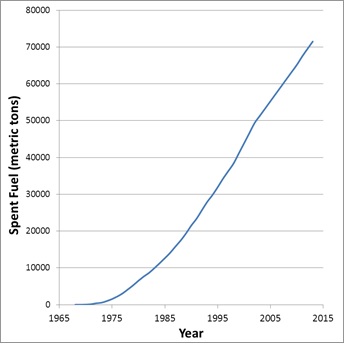
Because the U.S. has not opened a repository to store reactor waste, the government has not fulfilled its promise to take spent fuel from nuclear plants and dispose of it. As a result, spent nuclear fuel has accumulated at the reactor sites, reaching a level of 70,000 metric tons today. And over 70% of that waste is stored in increasingly crowded cooling pools that were originally intended to hold much less fuel.
A key step to increase the current safety of U.S. nuclear power is to transfer a large amount of the spent fuel from pools into concrete “dry casks” that would be stored temporarily at the plant. Since spent nuclear fuel is cool enough to transfer to dry casks after 5 years, more than 80% of spent fuel currently in pools could be moved to dry casks.
Fig. 1: Growth of spent fuel stored at reactor sites
Pool accidents could be disastrous
Nuclear fuel typically stays in the core of a reactor generating energy for several years. When they are taken out of the core the fuel rods are highly radioactive and continue to generate lots of heat. They are moved into a cooling pool at the reactor site, where the water acts as a radiation shield and carries the heat away from the rods. The water must be continuously cooled, which requires electric power.
If cooling is lost, the spent fuel can overheat, catch fire, and potentially release large clouds of radiation to the environment.
Cooling can be lost in a couple ways. If electric power to the plant is cut off, as it was following the earthquake and tsunami at Fukushima, the water can heat up and boil away. If water is not added fast enough (which it was at Fukushima) the fuel will overheat.
Tepco makes official announcements to deny “misinformation” by press, on both of their websites in English and Japanese occasionally.
In the press conference of 11/29/2013, Tepco’s spokesman stated they publish those announcements to deny “misinformation” when they think it may affect the company stock price.
The reason why they deny it when it may affect the stock price wasn’t explained.
On their English website, they recently made those announcements on Sep 21, Sep 24, Sep 26, Nov 8, and Nov 22.
This is the latest announcement below.
(Quote start)
<Title>
With Respect to ‘Another Moral Hazard of a Banking Organization Financing TEPCO Proceeding’ on the Page 28 of a Morning Issue on Tokyo Shimbun as of November 22, 2013
<Content>
On November 22, 2013, Tokyo Shimbun issued an article on the page 28 of its morning edition saying “A banking organization financing TEPCO has been switching its uncollateralized bonds to the collateralized utility bonds. The utility bonds have priority over the damage compensation for victims of Fukushima NPS accident, in case of TEPCO’s bankruptcy. Government of Japan expresses concern that the compensation might fall behind, in case it resolves and disposes of TEPCO. However, the government pretends not to see the act of the banking organization which could deteriorate the situation. A moral hazard (lack of a sense of morality) is proceeding, which is more vicious than the finance for gang groups.”
In order for TEPCO to steadily implement the longitudinal decontamination, or to fulfill our societal responsibility to supply with stable electricity, it is inevitable for us to receive loans from banking organizations. Comprehensive Special Business Plan approved in May 2012 includes such supportive measures as for all affiliated banking organizations to give TEPCO credit via refinancing etc. until TEPCO restores its independent funding such as rejoining a bond market etc., following the outcomes at the conference between Nuclear Damage Liability Facilitate Fund and us.
However, taking our current situation into consideration, it is very difficult for us to take a loan from a bank organization unconditionally, therefore, we try to obtain loans by issuing collateralized private-placement bonds, based on Electricity Business Act, Article 37.
The issue status for the private-placement bonds is released in handouts etc. intended for investors etc on our web-site.
Yesterday (on November 21), we gave these above circumstances to Tokyo Shimbun as a response to the interview with that press, though all our responses were omitted in that article, in addition, the press mentioned there financing for gang groups completely irrelevant to us saying “A moral hazard (lack of a sense of morality) is proceeding, which is more vicious than the finance for gang groups.” The article is inappropriate as a press report which is supposed to be accurate, fair, and responsible, and we regard the article as a one-sided media report seriously lacking in fairness.