From someone who is keeping his/her wits
I have been following this latest panic blitz…
It’s complicated, here’s my quick take:
There was a fake *URGENT*ALERT* about escaping steam blowing west in Japan, back at the end of 2012
Had all of us really shook up
Turned out was faked, by survivalist/end-times trolls having fun? or paid professionals?
I think it’s a psyops campaign:
1) Introduce secrecy laws to shut down all news from FukushimaD’un Renad
2) Fill the internet void this creates with orchestrated news & noise
3) Float rumors & start feuds (hat-trick vs Arnie, is ENEnews part of TEPCO cover-up, etc
4) Gradually raise heat & stir briskly with panic (drive ’em crazy w/info overload, get ’em poppin’ like popcorn
This will heat up & polarize the issue, disrupt clear thinking, bury true info on subject and neutralize (discredit, divert, demonize) those who know pieces of it before they can infect others…
How?
Those of us following online Fuku news closely are supposed to fall/jump for fake alarm
We get excited and relay bogus info, that can be debunked at later date…
And start to look/sound like kooks to the normal sleeper-walkers, forcing them to choose: which side do you believe
This will reinforce identity positions vis-a-vis Fuku, ie I’m not a kook, it’s all okay, nuke is safe, etc
And I can stop listening to those who are trying to tell me otherwise…
But tarnish us with a bogus CPM panic now, at Christmas time no less!
And people won’t trust us any more than they do the grinch, later when the numbers do start climbing
The nuke industry & war machine nexus is doing all it can to keep nuke power & profit going
Hence psyops to neutralize the global networks of awareness are logical (and likely enjoy unlimited budgets
But these misguided miscreants are on a serious pathological & global death trip
So while this burst of provoked panic is phony and I wouldn’t get excited about it
The situation is not good, and will never be (until the thieves & thugs are dethroned…
Intentional viral confusion of facts & fears buys time (this works because it may take 50 years to see the full proofs)
But the time we’re wasting with lies, secrecy, inept response efforts & bogus ‘news’ games is the outrage, and a crime
And that’s where real panic sets in for me, that’s the worst news
All this effort & expense to keep people blind so the homicidal corruption can continue even when it will destroy all life…scary thought: we are a psychotic species!
One thing for sure, I think it’s time we turned ‘Turner Radio” news on its spooky head
Haven’t trusted them since I saw their story about USS Reagan sailors lawsuit: claimed sailors were contaminated because they swam in contaminated ocean, had desalinated water contaminate their bathtubs, etc
AND their related story: Navy was innocent because Japan knew but didn’t tell them about radiation levels…
hahahaha
By my thinking, Turner is a bogus source, a trojan horse (with shady b/g, see home page explantaion…
And they have sure done a lot to push this, what I’d call the “2013 holiday panic campaign”
Here’s the relevant links http://www.turnerradionetwork.com/news/146-mjt http://www.occupycorporatism.com/tepco-quietly-admits-reactor-3-melting-now/
The giveaway clue is in the title:
Because reactor cores 1, 2 & 3 ‘melted down’ in March 2011
Then soon after ‘melted through’ containment vessels
Now they are called ‘corium’ (this is the word that dare not be spoken!
And the CORIUM is in the ground in contact with ground water & sea
Three 100 ton lumps of nuclear material gone critical, ie out of control chain reactions
Like a faucet, the corium in Fukushima will spew isotopes for hundreds of years into our ocean and atmosphere
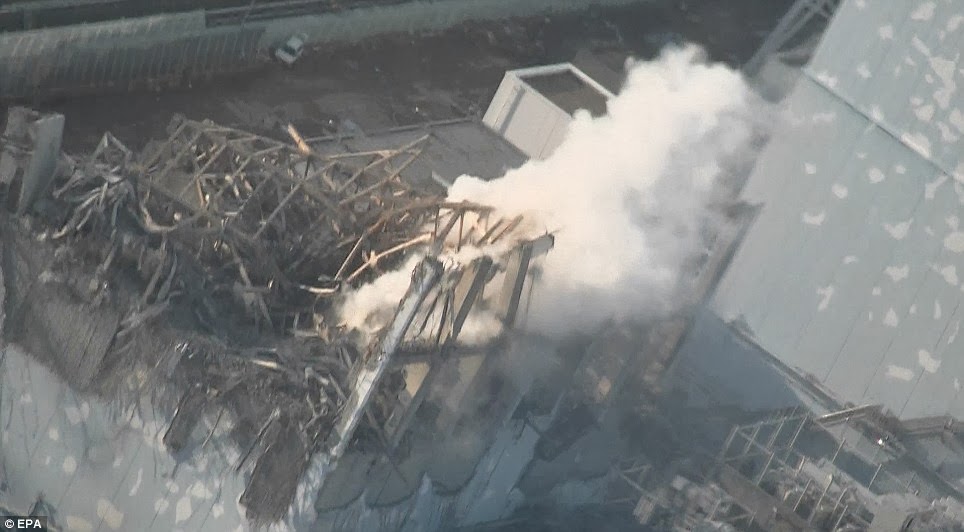
There are also spent fuel pools, turns out the one in unit4 went dry and the initial plume was far worse than any of us imagined then
This is the news they don’t want circulated or understood, thus it’s open season on credible messengers to carry it…
It seems we Fuku aware folks are being squeezed from both directions:.
Exaggerated reports are widely disseminated spreading distortions that may discredit our efforts. When people learn that their fears were needlessly aroused, they may lose interest in the issue.
From the other direction, there’s misinfo of the opposite variety that says there’s no problem or that risks are insignificant.
In correcting that misinfo, cite and/or link to reputable/credible sources to back concerns .
In calming undue panic, also emphasize that the problem is important and requires our action.
Yeah & yes, no time like the right time to watch our wingspans fellow sparrows of truth, there be plenty of crows out lately, looking to trip up the true…
宛先:The Norwegian Nobel Committee : Dear Mr.Thorbjorn Jagland (Chair of the Nobel Committee)
世界各国に平和憲法を広めるために、日本国憲法、特に第9条、を保持している日本国民にノーベル平和賞を授与してください please award the Nobel Peace Prize to the Japanese citizens who have continued maintaining this pacifist constitution, Article 9 in particular, up until present.
I had to reblog this evidence and some earlier evidence that explains the thyroid cancer rate around children..
<p>
Published on 13 Mar 2012
This video shows radiation levels on May 29th 2011, in Fukushima city (Japan) about 60-65 km from the Fukushima Daiichi nuclear reactors.
Measurements are made by a CRIIRAD scientist (Bruno. Chareyron, engineer in nuclear physics) during a meeting between CRIIRAD and Japanese citizens : M. Wataru Iwata (co-founder of Project 47 and CRMS) and persons in charge of the network “Fukushima Network for Saving Children from Radiation”, including M. Nagate (ex-representative), Mrs Marumori (now Executive Director of CRMS) and Mrs Sato. CRIIRAD is sharing its experience of independent radiation monitoring with the Fukushima citizens.
In this video, CRIIRAD researcher is using a gamma radiation detector (DG5 scintillometer) to show the intensity of radiation rates, even inside the office at floor level. Radiation rates are given in counts per second (c/s). With this device, normal values should be about 50 to 150 c/s depending on natural radiation.
The powerful gamma radiations emitted by radioactive caesium deposited on the ground of the parking located in front of the building give a radiation rate about 10 times above normal values inside the building (at the centre of the office), and 15 times above near the window. This radiation will decrease only very slowly. After one year, the decrease should be about 23 % only.
Additional info : look at http://www.criirad.org
While trawling the web i came upon this message on the RADSAFE comments.. No mention of Japans 100mSv/year dose allowance ..
However, there are moves to increase the dose allowance of gamma, Beta and Alpha energies even further, with no mention of internal dose allowances.. A figure mentioned in the message is O.2 Rontgen a day or 71 mSv/year.
I find it interesting that now the Nuclear Health Physicists are supporting the failed ICRP model so as to not make any bad publicity. At least that is the discussion.. Read on..
Dear RADSAFERS,

Let me at the very outset wish all of you a happy, healthy and productive New Year.

I thought it is time to discuss some of the developments in radiation risk assessment.
A  review  titled
"Evidence for beneficial low level
radiation effects and
radiation
hormesis"by Dr L E
FEINENDEGEN  published in the British
Medical Journal concluded :

"Thus, the
linear-no-threshold (LNT) hypothesis for cancer risk is scientifically
unfounded and appears to be invalid in favour of a threshold or hormesis. This
is consistent with data both from animal studies and human epidemiological
observations on low-dose induced cancer. The LNT hypothesis should be abandoned
and be replaced by a hypothesis that is scientifically justified and causes
less unreasonable fear and unnecessary expenditure". (BJR , 78 (2005), 3–7)

Shortly thereafter, The French
Academy of Sciences chaired by Prof.  Tubiana came to similar conclusions. Several
papers appeared since then. Many of them concluded that LNT theory is  not supported by scientific evidence.

The French report concluded that
on the basis of our present knowledge, it is not possible to define the
threshold level (between 5 and 50 mSv?) or to provide evidence for it.

A draft  summary of the DOE funded Low Dose Radiation Research
Programme  over 10 years from
1998-2008  concluded

"To date, these data have
had major impact on understanding the biological processes triggered by low
doses of radiation but require additional research, development of methods of
using the data, and communication before such data can impact radiation
standards"

The quest for a scientifically
supported model continues. Every one fervently hopes that the model may provide
evidence for a quantitative value for a threshold dose.

What is the  way forward.? Fukushima has added another
dimension to the discourse. Evacuation  caused over 1000 deaths

In his article titled "Commentary on Fukushima and Beneficial
Effects of Low Radiation" Dr Jerry Cuttler made a persuasive and
thought provoking  statement and a recommendation

. "The ICRP’s concept of
radiation risk is wrong. It should revert to its 1934 concept, which was a
tolerance dose of 0.2 roentgen (r) per day based on more than 35 years of
medical experience".

I
request  RADSAFERS to please respond to the following:

1) How many radsafers  are willing to accept Dr Cuttler's
recommendation?
2) My take is to keep the current
ICRP recommendations in tact. Fear of radiation arises from the improper and
incorrect use of  concepts. ICRP earlier
and UNSCEAR now  has cleared the air. A
well focused  public information
programme  must be tried to  allay radiation phobia.

We should unambiguously state
thus:

"There is substantial  and convincing evidence for health risks
following high dose exposures. However, below 5–10 rem (which includes
occupational and environmental exposures), risks of health effects are either
too small to be observed or are nonexistent." (Part of the position
statement by the US Health Physics Society)
Do you agree with this proposal?
3) Dose levels at which any emergency
has to be handled   should be decided in advance;  all stake-holders must participate in that
exercise.

Is that acceptable?
He said the PISA has been engaged in the number of Cyber Drills during last year and has trained more than 1000 university students, information security professionals and members of law & enforcements for secure use of Cyber Space and to establish international liaison with the similar organizations functioning in other different countries.
Senate’s Defence Committee has taken the initiative for the formulation of Cyber Security Policy to preserve, promote and protect Pakistan’s national security digitally.
Senator Mushahid Hussain Sayed, Chairman of Senate Defence Committee — who was attending the Cyber Secure Pakistan Conference as Chief Guest – announced this today.
Senator Mushahid Hussain, while defining the role of the Task Force on Cyber Security Policy, said the task force working jointly with Pakistan Information Security Association (PISA) under Senate Defence Committee will be asked to define the nature of the new emerging threats to Pakistan’s national security & defence in the digital battlefield and to prepare Cyber Security Policy, in consultation and with cooperation of experts and professionals from PISA and government organisations as well.
He said legislation and legal framework for Cyber Security and guarding against Cyber Warfare will be another most important task as the Cyber Warfare is already being waged by certain elements and must be countered with courage. In this connection, Senator Mushahid Hussain also welcomed recommendations made in the International Judicial Conference yesterday organised by the Supreme Court.
He hoped the joint task force will be capable to promote the required awareness for Cyber Security and to bring all relevant stakeholders on one platform for collaborated and organized efforts.
In his address, Mr. Ammar Jaffri, President PISA and organizer of the Cyber Secure Pakistan Conference informed the participants about the different steps taken by PISA to secure the Cyber Space of Pakistan. He said the PISA has been engaged in the number of Cyber Drills during last year and has trained more than 1000 university students, information security professionals and members of law & enforcements for secure use of Cyber Space and to establish international liaison with the similar organizations functioning in other different countries.
Mr. Jaffri welcomed the formation of Joint Task Force on Cyber Security and hoped to boost the collaboration between public & private organization as relevant state holders of Cyber Security.
Cyber Security professionals from number of other countries Malaysia, USA, Australia Kingdom of Saudi Arabia etc. were also participated in the annual conference and had delivered their key note speeches on vital topics related to Cyber Security.
…The plant sat in limbo until 2000, when Russian President Vladimir Putin, on an official visit in Cuba, offered then-President Fidel Castro a belated $800 million. But Castro declined, for reasons unknown. The abandoned plant sits on the Caribbean coast, and access is not permitted to foreigners….
Tiny Bolivia, the poorest nation in South America, packs a punch — or so says President Evo Morales, who welcomed the new year with an announcement: Bolivia is ready to pursue nuclear energy. Morales assured that the country has the necessary raw materials for the quest to be successful, and said nuclear power is a “right for every Bolivian.”
“Nuclear energy is not a privilege for developed countries, and others have to be deprived of it,” he said, adding that Bolivia is not a warlike country and nuclear energy would be used for “peaceful ends.”
Morales did make a point to say that it will take some time to develop the necessary technology, and that countries like France and Argentina were helping out. “It is time to take Bolivia off the last row in Latin American development,” he said.
However, Morales’ enthusiasm for this technology notwithstanding, the history of Latin America with nuclear energy is not very promising. Three countries in the region — Mexico, Brazil and Argentina — use nuclear power, all under the Treaty of Tlateloco of 1967, which forbids nuclear weapons and the use of nuclear energy for war. Others, like Chile and Cuba, have expressed interest in developing nuclear energy.
But no Latin American countries have been very successful with it, for various reasons.
National Nuclear Security Administration, which runs both Sandia National Laboratories and Los Alamos National Laboratory, said the two labs were critical to the agency meeting several of its goals.
The largest capital project the agency completed for the year was the Radiological Laboratory Office Building Equipment Installation at LANL, which is the first nuclear project NNSA has delivered under budget and ahead of schedule.
NNSA also recognized New Mexico researchers who garnered four of “Popular Science” magazine’s 100 best innovations from 2013, which came from LANL and Sandia. Also, researchers from Sandia were responsible for radar drop tests of B61 nuclear bombs at the Tonopah Test Range in Nevada.
The Indian ruling class’ colonial mentality was revealed by what Dr. Manmohan Singh said while accepting an honorary degree from the Oxford University on July 8, 2005: “As we look back and also look ahead, it is clear that the Indo-British relationship is one of ‘give and take’. The challenge before us today is to see how we can take this mutually beneficial relationship forward in an increasingly inter-dependent and globalized world that we live in.”
Confronting the Nuke-colonization of India: A National Convention of Anti-Nuclear Movements will be held in Idinthakarai, Tamil Nadu on January 4 and 5. This will be inaugurated by Admiral (retd.) L. Ramdas.In the context of the unprecedented threats facing the world due to global warming and the rapid depletion of conventional energy sources, the nuclear establishment is most opportunistically pushing nuclear energy as a climate-friendly energy source. However, all the activities associated with nuclear power generation – the mining and processing of uranium, the building of nuclear power stations involving huge amounts of cement and steel, the long construction process, the decommissioning of plants and the handling of radioactive waste – are highly unsafe and expensive, and cause enormous climate-changing pollution. Nuclear energy is not cheap, safe, clean or sustainable. It also does not offer a solution to our energy problems.
The Nuke-Colonization of India
However, the government of India headed by Dr. Manmohan Singh has been aggressively expanding nuclear power generation and enhancing nuclear business with countries such as the United States, Russia, France, Kazakhstan, Australia, Japan and others without any regard for the norms of democratic decision making. Throwing all the democratic precepts and practices to the air, the two-term UPA government unilaterally took upon the task of nuclearizing the highly and densely populated country, India, and securing a ludicrous legacy for the discredited prime minister.
A highly populated country like India does have an increasing need for energy. But for that very reason, the energy options we choose must be economical, sustainable, safe and environmentally-friendly. Moreover, energy distribution must be made more equitable, just and efficient.
What is happening in India right now is not just nuclearization of the country, but growing nuke-colonization, colonizing India all over again with the help of nuclear powers such as the United States, Russia, France etc. Both the Congress Party and the Bharatiya Janata Party (BJP) are complicit in this national crime!
GE has wisely chosen a high margin part of the oil and gas business that plays well with their exceptional skills in specialized materials and remote sensing. Not only does deep drilling require sophisticated materials, but it also requires mobile generators and an increasingly large array of treatment systems. Since hydraulically fractured wells exhibit depletion rates in the 5-10% per month range, maintaining a steady supply of gas from shale rock formations that require fracking means a continuing need to drill an ever larger number of wells.
Bill Loveless from Platts Energy Week recently interviewed Mark Little, GE’s chief technology officer, about the company’s interests in the oil and gas extraction sector. Loveless and Little discussed GE’s planned investments into an Oklahoma-based research center that will be the first GE technology development laboratory that is focused on a single business sector.
Mark Little: We’re very excited about going to Oklahoma. We have a global network of research centers that support all of our businesses. The first one was in upstate New York. First industrial research lab ever in the United States. We built out from that to India, China, Germany, Brazil, other places in the US. We’re going to Oklahoma for the first time with the intent of having a single business focused center. All these other centers support every business. This one will be focused solely on oil and gas.
Why are we doing that? There’s such a rich technology opportunity here to get technology into the oil and gas space. We wanted to really focus on that; make a showcase for our customers from around the world to come and see this and to help us develop technologies that they need to make their operations more efficient and more productive.
After watching that interview, do you have any more doubt about why GE leaders spend little or no time marketing new nuclear power plants that would reduce the growing demand for natural gas in the lucrative US electrical power market?
…”Sea level rise, especially in the south-east of England, will mean some of these sites will be under water within 100 years,” said David Crichton, a flood specialist and honorary professor at the hazard research centre at University College London. “This will make decommissioning expensive and difficult, not to mention the recovery and movement of nuclear waste to higher ground.”….
….”It makes you wonder what other important information about the safety of our nuclear plants the government and EDF might be hiding,”….
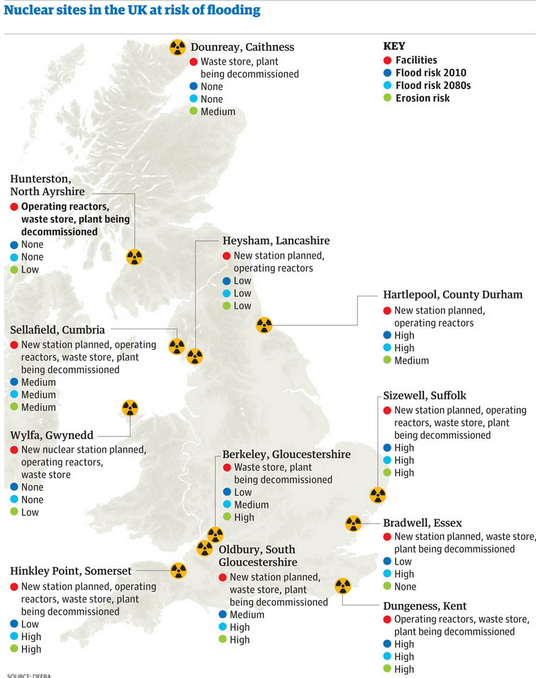
Rising sea levels because of climate change put 12 of 19 sites at risk, unpublished government analysis shows
Nine of the sites have been assessed by the Department for Environment, Food and Rural Affairs (Defra) as being vulnerable now, while others are in danger from rising sea levels and storms in the future.
The sites include all of the eight proposed for new nuclear power stations around the coast, as well as numerous radioactive waste stores, operating reactors and defunct nuclear facilities. Two of the sites for the new stations – Sizewell in Suffolk and Hartlepool in County Durham, where there are also operating reactors – are said to have a current high risk of flooding. Closed and running reactors at Dungeness, Kent, are also classed as currently at high risk.
Another of the sites at risk is Hinkley Point in Somerset, where the first of the new nuclear stations is planned and where there are reactors in operation and being decommissioned.
According to Defra, Hinkley Point already has a low risk of flooding, and by the 2080s will face a high risk of both flooding and erosion.
Other new reactor sites that face some risk now and high risk by the 2080s are Oldbury in Gloucestershire and Bradwell, Essex.
The huge old nuclear complex at Sellafield, Cumbria, is said to face a medium risk of flooding now and later.
Defra has now, however, released its full analysis in response to a request under freedom of information legislation. As a result, the department’s assessments of the risks for individual sites can be disclosed for the first time.
Many of the sites date back to the 1950s and 1960s, and are unlikely to be fully decommissioned for many decades. Seven of those containing radioactive waste stores are judged to be at some risk of flooding now, with a further three at risk of erosion by the 2080s.
Experts suggested the main concern was of inundation causing nuclear waste leaks.
Former MSNBC host Cenk Uygur was told not to warn the public about the danger posed by the meltdown at the Fukushima nuclear plant during his time as a host on the cable network.
2:45;
“I was on MSNBC at the time when this happened, I said, “Don’t trust what the Japanese government is saying, they’ll say trust what the electric power company is saying. Go, go, go, get outta there. Get as far away from that plant as you can. It’s literally a core meltdown.” And they always don’t want people to panic, so they were always like, “Oh it’s going to be okay.” […] I’m like, “You’re crazy man, don’t be anywhere near that reactor.” And I remember at the time, of course not at The Young Turks, but on cable news, people were like, “Hey Cenk, you know, I don’t know that you want to say that, because the official government position is that it’s safe.” Oh, is that the official government position? Now go explain that to the people who served on the USS Ronald Reagan.”
Uygur previously revealed how MSNBC president Phil Griffin ordered him to tone down his show because “people in Washington” were concerned about Uygur being too combative towards “those in power.” Despite the fact that his show had good ratings, Uygur walked away from the network to create his own online broadcast.
Uygur’s reference to the USS Ronald Reagan concerns recent revelations that 71 U.S. sailors who helped during the initial Fukushima relief efforts returned with thyroid cancer, Leukemia, and brain tumors as a result of being exposed to radiation at 300 times the safe level.
The sailors are suing the Tokyo Electric Power Co. (TEPCO), which repeatedly lied in an effort to downplay the severity of the situation.
Now that radioactive debris is hitting the West Coast of North America, numerous different animals and sea life are suffering from mysterious diseases, including 20 bald eagles that have died in Utah over the last few weeks alone.
Top scientists have warned that if another major earthquake hits Fukushima, which is almost inevitable, it would mean “bye bye Japan” and the complete evacuation of the west coast of North America.
Nuclear Expert: Fukushima reactor cores melted right down into the ground — That radioactive material is getting washed out into Pacific Ocean (AUDIO) http://enenews.com/nuclear-expert-fuk…
Japan to set new policy for nuclear waste disposal
The Japanese government plans to revise a basic policy for disposing of nuclear waste so that it can play a more active role in selecting disposal sites.
The industry ministry says starting early this year it will act on proposals submitted in November by a panel of experts.
The government plans to store highly-radioactive waste from nuclear power plants deep underground. It has been asking local governments to come up with candidate sites under a law that came into effect in 2000.
But no municipalities have stepped forward, and the government has still not secured any candidate sites.
Nuclear plants unlikely to resume operations soon
Officials with the Nuclear Regulation Authority in Japan say no nuclear plants are likely to resume operations in the near future.
They set new safety standards last July following the 2011 accident at Fukushima Daiichi. The guidelines call on operators to prepare for severe accidents and to reinforce facilities to make them earthquake-resistant.
Seven utilities have applied for safety screenings for 9 plants so they can restart operations.
Annual New Year sit-in held in Nagasaki
A group of atomic bomb survivors and other citizens have staged an annual New Year’s Day sit-in in Nagasaki, calling for the elimination of nuclear arms.
About 60 people took part in the event at the city’s Peace Park on Wednesday.
Speaking at the rally, 91-year-old former Nagasaki mayor Hitoshi Motoshima said helping create a peaceful world is the duty of Japan which inflicted damage and pain against the people of Asian nations during World War Two.
“The evacuees arrived at the temporary housing to take refuge from radiation. I also fled my home country and arrived here,” Thuan said. “Many people helped me get to where I am now. It is natural for me to help others”.
AsiaNews: Welcomed in Japan 28 years ago after fleeing with his family from South Vietnam, today the 36-year old priest Nguyen Quang Thuan “is giving back ” to the country that took him in by devoting psychological help to those who were evacuated from their homes in the aftermath of the Fukushima nuclear power plant disaster of March 2011.
They are people housed in temporary accommodation in the city of Iwaki, Fukushima Prefecture, isolated within their shelters, to the point that a meeting place has been ste up for them called “outreach cafe”.
The Vietnamese priest goes there every day: he prays for displaced people, listens to them, tries to help them out of their isolation, to socialize. Don Thuan is in charge of 10 temporary housing complexes: Together with volunteers from the Catholic church they visit and chat with residents. “Evacuees – he said – are worried about whether they will be able to go home in the future. I want them to be positive about their lives, even if it’s just a little”.
Born in the suburbs of Ho Chi Minh City, formerly known as Saigon, Thuan lived with his two brothers and sister, as well as his parents who ran a coffee plantation. However, his family decided to leave Vietnam for fear of persecution by the new government in the chaos just after the end of the Vietnam war.
One day when Thuan was 5 years old, found himself on a small wooden boat, one of the estimated 1.44 million refugees who escaped from Vietnam, Laos, and Cambodia after Saigon’s fall in 1975.