SHELLFISH from Cumbria, the Solway Firth and Morecambe Bay could be banned under new international food safety regulations.
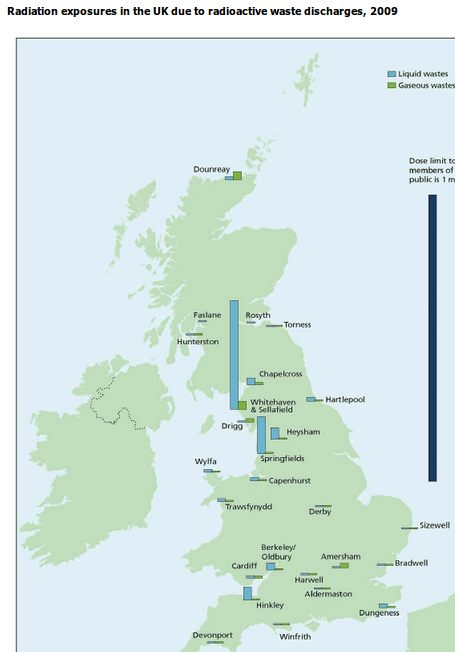
The UK’s Food Standards Agency (FSA) has warned that lobsters, cockles and scallops from the north west of England and the south west of Scotland are so contaminated with plutonium discharges from Sellafield that they will breach limits due to be introduced by the United Nations next year.
The UN’s Codex Alimentarius – which brings together the World Health Organization and the Food and Agriculture Organization – is proposing a safety limit for plutonium in food of one becquerel per kilogram (1Bq/kg).
The aim is to reduce the long-term risk of getting cancer from eating these foods to below one in a million.
The proposal takes into account scientific uncertainties about the health risks of small amounts of plutonium in the body. It is in line with radiation safety limits recommended by other regulatory authorities internationally, in the US and in the UK.
Concentrations of plutonium and other radioactivity in all the shellfish sampled by the FSA between the Ribble estuary at Preston and Kirkcudbright on the north Solway coast in 2002 exceeded 1Bq/kg. Winkles from St Bees contained 66 Bq/kg.
The new limits are welcomed by radiation experts, but have angered the shellfishing industry.
INTERVIEWS: First-hand reports on the recent meetings between anti-nuclear activists and top level reps of the NRC, EPA and Senate Committee on Environment and Public Works.
Dr. Marvin Resnikoff, Senior Associate at Radioactive Waste Management Associates, has been an international consultant on radioactive waste management for decades. He met with NRC Chair Alison Macfarlane and Commissioners Magwood and Apostolakis and really burned them up with the hard facts of what they don’t know about high burn-up nuclear fuel in their own reactors!
Diane D’Arrigo, Radioactive Waste Project Director for Nuclear Information and Resource Service (NIRS) explains how she took on the EPA over their inability to take radiation readings on the California coast after Fukushima — and perhaps it was something other than incompetence?
It’s farewell to your centuries-old right to free speech today, after your Conservative and Liberal Democrat MPs won their bid to get the Gagging Bill passed by the House of Lords. It won’t go back to the Commons because the Lords made no amendments.
While you, personally, will be allowed to continue complaining about anything you want, you will no longer have the ability to link up with others to protest government actions in any meaningful way as such action may breach Liberal Democrat and Tory government-imposed spending limits. Your personal complaints will be deemed unrepresentative of the people.
You will still be able to have your e-petition on the government’s website – if you win enough signatures to have it debated in Parliament – ignored by the Tories and Liberal Democrats in the House of Commons.
The Liberal Democrats and Tories have even managed to rub salt into the wound by creating a register of all the corporate lackeys who will still be able to influence their policies – freelance lobbyists employed by large companies for the specific purpose of swaying government policy. Lobbyists who are company employees will not be listed as the government says their purposes for meeting MPs should be obvious.
This means the new law will do nothing to restrict the power of corporations to write government policy or prevent lobbying scandals such as those involving former Tory MP Patrick Mercer, along with Tories Peter Cruddas and Liam Fox.
The new law protects in-house corporate lobbying operations from official scrutiny, while preventing the public from enjoying the same privileges of access to the government. That is what your Conservative and Liberal Democrat MPs have fought so assiduously to obtain, over the eight months or so that this legislation, “one of the worst… any government produce[d] in a very long time”, has spent being digested by Parliament.
In a Commons debate in September, Glenda Jackson MP warned that her constituents “know that the Bill… would prevent democratic voices from being heard”.
In response, Andrew Lansley – the Conservative who gave us the hated Health and Social Care Act 2012, another incredibly poor piece of legislation – said; “I look forward to the Honourable Lady having an opportunity… to go back to her constituents, to tell them that the things they are alarmed about will not happen.”
@UKJCP immediately resurrected itself as @DeadParrotJCP and @Director_UKJCP. We’ll see how long they last.
Let us not forget, also, that the third part of this law cracks down on trade unions, enforcing strict rules on membership records to ensure, it seems, that it is possible to ‘blacklist’ any trade unionist who finds him- or herself seeking work.
With free speech flushed away, you may still resort to public protest – but the Association of Chief Police Officers (ACPO) has that covered.
Greenpeace activists have transformed a Budapest roundabout into a giant atomic symbol to highlight…
euronews, the most watched news channel in Europe Subscribe for your daily dose of international news, curated and explained:http://eurone.ws/10ZCK4a Euronews is available in 13 other languages: http://eurone.ws/17moBCU
http://www.euronews.com/2014/01/30/gr…
Greenpeace activists have transformed a Budapest roundabout into a giant atomic symbol to highlight a 10 billion euro nuclear cooperation agreement between Russia and Hungary.
…For nuclear operators, the bill expands the range of damages that can be claimed and will triple to 30 years the length of time a person can wait to make a claim for latent illnesses.
The bill will also set up a quasi-judicial claims tribunal, if needed, to handle damage claims in the event of an accident.
Only half the billion-dollar liability coverage for nuclear operators will have to be covered using traditional insurance. Operators will be allowed to put up other forms of financial security for the remaining $500 million.
And the government of Canada will provide some of the coverage for lower-risk nuclear facilities, such as smaller research reactors…..
By Bruce Cheadle, The Canadian PressJanuary 30, 2014
OTTAWA – The Conservative government has introduced legislation that would dramatically bump up the amount of liability coverage required for nuclear plants and offshore oil and gas operations.
The new $1-billion liability replaces the current $75-million minimum for nuclear operators, and liability thresholds of between $30 million and $40 million for energy companies and offshore shippers, depending on where they operate.
Natural Resources Minister Joe Oliver called the billion-dollar target “a very significant, robust amount which is comparable to international standards.”
And he stressed the $1 billion limit only applies to no-fault liabilities.
“But the responsibility at fault is unlimited,” said the minister. “In other words, if it’s the fault of the operator, there is no limit at all.”
Oliver also said the chosen liability figure is high enough to protect the public but not so high as to discourage investment and development.
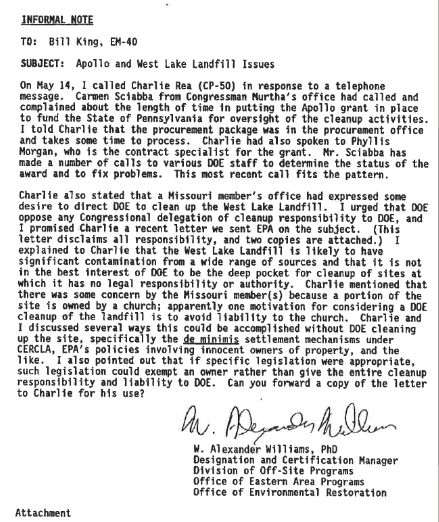
ST. LOUIS COUNTY – Documents obtained by 5 on Your Side show how one government agency, the Department of Energy, went to great length to avoid any responsibility for cleaning up the West Lake Landfill.
In the 1940s, Mallinckrodt Chemical Works in downtown St. Louis purified thousands of tons of uranium to make the first atomic bombs. But the process also generated enormous amounts of radioactive waste. Citing national security, the Atomic Energy Commission, now the Department of Energy, quietly ordered the material moved to north St. Louis County in 1947.
According to records, 8,000 tons of that waste was illegally dumped at West Lake by a private company. From that point forward, documents show the DOE used that dump as a “get out of responsibility” card.
In a memo dated May 1992, the Department of Energy worker wrote “The DOE does not have any liability or responsibility for the site…”
Three days later, a note from a DOE official stated: “A Missouri member’s office expressed desire to direct DOE to clean up the West Lake Landfill. I urge that DOE oppose any Congressional delegation of clean up responsibility…”
“The West Lake Landfill is likely to have significant contamination…it is not in the best interest of DOE to be the deep pocket for cleanup of sites which it has no legal responsibility…”
Clearly, the federal government knew 22 years ago how dangerous this stuff was.
The DOE official wrote: “There was some concern by the Missouri member(S) because a portion of the site is owned by a church; apparently one motivation for considering a DOE cleanup of the landfill is to avoid liability to the church.”
“I discussed several ways this could be accomplished without DOE cleaning up the site, specifically the de minimis settlement.”
Sources told 5 on your Side if West Lake became a superfund site, and EPA had responsibility, innocent owners, like the church, would be exempt from liability under de minimis.
The DOE official wrote, “I pointed out if specific legislation were appropriate, such legislation could exempt an owner rather than give the entire cleanup responsibility and liability to DOE.”
Another words, DOE would share costs with EPA and other responsible parties.
While some people have asked that the EPA step aside and let the DOE get more involved in West Lake, that doesn’t appear likely. A DOE spokesperson told us to call the EPA.
…..And this is an international team of scientists that commissions these studies. It is funded by multiple nations, but based in Moscow. Tremendous science is being applied to this.
It remains to be seen whether humans, plants or animals will have much chance right there around the perimeter of the nuclear power plants in Fukushima for many years to come…
Rep. Cynthia Lummis, a congressman from the US State of Wyoming,
Recently you went to Russia. Was it your first trip? And what was the purpose of your visit?
It was my first trip to Russia. I was so impressed and pleasantly surprised with my trip to Moscow. I had never been there, but I had impressions from American movies that it was dull and drab, kind of dirty, and nothing could have been further from the truth. It was so beautiful. The buildings are lovely, it was extremely clean, the people were very nice. It seemed very cosmopolitan, and I was extremely impressed with Moscow. We did not get to meet with Mr. Putin because he was busy with Sochi, with the Olympics, with the situation in Kiev and other matters that were regionally important. So, that was one of the meetings that we had hoped to have that we did not. But we had a wonderful meeting with an international group that is based in Moscow that would help with the mediation of the nuclear disaster in Fukushima and also monitoring. And based on the repurposing of the Russian scientists after the Cold War ended to look at civilian and energy uses of the nuclear power, a tremendous amount of the Russian expertise is coming to the fore in the issues of the mediation and monitoring when it comes to nuclear power plants. So, that was fascinating. I am on the Science and Technology Committee here in the Congress and it was right up my alley. So, I would have to say that my trip to Moscow, my very first trip, was very impressive, I was pleasantly surprised and hugely convinced that this is an important relationship for the United States.
How difficult is the situation in Fukushima? Some experts, scientists say that the worst is behind us, some say that it is even getting worse and worse.
Too soon to tell. I do know that with regard to soil contamination that could affect the livability in Fukushima for both people and plants and animals there is a lot of work to be done.
Six studies were commissioned: three based on the Chernobyl experience and three more that were based outside of Ukraine that are going to be revealed in April of this year to help understand how we can monitor and remediate the soil around the Fukushima. And this is an international team of scientists that commissions these studies. It is funded by multiple nations, but based in Moscow. Tremendous science is being applied to this. It remains to be seen whether humans, plants or animals will have much chance right there around the perimeter of the nuclear power plants in Fukushima for many years to come.
Really the more consequential issue is the oceans, the currents, the concerns that the global community has about radioactive material moving around the world by way of ocean currents. So, that is the much more sticky wicket that will have to be studied and dealt with by the scientists. The good news is that it is an application of tremendous global expertise to a problem that was experienced in Japan, where science based on previous incidents such as Chernobyl can be very helpful and telling. … More on link
After two and a half years of negotiations, just when it looked like Duke Energy would buy a portion of a new nuclear plant in South Carolina, the company announced it has cut off negotiations.
Duke had been looking to purchase a share of two nuclear units being built at the V.C. Summer station near Jenkinsville, South Carolina—one of the first new nuclear plants in decades, projected to cost roughly $10 billion. Duke began talks in 2011 with the minority owner, power company Santee Cooper for a 10 percent stake and looked poised to pull the trigger. Santee Cooper’s board voted today to sell a portion of the project.
But, it turns out, not to Duke and not 10 percent. It will transfer five percent to South Carolina utility SCG&E, which already owns the majority of project.
Duke filed a notice with the Securities and Exchange Commission that it has ended negotiations with Santee Cooper—a spokesman said the companies couldn’t agree to terms. Duke will continue to move forward with plans to build two new reactors at the Lee Nuclear Station in Cherokee County, South Carolina.
The Nuclear Regulatory Commission announced Monday that it is conducting a special inspection at the Calvert Cliffs nuclear power plant in southern Maryland after an electrical malfunction caused the two reactors there to shut down.
The plant, which restarted both reactors over the weekend, suffered the shutdown after snow and ice during a storm Jan. 21 apparently affected a ventilation louver filter and caused a short circuit. After the electrical supply system shut down, so did several plant systems and components that rely on electricity, the nuclear regulatory agency said Monday.
Those components included motors for moving control rods and water circulating pumps for the Unit 2 reactor, the agency said. The main turbine control circuit for the Unit 1 reactor also malfunctioned after the electricity loss.
Both units shut down as a result, with “no impacts on public health and safety,” the agency said.
The three-person inspection team began working at the plant Monday, the Nuclear Regulatory Commission said.
“We want to gain a better understanding of the chain of events that caused both of the reactors to simultaneously shut down and equipment anomalies subsequent to the plant trips,” said Bill Dean, the commission’s administrator for the region that includes Maryland, in a statement. “This inspection is designed to shed additional light on not only why the outages happened but how the plant operators handled them.”
AConstellation Energy Nuclear Group spokesman said in an email that federal reviews after shutdowns are common, adding that the company welcomed the inspection at its plant.
If justice is served Tuesday, a federal judge will exercise leniency when he sentences Sister Megan Rice, Greg Boertje-Obed, and Michael Walli for their non-violent protest at the Y-12 nuclear facility in Oak Ridge, Tenn., in July 2012.
The three peace activists did much more to raise awareness about the security gaps at Y-12 than any harm committed when they breached the compound’s outer fence.
Important lessons were learned about the nuclear weapons complex’s security failings and, more importantly, the failings were discovered through non-violent methods.
We hope the court will take into account that the only real impact their protest had was to expose the extremely flawed and dangerous security at Y-12.
Whilst Japans new secrecy law was being unveiled, under the noses of the big international NGO`s and Global press scrutiny (sort of), a little known Cancer Registration Law was quietly brought into being.
This registry law comes with teeth – up to a 2 year prison sentence for doctors or other health staff with the option for a huge fine (For the doctors). The law and its threatening posture means that the Law has really now begun and few if any cancer statistics will be released. Apart from coourageous japanese whistleblowers. We bloggers should all support their efforts to get the hidden truth out there to the masses.
Some debate on this is floating around the Japanese Blog scene. And I will attempt to recreate some of the comments here. I will also leave links and comments in Japanese for our Japanese viewers for further investigation;
The Cancer registration Law(がん登録法 ) had passed the lower house (It passed the Upper house sometime before) recently (6/12/13) along with the new secrets law. Doctors are complied with registering this information on their patients who have developed cancer.
They get of up to 1,000,000 yen fine or 2 years in the jail if they leak the data of their cancer patients. They said it’s going to take an effect from January in 2016 at the earliest.
The In this law all the hospitals in Japan are required to notify the specific “cancer registry “ department;
The details that will be passed exclusively to the secretive cancer registry are the ;
Names, birth dates, type of cancer , grade, treatment, and other valuable epidemiological research data.
In a recent court case in Tokyo a judge decided that it is perfectly legal, without giving the legal justification, for the Japanese police to collect all personal information on Muslims for no other reason than the fact they are Muslims.
CAIRO – A growing number of Japanese universities are offering halal meals in their menus to cater to the needs of the growing number of Muslim students.
“I’d been making my own meals until now, so this is helpful,” a 21-year-old student from Malaysia, eating a halal curry dish, told The Mainichi on Sunday, January 26.
The student was at the student cafeteria at the University of Yamanashi, where new items labeled with Halal stickers were added to the menu.
Former head of Physicians For Social Responsibility, Dr. Jeff Patterson unexpectedly died of a heart attack earlier this week.
Dr. Patterson was a long time member of PSR, starting the chapter in Madison WI and working at the national level. He also worked extensively with the Hackett Hemwall Foundation to bring medical care to people in Mexico and the Phillipines.
Rendering of the new LK-70 icebreaker, for which the keel has been laid at the Baltic Shipyard in St Petersburg
Work has begun in Russia on a new nuclear-powered icebreaker, considerably larger and more powerful than any existing vessel, while a smaller Russian icebreaker soon to be completed in Finland, offers a novel approach to clearing wide channels, writes Dag Pike.
As part of the Russian programme to open up the Northern Sea route across the Arctic and to assist with the exploitation of the natural resources in the region, a Russian shipyard has started construction of the world’s largest icebreaker. Russia already has the world’s only fleet of very powerful nuclear powered icebreakers, but the new vessel will be by far the largest and most powerful ever built.
The keel of the new vessel has been laid at Baltiysky Zavod (Baltic Shipyard) in St.Petersburg and completion of this major newbuilding project is scheduled for 2017. The new icebreaker is codenamed LK60. The length of the vessel will be 173.3m on a 34m beam. The wide beam will allow the vessel to cut a channel through ice which will be sufficient in width for tankers up to 70,000dwt. Previously two icebreakers working together were necessary to cut a wide enough channel for these larger ships.
The LK-60 has been designed with a variable draught. In open waters the vessel would operate at a minimum draft of 10.5m but this measurement can be reduced to 8.55m when the icebreaker is operating in inshore waters and in rivers. The difference in draught is achieved through a specially-designed ballasting system.
The design of this icebreaker was originally developed by CDB Aisberg back in 2009. LK-60 will be the first such ship with the capability of creating a channel through ice up to 3m thick, which will allow shipping routes in the Arctic to stay operational through longer winter periods.
The nuclear power unit for LK-60 will be a new design of liquid cooled pressurised water reactor developed by Rosatom’s Nizhniy Novagorod located OKBM Afrikantov. This is claimed to be half the size of existing reactors and to be more reliable and economical, with the core needing refuelling every seven years. The lifespan of this icebreaker is expected to be around 40 years. This reactor is said to have a capacity of 170MW, and this will be applied with a total propulsion power of 60MW divided between three shafts.
Reports say that the ship will be named Arktika as a tribute to a former prominent Soviet nuclear-powered icebreaker of the same name, which was the first surface ship to reach the North Pole. Russia is due to build three such icebreakers in the next decade, which are expected to replace four smaller ships. An even more powerful vessel, codenamed LK-110yA, is said to be at the design stage. This will be able to negotiate ice up to 3.5m in thickness, which should allow Arctic navigation through the entire winter period in most years.
Plutonium is a radioactive transuranic elements of American Scientists first discovered the element in 1940 and it is currently being used in nuclear weapons and nuclear reactors. Compared to other radioactive elements, the greater the risk of plutonium, once into the human body, plutonium will be lurking in the lungs, bones and other tissue cells, genetic damage cells, raising the risk of cancer, according to Xinhua News Agency
Japanese media quoted the 26th in Japan and the United States government news sources reported that the United States is urging Japan returned more than 300 kilograms of plutonium radioactive substances. Reported that the United States during the Cold War put these radioactive substances to Japan for study, most of them weapons-grade plutonium.
This exclusive Kyodo news release on the 26th. Reported that during the Cold War the United States had handed over 331 kilograms of plutonium in Japan, most of the abundance of weapons-grade plutonium for nuclear research. Kyodo said these plutonium present in Naka-gun, Ibaraki Prefecture, Japan Tokai-mura used for fast reactor fuel.



 Rendering of the new LK-70 icebreaker, for which the keel has been laid at the Baltic Shipyard in St Petersburg







