“Nuclear Power Is Dead” Jeremy Rifkin
Published on Mar 1, 2013
Let’s Hope Jeremy Rifkin is Right (with the Exception of building MORE nuclear power plants)! BUT, the NEXT QUESTION IS: WHAT THE HELL are we going to DO with all the current fuel they have accumulated Thus FAR? There IS NO SAFE PLACE TO STORE THE WASTE! There Never Has Been! ***see below link***
Q&A with Jeremy Rifkin on nuclear power
Wermuth Asset Management, 5th Annual Investors Event
Question: What would be your view on nuclear energy? […]
Jeremy Rifkin*: […] Frankly, I think from a business perspective, it’s over. I think it’s over. Let me explain why. There may be a lot of ideological issues, but from a business perspective here’s the situation […]
*CNN: “Internationally renowned economist”; Forbes: “Economist and energy visionary […] advisor to the European Union and to heads of state around the world.”
http://enenews.com/
Testimony of an Evacuee from Fukushima
Published on Mar 1, 2013
On February 23, an evacuee addresses the reality in Fukushima.
The Fukushima Collective Evacuation Trial Team
http://fukushima-evacuation-e.blogspo…
World Network for Saving Children from Radiation
http://www.save-children-from-radiati…
HIGHLY Radioactive FISH Found & Fukushima Update 2/28/13
Published on Feb 28, 2013
Highest radiation detected in fish at TEPCO port
That’s the highest ever detected in fish and about 5,100 times the government safety limit. So, they are putting NETS around the area and planning on destroying the fish. So the contamination still flows out of the nets into the Pacific Ocean, and What will they do with the radioactive Fish? Hummmmm???
http://www3.nhk.or.jp/daily/english/2…
Fukushima radiation spread to residential areas hours before venting
http://mainichi.jp/english/english/ne…
TEPCO fails to report worker radiation levels
http://www3.nhk.or.jp/daily/english/2…
New Evacuation Guidelines for Future Nuclear Accidents (looks like Japan is going to be firing up those death machines soon ignoring the popular consent of the people)
Hokkaido area to investigate hot springs from the VOLCANIC RESOURCES on Japan in it’s Park area for geothermal energy production. I wonder if the IAEA Okay’d the Volcano for Nuclear Power production in Japan.
LOL Japan trying to boost economy by promoting cool stuff from Japan. OMG
US hopeful and cautious on nuclear Iran
http://www3.nhk.or.jp/daily/english/2…
North Korea honors nuclear scientists but won’t name names.
http://enenews.com/ headlines
Top UK Newspaper Headline: Fukushima cancer risk ‘played down to aid nuclear industry’
TV: Fukushima kids with nose bleeds, diarrhea, mouth blisters, other problems — Symptoms go away after leaving area — Used to be in good health, now picking up every little bug going around (VIDEO)
New WHO study claims even highly exposed Fukushima Daiichi workers will be fine… a few might end up with thyroid disorders — U.N. made similar statements after Chernobyl
Reports: Two dead, one wounded at nuclear plant in France
WHO: Small cancer risk after Fukushima accident say British University Professors
“The additional risk is quite small and will probably be hidden by the noise of other (cancer) risks like people’s lifestyle choices and statistical fluctuations,” said Richard Wakeford of the University of Manchester, one of the authors of the report. “It’s more important not to start smoking than having been in Fukushima.”
“…Wakeford said the increase may be so small it will probably not be observable….”
“…For people beyond the most directly affected areas of Fukushima, Wakeford said the projected cancer risk from the radiation dropped dramatically. “The risks to everyone else were just infinitesimal.”…”
“….David Brenner of Columbia University in New York, an expert on radiation-induced cancers, said that although the risk to individuals is tiny outside the most contaminated areas, some cancers might still result, at least in theory. But they’d be too rare to be detectable in overall cancer rates, he said.
Brenner said the numerical risk estimates in the WHO report were not surprising. He also said they should be considered imprecise because of the difficulty in determining risk from low doses of radiation. He was not connected with the WHO report…..”
“… “On the basis of the radiation doses people have received, there is no reason to think there would be an increase in cancer in the next 50 years,” said Wade Allison, an emeritus professor of physics at Oxford University, who also had no role in developing the new report. “The very small increase in cancers means that it’s even less than the risk of crossing the road,” he said. … ”
“….. Gerry Thomas, a professor of molecular pathology at Imperial College London (UK Thyroid Assoc.), accused the United Nations health agency of hyping the cancer risk.
“It’s understandable that WHO wants to err on the side of caution, but telling the Japanese about a barely significant personal risk may not be helpful,” she said.
Thomas said the WHO report used inflated estimates of radiation doses and didn’t properly take into account Japan’s quick evacuation of people from Fukushima.
“This will fuel fears in Japan that could be more dangerous than the physical effects of radiation,” she said, noting that people living under stress have higher rates of heart problems, suicide and mental illness…. ”
“…..In Japan, Norio Kanno, the chief of Iitate village, in one of the regions hardest hit by the disaster, harshly criticized the WHO report on Japanese public television channel NHK, describing it as “totally hypothetical.”….”
By MARIA CHENG
Japan Today
LONDON —
Two years after Japan’s nuclear plant disaster, an international team of experts said Thursday that residents of areas hit by the highest doses of radiation face an increased cancer risk so small it probably won’t be detectable.
In fact, experts calculated that increase at about 1 extra percentage point added to a Japanese infant’s lifetime cancer risk.
[….]
Many people who remain in Fukushima still fear long-term health risks from the radiation, and some refuse to let their children play outside or eat locally grown food.
Some restrictions have been lifted on a 20-kilometer zone around the nuclear plant. But large sections of land in the area remain off-limits. Many residents aren’t expected to be able to return to their homes for years……__
Online:
WHO report: http://bit.ly/YDCXcb
See more at: http://www.japantoday.com/category/national/view/who-small-cancer-risk-after-fukushima-accident#sthash.HivRqR1a.dpuf
TEPCO Hires UK Propaganda Chief
“…To be sure, the nuclear issue still divides opinion sharply. Judge admits that a repeat of the Chernobyl disaster would close the industry down for 20 years…” 22 July 2009 –Barbara Judge
Published on Feb 11, 2013
https://nuclear-news.net/2013/02/18/tepco-hires-uk-propaganda-chief/
Fukushima: BBC Debunked – Chernobyl: BBC Debunked
“A range of other evidence assessed by the ESC included a report showing there have been 6,000 cases of thyroid cancer reported in children and adolescents as of 2005 – with many more expected over the coming decades.‘”
https://nuclear-news.net/2013/02/15/fukushima-bbc-debunked-chernobyl-bbc-debunked/
And a quick summary of the Q&A panel held after premier screening of ‘After the Apocalypse’. The panel included Baroness Helena Kennedy. Geraldine Thomas (oncology), Steve Wilkinson,
Prof Thomas says that genetic science is not accurate anyway?
Prof Thomas says the doctors in the film are trying to source funding by highlighting deformity etc
Prof Thomas doesn’t comment on the enforced genetic passports?? Everyone else on the panel does.
Prof Thomas says the incidence is of small incremental amounts but doesnt give a percentage..
Any percentage of millions/billions of people are huge numbers of personal distress and loss!!
The director looks harassed.. the film has been taken off You Tube.. Prof Thomas blames alcoholism for the gross defects of bibgul and her mother..
And here is the original list of speakers, no Prof Thomas?
[…]
May 5 ’11 After the Apocalypse Premiere
Good Pitch UK 2009 Alumnus After the Apocalypse,
A film about aftermath of soviet era nuclear experiments, is set to premiere in the UK on May 11th at Princes Charles Cinema.
Screening followed by a Q&A with key Genetic and Ethical specialists – Baroness Helena
Kennedy, the former Head of the Human Genetics Commission; Professor Yuri Dubrova –
Professor of Genetics at the University of Leicester and Steve Wilkinson – Professor of Medical
Ethics at Keele University.
Saturday, October 8, 2011
The Economist: Oxford Professor Says OK to Raise Annual Dose Limit by 1000 Times for the Japanese, But the Reporter Reluctant to Inhale
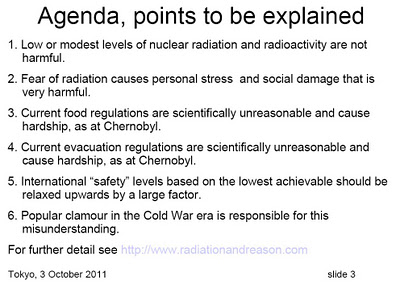
Dr. Wade Allison is professor emeritus of physics (particle physics) at Oxford University. The event that the Economist’s reporter refers to in the article must be the talk given at American Chamber of Commerce in Japan (ACCJ) on October 3, where the professor, along with another researcher, presented the strong case that the radiation exposure below 100 millisieverts per year was not a problem, if one only gets rid of the unreasonable fear of radiation. He also says the current food regulation, evacuation regulation are “unreasonable” and should be relaxed significantly.
Here’s the screen capture of a page from his presentation slides he used in the ACCJ talk:
Time is running out : Demonstration in Shinjuku Tokyo – The citizens of Fukushima speak out!
Published on Feb 28, 2013
On February 23, a Demonstration for the evacuation of Fukushima children took place in Shinjuku Tokyo.
The Fukushima Collective Evacuation Trial Team
http://fukushima-evacuation-e.blogspo…
World Network for Saving Children from Radiation
http://www.save-children-from-radiati…
Fukushima Documentary: Surviving The Tsunami; Radiation Exposure
Evidence of Japanese government cover up of blood tests designed to confirm or deny low level ionising dose damage! @ 21.07 mins
Published on Feb 27, 2013
CCTV documentary aired 3/16/12
Japan’s Dr. Shuntaro Hida strongly opposes the safe levels of radiation exposure that are currently being advocated by the government. “They are not dictated by safety standards, but by a nuclear industry that wields far too much power, and not just in Japan”.
Shuntaro: “At the root of the problem is US nuclear policy which asserts that a small intake of radiation is harmless”.
http://enenews.com/ap-flurry-of-films…
New Fukushima Documentary: “We’ve been deceived… We’ve been betrayed” (VIDEO)
http://www.youtube.com/watch?feature=…
GE will not chase nuke business if laws don’t change !!

One big multinational is almost certain to be out of the race for nuclear energy business in India. On Wednesday I had met John Flannery, outgoing President and Chief Executive Officer of GE in India for a chat before he left for his new assignment: finding targets for the company to buy. Flannery said GE will rather give up business than play within India’s civil nuclear liability rules.
“If the [civil nuclear] liability law stays the way it is, we won’t pursue the business.”
Flannery knows other companies, French and Russian, are nosing ahead in the race but points out that they are backed by the government. He is very clear about his own: “We are a private enterprise and we just can’t take that kind of risk profiles.”
Last week, on his maiden visit to India as French President, Fracois Hollande had said that his country was okay with Indian laws. “Regarding civil nuclear liability, we obviously respect Indian law. It is the sovereign decision of a country that has witnessed catastrophes like the Bhopal gas tragedy,” Holande had told an interviewer from the Times of India February 14.
France’s Areva wants to supply nuclear reactors and fuel to India’s Nuclear Power Corporation which is planning to add about 37500 MW generation capacity. The contracts could be worth billions of dollars. Many of the units that the corporation plans to build such as at Jaitapur in Maharashtra are large ones with a capacity of 1000 MW and above. Areva also has an advantage here because it is also building similar sized reactors at home.
The world has been thinking deeply since March 11, 2011, whether nuclear plants are worth the risk………
– See more at: http://forbesindia.com/blog/business-strategy/ge-will-not-chase-nuke-business-if-laws-dont-change/#sthash.frMlRDjt.dpuf
H/t Sue and Anne
Japan to Begin Restarting Idled Nuclear Plants, Abe Says
“…Mr. Abe also said Japan will continue seeking energy alternatives to reduce its dependence on nuclear power, even without going so far as to eliminate it….”
By MARTIN FACKLER
Published: February 28, 2013
NY Times
TOKYO – Japan will begin restarting its idled nuclear plants once new safety guidelines are in place later this year, Prime Minister Shinzo Abe said Thursday, moving to ensure a stable energy supply despite public safety concerns after the Fukushima disaster.
In a speech to Parliament, Mr. Abe pledged to restart nuclear plants that pass the tougher new guidelines, which are expected to be adopted by a newly created independent watchdog agency, the Nuclear Regulation Authority, as early as July. However, he did not specify when any of the reactors might resume operation. News reports have suggested that it might take months or even years to make the expensive upgrades needed to meet the new safety standards.
All of Japan’s 50 operable nuclear reactors were shut down following the March 2011 triple meltdown at the Fukushima Daiichi plant, which spewed radiation across northern Japan after a huge earthquake and tsunami knocked out vital cooling systems. Two were later restarted as an emergency measure to avert power shortages in the heavily populated region that includes the cities of Osaka and Kyoto.
Responding to public safety concerns, leaders from the previous Democratic Party government had vowed to slowly phase out nuclear power by the 2030s in favor of cleaner alternatives like solar and wind. However, Mr. Abe, who took power after his Liberal Democratic Party won national elections in December, has vowed to shelve the planned phase out, saying that Japan needs stable and cheap electricity from nuclear power to compete economically.
On Thursday, Mr. Abe said that Japan had learned the need for tougher safety standards from the Fukushima accident, which forced more than 100,000 people to evacuate. He said the new safety standards will be enforced “without compromise.”
BREAKING! World Health Organisation report into estimated health effects from the Japanese Nuclear accident at Fukushima
The values presented in the report should be regarded as
inferences of the magnitude of the health risks, rather than as precise predictions.“….Moreover, it is also important to note that the exposure data upon which this report is based are preliminary and include only data that were available as of September 2011.
Because scientific understanding of radiation effects, particularly at low doses, may increase in the future, it is possible that further investigation may change our understanding of the risks of this radiation accident……”
[Highlighted parts for your conenience. Also, there is nothing about the data on Thyroids as they stopped the data set in Sept 2011, before the results of the preliminary thyroid tests in early 2012?? So the estimated figures here are not very accurate? Why? – Arclight2011]

Image source : http://fukushima-diary.com/2012/09/thyroid-cancer-found-from-fukushima-children/
SUMMARY.
Published on 28 Feb 2013
Health Risk Assessment from the nuclear accident after the
2011 Great East Japan Earthquake and Tsunami
based on a preliminary dose estimation
EXECUTIVE SUMMARY
Introduction
The earthquake and tsunami in Japan on 11 March 2011 led to releases of radioactive
material into the environment from the Tokyo Electric Power Company’s Fukushima
Daiichi nuclear power station.
A major release of radioactivity to the environment is always of concern, owing to
potential acute and long-term health effects. Evidence from historic events confirms that
any major uncontrolled release of radiation should be cause for immediate response
and scientific assessment of potential health effects.
When such an event occurs, the World Health Organization’s mandate, as described in
the Joint Radiation Emergency Management Plan of the International Organizations, is
to assess and respond to public health risks.
The primary purpose of this health risk assessment of the Fukushima Daiichi nuclear
accident is to estimate its potential public health impact so that future health needs can
be anticipated and public health actions can be taken. This assessment is based on a
preliminary estimate of radiation doses, as described in a WHO report published in May
2012.
Methods
This health risk assessment was conducted by independent international experts who
were selected by WHO for their expertise and experience in radiation risk modelling,
epidemiology, dosimetry, radiation effects and public health. All experts completed a
declaration of interests form. The group met in December 2011 and March 2012. At
both meetings, observers were in attendance from the United Nations Scientific
Committee on the Effects of Atomic Radiation (UNSCEAR), the International LabourOrganization, and the Government of Japan. The observers participated in discussions
and sharing of data but were not involved in the decision making process.
The risk assessment was made using four steps:
•
The specific radiation sources, such as different radionuclides and pathways
of exposure, were identified (hazard identification).
•
The types of harmful effects that could result were identified based on
scientific knowledge about the relationships between radiation dose and
biological effects (dose-response relationships).
•
Based on the preliminary dose assessment, lifetime organ doses were
estimated for the general population within geographical locations ranging
from the most affected areas of Fukushima prefecture to the rest of the world.
Based on available data on occupational exposure assessed by the operator
of the nuclear power station, lifetime organ doses were also estimated for
emergency workers (exposure assessment).
•
The lifetime risk of cancer was estimated for all solid cancers combined, and
also for individual cancer sites most closely associated with radiation
exposure and with a known dependence of the magnitude of risk on age-at-
exposure (leukaemia, thyroid cancer and female breast cancer). The lifetime
risks were estimated for both sexes and three different ages at exposure
(1 year [infant], 10 years [child], and 20 years [adult]). Calculations of the
cumulative risks for the 15 years following the accident were also performed.
Health risks for male emergency workers were estimated for three different
ages (20 years, 40 years, and 60 years) (risk characterization).
Findings
In view of the estimated exposure levels, an increased risk of cancer is the potential
health effect of greatest relevance. The relationship between radiation exposure and
lifetime risk of cancer is complex and varies depending on several factors, mainly
radiation dose, age at time of exposure, sex and cancer site. These factors can
influence the uncertainty in projecting radiation risks, in particular when assessing risks
at low doses.
Outside of the geographical areas most affected by radiation, even in locations within
Fukushima prefecture, the predicted risks remain low and no observable increases in
cancer above natural variation in baseline rates are anticipated.
Some health effects of radiation, termed deterministic effects, are known to occur only
after certain radiation dose levels are exceeded. The radiation doses in Fukushima
prefecture were well below such levels and therefore such effects are not expected to
occur in the general population.
The estimated dose levels in Fukushima prefecture were also too low to affect fetal
development or outcome of pregnancy and no increases, as a result of antenatal
2 radiation exposure, in spontaneous abortion, miscarriage, perinatal mortality, congenital
defects or cognitive impairment are anticipated.
In the two most affected locations of Fukushima prefecture, the preliminary estimated
radiation effective doses for the first year ranged from 12 to 25 mSv. In the highest dose
location, the estimated additional lifetime risks for the development of leukaemia, breast
cancer, thyroid cancer and all solid cancers over baseline rates are likely to represent
an upper bound of the risk as methodological options were consciously chosen to avoid
underestimation of risks. For leukaemia, the lifetime risks are predicted to increase by
up to around 7% over baseline cancer rates in males exposed as infants; for breast
cancer, the estimated lifetime risks increase by up to around 6% over baseline rates in
females exposed as infants; for all solid cancers, the estimated lifetime risks increase by
up to around 4% over baseline rates in females exposed as infants; and for thyroid
cancer, the estimated lifetime risk increases by up to around 70% over baseline rates in
females exposed as infants. These percentages represent estimated relative increases
over the baseline rates and are not absolute risks for developing such cancers. Due to
the low baseline rates of thyroid cancer, even a large relative increase represents a
small absolute increase in risks. For example, the baseline lifetime risk of thyroid cancer
for females is just three-quarters of one percent and the additional lifetime risk
estimated in this assessment for a female infant exposed in the most affected location is
one-half of one percent.
These estimated increases presented above apply only to the most affected location of
Fukushima prefecture. For the people in the second most affected location, the
estimated additional lifetime cancer risks over baseline rates are approximately one-half
of those in the highest dose location. The estimated risks are lower for people exposed
as children and adults compared to infants.
In the next most exposed group of locations in Fukushima prefecture, where preliminary
estimated radiation effective doses were 3 to 5 mSv, the increased lifetime estimates for
cancer risks over baseline rates were approximately one-quarter to one-third of those
for the people in the most affected geographical location.
Among Fukushima-Daiichi nuclear power station emergency workers, the lifetime risks
for leukaemia, thyroid cancer and all solid cancers are estimated to be increased over
baseline rates, based upon plausible radiation exposure scenarios. These scenarios
and their corresponding estimated risks are detailed in the body of this report. A few
emergency workers who inhaled significant quantities of radioactive iodine may develop
non-cancer thyroid disorders.
Conclusions
This health risk assessment is based on the current state of scientific knowledge. The
assessment models used were derived from previous radiation events and experience,
which do not match exactly the pattern of exposure seen in Fukushima; thus,
3 adjustments were required. The dose estimates and assumptions used in this
assessment were deliberately chosen to minimize the possibility of underestimating
eventual health risks. The values presented in the report should be regarded as
inferences of the magnitude of the health risks, rather than as precise predictions.
Moreover, it is also important to note that the exposure data upon which this report is
based are preliminary and include only data that were available as of September 2011.
Because scientific understanding of radiation effects, particularly at low doses, may
increase in the future, it is possible that further investigation may change our
understanding of the risks of this radiation accident.
This health risk assessment concludes that no discernible increase in health risks from
the Fukushima event is expected outside Japan. With respect to Japan, this
assessment estimates that the lifetime risk for some cancers may be somewhat
elevated above baseline rates in certain age and sex groups that were in the areas
most affected. These estimates provide valuable information for setting priorities in the
coming years for population health monitoring, as has already begun with the
Fukushima Health Management Survey.
On the basis of these findings, the continued monitoring of food and the environment
remains important. When additional dose estimations become available from studies
undertaken by UNSCEAR and others, such data can be used to further refine these risk
estimates.
Executive summaries
Download FULL REPORT
Source:
http://www.who.int/ionizing_radiation/pub_meet/fukushima_report/en/index.html
Reported here
Bulgarian parliament suspends power plant construction!
27 February
Image Source : http://cryptome.org/info/nuclear-protest2/nuclear-protest2.htm
RT Breaking News
The Bulgarian parliament has suspended the construction of the country’s second nuclear power plant (NPP) that was approved in 2005. The decision comes after more than 60 per cent of voters in a referendum in January said “yes” to the question on whether the country should build a new NPP. However, only 20 per cent of the eligible population took part in the referendum. In accordance with the Bulgarian constitution the decision still needed approval from parliament. The project has been frozen since July 2009 when the GERB party of Prime-minister Boyko Borisov came to power.
映画「カリーナの林檎 チェルノブイリの森」Web予告 – Kalinas Apple, Forest of Chernobyl
Russian with Japanese subtitles
SAMBOLGHINI·
Uploaded on Apr 16, 2011
映画「カリーナの林檎 チェルノブイリの森」Web用予告編です。
この映画を、取材途中で亡くなったカリーナ(仮名)という少女に捧げたいと思います。
Akiyoshi Imazeki began shooting “Kalina’s Apple, Forest of Chernobyl” in 2003, a film about a girl who falls sick by eating the radiated apples grown on her grandmother’s farm. It was a film he believed in, but he had never hoped for massive appeal.
His post-Fukushima 2011 re-edit _ with its juxtaposition of pastoral lakes and forests, so much like Fukushima landscapes, with the forlorn faces of children hospitalized for cancer _ is striking home with many Japanese.
The film was shot quietly like many Japanese classics, and the cast is entirely Belarusian and Russian. But the dozens of screenings in Fukushima are drawing positive reviews.
“They all cry,” said Imazeki.
Imazeki is convinced the parallels between Fukushima and Chernobyl are striking, and stressed “Kalina’s Apple, Forest of Chernobyl” dramatizes the tragedy of radiation.
“The invisibility adds to the turmoil,” he said. “Families can no longer live normal happy lives.”
New! Iran, P5+1 to return to Almaty after expert-level nuclear talks: report

Image source : http://www.huffingtonpost.com/2013/02/26/iran-nuclear-talks_n_2764270.html
Reuters
27 February 2013
(Reporting By Marcus George; Editing by Pravin Char)
DUBAI (Reuters) – Iran and world powers have agreed to hold a further meeting to discuss Iran’s nuclear program in Almaty, Kazakhstan, after first holding “expert-level” talks in Istanbul, Iran’s Fars news agency reported on Wednesday.
The report did not specify any dates for the two meetings but said the expert-level talks would take place “days before” the Almaty meeting. There were no further details.
The two sides met in Almaty on Tuesday and Wednesday in an attempt to resolve international concerns over Iran’s nuclear activities.
http://sg.finance.yahoo.com/news/iran-p5-1-return-almaty-expert-level-nuclear-080102462–sector.html
Nuclear plant safety tests to continue: Taiwan government
Hwang predicted problems at least before 2015 as power plants closed and economic growth picked up again, leading to increased demand from business. Using coal to produce power would damage the environment, while gas was hard to store more than seven days during the low season in summer, he reportedly told lawmakers. He didn’t rule out the possibility of his company going bankrupt if problems continued to mount..
With abundant wind resources along the west coast and on offshore island, Taiwan has superior advantages in geographic location to develop wind energy……
http://web3.moeaboe.gov.tw/ECW_WEBPAGE/webpage/book_en1/page1.htm

Taiwan News, Staff Writer
2013-02-27 03:50 PM
TAIPEI (Taiwan News) – Safety tests at the fourth nuclear plant will continue despite a Legislative Yuan decision to stop work on the project ahead of an eventual referendum, the government said Wednesday.
Premier Jiang Yi-huah announced Monday that he would allow a referendum about the controversial reactors under construction in Gongliao, New Taipei City, while caucuses at the Legislature agreed on Tuesday that work should be halted and new funding would not be approved as long as the vote had not been held.
Cabinet spokeswoman Cheng Li-wun said Wednesday the lawmakers had agreed that safety-related work could continue, so the government would still invite domestic and foreign experts to visit the plant and conduct safety tests. In the wake of the 2011 Fukushima disaster, public concern has been mounting that an earthquake could cause a nuclear calamity in Taiwan as well.
Additional budgets for the plant requested by the state-run Taiwan Power Corporation will not be approved but the installation of the first fuel rods will not be affected by the legislative agreement because it was planned for next year, Cheng said.
Opposition Demands Fair Referendum on New Taiwan Nuclear Plant
Opposition-backed demonstrators have demanded a halt to the New Taipei City project, with many protesters citing design and construction flaws.
Clare Jim | February 27, 2013
Taipei, Taiwan. Taiwan’s main opposition party called on Tuesday for a change in the law governing referendums to give voters a fair chance to decide whether to halt construction of a fourth nuclear power station on the self-governing island.
The ruling Nationalist Party, long a backer of the project, bowed to opposition demands on Monday to hold a referendum on halting the construction of two reactors in New Taipei City county in northern Taiwan.
The opposition says provisions of Taiwan’s Referendum Act make it difficult to pass any motion submitted for approval, as half of all voters must take part, and half of them must vote in favor of a motion for it to pass.
“We want an impartial and fair referendum,” opposition Democratic Progressive Party Chairman Su Tseng-chang said in a statement. “Not with this ‘bird cage’ referendum law and not in this deceptive manner.”
The government is clearly gambling on a favorable vote to proceed.
Construction is 98 percent complete and tests have begun on the first reactor. Any halt to the project would incur huge costs, with the budget standing at T$283.8 billion ($9.57 billion), according to state-owned Taipower, and the cabinet is expected to seek additional funds in June.
Opposition to nuclear power swept across the world following the 2011 crisis at Japan’s Fukushima Daiichi plant, triggered by an earthquake and tsunami. But pressure on governments to reduce reliance on oil and tap cheaper energy forms is bringing projects back to the drawing board.
Last month, South Korea decided to expand its nuclear program despite safety concerns and scares that closed two reactors. China this month started up the first reactor commissioned since the meltdowns at Fukushima, the world’s worst nuclear accident in 25 years.
Continue reading
Korean Kids Lose Out in Japan After Pyongyang’s Nuclear Test
“North Korea fired its missile and went ahead with a nuclear test. They are such provocative actions against the wishes of the international community,” he said at a press conference. “I have no intention of continuing to defend Korean schools anymore.” Governor Yuji Kuroiwa
“I once thought maybe the schools could become independent [from Pyongyang] — but not now,” she said. “Not until Japan becomes completely free of discrimination against Koreans.”
And beyond all the politicking, Han Bok-Myong, a mother of three students at the school, says it is the children who are suffering.
No Free Education for Pro-DPRK High School in Japan
February 27, 2013
As the world rushed to condemn North Korea for its nuclear test, the shockwaves from international politics rippled into the daily lives of ethnic Korean children living in Japan.
Amid clamor for an effective way to punish a Pyongyang leadership that has proved immune to years of diplomatic pressure, youngsters who have never lived under the regime are bearing the brunt of Japanese anger.
The schools many of these children attend are having their funding withdrawn by Japan, leaving students and parents wondering why they are being punished for something they cannot control.
“Every time something happens in our fatherland of Korea, small Korean children get harassed verbally and physically by those who watch the news,” said Kim Su-Hong, a 17-year-old pupil at a school in Yokohama, near Tokyo. “The daily reality of discrimination that we face really hurts.”
There are around 500,000 ethnic Koreans in Japan, mostly descendants of migrants and forced workers from Tokyo’s sometimes brutal 1910-1945 occupation of the Korean peninsula.
Many are effectively stateless, having forfeited their Japanese nationality with Japan’s 1945 defeat. They remain without the vote in their host country.
When Korea was divided in 1953, they were forced to choose between allegiance to the US-allied Seoul or to Beijing-backed Pyongyang.
1 This Month
10 March A LIVE WEBINAR THE REAL EFFECTS OF NUCLEAR POWER
What the Industry Isn’t Telling Us
1:00 PM Mountain, 2 pm Central, 3 pm Eastern. Live on the Keepers of the Water Facebook page



18 March Webinar @ 1 PM EST: An Assessment of SMR Projects: The Case of Canada
register for the zoom:
https://us02web.zoom.us/webinar/register/WN_o8BIIOUvQ2ONJR1nta65DQ#/registration


of the week – STOP SMALL MODULAR REACTORS IN CANADA
To see nuclear-related stories in greater depth and intensity – go to https://nuclearinformation.wordpress.com
-
Archives
- March 2026 (119)
- February 2026 (268)
- January 2026 (308)
- December 2025 (358)
- November 2025 (359)
- October 2025 (376)
- September 2025 (258)
- August 2025 (319)
- July 2025 (230)
- June 2025 (348)
- May 2025 (261)
- April 2025 (305)
-
Categories
- 1
- 1 NUCLEAR ISSUES
- business and costs
- climate change
- culture and arts
- ENERGY
- environment
- health
- history
- indigenous issues
- Legal
- marketing of nuclear
- media
- opposition to nuclear
- PERSONAL STORIES
- politics
- politics international
- Religion and ethics
- safety
- secrets,lies and civil liberties
- spinbuster
- technology
- Uranium
- wastes
- weapons and war
- Women
- 2 WORLD
- ACTION
- AFRICA
- Atrocities
- AUSTRALIA
- Christina's notes
- Christina's themes
- culture and arts
- Events
- Fuk 2022
- Fuk 2023
- Fukushima 2017
- Fukushima 2018
- fukushima 2019
- Fukushima 2020
- Fukushima 2021
- general
- global warming
- Humour (God we need it)
- Nuclear
- RARE EARTHS
- Reference
- resources – print
- Resources -audiovicual
- Weekly Newsletter
- World
- World Nuclear
- YouTube
-
RSS
Entries RSS
Comments RSS
 nuclear-news