Breaking! Sellafield, the BBC and EURDEP lie to cover up contamination incident! Irish coast hit!
Thanks to http://www.facebook.com/SouthWestAgainstNuclear for the heads up
Some thoughts on the likely scenario concerning the latest emergency at the Sellafield nuclear site.
I have been asked to make some comment on the possible problems that have occurred at Sellafield where the workers had to reportedly don gas masks and vacate the site.. with evidence of widespread contamination in the charts below.

During some investigation last year of air quality issues during the worst pollution incidents in the UK for some years (Yep! During the Oilympics too! Shhh!)(reported on the Kings College pollution watch website) . The Air had an isotopic quality during these incidents which likely caused Lead poisoning in some wild birds.. The isotopic content came from nuclear waste, Medical and Nuclear Power plants from the UK and Europe..
Going by the evidence thus far:
I managed to access EURDEP radiation monitoring and got proof that the system (meant to be used by the emergency services in the case of an accident) has been switched off.. this was normal practice and the map developer in Italy was never informed of these switch offs and was surprised when I talked with him last year.. the other main server is in Germany and that is where it was likely switched off from, not the Italian server.. The German nuclear lobby is still strong.
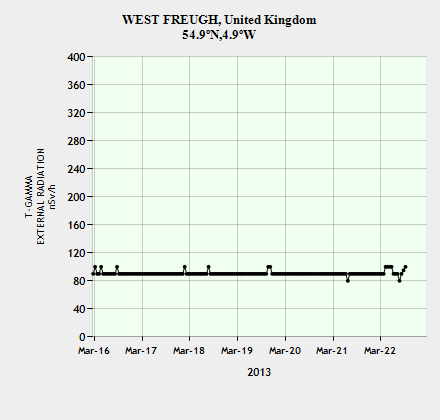
This graph shows the UK monitoring switch off that is not present on the Irish graphs below!
Data points for above graph showing increases and last data point are given below..
The Chart above I accessed shows some movement from after midnight on the morning of the 22 March 2013 and he chart is finally switched off at 12 noon on the 22 March 2013
(It Is normal for most European countries to ignore radon peaks and some actually scrub them of the charts others like CRIIRAD show them but make a note to say it is “Normal radon” its not easy to tell the difference) In this case the plume cleared the UK but hit Ireland to some degree or other on the 21st March 2013.
Here are the Irish charts I managed to access showing varying degrees of light contamination hitting Ireland from early on the 21st that proves that Sellafield was outputting large quantities of radioactive gases for some time..
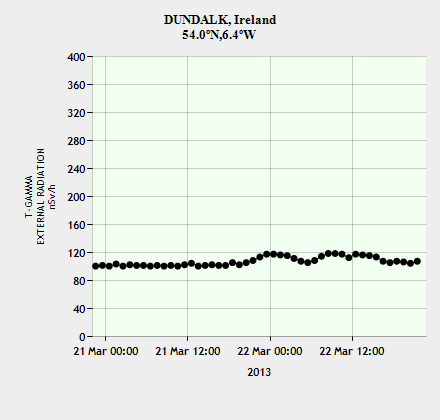
Concerning the actual levels shown on these graphs, you will find them lower than what you would measure with a Geiger counter as the averaging software that is used hides a multitude of sins.. the same situation is found in Fukushima Japan.

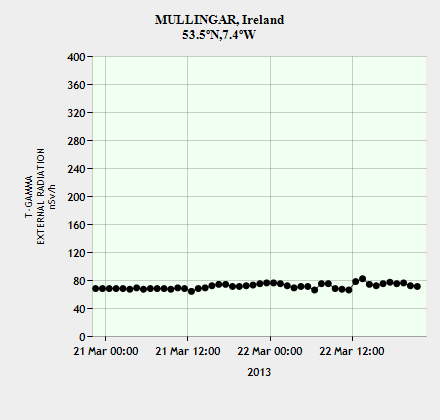
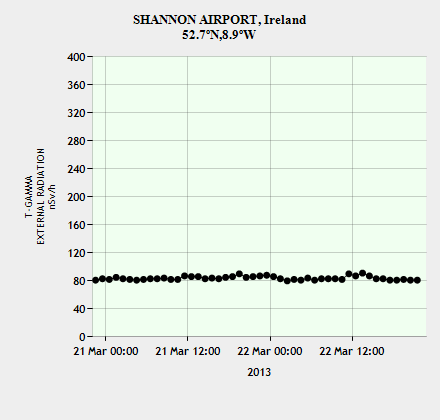
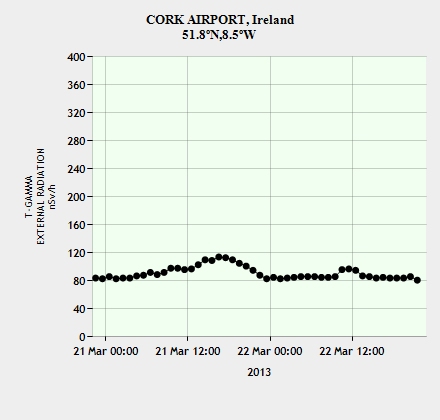
The clouds of radon are hitting the few working monitors randomly but the timing of the hits is most relevant here I believe. What about the locals near the Sellafield site the Gamma dose levels must be high there? Children and Foetuses are at most risk in these short sharp radiation dose hits!
The Low level wind chart shows the wind blowing to the north west and its possible some has moved down the channel as the east coast of Ireland shows a higher reading on the coastal monitoring stations. but the whole of Ireland looks like it is getting a hit. Some radiation monitoring stations are turned off in Ireland.
The winds taking the main plume out to the Atlantic are likely to bring this contamination back to either Ireland or even the UK as there is a moving LOW pressure zone west of Ireland
I was initially unable to access the gamma measurements after the initial find, as the German EURDEP crowd have blocked any further access to this data.. ( a sure sign of dodgy goings on and possibly more accurate proof than the mostly dysfunctional EURDEP mapping system), However a little trick I employed allowed me continued access even though the main EURDEP map was blocked, hence the graphs.
So the likely scenario is that the wind conditions have caused the gases that flow up the smoke stacks to come down to the ground instead of rising up and away towards the “civvies”. The gases have likely swamped the site and although they had to wear masks there “is no danger to” David Cameron and his friends!
However the same may not be said of the workers .. some of whom may need to take a dose break leaving Sellafield understaffed and this may pose a “significant” danger to David Cameron and his friends.
Down-drafts, from Stacks are rare but DO occur. As an aside this scenario where a down-draft causes local site contamination is the only time that the official IAEA ring a round the nuke plant actually sort of works. In most cases the plume lands a distance away from the plant, leaving the local area relatively clean. These down-drafts are likely the cause of local leukaemia in children and cancers in adults. Even Radon is nasty.
They may be packing plutonium in Glass (vitrification) and one hopes that they have not released any plutonium waste products.
[TOOK AN INNACURACY OUT HERE Arclight2011]
| 2013-03-22 10:49 | 2013-03-22 11:49 | 9.50E+01 | “” | And then the monitor is off |
| 2013-03-22 09:49 | 2013-03-22 10:49 | 9.00E+01 | “” | NV |
| 2013-03-22 08:49 | 2013-03-22 09:49 | 8.00E+01 | “” | NV |
| 2013-03-22 07:49 | 2013-03-22 08:49 | 9.00E+01 | “” | NV |
| 2013-03-22 06:49 | 2013-03-22 07:49 | 9.00E+01 | “” | NV |
| 2013-03-22 05:49 | 2013-03-22 06:49 | 9.00E+01 | “” | NV |
| 2013-03-22 04:49 | 2013-03-22 05:49 | 1.00E+02 | “” | NV |
| 2013-03-22 03:49 | 2013-03-22 04:49 | 1.00E+02 | “” | NV |
| 2013-03-22 02:49 | 2013-03-22 03:49 | 1.00E+02 | “” | NV |
| 2013-03-22 01:49 | 2013-03-22 02:49 | 1.00E+02 | “” | NV |
| 2013-03-22 00:49 | 2013-03-22 01:49 | 9.00E+01 | “” | NV |
| 2013-03-21 23:49 | 2013-03-22 00:49 | 9.00E+01 | “” | NV |
| 2013-03-21 22:49 | 2013-03-21 23:49 | 9.00E+01 | “” | NV |
| 2013-03-21 21:49 | 2013-03-21 22:49 | 9.00E+01 | “” | NV |
| 2013-03-21 20:49 | 2013-03-21 21:49 | 9.00E+01 | “” | NV |
| 2013-03-21 19:49 | 2013-03-21 20:49 | 9.00E+01 | “” | NV |
| 2013-03-21 18:49 | 2013-03-21 19:49 | 9.00E+01 | “” | NV |
| 2013-03-21 17:49 | 2013-03-21 18:49 | 9.00E+01 | “” | NV |
| 2013-03-21 16:49 | 2013-03-21 17:49 | 9.00E+01 | “” | NV |
Some nuclear PR from the BBC here… if you want to support the BBC click rate click on link! 🙂
The Sellafield nuclear reprocessing plant has been shut down because of severe weather conditions.
22 March 2013 Last updated at 20:58
BBC
“There is no reason to believe that there will be any off-site nuclear, environmental or conventional safety issues associated with the incident. The priority for the team is to protect our workforce, the community and the environment.”
Sellafield Ltd said the move, which came as snow and high winds affected the county, was to allow staff to leave early and get home safely.
It said the shutdown was nothing to do with the work at the site and there were no safety issues.
Spokesman Karl Connor said: “This is purely a safety issue because of the high winds and snow we want our 8,500 workers to go early and get home safely.”
http://www.bbc.co.uk/news/uk-england-cumbria-21895654
And this from October 2012
https://nuclear-news.net/2013/03/23/sellafield-smoke-stack-incident-20-october-2012-picture-repost/
I WAS GOING TO POST THE GRAPHS LIKE ABOVE BUT THE PICTURE FORMAT HAS BEEN CHANGED?? THEY ARE QUICK.. DAMAGE LIMITATION?? NO MATTER heres the urls 🙂
You will need to plat around with the date range.. In the top left corner is a drop down.. set it to 1 week and then 1 month.. and then youve become a net nerd!! 🙂
Portugal
CLONSKEAGH (Ireland)
MALIN HEAD (Ireland)
FR2622 – LB0KRS932MA – 41 – SIT – GM (France
Manuwangku, Under the Nuclear Cloud Canberra opening – Jagath Dheerasekara photographer exibition
……“Nomination of their traditional lands as a domestic nuclear waste dump site in 2007, coupled with proposals for Australia to ‘lease’ uranium and take back nuclear waste from overseas, have generated justifiable fear and concern among the Aboriginal communities in and around Muckaty (Manuwangku), 120 km north of Tennant Creek in the Northern Territory…….

Sunday April 7, 4:30-6pm
Photographs by Jagath Dheerasekara
Curated By Judith Crispin
Special guest speaker: Muckaty Traditional Owner Penny Phillips
“Manuwangku, Under the Nuclear Cloud” is a photographic exhibition presenting the community and country in the Northern Territory targeted to host a federal radioactive waste dump. The photos aim to break down the conception that these areas are the ‘middle of nowhere‘ and thus suitable for dumping of hazardous materials.
Sri Lankan photographer Jagath Dheerasekara received the Amnesty International Human Rights Innovation Grant 2010 and has developed the exhibition as a collaborative project with the Beyond Nuclear Initiative and Muckaty Traditional Owners.
Please support this important campaign by attending the Canberra opening and considering a donation to assist with costs for Penny Phillips to travel from Tennant Creek.
Details for contributions are at: http://beyondnuclearinitiative.com/donate/
Date:Sunday April 7, 2013
Time:430pm-6pm
Entry:$15 or $10 for students/members
Venue: Manning Clark House Gallery,
11 Tasmania Circle, Forrest, ACT


Jagath Dheerasekara (Australia):
Manuwangku, Under the Nuclear Cloud
“Nomination of their traditional lands as a domestic nuclear waste dump site in 2007, coupled with proposals for Australia to ‘lease’ uranium and take back nuclear waste from overseas, have generated justifiable fear and concern among the Aboriginal communities in and around Muckaty (Manuwangku), 120 km north of Tennant Creek in the Northern Territory.
Manuwangku, Under the Nuclear Cloud attempts to document the spirit, connection to land and collective voice of this community, as they protest in defence of their right to live in a clean environment, free from hazardous waste.”
Photography, a boyhood passion, took on a new meaning for Jagath Dheerasekara as a university student in Sri Lanka, when he began documenting the mass political killings of the late 1980s and early 1990s. A key member of Students for Human Rights, his resulting detention as a political prisoner led to exile, when France granted him political asylum.
He returned to Sri Lanka following the regime change in the mid 1990s and settled in Australia in 2008, where his work now focuses on Aboriginal, refugee and environmental themes. He was an Amnesty International Human Rights Innovation Fund grant recipient in 2010 and a finalist in the William and Winifred Bowness Photography Prize in 2011, and exhibits his work internationally.
Images © Jagath Dheerasekara.
http://jagathdeerasekera.blogspot.co.uk/
UK – Join the anti-Trident protest at Easter April 1st 2013 – Reading – Details!
….We will point out that the UK is in no position to object to nuclear proliferation while it insists on retaining its own nuclear ‘capacity’, in breach of its treaty obligations, and propose that instead we should join the non-nuclear majority in working for a nuclear-free world…..

Like others I expect, I’ve already been thinking ahead to Easter – in particular how to use that lovely extra free day on the Monday.
But the thinking didn’t take long, because this year there’s is a must for the calendar: a demonstration at the Atomic Weapons Establishment (AWE) at Aldermaston, near Reading.
That’s where Britain’s nuclear bombs are made, currently for the Trident system, in which the warheads and their missiles are placed on Trident submarines.
It’s also where the research and development are being done for the proposed successor system to Trident.
That’s why, this Easter Monday, thousands will gather there from around Britain, to protest against Trident’s replacement and the vast sums of money that are being poured into costly related developments long before the 2016 date for the final decision in Parliament as to whether Trident should in fact be replaced.
The protesters will call for the halting of all such preemptive activities and the scrapping rather than replacement of Trident, which would cost more than 100 billion pounds.
The protesters (currently backed by a substantial majority in recent opinion polls) will argue that at this time of cuts to jobs, housing and public services it is madness to waste money in this way; that nuclear weapons are genocidal and morally beyond the pale; that they do nothing to increase our security; and that most countries manage perfectly well without them.
We will point out that the UK is in no position to object to nuclear proliferation while it insists on retaining its own nuclear ‘capacity’, in breach of its treaty obligations, and propose that instead we should join the non-nuclear majority in working for a nuclear-free world.
Why not come with us on the Bath coach? Contact me for details and tickets.
Diana Francis Prospect Place Beechen Cliff, Bath Tel: 01225 480782
Trident nuclear weapons system – Pointless?
British anti-nukes campaigners are pressuring the government to change course on replacing its Trident nuclear weapons system at an annual cost of £3 billion and rather spend the money on housing.
video on link
http://www.presstv.ir/detail/2013/03/09/292732/trident-nuclear-weapons-system/
Time to Scrap Trident: Stop fooling with nuclear weapons
 Protest at AWE Aldermaston
- 12 noon to 2pm
- Easter Monday 1st April
- Join us and invite all your friends on Facebook!
- Watch and share the video!
This year on April Fools’ Day, we will be going to Aldermaston to highlight our opposition to Britain’s Trident nuclear weapons system – because that’s where the nuclear bombs are made.
We’ll be saying Scrap Trident and cancel plans to replace it.
We’ll be gathering around the base in our thousands with music, colour, and speeches.
Why are we going?
2013 is a year of continuous activity at AWE Aldermaston, prompted by the formation of grassroots campaign Action AWE, to highlight the site’s nuclear bomb-making function.
This is vital as we head towards the 2016 decision point on whether or not Trident should be replaced. Vast sums of money are being poured into developments at Aldermaston, even before any decision is taken on Trident.
The total cost of a replacement for Trident would be over £100 billion. At this time of cuts to jobs, housing and public services think what else Trident’s £100 billion could be spent on! We say it’s time to scrap Trident, and on April Fools’ Day we’ll be telling the government to ‘stop fooling with nuclear weapons’!
 How can you get involved?
Fukushima deletes radiation data needed for exposure assessment!
“……”We were preoccupied with other tasks and were late in collecting the dosimeter. The maker told us that data couldn’t be taken from the device, and we overwrote the readings because we needed to use the dosimeter to monitor radiation levels in various parts of the prefecture,” an official of the task force said. “We’ve heard that radiation levels were normal at the time. We didn’t report the loss of the data, and we’re extremely sorry.”
However, the manufacturer denies that data cannot be extracted from the dosimeter.
“Readings are saved in the dosimeter’s memory chip and can be extracted using a special program installed on a computer,” a representative of the manufacturer said….”
Prof Yamashita – Japan Thyroid Association and ex Fukushima Medical Uni Hospital
Prof Thomas – BBC PRopagandist (UK Thyroid Association and Imperial College University London)
Richard Wakeford – Statisticall Liar for UNSCEAR and the BBC (ex BNFL)
A crying child!
Photo by Ritika Mittal


March 09, 2013 (Mainichi Japan)
FUKUSHIMA — The prefectural government deleted radiation data that it gathered at an evacuation shelter near the crippled Fukushima nuclear plant shortly after the disaster broke out, it has been learned.
Click here for the original Japanese story
The Fukushima Prefectural Government explained that it wrote over the data without saving it. It failed to report the case to the national government.
The move has made it impossible for the prefectural government to assess how much radiation residents near the nuclear power station were exposed to shortly after the accident — although such assessment is required under national government guidelines.
It was earlier learned that the prefectural government’s analysis of data from radiation monitoring posts was delayed until September last year, and was not reflected in final reports compiled by the government and Diet’s respective nuclear disaster investigation committees.
The latest revelations could influence discussions by a Nuclear Regulation Authority (NRA) panel on measures to improve methods for monitoring radiation doses in the event of an emergency at an atomic power station.
At around 3 a.m. on March 12, 2011, the day after the massive earthquake and tsunami that triggered the nuclear crisis, the Fukushima Prefectural Government instructed the nuclear plant’s operator, Tokyo Electric Power Co. (TEPCO), to dispatch employees to accompany prefectural officials for emergency monitoring of radiation, according to the prefecture and TEPCO. The order was issued during a meeting of an accident task force in the town of Okuma in accordance with the prefecture’s regional disaster-prevention plan, which was worked out within the framework of the national government’s guidelines.
At least three people clad in radiation suits, including prefectural government officials, headed to Okuma Junior High School, about five kilometers west of the tsunami-hit Fukushima No. 1 Nuclear Power Plant, on a TEPCO bus carrying a portable dosimeter and dust collectors, among other equipment. They arrived at the school at around 5 a.m., and installed the devices near the school’s gymnasium, where about 100 local residents were taking shelter.
Even though power supply was cut off in the wake of the disaster, the portable dosimeter functioned properly until the afternoon of that day — when a hydrogen explosion occurred at the power plant’s No. 1 reactor building — because the device was equipped with a small power generator.
However, the prefectural government deleted the data in September 2011 after it collected all dosimeters used for radiation monitoring.
A report on emergency radiation monitoring that the Education, Culture, Sports, Science and Technology Ministry compiled in July last year, states that monitoring was first conducted at 8:09 a.m. on March 12 in Okuma — shortly after all residents evacuated from the junior high school to other places — using another dosimeter. But the latest findings indicate that the monitoring actually commenced at least three hours earlier.
The prefectural government’s disaster task force explained that it wrote over the data because the manufacturer of the dosimeter said data could not be taken from the device.
Some great info concerning potential disasters and their effects..
lots of information!!


Hamaoka Nuclear Power Plant in earthquake/tsunami zone south of Fukushima
The precarious situation in Fukushima has made the news again: TEPCO partially restores power to cooling systems at Fukushima plant and there is no excuse for this because the Fukushima plant outage reveals lack of backup power source 2 years after crisis outbreak. Closing the nuclear power plants has caused Japan’s Feb trade deficit gets worse at $8.1B as exports lag imports.
View original post 907 more words
Tokyo – Protest occupiers face being evicted by the Japanese Government
Published on 20 Mar 2013
Ryan interviews one of the occupiers in Tokyo to get some details for us!
Fukushima after 2 years / hundreds of thousands of people still live in heavily contaminated territory
….These initiatives will lead to the creation of CRMS. These technical means and the procedures receive the financial support of the Region Rhône-Alpes….
What is CRIIRAD ? What are the objectives of this video series?
O2 Fukushima prefecture / OGUNI area of Date city / June 2012
Published on 5 Dec 2012
This film shows gamma radiation measurements performed by a scientist from CRIIRAD laboratory (B. Chareyron), during a mission to Oguni area of Date City in June 2012, more than one year after the Fukushima Daiichi nuclear disaster. Oguni area (see point O on the map) is located about 10 km east of the city of Fukushima and 55 km north-west away from the damaged nuclear reactors.
This mission has been performed with a team from CRMS (M. Wataru Iwata and M. Kanno). The device is a gamma radiation scintillometer whose results are given in counts per second (c/s). A gamma radiation rate of 3 000 c/s monitored 1 meter above ground is equivalent to 1.48 µSv/h (microSievert per hour). Due to high gamma radiation rates all over the area, including inside houses (0.3 to 0.7 µSv/h inside this particular house) most of the people living there are exposed to annual doses above 1 milliSievert. According to ICRP risk coefficients, a dose of 1 milliSievert corresponds to 17 cancers for each 100 000 exposed persons. For additional information look at http://www.criirad.org and http://www.crms-jpn.com
CRIIRAD
2 years after Fukushima: Public Meeting Friday, March 8 at the show Primrose (Chassieu – 69) followed by a press conference
05/03/2013:
CRIIRAD Commission of Independent Research and Information on Radioactivity

With the participation of Mr. Wataru Iwata Director of CRMS (Citizen’s Radioactivity Measurement Station), Mr Alain Chabrolle, Vice President for Health and the Environment in the Rhône-Alpes Regional Council, Mr. Roland Desbordes and Bruno Chareyron, respectively president of the CRIIRAD and laboratory manager CRIIRAD.
Access to reliable and independent radioactivity testing is essential, especially after a nuclear disaster. In March 2011, CRIIRAD has increased controls to assess the impact of Fukushima fallout in France, through a network of independent monitoring supported by the Rhône-Alpes Region.
This financial support allowed CRIIRAD to carry out several missions to Japan and strengthen local citizen initiatives. It has contributed to the birth of Japan CRMS (Citizen’s Radioactivity Measurement Station).
One of our priorities of the association is to defend the right to resettlement of hundreds of thousands of Japanese citizens still living in heavily contaminated territories and whose total decontamination is impossible.
Note: Wataru Iwata, Director of CRMS and Bruno Chareyron, laboratory manager CRIIRAD also intervene in Paris for a press conference Tuesday, March 12 from 11am to 13H for mayor of the 2nd district. Contact reporter msb.jne @ free.fr
What is CRMS?
CRMS (Citizen’s Radioactivity Measurement Station) is a Japanese, non-profit, created in 2011 whose objective is to improve the protection of citizens against ionizing radiation.
It is an independent organization whose mission is to provide citizens with the tools to acquire knowledge on radiation protection, to learn how to measure radioactivity and thereby improve their protection independently. The CRMS radioactivity measurements made at the request of citizens and publishes the results on its website or in other media to share the data with the largest number. They are made by citizens in 9 laboratories CRMS located on the territory of the prefecture of Fukushima and 10th located in Tokyo in late 2012.
For more information: http://fr.crms-jpn.com/
What is CRIIRAD?
CRIIRAD (Commission for Independent Research and Information on Radioactivity) is a non-profit organization created in 1986 following the Chernobyl disaster. Indeed, at that time, the French authorities have lied about the intensity of the radioactive fallout. In order to make independent measurements, CRIIRAD created his own laboratory.
Following the Fukushima disaster (March 2011), CRIIRAD conducted an impact assessment on the French territory through a combination of technical means to measure radioactivity in the air (network of beacons) and impact benefits (monitoring of the food chain) and its support for Japanese citizens in their efforts to create independent monitoring methods. These initiatives will lead to the creation of CRMS. These technical means and the procedures receive the financial support of the Region Rhône-Alpes.
For more information on the actions taken in 2011 and 2012 by CRIIRAD alongside CRMS, see:
http://www.criirad.org/actualites/dossier2011/japon_bis/crms/extrait_Japon.pdf
http://www.criirad.org/actualites/dossier2012/fukushima/5dec2012.html
Chris Busby: Nuclear Test Veterans betrayal by UK MOD and justice system!
Published on 19 Mar 2013
U235 dirty bomb used as first UK nuclear test?
Prof Busby talks about the Test veterans radiation Pensions Appeals Tribunals cases.

He explains how the veterans have been betrayed by their solicitors through a complex series of changes in the nature of the hearings and the sudden withdrawal of one solicitor firm Rosenblatts and its curious replacement by another, Hogan Lovells, culminating in the removal of all the critical evidence from the cases and the exclusion of Busby’s evidence collected over three years, without the knowledge of the individual litigants.
Prof Busby explains how secret documents, released under Freedom of Information requests and Directions by the Judge, Hugh Stubbs, point to Uranium, the main component of the bombs, as the major cause of the health effects in the veterans and their children and grandchildren. He has decided to put all the information from his many reports, including information obtained from redacted secret sources, on the internet.
This information was excluded by the new solicitors to the case, (Hogan Lovells International),which was held in February 2013. Reports will be placed on the internet on the sites: http://www.llrc.org and http://www.greenaudit.org
-
Category
-
Licence
Standard YouTube Licence
https://nuclear-news.net/2011/11/25/the-struggle-drags-on-for-justice-for-uks-nuclear-test-veterans/
https://nuclear-news.net/2010/09/06/uk-govts-secret-research-into-dead-nuclear-test-veterans/
https://nuclear-news.net/2010/07/10/nuclear-test-veterans-die-as-the-law-delays/
Videos now officially released for the Medical and Ecological Consequences of the Fukushima Nuclear Accident – 11 March 2013 – New York
 Videos now officially released with good quality and quick links with supporting Power point presentations..
March 11, 2013
The Medical and Ecological Consequences of the Fukushima Nuclear Accident, Day 2
March 12, 2013
Ten Years Later, U.S. Has Left Iraq With Mass Displacement & Epidemic of Birth Defects, Cancers
democracynow.org
20 March 2012

In part two of our interview, Al Jazeera reporter Dahr Jamail discusses how the U.S. invasion of Iraq has left behind a legacy of cancer and birth defects suspected of being caused by the U.S. military’s extensive use of depleted uranium and white phosphorus. Noting the birth defects in the Iraqi city of Fallujah, Jamail says:
“They’re are extremely hard to bear witness to, but it’s something that we all need to pay attention to …
What this has generated is from 2004 up to this day, we are seeing a rate of congenital malformations in the city of Fallujah that has surpassed even that in the wake of the Japanese cities of Hiroshima and Nagasaki that nuclear bombs were dropped on at the end of World War II.”
Jamail has also reported on the refugee crisis of more than one million displaced Iraqis still inside the country, who are struggling to survive without government aid, a majority of them living in Baghdad. Click here to watch part 1 of the interview. [Transcript to come and part 1 . Check back soon.]
http://www.democracynow.org/2013/3/20/ten_years_later_us_has_left
…….Last year, Indian and Russia had signed a protocol for funding two new units at Kudankulam.
As per the protocol, Russia will extend an export credit of $3.400 billion to Russian organisations to help build the units at four per cent interest…..
I wonder if that has to do with this…?
UPDATE: Raid on Bellona’s St. Petersburg offices casts uncertain shadow over organization’s future
Lyubyanka, headquarters of the Russian FSB, is part of a new assault launched on Russian NGOs.
Coutesy of Thomas Nilsen, the Barents ObserverCharles Digges, 20/03-2013 ……
Bellona’s office in St. Petersburg yesterday got a surprise look at how the Russian government plans to enforce its law requiring NGOs that receive foreign funding to register as “foreign agents” with an unannounced inspection from the general prosecutor and other authorities.
http://www.bellona.org/articles/articles_2013/bellona_ngo_raid
Because of these?
Road to Fukushima fraught with ongoing tragedy and innovations ignored
http://www.bellona.org/articles/articles_2013/fukushima_series_three
Analysis: Fukushima two years later
http://www.bellona.org/articles/articles_2013/Nils_fukushima_comment
New Japanese nuclear regulatory agency must assert its opinion as confusion around Fukushima disaster still lingers
http://www.bellona.org/articles/articles_2013/fuku_series_last
Fukushima power outage to spent nuclear fuel storage ponds partially restored
http://www.bellona.org/articles/articles_2013/fukushima_power_outage

PTI
As engineers race to commission the nuclear power plant at Kudankulam, the government has given its nod to build two more such units of 1,000 MW at the site in Tirunelveli district of Tamil Nadu.
The Cabinet Committee on Security, at a meeting chaired by Prime Minister Manmohan Singh on Tuesday evening, approved the proposal to grant administrative and financial sanction for building units 3&4 at Kudankulam site, officials said.
The decision comes at a time when engineers of Nuclear Power Corporation of India Limited (NPCIL) are working to commission the first 1,000 MW unit of the Kudankulam nuclear power project.
Sources said the estimated cost of building the two plants has been pegged at Rs. 20 crore per megawatt.
The CCS nod paves the way for signing of the general framework agreement (GFA) between NPCIL and Russian suppliers of nuclear equipment.
The GFA will spell…
View original post 161 more words
NATO Advisory Report Urges Against Cyberstrikes on Nuclear Plants

“If you look at the way they must have organized the entire attack, it’s very impressive,” Schouwenberg said. “These guys are absolutely top of the line in terms of sophistication.”
Image source : http://krebsonsecurity.com/2010/09/stuxnet-worm-far-more-sophisticated-than-previously-thought/

March 20, 2013
An advisory report for NATO urges governments against carrying out cyberstrikes on atomic energy plants and other key non-military infrastructure, the London Guardian reported on Monday.
“In order to avoid the release of dangerous forces and consequent severe losses among the civilian population, particular care must be taken during cyberattacks against works and installations containing dangerous forces, namely dams, dykes and nuclear electrical generating stations, as well as installations located in their vicinity,” according to 20 law specialists who collaborated with the International Committee of the Red Cross and the U.S. Cyber Command in writing the NATO handbook.
http://www.nti.org/gsn/article/nato-advisory-report-urges-against-cyberstrikes-nuclear-plants/
BelTA to host online conference on nuclear energy on 22 March
….As arguments against the NPP, the statement lists the threat of an accident or a disaster prompted by an operational failure at the plant, a possible increase in cancer incidence caused by so-called “sanctioned” radiation discharges that a nuclear power plant releases even in the course of routine operation (please see a report on this subject here), the risk of another violent earthquake of the scale of the 1909 disaster (the 7.0 magnitude quake of 1909 was the strongest ever recorded in Belarus), and the dominant western winds, which would carry the radioactive fallout all over the country should an accident in fact take place….. Bellona 2009
20.03.2013 17:40
MINSK, 20 March (BelTA) – An online conference featuring Director of the Nuclear Energy Department of the Energy Ministry of the Republic of Belarus Nikolai Grusha and Advisor to the Executive Vice-President of Rusatom Overseas Sergei Boyarkin will be held on the website of the BelTA News Agency from 12:00 to 13:00 on 22 March. The conference will be titled “Nuclear power: environment, safety, advantages”.

Belarus launched its own nuclear program not so long ago; however the IAEA experts believe that our country can be called one of the most advanced newcomers. The quality of preparation works on the Ostrovets site was hailed by Russian and international experts. As early as the summer of 2013 the concrete will be poured; works on all the 62 objects of the production base and out-of-site facilities, networks and structures will be completed by September. Director General of the Russian state corporation for nuclear energy Rosatom Sergei Kiriyenko has recently visited the construction site. He praised the high quality of works and said that Belarusian construction workers might get licenses to build nuclear power plants in Russia.

Image source ; Belarus, Lithuania, and a nuclear power plant in search of a solution
Environmentalists and scientists say that nuclear power is the most promising, most advanced and the cheapest source of energy. The humankind is unlikely to come up with an alternative to nuclear power in the near future. Leading European countries remain committed to supporting nuclear energy development. Representatives of 12 EU member states, namely Bulgaria, the United Kingdom, Hungary, Spain, Lithuania, Poland, Romania, Slovakia, Finland, the Netherlands, France and Czechoslovakia have confirmed their plans to promote nuclear energy.
Even Japan announced its decision to consider resuming the nuclear power program two years after the Fukushima accident.
What is Belarus’ strategy for developing nuclear energy?
What are the advantages of the Russian NPP design?
How will the Belarusian NPP be protected from external emergencies?
Is there any connection between the NPP and greenhouse effect?
These and other questions will be answered by Nikolai Grusha and Sergei Boyarkin during the online conference.
Questions can be submitted in advance or during the conference on the BelTA website
in the section ONLINE CONFERENCE. Answers will be posted after 12:00 on 22 March real-time.
http://news.belta.by/en/news/society?id=710135
Belarus, Lithuania, and a nuclear power plant in search of a solution
Andrei Ozharovsky, 16/03-2009 – Translated by Maria Kaminskaya
GRODNO REGION, Belarus – Debates are still ongoing on the issue of possible construction of a nuclear power plant in Belarus. The suggested site is in the Ostrovets District in the Grodno Region – or just some fifty kilometres away from neighbouring Lithuania’s capital of Vilnius. Bellona’s regular contributor Andrei Ozharovsky offers a comment on the developing project and the public sentiment it is causing.
Lithuania is worried, Belarus’ Foreign Affairs Ministry is circling the wagons, and Ostrovets residents keep collecting signatures for a petition to stop the project. All the while, the Belarusian KGB – still very much alive in this former Soviet republic, which bore the brunt of the nuclear fallout from the 1986 Chernobyl disaster – is calling activists in for questioning, and the propaganda machine of the country’s nuclear establishment is painting anti-nuclear protesters as members of sex minorities, quite a stigma in a country viewed widely as one of the Eastern European states with the worst human rights record.
The site for future Chernobyl-2?
Initially, several sites were proposed to host the envisioned nuclear power plant (NPP). The choice was between the regions surrounding such Belarusian cities as Mogilyov, Vitebsk, and Grodno.
Last January, reports appeared in Belarus’ official media outlets that the choice had finally been made. The NPP is supposed to be built near the village of Mikhalishki in the Ostrovets District of the Grodno Region. However, as activists with an organisation called The Anti-Nuclear Campaign of Belarus found out, no final decision had actually been settled upon: There was only a recommendation made by a certain unidentified commission, and making a formal decision to place a new nuclear power plant at a particular site is a prerogative afforded only the president of the country.
 |
| A selection of sites were first proposed to host the future NPP: Mogilyov, Vitebsk, and Grodno (shown above is a Russian-language map of suggested NPP sites in Belarus). |
| http://www.naviny.by/ |
No reports, meanwhile, were coming that Belarusian President Alexander Lukashenko had made up his mind on the future location. One guess seems appropriate that the media were either indulging in wishful thinking or simply not quite grasping the situation. It is likewise possible that the government had engaged in a disinformation offensive:
Florida nuclear power industry defends charges for plants that may not be built!
……Legislation is in the pipeline to reverse a 2006 law that has allowed more than $800 million to be collected towards the construction of nuclear power plants that may never get built…..
…..House Speaker Will Weatherford has said that as the state’s energy demands have changed, notably the downward cost of natural gas which is expected to account for 60 percent of Florida’s energy source, he was open to revisiting the law……

Mar 19, 2013, 6:36am EDT
- JIM TURNER, THE NEWS SERVICE OF FLORIDA
Legislation is in the pipeline to reverse a 2006 law that has allowed more than $800 million to be collected towards the construction of nuclear power plants that may never get built.
But industry leaders and representatives for the state’s largest utilities on Monday praised the law, which they say has allowed them to be ready for increased demand.
Florida Power & Light Senior Director of Nuclear Development Steven Scroggs said the 2006 law has allowed the Juno Beach-based utility to acquire advantageous financing rates on projects while planning for new nuclear facilities. It can take more than six years to land federal permits and take a decade before construction begins, he said.
“We don’t really have the luxury of sitting by idly, we have to plan ahead,” Scroggs said. “Just as if we know hurricanes and tornadoes are coming we position crews in position to be able to respond quickly as soon as that weather has passed, similarly we cannot wait to make decisions about new generation investment until our customers need additional power. We have an obligation to plan far in advance.”
The law has allowed FPL to upgrade already-existing nuclear plants in Miami-Dade and St. Lucie counties, while planning for the possible construction of two new reactors.
Honeywell cleans irradiated water at Fukushima nuclear power plant
IONSIV adsorbents are expected to remain in use for the next 10 years to remove cesium and strontium from various contaminated water sources at Fukushima….

Image source : http://www.nyse.com/about/listed/lcddata.html?ticker=HON&fq=D&ezd=1Y&index=5
03/20/2013

Adsorbent materials made by Honeywell (HON) were used to clean nearly 100 million gallons of radiation-contaminated water at the Fukushima Daiichi nuclear power plant in Japan.
Honeywell’s UOP IONSIV Selective Media adsorbents have been used by Toshiba Corp. and Shaw Global Services LLC as part of the Simplified Active Water Retrieve and Recovery System (SARRY), which is being used to treat wastewater that was contaminated after the earthquake and tsunami in Japan in March 2011.
Honeywell’s UOP material has been used in the system since August 2011 and has reduced cesium to below detectable levels.
Honeywell’s UOP IONSIV Selective Media adsorbents are crystalline materials designed to selectively remove radioactive ions, particularly cesium and strontium, from liquids.
Previous generations of these products have been used commercially for more than 30 years to treat radioactive waste streams in commercial nuclear power plants, alkaline tank waste and spent fuel storage pool water. Honeywell’s UOP R9120-B adsorbent and its UOP R9160-G adsorbent were used in the cleanup efforts at the plant.
The SARRY system, developed by Toshiba, the Shaw Group and AVANTech, Inc., has operated at the plant since its installation. Cleanup efforts are still under way and IONSIV adsorbents are expected to remain in use for the next 10 years to remove cesium and strontium from various contaminated water sources at Fukushima.
April 03, 2012
“…”This investment helps us meet the demand for our newest advanced materials, as well as established products that are in demand by customers around the world,” said Mike Millard, senior vice president and general manager for Honeywell’s UOP Catalyst, Adsorbents and Specialties business. “We continue to invest in new technologies that will help meet refiners and petrochemical producers’ needs for materials that offer more flexibility, increase production and lower cost.”
IONSIV Ion Exchanger adsorbents are crystalline materials that can selectively remove radioactive ions from liquids. At Japan’s Fukushima Daiichi nuclear power plant, these adsorbents are successfully being used to reduce radioactive cesium to non-detectable levels in the plant’s contaminated wastewater after the earthquake and tsunami last year. These materials have been used commercially for more than 30 years to remove radioactive ions from liquids, such as radioactive waste streams in commercial nuclear power plants, alkaline tank waste, and spent fuel storage pool water….”
[…]
“….Honeywell UOP is a leading producer of catalysts, used in refining, petrochemical and other applications, to produce products ranging from transportation fuels to biodegradable detergents. It pioneered the adsorbents industry more than 60 years ago with the invention of the first synthetic zeolites for use as molecular sieve adsorbents. Today, in addition to a wide range of molecular sieve and activated alumina products, it offers a broad portfolio of adsorbents for the removal of contaminants such as mercury and sulfur compounds.
In addition to Mobile, Honeywell UOP produces catalysts and adsorbents in Baton Rouge, La.; Shreveport, La.; McCook, Ill..; Shanghai, China; Brimsdown, U.K.; and Reggio Calabria, Italy. The company’s New York Stock Exchange symbol is HON…..”
http://blog.al.com/press-register-business/2012/04/honeywell_company_uop_expandin.html
1 This Month
10 March A LIVE WEBINAR THE REAL EFFECTS OF NUCLEAR POWER
What the Industry Isn’t Telling Us
1:00 PM Mountain, 2 pm Central, 3 pm Eastern. Live on the Keepers of the Water Facebook page



18 March Webinar @ 1 PM EST: An Assessment of SMR Projects: The Case of Canada
register for the zoom:
https://us02web.zoom.us/webinar/register/WN_o8BIIOUvQ2ONJR1nta65DQ#/registration


of the week – STOP SMALL MODULAR REACTORS IN CANADA
To see nuclear-related stories in greater depth and intensity – go to https://nuclearinformation.wordpress.com
-
Archives
- March 2026 (109)
- February 2026 (268)
- January 2026 (308)
- December 2025 (358)
- November 2025 (359)
- October 2025 (376)
- September 2025 (258)
- August 2025 (319)
- July 2025 (230)
- June 2025 (348)
- May 2025 (261)
- April 2025 (305)
-
Categories
- 1
- 1 NUCLEAR ISSUES
- business and costs
- climate change
- culture and arts
- ENERGY
- environment
- health
- history
- indigenous issues
- Legal
- marketing of nuclear
- media
- opposition to nuclear
- PERSONAL STORIES
- politics
- politics international
- Religion and ethics
- safety
- secrets,lies and civil liberties
- spinbuster
- technology
- Uranium
- wastes
- weapons and war
- Women
- 2 WORLD
- ACTION
- AFRICA
- Atrocities
- AUSTRALIA
- Christina's notes
- Christina's themes
- culture and arts
- Events
- Fuk 2022
- Fuk 2023
- Fukushima 2017
- Fukushima 2018
- fukushima 2019
- Fukushima 2020
- Fukushima 2021
- general
- global warming
- Humour (God we need it)
- Nuclear
- RARE EARTHS
- Reference
- resources – print
- Resources -audiovicual
- Weekly Newsletter
- World
- World Nuclear
- YouTube
-
RSS
Entries RSS
Comments RSS
 nuclear-news