Empire Managers Invent Fake Threats So We Won’t Fight The Real Monsters
Caitlin Johnstone, Jul 04, 2026, https://www.caitlinjohnst.one/p/empire-managers-invent-fake-threats?utm_source=post-email-title&publication_id=82124&post_id=205002670&utm_campaign=email-post-title&isFreemail=true&r=1ise1&triedRedirect=true&utm_medium=email
Western politics is mostly just empire managers making up fake problems to fight so they don’t have to address the real problems.
Can’t stop waging wars or the western empire will collapse. So they make up fake threats from dictators and tyrants and take action to stop them.
Can’t stop inflating the military budget and circling the planet with more and more war machinery or the military-industrial complex will stop reaping profits. So they tell you to be afraid of Muslims and “terrorists” and Russia and China and take action to protect you from them.
Can’t stop polluting the world and destroying the biosphere or capitalism will perish. So they split us into two mainstream warring factions arguing about culture war wedge issues and promise to protect each faction from the other side.
Can’t stop supporting Israeli atrocities or they’ll hamstring their hegemonic agendas in west Asia and make an enemy of the Zionists. So they create a boogie man of “antisemitism” and set up envoys, inquiries and task forces dedicated to stopping it.
Can’t get money out of politics and stop wealthy oligarchs from using their riches to manipulate western politics to their advantage, because the oligarchs run the empire. So they fearmonger about “communism” on the right and tell the centrists that the leftists are costing them elections.
Can’t stop ramping up authoritarianism and eroding the civil liberties of the citizenry or else they won’t be able to suppress future revolutions. So they cite unpopular people and groups as reasons why the authoritarianism is necessary to protect the public while constructing a giant cage of surveillance and control around everyone.
Can’t stop coercively extracting resources and labor from the global south because that’s the whole reason the empire was set up in the first place. So they tell everyone the immigrants are the source of all their problems and make western politics revolve around immigration policy.
The empire managers make up fake problems to solve because the empire is the source of all the real problems
They make up fake monsters to protect us from because they themselves are the real monsters.
They make up imaginary ghouls and goblins lurking around every corner because they don’t want us looking up and seeing the real bastards who are poisoning our world.
US moves to eliminate longtime radiation safety principle for nuclear power
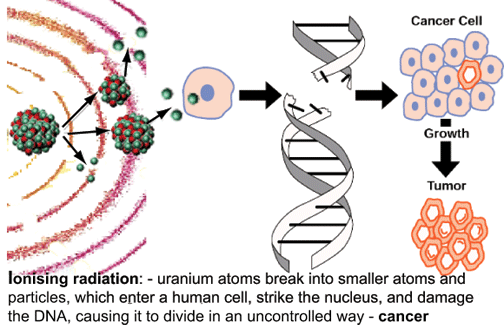
“the change could ultimately make it so that currently low doses of radiation that workers and the public are exposed to “could increase really all the way up to regulatory limits without any sanction from the NRC.”
by Rachel Frazin – 07/02/26, https://thehill.com/policy/energy-environment/5951671-nuclear-power-radiation-exposure-nrc/
The federal government is proposing to overhaul radiation safety regulations for nuclear power, including by eliminating a long-term principle for nuclear safety.
The Nuclear Regulatory Commission (NRC) this week proposed to get rid of the requirement for nuclear plants to ensure that radiation exposure is “as low as is reasonably achievable.”
Proponents of the change say just using radiation dose limits is less subjective than going by the “as low as is reasonably achievable” principle — and that it led to overly conservative protections that stifled the nuclear industry.
Supporters of the current language, however, say that having the “as low as reasonably achievable” principle, also known as ALARA, in place ensures that nuclear plants take all measures possible to reduce exposure for workers and the general public.
NRC Chair Ho Nieh said in a statement that the agency is “raising the standard for regulatory clarity, not lowering the standard for safety.”
“Our radiation dose limits remain unchanged — what we’re eliminating is unnecessary ambiguity,” he said.
But critics say that eliminating ALARA means getting rid of a key incentive for energy companies to keep radiation levels as low as possible — and could mean more cancer cases.
“Facility owners felt like … ALARA was forcing them to go well below the allowable radiation limits and spend a lot of money to do that,” said Edwin Lyman, director of nuclear power safety at the Union of Concerned Scientists.
Lyman warned that the change could ultimately make it so that currently low doses of radiation that workers and the public are exposed to “could increase really all the way up to regulatory limits without any sanction from the NRC.”
He said this could include by having employees work longer shifts and therefore getting more radiation exposure.
Overall, he said, “this is opening the door for sloppier practices” and “worse management.”
In addition to axing ALARA, the NRC is proposing other changes, including loosening emissions limits for radioactive material.
It said that under one of the rules it is proposing to change, current regulations would allow for an estimated four excess cases of fatal cancer for every 10,000 people exposed to the maximum allowable radiation for 70 years. It said that the change it is making would allow this number to go up to nine cases for every 10,000 people.
It also proposed increasing how much radiation caregivers for people who receive radiation treatment can be exposed to.
The agency said that all of the changes it is proposing would save the industry about $9.53 million per year.
The moves come as the Trump administration has been pushing for the U.S. to build more nuclear power. Last year, an executive order from President Trump set the goal of quadrupling the nation’s nuclear power capacity by 2050.
It also directed the NRC to reconsider its use of ALARA and to speed up approvals for nuclear reactor licenses.
While the NRC is technically an independent agency, it is made up of three Republicans and two Democrats.
Last year, the White House fired a Democrat from the commission, which at the time, had a 3-2 Democratic majority. On Monday, the Supreme Court ruled the White House can conduct such firings.
GBE-N ‘doesn’t hold’ breakdown of proposed £20bn budget for SMR contract

30 Jun, 2026 By Tom Pashby,
https://www.newcivilengineer.com/latest/gbe-n-doesnt-hold-breakdown-of-proposed-20bn-budget-for-smr-contract-30-06-2026/
Great British Energy – Nuclear (GBE-N) has said it “doesn’t hold” a breakdown of the £20bn it initially forecast that it may need to cover the cost of the Small Modular Reactor Technology Partner (TP) Contract.
The TP Contract was initially designed to include up to four awards, split into two stages.
“The forecast Stage 2 price of the TP Contract is approximately £8,168,000,000”, the award notice said.
It added: “This forecast price is indicative only as the pricing mechanism for Stage 2 remains subject to negotiation during Stage 1.”
This forecast price puts the total TP Contract value at £8.527bn.
The 8 May award notice also said: “The estimated total value within the tender notice for the two-stage TP Contract was £20,000,000,000 excluding VAT.
“This value was indicative only and based upon GBE-N’s initial understanding of the potential costs of developing a first-of-a-kind technology.
“This estimated total value was based on the fact that in the tender notice GBE-N reserved the right to make up to four awards, although GBE-N also reserved the right to award three, two or only one contract(s).
“GBE-N has ultimately decided to award only one TP Contract and the contract award notice value reflects this.”
The notice did not say what the estimated budget was for each of those up to four awards. If they had been of equal value, the awards would have been for £5bn for the two stages, meaning that they had underestimated total costs according to their current calculations by £3.5bn.
NCE requested a breakdown of the £20bn initial estimated figure for the up to four TP Contract awards, via the Freedom of Information (FOI) Act.
In response, GBE-N said: “Following reasonable and proportionate searches of our records, we confirm that Great British Energy – Nuclear (GBE-N) does not hold the information you have requested.”
NCE is challenging this response via an internal review on the basis that there is a reasonable expectation that GBE-N would hold more detailed information about the £20bn initial estimated budget.
GBE-N declined to comment when approached about the FOI response.
Lithuania to lift ban on nukes, president says
The country’s constitution bans nuclear weapons and foreign military bases, but its parliamentary leaders have agreed that this provision is now “outdated.”
July 2, 2026 , By Jonas Loesel, https://www.politico.eu/article/lithuanias-leaders-want-lift-ban-nukes-president-says/
Lithuanian President Gitanas Nausėda said Thursday that there was “practically unanimous” support among party leaders for ending the country’s ban on nuclear weapons.
“Opinions were practically unanimous. Almost all parliamentary faction leaders expressed the view that Article 137 has become obsolete and should not merely be amended but removed,” Nausėda told reporters, referring to the section of Lithuania’s constitution that bans nuclear weapons and foreign military bases.
Speaking after meeting with parliamentary faction leaders, Nausėda indicated that the legislature would soon look to amend the legislation. Vilnius, a staunch ally of Ukraine, has previously indicated interest in hosting U.S. nuclear weapons as it looks for deterrents against neighboring Russia.
Lithuania joined NATO in 2004, and Nausėda said the country’s parliamentary leaders did not want to be in a “gray zone” within the military alliance as one of the only countries that continues to ban nuclear weapons. Finland repealed a similar ban last June.
“Today, 35 years later, the situation is different. As NATO members, we have the right, the duty, and the desire to be full and equal members of NATO. The primary means of deterrence is nuclear deterrence,” said Juozas Olekas, the speaker of Lithuania’s parliament.
The Financial Times previously reported that the U.S. had discussed deploying nuclear warheads to countries on NATO’s eastern flank. U.S. nuclear weapons are currently stored on military bases in the U.K., Germany, Italy, Turkey, Belgium and the Netherlands.
Pacific nuclear survivors urge Australia to sign and ratify UN treaty banning nuclear weapons ahead of key conference
Australia is the only state party to a nuclear-weapon-free zone treaty in any region of the world that has claimed to be protected by the nuclear weapons of another state.
Andrew Mathieson, July 3, 2026, https://nit.com.au/03-07-2026/25161/pacific-nuclear-survivors-urges-australia-to-sign-and-ratify-the-un-treaty-banning-nuclear-weapons-ahead-of-key-party-conference
A delegation of Pacific nuclear survivors joined Indigenous advocates in Canberra on Wednesday to call on Prime Minister Anthony Albanese to sign and ratify an international disarmament agreement which aims to comprehensively ban and eliminate nuclear weapons in the region.
Members of the Parliamentary Friends of the Treaty on the Prohibition of Nuclear Weapons invited members of the Pacific civil society to Australia’s Federal parliament to lay bare the human and environmental toll of tests over several decades.
The Australian parliamentary friends forms a bipartisan, cross-party forum, which currently is comprised of 47 of the 226 MPs across both houses and from all sides of politics, who meet and interact with nuclear disarmament and non-proliferation proponents to discuss treaty matters and their ongoing issues.
They were also reportedly joined this week by Anangu-Yankunytjatjara woman and second-generation nuclear test survivor, Karina Lester, who recently spoke with National Indigenous Times about the impact on her family of the 1953 British nuclear tests at Emu Field in remote South Australia.
She urged mobs that were “tested on, mined on, threatened with nuclear waste dumps or feared the impacts on their people, country and culture” to find their voice and speak up at the public inquiry that had commenced last month in Melbourne.
Australia has not yet signed or ratified the treaty which the United Nations first established as a resolution in 2017.
The invitation to multiple Pacific islander representatives coincided with two significant anniversaries falling on the first two days of the month: the 80th year of the first US test detonation on Bikini Atoll in the Marshall Islands followed by the 60th year of the first French test detonation at Mururoa Atoll, Mā’ohi Nui in colonial French Polynesia.
‘Powerful nations can have consequences that last for generations’
Pacific civil society members lined up to plea to Australian MPs from the Labor Party, the Liberal-National coalition, the Greens and Independents.
“The experiences of the Marshall Islands and other Pacific communities remind us the decisions made by powerful nations can have consequences that last for generations,” the spokesperson for a concerned Marshall Islands Student Association, Samuel Barton, told the gathering.
“We ask the world to remember our history, stand with survivors, pursue nuclear disarmament, and place human dignity, justice, and peace at the centre of global decision-making.”
The UN general assembly first decided nine years ago to convene a conference to negotiate a legally-binding instrument to prohibit the use of nuclear weapons.
The Australian government announced in 2023 that it was “considering the treaty systematically and methodically, as part of (Australia’s) ambitious agenda to advance nuclear non-proliferation and disarmament”.
According to the Labor government’s national defence strategy published two years ago, “Australia’s best protection against the increasing risk of nuclear escalation is (the) US extended nuclear deterrence and the pursuit of new avenues of arms control”.
But this implicit endorsement of nuclear weapons is incompatible with the Treaty on the Prohibition of Nuclear Weapons, the government has also admitted.
‘Australia must match its history with urgent new action’
Australia is the only state party to a nuclear-weapon-free zone treaty in any region of the world that has claimed to be protected by the nuclear weapons of another state.
Reverend James Bhagwan, General Secretary of the Pacific Conference of Churches, said that in a region of increasingly militarisation that signing the treaty “would be a clear commitment to a nuclear-free free Pacific and a genuine ocean of peace”.
Merewalesi Tuilau, speaking on behalf of the Fiji Veterans and Families Association, added the Pacific “demands and deserves complete freedom from nuclear weapons and their threat – not simply management, but total elimination.
“Australia has shown it can lead,” Mr Tuilau said, “Australia must match its history with urgent new action”.
‘We want nuclear weapons testing to be relegated to history’
The anniversaries of the dual detonations in the Pacific were acknowledged after Labor member for Macquarie Susan Templeton put forward a motion to push the government to signing the treaty ahead of its ALP national conference later this month.
“With the legacy of nuclear testing still felt deeply in Australia, our region, right across the world, we want nuclear weapons testing to be relegated to history,” she said.
“I will continue to advocate for the importance of sustained international commitment to nuclear non-proliferation, including the Treaty on Nuclear Non-Proliferation and also the Treaty on the Prohibition of Nuclear Weapons.”
The Canberra event was a part of a wider lobby and advocacy tour that also took in Sydney and Melbourne, sharing heartfelt testimony from Indigenous communities affected by nuclear testing and calling for a Pacific region that is “decolonised, demilitarised, de-nuclearised and decarbonised”.
Articles 6 and 7 of the Treaty on the Prohibition of Nuclear Weapons call on “victim assistance, environmental remediation, and international cooperation and assistance” to address ongoing and unresolved humanitarian, human rights, and environmental impacts from nuclear weapons.
CNBC Helps SpaceX Pull Off Trillion-Dollar Pump-and-Dump

SpaceX’s public offering has all of the hallmarks of a pump-and-dump scheme, using a “staggered lock-up” schedule that allows insiders to sell off shares much earlier than most other publicly traded firms—enabling them to cash out while the stock is still grossly overvalued. This gambit is also called a “bagholder” scheme, as retail investors are left holding a rapidly depreciating asset.
Wilson Korik, FAIR, July 3, 2026
Elon Musk became—at least temporarily—the world’s first trillionaire on June 12 after his space, telecommunications and AI company SpaceX had the largest initial public offering in history. Initially priced at $135 per share for a valuation around $1.77 trillion, shares opened at $150 and peaked on June 16 at $225.64 (a valuation of nearly $3 trillion). The price spiked after Musk announced, before markets reopened on June 15, that he believes “SpaceX might be able to reach approximately $1T revenue in 2030” (CNBC, 6/15/26).
Since its June 16 peak, however, SpaceX’s share price has fallen, steadily declining until June 22 and settling around $160 since. Markets closed on Thursday, July 2, with a share price of $162.00.
SpaceX’s big slump coincided with a mass tech sell-off last week, prompted by mounting concerns that tech firms cannot generate the returns necessary to pay off the colossal debts financing massive AI infrastructure buildouts, especially as companies are beginning to rein in their spending on AI (404 Media, 6/24/26; TechCrunch, 6/24/26).
That was likely a surprise to viewers of CNBC, whose full-day IPO coverage pumped the stock by inviting sources with vested interests to celebrate Musk’s cult of personality and obfuscate the magical thinking behind the company’s projections.
All in on business-facing Grok
According to its own S-1 filing with the SEC, SpaceX anticipates that its greatest earnings potential does not come from the rocket business for which it is famous, but from selling AI to other businesses. The breathless CNBC discussions entirely omitted the dubious origins of SpaceX’s gargantuan estimate of its maximum potential revenue—a key investor metric known as total addressable market (TAM).
In its S-1 prospectus, SpaceX claims a TAM of $28.5 trillion, larger than the entire GDP of China.
The document separates this figure into SpaceX’s three sectors: space, connectivity and AI. Although the filing argues that space “represents the largest economic frontier in human history,” space makes up just $370 billion, or 1.3%, of SpaceX’s supposed TAM. Meanwhile, AI makes up $26.5 trillion, or 93%, the vast majority of which is for “enterprise applications.”
Enterprise AI is a broad category of business-oriented applications for firms looking to simplify and accelerate workflows, like converting text files into presentation formats, writing and debugging string code, and automating some sales, marketing, HR and IT functions. The most popular AI assistant by far is OpenAI’s ChatGPT, followed by Google’s Google Gemini and Anthropic’s Claude (TechCrunch, 6/16/26).
A closer reading of SpaceX’s S-1 filing reveals that its $22.7 trillion estimate for enterprise AI applications does not actually represent the TAM of the company’s enterprise AI, but is instead an estimate of the size of the entire digital economy—posing a hypothetical wherein xAI’s Grok Business and Grok Enterprise monopolize all digital commerce. It’s worth noting that xAI currently has extremely limited enterprise AI market share, with a March Enterprise Technology Research survey finding that just 7% of respondents use Grok (Wall Street Journal, 5/11/26).
Note also that subscriptions to xAI‘s consumer AI, SuperGrok, on X (labeled “consumer subscriptions” in the chart) alone make up $760 billion, or 2.7% of SpaceX’s TAM. That’s calculated
based on the global population of individuals aged 10 and over in 2025 … multiplied by the weighted average monthly subscription revenue of $12, resulting in an annualized market opportunity of approximately $760 billion.
So if every person on the planet over the age of 9 sends SpaceX $12 every month to use Grok, the X chatbot that spent four days last year calling itself MechaHitler and promoting the Great Replacement Theory, SpaceX will take in $760 billion per year. Sounds like a business plan!
SpaceX’s public offering has all of the hallmarks of a pump-and-dump scheme, using a “staggered lock-up” schedule that allows insiders to sell off shares much earlier than most other publicly traded firms—enabling them to cash out while the stock is still grossly overvalued. This gambit is also called a “bagholder” scheme, as retail investors are left holding a rapidly depreciating asset.
While most IPOs prevent insiders from selling shares for the first 180 days of public trading, SpaceX uses an expedited schedule that allows most insiders to sell much sooner—selling off overvalued shares to retail customers.
While this pump-and-dump began with retail consumers who bought shares on the first day of public trading, these massive wealth transfers are being thrust upon working people whether they like them or not, as Musk successfully negotiated new rules that fast-track SpaceX’s inclusion in major index funds, including the Russell 1000 and NASDAQ funds—transferring rapidly devaluing stock from SpaceX insiders to working people’s retirement accounts.
But none of this was explored on CNBC the day of the SpaceX IPO launch. FAIR could find not a single guest or anchor that mentioned that “Elon Musk’s rocket company” valued the potential for SuperGrok X subscriptions at more than twice the total projected TAM for the space industry, nor that SpaceX’s TAM is based on a scenario in which business-facing Grok controls all e-commerce—and certainly not that the IPO would essentially serve as a massive wealth transfer from retail investors to SpaceX insiders.
‘You should have bought as much as you could’
Instead, in the hours leading up to SpaceX’s first trade, CNBC viewers were primed by Squawk Box co-host Joe Kernen (6/12/26) lamenting that orders were being snatched up by large institutional investors, and hoping that trades would begin at under $300 per share. He assured viewers that, although he’s nervous, “whenever we’ve worried about any of these great tech companies…wherever it was on opening day, you should have bought them as much as you could.”
The rest of the influential three-hour morning program was as much of a commercial for SpaceX as this opening scene. Squawk Box‘s guests included SpaceX COO Gwynne Shotwell (interviewed by Morning Call host Morgan Brennan), Elon Musk biographer Walter Isaacson, long-time Musk investor David George, head of financial technology research at Citizens Bank Devin Ryan, and venture capitalist and investor Ben Narasin.
All but one of these guests have vested interests or are members of Musk’s inner circle, and used their airtime to generate excitement around the stock by focusing on Musk as a visionary key man. Kernen, co-host Andrew Ross Sorkin and guest host Melissa Lee offered no pushback………………………………………………………………………………………………………………………………………………………………………………….
‘A number so large it destroys your credibility’
This isn’t to say that CNBC’s coverage of SpaceX’s IPO was completely without critical perspectives: Squawk on the Street’s David Faber (6/12/26) spent much of his onscreen time grilling insider guests on whether they’ll sell early, and pushing back on vague, aspirational framing around the AI and space industries.
Faber repeatedly reminded his audience that the S-1 prospectus specifically sees most of SpaceX’s potential in enterprise AI. He skeptically took the projected $22.7 trillion TAM for enterprise AI as given, but pointed out that “it’s not clear” how SpaceX’s Grok could compete with other enterprise AI products:
It’s interesting, as much as we talk about SpaceX, as much as we hear Musk talking about space and then Starlink, the real opportunity in terms of addressing this enormous number is actually still the same opportunity that’s being sought after by Anthropic, and OpenAI, and Alphabet and others.
Squawk on the Street also featured the most critical guest by far, NYU business school professor Aswath Damodaran, who came closest to questioning the origin of the TAM of any host or guest on any of the programs:
When I read [the S-1], I thought Grok had written the prospectus, because we know AI is subject to hallucinations…. I don’t know if it’s a banker who wrote it, I would be embarrassed to even put that number out. I mean, it’s a big market. Why do you need to make up a number, a number so large it destroys your credibility?
But even in scrutinizing SpaceX’s prospects, or the true size of the enterprise AI market, Squawk on the Street’s criticism missed the bigger picture: SpaceX’s record-setting IPO is a pump-and-dump, and retail investments provide the exit liquidity for insiders looking to get out of a failing AI company.
Every day, dozens of guests representing various companies advertise their stock on CNBC for retail consumers, who trust the judgment of their favorite program hosts to give completely uncontentious interviews, essentially constituting a series of infomercials, rather than actual financial journalism. FAIR (3/18/09, 2/3/20) has criticized CNBC on this basis for decades.
So when CNBC invites SpaceX insiders with vested interests to pump the valuation of their stock on the air shortly before dumping it on retail consumers, it seems obvious why even the most critical host cannot alert his viewers to what is really going on: because CNBC’s reporting exists to boost stock, rather than protect consumers. https://fair.org/home/cnbc-helps-spacex-pull-off-trillion-dollar-pump-and-dump/
UN Peacebuilding Week: Military Expenditure Soars as Funding for Civilian Protection and Prevention Collapses

By Oritro Karim, UNITED NATIONS, Jul 1 2026 (IPS) –
From June 22 to 26, the United Nations (UN) commemorated its first annual Peacebuilding Week, marking the 20th anniversary of the UN Peacebuilding Commission’s inaugural session. Featuring discussions among world leaders, policymakers, civil society, and advocates, the event explored how collaboration among governments, international organizations, and the private sector can enhance the visibility and effectiveness of peacebuilding efforts worldwide.
The goals of the Peacebuilding Week are particularly critical today, as increasing geopolitical tensions fracture international cooperation and severe financing shortfalls deplete resources, hindering relief efforts for civilians trapped in conflict. Despite a historic surge in active armed conflicts worldwide recorded over the past two years, peacebuilding and relief funding suffered a severe 40 percent decline between 2024 and 2025, leaving millions of people around the globe in a state of extreme insecurity.
“Peace does not occur automatically. It is built through persistent diplomacy, collective action and political will,” said Annalena Baerbock, President of the UN General Assembly. “Wars that never happen because of peacebuilding, conflict-prevention or sustainable-development efforts rarely make headlines. Yet, like everything else, peacebuilding is only possible when properly resourced.”
On June 26, the Peacebuilding Impact Hub—part of the Peacebuilding and Peace Support Office (PBPSO) within the UN Departments of Political and Peacebuilding Affairs and Peace Operations (DPPA-DPO)—launched its inaugural Peacebuilding Overview, titled Investing in Peace When the World Pays for War. This report analyzes data gathered from governments, civil society, scholars, and UN field operations across numerous, diverse contexts.
By addressing the root causes of conflict and encouraging the implementation of digital technologies—alongside active participation from youth and the private sector—the report aims to forge new paths for peacebuilding that are resilient, inclusive, and globally supported. Aiming to identify structural gaps in data sharing that prevent vital information from being shared internationally and from being fully utilized by policymakers and the public, the report was launched alongside a side event titled Building Peace in a Changing World.
At the event, Paul Fargues, one of the report’s authors and a Political Affairs Officer for the UN Department for Political and Peacebuilding Affairs (DPPA), told reporters that the world is currently at a “crossroads, where conflict is on the rise, good governance is declining, and civic space is shrinking.” He noted that this is compounded by severe budget cuts and disproportionate investment in military expenditure rather than civilian protection and prevention efforts, making humanitarian relief operations increasingly difficult.
According to the report, over the last two decades, the world has invested only one dollar in peacebuilding efforts for every 100 dollars spent on military expenditure. Fargues added that the world’s most vulnerable populations are projected to suffer the most, particularly in dire contexts where aid constitutes more than 60 percent of all external funding and acts as a vital lifeline. Additionally, the DDPA found that roughly two-thirds of the countries whose economies are most dependent on UN aid are also the ones most adversely affected by the funding cuts.
Fargues argued that some of the central obstacles in advancing peacebuilding efforts today are the persistent structural gaps in the dissemination of evidence and data, which is critically underdeveloped when compared to the development and humanitarian sectors.
“Peacebuilding has no underlying framework to create shared data practices, to generate insights at the global level to enhance evidence-based decision-making, or simply to communicate its value to broader non-technical audiences,” Fargues said. “Peacebuilders and those who support them must do a better job at measuring, proving, and communicating this. Given the incredibly challenging contexts, producing more robust data and evidence of impact is a bare minimum.
Katherina Ahrendts, the Director-General for Global Order, United Nations and Humanitarian Assistance of the Federal Foreign Office of Germany, stated that although the case for investing in protection and prevention efforts is clear, political and financial contributions lag significantly behind. According to figures from the International Monetary Fund (IMF), for every dollar invested in preventive macroeconomic policies, up to 103 dollars could be generated in returns. DPPA also estimated that with adequate investment in prevention and protection measures, humanitarian needs could be reduced by approximately USD 3.6 billion annually……………………………………………………………………………………………………………………………………. https://www.ipsnews.net/2026/07/un-peacebuilding-week-military-expenditure-soars-as-funding-for-civilian-protection-and-prevention-collapses/?utm_source=email_marketing&utm_admin=146128&utm_medium=email&utm_campaign=Military_Expenditure_Soars_as_Funding_for_Civilian_Protection_and_Prevention_Collapses_US_Slams_Isra
AI is changing biological and nuclear risks; governance must change accordingly

Bulletin, By Stephen Herzog, Allison Berke, Yanliang Pan, William C. Potter, Douglas B. Shaw June 18, 2026
On April 7th, Anthropic announced that it was restricting public access to its most advanced artificial intelligence (AI) model, Claude Mythos Preview, because the system could discover and exploit unknown security vulnerabilities in software. The developer is far from alone in these concerns; such risks extend well beyond hacking and digital security.
A major industry safety report from 2026 found that several frontier AI labs have recently added restrictions to their systems since they could not rule out that their models might assist novices in developing chemical or biological weapons. AI companies usually become aware of serious risks long before governments and international organizations can respond, making their involvement in shaping oversight rules critical from the start. But when it comes to restricting their own commercially valuable AI models, the industry has often stopped short. Moving beyond ad hoc restraint requires a standing forum where AI developers and outside security experts can jointly determine which emerging capabilities warrant closer scrutiny or limits.
Against that backdrop, the James Martin Center for Nonproliferation Studies convened a host of experts on April 8 and 9 at California’s Asilomar Conference Grounds. The setting was fitting, as Asilomar has long been associated with landmark efforts to govern transformative technologies. More than 100 experts gathered to discuss how AI may affect nuclear and biological weapons. Participants included representatives from universities, think tanks, research institutions, the national laboratories, governments, and crucially, the AI industry. The meeting launched a new Asilomar Process to develop practical safeguards for AI-related nuclear and biological risks as the technology continues to advance.
AI will affect nuclear and biological threats in different ways, but those ways connect to common governance problems…………………………………………………………………………………………………………………………………………………………………………………………………………………………….
Governments have begun to acknowledge these nuclear dangers. In December 2025, the UN General Assembly adopted a resolution on risks from AI in nuclear command, control, and communications. Likewise, while AI may improve monitoring and verification, recent research also warns that it may eventually help potential proliferators overcome bottlenecks to building the bomb. AI could also expose nuclear personnel and facilities to combined cyber, physical, and information attacks. Yet, at the 2026 Nuclear Non-Proliferation Treaty Review Conference, specific language on AI-related nuclear risks was removed from the final draft outcome document.
Taken together, the nuclear and biological cases reveal a fundamental gap in international AI governance. ……………………….
Following the Asilomar meeting and subsequent deliberations, the conference Secretariat adopted seven principles for governing AI applications in nuclear and biological security. The novelty of these principles lies in trying to build a bridge between the AI industry, which may encounter new capabilities first, and the experts and regimes trying to prevent the spread of nuclear and biological weapons. As the first public statement of the new Asilomar Process, they are reproduced below in full.
The Asilomar principles for governing AI applications in nuclear and biological security. These principles are intended to recognize AI’s potential contributions to human safety, as well as its capacity to create or amplify global catastrophic risks. As the first statement of an ongoing Asilomar Process, the principles aim to set an agenda for further research and implementation work, while remaining open to refinement as experience and capabilities evolve.
AI must protect human survival. AI systems must reinforce—and never erode—barriers against the use of nuclear and biological weapons. These armaments pose extinction risks to humanity that predate the development of AI. Such risks must not be accelerated or exacerbated by AI systems. The protection of human survival should therefore be the first priority in the deployment of AI tools affecting these domains.
Nuclear weapons use decisions must remain under meaningful human control. AI systems must not initiate, authorize, or otherwise cause the use of nuclear weapons. Human decision-makers must retain the ability to review and override AI outputs, even under severe time pressure and in circumstances where automation bias may distort judgment. Any AI system involved in nuclear-decision support must accordingly be auditable in both data and logic—by civilian and military authorities—in peacetime and in crises. New intelligence, surveillance, and reconnaissance (ISR) systems and nuclear command, control, and communications (NC3) architectures should be deployed only when they are shown to decrease the risk of nuclear weapons use.
AI governance must strengthen nonproliferation and strategic stability. Nuclear and biological research activities must be made safer, more secure, and more proliferation-resistant in light of AI’s disruptive potential. Existing practices of restraint must evolve to address new risks introduced by AI, including through commitments that reduce the dangers of AI-enabled escalation, miscalculation, or proliferation. Behavioral arms control and confidence-building measures should be pursued alongside the responsible use of AI tools to improve crisis communication.
AI-enhanced monitoring and verification must be responsible and ethical. AI systems may significantly improve the monitoring and verification of peaceful nuclear and biological activities, as well as efforts to detect diversion in support of weapons of mass destruction programs. Because these judgments carry high stakes, the use of AI must not weaken established standards for explainability, objectivity, validity, data provenance, and ultimate human accountability. AI should be used in ways that protect privacy and personal safety, while also guarding against the disclosure of sensitive nuclear or biological information that could aid malicious actors or undermine strategic stability. AI models used for monitoring and verification must themselves be protected, so that they do not become tools for helping proliferators evade detection.
AI governance must be globally inclusive. International collaboration—aligned with frameworks such as the Treaty on the Non-Proliferation of Nuclear Weapons (NPT) and the Biological Weapons Convention (BWC)—should ensure that the benefits of AI accrue to all humanity without deepening security or development divides. This work should cultivate shared strategic understanding, reducing rather than compounding the risks of nuclear proliferation, nuclear escalation, war, and catastrophic biological events. Measures that restrict access to dangerous capabilities should therefore be paired with efforts to reduce the incentives that drive states or other actors to acquire them.
AI must not enable disinformation or attacks on nuclear and biological facilities. False or manipulated information concerning the use or development of nuclear and biological weapons can be highly damaging. Safeguards should be established to prevent actors from using AI to create or disseminate highly realistic falsehoods in these domains. Active resilience must also be developed against AI-enhanced physical and cyberattacks on nuclear and biological facilities, including attacks intended to enable material theft or sabotage. These measures should address both crisis decision-making and public perceptions of nuclear and biological threats. The societal, economic, and psychological effects of information warfare may be difficult to reverse.
From principles to practice. Moving forward, the Asilomar Process should create a collaborative environment for developing thresholds about when emerging AI capabilities present serious concerns. In nuclear security, this means asking whether an AI system changes crisis stability dynamics or proliferation risks. In biological security, this means assessing whether a model materially shortens the path to producing a pathogen capable of causing an outbreak. Such judgments cannot remain informal or hidden behind commercial secrecy. Clearer evaluation protocols should guide risk mitigation measures so that developers and governments can act before dangerous capabilities spread.
Ultimately, this work should inform national authorities and the international institutions charged with reducing nuclear and biological threats to humanity. The Nuclear Non-Proliferation Treaty and the Biological Weapons Convention are at the heart of this governance architecture. But neither was designed for a world in which commercial AI capabilities may reshape security risks faster than multilateral processes can respond. The Asilomar Process is intended to connect technical evaluations of emerging AI capabilities to the policy choices that governments make under these regimes. Without that bridge, states may confront AI-enabled nuclear or biological catastrophe only after the most important decisions have already been made. https://thebulletin.org/2026/06/ai-is-changing-biological-and-nuclear-risks-governance-must-change-accordingly/
Nuclear Waste Transportation and Burial Plan Could be “Pre-Approved
3 July 26, https://nuclearwastewatch.weebly.com/
NUCLEAR WASTE ACTION ALERT! On June 24th three federal Ministers lined up to announce that it had referred three projects to the Major Project Office to consider the potential “listing” of the NWMO DGR under the Build Canada Act (aka Bill C-5). That’s a bit cryptic, but what it means is that these projects – if listed – would in essence be pre-approved. As the Minsters’ statement put it, this would mean “shifting Canada’s regulatory focus from ‘whether’ … to ‘how.”
Shockingly, one of these projects is the extremely controversial plan to transport, process, bury and abandon all of Canada’s high-level nuclear waste at the Revell site in northwestern Ontario. The project is the subject of broad opposition and is in the early stage of an impact assessment. It’s unprecedented – there are no other operating deep geological repositories for nuclear fuel waste anywhere in the world – and the plan is still largely conceptual, with many parts of the operation not yet designed. If ever there was a project that needs a rigorous review it is this one. The plan includes 2-3 trucks per day hauling the waste for thousands of kilometres and radioactive waste that will remain hazardous for one million years. Does this sound like a project that should be handed over to the rubber-stamp department?
The federal government is not inviting public comment. Take one minute to send your message today. Go to tinyurl.com/MessageMPs.
The Nuclear Fist: Five Federal Initiatives Pushing and Promoting Nuclear Power
There are currently five federal nuclear related initiatives / announcements: “Getting Major Projects Built in Canada – Discussion Paper on Proposed Legislative, Regulatory, and Policy Reforms” announced May 8th with the deadline now extended to July 22; the electricity strategy “Powering Canada Strong: A National Strategy for an Electrified Canadian Economy” which was announced May 14 with comment invited but no deadline; the Standing Committee on Natural Resources and the Environment electrification study with the deadline – and the study – now extended to mid-September; the Nuclear Energy Strategy for Canada announced June 22 with no comment invited and so no deadline for comment, and the June 24 announcement of the potential “listing” of the NWMO DGR under the Build Canada Act (aka Bill C-5), also no public comment period.
The federal government has unleashed a “discussion paper” outlining the next rush to dismantle what remains of environmental assessment. Top target: independent assessment of nuclear projects, which the paper proposes would be handed over to the Canadian Nuclear Safety Commission. The deadline for comment has been extended to July 22. It’s expected that new legislation will follow quickly. Read more HERE. |
Gaza: How We’re Learning to see the AI-Driven Genocide
“Indeed, this is the first genocide in history where artificial intelligence has been deployed as a primary tool for slaughter and devastation. Furthermore, this genocide is backed by a dedicated propaganda apparatus designed to instantly rationalize every atrocity.“
June 28, 2026, https://scheerpost.com/2026/06/28/gaza-how-were-learning-to-see-the-ai-driven-genocide/
People can be consciously aware of atrocities without experiencing the moral outrage those horrors warrant. This emotional detachment is particularly pronounced when atrocities target “those who are different,” occur in seemingly “remote” lands, or repeat so frequently that they dissolve into a familiar, predictable monotony. Psychological frameworks explain this affective insularity through cognitive biases like the “just-world fallacy,” which blocks empathy in otherwise deserving cases to protect one’s own psychological comfort. Alternatively, it manifests as victim-blaming to rationalize aligning with the oppressor, or as compliance with propaganda narratives designed to dehumanize victims and render them unworthy of concern.
The rendering of atrocities into something ordinary through repetitive exposure systematically erodes the human capacity for a fittingly shocked response. This was vividly demonstrated as Israeli forces systematically targeted hospitals across the Gaza Strip one after another, until such strikes became routine footnotes in daily news cycles. A similar desensitization occurred regarding the targeted attacks on United Nations facilities. Once an initial war crime is permitted to pass, its predictable repetition fosters a form of emotional conditioning among the public—even alongside the abstract knowledge that a grave violation is occurring. The global public has grown accustomed to watching high-rise residential blocks collapse in seconds under Israeli bombardment. Consequently, this recurring crime no longer registers as an anomaly, so long as it remains confined to Gaza.
This shift can be measured by comparing the fierce global condemnation that followed the May 15, 2021, destruction of Gaza City’s 11-story al-Jalaa Tower with the relative apathy with which the systematic destruction of Gaza’s remaining residential high-rises through a series of Israeli airstrikes was met in September 2025. Breaking free from this paralyzing sense of desensitisation is a profound challenge if our world is to avoid acclimatizing to atrocities in the twenty-first century.
Another critical dilemma is that our perception of the gravity of such brutality can be disrupted when they are executed through modern, highly sophisticated tools.
“Human horror is easily triggered by the primal image of a vicious killer in ragged clothes holding a blood-dripping blade over a helpless victim. Yet, that killer becomes entirely invisible when stationed in a distant control room, calmly orchestrating mass slaughter against innocent civilians in Gaza by pressing glowing buttons while sipping American coffee in front of a screen—a method inherently more efficient than a primitive blade.“
This dilemma deepens when the act of killing is fully outsourced to technology, such as unmanned drones or autonomous AI-driven targeting systems, both of which the Israeli occupation military relied upon to perpetrate genocidal atrocities in Gaza. While this modern machinery is faster, deadlier, and vastly more devastating than primitive butchery, it acts as a powerful buffer, inducing a profound emotional numbness toward the horrors being inflicted.
Modern brutality often wears friendly masks that shield the observer from immediate shock or revulsion. It does not slit children’s throats with knives; instead, it obliterates their bodies entirely. At times, children literally vaporize under the impact of advanced, multi-ton munitions dropped onto impoverished refugee camps. The viewer is ultimately presented with nothing but a massive crater, concealing the gruesome details of mass slaughter and vast destruction. Despite this, numerous Israeli officers and soldiers have refused to suppress their appetite for hunting humans, abusing captives, and indulging in primal cruelties—frequently filming their actions to boast about them on social media.
It is vital to recognize how this genocide has operated on a scale that completely caught contemporary generations off guard. Many believed that such staggering atrocities belonged strictly to a black-and-white past, assuming that fascism and war crimes would only reappear alongside the vintage, recognizable imagery of defunct regimes. The human psyche was unprepared to comprehend that a twenty-first-century genocide could be so highly organized, technologically advanced, and meticulously targeted.
“Indeed, this is the first genocide in history where artificial intelligence has been deployed as a primary tool for slaughter and devastation. Furthermore, this genocide is backed by a dedicated propaganda apparatus designed to instantly rationalize every atrocity.“
It deploys tightly woven narratives delivered by leaders, spokespersons, and commentators skilled in rhetorical evasion and body language, all working in tandem to divert global attention away from the killing fields of the Gaza Strip.
Awakening the human conscience to the reality of the horrific genocide perpetrated in the Gaza Strip for at least two years demands an unrelenting effort to expose its chapters, re-open its cases, and launch intensive, coordinated initiatives. These efforts must elevate field testimonies and documented facts from independent international reports into the active domain of human awareness. It is only fair to acknowledge that significant journalistic, creative, and grassroots efforts have been made worldwide in this regard, but the sheer duration of this genocide demands increasingly creative and unyielding approaches.
Consider the profound impact of reimagining the scenes of genocide, ethnic cleansing, total destruction, and manufactured starvation through diverse literary, artistic, and cinematic works. Such creative interventions can produce world-class, brilliant pieces, even if Hollywood and mainstream institutions maintain their traditional indifference toward Palestine. Imagine visual works depicting this modern genocide in stark black-and-white, a stylistic choice that emotionally and intellectually links Gaza to past mass killings and crimes against humanity already solidified in the global conscience. This framing positions Gaza’s horrors as a logical continuation of historical brutality, which they undeniably are. This approach has already been successfully championed by highly conscious grassroots movements. For instance, in the Basque Region of Spain, highly artistic public demonstrations have repeatedly linked the atrocities in Gaza to the horrors of Guernica, famously immortalized by Pablo Picasso in 1937. Such initiatives are indispensable to confronting and exposing the deep-seated tendency of genocide denial pushed by prominent global leaders and elites.
“Humanizing the victims is an indispensable entry point; they must be given recognizable faces, familiar names, and stories to be told. This begins by invoking individuals like the child Hind Rajab, the academic and poet Refaat Alareer, or the abducted physician Hussam Abu Safiye, among countl“
We must unearth the latent human symbolism embedded within this landscape of tragedy and profound moral fortitude. We also need the symbolism of the place itself. The crowded sites of destruction and resilience throughout Gaza must move the human conscience through uncovering of stories currently buried beneath the rubble.”
Presenting these faces, names, and details with the dignity they deserve is capable of stirring a global sense of shared humanity and moral alignment with those targeted by this genocide—an atrocity the world has watched live on mobile screens for at least two full years. We must collectively internalize that the displaced, starving child is everyone’s child. The grandmother whose frail body was crushed beneath collapsing walls, left trapped until her final breath, is everyone’s grandmother. The same holds true for the mothers, the sick, and the disabled. It is no exaggeration to recognize that the victims are us. An assault on them is an assault on the very fabric of human life and dignity. The dismantling of international law and universal values means that every one of us is directly affected by these horrific violations, regardless of how they are spun by sophisticated propaganda or sustained through international complicity. Transforming an overwhelming statistical body of victims into deeply personal stories and recognizable symbols is an urgent necessity if we are to escape the trap of statistical reductionism, which reduces human beings to mere numbers devoid of feeling.
Awakening this human consciousness is the ultimate key to compelling individuals worldwide to honour their ethical commitments, translating empty slogans into concrete action. It is the catalyst needed to pressure the enablers of genocide and challenge those political discourses that insult public intelligence and moral decency. When these deeper human impulses are awakened, people will naturally discover their roles in confronting this pervasive injustice and aggression. This emotional awakening will pave the way for sustained mobilization, converting raw sentiment into tangible pressure, accountability, and justice—ensuring that the horrific genocide against the Palestinian people in Gaza remains at the centre of global consciousness for generations to come.
1 This Month





PLEASE OPPOSE HR 8255 AND S.3639 – bills would accelerate satellite deployment, with no environmental review or safeguards – https://ncstd5li.quorum.us/campaign/169331/
To see nuclear-related stories in greater depth and intensity – go to https://nuclearinformation.wordpress.com
-
Archives
- October 2026 (74)
- September 2026 (339)
- August 2026 (330)
- July 2026 (355)
- June 2026 (287)
- May 2026 (306)
- April 2026 (356)
- March 2026 (251)
- February 2026 (267)
- January 2026 (308)
- December 2025 (358)
- November 2025 (359)
-
Categories
- 1
- 1 NUCLEAR ISSUES
- business and costs
- climate change
- culture and arts
- ENERGY
- environment
- health
- history
- indigenous issues
- Legal
- marketing of nuclear
- media
- opposition to nuclear
- PERSONAL STORIES
- politics
- politics international
- Religion and ethics
- safety
- secrets,lies and civil liberties
- spinbuster
- technology
- Uranium
- wastes
- weapons and war
- Women
- 2 WORLD
- ACTION
- AFRICA
- Atrocities
- AUSTRALIA
- Christina's notes
- Christina's themes
- culture and arts
- Events
- Fuk 2022
- Fuk 2023
- Fukushima 2017
- Fukushima 2018
- fukushima 2019
- Fukushima 2020
- Fukushima 2021
- general
- global warming
- Humour (God we need it)
- Nuclear
- RARE EARTHS
- Reference
- resources – print
- Resources -audiovicual
- Weekly Newsletter
- World
- World Nuclear
- YouTube
-
RSS
Entries RSS
Comments RSS

