The risk of relying on EDF to deliver Europe’s nuclear renaissance
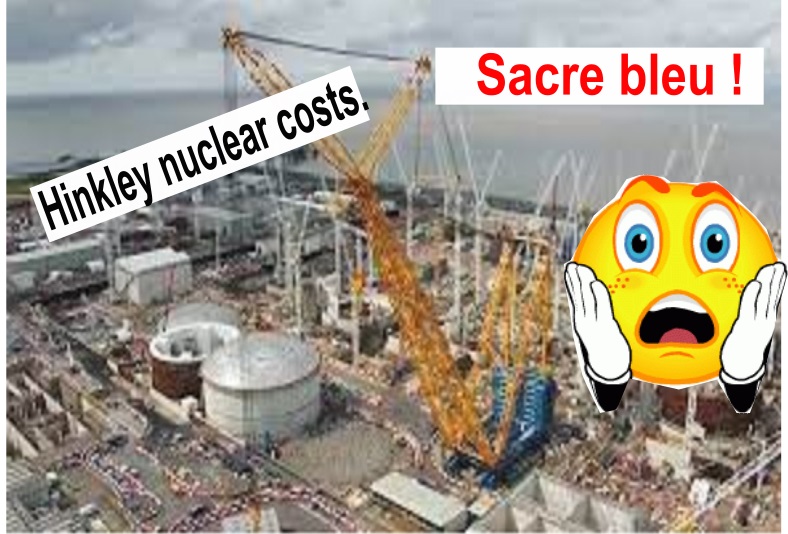
The group needs to cut costs and rejuvenate its reactor-building expertise. In
mid-March, France’s President Emmanuel Macron visited Penly in Normandy,
the site of two nuclear reactors due to start generating electricity from
2038. Donning a hi-vis coat and a white helmet, he hailed the “works of
the century”, saying France would “do for its children what our parents
did for us”.
Some 225km to the west, another nuclear power development
demonstrates how enormous that undertaking will be. Last December, the
Flamanville 3 reactor reached full power, 12 years after its scheduled
start-up date and costing seven times its original budget.
New reactors in
the UK have also been beset by delays and budget increases. EDF, the
state-owned company responsible for these projects, is Europe’s leading
nuclear power generator and, for many French, a potent symbol of the
country’s industrial and technological prowess. “There’s pride in the
industry, linked to nostalgia for a winning version of France,” says HEC
Paris professor François Gemenne.
But in the decades since France
commissioned its previous generation of reactors, EDF has mutated into a
sprawling, bureaucratic organisation. Its large workforce wields
considerable political influence. It often finds itself torn between its
own competing priorities and changing injunctions from a government that
has veered between cooling on nuclear and doubling down on it.
This backdrop makes the challenge of controlling costs and refining new
technology, while completing six new reactor units in France, plus four in
the UK over the next decade, all the more daunting. In an era of renewed
energy supply disruptions, EDF’s nuclear reactors are central to energy
security in France and, increasingly, across Europe.
As prices rise again
following the war in Iran, the task of renewing that fleet, and securing
nuclear’s place in a pan-European, low-carbon energy system, has taken on
even more importance. EDF has a lot to prove. The group has pinned its
fortunes on its own design for a water-pressurised reactor, but early
iterations in Finland and France came on stream more than a decade late and
more recent projects in the UK are also delayed.
EDF is also developing a
design for smaller reactors that might one day power data centres and
factories, although it faces competition from both established names such
as Rolls-Royce and Westinghouse and relatively new companies. The most
immediate test of EDF’s newer working methods will be the two reactors at
Sizewell C in the UK. These are supposed to be exact replicas of the
Hinkley Point C reactors in Somerset, which are currently due to enter
service in 2030.
FT 14th May 2026,
https://www.ft.com/content/4c48679b-edc3-4f81-b5be-9768fa2e63e5
No comments yet.
-
Archives
- October 2026 (120)
- September 2026 (339)
- August 2026 (330)
- July 2026 (355)
- June 2026 (287)
- May 2026 (306)
- April 2026 (356)
- March 2026 (251)
- February 2026 (267)
- January 2026 (308)
- December 2025 (358)
- November 2025 (359)
-
Categories
- 1
- 1 NUCLEAR ISSUES
- business and costs
- climate change
- culture and arts
- ENERGY
- environment
- health
- history
- indigenous issues
- Legal
- marketing of nuclear
- media
- opposition to nuclear
- PERSONAL STORIES
- politics
- politics international
- Religion and ethics
- safety
- secrets,lies and civil liberties
- spinbuster
- technology
- Uranium
- wastes
- weapons and war
- Women
- 2 WORLD
- ACTION
- AFRICA
- Atrocities
- AUSTRALIA
- Christina's notes
- Christina's themes
- culture and arts
- Events
- Fuk 2022
- Fuk 2023
- Fukushima 2017
- Fukushima 2018
- fukushima 2019
- Fukushima 2020
- Fukushima 2021
- general
- global warming
- Humour (God we need it)
- Nuclear
- RARE EARTHS
- Reference
- resources – print
- Resources -audiovicual
- Weekly Newsletter
- World
- World Nuclear
- YouTube
-
RSS
Entries RSS
Comments RSS


Leave a Reply