Biden Official: Biden Was Preparing To Bomb Iran If Re-Elected
Caitlin Johnstone, Apr 21, 2026, https://www.caitlinjohnst.one/p/biden-official-biden-was-preparing?utm_source=post-email-title&publication_id=82124&post_id=194907653&utm_campaign=email-post-title&isFreemail=true&r=1ise1&triedRedirect=true&utm_medium=email
Former senior Biden advisor Amos Hochstein said during an interview on Sunday that the Biden administration had been preparing to bomb Iran if they had won re-election in 2024.
Hochstein was asked by Face the Nation’s Margaret Brennan, “In July 2024 Secretary Blinken claimed Iran was one or two weeks away from having enough fissile material breakout capacity to eventually make a weapon if Iran had decided to do so. There were indirect negotiations that the Biden administration did, but it went nowhere. So when President Trump argues that he did what no other president would, is it just simply that the bill was coming due and it fell on his watch?”
“I do think there’s a certain element to that, and that’s why I was supportive of President Trump joining in in June to take the strikes that we had thought internally in the Biden administration, we may have to take if there was a second term,” Hochstein replied. “We thought that the spring, summer of 2025 was probably, we may have to be there in the same place. And we did, we did war games. We did some practice runs on what it would look like to look into it, because that may have had to happen under our watch as well.”
Hochstein, for the record, is an Israel-born IDF veteran who reportedly played a major role in the Biden administration encouraging Israel’s horrific bombardment of Lebanon in September 2024. And his narrative that an attack on Iranian nuclear facilities “may have had to happen” under a theoretical second Biden term is false.
In March of last year, US intelligence chief Tulsi Gabbard testified before Congress that the intelligence community “continues to assess that Iran is not building a nuclear weapon and supreme leader Khomeini [sic] has not authorized the nuclear weapons program that he suspended in 2003,” contradicting both the claims of President Trump and of Antony Blinken the year before.
But even if you accept that Iran was a nuclear risk, there was nothing stopping the Biden administration from simply restarting the nuclear deal that the Obama administration secured with Tehran in 2015. The JCPOA was working fine while it was in place; anyone who says otherwise is a lying warmonger. Trump and his handlers torched the JCPOA in 2018 because it was the primary obstacle preventing them from getting to war with Iran, and the Biden administration refused to reverse this move because they wanted war too.
The Democrats were beating the drums of war for Iran well ahead of the 2024 election. Here’s an excerpt from the official 2024 Democratic Party platform explicitly attacking Trump for not going to war with Iran in his first term:
“All of this stands in sharp contrast to Trump’s fecklessness and weakness in the face of Iranian aggression during his presidency. In 2018, when Iranian-backed militias repeatedly attacked the U.S. consulate in Basra, Iraq Trump’s only response was to close our diplomatic facility. In June 2019, when Iran shot down a U.S. surveillance aircraft operating in international airspace above the Straits of Hormuz, Trump responded by tweet and then abruptly called off any actual retaliation, causing confusion and concern among his own national security team. In September 2019, when Iranian-backed groups threatened global energy markets by attacking Saudi oil infrastructure, Trump failed to respond against Iran or its proxies. In January 2020, when Iran, for the first and only time in its history, directly launched ballistic missiles against U.S. troops in western Iraq, Trump mocked the resulting Traumatic Brain Injuries suffered by dozens of American servicemembers as mere ‘headaches’ — and again, took no action.”
Kamala Harris, who controversially replaced the dementia-addled Biden as the Democratic candidate late in the race, labeled Iran the number one enemy of the United States. In their 2024 debate, Harris repeatedly slammed Trump for being too soft on America’s enemies and announced that she “will always give Israel the ability to defend itself, in particular as it relates to Iran and any threat that Iran and its proxies pose to Israel.”
I’ve seen a lot of people trying to argue that Trump’s depravity in Iran proves everyone should support Democrats, but it’s clear the Democratic Party is just the more polite-looking face on the same evil power structure.
The war with Iran was always planned. Analysts like Brian Berletic and Richard Medhurst have been laying out solid arguments that this American war is more about attacking the economic and energy interests of Russia and China in a last-ditch effort to retain planetary hegemony than it is about assisting Israel. This places the United States on a dangerous trajectory toward increasingly hostile escalations between nuclear-armed powers.
These moves were planned years in advance, and would have been rolled out regardless of what impotent meat puppet happened to be wheeled into office in January 2025.
You don’t get to vote out an empire. Whether or not the US will continue working to dominate the planet will never be on the ballot. We will continue seeing reckless US wars of immense human consequence until the empire falls, or until the American people bring the revolutionary change to their country that the world so desperately needs.
A Modern Perspective on Nuclear Power Technology – Dr. Gordon Edwards.
24 Apr 2026Hosted by Tanya Novikova of Belarus, this presentation by Dr. Gordon Edwards o April 14, 2026, gives an overview of the nuclear power industry’s efforts to reverse the industry’s steep decline in market share during the last 30 years. The slides can be downloaded at https://www.ccnr.org/GE_Transatlantic… .
Heatwaves, floods and wildfires pose rising threat to democracy, report finds

Democracy is under mounting threat from the climate crisis, with new
analysis documenting how elections are increasingly shaped not only by
political forces but also by floods, wildfires and extreme weather.
At least 94 elections and referendums across 52 countries have been disrupted
by climate-related impacts over the last two decades, researchers found. As
risks intensify, the pressure on already fragile democratic systems –
particularly in Africa and Asia – is forecast to grow.
The findings, from
the International Institute for Democracy and Electoral Assistance, an
intergovernmental organisation that aims to support democracy around the
world, is the first global analysis of how natural hazards are affecting
elections.
Guardian 22nd April 2026, https://www.theguardian.com/global-development/2026/apr/22/climate-change-extreme-weather-heatwaves-floods-wildfires-threat-democracy-elections
Electricity: Solar and wind power will overtake nuclear power this year
While some thirty countries are in the race to build their first reactor or
renew their fleet, from the United States to Poland, Egypt and Kenya, the
long term of nuclear power is finding it increasingly difficult to compete
with renewable energies. “Solar and wind are each expected to surpass
nuclear power in 2026″ in terms of electricity produced, the Ember think
tank predicts in its Global Electricity Review 2026, published on Tuesday.
Les Echos 21st April 2026, https://www.lesechos.fr/industrie-services/energie-environnement/electricite-le-solaire-et-leolien-depasseront-le-nucleaire-cette-annee-2227589
Forty years after Chornobyl, more nuclear disasters are inevitable — plan for them
Civil nuclear technology comes with unlikely but dangerous risks that shouldn’t be overlooked.
Nature 21st April 2026, https://www.nature.com/articles/d41586-026-01255-8
A test of reactor 4 at the Chornobyl Nuclear Power Plant in Ukraine went awry, setting one such event into motion. A cascade of calamities led to the worst nuclear meltdown in history. I still remember the spotty accounts of the disaster on the nightly news, and my mother on tenterhooks, frantically calling our family in Finland as the world watched a radioactive cloud creep northward. The nuclear-power nightmare that so many feared had manifested.
The literal and figurative fall-out from Chornobyl was unprecedented. Thousands of people were displaced, many developed cancers, and farmland and water sources were contaminated far beyond Ukraine’s borders. Areas around the plant remain uninhabitable to this day.Alexandra Bell
Almost 25 years after Chornobyl, another low-probability, high-impact nuclear catastrophe unfolded at the Fukushima Daiichi Power Plant in Japan, when an earthquake-induced tsunami led to the destruction of all the reactors on site. Beyond the horrific human costs and the environmental damage, which is ongoing, estimates of the total clean-up costs are nearing a trillion dollars.
The two incidents soured the public perception of nuclear power. But time goes on, memories fade and technologies advance. With rising energy demands, exacerbated by the development of artificial-intelligence tools by tech companies in Silicon Valley and elsewhere and supply disruptions amid conflicts in the Middle East, the world is at the dawn of a much-vaunted nuclear-energy renaissance.
Many think that civil nuclear technology is key to helping humanity manage and mitigate the effects of climate change — at least until the costs of renewable energy technologies come down and their efficiencies improve. Still, as the world hurries to build a new generation of nuclear reactors, the Chornobyl disaster casts a long shadow, and rightly so.
To avoid future calamities, the public must pressure policymakers to maintain rigorous standards required for building, operating and maintaining nuclear facilities worldwide.
Nuclear Power No Thanks

Mike Small, 20th April 2026, https://bellacaledonia.org.uk/2026/04/20/nuclear-power-no-thanks/
A new Survation poll has shown a “miserable” level of support for nuclear power in Scotland while more than half believe the main focus should be on renewables. The polling makes grim reading for Scottish Labour and the LibDems who are both promoting new nuclear. The study carried out by Survation showed just 14% thought Scotland should rely on uranium used in nuclear reactors for its long-term energy security needs.
Only Reform UK and Conservative voters appear to prefer a focus on nuclear power. People who voted SNP and Green in 2024 appear overwhelmingly (over two thirds) in support of renewables.
In regions where nuclear facilities exist around Hunterston, Torness and Dounreay, a preference for renewables was in the clear majority over nuclear. When asked which energy sector could be trusted most to ‘tell the truth’ about their costs, pollutants and safety record, nuclear scored last at 12%, just behind the oil and gas industry at 13%.
This despite the fact that, as we exposed here the nuclear lobby group Britain Remade are run by PR/lobbying firm Stonehaven who donated £7,200 to the Scottish Labour Party.
Read our previous investigation here: Who are Britain Remade? – Bella Caledonia
Read The Ferret investigation here: This pro-nuclear group claims to be ‘grassroots’. So why are its directors industry lobbyists?
George Baxter, from Green Power said:
“New nuclear power is a costly distraction for Scotland. Between eye-watering costs, huge public subsidies, decades-long delivery timelines and leaving a toxic legacy for future generations, it cannot compete with the immediate, affordable potential of our renewable resources. With the technology already available, a 100% renewables-led system is the only logical path to a secure and sustainable economy.”
“A renewables-based energy system needs flexible power, a modern upgraded grid and energy storage, these should be the priority. That is what will provide lower cost energy, power industry and keep the lights on. Moreover, because nuclear is so inflexible it blocks renewables off the grid, forcing green energy generators to be turned off. Nuclear is no friend of sustainable energy
Nuclear Free Scotland
This is a major blow to the dark money, the front-groups, and the media campaigns that have been desperately promoting new nuclear for the past year.
Commonweal has covered this with a handy briefing note on the nuclear lobby [How to debunk the nuclear lies — Common Weal]. They ask you to Google search:
“How many former Labour politicians have been lobbyists for the nuclear industry, and who is the current CEO of the Nuclear Industry Association, which is behind all of this lobbying?”
The answer is:
Tom Greatrex, a former Labour MP and energy spokesperson, is the current CEO of the Nuclear Industry Association (NIA), representing the industry. While the specific number of former Labour politicians acting as nuclear lobbyists varies over time, key figures like Brian Wilson and Tom Greatrex have bridged the Labour Party and the nuclear industry.
Brian Wilson is of course is a devout nuclear enthusiast. In 2013 he decried Scotland’s energy policy as “Salmond’s nuclear fatwa”. In October 2005, he was appointed non-executive director of AMEC Nuclear Holdings Ltd, the nuclear services arm of AMEC plc. The announcement boasted that the firm is the UK’s largest private nuclear services business. In 2021 it was announced that he would lead a commission into new nuclear power [see Labour Go Nuclear – Bella Caledonia].
The extent to which new nuclear is a major focus for Scottish Labour is demonstrated in their manifesto, in which their ‘top priorities’ are listed as ‘Improve the NHS’, Top up tax-free childcare’ and ‘Back nuclear energy.’ In their Economy section the first two actions listed are ‘Create a Scottish Treasury’ and second ‘Remove the Scottish government’s block on nuclear energy.’ See:
Scottish Labour’s 2026 election manifesto at-a-glance – BBC News
This is a major blow to the Labour Party and the nuclear lobby, showing once again that the Scottish people are resolutely opposed to nuclear power.
Pull the plug over nuclear reactors
Sir, – I refer to the letter from Dr Steven Welsh (April 11) headed “We have been failed on energy and jobs” in which he states that “Dounreay is crying out to be developed as a site for a small modular nuclear reactor”.
He argues that by ignoring our crying need for nuclear Scotland continues to miss out on investment, jobs and a long-term future for Scotland’s civil nuclear sector.
I presume he knows that Dounreay currently employs 1,300 people with 700 in the supply chain and that the clean up will continue into the 2070s at a cost of £8.7 billion.
Highlands Against Nuclear Power (HANP) will be crying out to prevent any
nuclear in Scotland as it is not carbon free nor safe, does nothing to
reach netzero, is the most expensive form of energy production and the UK
has no solution for dealing with highly radioactive nuclear waste.
Press & Journal 20th April 2026, https://www.pressreader.com/uk/the-press-and-journal-aberdeen-and-aberdeenshire/20260420/282041923714019
Will Netanyahu demolish second consecutive US administration in ’28?
22 April 2026 AIMN Editorial, Walt Zlotow, West Suburban Peace Coalition Glen Ellyn IL, https://theaimn.net/will-netanyahu-demolish-second-consecutive-us-administration-in-28/
In the ’24 election Kamala Harris got a lot of votes, 75,017,613. But astonishingly, she got 6,268,841 less votes than when she ran with victorious Joe Biden in 2020, a massive 7.7% drop. Some of those missing voters selected third party. Some voted for Donald Trump. Many simply stayed home.
While there were several reasons, the one most cited was Biden and Harris’ complete support and enabling of Israel’s genocide in Gaza. Prime Minister Benjamin Netanyahu had near total control over the Biden administration, causing revulsion in peace advocates and many sensible 2020 Biden voters horrified their presidential choice would engage in such an abomination.
Harris made a mistake not breaking with Biden on genocide. By a more than three-to-one margin, Biden 2020 voters who did not vote for Harris, say they would more likely have voted for Harris if she pledged to break from President Biden’s policy toward Gaza by promising to withhold additional weapons to Israel.
There was precedent for Harris doing so. In 1968 Democratic nominee Vice President Hubert Humphrey was losing badly to Richard Nixon due to massive defections from anti-Vietnam War Democrats. Humphrey, like Harris was a good soldier VP supporting his boss’s self-destructive war policies. A month before the election, Humphrey pivoted to peace in a prime time address. It closed the double digit gap but was too little too late. Had he broken from LBJ from the get go…likely no Nixon and no 5 year prolonged bloodbath under Nixon.
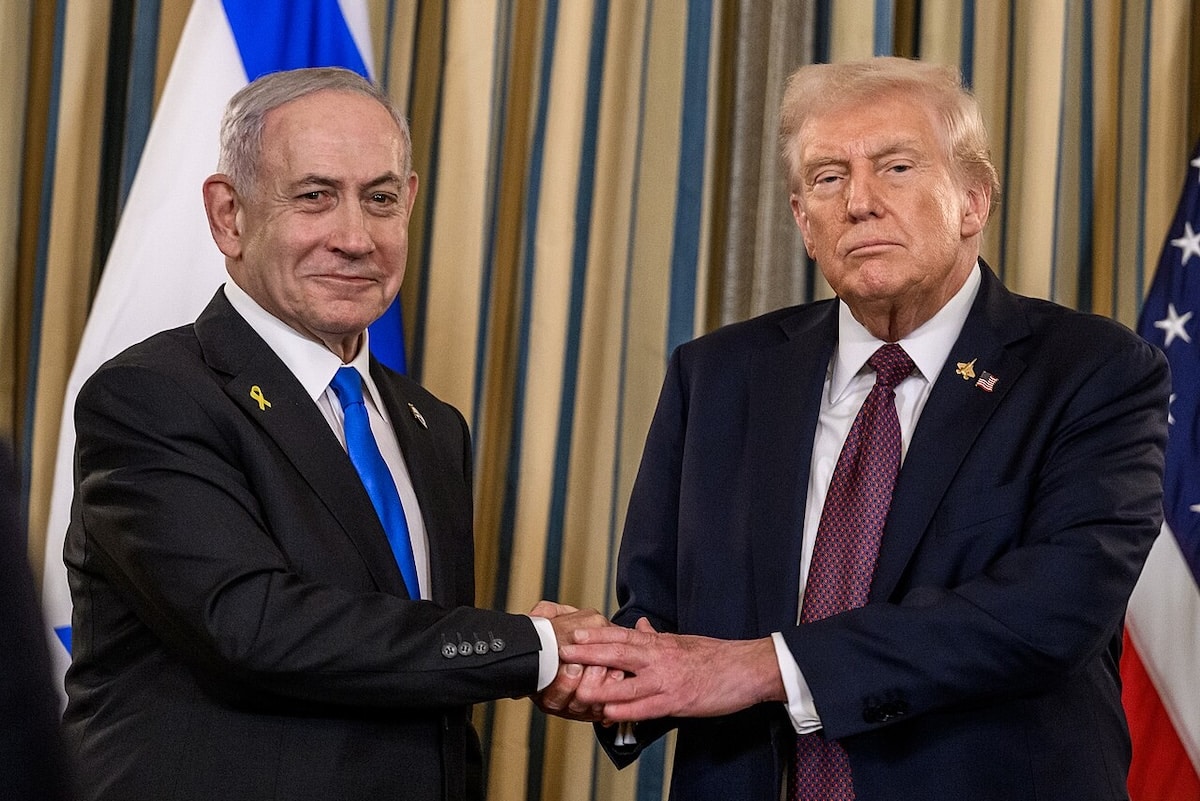
A little over a year into Trump’s second term, Netanyahu is at it again, sabotaging a US administration from winning in ’28. At his February 11 meeting with Trump, Netanyahu implored Trump to launch his now failed war on Iran by guaranteeing him victory in a couple of days after Israel assassinated Iranian leader Ali Khamenei.
Not only has the war failed to achieve every stated goal, it has thrown the world into economic chaos. Now every one of Trump’s 77,302,580 voters are paying over $4 a gallon to fill their gas guzzlers and soon will be paying higher prices for just about everything.
And Just like Vice President Harris who self-destructed in ’24 by staying loyal to her genocide enabling president, JD Vance is self-destructing staying loyal to his senseless, war mongering president, all due to the interference in American foreign policy of Benjamin Netanyahu.
As loyal as he is, Vance knew the war was a terrible idea. He told Trump so but once Trump decided to follow Netanyahu down the rabbit hole of lost war, Vance followed right behind. Apparently, Vance has learned nothing from Harris’ fealty to Benjamin Netanyahu in ’24.
Much can happen before the next election. But history tells that as Vice President of a lame duck President, Vance in a near certainty to be anointed Trump’s successor at the GOP Convention in 2 years.
Another near certainty? Unless Vance breaks with Trump and comes out strongly against the lost war in Iran upending the world economy, Benjamin Netanyahu will sabotage his second consecutive US administration in the ’28 election.
Remembering Chornobyl
by beyondnuclearinternational, https://beyondnuclearinternational.org/2026/04/19/remembering-chornobyl/
40 years on we are still asking the wrong questions and getting a lot of wrong answers, writes Linda Pentz Gunter
Probably the most heinous crime, other than the avoidable accident itself and its immediate coverup, is the way that the Chornobyl (Ukrainian equivalent spelling) nuclear power disaster in Ukraine, 40 years old this week, has been used to downplay and normalize the long-lasting health impacts caused by that April 26, 1986 explosion.
Still today, the myth is repeated that “no one died” — meaning no one in the public. Instead, we are told over and over that it was only a handful of liquidators, sent in to deal with the immediate crisis, who were killed by the massive release of radiation resulting from the reactor explosion.
And still today, in part because of that myth, now so firmly cemented in the public and media narratives around the Chornobyl disaster, the true health effects of even just routine reactor operation, or the exposures suffered by communities living around active or abandoned uranium mines, or by those working in uranium enrichment or fuel fabrication facilities, are discounted and dismissed.
Worse still, we are now facing a concerted effort by the Trump administration to emasculate already weak radiation protection standards, once again ignoring females who are most vulnerable to harm, and especially pregnant women, babies and children.
Through yet another executive order accelerating nuclear power expansion while sparing the industry the costs it should incur to guarantee safety (an impossibility anyway), the White House wants to abandon the long-held Linear No Threshold (LNT) model.
LNT holds that radiation damage increases with higher exposures, and that harm is posed by all radiation exposure no matter how small. But LNT itself is already unsatisfactory, since health studies continue to indicate that more — not less — protection is needed for non-cancer impacts, and for radionuclides taken internally, than is already provided by applying LNT.
This is what makes the perpetual focus on “who died” when it comes to major nuclear accidents, fundamentally the wrong question. We will likely never know who or how many died as a result of the Chornobyl disaster. Registries and statistics weren’t kept, people moved around, and, as is so often the case, illnesses were ascribed to other causes. Certainty is hard to achieve.
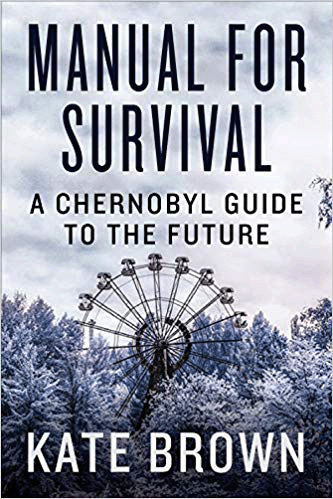
Nevertheless, perhaps one of the most important pieces of research on the health realities of the Chornobyl aftermath was done by historian Kate Brown in her book Manual For Survival. A Chernobyl Guide to the Future. It looks like a “hefty tome”, but it is anything but. Despite being nonfiction, it reads like a page-turning thriller and some of what she uncovers is eye-stretching. And, of course, by saying “uncovers,” we immediately understand that this was indeed a cover-up, first by the then Soviet Union, and then compliantly perpetuated by the United States and other western allies eager to avoid any shocking realization by the general public that nuclear power technology is phenomenally dangerous and human beings are liable to lose control of it, with disastrous results.
This returns us to the question about the protracted harm that can be caused if something goes very badly wrong at a nuclear power plant. And it returns us to dispensing with the wrong question, which is “how many people died?”
That wrong question, a favorite of headline writers and spin doctors, sets us on a perpetual path to dispute. The health figures, especially fatalities, have become the most misrepresented statistic related to the Chornobyl disaster. But focusing only on fatalities also serves to diminish the disaster’s impact. Nuclear power plant accidents often do not kill people instantly and sometimes not at all. It can take years before fatal illnesses triggered by a nuclear accident take hold. This creates a challenge in calculating just who eventually died due to the accident and who suffered non-fatal consequences.
Exposure to ionizing radiation released by a nuclear power plant (and not just from accidents but every day) can cause serious non-fatal illnesses as well. These should not be discounted. Arguably, neither should post-accident psychological trauma. Nuclear power plant accidents can and should be prevented. The only sure way to do so is to close them all down. Otherwise we risk another Chornobyl, or Three Mile Island, or Fukushima.
In our Thunderbird newsletter of 2018, we examined some of the key myths around the impacts of the Chornobyl disaster now 40 years ago. Below, is a synopsis of some of the key points, as they bear repeating and remain perpetually true. The full document can be read here.
What happened?
On April 26, 1986, Unit 4 at the Chornobyl nuclear power plant exploded. That explosion and the resulting fire, lofted huge amounts of radioactivity into the atmosphere. Unit 4 was relatively new, having only been in service for just over two years. The accident occurred during what should have been a routine test to see how the plant would operate if it lost power. The test involved shutting down safety systems but a series of human errors, compounded by design flaws, instead set in motion a catastrophic chain of events.
After shutting down the turbine system that provided the cooling water to the reactor, the water began boiling and workers desperately tried to re-insert control rods to slow down the nuclear reaction. But the rods jammed and control of Unit 4 was irrevocably lost. The explosion and fire — which took five months to put out — dispersed at least 200 times more radioactivity than that produced by the Hiroshima and Nagasaki bombs. The fallout contaminated several million square kilometers of land in the former Soviet Union and in Europe and was also detected in the US
Soviet authorities were slow to react. The accident was first detected by monitors in Sweden. The nearby city of Pripyat was not evacuated immediately. By the time they did so, radioactivity levels were 60,000 times higher than “normal”.
The financial cost of the accident, while difficult to calculate given the many unknowns, is estimated to be in the region of $700 billion and is expected to keep rising.
The Liquidators
The Chornobyl liquidators were dispatched to the stricken nuclear plant in the immediate aftermath, as well as for at least the subsequent two years, to manage and endeavor to “clean up” the disaster. They included military as well as civilian personnel such as firefighters, nuclear plant workers and other skilled professionals.
While estimates of the number of liquidators varies, the generally accepted figure is around 800,000. However, evaluating their fate has been difficult. Only a small portion of them were subject to medical examinations.
Yet, by 1992 it was estimated that 70,000 liquidators were invalids and 13,000 had died. These estimates rose to 50,000 then to 100,000 deaths among liquidators in 2006. By 2010, Yablokov et al. estimated a death toll of 112,000 to 125,000 liquidators.
Even the Russian authorities admit findings of liquidators aging prematurely, with a higher than average number having developed various forms of cancer, leukemia, somatic and neurological problems, psychiatric illnesses and cataracts.
The UN Office for the Coordination of Humanitarian Affairs found a statistically significant increase of leukemia among Russian liquidators who were in service at Chernobyl in 1986 and 1987.
General populations inside and outside the former Soviet Union
As with the liquidators, tracking the health of general populations exposed to the plume pathway of Chornobyl has been problematic. Within the Soviet Union, people moved away and neither they nor many living in other affected countries were tracked or monitored. While countless numbers may have died from their Chornobyl-related illnesses, equal or even greater numbers may have survived with debilitating or chronic physical as well as mental illnesses caused by the accident.
Establishing exact numbers may never be possible. Media reports often rely on the 2003-2005 Chernobyl Forum report produced by the nuclear promoting International Atomic Energy Agency. The agency ignored its own data that indicated there would be 9,000 future fatal future cancers in Belarus, Russia and Ukraine, claiming there would be no more than 4,000. Both numbers are gross underestimations. The report focused only on the most heavily exposed areas in making its predictions. It ignored the much larger populations in the affected countries as a whole, and in the rest of the world, who have been exposed to lower but chronic levels of radiation from Chornobyl.
In contrast, a comprehensive analysis by the late Soviet scientist, Alexey Yablokov and colleagues, examined more than 5,000 Russian studies. They concluded that almost a million premature deaths would result from Chornobyl. Meanwhile, the TORCH report (The Other Report on Chernobyl), by Dr. Ian Fairlie, predicts between 30,000 and 60,000 excess cancer deaths worldwide due to the accident.
More than half the Chornobyl fallout landed outside of the Ukraine, Belarus and Russia — in Europe, Asia and North America. Fallout from Chornobyl contaminated about 40% of Europe’s surface. Immediately after the accident, thyroid cancer was particularly rampant in Belarus, Ukraine and Russia, where no prophylactic remedy in the form of potassium iodide pills was offered. Consequently, as Baverstock and Williams found in 2006, “by far, the most prominent health consequence of the accident is the increase in thyroid cancer among those exposed as children . . . particularly in children living close to the reactor.”
In contrast, Poland, where potassium iodide was distributed, experienced relatively low rates of thyroid cancers. While thyroid cancer is considered one of the more treatable kinds of cancers, this does not mean it should be viewed as an acceptable consequence of a nuclear power plant accident. Such diseases — especially among children — impact emotional, social, and physical wellbeing. In the former Soviet Union, those operated on bear a scare referred to grimly as the “Chornobyl necklace.”
Dr. Wladimir Wertelecki, a physician and geneticist, has conducted research, particularly focused on Polissia, Ukraine. There he found clear indications of altered child development patterns, or teratogenesis. Wertelecki noted birth defects and other health disturbances among not only those who were adults at the time of the Chornobyl disaster, but their children who were in utero at the time and, most disturbingly, their later offspring.
Important research has also been conducted on psychological effects. Pierre Flor-Henry and others examined some of the psychological disorders resulting from Chornobyl and found a clinical pathology related to radiation exposure. Flor-Henry found that schizophrenia and chronic fatigue syndrome among a high percentage of liquidators were accompanied by organic changes in the brain. This suggested that various neurological and psychological illnesses could be caused by exposure to radiation levels between 0.15 and 0.5 sieverts.
There are of course many other non-cancerous diseases caused by nuclear accidents that release radioactivity. A peak in Down Syndrome cases was observed in newborns born in 1987 in Belarus, one year after the Chornobyl nuclear accident. This phenomenon has been found around other nuclear sites. Abnormally high rates of Down Syndrome were found in the Dundalk, Ireland population possibly tied to the operation of the Sellafield nuclear waste reprocessing plant across the Irish Sea in Cumbria, England.
Read full Thunderbird: Chornobyl: The Facts.
Linda Pentz Gunter is the Executive Director of Beyond Nuclear and writes for and edits Beyond Nuclear International. She is the author of the book, No To Nuclear. Why Nuclear Power Destroys Lives, Derails Climate Progress And Provokes War, published by Pluto Press. Any opinions are her own.
The Consequences of Incompetence

While Iran has approached the current negotiations from a practical, reality-based posture predicated on resolving the actual major points of difference between the US and Iran, the US is being held hostage by the politicized whim of an American President who needs to shape domestic public opinion in a way which transforms the reality of a humiliating defeat into the perception of a bold victory.
The US lost the first round of the war with Iran decisively. If Trump decides to go a second round, the results will be disastrous for American and its allies.
Scott Ritter, Apr 19, 2026, https://scottritter.substack.com/p/the-consequences-of-incompetence
For nearly 40 days, Israel and the United States carried out an extensive aerial campaign against Iran designed to topple the government and suppress Iran’s ability to defend itself. This campaign failed to achieve any of its stated objectives. Instead, it devolved into a numbers game where inflated outcomes were sold to an unquestioning public by military professionals and politicians alike. The Iranian government not only withstood the efforts at decapitation-induced regime change, but actually strengthened its hold on power when the people of Iran, instead of turning on the Islamic Republic, rallied to its cause. Moreover, rather than suppressing Iran’s ability to launch ballistic missiles and drones against US military bases, critical infrastructure in the Gulf Arab States, and Israel, Iran not only sustained its ability to strike, but deployed new generations of weapons that readily defeated all missile defense systems while, using intelligence information that permitted accurate targeting, destroyed critical military infrastructure worth tens of billions of dollars.
Regional experts had long warned about the consequences of entering an existential conflict with Iran, noting that Iran would not simply allow itself to be erased as a viable nation state without ensuring that the other nations of the region were subjected to similar existential threats to their survival, and that global energy security would be disrupted in such a manner as to trigger a world economic crisis. These assessments were backed up by a belied that Iran would not only be able to shut down shipping transiting the Strait of Hormuz, but also effectively target and destroy the major energy production potential of the Gulf Arab States.
It wasn’t that the politicians and military planners in the US and Israel doubted Iran’s ability to impact global energy markets or strike targets in Israel and the Gulf region.
They knew Iran had the potential.
They just believed that they would be able to achieve regime change in Tehran in relatively short order, thereby mooting any threat Iran might pose to energy supplies and infrastructure.
They were wrong, which is why the US was looking for an offramp from the war soon after it started.
The end result was this current ceasefire, which was ostensibly entered into to buy time for US and Iranian negotiators to hammer out a lasting peace plan.
There is a fundamental problem, however.
While Iran has approached the current negotiations from a practical, reality-based posture predicated on resolving the actual major points of difference between the US and Iran, the US is being held hostage by the politicized whim of an American President who needs to shape domestic public opinion in a way which transforms the reality of a humiliating defeat into the perception of a bold victory.
President Trump ran for office on a platform premised on the notion that he would keep America out of the kind of costly, open-ended military misadventures that had defined the US since the start of the 21st Century.
The war with Iran proved this promise to be a lie.
This lie, combined with numerous other political missteps that have transpired during the first year and a half of his second term in office, have put President Trump and his political legacy at risk, with critical midterm elections looming on the horizon that threaten to shift the balance of power in the US Congress away from the Republican Party, and to the Democratic Party. If the Republicans lose the House of Representatives, the impeachment of Donald Trump is all but a certainty. This alone would spell the end of Trump’s legislative agenda. But if the Democrats take the Senate as well, and with a wide enough margin, the Trump will not only find himself impeached, but possibly convicted.
And this would not only mean the end of the Trump Presidency, but also the end of the Trump brand, something Trump has been burnishing his entire adult life and which he has transformed into a political cult of personality that has redefined American politics.
Iran has entered the current round of negotiations focused on the practicalities and realities of geopolitics and national security.
Trump is about shaping perceptions to his political benefit.
These are not compatible goals and objectives, especially when Iran has emerged victorious from a war it did not want, and Trump is trying to invent a narrative that has him prevailing in a conflict his team not only should never have engaged in, but which they lost, and now Trump has to spin this dismal reality in a manner which benefits him politically.
Take the current impasse over the Strait of Hormuz.
Iran has asserted control over all shipping transiting this strategic waterway, and by being selective about which ships can transit, has created a global energy crisis which has detrimentally impacted US allies in Europe and Asia.
It was the reality that the US had no military solution to the problem of Iran’s compelled closure of the Strait that led the US to seek a diplomatic solution to the problems it alone had created.
There are other outstanding issues as well, such as Iran’s stockpile of 60% enriched uranium (which the US apparently tried to seize in a failed special operations raid), as well as the issue of Iran’s nuclear program in general, which the US insists can continue only if Iran forgoes enrichment altogether, something Iran has said it will never do.
The US also wishes to curtail Iran’s ballistic missile programs, despite the fact it is these very missiles which provided Iran with the ability to prevail militarily over the US, Israel and the Gulf Arab States.
The US also insists that Iran cease its relationship with regional allies such as Hezbollah in Lebanon (which is engaged in an open-ended conflict with Israel due to Israel’s ongoing occupation of southern Lebanon) and the Ansarullah movement in Yemen, which has been opposing a Saudi-led aggression since 2014.
There’s literally a snowball’s chance in hell Iran would concede any of these issues, especially after winning a war where all of the non-nuclear matters helped contribute to the Iranian victory.
And therein lies the rub.
Trump has largely bought into an Israeli-influenced narrative which defines victory as being predicated on Iran yielding on all of the issues listed above.
Something Iran will never do.
Trump has shown zero political acumen when it comes to trying to shape US public opinion in his favor.
Instead of taking credit for getting Iran to agree to open the Strait of Hormuz, Trump insists on posturing as a tough guy by insisting on continuing a naval blockade which exists in name only, prompting Iran to reverse course and close down the Strait.
And close down negotiations.
Leaving Trump further boxed into a corner of his own making.
With the only option available being the resumption of the very military operations that had proven unable to defeat Iran and, if initiated, will trigger consequences which will have a devastating impact on global energy markets—the very thing Trump was trying to avoid when seeking out the ceasefire to begin with.
But there may very well be other consequences.
Iran is at the point in this conflict where trying to play a game of escalation management is counterproductive.
If the US opts to resume its attacks on Iran, with or without Israel, Iran will have no choice but to go for the jugular from the start.
To strike not only the energy production capabilities of the regional actors, like the United Arab Emirates, Saudi Arabia, Kuwait, and Bahrain, that continue to provide assistance to the US when it comes to the conflict with Iran, but also their water desalinization plants and power production plants.
Denying these nations access to the very water they need to survive.
And power they need to provide air conditioning to the skyscrapers that have defined their status as modern oasis’ of civilization.
The hot summer months approach.
And if Iran eliminates water and air conditioning, then these modern Gulf Arab States become uninhabitable.
Cities like Dubai and Abu Dhabi become uninhabitable. So, too, Kuwait City, Riyadh, and Manama.
Everything the rulers of these Gulf nations have aspired to accomplish over the course of the past several decades will lie in ruins, ghost cities in place of thriving metropolis’.
And Iran would likely do the same to Israel, destroying the critical infrastructure the tiny Zionist enclave needs to survive as a modern nation states.
Making the land of milk and honey uninhabitable for millions of Israelis who will have no choice but to go back to their homes of origin.
These are all known knowns—there is no mystery about what the consequences of resuming military operations against Iran will bring.
Albert Einstein is widely quoted as once noting that the definition of insanity was doing the same thing over again and expecting a different result.
The US and Israel launched a surprise attack against Iran using the full strength of their respective air forces.
And they failed.
Today, Iran stands ready to receive a combined US-Israeli strike which will match, but not exceed, the destructive power of those initial attacks.
And Iran will respond with missile and drone attacks which will exceed by an order of magnitude the targeted destruction of its previous retaliatory strikes.
Iran will change the cycle of escalation by going straight for the jugular.
And Trump won’t know what hit him.
The consequences of incompetence are real.
Something Trump and the American people are about to find out in real time should the US go forward with the threats to resume bombing Iran in the next few days.
Pine Ridge Uranium is the real threat, not Tehran
Black Hills Uranium Is More Dangerous. Tell Burgum: Stop the Extraction.
Trump is bombing Iran over uranium enrichment 6,000 miles away. He’s fast-tracking uranium extraction in the Black Hills on Lakota treaty land, above the aquifer that feeds Pine Ridge. Two fast tracks. Two manufactured crises. Both bypassing the consent of the governed. Tell Secretary Burgum the real uranium threat is here.
This administration has put two things on a fast track to destruction. One is a war in Iran. The other is a uranium mine in the Black Hills. Both manufactured crises. Both bypassing democratic oversight. Both moving at the speed of executive order, because if either one slowed down long enough for the people to weigh in, the answer would be no.
Congress never authorized the war in Iran. They’ve voted four times to stop it. Overruled. The Lakota people never consented to uranium extraction from treaty land. They’ve fought it for 20 years. Overruled.
On February 27, 2026, the U.S. Forest Service approved new drilling around Pe’ Sla — the ceremonial heart of He Sapa, the Black Hills — over formal tribal objections, with no environmental review, under a document falsely claiming there are “no known Native American or Alaska Native religious or cultural sites within the project area.” About land a half-mile from Pe’ Sla.
Now the Bureau of Land Management has opened a 30-day comment window on the Dewey-Burdock uranium project — 50 miles from Pine Ridge, in Lakota treaty territory. The 1868 Fort Laramie Treaty appears in the review exactly zero times. The document resolving cultural harm to Lakota sacred sites won’t be signed until six weeks after the comment period closes.
They will go to war over uranium in Iran. They will not protect our water from uranium 50 miles from Pine Ridge.
In the end, the only backstop on this runaway train is the consent of the governed. Use it.
Tell Secretary of the Interior Doug Burgum:
1. Reverse the Pe’ Sla drilling permit — now
2. Remove Dewey-Burdock from the FAST-41 federal fast-track program
3. Suspend all extractive permits on treaty lands until full tribal consultation and a complete Environmental Impact Statement are done
The Black Hills are not for sale. Mni wiconi — water is life
Trump Nudges World Closer To Nuclear Doomsday

As the NPT frays, reckless US signals push rivals toward the bomb, bringing the world closer to nuclear catastrophe.
By Ramananda Sengupta, April 21, 2026, https://stratnewsglobal.com/united-states/trump-nudges-world-closer-to-nuclear-doomsday/
There is a difference between strategic ambiguity and strategic incoherence.
The first deters adversaries. The second unnerves allies, emboldens rivals, and corrodes the very architecture meant to prevent catastrophe.
Under President Donald Trump, the United States’ nuclear posture is drifting dangerously toward the latter, and the consequences are now rippling through the global non-proliferation regime.
The warning lights are not subtle. The Bulletin of the Atomic Scientists, hardly a sensationalist platform, has effectively accused Washington of taking a wrecking ball to decades of carefully constructed nuclear norms.
Across multiple recent analyses, the Bulletin outlines a pattern: erratic signalling, coercive use of force against nuclear-threshold states, and a cavalier attitude toward arms control obligations. The cumulative effect is not just instability. It is the potential unravelling of the Nuclear Non-Proliferation Treaty (NPT) itself.
Let’s start with the basics. The United States still possesses one of the largest nuclear arsenals in the world of around 3,700 warheads, according to the Bulletin’s Nuclear Notebook 2026.
That number alone is not the problem. It reflects decades of Cold War inheritance and gradual reductions. The real issue is how that arsenal is being politically framed and operationally signalled.
Trump’s approach has been marked by contradiction. On one hand, he speaks intermittently about arms control and reducing nuclear risks. On the other, he has openly floated resuming nuclear testing and declined to clarify whether the United States might actually conduct such tests.
Arms control depends on predictability. Treaties, verification regimes, and confidence-building measures exist precisely to eliminate guesswork.
When a nuclear superpower signals that it might abandon long-standing norms, such as the de facto moratorium on nuclear testing, it sends a clear message to others: restraint is optional.
Nowhere is this more evident than in Trump’s handling of Iran. According to the Bulletin’s April 2026 analysis, Washington’s actions risk teaching exactly the wrong lesson: that nuclear restraint does not guarantee security.
For decades, the NPT has functioned on a basic bargain. Non-nuclear states agree not to pursue weapons in exchange for access to peaceful nuclear technology and an implicit security framework backed by international norms.
But if a state that remains below the weaponisation threshold, maintaining “nuclear latency”, can still be attacked or coerced, that bargain begins to collapse.
The Bulletin puts it bluntly: states may conclude that only actual nuclear weapons, not compliance, not inspections, and not diplomacy, can ensure survival.
This is a profound shift. It transforms nuclear weapons from deterrents of last resort into perceived necessities for regime security. And once that logic takes hold, proliferation is no longer an aberration, it becomes rational behaviour.
The Bulletin’s other April piece goes further, accusing Washington of effectively undermining the NPT framework itself. The metaphor is deliberate: this is not erosion through neglect, but active damage.
The core problem lies in precedent.
International norms are not enforced by a global police force; they are sustained by consistent behaviour among major powers. When the United States disregards those norms, whether by sidelining diplomacy, undermining safeguards, or prioritising coercion, it weakens the legitimacy of the entire system
The NPT has survived for over half a century because it created a shared expectation: that nuclear powers would move, however slowly, toward disarmament, while non-nuclear states would abstain.
But that expectation is already fraying.
The expiry of the New START Treaty, the last major arms control agreement between Washington and Moscow, has removed a critical stabilising mechanism.
Experts warn that this opens the door to renewed arms competition and eliminates transparency measures that helped prevent miscalculation. Without such guardrails, the NPT’s credibility suffers further. The broader trajectory is unmistakable. The post-Cold War era of gradual nuclear restraint is giving way to a more volatile, competitive environment.
The United States and Russia still control the overwhelming majority of the world’s nuclear weapons, around 86 per cent of the global inventory. Historically, their bilateral agreements set the tone for global stability.
Today, that leadership vacuum is being filled not by cooperation, but by suspicion.
Trump’s push for “multilateral” arms control involving China might sound forward-looking, but in practice it has produced little tangible progress. Meanwhile, the absence of concrete negotiations and the collapse of existing treaties are accelerating uncertainty.
Even more troubling is the renewed emphasis on nuclear signalling as a tool of coercion.
The 2026 conflict with Iran, coupled with ambiguous nuclear rhetoric, suggests a willingness to blur the line between conventional and nuclear deterrence. That ambiguity increases the risk of escalation, intentional or otherwise.
The Bulletin of the Atomic Scientists has been ringing the alarm bell with increasing urgency. In 2026, it moved its famous Doomsday Clock to 85 seconds to midnight, the closest humanity has ever been to catastrophe.
This is not mere symbolism. It reflects a convergence of risks: nuclear, technological, and geopolitical. But nuclear weapons remain at the core of that assessment. The danger today is not just the existence of nuclear arsenals but the breakdown of the systems designed to manage them.
When arms control collapses, when norms erode, and when leadership becomes erratic, the probability of miscalculation rises sharply. And nuclear miscalculation is unforgiving. There are no second chances.
For countries like India, outside the NPT but deeply invested in strategic stability, the implications are particularly complex. A weakening non-proliferation regime could legitimise further expansion by nuclear and near-nuclear states across Asia.
If Iran, for instance, moves from latency to weaponisation, it could trigger a cascade of responses across West Asia. Similarly, the absence of US-Russia constraints may encourage China to accelerate its own arsenal expansion—already a concern in strategic circles.
In such a world, deterrence becomes more crowded, more opaque, and more dangerous. The risk is not just a bilateral arms race but a multipolar nuclear competition with fewer rules and weaker safeguards.
Perhaps the most insidious effect of Trump’s approach is not any single policy decision but the normalisation of instability.
When nuclear threats are used casually, when treaties are treated as optional, and when strategic clarity is replaced by improvisation, the entire system adapts to its own detriment.
What was once unthinkable becomes conceivable; what was once unacceptable becomes negotiable. The NPT does not collapse overnight. It erodes gradually, as states lose faith in its guarantees and begin hedging their bets. That process may already be underway.
The Bulletin’s warning is stark but credible: if current trends continue, the world could enter a new era where nuclear proliferation accelerates, arms control becomes an afterthought, and the threshold for nuclear use becomes dangerously blurred.
The global nuclear order has always been fragile, sustained less by enforcement than by mutual restraint. Under Donald Trump, that restraint is being tested as never before. An erratic doctrine, combined with coercive policies and the dismantling of arms control frameworks, is placing unprecedented strain on the non-proliferation regime.
The NPT, long considered the cornerstone of nuclear stability, is now under real pressure. Not from a single rogue state, but from the behaviour of its most powerful guarantor.
This is the paradox of the present moment: the country that helped build the system is now accelerating its decline.
And in the nuclear age, systemic decline is not an abstract risk. It is a countdown.
We are one crisis away from a nuclear point of no return
As global stability erodes, the greatest danger now comes not from rogue states, but from stable nations driven to the brink by fear
David BlairChief Foreign Affairs Commentator
Of all the branches of the United Nations, none has a higher calling than
the International Atomic Energy Agency (IAEA). In the end, its job is to
preserve humanity from nuclear destruction and embody the survival instinct
of our species.
Yet the whole intricate system designed to prevent calamity
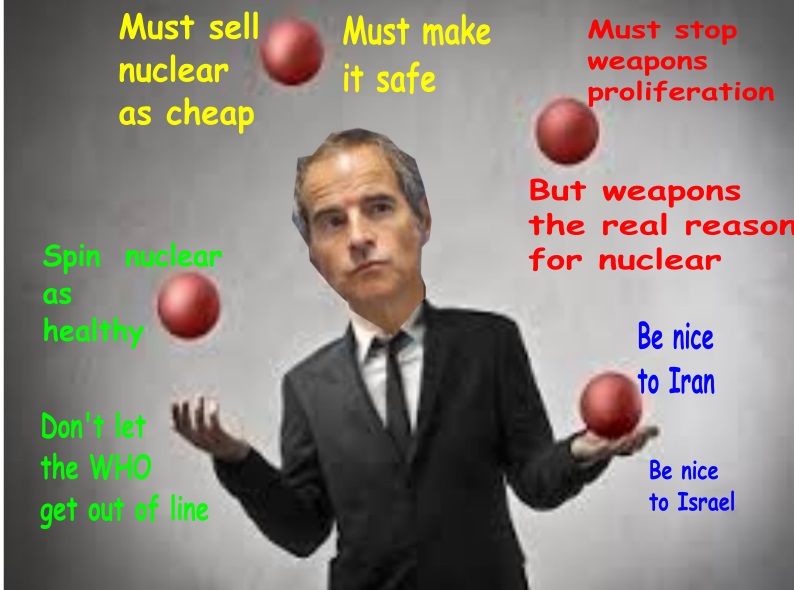
is crumbling before our eyes. Rafael Grossi, the director general of the
IAEA, describes in his Telegraph interview how “important countries in
Europe, in Asia minor and in the Far East” are publicly debating whether
to build nuclear weapons, despite having promised never to do so.
America and Russia have allowed all their nuclear disarmament treaties either to
collapse or expire without replacement. After invading Ukraine in 2022,
Vladimir Putin took another step towards the brink by suspending the
“strategic stability” arrangements with the US, under which the
world’s biggest nuclear powers had previously reassured one another by
sharing information about exercises and missile deployments.
One by one, the risk-reduction measures have fallen away, even as more countries
consider building nuclear arsenals. That leaves only one question: Have we
already passed the point of no return, or does humanity retain its survival
instinct?
Telegraph 20th April 2026, https://www.telegraph.co.uk/news/2026/04/20/one-crisis-away-nuclear-point-no-return/
Arms industry given direct influence over university courses
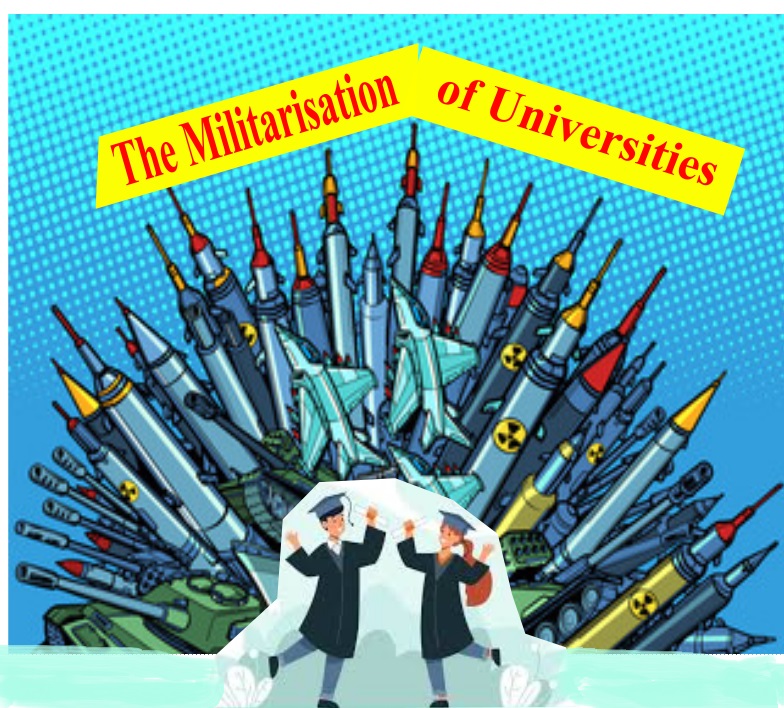
Officials from BAE Systems, Leonardo and Thales sit on advisory committees that oversee the ‘strategic direction’ of academic departments
Martin Williams, 8 April 2026, https://www.declassifieduk.org/arms-industry-given-direct-influence-over-university-courses/
Arms industry executives have been given direct influence over British university courses, Declassified can reveal.
BAE Systems, Leonardo, Thales and Rolls-Royce are among the firms who have been invited to sit on at least 53 university advisory committees across the country.
They are usually asked to provide “strategic direction” for academic departments – and sometimes also review the progress of research projects.
Using the Freedom of Information Act, Declassified found that at least 21 universities had asked arms companies to sit on their committees. They include the universities of Southampton, Edinburgh, Glasgow, Leicester, Cardiff, York and Queens University Belfast.
Some institutions boast that the setup allows them to “respond to the needs of employers”. The minutes of one committee meeting show that arms executives – along with officials from other companies – were thanked for “ensuring that our programmes fit industry requirements and demand”.
During a meeting at the University of Hull, an official from BAE Systems said they would “welcome applications” from students for “industrial placements”, adding that they would “like to develop the relationship”.
And a committee at the University of Cardiff discussed whether “industry” could “teach material to students,” noting that this would be “an appealing prospect for the School but would also offer good exposure for industry”.
They also agreed to meet with Rolls-Royce to discuss “research challenges”.
‘Disturbing’
The finding comes two years after it was revealed how British universities had taken almost £100m from defence companies – including many that are arming Israel.
In one case, BAE Systems gave almost £50,000 in sponsorship to University College London (UCL) to fund its Centre for Ethics and Law – despite the company being accused of being party to alleged war crimes in Yemen in 2019.
Universities including Oxford, Cambridge and Sheffield were all found to have taken huge sums from arms firms – accepting £17m, £10m, and £42m respectively.
Sam Perlo-Freeman, of the Campaign Against the Arms Trade (CAAT), said: “Declassified’s disturbing findings add to CAAT’s growing concern about deepening ties between UK universities and the military-industrial complex.
“As purveyors of a deeply corrupt and immoral trade that blights human life and the planet like no other, arms company executives should be nowhere near institutions of learning and intellectual freedom.”
He added: “Universities should be treating arms trade representatives as pariahs. Instead, and thanks to Declassified, we now know that they sit on at least 53 different advisory committees across 21 universities.
“We have little doubt that this will have impacted academic freedom and the integrity of higher education research. The question is exactly how. We need answers.”
Responding to our investigation, the co-founder of Demiliterise Education, Jinsella Kennaway, said: “Academic freedom is undermined while arms companies hold such influence over what gets researched, funded, and legitimised on campus”.
“Students deserve pathways into work that make the world safer and more humane, not careers that contribute to mass killing and deepening global insecurity,” they said.
“University leaders have a responsibility to ensure Britain’s knowledge centres contribute to saving lives, rather than allowing education to become a pipeline into the war economy.”
Martin is Declassified UK’s chief investigator. He previously worked for The Guardian, Channel 4 News and openDemocracy, where he was UK Investigations Editor. His book, ‘Parliament Ltd’, exposed widespread corruption in British politics and sparked multiple inquiries by Westminster authorities. It was described as “ground-breaking” by the Sunday Times, while the New Statesman said the book was “a powerful reminder that reporters can serve the public good”. Martin has published investigations on issues ranging from lobbying and dark money, to espionage and human rights. He has also produced investigations for TV and YouTube, including going undercover. Between 2015 and 2016, he co-presented a live stage show with comedian Josie Long which combined investigative journalism with stand-up.
PATRICK LAWRENCE: Iran & Ukraine — Two Theaters in the Non–West’s Single War for Parity
At that gathering of European officials in Berlin Wednesday, immediate pledges of new weapons supplies came to $4.7 billion, and there is more, much more, coming as Volodymyr Zelensky, Ukraine’s president, mooches his way around the European capitals.
Are the Western powers aware of the magnitude of the moment? I do not see how this can be anything other than so. Setting aside the Zionists’ obsessions and the visceral hatred Ukraine’s neo–Nazi regime nurses toward Russia and Russians, these conflicts are, when viewed broadly, about the defense of Western hegemony in its declining years.
In Iran and Ukraine, what is at stake — what is fought for and against — is a rebalancing of power that will prove of world-historical magnitude when it is at last accomplished.‘
By Patrick Lawrence, Consortium News, April 18, 2026, https://consortiumnews.com/2026/04/18/patrick-lawrence-iran-ukraine-two-theaters-of-non-wests-single-war-for-parity/
First came news that, on April 8, Israeli jets bombed what is known as the China–Iran railway, a key component of Beijing’s ambitious Belt and Road Initiative. Of all the targets the Zionist terror machine might have hit, why a Chinese-sponsored infrastructure project, you had to wonder.
Then on Wednesday came reports that officials from nearly 50 nations — I would love a list of these 50 — met in Berlin to make sure the fires of war against Russia do not flicker out. “We cannot lose sight of Ukraine,” Mark Rutte, NATO’s new secretary-general, declared a little forlornly.
There are other reports such as these of late. Dan Caine, chairman of the Joint Chiefs of Staff, announced Thursday that the Pentagon has authorized the Pacific Fleet to interdict ships in the Indian and Pacific oceans if they are deemed to be carrying Iranian oil to Asian ports or “material support” from Asia — read China — to the Islamic Republic.
It is time for a stock-take.
The war in Ukraine drones (literally) on and on, the West showing no inclination whatsoever to take the Russian position seriously. In West Asia we find a variant: The United States and the rabid dog that Bibi Netanyahu has made of Israel have no intention of considering the 10–point document wherein Iran states its conditions for ending a war it appears perfectly willing to continue waging.
What are we looking at? What animates these two confrontations such that to understand our moment we must see Ukraine and Iran as two theaters of a single war?
I do not care for self-referencing commentators, but an exception to my rule is the swiftest way to my reply to these questions.
I have argued since the turn of the millennium that parity between the West and the non–West is the foundational imperative of the 21st century. Any given nation or bloc may favor or oppose this eventuality, but there will be no stopping the turn of history’s wheel: This was my take at the opening of the era that announced itself with the events of Sept. 11, 2001.
And it is the painful birth of this new time we witness as the wars in Europe and West Asia grind on. In each case what is at stake, what is fought for and against, is a rebalancing of power that will prove of world-historical magnitude when it is at last accomplished.
What have the Russians sought since Donald Trump began his second term and declared his intention to end the war in Ukraine and restore relations with Moscow to some kind of equilibrium?
It is the same thing Moscow hoped for at the Cold War’s end, and the same thing they proposed when, in December 2021, they sent draft treaties, one to Washington and one to NATO headquarters in Brussels, as the basis of negotiations for a comprehensive settlement between the Russian Federation and the West.
Moscow’s Push for Equal Standing
Moscow has been clear on this point the whole of the post–Soviet era: It seeks a security architecture that takes cognizance of its interests and, so, recognizes Russia as an equal partner in its relations with the West.
President Putin and Sergei Lavrov, his able foreign minister, speak of the “root causes” of the war in Ukraine and insist these must be addressed if any kind of enduring settlement between East and West is to be achieved. This is merely another way of saying what the Russians have said for the past 30–odd years. [See: Ukraine Timeline Tells the Tale]
Neither has the West’s reply been any different: It amounts to one long list of refusals, however directly, dishonestly or incompetently these have been conveyed.
Last November the Trump regime issued a 28–point peace plan that was not less than shocking when cast against the past three and some decades of history. It called for a nonaggression pact Russia, Europe and Ukraine were to negotiate and sign. “All ambiguities of the last 30 years will be considered settled,” it read in part.
And further in this line:
“A dialogue will be held between Russia and NATO… to resolve all security issues and create conditions for de-escalation in order to ensure global security…”
These 28 provisions proved too good to be true. The Americans who developed this document, Secretary of State Marco Rubio and Steve Witkoff, the incompetent Trump insists must act as his “peace envoy,” simply did not know where the fence posts lie: While they almost certainly did not understand this, implicit in their 28 points was an East–West relationship based on parity.
Out of the question, as was immediately evident.
The Trump regime quickly abandoned its plan, despite its favorable reception in Moscow, and seems to have dropped all thought of “a deal” with Russia. The Europeans, freaked out at the very thought of a negotiated settlement, now resort to upside-down versions of reality I find it hard to believe they even try on.
At that gathering of European officials in Berlin Wednesday, immediate pledges of new weapons supplies came to $4.7 billion, and there is more, much more, coming as Volodymyr Zelensky, Ukraine’s president, mooches his way around the European capitals.
Boris Pistorius seems to have spoken for the group when the subject of peace talks arose. “The truth is, anyway, Russia has never taken them seriously,” the German defense minister declared. “This is why it is all the more important to support Ukraine.”
Russia has never taken negotiations seriously: Can you imagine how this kind of talk lands in Moscow? Can you imagine how low are the Russians’ expectations that the West will take their legitimate interests seriously until events on the battlefield force them to do so?
Tehran’s Conditions
The Iranians, it seems to me, are in a similar predicament.
Read the text of the 10–point plan wherein Tehran advances its demands for ending the war with the United States and Israel. An end to U.S. and Israeli attacks is merely the Iranians’ opener. The withdrawal of all U.S. forces from the region, a nonaggression pact with the United States, recognition of Iran’s rights on the nuclear side, war reparations: To borrow from the Russians, this is a demand to address root causes, a demand for “a new security architecture,” a demand — returning to my principal point — for parity as a non–Western power.
There is a lot in the press these days about a return to negotiations after Vice–President J.D. Vance’s debacle in Islamabad last weekend. I have no trouble imagining the Iranians are eager to avoid more of the savage, indiscriminate bombing their civilian population suffered prior to the two-week ceasefire that went into effect April 8. But I do not think, at the horizon, they will abandon the 10 demands they have advanced any more than the Russian will abandon theirs.
Both nations appear to have concluded it is time to confront the West in the name of that 21st century imperative I noted earlier. Two reasons. One, Russia and Iran have both gathered strength as non–Western powers in recent years, forged in the heat of incessant confrontations. This, indeed, is what history’s wheel looks like as it turns.
Declining Coherence & Power
Two, it is not difficult to recognize the declining coherence and power — and so the creeping desperation — of the United States and its European allies.
Are the Western powers aware of the magnitude of the moment? I do not see how this can be anything other than so. Setting aside the Zionists’ obsessions and the visceral hatred Ukraine’s neo–Nazi regime nurses toward Russia and Russians, these conflicts are, when viewed broadly, about the defense of Western hegemony in its declining years.
This is how I read that attack on the China–Iran railway. O.K., the Israelis did the wet work, as they say, but the bombing of a significant Chinese asset was not without intent: It reflects the United States’ mounting anxiety as the non–West’s premier power advances an imaginative global agenda that has the policy cliques in Washington, now that they belatedly recognize its significance, quaking.
Look at the map in this link. This rail line is key to China’s long-term plan to build efficient connections through southeastern Europe and on to the European capitals. To date, Beijing has reportedly spent 40 billion yuan, about $6 billion, on the project. This is part of the $400 billion investment agreement Beijing and Tehran signed in June 2020.
A little to my surprise, the Chinese have not reacted since the Israelis bombed their asset. There are several considerations at work here, but the most operative appears to be Beijing’s desire to assist in diplomatic mediations while presenting itself as a responsible world power in the face of the Trump regime’s serial insanities.
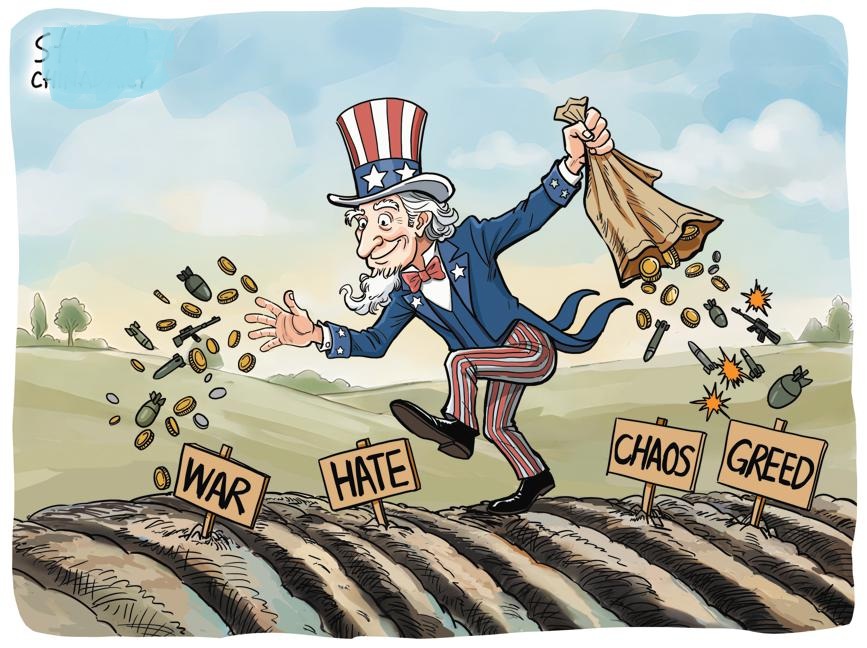
China Daily ran an editorial cartoon in its Tuesday editions that sheds useful light on Beijing’s perspective. It shows Uncle Sam profligately scattering money and weapons as he bounds through a field marked “War, Hate, Chaos and Greed.” The headline at the top is “The U.S. Reaps What It Sows.”
It is a darkly humorous reminder that Beijing knows very well what the war against Iran is fundamentally about and what time it is on history’s clock. You can always count on the Chinese to take the long view.
Patrick Lawrence, a correspondent abroad for many years, chiefly for the International Herald Tribune, is a columnist, essayist, lecturer and author, most recently of Journalists and Their Shadows, available from Clarity Press or via Amazon. Other books include Time No Longer: Americans After the American Century. His Twitter account, @thefloutist, has been restored after years of being censored.
1 This Month
23-25 October – on Zoom – World BEYOND War’s annual global conferenc


Shut down the radiation-damaged Heysham nuclear reactors now
To see nuclear-related stories in greater depth and intensity – go to https://nuclearinformation.wordpress.com

Say No to NASA’s Reckless Nuclear Reactor on the Moon
Say No to NASA’s Reckless Nuclear Reactor on the Moon

-
Archives
- October 2026 (247)
- September 2026 (339)
- August 2026 (330)
- July 2026 (355)
- June 2026 (287)
- May 2026 (306)
- April 2026 (356)
- March 2026 (251)
- February 2026 (267)
- January 2026 (308)
- December 2025 (358)
- November 2025 (359)
-
Categories
- 1
- 1 NUCLEAR ISSUES
- business and costs
- climate change
- culture and arts
- ENERGY
- environment
- health
- history
- indigenous issues
- Legal
- marketing of nuclear
- media
- opposition to nuclear
- PERSONAL STORIES
- politics
- politics international
- Religion and ethics
- safety
- secrets,lies and civil liberties
- spinbuster
- technology
- Uranium
- wastes
- weapons and war
- Women
- 2 WORLD
- ACTION
- AFRICA
- Atrocities
- AUSTRALIA
- Christina's notes
- Christina's themes
- culture and arts
- Events
- Fuk 2022
- Fuk 2023
- Fukushima 2017
- Fukushima 2018
- fukushima 2019
- Fukushima 2020
- Fukushima 2021
- general
- global warming
- Humour (God we need it)
- Nuclear
- RARE EARTHS
- Reference
- resources – print
- Resources -audiovicual
- Weekly Newsletter
- World
- World Nuclear
- YouTube
-
RSS
Entries RSS
Comments RSS

