The White House Is Fast-Tracking a Near Weapons-Grade Uranium to Power Next Gen SMR Nukes.

Bomb Grade Uranium For Sale
The hypocrisy is stunning. But the risks are worse because the danger posed by HALEU may be far worse than currently acknowledged.
April 22, 2026, Peter McKillop, https://www.theenergymix.com/the-white-house-is-fast-tracking-a-near-weapons-grade-uranium-to-power-next-gen-smr-nukes/
Oh, the irony. As the United States Defense Department spends billions to stop Iran from using enriched uranium to build a nuclear bomb, the U.S. Department of Energy (DOE) is fast-tracking a Bill Gates nuclear power project that could trigger a race to create a new generation of near bomb-grade uranium fuel.
Last month, as bombs rained down on Tehran, the Nuclear Regulatory Commission (NRC) unanimously approved a construction permit for TerraPower’s sodium‑cooled Natrium reactor, a fast reactor that requires High‑Assay Low‑Enriched Uranium (HALEU), a fuel experts say is significantly easier to weaponize than standard reactor fuel.
HALEU is uranium enriched between 5% and 20% uranium-235, compared to the maximum 5% used in today’s conventional reactor fleet. That higher enrichment level allows advanced reactors to achieve smaller, more compact designs that generate more power per unit of volume, run on longer operating cycles, and produce less radioactive waste. But there is an unintended consequence. Once the uranium mix is 20% and above, it is reclassified as highly enriched uranium (HEU) and is internationally recognized as being directly usable in nuclear weapons.
Despite this proliferation threat, HALEU remains central to the Energy Department’s advanced nuclear push because without it, most next-generation reactors cannot run. The DOE has now selected 11 advanced reactor designs under its Reactor Pilot Program, many of them planning to run on HALEU.
Only, the U.S. has no HALEU, only Russia does. So TerraPower has turned to South Africa to build a new enrichment facility that aims to produce roughly 15 tonnes of HALEU by 2027, enough to fuel the Natrium demonstration plant’s first core and more. And here lies the problem. By embracing HALEU, the DOE is effectively jump‑starting an international HALEU market and expanding the global circulation of material that can shorten the path to a bomb.
Nuclear safety expert Edwin Lyman of the Union of Concerned Scientists warns that this push “may greatly increase the risks of nuclear proliferation and terrorism.”
Bomb Grade Uranium For Sale
The hypocrisy is stunning. But the risks are worse because the danger posed by HALEU may be far worse than currently acknowledged. In a letter in Science, Lyman and three leading nuclear researchers—Scott Kemp of MIT, Mark Deinert of the Colorado School of Mines, and Frank von Hippel of Princeton—argue that HALEU can, in some cases, be used to make nuclear weapons without any further enrichment at all. Promoter of SMR’s, they argue, have not considered the potential proliferation and terrorism risks that the wide adoption of this fuel creates.
Opening the Gates
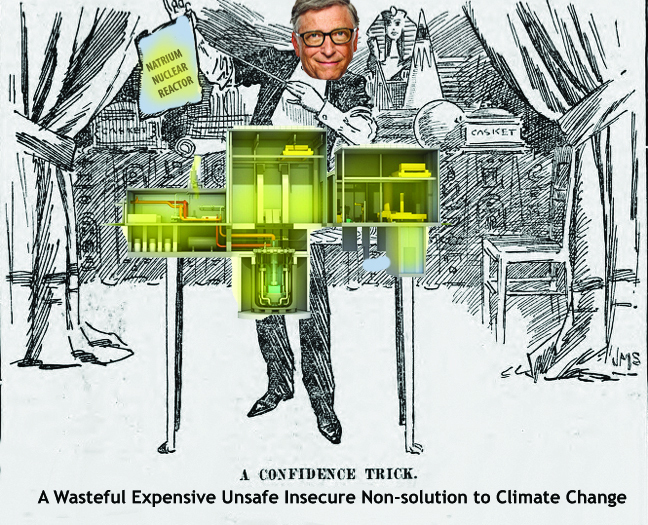
This has not stopped Bill Gates. As founder and chair, he is the driving force behind TerraPower. In the past year, Gates has dramatically shifted away from solar power to double down so-called ‘”innovative” nuclear power schemes.
Gates is aggressively courting the Trump administration, including DOE Secretary Chris Wright and Interior Secretary Doug Burgum, to help secure expedited NRC safety reviews to accelerate construction permits for the Wyoming Natrium site.
Why Bother?
At first glance, what Gates is championing does not seem totally unreasonable. With new power needs and climate deadlines looming, supporters argue that only reactors can provide round‑the‑clock, low‑carbon power without devouring land or depending on fickle weather. Small modular and “advanced” designs, they say, will be cheaper, quicker to build, and safer than the behemoths of the past, complementing wind and solar rather than competing with them.
In this view, HALEU is not a bug but a feature: the key to compact, flexible reactors that can decarbonize heavy industry and data centres alike.
Eisenhower’s Atoms for Peace
The problem is, we’ve seen this movie before, minus data centres and climate concerns. In the 1950s, the Eisenhower administration championed “Atoms for Peace” and actively helped Iran build a “peaceful” nuclear program—research reactors, fuel, training, the whole package—on the assumption that controlled access to advanced fuel cycles would lock in development and stability.
Seven decades and one revolution later, the United States and Israel are bombing that same program. It is hard to imagine a clearer warning against casually globalizing any technology that nudges civilian infrastructure closer to bomb‑grade fuel.
Bros for Bombs
But that does not seem to concern key members of America’s billionaire class. Jeff Bezos, is also a fan of SMRs and has plowed more than $1 billion into nuclear ventures that stand to benefit directly from such policies, and that the company he founded is a leading champion of nuclear power for data centres.
In this week’s edition of Climate & Capital Weekly, CCM editor Barclay Palmer teams up with former nuclear industry heavyweight-turned-watchdog Arnie Gundersen look into the nuclear influence peddlers shaping U.S. nuclear policy.
Gates and Bezos both know the economics of nuclear power are so brutal that only a government can finance its development. The last two reactors completed in the U.S.—Units 3 and 4 at the Vogtle plant in Georgia—came in at roughly $35 billion, nearly double their original budget, and were seven years behind schedule, helping drive Westinghouse into bankruptcy and nearly sinking the participating utility.
The billionaire bro partnership with Trump is a great example of how the administration operates. Today’s nuclear revival is a top‑down affair. Gates and Bezos have effectively captured the only institution large enough to bear the financial costs and political risks of nuclear construction: the federal government.
The payoff they are chasing is to fast-track the terawatt‑hours needed to feed their AI‑driven data‑centre empires, even if it means risking nuclear Armageddon.
No comments yet.
1 This Month





PLEASE OPPOSE HR 8255 AND S.3639 – bills would accelerate satellite deployment, with no environmental review or safeguards – https://ncstd5li.quorum.us/campaign/169331/
To see nuclear-related stories in greater depth and intensity – go to https://nuclearinformation.wordpress.com
-
Archives
- October 2026 (81)
- September 2026 (339)
- August 2026 (330)
- July 2026 (355)
- June 2026 (287)
- May 2026 (306)
- April 2026 (356)
- March 2026 (251)
- February 2026 (267)
- January 2026 (308)
- December 2025 (358)
- November 2025 (359)
-
Categories
- 1
- 1 NUCLEAR ISSUES
- business and costs
- climate change
- culture and arts
- ENERGY
- environment
- health
- history
- indigenous issues
- Legal
- marketing of nuclear
- media
- opposition to nuclear
- PERSONAL STORIES
- politics
- politics international
- Religion and ethics
- safety
- secrets,lies and civil liberties
- spinbuster
- technology
- Uranium
- wastes
- weapons and war
- Women
- 2 WORLD
- ACTION
- AFRICA
- Atrocities
- AUSTRALIA
- Christina's notes
- Christina's themes
- culture and arts
- Events
- Fuk 2022
- Fuk 2023
- Fukushima 2017
- Fukushima 2018
- fukushima 2019
- Fukushima 2020
- Fukushima 2021
- general
- global warming
- Humour (God we need it)
- Nuclear
- RARE EARTHS
- Reference
- resources – print
- Resources -audiovicual
- Weekly Newsletter
- World
- World Nuclear
- YouTube
-
RSS
Entries RSS
Comments RSS


Leave a comment