Mysterious Flashes in 1950s Skies Linked to Nuclear Tests and UAP Sightings: Study
Apr 10, 2026, Sci News, by Natali Anderson
A new statistical analysis of archival sky surveys from the early Cold War has found that mysterious, short-lived bursts of light in the night sky were more likely to appear around the time of above-ground nuclear weapons tests and to increase alongside reports of unexplained aerial phenomena (UAPs).
“Transient star-like objects have been identified in sky surveys conducted prior to the launch of the first artificial satellite on October 4, 1957,” said Dr. Beatriz Villarroel of the Nordic Institute for Theoretical Physics (Nordita) and Dr. Stephen Bruehl from the Vanderbilt University Medical Center.
“These short-lived transients — lasting less than one exposure time of 50 min — have point spread functions and are absent in images taken shortly before the transients appear and in all images from subsequent surveys.”…………………………………….
“Above-ground nuclear weapons tests (US, Soviet, and British) were conducted on 124 days (4.6%) during the study period.”
“UAP reports were recorded in the UFOCAT database on 2,428 days during the study period (89.3%).”
The researchers found that the transients were about 45% more likely to occur on days within a one-day window of a nuclear test than on other days.
The effect was strongest the day after a test, when the likelihood of observing a transient rose by roughly 68%.
The study also reported a modest correlation between the number of transients and the number of UAP sightings recorded on the same date……………………………………………..
This study adds to the small peer-reviewed literature seeking to apply systematic scientific methods to the study of UAP-related data.”
“The ultimate importance of the associations reported in the current work for enhancing understanding of transients and UAP remains to be determined.”
A paper on the findings was published on October 20, 2025 in the journal Scientific Reports. https://www.sci.news/astronomy/cold-war-transients-14688.html
27 April – Bangor University UK Dr David Toke talks on Chernobyl & Fukushima
Come to Neuadd Rathbone, College Road, Bangor University, Monday evening
27 April at 6:00 pm to a special meeting organised by CADNO/PAWB to note
that 15 years have passed since the Fukushima nuclear disaster, and 40
years since the nuclear explosion at the Chernobyl nuclear power station in
Ukraine which led to many European countries being polluted, including
Cymru. Photographs taken by the photographer Lis Fields of the effects of
the Fukushima disaster will be on display and we hope to have her company
online. The evening’s main speaker will be the campaigning academic, Dr
David Toke from Aberdeen University. David has written extensively about
the dangers of nuclear power and its extortionate cost. He also has strong
warnings for us about modular nuclear reactors such as the one Rolls Royce
wants to build at Wylfa
PAWB 10th April 2026, https://www.stop-wylfa.org/
“Heretic”: After Trump spiritual adviser Paula White-Cain likens Trump to Jesus during Easter, right-wing media figures lash out
Tucker Carlson called it “so vile” and “such a sacrilege,” while conservative influencer Brett Cooper said, “Maybe these people should not be involved in our government”
Media Matters, by Payton Armstrong, 04/08/26
Right-wing media figures are lashing out at President Donald Trump’s personal spiritual adviser and senior adviser to the White House Faith Office Paula White-Cain for likening Trump to Jesus during an Easter event, labeling her an “unabashed heretic” and “batsh*t crazy.”
White-Cain is a televangelist, pastor, and Trump’s longtime spiritual adviser who has “long been a prominent and polarizing figure in evangelical circles.” White-Cain has an extensive history of extreme rhetoric, including declaring that opposition to Trump is equivalent to opposition to God. Now a senior adviser to the White House Faith Office, White-Cain is part of Trump’s effort to expand “the power and influence of conservative Christians in government” in his second term.
At an April 1 closed-door Easter speech at the White House, White-Cain spoke next to Trump and directly likened him to Jesus, saying, “No one has paid the price like you have paid the price. It almost cost you your life. You were betrayed and arrested and falsely accused. It’s a familiar pattern that our lord and savior showed us.” The White House deleted video of the speech, which “was initially posted on the official White House website and YouTube channel,” and clips continued to circulate on social media.
On April 4, Fox host (and the president’s daughter-in-law) Lara Trump hosted White-Cain to share a message for Easter, in which she said it was her “favorite subject to talk about” to “give honor to God and to president Trump for being bold and unwavering with his faith.”…………………………………………………………………………………………………………………………………………………………………………………………………………………………………………. https://www.mediamatters.org/donald-trump/heretic-after-trump-spiritual-adviser-paula-white-cain-likens-trump-jesus-during
“Locked and Loaded”: Hegseth Says Trump’s War‑Crime Warnings Were Dead Serious
April 8, 2026, Joshua Scheer , https://scheerpost.com/2026/04/08/locked-and-loaded-hegseth-says-trumps-war-crime-warnings-were-dead-serious/
THE SICKNESS IS REAL — AND THE EMPIRE IS SHOWING ITS END:

Pete Hegseth openly acknowledged that the threat to obliterate Iran’s civilian infrastructure—its power plants, bridges, and economic lifelines—was not rhetorical. It was operational. “We were locked and loaded,” the Pentagon secretary declared, describing a readiness to cripple an entire nation in minutes
This is the normalization of mass destruction as policy.
And that normalization is a symptom of something deeper—a political and moral sickness that has spread through the highest levels of power.
With Hegseth who himself is already a possible war criminal because of his work in Venezuela said this “Had Iran refused our terms, the next targets would have been their power plants, their bridges, and oil and energy infrastructure—targets they could not defend and could not realistically rebuild,” Hegseth told reporters “We were locked and loaded… President Trump had the power to cripple Iran’s entire economy in minutes.”
Doubling down on the genocidal language of war, Hegseth said the United States “has the ability to strike [Iran] with impunity.”
In response Oona Hathaway, a Yale Law School professor and former Pentagon legal adviser, warned that even the threat of such attacks carries legal consequences under international law.
“Threats of the use of force also violate the United Nations Charter,” Hathaway said, adding that openly discussing the destruction of civilian infrastructure raises serious questions about whether the United States is acting within its legal obligations. More than that, she noted, such statements reveal intent—something that could become central in any future war crimes investigation.
But here is the uncomfortable truth that rarely gets said out loud:
For all its language and lofty principles, the United Nations Charter has often proven powerless in the face of empire.
From Ukraine to Tibet, from Iraq to countless other interventions, the reality is clear: global powers—especially those sitting on the UN Security Council—have repeatedly acted outside the very rules they claim to uphold. The institutions meant to enforce international law are too often shaped, constrained, or outright bypassed by the same nations they are supposed to hold accountable.
What does a charter mean when enforcement is selective?
What does “international law” mean when the most powerful actors face no consequences?
The result is a system where legality becomes flexible, where norms are invoked when convenient and ignored when inconvenient. And in that environment, warnings like Hathaway’s—while legally sound—collide with a deeper, harsher reality:
Power, not principle, too often determines what is allowed.
That does not make the law irrelevant. But it does expose the gap between what the international system claims to be—and how it actually functions when confronted with the interests of empire.
Often there is a complaint that we don’t offer solutions to these problems—but there are real ones right in front of us. One of the most important is to stay grounded and present, resisting the pull of constant outrage and burnout. From there, people can find and work with groups in their area or across the globe, turning individual concern into collective action that has the power to create real change.
The anger and urgency people feel right now can be turned into real, effective action if it’s focused in the right direction. Individuals can apply pressure by contacting elected officials, supporting candidates who challenge aggressive foreign policy, and demanding oversight of military actions. Joining or organizing with peace groups, community coalitions, and public forums helps transform isolated frustration into collective influence. Sharing credible information, writing, and challenging misleading narratives can shift public opinion over time, while supporting investigative journalism and accountability organizations helps expose abuses of power. Economic pressure—through divestment efforts, consumer awareness, and backing independent media—also plays a critical role. Just as important is building long-term awareness through education and discussion, connecting global conflicts to everyday realities. Lasting change doesn’t come from a single moment of outrage, but from sustained, organized engagement that holds power to account over time.
Norway should not work towards nuclear power generation now, commission finds
By Nora Buli, April 8, 2026, https://www.reuters.com/business/energy/norway-should-not-work-towards-nuclear-power-generation-now-commission-finds-2026-04-08/
OSLO, April 8 (Reuters) – Norway should refrain from starting a comprehensive process to introduce nuclear power at present, amid still plentiful hydropower supply and cheaper alternative new energy sources, a government appointment commission said on Wednesday.
The Norwegian government in 2024 appointed the 12-person committee to look at the potential future use of nuclear power in the Nordic country, the first such in-depth review since the 1970s.
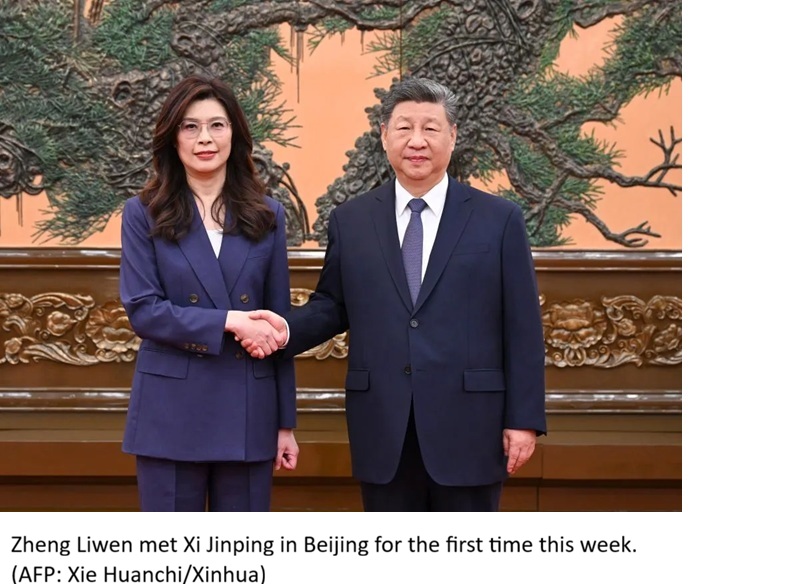
Xi–Zheng Meeting Sends Clear Signal: Peaceful Reunification Framed as Strategic Imperative for Chia’s Future
Author: Xu Jijun, founder of Han Tang Zhi Ku Analytical Centre, Apr 10, 2026
On the morning of 10 April 2026, inside the East Hall of the Great Hall of the People in Beijing, Xi Jinping, General Secretary of the Communist Party of China, met Zheng Liwen, Chair of the Kuomintang. The encounter marked the first meeting between leaders of the two parties in a decade. It unfolded at a moment of mounting global instability and heightened tensions across the Taiwan Strait, giving it both historical weight and immediate political relevance.
The meeting was not merely ceremonial. It articulated a shared position that people on both sides of the Strait seek peace and oppose division. It also set out a political direction aimed at returning cross-Strait relations to a path of peaceful development, with the stated goal of eventual peaceful reunification.
A venue heavy with history
For mainland observers, the deeper meaning of the Xi–Zheng meeting is tied closely to its setting. The East Hall has hosted landmark moments in China’s modern history, including events linked to the return of Hong Kong and Macau. Its reuse for high-level dialogue between representatives of the two sides of the Strait carries unmistakable symbolism.
The message conveyed is straightforward. Both sides belong to one China, and Taiwan is regarded as an inseparable part of it. External complexities do not alter this premise. Questions concerning the Chinese nation are framed as matters to be resolved internally, with peaceful dialogue presented as the appropriate course.
A world defined by conflict
The significance of the meeting becomes clearer when placed against the current global backdrop. Armed conflicts in recent years have illustrated the scale of destruction associated with modern warfare.
The Russia–Ukraine conflict continues to impose heavy losses. According to the Kyiv School of Economics (KSE Institute), in its March 2026 assessment, Ukraine has suffered cumulative income losses of approximately 1.7 trillion US dollars since the escalation of hostilities in 2022, including projected losses through the end of 2026. Urban areas have been devastated, energy infrastructure repeatedly targeted, millions displaced, and environmental damage described as long-lasting.
Since February 2026, military action by the United States and Israel against Iran has produced similarly severe consequences. Around 80 per cent of Iran’s air defence systems have been destroyed, along with more than 450 missile installations. Its capacity for ballistic missile retaliation has reportedly fallen by 90 per cent. Production lines for “Shahed” unmanned aerial vehicles have been eliminated, reducing output by 85 per cent. The Iranian navy has seen approximately 160 vessels sunk or disabled, its naval headquarters destroyed, and its control over the Persian Gulf lost. Up to 90 per cent of the defence industrial base, including key shipyards, has been destroyed.
After just 38 days of conflict, Iran’s military capability, built over four decades, has been largely dismantled. Regional shipping has been disrupted, energy markets have experienced sharp volatility, tens of thousands have been killed, and millions displaced. Regional stability has effectively collapsed.
These developments illustrate the destructive potential of modern high-technology warfare. Precision-guided munitions, drone swarms, and long-range strike systems can disable power supplies, destroy transport infrastructure, contaminate land, and set back economic and social development by decades in a matter of weeks.
Taiwan and the global economy
Against this background, the text argues that any attempt to pursue “Taiwan independence” carries serious risks. A conflict in the Taiwan Strait would likely exceed the scale and impact of the wars in Ukraine and the Middle East.
Taiwan occupies a central position in the global semiconductor industry. Firms such as TSMC hold a dominant share of advanced manufacturing capacity. In the event of war, supply chains would be disrupted immediately.
Simulations by international institutions suggest that, in a worst-case scenario, global GDP could fall by nearly 10 per cent in the first year of a Taiwan Strait conflict. Economic losses could reach 10.6 trillion US dollars, equivalent to around 333 trillion New Taiwan dollars. Taiwan’s own economy could contract by as much as 40 per cent. The shock would be felt across mainland China, the United States, Japan, South Korea, and the European Union.
The military consequences would be severe. High-density missile strikes, electronic warfare, and naval and air blockades could lead to large-scale destruction of infrastructure on the island. Casualties would be significant, while environmental and humanitarian damage could prove irreversible. Given the close social and cultural ties between people on both sides of the Strait, any armed confrontation would result in profound human cost. Regional tensions would escalate rapidly, posing risks to stability in East Asia and beyond.
Political signalling and red lines
Within this framework, the position presented is that “Taiwan independence” represents a path with no viable outcome. It is described as running counter to shared interests and broader historical trends.
The alternative, as outlined, lies in adherence to the 1992 Consensus and opposition to separatism. Zheng Liwen’s visit, described as a “journey for peace”, emphasised the notion of cross-Strait kinship and was framed as aligning with public sentiment and prevailing conditions.
The meeting between the leaderships of the Communist Party and the Kuomintang reaffirmed a shared political foundation. It also conveyed a clear warning that any attempt at secession would meet firm opposition from the Chinese population as a whole and would carry significant costs.
Peaceful reunification and national strategy
eaceful reunification is presented as both a collective aspiration and a structural requirement for what is described as the “great rejuvenation of the Chinese nation”. It is framed as a pathway to shared economic benefits and improved living standards for people in Taiwan within a broader national framework.
The argument also stresses its role in preventing war, preserving stability, and enabling joint prosperity. At a regional and global level, it is depicted as contributing to stability in the Asia-Pacific and demonstrating China’s role as a responsible major power.
Historical experience is cited to support this position. Periods characterised by adherence to the One China principle and the promotion of peaceful cross-Strait relations have coincided with stability and active exchanges. By contrast, deviations from this approach have led to tension and economic disruption.
A milestone with wider implications
The Xi–Zheng meeting is thus framed as another milestone in the trajectory of cross-Strait relations. It highlights what is described as the mainland’s consistent commitment to the principle that both sides form one family, alongside a stated willingness to pursue peaceful reunification with sincerity.
For the international community, the meeting is presented as an example of the principle that China’s internal affairs should be resolved domestically. It offers a contrast to conflict-driven approaches that have produced severe consequences in other regions.
The conclusion drawn is one of confidence. With sustained efforts on both sides of the Strait, the prospect of peaceful reunification is portrayed as increasingly attainable. The broader objective, the rejuvenation of the Chinese nation, is framed as a long-term historical trajectory.
No external force, the argument suggests, will ultimately be able to obstruct this course.
Conclusion
Peaceful reunification is presented as beneficial in the present and significant for generations to come. The current moment is described as a critical historical opportunity. By deepening economic integration, expanding cultural exchange, and strengthening cooperation in social development, both sides of the Strait are encouraged to move towards closer family ties, more integrated industries, broader opportunities for younger generations, and greater shared prosperity.
The overarching message is clear. The opportunity should be seized in the interests of people on both sides of the Strait and in pursuit of a more stable and prosperous future linked to the wider project of national rejuvenation.
1 This Month
26 September – International Day for the Total Elimination of Nuclear Weapons





PLEASE OPPOSE HR 8255 AND S.3639 – bills would accelerate satellite deployment, with no environmental review or safeguards – https://ncstd5li.quorum.us/campaign/169331/
To see nuclear-related stories in greater depth and intensity – go to https://nuclearinformation.wordpress.com
-
Archives
- September 2026 (290)
- August 2026 (330)
- July 2026 (355)
- June 2026 (287)
- May 2026 (306)
- April 2026 (356)
- March 2026 (251)
- February 2026 (267)
- January 2026 (308)
- December 2025 (358)
- November 2025 (359)
- October 2025 (375)
-
Categories
- 1
- 1 NUCLEAR ISSUES
- business and costs
- climate change
- culture and arts
- ENERGY
- environment
- health
- history
- indigenous issues
- Legal
- marketing of nuclear
- media
- opposition to nuclear
- PERSONAL STORIES
- politics
- politics international
- Religion and ethics
- safety
- secrets,lies and civil liberties
- spinbuster
- technology
- Uranium
- wastes
- weapons and war
- Women
- 2 WORLD
- ACTION
- AFRICA
- Atrocities
- AUSTRALIA
- Christina's notes
- Christina's themes
- culture and arts
- Events
- Fuk 2022
- Fuk 2023
- Fukushima 2017
- Fukushima 2018
- fukushima 2019
- Fukushima 2020
- Fukushima 2021
- general
- global warming
- Humour (God we need it)
- Nuclear
- RARE EARTHS
- Reference
- resources – print
- Resources -audiovicual
- Weekly Newsletter
- World
- World Nuclear
- YouTube
-
RSS
Entries RSS
Comments RSS

