“Locked and Loaded”: Hegseth Says Trump’s War‑Crime Warnings Were Dead Serious
April 8, 2026, Joshua Scheer , https://scheerpost.com/2026/04/08/locked-and-loaded-hegseth-says-trumps-war-crime-warnings-were-dead-serious/
THE SICKNESS IS REAL — AND THE EMPIRE IS SHOWING ITS END:
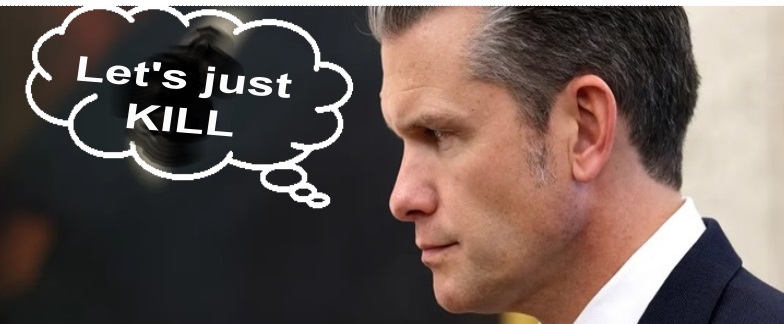
Pete Hegseth openly acknowledged that the threat to obliterate Iran’s civilian infrastructure—its power plants, bridges, and economic lifelines—was not rhetorical. It was operational. “We were locked and loaded,” the Pentagon secretary declared, describing a readiness to cripple an entire nation in minutes
This is the normalization of mass destruction as policy.
And that normalization is a symptom of something deeper—a political and moral sickness that has spread through the highest levels of power.
With Hegseth who himself is already a possible war criminal because of his work in Venezuela said this “Had Iran refused our terms, the next targets would have been their power plants, their bridges, and oil and energy infrastructure—targets they could not defend and could not realistically rebuild,” Hegseth told reporters “We were locked and loaded… President Trump had the power to cripple Iran’s entire economy in minutes.”
Doubling down on the genocidal language of war, Hegseth said the United States “has the ability to strike [Iran] with impunity.”
In response Oona Hathaway, a Yale Law School professor and former Pentagon legal adviser, warned that even the threat of such attacks carries legal consequences under international law.
“Threats of the use of force also violate the United Nations Charter,” Hathaway said, adding that openly discussing the destruction of civilian infrastructure raises serious questions about whether the United States is acting within its legal obligations. More than that, she noted, such statements reveal intent—something that could become central in any future war crimes investigation.
But here is the uncomfortable truth that rarely gets said out loud:
For all its language and lofty principles, the United Nations Charter has often proven powerless in the face of empire.
From Ukraine to Tibet, from Iraq to countless other interventions, the reality is clear: global powers—especially those sitting on the UN Security Council—have repeatedly acted outside the very rules they claim to uphold. The institutions meant to enforce international law are too often shaped, constrained, or outright bypassed by the same nations they are supposed to hold accountable.
What does a charter mean when enforcement is selective?
What does “international law” mean when the most powerful actors face no consequences?
The result is a system where legality becomes flexible, where norms are invoked when convenient and ignored when inconvenient. And in that environment, warnings like Hathaway’s—while legally sound—collide with a deeper, harsher reality:
Power, not principle, too often determines what is allowed.
That does not make the law irrelevant. But it does expose the gap between what the international system claims to be—and how it actually functions when confronted with the interests of empire.
Often there is a complaint that we don’t offer solutions to these problems—but there are real ones right in front of us. One of the most important is to stay grounded and present, resisting the pull of constant outrage and burnout. From there, people can find and work with groups in their area or across the globe, turning individual concern into collective action that has the power to create real change.
The anger and urgency people feel right now can be turned into real, effective action if it’s focused in the right direction. Individuals can apply pressure by contacting elected officials, supporting candidates who challenge aggressive foreign policy, and demanding oversight of military actions. Joining or organizing with peace groups, community coalitions, and public forums helps transform isolated frustration into collective influence. Sharing credible information, writing, and challenging misleading narratives can shift public opinion over time, while supporting investigative journalism and accountability organizations helps expose abuses of power. Economic pressure—through divestment efforts, consumer awareness, and backing independent media—also plays a critical role. Just as important is building long-term awareness through education and discussion, connecting global conflicts to everyday realities. Lasting change doesn’t come from a single moment of outrage, but from sustained, organized engagement that holds power to account over time.
No comments yet.
1 This Month
23-25 October – on Zoom – World BEYOND War’s annual global conferenc


Shut down the radiation-damaged Heysham nuclear reactors now
To see nuclear-related stories in greater depth and intensity – go to https://nuclearinformation.wordpress.com

Say No to NASA’s Reckless Nuclear Reactor on the Moon
Say No to NASA’s Reckless Nuclear Reactor on the Moon

-
Archives
- October 2026 (199)
- September 2026 (339)
- August 2026 (330)
- July 2026 (355)
- June 2026 (287)
- May 2026 (306)
- April 2026 (356)
- March 2026 (251)
- February 2026 (267)
- January 2026 (308)
- December 2025 (358)
- November 2025 (359)
-
Categories
- 1
- 1 NUCLEAR ISSUES
- business and costs
- climate change
- culture and arts
- ENERGY
- environment
- health
- history
- indigenous issues
- Legal
- marketing of nuclear
- media
- opposition to nuclear
- PERSONAL STORIES
- politics
- politics international
- Religion and ethics
- safety
- secrets,lies and civil liberties
- spinbuster
- technology
- Uranium
- wastes
- weapons and war
- Women
- 2 WORLD
- ACTION
- AFRICA
- Atrocities
- AUSTRALIA
- Christina's notes
- Christina's themes
- culture and arts
- Events
- Fuk 2022
- Fuk 2023
- Fukushima 2017
- Fukushima 2018
- fukushima 2019
- Fukushima 2020
- Fukushima 2021
- general
- global warming
- Humour (God we need it)
- Nuclear
- RARE EARTHS
- Reference
- resources – print
- Resources -audiovicual
- Weekly Newsletter
- World
- World Nuclear
- YouTube
-
RSS
Entries RSS
Comments RSS


Leave a Reply