National analysis of cancer mortality and proximity to nuclear power plants in the United States
Nature Communications volume 17, Article number: 1560 (2026) , 23 February 2026 [Excellent graphics and tables]
Abstract
Understanding the potential health implications of living near nuclear power plants is important given the renewed interest in nuclear energy as a low-carbon power source. Here we show that U.S. counties located closer to operational nuclear power plants have higher cancer mortality rates than those farther away.
Using nationwide mortality data from 2000-2018, we assess long-term spatial patterns of cancer mortality in relation to proximity to nuclear facilities while accounting for socioeconomic, demographic, behavioral, environmental, and healthcare factors. Cancer mortality is higher across multiple age groups in both males and females, with the strongest associations among older adults, males aged 65–74 and females aged 55–64. While our findings cannot establish causality, they highlight the need for further research into potential exposure pathways, latency effects, and cancer-specific risks, emphasizing the importance of addressing these potentially substantial but overlooked risks to public health.
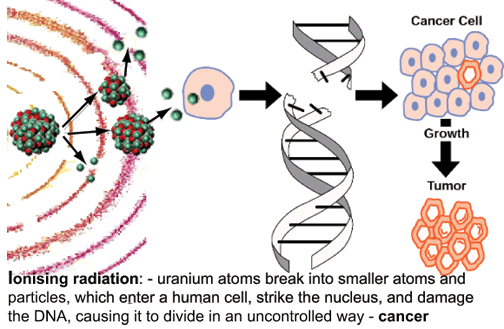
…………………………………………………………….Nuclear power plants emit radioactive pollutants that can disperse into the surrounding environment, leading to potential human exposure through inhalation, ingestion, and direct contact. These pollutants can be transported through air, water, and soil, contributing to long-term environmental contamination1. Populations residing near nuclear power plants may experience low-level chronic exposure to ionizing radiation via environmental release pathways. While our study does not include dosimetry, ionizing radiation is a well-established carcinogen2,3,4,5,6,7 and thus motivates investigation into proximity-based exposure patterns.
………………………Despite the importance and prevalence of nuclear power plants in the U.S., epidemiologic research regarding their health impacts remains rare. Most U.S. studies have focused on individual plants or limited regions, with only a few national assessments to date – many of which relied on fixed distance cutoffs to classify exposed populations8,9,11,12,19,21,22,23,24,25. These studies often focus on a single facility and its surrounding communities, which restricts their statistical power to detect effects and ability to capture broader exposure patterns. Furthermore, differences in study design, exposure assessment methods, and geographic scope make it difficult to draw generalizable conclusions.
In this work, we assess the association between county-level proximity to nuclear power plants and cancer mortality across the United States from 2000 to 2018. We find that counties located closer to operational nuclear power plants have higher cancer mortality rates, with stronger associations observed among older adults. These associations remain consistent across multiple sensitivity analyses and proximity definitions. The results highlight spatial patterns of cancer risk in relation to nuclear power generation and emphasize the importance of evaluating potential long-term health implications of nuclear energy infrastructure in population-scale studies…………………………………………………………………………………………………………………………………………………………………. https://www.nature.com/articles/s41467-026-69285-4
4 Comments »
Leave a reply to Christina Macpherson Cancel reply
1 This Month

of the week– Nuclear Reactor Information Task Force

14 May – online event From Bombs to Data Centres: the Face of Nuclear Colonialism
To see nuclear-related stories in greater depth and intensity – go to https://nuclearinformation.wordpress.com
-
Archives
- May 2026 (126)
- April 2026 (356)
- March 2026 (251)
- February 2026 (268)
- January 2026 (308)
- December 2025 (358)
- November 2025 (359)
- October 2025 (376)
- September 2025 (257)
- August 2025 (319)
- July 2025 (230)
- June 2025 (348)
-
Categories
- 1
- 1 NUCLEAR ISSUES
- business and costs
- climate change
- culture and arts
- ENERGY
- environment
- health
- history
- indigenous issues
- Legal
- marketing of nuclear
- media
- opposition to nuclear
- PERSONAL STORIES
- politics
- politics international
- Religion and ethics
- safety
- secrets,lies and civil liberties
- spinbuster
- technology
- Uranium
- wastes
- weapons and war
- Women
- 2 WORLD
- ACTION
- AFRICA
- Atrocities
- AUSTRALIA
- Christina's notes
- Christina's themes
- culture and arts
- Events
- Fuk 2022
- Fuk 2023
- Fukushima 2017
- Fukushima 2018
- fukushima 2019
- Fukushima 2020
- Fukushima 2021
- general
- global warming
- Humour (God we need it)
- Nuclear
- RARE EARTHS
- Reference
- resources – print
- Resources -audiovicual
- Weekly Newsletter
- World
- World Nuclear
- YouTube
-
RSS
Entries RSS
Comments RSS
 nuclear-news
[…] Full reading at nuclear-news 2189 ♥ […]
Pingback by Study Links Higher Cancer Mortality Rates to Proximity of Nuclear Power Plants in the U.S. - KillBait Archive | February 28, 2026 |
is there any research data about cancer occurrence among residents in the areas around nuclear plants not just deaths?
NUCLEAR NIGHTMARE FOR FAMILIES – STRONTIUM-90 IN BABIES TEETH NEAR FLORIDA REACTORS https://cooberpedytimes.com/2009/10/28/nuclear-nightmare-for-families-strontium-90-in-babies-teeth-near-florida-reactors/
Nuclear waste exposure in childhood associated with higher cancer incidence Harvard T.H. Chan School of Public Health, Jul 17 2025, https://www.news-medical.net/news/20250717/Nuclear-waste-exposure-in-childhood-associated-with-higher-cancer-incidence.aspx
THIS ONE IS MORE TELLING. Huge study of nuclear workers in France, the United Kingdom, and the United States confirms low dose radiation as a cause of cancer. https://www.bmj.com/content/382/bmj-2022-074520?fbclid=IwAR2zEZMejFSss68iOHNDBfzmnUMLBWGRuc9IRFhlWHoujUzQnQe-452Wx38—
Why were studies canceled? – Federal agencies won’t look at cancer impacts of commercial nuclear facilities – https://beyondnuclearinternational.org/2023/03/12/why-were-studies-canceled/