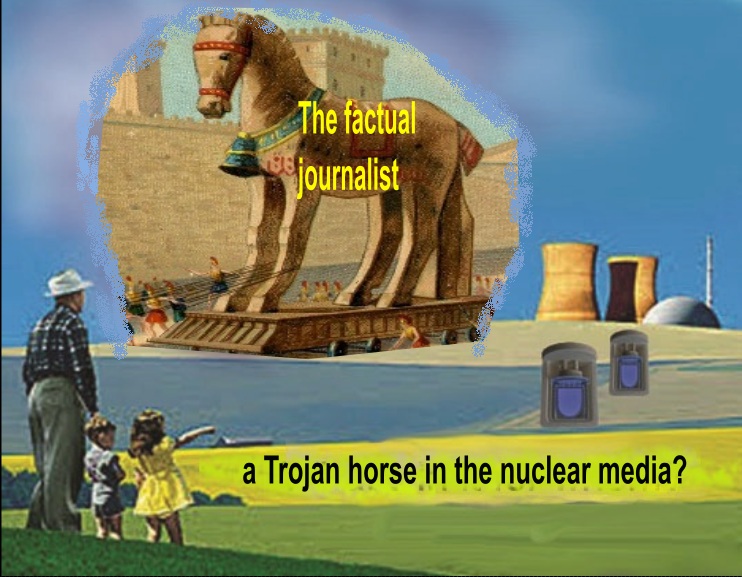
The brave journalists of the old-fashioned media.
21 January 2026, Noel Wauchope, https://theaimn.net/the-brave-journalists-of-the-old-fashioned-media/
It’s not easy being a journalist in a paid job in corporate print, TV or radio media. You have to toe the corporate line. It’s best to be writing on a specialised topic where you’re likely to not offend the powerful. Cooking, gardening, sport -are good, though even in them, hazardous aspects can arise – like race, religion, gender, sexuality.
But when it comes to environment, current affairs, politics, business – the prudent journalist needs to tread warily, lest he/she loses the job.
This is an awful pity. Although writers have always had to be careful about offending business owners and governments, It hasn’t always been as dangerous as it is now. And for us, the “consumers of media”, the advantages of “mainstream” media are great. There is funding to enable strong investigative journalism. There is fact-checking, meaning that the readers/viewers, listeners, can have confidence in the facts of the story. Heck! the editors even check grammar and spelling (well, mostly). And these are the reasons why I still like “mainstream” media.
And so, as I’m pondering on journalists and their contributions to society, I am very aware of those journalists who, still hanging on to their corporate-controlled jobs, manage to sneak in, or even state boldly, some unwelcome realities.
Nowhere is the media’s craven subservience to the powerful more obvious than in journalism’s coverage of the nuclear industry. Any day at all, if you bother to search “nuclear” on Google News, there will be a stream of articles describing the nuclear industry in positive terms, even with breathless enthusiasm.
I think that the nuclear lobby has done a fine job in teaching the world that no-one but nuclear industry experts can possibly understand nuclear issues – so journalists find it easiest and prudent to just regurgitate nuclear industry handouts. (Heaven forfend that we should fall for the message of a Dr Helen Caldicott – explaining that nuclear power is just an expensive way to boil water. Albert Einstein thought the same thing).
It’s not a Russia-China versus the West thing, as ALL these powerful governments are enthusiasts for nuclear power. So the critics of nuclear power are not “Left” or “Right”: they are simply critics of nuclear power.
So, in this climate of journalists playing safe, and not upsetting government or industry, I have to admire those who stay on in their media jobs, try not to offend, but communicate the facts, and manage to include some negative aspects of nuclear power.
Here’s one example, although he did not last long in his job in Russia. Vladimir Slivyak, a patriotic Russian, taught at the Moscow School of Economics. And that was alright for a while. But the coal and nuclear industries are highly treasured in Russia, and Slivyak wrote powerful articles, criticising them. You can’t get away with attacking Russian government policies for long, and the government eventually classified him as a foreign agent, and he had to emigrate to Germany. Silvyak is an unfailing critic of bad environmental policies of whatever government, so, now in the West, he continues to expose bad nuclear policies of the European countries, particularly France, and their continued dependence on Russian uranium.
It should be easier for writers in the West, with our famed “freedom of speech, freedom of the press”, but it’s not, really. Fearful not only of the disapproval of authorities, but also of showing their ignorance of matters nuclear, journalists find the publicity handouts and worthy utterances of nuclear experts to be the safest bet for informing the public. Hence, even if they do have their doubts, the vast majority of journalists practise self-censorship on those doubts.
Once a writer has become known as an opponent of the nuclear industry, he or she becomes not only unemployable in the mainstream media, but is widely disparaged as an eccentric, a ratbag, a communist tool, or like Dr Helen Caldicott: “hysterical” “crazy”. It doesn’t matter if, like Arnie Gunderson, they’re a nuclear engineer – they’re still a crank and not to be trusted.
So, the admirable skill, is to be able to write authoritatively on nuclear matters, and still sneak in those damning questions, those subtle criticisms. Physicist Dr Edwin Lyman managed this for a long time, actually advising the nuclear industry and USA Government on safety matters. But in more recent years, he’s gone a bit too definite in his views on nuclear unsafety:
“Be wary of new ‘smaller’ kinds of nuclear power plants“, with the result that nuclear expert Dr Al Scott and others have judged Lyman to be extreme in his views.
My favourite journalist within this narrow category of “staying inside media respectabilia” is a Canadian data journalist. I hesitate to name him – I’d hate to cast a gloom on his career. He writes for the Globe and Mail, and his articles are not anti-nuclear. They’re factual, but he’s inclined to point out things like:
“In a January report, the International Energy Agency said costs must come down; Small Modular Reactors need to reach US$4.5-million per megawatt by 2040 to enjoy rapid uptake, far less than Ontario Power Generation (OPG)’s estimated costs.”
“… the commissioners heard concerns from intervenors that GE-Hitachi hadn’t yet finished designing the reactor, raising questions about how its safety could be analyzed properly.”
His series on Canada’ s nuclear developments are detailed, and certainly not opposing the industry. It’s just that his facts on the need for taxpayer support, on fuel supply problems and costs, on the comparative economics of renewable energy – these facts are not encouraging for nuclear power.
I ponder that these kinds of critics, just gnawing away at the edges of the nuclear industry’s gospel, might be more effective opponents of that industry than the many articulate and impressive anti-nuclear activists. A subtle “Trojan horse” style of journalism?
What Canada’s nuclear waste plan means for New Brunswick
by Mayara Gonçalves e Lima, January 20, 2026, https://nbmediacoop.org/2026/01/20/what-canadas-nuclear-waste-plan-means-for-new-brunswick/
Canada is advancing plans for a Deep Geological Repository (DGR) to store the country’s used nuclear fuel. In early 2026, the Nuclear Waste Management Organization (NWMO) entered the federal regulatory process by submitting its Initial Project Description — a major step in a project with environmental and social implications that will last for generations.
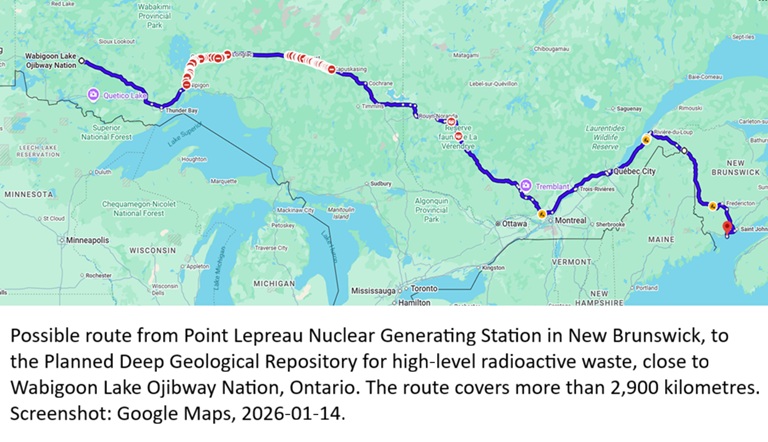
The implications of this project matter deeply to New Brunswickers because the province is already part of Canada’s nuclear legacy through the Point Lepreau Nuclear Generating Station. The proposed repository in Ontario is intended to become the final destination for used nuclear fuel generated in New Brunswick, currently stored on site at Point Lepreau.
If the project goes ahead, highly radioactive nuclear waste would be transported across New Brunswick. Current NWMO plans envision more than 2,100 transport packages of New Brunswick’s used nuclear fuel travelling approximately 2,900 kilometres, through public roads in the province and across Canada, over a period of 10 to 15 years.
For many residents, the project raises long-standing concerns about safety, accountability, and cost — especially as NB Power continues to invest in nuclear technologies and considers new reactors. Decisions about the DGR will influence how long New Brunswick remains tied to nuclear power, carrying the risks of waste that remains hazardous far beyond any political or economic planning horizon.
This is a critical moment because public input is still possible — but the comment period window is narrow. Environmental organizations and community advocates are calling for extended consultation timelines, full transparency on transport risks, and meaningful consent from affected communities. Several groups have organized a sign-on letter that readers can review and support.
How New Brunswickers respond now will help determine whether these decisions proceed quietly — or with public accountability.
Unproven science and public concerns
Globally, no deep geological repository for high-level nuclear waste has yet operated anywhere on the planet. Finland’s Onkalo facility is often cited as the first of its kind, but it remains in testing, relies on unproven assumptions about geological containment, and will not be fully sealed for decades.
The lack of proven DGR experience matters for Canada because the proposed repository would be among the world’s earliest attempts to isolate high-level radioactive waste “forever,” despite the absence of any real-world proof that such facilities can perform as claimed. Canada’s decision therefore sets not only a national course, but a global precedent built on uncertain science and long-term safety assumptions.
The proposed DGR would be built 650 to 800 metres underground in northwestern Ontario, near the Township of Ignace and Wabigoon Lake Ojibway Nation (WLON), in Treaty #3 territory. Its purpose is to bury and abandon nearly six million bundles of highly radioactive used nuclear fuel, attempting to isolate them from the biosphere for hundreds of thousands of years.
The Nuclear Waste Management Organization describes the site selection as “consent-based,” but this framing raises difficult questions. Consent in economically marginalized regions — particularly where long-term funding, jobs, and infrastructure are promised — is not the same as free, prior, and informed consent, especially when the risks extend far beyond any western planning horizon.
In 2024, the Assembly of First Nations held dialogue sessions on the transport and storage of used nuclear fuel. Communities raised serious concerns that the proposed DGR could harm land, water, and air — all central to Indigenous culture and way of life.
Guided by ancestral knowledge and a duty to protect future generations, the Assembly warned that the DGR threatens sacred sites, ecosystems, and groundwater, including the Great Lakes. Climate change and natural disasters heighten these risks, exposing the limits of the current monitoring plan and prompting calls for life-cycle oversight.
A token consultation for a monumental project
As anticipated, the Initial Project Description raises serious concerns about the DGR process itself. One of the most serious flaws is the stark mismatch between the project’s scale and the time allowed for public input. Although the DGR is framed as a 160-year project with risks lasting far longer, communities, Indigenous Nations, and civil society groups have been given just 30 days to review the Initial Project Description, with submissions due by February 4.
Thirty days to read dense technical documents, consult communities, seek independent expertise, formulate questions, and respond meaningfully to a proposal that will affect land, water, and people for generations. This is not a generous consultation — it is the bare legal minimum under federal impact assessment rules.
While regulators emphasize that the overall review will take years, this early stage is crucial in shaping what will be examined and questioned later. Rushing public input at the outset risks reducing participation to a procedural checkbox rather than a genuine democratic process, particularly for a decision whose consequences cannot be undone.
The overlooked threat of waste transport
Another serious shortcoming in the project proposal is a failure to adequately address the nationwide transport of radioactive waste. Transporting highly radioactive material through communities by road or rail is central to the project and carries significant safety and environmental risks that remain largely unexamined.
By excluding radioactive waste transportation from the Initial Project Description, the Nuclear Waste Management Organization is effectively removing it from the scope of the comprehensive federal Impact Assessment. If transport is not formally included at this stage, it will not receive the same level of environmental review, public scrutiny, or interdepartmental oversight as the repository itself.
Instead, transportation would be left primarily to the Canadian Nuclear Safety Commission and Transport Canada to assess under the existing regulations — an approach that is fragmented and insufficient given the scale, duration, and risks of moving highly radioactive waste through communities.
The transport of radioactive waste is a critical yet often overlooked issue. As Gordon Edwards, president of the Canadian Coalition for Nuclear Responsibility notes, Canada has no regulations specifically governing the transport of radioactive waste — only rules for radioactive materials treated as commercial goods. This gap matters because radioactive waste is more complex, less predictable, and potentially far more dangerous.
Transporting high-level nuclear waste is inherently risky: the material remains hazardous for centuries, and accidents, equipment failures, extreme weather, security breaches, or human error can still occur despite careful planning. Unlike other hazardous materials, radioactive contamination cannot be easily contained or cleaned up, leaving land, water, and ecosystems damaged for generations. Even a single transport incident could have lasting, irreversible consequences for communities along the route.
Radiation risks extend beyond transport workers. People traveling alongside shipments may face prolonged exposure, while those passing in the opposite direction are briefly exposed in much larger numbers. Residents and workers along transport routes can experience repeated exposure, and accidents or unplanned stops could result in localized contamination. Emergency response is further complicated by leaks or hard-to-detect releases, with standard spill or firefighting methods potentially spreading contamination.
These risks are not hypothetical. Last summer, Gentilly-1 used fuel was transported from Bécancour, Quebec, to Chalk River, Ontario, along public roads — without public notice, consultation, Indigenous consent, or clear evidence of regulatory compliance — underscoring the ongoing risks to our communities.
According to the 2024 Assembly of First Nations report, at least 210 First Nations communities could be affected by shipments of radioactive waste traveling from nuclear reactors to the repository via railways and major highways, though the full scope may be even larger when considering watersheds and alternative routes.
Given this reality, it is unacceptable that the DGR Project Description largely ignores waste transport. Any credible assessment must examine how waste will be moved, who will be affected, what rules apply, who is responsible for oversight, and how workers, communities, and the environment will be protected in emergencies. It is the job of the Impact Assessment Agency of Canada to examine these plans in depth.
A high-stakes decision that demands public voice
Canada’s proposed Deep Geological Repository is one of the most ambitious and high-stakes projects in nuclear waste management. Framed as a permanent solution, it remains untested — no country has safely operated a deep repository for used nuclear fuel over the long term. Scientific uncertainty and multi-decade timelines make its risks profound and enduring.
Dr. Gordon Edwards warns: “The Age of Nuclear Waste is just beginning. It’s time to stop and think. […] we must ensure three things: justification, notification, and consultation — before moving any of this dangerous, human-made, cancer-causing material over public roads and bridges.”
Now is the moment for public voices to be heard. Legal Advocates for Nature’s Defence (LAND), an environmental law non-profit, has prepared a sign-on letter and accompanying press release calling for a more precautionary, transparent, and democratic approach to the Deep Geological Repository. This is your chance to have a say in decisions that could expose you, your neighbours, and your communities to serious environmental and health risks.
The letter urges federal regulators to extend public consultation timelines, require that the Impact Assessment Agency of Canada conduct a comprehensive Impact Assessment that includes the transportation of radioactive waste, and uphold meaningful consent and accountability.
New Brunswickers and allies across the country are encouraged to read the letter, add their names, and speak up before decisions are finalized. How Canada handles nuclear waste today will shape risks borne by our communities for generations.
The DGR is more than a technical project; it is a test of democratic process, scientific caution, and intergenerational responsibility. Canadians deserve a transparent, thorough, and precautionary approach to ensure that decisions made today do not compromise the safety of future generations.
Mayara Gonçalves e Lima works with the Passamaquoddy Recognition Group Inc., focusing on nuclear energy. Their work combines environmental advocacy with efforts to ensure that the voice of the Passamaquoddy Nation is heard and respected in decisions that impact their land, waters, and future.
Danish MP Warns US Takeover of Greenland Will Start a War
by Kyle Anzalone , January 21, 2026 , https://news.antiwar.com/2026/01/20/danish-mp-warns-us-takeover-of-greenland-will-start-a-war/
Trump has placed tariffs on Europeans nations that oppose the US seizing Greenland
Amid threats from President Donald Trump to take over Greenland, a Danish politician said that if the US seized the colony, a war would break out.
Danish MP Rasmus Jarlov said that if the US military invades Greenland, “it would be a war, and we would be fighting against each other.”
“There’s no threat, there’s no hostility. There’s no need, because the Americans already have access to Greenland, both militarily and in all other ways.” He continued, “There are no drug routes. There is no illegitimate government in Greenland. There is absolutely no justification for it– no historical ownership, no broken treaties, nothing can justify it.”
In recent weeks, President Trump said the US will take control of Greenland. The President argues it is a matter of national security, as Russia or China will seize Greenland from Denmark if the US does not gain control first.
In response to Trump’s threats, Denmark has begun increasing its military presence in Greenland.
Trump’s plan to take Greenland has met stiff opposition in Europe. The President has slapped 10% tariffs on eight European countries. Trump said the tariffs would increase if those nations did not change policy and support the US seizure of Greenland.
An executive at Deutsche Bank suggested that European countries could pressure the US to back away from Greenland by refusing to buy US bonds. George Saravelos, head of FX research, explained, “For all its military and economic strength, the US has one key weakness: it relies on others to pay its bills via large external deficits.”
Trump and Treasury Secretary Scott Bessent downplayed the risk of a currency war with Europe. “The media has latched on to this. I think it is a completely false narrative. It defies any logic,” he said Tuesday.
“If you look, the US Treasury market was the best-performing market in the world, or the best G7-performing bond market, and we had the best performance since 2020. It is the most liquid market.” Bessent continued,” It is the basis for all financial transactions, and I am sure that the European governments will continue holding it.”
The President said he did not expect Europe to push back too much if he annexed Greenland. “I don’t think they are going to push back too much,” he said, adding, “We have to have it.”
Australia’s Frightening New “Hate Speech” Laws Are Clearly Aimed At Pro-Palestine Groups
Caitlin Johnstone, Jan 21, 2026, https://www.caitlinjohnst.one/p/australias-frightening-new-hate-speech?utm_source=post-email-title&publication_id=82124&post_id=185285586&utm_campaign=email-post-title&isFreemail=true&r=1ise1&triedRedirect=true&utm_medium=email
Australia’s Labor government has successfully passed a “hate speech” bill that’s plainly aimed, at least in part, at suppressing pro-Palestine organizations as “hate groups”.
Free speech advocates are sounding the alarm about the new laws, saying their extremely vague wording, lack of procedural fairness and low thresholds for implementation mean groups can now be banned if they make people feel unsafe or upset without ever actually posing any physical harm to anyone.
For me the most illuminating insight into what these laws are actually designed to do came up in an ABC interview with Attorney-General Michelle Rowland on Tuesday. Over and over again throughout the interview Rowland was asked by ABC’s David Speers to clarify whether the new laws could see activist groups banned for criticizing Israel and opposing its genocidal atrocities in a way that causes Jewish Australians to feel upset feelings, and she refused to rule out the possibility every single time.
“Let’s just go to what it means in practice: would a group be banned if it accuses Israel of genocide or apartheid, and as a result, Jewish Australians do feel intimidated?” Speers asked.
Rowland didn’t say no, instead saying “there are a number of other factors that would need to be satisfied there” and saying that agencies like the AFP and ASIO would need to make assessments of the situation.
“Okay, just coming back to the practical example though, if a group is suggesting that Israel is guilty of genocide, what other measures or factors would need to be met before they can be banned?” Speers asked.
“Under the provisions that are now before the parliament, there would also need to be able to demonstrate that there are for example, some aspects of state laws that deal with racial vilification that have been met as well,” Rowland responded, again leaving the possibility wide open.
(It should here be noted that Greens justice spokesperson David Shoebridge has pointed out that “state laws that deal with racial vilification” can include “tests like ‘ridicule’ and ‘contempt’,” meaning people could wind up spending years in prison for associating with groups that were essentially banned for upsetting someone’s feelings.)
“Just to be clear, if a group is saying Israel is engaged in genocide, or they’re saying that Israel should no longer exist, that is not enough for that group to be banned?” asked Speers.
“Well, again, that would depend on the other evidence that is gathered, David, so I would be reluctant to be naming and ruling in and ruling out specific kinds of conduct that you are describing here,” Rowland replied.
All this waffling can safely interpreted as a yes. Rowland is saying yes. Speers pushed this question three different times from three different angles because it’s the most immediate and obvious concern about these new laws, and instead of reassuring the public that they can’t be used to target pro-Palestine groups and aren’t intended for that purpose, the nation’s Attorney General confirmed that it was indeed possible.
So that’s it then. Under the new laws we can expect to see the Israel lobby crying about Jewish Australians feeling threatened and unsafe by every pro-Palestine group under the sun, and then from there all it takes is the thumbs-up from ASIO to put the group on the banned list and cage anyone who continues associating with it for up to 15 years.
The bill that ended up making it through Parliament is actually a narrowed down version of an even scarier bill that was scrapped by Labor due to lack of support which went after individuals as well as groups. The earlier version contained “racial vilification” components which could have been used to target any individual who voices criticisms of Israel or Zionism — so it doesn’t look like I’ll be doing any prison time for my writing any time soon. The new version moved its crosshairs to groups with the obvious intent to disrupt pro-Palestine organizing in Australia.
And we’re already seeing the Israel lobby pushing to resurrect the laws targeting individuals. A new ABC article titled “Jewish leaders call for vilification offence to be revisited as Coalition splits over watered-down hate laws” cites Zionist Federation of Australia president Jeremy Leibler and Executive Council of Australian Jewry co-chief executive Peter Wertheim arguing that the new laws don’t go far enough.
So we can expect the Australian Israel lobby to both (A) push to get pro-Palestine groups classified as “hate groups” under the new laws and (B) keep pushing to make it illegal for individuals to criticize Israel in the form of new “racial vilification” laws. They’ll keep trying over and over again, from government to government to government, until they get their way.
This comes after Australia/Israel & Jewish Affairs Council Executive Manager Joel Burnie publicly stated that he wants to ban pro-Palestine protests and criticism of Israel throughout the nation, and as prosecutors drag an Australian woman to court for an antisemitic hate crime because she accidentally butt-dialed a Jewish nutritionist and left a blank voicemail.
So things are already ugly, and they’re getting worse.
It’s so creepy knowing I share a country with people who want to destroy my right to normal political speech. It would never occur to me to try to kill Zionists’ right to free speech, but they very openly want to kill mine. They want to permanently silence me and anyone like me. I find that profoundly disturbing.
Israel supporters are horrible people. And I hope my saying that hurts their feelings.
Chernobyl power plant LOSES external power supply after Russian attacks on Ukraine’s energy infrastructure, IAEA warns.

However, last month, Russia was thrown into complete darkness due to a power outage after Ukraine launched a series of drone strikes on Moscow.
Daily Mail By TARYN KAUR PEDLER, FOREIGN NEWS REPORTER, 21 January 2026
The Chernobyl power plant has lost its external power supply after a series of Russian attacks on Ukraine‘s energy infrastructure, the IAEA has warned.
The International Atomic Energy Agency Director General, Rafael Grossi, reported this morning that several Ukrainian power substations had been affected by large-scale military activity.
One of these was the Chernobyl Nuclear Power Plant, which lost all external power supply, as well as several other power lines to other nuclear plants.
‘The IAEA is actively monitoring developments to assess the impact on nuclear safety,’ added Director General Grossi.
It comes just a day after military intelligence officers in Ukraine warned that Russian missile strikes against the country’s power grid could lead to a ‘second Chernobyl’.
Ukrainian experts say that Vladimir Putin‘s ongoing bombardment of Ukraine’s power grid, cutting electricity and heating in freezing temperatures, could trigger a major disaster.
Serhiy Beskrestnov, a Ukrainian expert in electronic warfare, said that the missiles being launched at energy infrastructure are landing in close proximity to nuclear reactors – some just 300 metres away.
If a Russian strike against sucha substation were to miss, it could trigger a disaster, he warned.
He compared the impact of such an attack to the 1986 Chernobyl disaster, when a catastrophic explosion at the Chernobyl Nuclear Power Plant unleashed huge amounts of radiation, forcing hundreds of thousands of evacuations.
Taking to his Telegram channel on Monday, he said: ‘A miss by an Iskander or a Kinzhal could turn into a second Chernobyl’.
He added that the combination of a Russian strike against such substations, in an attempt to cause a nationwide blackout, as well as their track record for missing targets, made for a very dangerous situation……………………………………….
Ukrainian officials have introduced emergency measures, including temporarily easing curfew restrictions, allowing people to go to public heating centres set up by the authorities, Shmyhal said.
However, last month, Russia was thrown into complete darkness due to a power outage after Ukraine launched a series of drone strikes on Moscow.
Footage emerged from the Russian capital, showing entire tower blocks without light and dead street lamps due to the widespread blackout.
According to the Russian power company PAO Rosseti, over 100,000 residents of Ramensky, Zhukovsky, and Lytkarino were left without electricity in the dead of winter.
Russia claimed the power outage occurred due to an automatic shutdown at a high-voltage electricity substation, though it was unclear whether this was the cause or if it resulted from a Ukrainian drone strike.
Ukrainian President Volodymyr Zelensky’s former press secretary, Iuliia Mendel, said at the time: ‘Total blackout hits Moscow region is reported on social media.
‘Over 600,000 people plunged into darkness for more than four hours — no electricity, no mobile signal, total isolation. Drone threat declared across the oblast right now.’
The strike came in the dead of winter, with images revealing a thick layer of snow covering the frigid Moscow streets.
The reported attacks came just a day after Russia accused Ukraine, without providing evidence, of trying to attack President Vladimir Putin’s residence……. https://www.dailymail.co.uk/news/article-15480223/Chernobyl-power-plant-LOSES-external-power-supply-Russian-attacks-Ukraines-energy-infrastructure-IAEA-warns.html
This country wants to build a nuclear power plant on the moon.
The project aims to supply energy for its lunar space programme
Guy Faulconbridge, Tuesday 20 January 2026, https://www.independent.co.uk/space/russia-china-space-race-moon-nuclear-b2904029.html
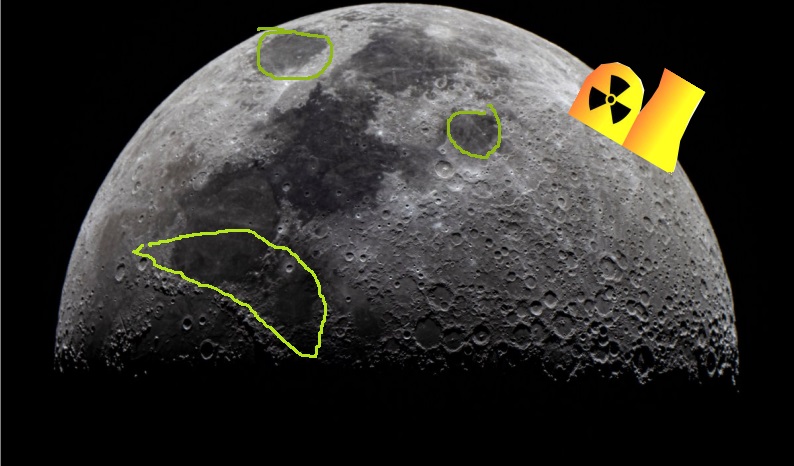
Russia is reportedly planning to establish a nuclear power plant on the moon within the next decade.
This ambitious project aims to supply energy for its lunar space programme and a joint research station with China, as global powers intensify their efforts in lunar exploration.
Historically, Russia has held a prominent position in space, notably with Yuri Gagarin’s pioneering journey in 1961.
However, its dominance has waned in recent decades, with the nation now trailing behind the United States and, increasingly, China.
The country’s lunar aspirations faced a significant setback in August 2023 when its uncrewed Luna-25 mission crashed during a landing attempt.
Furthermore, the landscape of space launches, once a Russian speciality, has been revolutionised by figures such as Elon Musk, adding to the competitive pressure.
Russia’s state space corporation, Roscosmos, said in a statement that it planned to build a lunar power plant by 2036 and signed a contract with the Lavochkin Association aerospace company to do it.
Roscosmos said the purpose of the plant was to power Russia’s lunar programme, including rovers, an observatory and the infrastructure of the joint Russian-Chinese International Lunar Research Station.
“The project is an important step towards the creation of a permanently functioning scientific lunar station and the transition from one-time missions to a long-term lunar exploration program,” Roscosmos said.
Roscosmos did not say explicitly that the plant would be nuclear but it said the participants included Russian state nuclear corporation Rosatom and the Kurchatov Institute, Russia’s leading nuclear research institute.
The head of Roscosmos, Dmitry Bakanov, said in June that one of the corporation’s aims was to put a nuclear power plant on the moon and to explore Venus, known as Earth’s “sister” planet.
The moon, which is 384,400 km (238,855 miles) from our planet, moderates Earth’s wobble on its axis, which ensures a more stable climate. It also causes tides in the world’s oceans.
It wasn’t Trump’s mind or morality that stopped his Iran attack.
Walt Zlotow West Suburban Peace Coalition, 21 Jan 26
A week ago President Trump was posturing about an imminent attack to overthrow the Iranian regime embroiled in massive protests. His declared motive was to save the Iranian protesters seeking internal regime change who were being slaughtered by the regime.
Then Trump pivoted, declaring since the regime was no longer planning to execute protesters, he wouldn’t attack.
But it wasn’t Iranian government benevolence that persuaded Trump to stand down. The two reasons Trump’s explanation was covering up were reality on the ground and a phone call.
The massive but failed protests were not solely a spontaneous internal revolt. They were fomented and supported by both the US and Israel to complete their long sought dream of regime change to destabilize Iran, Israel’s last hegemonic rival in the region. Israel’s Mossad was definitely on the ground and likely the CIA as well. Trump was cheering on the protests from the sidelines.
Trump was poised to attack to complete the regime change operation when protest success appeared imminent. But Iran’s government quickly and decisively snuffed out the protests, ending Trump’s dream of adding more thousands to his massive, murderous death toll bombing 7 countries in his first year of term two.
Trump also got a call from the real boss of US Middle East policy….Israel’s Benjamin Netanyahu. He told Trump that with the regime intact, Israel would be decimated by thousands of Iranian missiles once Trump attacked.
Iran’s government may be secure for now but Israeli, US dream of Iranian regime change will never cease.
Trump lied to the New York Times when he said the only thing that can stop him from foreign intervention is “my own mind, my own morality.” What stopped Trump from attacking Iran again, as he did in June, is what stopped him then… failure on the ground and a call from the guy giving Trump his orders on Middle East foreign policy.
1 This Month

of the week – Shut Down Drone Warfare!


Tell the Ukrainian Government to Drop Prosecution of Peace Activist Yurii Sheliazhenko

Petition to revoke the licensing of the Near Surface Nuclear Disposal Facility (NSDF) at Chalk River. https://www.ourcommons.ca/petitions/en/Petition/Details?Petition=e-7247
To see nuclear-related stories in greater depth and intensity – go to https://nuclearinformation.wordpress.com
-
Archives
- April 2026 (107)
- March 2026 (251)
- February 2026 (268)
- January 2026 (308)
- December 2025 (358)
- November 2025 (359)
- October 2025 (376)
- September 2025 (257)
- August 2025 (319)
- July 2025 (230)
- June 2025 (348)
- May 2025 (261)
-
Categories
- 1
- 1 NUCLEAR ISSUES
- business and costs
- climate change
- culture and arts
- ENERGY
- environment
- health
- history
- indigenous issues
- Legal
- marketing of nuclear
- media
- opposition to nuclear
- PERSONAL STORIES
- politics
- politics international
- Religion and ethics
- safety
- secrets,lies and civil liberties
- spinbuster
- technology
- Uranium
- wastes
- weapons and war
- Women
- 2 WORLD
- ACTION
- AFRICA
- Atrocities
- AUSTRALIA
- Christina's notes
- Christina's themes
- culture and arts
- Events
- Fuk 2022
- Fuk 2023
- Fukushima 2017
- Fukushima 2018
- fukushima 2019
- Fukushima 2020
- Fukushima 2021
- general
- global warming
- Humour (God we need it)
- Nuclear
- RARE EARTHS
- Reference
- resources – print
- Resources -audiovicual
- Weekly Newsletter
- World
- World Nuclear
- YouTube
-
RSS
Entries RSS
Comments RSS
 nuclear-news