The Risky Movement to Make America Nuclear Again

As the licensing team dug in, Oklo couldn’t provide the supporting analysis for many of its basic safety assumptions
As the licensing team dug in, Oklo couldn’t provide the supporting analysis for many of its basic safety assumptions
A Silicon Valley startup called Oklo is leading the charge to bring nuclear power back to the US with small reactors. Its backers have wealth and political connections that could undermine nuclear safety.
Bloomberg, By Michael Riley,
When Oklo Inc., a nuclear power startup, applied in 2020 to operate its first reactor, the company rested largely on outsize ambition. Its MIT-educated co-founders, a married couple named Jacob and Caroline DeWitte, lived in a mobile home park in Mountain View, California, in space 38. Oklo, which had only 20 full-time employees, wanted to build small reactors across the country, transforming the way towns and industries are powered. To realize that dream, it needed the US Nuclear Regulatory Commission to say the company’s design was safe.
Two years later, Oklo had failed to pass even the first step of the approval process. In 2022, after months of frustrating back and forth, the NRC concluded that the company didn’t provide verifiable answers to the most basic safety questions. The regulator denied the application. A former senior agency official, who spoke on the condition of anonymity, says Oklo “is probably the worst applicant the NRC has ever had.”
For Jake DeWitte, the denial was maddening. He still grows visibly agitated when recounting the moment. “They completely screwed up,” he says. By the end, Caroline says, the agency “became kind of malicious, frankly.”
In 2025, Oklo’s reactor design is still unlicensed. But, in a sign of how radically the safety landscape has changed for nuclear power, the company’s business promise seems bright. Oklo went public last year and now has a market value hovering around $20 billion. In May, Jake was in the White House when President Donald Trump signed four executive orders designed to herald a nuclear renaissance. “It’s a brilliant industry,” Trump said, DeWitte at his side.
The startup’s backers long had a Plan B: If Oklo couldn’t win approval from the agency charged with protecting the public from nuclear accidents, they would, essentially, go after the regulator, in much the way Uber Technologies Inc. and other Silicon Valley startups have obliterated regulatory roadblocks. One of the architects of Oklo’s attack-the-regulator strategy is a law professor-turned-venture capitalist with ties to the Koch empire. He says the public shouldn’t be worried.
The revival of nuclear power in the US has been predicted countless times since President Dwight D. Eisenhower’s Atoms for Peace program rose from the ashes of Hiroshima and Nagasaki. This version, though, is something never before seen. Rather than huge power stations built by engineering companies for giant utilities, a new breed of nuclear startup wants to commercialize reactors, some so small they could be carried on semitrucks, so mighty they could power the hungriest of artificial intelligence data centers. Not one of these so-called advanced reactors has yet to be built in the US, but their promise has touched off a dealmaking frenzy, with backing from tech giants including Amazon.com, Google, Meta Platforms and Microsoft. The US Department of Energy has announced a goal of having at least three of these reactors switched on by July 4 of next year.
Oklo’s power and influence in the MAGA era have let it seize the political moment
Oklo isn’t the most obvious company of the two dozen or so newcomers to have broken through as a front-runner. Bill Gates’ TerraPower LLC has been trying to develop an advanced reactor for almost two decades. Kairos Power LLC, backed by Google, has made quick progress through the government’s licensing process.
But Oklo’s power and influence in the MAGA era have let it seize the political moment. The company is backed by some of Silicon Valley’s most important leaders, including Sam Altman, co-founder of OpenAI. A former board member is now Trump’s secretary of energy. Critically, Oklo has capitalized on the deregulatory fever gripping Washington. The NRC, which became a target of Trump’s Department of Government Efficiency, or DOGE, has lost at least 195 staff since January, and efforts to strip the agency of key powers are underway.
For a half-century, the NRC has been the watchdog of an industry built on some of the most dangerous technologies ever known. Yet Oklo and its backers say that its reactors will be so small and safe, little NRC oversight is needed.
Even a year ago, this proposition would have been absurd. Experts say advanced reactors are indeed safer in some respects: Because they’re a third or less the size of traditional reactors and aren’t cooled by water circulating under immense pressure, a serious accident is less likely to spread radioactive debris across a major populace. But for anyone nearby—workers operating the plant, say, or soldiers on a military base powered by one—the dangers could be substantial.
“All these nuke bros who know nothing about operating a reactor, they just want a free pass,” says Allison Macfarlane, former chairman of the NRC. “They can have their free pass, but then they will have an accident.”…………………………………………………………………………………………………………………………………………………………………………….
Transatomic’s collapse left venture capital’s tech titans looking for a new standard bearer in their drive to disrupt nuclear power.
In January 2018, some of the country’s richest and most powerful descended on the desert resort town of Indian Wells, California, for three days of hobnobbing over canapés and golf. They had come for the annual donor retreat established by the chemicals-and-refining billionaires Charles and David Koch; before the weekend was out, they had pledged to spend more than $400 million to support the Kochs’ political influence operation, which counted governors, senators and state legislative leaders as foot soldiers.
Among those attending was a law professor-turned-venture capitalist named Salen Churi. Co-founder of a new Koch-backed VC firm called Trust Ventures, Churi explained the firm’s novel strategy as he worked the target-rich room for potential investors: identify startups facing steep regulatory challenges; solve them through litigation, advocacy and political influence; and then watch the profits roll in.
“Imagine a startup able to tap into the know-how of Koch from Day 1,” Churi said, according to news coverage of his presentation. The company’s first big investment, in mid-2018, was in Oklo. (Another investor in 2018 was Rothrock; he invested in Oklo around the same time that Transatomic folded.)……………………………………………..
…………………………………………………….. Eighty feet high and fashioned from 1-inch-thick steel plating, the shiny silver dome of the Experimental Breeder Reactor-II rises from the eastern Idaho sagebrush like a lost artifact of the Atomic Age. At one point, 52 test reactors of various types operated on this stretch of high desert. It’s the home of the Idaho National Laboratory, formerly known as Argonne-West, where nuclear power was born.
Nowadays, scientists, government officials, tourists and others have turned this site into a pilgrimage. (The filmmaker Oliver Stone paid a visit not long ago.) Some of them come to see or learn from the Experimental Breeder Reactor-II, or EBR-II, a sodium fast reactor that is considered by many to be the lab’s most successful attempt to revolutionize the way nuclear energy is created.
There’s a renewed belief that this long-forgotten technology—EBR-II was built six decades ago and decommissioned in the mid-1990s—holds the keys to a safer, more efficient nuclear industry. Adherents argue that the technology, unlike other reactors, is “passively safe”—so safe that in even some of the worst accident scenarios, a sodium fast reactor would shut down without human intervention.
Not far from the massive silver dome is a patch of government land where the DeWittes have staked their future. Little more than a sign and a couple of porta potties stashed amid the juniper bushes, this is where the two are planning to build Oklo’s reactor, Aurora, which they’ve described as a more modern version of the EBR-II. They have vowed that their reactor will share the same inherent safety characteristics.
Edwin Lyman, a physicist and director of nuclear power safety with the Union of Concerned Scientists, says the assumption that reactors like EBR-II are “passively safe” is misguided. “It’s gaslighting,” he says. Sodium fast reactors are notoriously difficult to operate, which accounts for the technology’s long history of accidents and meltdowns. Sodium leaks can create fires that spray a toxic sodium-oxide aerosol into the air. If the coolant comes into contact with water, hydrogen explosions can result in both the reactor itself and the power generation plant. And compared with light-water reactors, fast reactors leak neutrons that need extensive shielding to make them safe. “If something goes wrong, the potential for a Chernobyl-like escalating event is actually much higher than it is with light-water reactors,” Lyman says.
When Oklo submitted its first application to the NRC in 2020, the agency was under pressure from Congress and the industry to show it could license new reactors more efficiently. The agency’s licensing team was eager to begin what it called a Phase 1 review—essentially checking that the application is complete enough to move to a more rigorous scientific and safety evaluation. With an experienced company, Phase 1 usually takes about two months. “We thought we could get Oklo to that point in about six months,” says a former agency official familiar with the company’s application, who asked for anonymity to talk openly about the company’s application.
Major sticking points soon emerged. The company declared that, based on its extensive calculations, Aurora was one of the safest nuclear reactors in the world and there was no plausible accident that would result in a release of radiation into the environment. Yet the NRC staff identified important scenarios that Oklo didn’t appear to consider: What if undulating pipes from a sudden leak wrecked key systems? What if the seals of the reactor capsule failed, creating a pathway for radiation to reach the outside? The regulators also asked about the risk of flooding inside the reactor capsule, which the NRC said “may represent a potential criticality issue.” Nuclear experts say that’s a technical way of saying that the agency was worried about the possibility of an uncontrolled fission uncontrolled fission event, which could result in a dangerous steam explosion inside the reactor vessel.
As the licensing team dug in, Oklo couldn’t provide the supporting analysis for many of its basic safety assumptions, according to four officials who spoke to Businessweek about the application, as well as public NRC documents. In some cases, supporting files the company claimed to have were not available when the NRC tried to examine them, one official says.
“We needed the evidence that this reactor could be built and operated safely, and it just wasn’t forthcoming,” says one of the four officials.
Finally, in January 2022, the NRC denied Oklo’s application. By that point, the company had raised more than $25 million, and its dream of mass producing small nuclear reactors had seemed in reach. But at the NRC, the company never made it beyond Phase 1.
In a flashy video posted on YouTube last year, the DeWittes, clad in jeans, stroll across the high prairie near the Idaho National Laboratory. They’re introduced by a narrator whose tone mixes soothing and serious. “Meet the husband-and-wife engineering duo that discovered a game-changing technology buried in a government lab in Idaho,” the narrator says.
The six-and-a-half-minute video was published on the YouTube channel of a Utah-based organization called the Abundance Institute, identified on its website as “a mission-driven nonprofit focused on creating a space for emerging technologies.” In contrast to other pro-nuclear outfits including Third Way and the Breakthrough Institute, the Abundance Institute has been ferocious in its criticism of the NRC. In January its CEO penned an op-ed in the Wall Street Journal that labeled the regulator “lawless,” then followed up with social media posts declaring that it was time to abolish the agency.
What the videos and op-eds don’t disclose is that the Abundance Institute is Churi’s brainchild. He’s a co-founder and is listed as the institute’s treasurer in papers filed with the Utah secretary of state’s office. The same papers list, as an institute director, Derek Johnson. He’s a central player on the Kochs’ national political team and executive vice president at the Kochs’ umbrella group, Stand Together, which also published the Oklo video……………….
“The people who get one-cent electricity from nuclear don’t exist yet because we can’t give it to them yet,” Churi says. “We wanted to be the lobbyist for companies that don’t exist yet and for consumers who haven’t gotten the benefit of those technologies yet.”
The institute is so intertwined with the Koch family’s famed influence network that it’s hard to distinguish between the two. Many of its key employees, including the CEO, come from the Center for Growth and Opportunity at Utah State University, sometimes called “Koch U of the West,” a reference to a similar Koch-funded outfit at George Mason University in Virginia. Churi listed CGO’s offices as his address in papers that the Abundance Institute filed with the state. (Christopher Koopman, the institute’s CEO, called that a “clerical error.”)
Emails and other documents obtained through public records requests show that the Abundance Institute effectively serves as a front for Churi’s attack-the-regulator mission. As his team dissected federal regulations, Churi spotted language that might offer an opening. In 1956 the Atomic Energy Commission determined that because any apparatus designed to carry out a nuclear fission chain reaction can affect the health and safety of the public, it needs a federal license. Nuclear startups could argue that their reactors are so small and safe that they don’t present any risk to the public—and therefore fall outside federal jurisdiction. It was a long-shot position on the science, but the right court might just buy it. Churi and the team went to work.
They began looking for a nuclear startup willing to be the public face of the challenge. And, because a major goal of the lawsuit was to shift oversight of small nuclear reactors from the NRC to the states, they recruited state attorneys general as lead plaintiffs.
For the first, they linked up with Bret Kugelmass, founder and CEO of Last Energy Inc., which boasts a reactor design using off-the-shelf components. Kugelmass has little to no experience in nuclear engineering—his last company used drones to map farmland—but he has a popular energy podcast and is close to the MAGA movement. One Oklo investor called him “like Elon in his take-no-prisoners approach to getting stuff done.”
For the second, Churi and the Abundance Institute targeted officials in Texas and Utah, two states where Churi spends much of his time and knows, he says, “a lot of folks who work in both politics and the AG offices.” In Utah, the Abundance Institute served as a conduit to those officials, leveraging the Koch family’s political clout as well.
According to emails obtained by Businessweek through a public records request, Utah Senate President J. Stuart Adams and an aide met with Abundance Institute staff in the fall of 2024. Afterward, the aide wrote Utah Chief Deputy Attorney General Dan Burton, saying the institute was “gathering clients for a nationwide lawsuit against the NRC.” Then he added, “We think it would be worth you/the AG’s time to explore their proposal and determine whether it makes sense for Utah to join.”…………………………………………………..
As the team prepared to file its federal lawsuit, a second and potentially more direct path to gutting the NRC opened up. The country had just voted to send Donald Trump back to the White House.
In February 2023, Jake DeWitte flew spur of the moment to Denver in hopes of buying a Kia Telluride he’d found online. His trip changed the future of the company.
Denver happened to be the home base for Chris Wright, founder and CEO of the second-largest fracking company in North America, Liberty Energy Inc. …………………………….
The timing was propitious, and not only for Oklo. The buy-in—structured as a $10 million strategic investment by Liberty—was finalized just weeks before an announcement in June that one of Altman’s companies, a special purpose acquisition company (SPAC), would take Oklo public. Jake says Oklo extended its last VC round to allow Liberty to get in under the wire, making Liberty one of the last early investors before Oklo began trading on the New York Stock Exchange the following year, with an initial valuation of $850 million……………………………………………..
In his first departmental directive, issued in early February, Wright declared that “the long-awaited American nuclear renaissance must launch during President Trump’s administration.” The directive said that the Energy Department would work to enable the “rapid deployment” of next-generation nuclear technology.
Meanwhile, Trump began a slash-and-burn campaign to hollow out federal regulators, including nominally independent agencies such as the Securities and Exchange Commission and the National Labor Relations Board. By April, drafts of four executive orders targeting the regulation of nuclear energy began circulating…………………………………………………………………..
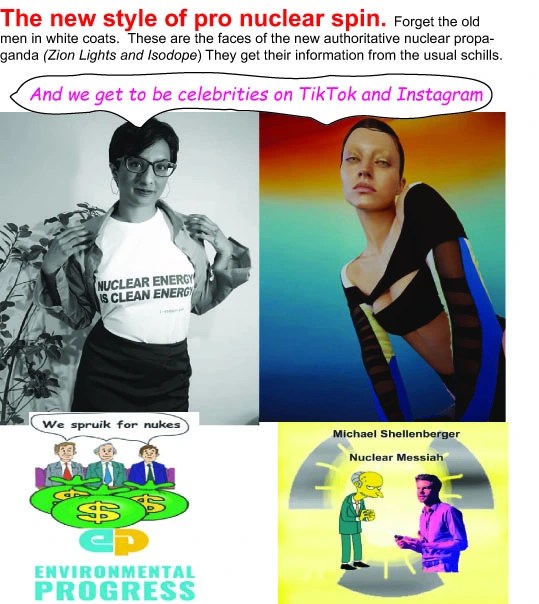
One person who did get input on the orders, by her own account, was Isabelle Boemeke, a Brazilian model and self-described nuclear energy influencer who goes by the moniker Isodope. Author of a book on nuclear power titled Rad Future, Boemeke is famous for mobilizing her social media followers in a successful drive to keep the Diablo Canyon nuclear power plant north of Los Angeles operating beyond its scheduled retirement. She’s also the spouse of Joe Gebbia, one of the founders of Airbnb and a prominent DOGE figure………………………………………….
……………………………………….. The federal lawsuit against the NRC was filed in December, with Texas and Utah as lead plaintiffs. By March the NRC had responded with a strongly worded motion asking the court to dismiss the lawsuit.
Behind the scenes, something very different was happening. At the end of April, the plaintiffs’ lead lawyer, a partner at the boutique firm Boyden Gray named Michael Buschbacher, emailed his colleagues with good news. The NRC was ready to discuss a settlement and potentially agree to the plaintiffs’ biggest demand: the initiation of a rule-making process with the goal of exempting some small nuclear reactors from traditional NRC oversight and handing it to state agencies instead.
Meanwhile, the startups have another pathway to get their reactors to market quickly. In August, the Department of Energy announced a pilot program with the goal of deploying at least three untested reactors by next July 4, to coincide with the 250th anniversary of the signing of the Declaration of Independence. Oklo plans to license its first Aurora reactor through this program, the company says, although its reactor won’t be ready by then.
The company says it still plans to license future reactors via the NRC, but it will benefit from a radically changed agency. The executive orders signed in May push the agency to approve new reactor licenses within 18 months and to further expedite approval for any power plants already OK’d by the Defense Department or the Energy Department, two entities that have never licensed a commercial reactor. The NRC’s Advisory Committee on Reactor Safeguards, a panel of experts who weigh in on safety issues posed by new designs, had its remit pared back to the “minimum necessary” required by law.
………………………..both the NRC’s general counsel and its executive director of operations were pushed out, two people familiar with those moves said. Trump fired one commissioner in mid-June, and a second resigned a few weeks later.
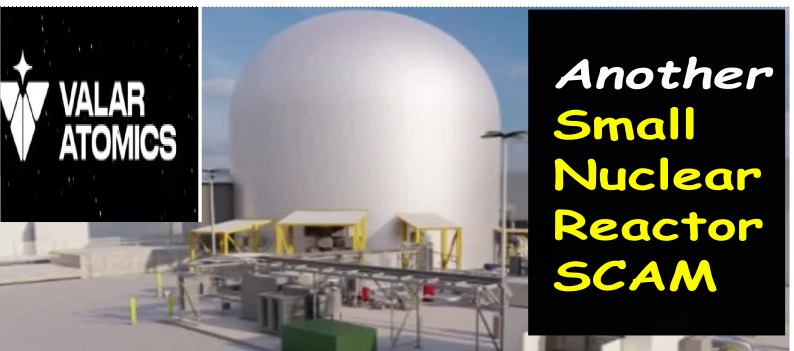
………………………………………… At a recent meeting with NRC employees, DOGE representatives handed out black ballcaps emblazoned with “Make Nuclear Great Again” alongside the logo for another nuclear startup, Valar Atomics, according to a former agency official familiar with the meeting……………………………………………………………………………
By this summer, it was clear that Churi and his team had won, and not only for Oklo. Their efforts have created an opening that other nuclear startups—and their Silicon Valley backers—can now draft behind. One of those companies, Deep Fission, plans to operate small nuclear reactors a mile underground, a concept that’s never been tried anywhere. Valar Atomics, which joined the lawsuit against the NRC in April, claims on its website that you can safely hold spent nuclear fuel from its reactor for five minutes in the palm of your hand—something that nuclear experts say would quickly kill anyone who tries it. Both companies were also recently chosen for the Energy Department’s new accelerated licensing program………………….. https://www.bloomberg.com/news/features/2025-10-30/silicon-valley-s-risky-plan-to-revive-nuclear-power-in-america?embedded-checkout=true
2 Comments »
Leave a reply to Jerry Alatalo Cancel reply
1 This Month
23 April – WEBINAR – Why new nuclear reactors are the wrong tools for decarbonization Thursday, April 23 • 1 AM – 2 AM AEST
World Nuclear Power. Reactors 1951-2026, 75 Years of Nuclear Power.
Interactive Map– https://dv.worldnuclearreport.org/
Chernobyl: The Lost Tapes – A good documentary on Chernobyl on SBS available On Demand for the next 3 weeks– https://www.sbs.com.au/ondemand/tv-program/chernobyl-the-lost-tapes/2352741955560

of the week–London Campaign for Nuclear Disarmament

Tell the Ukrainian Government to Drop Prosecution of Peace Activist Yurii Sheliazhenko
To see nuclear-related stories in greater depth and intensity – go to https://nuclearinformation.wordpress.com
-
Archives
- April 2026 (231)
- March 2026 (251)
- February 2026 (268)
- January 2026 (308)
- December 2025 (358)
- November 2025 (359)
- October 2025 (376)
- September 2025 (257)
- August 2025 (319)
- July 2025 (230)
- June 2025 (348)
- May 2025 (261)
-
Categories
- 1
- 1 NUCLEAR ISSUES
- business and costs
- climate change
- culture and arts
- ENERGY
- environment
- health
- history
- indigenous issues
- Legal
- marketing of nuclear
- media
- opposition to nuclear
- PERSONAL STORIES
- politics
- politics international
- Religion and ethics
- safety
- secrets,lies and civil liberties
- spinbuster
- technology
- Uranium
- wastes
- weapons and war
- Women
- 2 WORLD
- ACTION
- AFRICA
- Atrocities
- AUSTRALIA
- Christina's notes
- Christina's themes
- culture and arts
- Events
- Fuk 2022
- Fuk 2023
- Fukushima 2017
- Fukushima 2018
- fukushima 2019
- Fukushima 2020
- Fukushima 2021
- general
- global warming
- Humour (God we need it)
- Nuclear
- RARE EARTHS
- Reference
- resources – print
- Resources -audiovicual
- Weekly Newsletter
- World
- World Nuclear
- YouTube
-
RSS
Entries RSS
Comments RSS
 nuclear-news
The article’s author misses the most important reason for Trump’s push on nuclear energy: Powering massive data centers necessary for establishing the Fascist technocracy-transhumanist dictatorship.
Elizabeth Theranos on steroids multiplied be a factor of extreme greed and ignorance! A pure play deadly combination!!!