Government allocates £154m for plutonium disposal.

Jason Arunn Murugesu, BBC News, North East and Cumbria, 28 Aug 25, https://www.bbc.com/news/articles/czjmzdj7l7wo
More than £150m will be spent by the government to investigate how best to dispose of the 140 tonnes of radioactive plutonium it currently stores at a nuclear plant.
Sellafield in Cumbria holds the world’s largest stockpile of the hazardous material.
Earlier this year, the government announced the material would not be reused and instead would be made ready for permanent disposal deep underground and put “beyond reach”.
The Department for Energy Security and Net Zero (DESNZ) said the money would be used to “test and prove” two technologies currently being explored to “immobilise” the highly radioactive material.
Plutonium has been kept at Sellafield for decades and successive governments have kept it to leave open the option to recycle it into new nuclear fuel.
Storing it in its current form is expensive and difficult as it frequently needs to be repackaged because radiation damages storage containers.
In January the government said the safest, most economically viable solution was to “immobilise” its entire plutonium stockpile.
DESNZ said it would spend £154m over five years to allow the Nuclear Decommissioning Authority to build specialist lab facilities at Sellafield which would be used to test two emerging immobilisation technologies – Disposal Mox and Hot Isostatic Pressing.
Dr Lewis Blackburn from the University of Sheffield said the two methods involved converting the plutonium into a “mechanically and chemically stable ceramic material” which could then be disposed of.
Mid Copeland and South Copeland in Cumbria are the only two sites in the UK currently being considered by the government to host a nuclear waste disposal site.
It follows a possible site in Lincolnshire earmarked by the government body Nuclear Waste Services pulling out in June.
OUR NUCLEAR WORLD: PICK YOUR TARGET
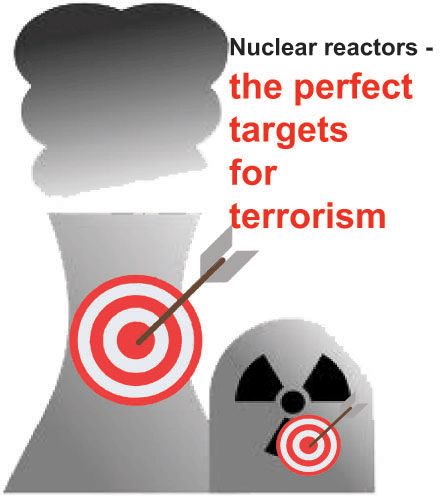
Why use your own nuclear weapons (with all the risks of escalation that this entails) when you can just take out your enemy’s nuclear power stations or nuclear waste facilities?
Jonathon Porritt 27th Aug 2025
I’ve reluctantly come to the conclusion that the only way the nuclear industry’s hype-machine is going to be stopped in its tracks is a Russian cyber-attack on the nine nuclear reactors still operating here in the UK, causing them all to close down and leading to the grid temporarily collapsing. That should do it.
I jest – sort of. But nothing else has worked. In just the last few weeks:
1 The Treasury’s financial modelling for the new power station at Sizewell C (seen by the Financial Times) gives a range of roughly £80 billion to £100 billion, far higher than the official estimate of £47 billion from the Department of Net Zero and Energy Security – which in itself was already nearly double the original cost of £20 billion!
2 The Treasury recently described the Government’s proposals for a new Geological Disposal Facility to deal with the 700,000 cubic metres of spent nuclear fuel as ‘unachievable’. This is a truly extraordinary development – confirming that the UK still has NO idea what to do about its legacy nuclear waste, let alone the waste that will be produced by any new reactors. Yet this got hardly a mention in the media.
3 The Government confirmed that it will be splurging a further £17 billion of taxpayers’ money between now and 2030 on Sizewell C, Small Modular Reactors and fusion energy – even as it continues to ignore the scourge of chronic poverty here in the UK, with 4.5 million children living in poverty – the highest number ever recorded.
On top of which, the industry’s hype-machine is now being turbocharged by the even more powerful hype-machine of AI. Never forget that the nuclear industry is supremely well-equipped to leap onto any and every boondoggle coming down the track – the Bitcoin/Crypto boom a decade ago (which never quite happened), and then green hydrogen. With every hard-to-abate sector queueing up for its share of vanishingly small volumes of green hydrogen, the Knights of Nuclear were up into their saddles just as fast as enough hobby horses could be corralled together to claim that it is only nuclear power that can provide the electricity required.
And now it’s AI. We’ve all read the growth projections for AI-enabled markets – from billions of dollars today to trillions tomorrow. I won’t weary you with the extrapolated increases in electricity consumption for all the new data centres that this entails – but it’s going to be a lot. On a par with the electricity consumption of small countries. New data centres are being built right now, ever bigger, already gobbling up more and more electricity. Nor will I invite you to ask why this AI boom must not – ever, on any terms – be subjected to much deeper scrutiny as to the balance of costs and benefits that will emerge. AI represents the apogee of latter-day technological determinism: if it can be done, then it must and will be done. So suck it up.
I’m not making light of this. The AI-driven nuclear boom in the USA is for real. Donald Trump is getting rid of most regulatory oversight of the nuclear industry, to speed things up, and stock prices of all the publicly traded nuclear companies are up by huge percentages. And it doesn’t seem to matter what kind of nuclear we’re talking about: 40-year-old decommissioned reactors to be given a new lease of life; plans for new big reactors, even in blue states like New York, being fast-tracked; Big Tech applying for construction permits for Small Modular Reactors that are still on the drawing board; and more than $500 billion apparently raised for new fusion reactors – seriously!
It’s not (yet) quite so insane here in the UK, but the signals are worrying. Strenuous efforts are being made by Ministers to force the Office for Nuclear Regulation to fast track any old nuclear proposal. Sweetheart deals with the private sector are being sorted out – regardless of the costs to taxpayers. Rational, evidence-based decision-making is a long-gone memory.
What exactly lies behind this mania? In the timeless words of Sherlock Holmes: ”once you have eliminated the impossible, whatever remains, no matter how improbable, must be the truth”.
So, let’s try that out for size in the context of nuclear power. It would surely be completely impossible for any responsible government pursuing a Net Zero energy strategy to prioritise nuclear power over all other options, given that:
- Large-scale nuclear reactors are now by far the most expensive option (on a Levelised Cost of Energy basis). UK Government figures in July this year showed new nuclear at £109 per MWh, offshore wind at £44MWh, large-scale solar at £41MWh and onshore wind at £38MWh.
- Small Modular Reactors (SMRs) don’t yet exist, but all experts agree their electricity will be even more expensive than that of large reactors – precisely because they can’t achieve the same economies of scale.
- The contribution of both big and small new reactors to a Net Zero electricity system in the UK will be literally ZERO before 2035 at the very earliest.
- Both big and small reactors will continue to produce significant levels of nuclear waste, adding to a waste crisis to which (as already mentioned) we have no long-term solution.
- ALL nuclear facilities pose a significant security risk, both from the point of view of cybersecurity (more later) and the very real possibility of physical attacks through ‘hostile third parties’.
Which brings us to the extraordinarily improbable truth of it: these days, nuclear power has little to do with electricity generation, and a whole lot more to do with the maintenance of the UK’s nuclear weapons capability……………………………………………………………………
It took a while for the UK Government to catch up, but in its latest Nuclear Roadmap it no longer beats around the bush. There are multiple references to the synergies between nuclear power and nuclear weapons: “this Government will proactively look for opportunities to align delivery of the civil and nuclear defence enterprises….it acknowledges the crucial importance of the nuclear industry to our national security, both in terms of energy supply and the defence nuclear enterprise”, and so on.
Big corporations are loving the fact that this is now out in the open. Bechtel, Babcock and Wilcox, AECOM, Rolls Royce – they’ve all spent decades feeding at the trough of either overt or hidden cross-subsidies between nuclear power and nuclear weapons. Rolls-Royce has been one of the most outspoken advocates for Small Modular Reactors, arguing their importance back in 2017 “to relieve the Ministry of Defence of the burden of retaining the skills and capability”………………………………………………………………….
As nuclear nations double down on nuclear power, it’s blindingly obvious that they are ramping up serious threats to national security. Nowhere is this clearer than with the drive to develop SMRs. Most designs currently on the drawing board (that are not light water reactors) will be using as their fuel high-assay, low-enriched uranium – or HALEU, to use the jargon. When it’s first extracted from the earth, uranium concentrations are usually around 1% of the total volume of the ore. HALEU fuel has to be enriched up to around 19% – just below the 20% threshold for the kind of highly-enriched uranium judged to be viable for the manufacture of nuclear bombs. And almost all HALEU fuel comes from Russia!
Beyond that, every nuclear facility (old and new) becomes a target for hostile third parties. Welcome back to the inconceivably scary world of nuclear cyberwarfare. Despite the highest grade of propaganda promoted by the Ministry of Defence – that all nuclear facilities are ‘bomb-proof’ (I kid you not!) – most cyber-experts grudgingly acknowledge that this is just bullshit when it comes to cyber-defence.
And we have no finer example of that than Sellafield, one of the most hazardous nuclear waste and decommissioning sites in the world, sprawling across 2 square miles on the Cumbrian coast. Back in December 2023, a Guardian exclusive revealed that Sellafield had been hacked into ‘by cyber groups closely linked to Russia and China’ since 2015 – despite years of cover-ups by senior staff. “The full extent of any data loss and any continuing risks to systems was made harder to quantify by Sellafield’s failure to alert nuclear regulators for several years”. The denials didn’t last long. The Guardian’s painstaking research over 18 months had got Sellafield bang to rights. In October 2024, it was fined £400,000 by the Office For Nuclear Regulation after it pleaded guilty to criminal charges over years of cyber-security breaches. Astonishingly, the ONR also found that 75% of its computer servers were vulnerable to cyber-attack.
…………………..Why use your own nuclear weapons (with all the risks of escalation that this entails) when you can just take out your enemy’s nuclear power stations or nuclear waste facilities?
…………………… https://jonathonporritt.com/uk-nuclear-policy-risks/
Ecological Justice group explains impacts of the nuclear project on Alberta

Except from our Ecological Justice group:
The Project Affects Alberta
The Guidelines do not address the scope of impacts to the province.
This nuclear project proposed for Peace River has ramifications for the future of Alberta in that it would lock the province into
● the financial burden of this very expensive energy option with on-going post-operative costs
● the diversion of money and other resources from cleaner, safer, cheaper energy options and grid modernization to rapidly support climate action
● the on-site security risks
● the risk of nuclear reactors as stranded assets
● the risk of the nuclear reactors being diverted to military use
● the long-term storage of low and intermediate radioactive wastes
● the radiologic impacts on life and the environment not only locally but far-reaching should a severe event occur
● the issue of nuclear fuel waste for which no method of containment is known that will isolate it for the timeframe of its inherent risk of chemical and radiological toxicity:
○ Alberta may be required to host a nuclear fuel waste deep geological disposal site with the timeframe of “indefinitely” or
○ Alberta and other provinces may suffer the transportation-related consequences of moving Alberta’s nuclear fuel waste to an out-of-province disposal site
Require the proponent to address the scope of impacts to the province.
Entire UN Security Council Except US Says Gaza Famine ‘Man-Made’ as 10 More People Starve to Death
While acknowledging that “hunger is a real issue in Gaza,” the US ambassador to the UN repeated a debunked claim that the world’s leading authority on starvation lowered its standards to declare a famine.
Brett Wilkins, Common Dreams, Aug 27, 2025
Every member nation of the United Nations Security Council except the United States on Wednesday affirmed that Israel’s engineered famine in Gaza is “man-made” as 10 more Palestinians died of starvation amid what UN experts warned is a worsening crisis.
Fourteen of the 15 Security Council members issued a joint statement calling for an immediate Gaza ceasefire, release of all remaining hostages held by Hamas, and lifting of all Israeli restrictions on aid delivery into the embattled strip, where hundreds of Palestinians have died from starvation and hundreds of thousands more are starving.
“Famine in Gaza must be stopped immediately,” they said. “Time is of the essence. The humanitarian emergency must be addressed without delay and Israel must reverse course.”
“Famine in Gaza must be stopped immediately,” they said. “Time is of the essence. The humanitarian emergency must be addressed without delay and Israel must reverse course.”
“This is a man-made crisis,” the statement stresses. “The use of starvation as a weapon of war is clearly prohibited under international humanitarian law.”
Israel, which is facing a genocide case at the UN’s International Court of Justice, denies the existence of famine in Gaza. Israeli Prime Minister Benjamin Netanyahu and former Defense Minister Yoav Gallant are wanted by the International Court of Justice for alleged war crimes and crimes against humanity, including murder and forced starvation.
The 14 countries issuing the joint statement are: Algeria, China, Denmark, France, Greece, Guyana, Pakistan, Panama, the Republic of Korea, the Russian Federation, Sierra Leone, Slovenia, Somalia, and the United Kingdom.
While acknowledging that “hunger is a real issue in Gaza and that there are significant humanitarian needs which must be met,” US Ambassador to the UN Dorothy Shea rejected the resolution and the IPC’s findings…………………………………………………………………………………………….. https://www.commondreams.org/news/un-security-council-gaza-famine
Japan exploring whether AI could help inspect its nuclear power plants.
Japan’s Nuclear Regulation Authority has requested extra funds to
experiment with AI-powered nuclear plant inspectors. Japanese media report
that the authority wants to explore AI inspection because many nuclear
plants operated by Japanese energy companies are already old and will
likely need more oversight as they continue operating. Decommissioning
those plants will also create a need for extra supervision. The regulator
reportedly said it doesn’t have sufficient staff to handle the
inspections needed for extended operations and decommissioning of old
plants.
The Register 28th Aug 2025, https://www.theregister.com/2025/08/28/japan_ai_for_nuclear_inspectiona/
Podcast | The 30-year journey to an underground facility for long-term nuclear waste storage
This month’s podcast discusses the UK’s long-term plan for a vast
underground storage facility for nuclear waste – known as a geological
disposal facility (GDF) – with Nuclear Waste Services (NWS).
NWS chief
scientific adviser Neil Hyatt and NWS head of major permissions Malcolm
Orford join host Rob Hakimian to discuss the need for a GDF, especially in
the context of the UK ramping up its nuclear power intentions. They discuss
examples of similar facilities being developed elsewhere in the world and
how the UK’s will compare.
Malcolm and Neil also talk about the long
process to getting to build a GDF, including the extensive dialogue and
collaboration with the communities that could potentially host it, the
in-depth siting process and what NWS is looking for to determine its final
location. Looking even further into the future, the guests tell Rob about
the potential construction and engineering that would be required to
undertake an infrastructure of this scale and when we might see work begin.
New Civil Engineer 28th Aug 2025, https://www.newcivilengineer.com/podcast/podcast-the-30-year-journey-to-an-underground-facility-for-long-term-nuclear-waste-storage-28-08-2025/
How AI and surveillance capitalism are undermining democracy

Bulletin, By Suresh Venkatasubramanian | August 21, 2025
On March 6, 2025, Axios reported that the State Department had launched a new social media surveillance program called “Catch and Revoke.” The intended goal of this program was to use artificial intelligence to assist in reviewing “tens of thousands of student visa holders’ social media footprints” to find “evidence of alleged terrorist sympathies expressed after Hamas’ attack on Israel.”
Whether you find this a horrifying development, an exciting application of AI, a flagrant violation of First Amendment rights, or even just a headscratcher, this incident captures the dynamics of how artificial intelligence, surveillance, and threats to democracy all come together. In a nutshell: AI’s promise of behavior prediction and control fuels a vicious cycle of surveillance which inevitably triggers abuses of power.
Throughout history, humans have always searched for ways to predict (and control) behavior, whether this constituted consulting an oracle, throwing bones, reading tea leaves, or even examining the shape of a person’s face and body to determine personality traits (which seems awfully contemporary if you start diving into the literature on “emotion AI”). As people became more adept at collecting data of various kinds, the field of statistics emerged to aid them in using data for prediction. (One of the amusing facts about AI research is that virtually every debate one encounters about the appropriate use of artificial intelligence in some social setting has parallels in history, often much earlier, which make it clear that efforts to predict and control behavior was never about AI at all.)
The problem with using data to make predictions is that the process can be used as a weapon against society, threatening democratic values. As the lines between private and public data are blurred in modern society, many won’t realize that their private lives are becoming data points used to make decisions about them. …………………………………………………………………………………………………… https://thebulletin.org/2025/08/how-ai-and-surveillance-capitalism-are-undermining-democracy/#post-heading
Radioactive waste burning by nuclear transmutation: CoRWM position paper
The Committee on Radioactive Waste Management (CoRWM) investigates the
feasibility of proposed ‘waste burning’ reactors in the UK. These
technologies are designed to reduce the amount of long-lived radioactive
waste present in spent nuclear fuel. This work is in 2 parts: the first
paper gives a brief background and summarises main considerations for
‘waste burner’ reactors in the UK; the second is a technical report which
discusses the details of waste burning schemes and their implications for
waste management, and presents conclusions and recommendations.
CoRWM 28th Aug 2025, https://www.gov.uk/government/publications/radioactive-waste-burning-by-nuclear-transmutation
The evolution of Volodymyr Zelenskyy and the Israel-Ukraine bond.

Orinoco Tribune By Sarah B. – Aug 20, 2025
Volodymyr Zelenskyy: The Pragmatist Who Normalized the Extreme,
Volodymyr Aleksandrovich Zelenskyy, born in 1978 in Krivoy Rog, is one of the most paradoxical figures to emerge from the war. A Jewish comedian turned wartime leader, he has become an international symbol of “resistance” and Western liberal values. But beneath the cultivated myth lies a far more uncomfortable truth: Zelenskyy is the keystone legitimizer in Ukraine’s normalization of far-right extremism, not in spite of his identity, but because of it.
Raised in a Russian-speaking Jewish family in the industrial city of Krivoy Rog, Zelenskyy experienced firsthand the Soviet-era antisemitism and post-Soviet chaos that shaped a generation. He earned a law degree from the Krivoy Rog Economic Institute in 2000, but chose a career in comedy and satire, eventually founding the Kvartal 95 troupe. His 2015 television show Servant of the People, in which he played a humble schoolteacher who unexpectedly becomes president, catapulted him into national fame.
In 2018, life imitated art. Riding a wave of anti-oligarch sentiment and public fatigue with Petro Poroshenko, Zelenskyy launched his own political party, borrowing the name of his TV show, and won the 2019 presidential election in a landslide, taking over 70% of the vote.
At the time, Zelenskyy appeared ideologically distant from Ukraine’s far-right fringe. His campaign promised peace with Donbass and normalization of relations with Russia. But once in power, his rhetoric softened, his promises evaporated, and the machinery of war began grinding forward with the same paramilitary formations he once distanced himself from now integrated into the state apparatus under his watch.
Zelenskyy’s presidency coincided with the formal mainstreaming of extremist militias like the Azov Regiment, the Tornado Battalion, and Right Sector. Though Azov had been absorbed into Ukraine’s National Guard in 2014, it was under Zelenskyy that it achieved full symbolic legitimacy. In 2023, Azov members were publicly awarded medals despite their use of SS-style insignia, and Zelenskyy referred to them in national speeches as “defenders of freedom.”
Zelenskyy’s defenders argued these moves were necessary under conditions of war. But the symbolic shift was profound: the Jewish president of Ukraine had now become the key validator of openly neo-Nazi formations and, more broadly, of a political culture that increasingly erased the boundaries between patriotism and fascism.
Zelenskyy’s Jewish identity played a central role in shaping his geopolitical posture. Early in his presidency, he gained support from prominent Jewish donors and Western liberal institutions. But it was his alignment with Israeli ideology and strategy that proved most consequential.
In a 2022 interview with Haaretz, Zelenskyy stated that Ukraine’s future should resemble a “big Israel,” a state built on constant mobilization, militarism, and national unity. The comparison wasn’t metaphorical. Zelenskyy repeatedly cited Israel’s compulsory service, hardened identity, and “resilience” as ideals for a wartime Ukraine.
“I think all our people will be our great army. We cannot talk about “Switzerland of the future.” But we will definitely become a “big Israel” with its own face. We will not be surprised that we will have representatives of the Armed Forces or the National Guard in all institutions, supermarkets, cinemas, there will be people with weapons.
— Volodymyr Zelenskyy, April 2022
In practice, this meant close coordination with Israeli and Zionist networks. Zelenskyy has consistently refused to condemn Israel’s military actions in Gaza, including the 2024–2025 bombardments that employed starvation tactics and AI-guided strikes. Instead, he echoed Israeli rhetoric about terrorism and security, drawing direct parallels between Ukraine’s fight against Russia and Israel’s war with Iran and its regional proxies.
Military cooperation followed suit. Israeli-made drones and surveillance systems flowed to Ukraine through third parties. Ukrainian forces supplied intelligence to Israel on Iranian missile tech recovered from Russian stockpiles and downed drones. Zelenskyy hosted Israeli officials, sought Iron Dome defense systems, and oversaw joint data-sharing agreements between Ukraine’s cyber units and Israeli partners.
Zelenskyy’s personal connections only deepen the alignment. His parents have reportedly lived in Israel for years, a fact often omitted in mainstream profiles but acknowledged in Jewish community outlets. In 2020, Zelenskyy visited Yad Vashem and gave a carefully worded speech reframing Ukrainian nationalism as compatible with Holocaust memory. Instead of confronting Ukraine’s role in the Shoah, Zelenskyy emphasized shared trauma and unity, an appeal that resonated with Israeli officials eager for a strategic partner in Eastern Europe.
Zelenskyy’s ties to the Chabad-Lubavitch movement also run deep. Chabad maintains a large presence in Dnepropetrovsk, historically bankrolled by oligarch Igor Kolomoyskiy. Zelenskyy has also attended Chabad-sponsored events and leaned heavily on global Jewish networks to secure diplomatic and military aid.
The Shifting Center
Zelenskyy’s ideological transformation can be summarized in three phases:
· Pre-2019: A secular liberal, anti-corruption satirist with no links to the far-right.
· 2019–2022: A centrist reformer forced into security pragmatism by war.
· 2022–Present: A full convert to the “big Israel” model, integrating far-right forces and prioritizing militarized nationalism over liberal pluralism.
In the end, Volodymyr Zelenskyy may not be a fascist. But he has become the indispensable manager of a system that rehabilitates fascism, at home, abroad, and in the name of something larger. His legacy will not be one of purity or resistance, but of convergence.
An extract from Gaza to Donbass: How Israel and Ukraine Built a Fascist, Transnational War Machine.
Israel’s Killing of Journalists Follows a Pattern of Silencing Palestinian Media That Stretches Back to 1967.

From the first days of the occupation in 1967, Israel has tried to keep a tight grip on media reporting, building a legal and military architecture that aimed to control and censor Palestinian journalism.
The Conversation, August 27, 2025, Maha Nassar, Associate Professor in the School of Middle Eastern and North African Studies, University of Arizona
Five journalists were among the 22 people killed on Aug. 25, 2025, in Israeli strikes on the Nasser Hospital in the Gaza Strip. Following global condemnation, the office of Israeli Prime Minister Benjamin Netanyahu issued a statement saying Israel “values the work of journalists.” But the numbers tell a different story.
Those deaths bring the total number of journalists killed in Gaza in almost two years of war to 192. The Committee to Protect Journalists, which collates that data, accuses Israel of “engaging in the deadliest and most deliberate effort to kill and silence journalists” that the U.S.-based nonprofit has ever seen. “Palestinian journalists are being threatened, directly targeted and murdered by Israeli forces, and are arbitrarily detained and tortured in retaliation for their work,” the committee added.
As a scholar of modern Palestinian history, I see the current killing of reporters, photographers and other media professionals in Gaza as part of a longer history of Israeli attempts to silence Palestinian journalists. This history stretches back to at least 1967, when Israel militarily occupied the Palestinian territories of the West Bank, East Jerusalem and the Gaza Strip following the Six-Day War.
Beyond the humanitarian toll, what makes matters even more drastic now is that, with Israeli restrictions on foreign media entering Gaza, local Palestinian journalists are the only people who can bear witness to the death and destruction taking place – and report it to a wider world. Indeed, nearly all of the nearly 200 journalists killed since Oct. 7, 2023, have been Palestinian.
A decades-long process in the making
From the first days of the occupation in 1967, Israel has tried to keep a tight grip on media reporting, building a legal and military architecture that aimed to control and censor Palestinian journalism.
In August 1967, the army issued Military Order 101, effectively criminalizing “political” assembly and “propagandistic” publications in the occupied territories. …………………………………………………………………………………………………………………………………………………………………………………….
Culture of impunity
Even prior to the deadly Hamas-led attacks on Israel on Oct. 7, 2023, the picture emerging was that of impunity for Israeli forces who killed journalists – by accident or by design. A May 2023 report from the Committee to Protect Journalists concluded that Israel engaged in a “deadly pattern” of lethal force against journalists and failed to hold perpetrators accountable.
Since October 2023, journalists in Gaza have faced even deadlier conditions. Israel continues to ban international news agencies from reporting inside the Gaza Strip. As a result, local Palestinian journalists are often the only ones on the ground.
Aside from the deadly conditions, they contend with Israeli smears against their work and threats against their families.
Palestinian journalists there often run toward bombardments when others run away. As a result, they are sometimes killed in “double-tap” strikes, where Israeli air and drone strikes return to an area that has just been struck, killing rescue workers and the journalists covering them.
All this has led to an unbearable personal toll for those continuing to report from within Gaza. On Oct. 25, 2023, Al Jazeera’s Gaza bureau chief, Wael al-Dahdouh, was reporting live on air when he learned that an Israeli airstrike had killed his wife, two children and grandson. He returned on air the next day.
And the killing has not eased up. On Aug. 10, 2025, Israeli forces killed Anas al-Sharif in Gaza City, another prominent Al Jazeera correspondent who had stayed on the streets through months of bombardment. Five of his fellow journalists were also killed in the same airstrike.
The Aug. 25 strike on Nasser Hospital is just the latest in this deadly pattern.
Among the five journalists killed in that attack were freelancers working for Reuters and The Associated Press – two international media outlets frustrated by Israel’s refusal to allow its journalists into Gaza to document the war.
Despite the danger, global newsrooms have repeatedly urged Israel to open Gaza to independent media, and a coalition of 27 countries recently pressed for access in Gaza.
Israel continues to refuse these requests. As such, Palestinian journalists remain the primary witnesses of Israel’s relentless assault on Gaza. And they are increasingly killed as they do so. The question remains whether the international community will hold Israel to account. https://theconversation.com/israels-killing-of-journalists-follows-a-pattern-of-silencing-palestinian-media-that-stretches-back-to-1967-263891
UK aware of Israel’s ‘terror’ for over 20 years
Declassified files show Britain has long known of Israel’s criminality against Palestinians, as Whitehall has deepened its military, trade and diplomatic support.
MARK CURTIS, 15 August 2025, https://www.declassifieduk.org/uk-aware-of-israels-terror-for-over-20-years/
The parallels are remarkable.
There were “numerous reports that the Israeli authorities have prevented medical and other humanitarian assistance from reaching those in need”.
The Red Cross was saying “that their staff have been threatened at gunpoint, warning shots have been fired at their vehicles and two ICRC [Red Cross] vehicles have been damaged by tanks”.
There were “media reports of people dying for lack of treatment” and on the “humanitarian impact of curfews affecting over 1 million people”.
There were Israeli soldiers indulging in “theft and looting from homes and shops and the vandalism of people’s homes”.
And “many reports of the killing of unarmed Palestinians”.
Sound familiar?
But this is not Gaza in 2025. It was the occupied West Bank in 2002, described in an internal Foreign Office report revealed in the British archives.
‘Defensive shield’
Then as now, Israel claimed to be acting “defensively”.
In April 2002, it launched “Operation Defensive Shield”, a large-scale military intervention in the major cities and surrounding areas of the West Bank.
Ordered by then prime minister Ariel Sharon in response to numerous suicide bombings against Israelis by Palestinian militant groups, including Hamas, the Israeli military killed nearly 500 Palestinians within a month.
An official in the Foreign Office’s Middle East Peace Process Section wrote that the intervention in the West Bank involved a “pattern” of “human rights abuses” by the Israeli military.
Some British officials protested at the nature of those Israeli military operations. Sherard Cowper-Coles, Britain’s ambassador to Israel, privately told Sharon’s foreign policy adviser, Danny Ayalon, that he was “appalled at the military assault on the Palestinian areas”.
“The IDF’s behaviour was worthy more of the Russian army than that of a supposedly civilised country”, he told him. “There was no doubt that individual soldiers were out of control, and committing acts which were outraging international opinion”.
Lord Michael Levy, prime minister Tony Blair’s special envoy to the Middle East, was just as blunt. He told Israeli defence minister Binyamin Ben-Eliezer in another private meeting that “There was no military solution to this kind of problem. We condemned terror from either side, Palestinian or the IDF”.
Ben-Eliezer responded by repeating that Israel sought to “destroy all terrorist infrastructure”.
Indeed, as in Gaza today, the onslaught in 2002 was supposedly meant to end terrorism against Israel.
Two weeks before major operations began, Ayalon told Cowper-Coles that “the plan was to mount long-term, large-scale military operations in the Territories, which would dismantle once and for all the terrorist infrastructures there”.
‘Routine excessive force’
The files, released last year, contain an extraordinary report by an unnamed senior British army officer, who wrote that the Israel Defense Forces (IDF) were a “second rate, ill disciplined, swaggering and bullying force”.
“They routinely use excessive force such as firing at the ‘legs’ of stone throwers or at ‘car tyres’ with the inevitable stream of ambulances ferrying youths to hospital with fatal bullet wounds to the head and body”, he wrote.
The officer added, in another echo of the present: “The only area where individuals have been held accountable is where IDF actions have resulted in deaths of their own as opposed to the deaths of Palestinians”.
He believed the IDF “look down on the Arabs and despise them… It needs to be said that the average Israeli does not value an Arab life as equal to a Jewish one.”
Then as now, Israeli actions involved war crimes. The files contain a report from Oxfam lamenting that in April 2002 the Israeli military used its tanks and bulldozers to cut the main water supply pipelines at 24 different places in Ramallah and other towns in the West Bank.
When Israel cut off water supplies in Gaza in October 2023 Keir Starmer notoriously supported it. When asked on LBC, he said Israel had the “right” to do that.
Indeed, Oxfam’s 2002 report could virtually have been written at any time during Israel’s latest onslaught against Gaza.
It noted “grave breaches of humanitarian law, including the targeting of medical personnel, denial of medical care to the injured and chronically ill, actual and threatened violence against clearly-identified staff of the ICRC, Palestinian Red Crescent Society and the UN, wanton destruction of civilian infrastructure for water and electricity, and a basic lack of respect for civilian life and welfare”.
20 years of support
What has the UK been doing in the 23 years since officials were privately horrified by Israeli war crimes during Operation Defensive Shield?
The answer is that it has been deepening relations with Israel across the board.
In April 2002, the UK was supplying less than £1m a year in arms to Israel, the files state. Even since 2008, the UK has exported no less than £590m worth of military equipment to Israel.
At times, during other episodes in Israel’s criminality, Britain has temporarily halted some arms exports, as it has today. But then they always resume, supplying the same army known to have committed war crimes.
Then there’s the military training and exercises, across all branches of the UK and Israeli services, ongoing over the decades, again benefitting the forces promoting “terror” against Palestinians.
There’s the secret military agreement the UK signed with Israel in December 2020 and the strategic ‘Roadmap’ accord agreed between Britain and Israel in 2023.
Not to mention the 2022 “strategic approach” to securing a new trade agreement and a host of further financial and diplomatic backing emanating from Whitehall, in Westminster and at the UN and globally.
Over the past 20 years, Britain has been one of the leading world forces aiding Israel, helping to prevent international action against it as the brutal occupation and illegal settling of Palestine have intensified.
Promoting terrorism
All this has been done in the knowledge that Israel’s repressive policies and “routine excessive force” have inspired the terrorism that Israel says it is fighting. The 2002 files are explicit on this point.
Levy told Ben-Eliezer in April 2002, referring to Israel’s military activities, that “all it would do was produce more suicide bombers”.
Indeed, Levy wrote to Blair and foreign secretary Jack Straw on 1 April 2002 stating: “Dreadful suicide bombs almost daily and motivation only increased by current IDF operations”.
He added: “My experience in the region is that it is just not possible to keep 3½ million Palestinians under formal occupation against their will. If a 16 year old girl is prepared to join the ranks of suicide bombers something is fundamentally wrong”.
But still helping Israel
Yet these officials, while coldly recognising the reality of Israel’s actions, still couldn’t bring themselves to make Britain seriously challenge it.
The write–up of Levy’s meeting with Ben-Eliezer states: “Lord Levy ended the meeting by underlining our wish to help Israel get out of the mess into which it has got itself by launching the campaign into Palestinian areas.”
On 9 April, Blair’s private secretary Matthew Rycroft suggested that his boss “reaffirm my own commitment to Israel” in being awarded an honorary doctorate from Haifa University.
Neither could those officials bring themselves to unequivocally recognise Palestine as a state.
The 2002 files contain a ten-page report by the Cabinet Office called “Making a Palestinian State”. Twenty three years on, the conditions for the emergence of a viable Palestinian state are far worse, with hundreds of thousands of illegal Israeli settlers now living in the West Bank.
British officials knew then of Israel’s effective opposition to a Palestinian state. David Manning, Blair’s foreign policy adviser, wrote on 2 April that Sharon’s government offered only “some extremely vague idea of a Palestinian state that might at some point acquire the attributes of true statehood, but only when it suited Israel”.
Two years later, Blair even considered establishing a “privileged Israeli partnership” with Nato and the European Union in the event of a peace deal with the Palestinians, the British files also show.
There were no red lines, there are no red lines. British ministers, in both 2002 and in 2025, remain knee-deep in aiding and abetting what they know is Israel’s brutal criminality.
Peace in Ukraine spells disaster for mainstream political parties in Europe.

we are living in an era of high debts and constant pressure for cuts, while carrying on funnelling billions into Zelensky’s life ending gravy train. It’s quite remarkable.
In discussion with Jamarl Thomas
Ian Proud, Aug 27, 2025 https://thepeacemonger.substack.com/p/peace-in-ukraine-spells-disaster?utm_source=post-email-title&publication_id=3221990&post_id=172084456&utm_campaign=email-post-title&isFreemail=true&r=1ise1&triedRedirect=true&utm_medium=email
I enjoyed talking today for the first time to Jamarl Thomas, an American commentator, currently living in Indonesia (a country I have a soft spot for from my time as Head of the Indonesia and East Timor Section at the start of my Foreign Office career). The conversation covers the first 45 minutes of the video.
We covered the normal topic – Ukraine. I set out my view that peace in Ukraine spells disaster for mainstream political parties in Europe, because they would have to admit a massive foreign policy blunder in the face of a rising tide of nationalism, including in the UK, Germany and France.
Of course, cutting their losses now and pushing Zelensky to sue for peace would increase their chances to repairing the damage before the next rounds of elections. Instead, they are pushing increasingly unsustainable policies, including massive welfare upheaval in Germany at a time when that country wants to boost defence spending by 100bn Euros per year by 2029! Britain, apparently, is edging closer to an IMF bailout – I personally think that story is overblown by the right wing media in the UK. However, we are living in an era of high debts and constant pressure for cuts, while carrying on funnelling billions into Zelensky’s life ending gravy train. It’s quite remarkable.
Partly, this is a bi-product of the erosion of democracy in Europe, characterised best by the ever centralising tendencies of the European Institutions.
Keir Starmer may wonder why his seemingly unassailable lead has been gobbled up by Reform (who, by the way, I’d personally never vote for). Rather than worry about English people putting up English flags, he might wonder whether, in fact, British voters want him to put British interests first.
Seems obvious, right? Clearly not, though..
I hope you find the discussion interesting. Also note I am setting up a new area in my study for podcast interviews which is a bit more personal.
The red plate over my shoulder is my Diplomatic number plate from Moscow.
PATRICK LAWRENCE: Trump & the Russophobes

There is no faction in Washington on either side of the aisle — if, indeed, any such aisle any longer matters — that does not nurse one or another measure of Russophobic paranoia.
The extent to which Trump’s démarche toward Moscow succeeds will be the extent to which the U.S. can transcend a long, regrettable history and finally embrace the 21st century.
By Patrick Lawrence, Consortium News, August 25, 2025
There is no saying yet whether Donald Trump will succeed in negotiating the end of the Ukraine war, or a new era of détente between Washington and Moscow, or new security relations between Russia and the West, or cooperation in the Arctic, or all the goodies to come of reopened trade and investment ties.
All this remains to be seen. Trump’s mid–August summit with Vladimir Putin in Anchorage may or may not turn out to be “historic,” a descriptive all presidents in the business of great-power diplomacy long for.
There are all sorts of reasons to harbor doubts at this early moment. Can Trump promise the Russian president peace given the policy cliques, the Deep State, the military-industrial complex, and other such constituencies that have so long and vigorously made certain no such thing breaks out?
Those who craft the Deep State’s subterfuge ops viciously destroyed Trump’s better policy initiatives during his first term — his initial attempt to reconstruct relations with Russia, those imaginative talks — too promising for their own good — with North Korea’s leader. The record suggests we had better brace for the same should Trump and his people do well in negotiations as the weeks — and it will be weeks at the very least — go by.
And so to the question of Trump and his people. Marco Rubio at State, Pete Hegseth at Defense, Steve Witkoff taking time away from his real estate ventures in New York, all subject to the president’s orders, none with any experience in statecraft: Is the Trump regime competent to navigate through a diplomatic process this complex and of this potential consequence?
Let us not count these people out, but it is hard to see it.
And finally to the Russophobia that Trump brought forth as soon as he came to political prominence during the 2016 campaign season. I consider this the most formidable challenge Trump now takes on as he attempts to end a proxy war and bring relations with Russia into a new time.
I say this because Russophobia is about more, much more, than near-term geopolitical strategies and policy choices. This is a question that goes to the ideology that makes America America, to the collective psyche, to Otherness and identity (which are intimately related in the American mind).
It was interesting to hear Trump make reference to the Russiagate rubbish during his post-summit remarks in Anchorage. Here, according to the Kremlin’s transcript, is part of what he had to say as to the disruptive effects of the Russiagate years:
“We had to put up with the Russia, Russia, Russia hoax. He knew it was a hoax, and I knew it was a hoax, but what was done was very criminal, but it made it harder for us to deal as a country in terms of the business and all of the things that we would like to have dealt with. But we will have a good chance when this is over.”
This is fine, true enough so far as it goes. But behind Russiagate there is a century of history — two if you go back to the beginning. Trump may not understand this as he pursues his démarche toward Moscow — almost certainly he doesn’t, actually — but this is the magnitude of his project when viewed in the large. This is the history, in the thought he might accomplish something “historic.”
Can Trump put a long, regrettable past thoroughly into the past, or at least set America on a path such that it may finally embrace the 21st century instead of continuing to fall behind in it?
Of all the questions I pose here, this is by a long way the weightiest.
History’s Ebb & Flow
This may seem a frivolous line of inquiry given the unrelenting prevalence of anti–Russian fervor abroad among America’s power elites. There is no faction in Washington on either side of the aisle — if, indeed, any such aisle any longer matters — that does not nurse one or another measure of Russophobic paranoia.
But the history of America’s Russophobia is to be read two ways. Animosity toward Russia, from the Czarist Empire to the Soviet Union and now to the Russian Federation, is a sort of basso ostinato in the history of U.S.–Russian relations. But we also find a top-to-bottom ebb and flow among Americans, in policy and popular sentiment alike.
Speaking straight into the poisonous state of U.S.–Russian relations, Putin went to considerable lengths in Anchorage to note the many occasions in the past when Russians and and Americans took harmonious and constructive relations more or less for granted.
This story begins in the first decades of the 19th century, when the United States was but a half-century old and the West began to take note of the modernizations Peter the Great set in motion a hundred years earlier. Here is the ever-perceptive de Tocqueville in the first volume of Democracy in America:
“There are at the present time two great nations in the world, which started from different points, but seem to tend towards the same end. I allude to the Russians and the Americans. Both of them have grown up unnoticed; and whilst the attention of mankind was directed elsewhere, they have suddenly placed themselves in the front rank among the nations, and the world learned their existence and their greatness at almost the same time …. Their starting-point is different, and their courses are not the same; yet each of them seems marked out by the will of Heaven to sway the destinies of half the globe.”
Apposition from the first, then — if not opposition. Indeed, the idea of “the West” as a political construct arose during de Tocqueville’s time precisely in response to the rise of Czarist Russia. It was, thus, a defensive reaction from the first.
Seven decades later America swooned into the first Red Scare in response to the Bolshevik Revolution. And two more decades after that, what? With the World War II alliance against the Axis Powers, F.D.R., clever man, had Americans referring to Stalin as “Uncle Joe.”
Alas, the extraordinary powers of media and propaganda. No sooner was World War II over (and Roosevelt in his grave) than America plunged into the second Red Scare, a.k.a. the McCarthyist 1950s. And after that the détente of the late 1960s and 1970s, and after that Reagan’s “evil empire” nonsense.
After the Soviet Union’s collapse we had the Russia-as-junior-partner years, when the inebriated Boris Yeltsin stood aside while Western capital raped the formidable remains of the Soviet economy. And then to the Putin years. What we live through now would amount to a third Red Scare apart from the fact Russia is no longer Red.
Looked at another way, U.S.–Russian relations are back where they more or less started. “Putin’s Russia,” as the phrase goes, is again America’s great Other, and by easy extension the West’s, just as it was two centuries back. Then as now, the project is to “make Russia great again,” as we might put it; then as now the West drifts into irrational reaction in response to the emergence of a nation of another civilizational tradition.
There is no missing the fungibility inherent in the U.S. stance toward Russia over the years, decades, and centuries — the extent, I mean, to which it is changeable according to changing geopolitical circumstances. It is not merely possible that the reigning Russophobia of our time will at some point pass. History’s lesson is that this is probable — maybe even inevitable.
But one man’s horse-trading and dealmaking will not make this happen, and I would say this is so especially if the man is Donald Trump. History itself will do this work. Its wheel will turn such that America’s alienation from Russia, and by extension the non–West, will prove too costly. This is already the case, providing one is willing to look instead of pretending otherwise.
At a certain point, to put this another way, refusing to accommodate the emergence of the new world order that stares the West in the face as we speak will come at a higher price than accommodating it.
In so many words, Donald Trump proposes an accommodation of just this kind. The extent to which his démarche toward the Russian Federation succeeds will be the extent to which America proves able again to transcend the Russophobia into which it has once more fallen.
Trump may not, once again, understand this, but I don’t see that this matters overmuch. He has taken a step on a path. For now it remains to see how far down America is prepared to go.
Patrick Lawrence, a correspondent abroad for many years, chiefly for the International Herald Tribune, is a columnist, essayist, lecturer and author, most recently of Journalists and Their Shadows, available from Clarity Press or via Amazon. Other books include Time No Longer: Americans After the American Century. His Twitter account, @thefloutist, has been restored after years of being permanently censored.
Russia outsmarts France with nuclear power move in Niger

BBC, Paul Melly, West Africa analyst, 26 Aug 25
Russia has dangled the possibility of building a nuclear power plant in uranium-rich Niger – a vast, arid state on the edge of the Sahara desert that has to import most of its electricity.
It may be deemed impractical and may never happen, but the concept is yet another move by Moscow to seek a geopolitical advantage over Western nations.
Niger has historically exported the metal for further refining in France, but that is changing as the military-led country cuts off ties with the former colonial power.
The uranium-mining operation operated by French nuclear group Orano was nationalised in June, which cleared the way for Russia to put itself forward as a new partner.
It is talking about power generation and medical applications, with a focus on training local expertise under a co-operation agreement signed between Russian-state corporation Rosatom and the Nigerien authorities.
If ever brought to fruition this would be the first nuclear power project in West Africa.
Beyond initial discussions, it is unclear how far down this road things will progress. But already, with this first move, Moscow has shown that it grasps the depth of local frustrations.
For more than five decades Orano – which until 2018 was known as Areva – mined Niger’s uranium, to supply the nuclear power sector that is at the heart of France’s energy strategy.
The French government-owned company now gets most of its supplies from Canada and Kazakhstan and has projects in development in Mongolia and Uzbekistan.
But the Nigerien connection remained significant and freighted with a degree of political and perhaps even cultural weight.
Yet Paris did not share its nuclear energy knowhow with its loyal African supplier. Niger, meanwhile, has to rely largely on coal-fired generation and imports of electricity from Nigeria.
But now, the rupture in relations between Niger’s junta and France has allowed Moscow to offer the hope, however distant, of a nuclear future, something that Areva/Orano, over so many years of local operation, had failed to do.
“Our task is not simply to participate in uranium mining. We must create an entire system for the development of peaceful atomic energy in Niger,” Russian Energy Minister Sergei Tsivilev declared on 28 July during a visit to Niamey.
Naturally, this is not entirely altruistic. There are economic benefits for Russia and it is part of a broader push to displace Western influence from the Sahel region.
The Russians could get the chance to develop the mine in Imouraren, one of the world’s largest uranium deposits……………………………………………………………………………….
Building a nuclear plant can take years and such projects require a huge amount of capital investment, and once operational they need a large and secure power supply.
Furthermore, viability depends on the availability of industrial and domestic consumers who can afford the price of the power being generated.
There are also questions over whether a nuclear power plant could be safely built and protected in today’s fragile and violent Sahel region. Jihadist armed groups control large areas of terrain in Mali and Burkina Faso, and parts of western Niger which makes the area highly insecure.
Given the time, the costs and the complications of developing the nuclear sector in Niger, this remains a distant prospect…………………………………………………………………
the junta in power today now seems determined to bring the era of French uranium mining in Niger to an end, with one official telling the Paris newspaper Le Monde that Orano had been “stuffing itself with our country’s natural resources”.
Who can say what Moscow’s proposals for nuclear scientific partnership and perhaps even power generation will ever amount to in concrete terms?
But one thing is clear, in Niger it is the Russians who have correctly read the political mood. https://www.bbc.com/news/articles/c5y23lvm05no
Atomic Bill and the Payment Due

The play is “a true story about media manipulation at the dawn of the Atomic Age and the New York Times reporter who sold his soul to get the story.”
By Karl Grossman, Nation of Change, 27 Aug 25
Can a play influence public perception of our shared atomic history enough to shift the conversation away from a presumed nuclear “renaissance” and into a more critical, life-protective examination of what this technology is and could do to us all?
Playwright and podcaster Libbe HaLevy believes it can. She spent 13 years researching and writing that play—Atomic Bill and the Payment Due—which will have its premiere staged reading next week, on Sept. 9, as a featured presentation at the 50th anniversary celebration of the establishment of the Peace Resource Center at Wilmington College in Ohio.
For 14 years, HaLevy has hosted the podcast Nuclear Hotseat, aired on 20 Pacifica affiliate radio stations throughout the United States and, as its website (NuclearHotseat.com) says, has been tuned into and downloaded by audiences in over 124 countries around the world.
It was while working on a 2012 episode focusing on the Trinity atomic bomb test in New Mexico that she became aware of journalistic irregularities around that event that piqued her interest.
The play, says its program notes, is “a true story about media manipulation at the dawn of the Atomic Age and the New York Times reporter who sold his soul to get the story.”
That reporter is William Laurence, a Pulitzer Prize-winning science reporter at the Times. In 1945, General Leslie Groves, director of the Manhattan Project, arranged with Times publisher Arthur Hays Sulzberger, and Edwin James, its managing editor, to have Laurence secretly inserted into the Manhattan Project. He was the only journalist embedded in the crash program to build the first atomic bombs—a position he relished.
Before World War II broke out and the splitting of the atom first occurred, Laurence wrote in the Times about how atomic energy could for mankind “return the Earth to the Eden he had lost.” He witnessed the Trinity test in New Mexico in July 1945, and wrote the Manhattan Project press release that was distributed afterwards, which claimed only that an ammunition dump exploded and no one was hurt. He had arranged a seat on the Enola Gay for its dropping of an atomic bomb on Hiroshima, but missed getting on—a bitter disappointment. But he did fly on an airplane that followed the B-29 that dropped an atomic bomb on Nagasaki. When the war ended, he wrote articles in the Times glorifying the Manhattan Project and for many years promoted nuclear energy in his stories— ignoring the lethal impacts of radioactivity.
HaLevy sensed a play lurking in the story. ………………………………………………………………………………………………………………………… https://www.nationofchange.org/2025/08/26/atomic-bill-and-the-payment-due/
August 26, 2025
242
SOURCENationofChange
2
-
Archives
- February 2026 (211)
- January 2026 (308)
- December 2025 (358)
- November 2025 (359)
- October 2025 (376)
- September 2025 (258)
- August 2025 (319)
- July 2025 (230)
- June 2025 (348)
- May 2025 (261)
- April 2025 (305)
- March 2025 (319)
-
Categories
- 1
- 1 NUCLEAR ISSUES
- business and costs
- climate change
- culture and arts
- ENERGY
- environment
- health
- history
- indigenous issues
- Legal
- marketing of nuclear
- media
- opposition to nuclear
- PERSONAL STORIES
- politics
- politics international
- Religion and ethics
- safety
- secrets,lies and civil liberties
- spinbuster
- technology
- Uranium
- wastes
- weapons and war
- Women
- 2 WORLD
- ACTION
- AFRICA
- Atrocities
- AUSTRALIA
- Christina's notes
- Christina's themes
- culture and arts
- Events
- Fuk 2022
- Fuk 2023
- Fukushima 2017
- Fukushima 2018
- fukushima 2019
- Fukushima 2020
- Fukushima 2021
- general
- global warming
- Humour (God we need it)
- Nuclear
- RARE EARTHS
- Reference
- resources – print
- Resources -audiovicual
- Weekly Newsletter
- World
- World Nuclear
- YouTube
-
RSS
Entries RSS
Comments RSS
 nuclear-news