The cost of the UK’s strategic nuclear deterrent

Research Briefing, 12 August, 2025 Claire Mills, Esme Kirk-Wade, https://commonslibrary.parliament.uk/research-briefings/cbp-8166/
Since the acquisition of the UK’s first strategic nuclear deterrent in the 1950s, the cost of procuring and maintaining it, and which Government department should finance it, has always been a matter of debate.
Ascertaining precise costs for the nuclear deterrent can be difficult, as this information is not easily available from public sources. The nuclear deterrent is also supported by an overarching, and complex, network of programmes, infrastructure, equipment and people, which is referred to as the Defence Nuclear Enterprise (DNE). Separating out individual costs for the nuclear deterrent from within that structure is not straightforward, particularly since 2023 when the government started reporting all nuclear-related spending as a single line (the DNE) in its departmental estimates.
Synergies between the civilian nuclear sector and the defence nuclear enterprise complicate that picture further.
Cost of the existing ‘Trident’ nuclear deterrent
The UK’s nuclear deterrent is provided by four Vanguard-class ballistic missile submarines (SSBN) which house the Trident II D5A missile and associated Mk4A/Holbrook warhead. The decision to procure Trident, as the nuclear deterrent is often referred, was taken in the early 1980s. Spending on the programme was largely complete by the time of the 1998 Strategic Defence Review. Total acquisition expenditure on the programme was £12.52 billion, which equates to approximately £23 billion in 2024/25 prices.
Prior to 2023, annual in-service costs, which also included the costs of the Atomic Weapons Establishment (AWE) and the Nuclear Warhead Sustainment Capability Programme, basing, decommissioning and disposals, were estimated at 6% of the defence budget (£3 billion for 2022/23). In 2023, the decision was taken to bring all nuclear-related programmes and expenditure, including the in-service running costs of the deterrent, under one heading: the Defence Nuclear Enterprise (DNE), and to ringfence it within the MOD budget. The intention is to provide greater flexibility within the nuclear programme and to try and insulate the rest of the conventional equipment plan from any changes in nuclear spending. In doing so, direct comparisons of in-service costs for the nuclear deterrent over time are no longer possible.
Replacing the nuclear deterrent
A programme is currently underway to replace the Vanguard-class submarines from the early 2030s.
The estimated cost of the design and manufacture of a new Dreadnought- class of four SSBN is £31 billion, including inflation over the life of the programme. A £10 billion contingency has also been set aside, making an upper-end estimate of £41 billion in total acquisition costs for the Dreadnought class. In May 2025 the Ministry of Defence said that £3.37 billion of the contingency had been accessed as of March 2024. It also said that the remainder had been allocated to future years, suggesting that the full £10 billion in contingency funding will be spent.
In 2016 the goverment said that it expected in-service costs for the nuclear- deterrent, once the new Dreadnought SSBN entered service, to continue at approximately 6% of the defence budget. Following the decision in 2023 to amalgamate all nuclear-related spend under a single DNE budget, however, the government said that an “equivalent comparison” for future in-service costs was no longer possible.
A programme to replace the UK’s nuclear warhead was also confirmed in February 2020. In the 2025 Strategic Defence Review, the government announced £15 billion for the programme within the current Parliament (to 2029).
Wider costs
The decision to amalgamate nuclear spending under one budget heading: the Defence Nuclear Enterprise (DNE), reflects the increasing interdependence between the nuclear deterrent and the Royal Navy’s other conventionally armed nuclear-powered submarine programmes, including the new AUKUS-SSN being developed in conjunction with the US and Australia. This is particularly relevant to the costs associated with basing, infrastructure and nuclear propulsion.
There are various costs associated with replacing the nuclear deterrent that are not part of the capital costs of the Dreadnought programme or the sovereign warhead programme, but fall within wider spending on the defence nuclear enterprise. Those costs include the UK’s participation in the US-led Trident Service-Life Extension programme, extension of the service-life of the current Vanguard-class SSBN, and various basing and nuclear infrastructure projects.
Spending on nuclear programmes across of the whole Defence Equipment Plan to 2033 is currently forecast at £128 billion. That represents a £10 billion increase on the original forecasts in the 2023-2033 equipment plan.
Who will pay for it?
In line with convention, the Dreadnought programme will be funded from the Ministry of Defence’s departmental budget.
There has been a longstanding debate over budgetary responsibility for the nuclear deterrent, with frequent calls made for the capital costs of the replacement programme to be removed from the MOD budget.
Pentagon to Create ‘Domestic Civil Disturbance Quick Reaction Force’

“You will see them flowing into the streets of Washington“
“They will be strong, they will be tough and they will stand with their law enforcement partners.”
by Kyle Anzalone | Aug 12, 2025, https://libertarianinstitute.org/news/pentagon-to-create-domestic-civil-disturbance-quick-reaction-force/
The Department of Defense is planning to create a rapid response force of National Guard troops to quickly deploy to American cities where protests or unrest are occurring.
On Tuesday, The Washington Post reported that it obtained documents showing the Pentagon is creating a “Domestic Civil Disturbance Quick Reaction Force.”
“The plan calls for 600 troops to be on standby at all times so they can deploy in as little as one hour,” the outlet explained. “They would be split into two groups of 300 and stationed at military bases in Alabama and Arizona, with purview of regions east and west of the Mississippi River, respectively.”
One hundred troops at each base would be on standby to deploy within an hour, while the entire quick force would begin operations within 12 hours. The National Guard will be equipped with weapons and riot gear, and the deployments will be limited to 90 days to prevent burnout among the troops.
On Monday, Trump announced a major crackdown on crime in Washington, DC, by federalizing the Metropolitan DC police and deploying 800 National Guard troops to the capital city. “This is Liberation Day in DC, and we’re going to take our capital back,” Trump said during a press conference at the White House. “I’m officially invoking the District of Columbia Home Rule Act. And placing the DC Metropolitan Police under direct federal control.”
“In addition, I’m deploying the National Guard to help restore law, order and public safety,” he added.
Defense Secretary Pete Hegseth said residents of DC will soon see the National Guard in the capital. “You will see them flowing into the streets of Washington in the coming week,” he explained. “At your direction as well, sir, there are other units we are prepared to bring in — other National Guard units, other specialized units. They will be strong, they will be tough and they will stand with their law enforcement partners.”
The new quick reaction force may be deployed to other American cities if Trump perceives that there is too much crime. Trump threatened to take similar steps in other major cities, noting he hopes some of them “self-clean up.” “If we need to, we’re going to do the same thing in Chicago, which is a disaster,” the president said.
The planned force could face legal barriers as it attempts to deploy to American cities. Many Democratic led-cities may object to a Republican President deploying troops. Additionally, federal law limits the National Guard’s ability to conduct law enforcement within the U.S.
Vonnegut on Nagasaki: “The most racist, nastiest act by this country, after human slavery”

““The rights and wrongs of Hiroshima are debatable,” Telford Taylor, the chief prosecutor at Nuremberg, once said, “but I have never heard a plausible justification of Nagasaki” — which he labeled a war crime.”
Author: John LaForge, August 7, 2014, https://www.peacevoice.info/2014/08/06/vonnegut-on-nagasaki-the-most-racist-nastiest-act-by-this-country-after-human-slavery/
For the full article:
Vonnegut on Nagasaki: “The most racist, nastiest act by this country, after human slavery”
877 Words
“The rights and wrongs of Hiroshima are debatable,” Telford Taylor, the chief prosecutor at Nuremberg, once said, “but I have never heard a plausible justification of Nagasaki” — which he labeled a war crime.
In his 2011 book Atomic Cover-Up, Greg Mitchell says, “If Hiroshima suggests how cheap life had become in the atomic age, Nagasaki shows that it could be judged to have no value whatsoever.” Mitchell notes that the US writer Dwight MacDonald cited in 1945 America’s “decline to barbarism” for dropping “half-understood poisons” on a civilian population. The New York Herald Tribune editorialized there was “no satisfaction in the thought that an American air crew had produced what must without doubt be the greatest simultaneous slaughter in the whole history of mankind.”
Mitchell reports that the novelist Kurt Vonnegut, Jr. — who experienced the firebombing of Dresden first hand and described it in Slaughterhouse Five — said, “The most racist, nastiest act by this country, after human slavery, was the bombing of Nagasaki.”
On Aug. 17, 1945, David Lawrence, the conservative columnist and editor of US News, put it this way: “Last week we destroyed hundreds of thousands of civilians in Japanese cities with the new atomic bomb. …we shall not soon purge ourselves of the feeling of guilt. …we…did not hesitate to employ the most destructive weapon of all times indiscriminately against men, women and children. … Surely we cannot be proud of what we have done. If we state our inner thoughts honestly, we are ashamed of it.”
If shame is the natural response to Hiroshima, how is one to respond to Nagasaki, especially in view of all the declassified government papers on the subject? According to Dr. Joseph Gerson’s With Hiroshima Eye, some 74,000 were killed instantly at Nagasaki, another 75,000 were injured and 120,000 were poisoned.
If Hiroshima was unnecessary, how to justify Nagasaki?
The saving of thousands of US lives is held up as the official justification for the two atomic bombings. Leaving aside the ethical and legal question of slaughtering civilians to protect soldiers, what can be made of the Nagasaki bomb if Hiroshima’s incineration was not necessary?
The most amazingly under-reported statement in this context is that of Truman’s Secretary of State James Byrnes, quoted on the front page of the August 29, 1945 New York Times with the headline, “Japan Beaten Before Atom Bomb, Byrnes Says, Citing Peace Bids.” Byrnes cited what he called “proof that the Japanese knew that they were beaten before the first atomic bomb was dropped on Hiroshima.”
On Sept. 20, 1945, Gen. Curtis LeMay, the famous bombing commander, told a press conference, “The war would have been over in two weeks without the Russians entering and without the atomic bomb. The atomic bomb had nothing to do with the end of the war at all.”
According to Robert Lifton’s and Greg Mitchel’s Hiroshima in America: 50 Years of Denial (1995), only weeks after August 6 and 9, President Truman himself publicly declared that the bomb “did not win the war.”
The US Strategic Bombing Survey, conducted by Paul Nitze less than a year after the atom bombings, concluded that “certainly prior to 31 December 1945, and in all probability prior to 1 November 1945, Japan would have surrendered even if the atomic bombs had not been dropped, even if Russia had not entered the war, and ever if no invasion had been planned or contemplated.”
Likewise, the Intelligence Group of the US War Department’s Military Intelligence Division conducted a study from January to April 1946 and declared that the bombs had not been needed to end the war, according to reports Gar Alperovitz in his massive The Decision to Drop the Atomic Bomb. The IG said it is “almost a certainty that the Japanese would have capitulated upon the entry of Russia into the war.”
Russia did so, Aug. 8, 1945, and as Ward Wilson reports in his Five Myths about Nuclear Weapons, six hours after news of Russia’s invasion of Sakhalin Island reached Tokyo — and before Nagasaki was bombed — the Supreme Council met to discuss unconditional surrender.
Experiments with hell fire?
Nagasaki was attacked with a bomb made of plutonium, named after Pluto, god of the underworld earlier known as Hades, in what some believe to have been a ghastly trial. The most toxic substance known to science, developed for mass destruction, plutonium is so lethal it contaminates everything nearby forever, every isotope a little bit of hell fire.
According to Atomic Cover-Up, Hitoshi Motoshima, mayor of Nagasaki from 1979 to 1995, said, “The reason for Nagasaki was to experiment with the plutonium bomb.” Mitchell notes that “hard evidence to support this ‘experiment’ as the major reason for the bombing remains sketchy.” But according to a wire service report in Newsweek, Aug. 20, 1945, by a journalist traveling with the president aboard the USS Augusta, Truman reportedly announced to his shipmates, “The experiment has been an overwhelming success.”
US investigators visiting Hiroshima Sept. 8, 1945 met with Japan’s leading radiation expert, Professor Masao Tsuzuki. One was given a 1926 paper on Tsuzuki’s famous radiation experiments on rabbits. “Ah, but the Americans, they are wonderful,” Tsuzuki told the group. “It has remained for them to conduct the human experiment!”
~~~~~~~~~~~~~~~
John LaForge is a Co-director of Nukewatch, a nuclear watchdog and environmental justice group in Wisconsin, edits its quarterly newsletter, and writes for PeaceVoice.
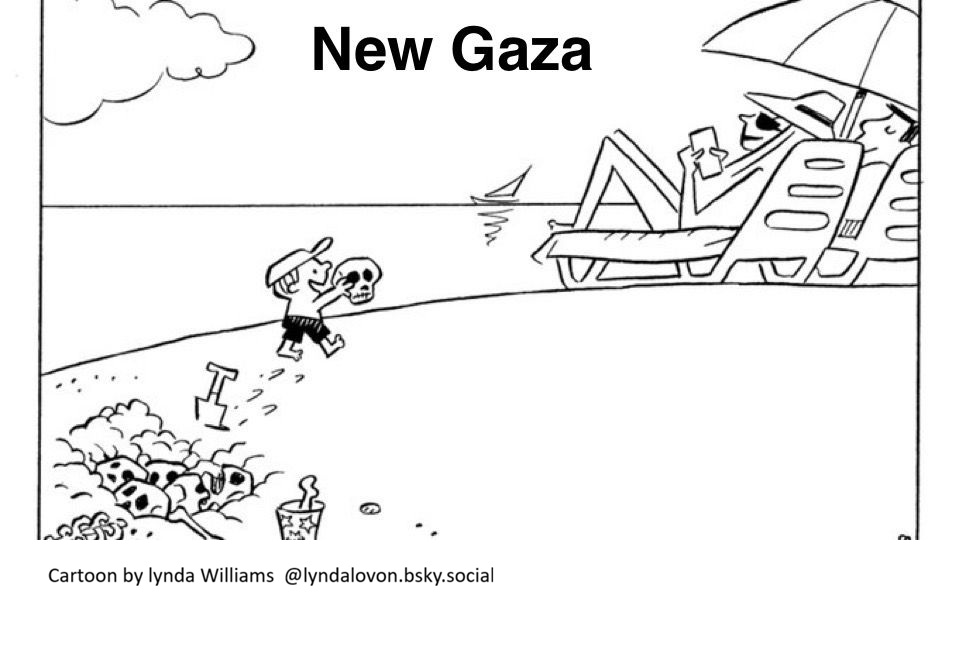
Over 100 Children Have Died of Severe Hunger Amid Israeli Siege: Gaza Health Ministry.

“People are being starved, children are being killed, families have lost everything,” said the United Nations agency for Palestinian Refugees.
Brad Reed, Aug 11, 2025, https://www.commondreams.org/news/gaza-children-starvation-2673875979
The Gaza Health Ministry announced on Monday that more than 100 children in Gaza have died of severe hunger during Israel’s siege of the territory.
As Al Jazeera reported, the Hamas-run Health Ministry said that a total of 222 Palestinians have died from hunger during the siege, including 101 children. The vast majority of these deaths have come in just the last three weeks when the hunger crisis in Gaza started to garner international media attention, the ministry said.
The United Nations Relief and Works Agency for Palestine Refugees in the Near East on Monday emphasized the direness of the situation in a statement calling for a cease-fire to allow more aid into Gaza.
“People are being starved, children are being killed,” the agency said. “Families have lost everything. Political will and leadership can stop an escalation and end the war. Every heartbeat counts.”
Israeli Prime Minister Benjamin Netanyahu has claimed that there is no starvation crisis in Gaza and has said such reports are part of a “fake” propaganda campaign waged by Israel’s enemies.
However, it isn’t just the Gaza Health Ministry warning of a hunger crisis in the region, as international charity Save the Children last week said that 43% of pregnant and breastfeeding women who showed up to its clinics in Gaza last month were malnourished, which represented a threefold increase since March, when the Israeli military imposed a total siege on the area.
The latest numbers about starvation in Gaza come as the Israeli government is pushing forward with a plan to fully invade and occupy Gaza, which experts have warned will only exacerbate the humanitarian crisis among its people.
“If these plans are implemented, they will likely trigger another calamity in Gaza, reverberating across the region and causing further forced displacement, killings, and destruction,” said Miroslav Jenca, the United Nations assistant secretary general, over the weekend.
Netanyahu’s Plan To Occupy Gaza Violates World Court Ruling That Israeli Occupation is Illegal.

August 12, 2025 By Marjorie Cohn ScheerPost, https://scheerpost.com/2025/08/12/netanyahus-plan-to-occupy-gaza-violates-world-court-ruling-that-israeli-occupation-is-illegal/
As the death toll of Palestinians in the Gaza Strip surpasses 61,000 and Israel continues to starve Gazans to death, Prime Minister Benjamin Netanyahu made clear that Israel plans to occupy all of Gaza. When asked in an August 7 appearance on Fox News whether Israel would “take control of all of Gaza,” Netanyahu replied, “We intend to.”
The Israeli Occupation Forces say they already control about 75 percent of Gaza. The remaining 25 percent includes Gaza City, Khan Younis, and many neighborhoods and refugee camps in central Gaza.
Israel’s occupation of Gaza flies in the face of the July 19 ruling of the International Court of Justice (ICJ, or World Court). In its landmark 83-page advisory opinion, the ICJ held, “The sustained abuse by Israel of its position as an occupying Power, through annexation and an assertion of permanent control over the Occupied Palestinian Territory and continued frustration of the right of the Palestinian people to self-determination, violates fundamental principles of international law and renders Israel’s presence in the Occupied Palestinian Territory unlawful.”
During the proceedings at the ICJ, Israel had argued that because it withdrew its military forces from Gaza in 2005, it no longer occupied the Gaza Strip. But the World Court concluded that Israel continues to occupy Gaza because it exercises “effective control” of “the land, sea and air borders” and maintains “restrictions on movement of people and goods, collection of import and export taxes, and military control over the buffer zone.” The court noted that “This is even more so since 7 October 2023.”
Israel’s Security Cabinet Approves the Takeover of Gaza City
Netanyahu’s stated intention leaves no doubt that he aims to make Israel’s occupation of Gaza official. On August 8, in the first step toward executing that plan, the Israeli security cabinet authorized the takeover of Gaza City, the forcible displacement of the 1 million Palestinians taking refuge there, and their confinement in “camps.”
To eliminate media witnesses to its impending slaughter, Israeli Occupation Forces killed five Al Jazeera journalists near Gaza City’s al-Shifa Hospital on the evening of August 10. They included the beloved Al Jazeera Arabic correspondent Anas al-Sharif, who had reported widely from northern Gaza.
“The Israeli Government’s plan for a complete military takeover of the occupied Gaza strip must be immediately halted. It runs contrary to the ruling of the International Court of Justice that Israel must bring its occupation to an end as soon as possible, to the realisation of the agreed two-State solution and to the right of Palestinians to self-determination,” UN Human Rights Chief Volker Türk stated on August 8. “On all evidence to date, this further escalation will result in more massive forced displacement, more killing, more unbearable suffering, senseless destruction and atrocity crimes.”
In a Joint Statement issued on August 9, more than 20 countries, joined by the League of Arab States and the Organization of Islamic Cooperation, expressed “their strong condemnation and categorical rejection of Israel’s announcement of its intention to impose full military control over the Gaza Strip.” They wrote, “We consider this announcement a dangerous and unacceptable escalation, a flagrant violation of international law, and an attempt to entrench the illegal occupation and impose a fait accompli/facts on the ground by force, in contravention of international legitimacy.”
On August 10, the United Nations Security Council convened an emergency meeting at the request of the United Kingdom, Denmark, France, Greece, and Slovenia, who issued the following statement:
We condemn the Government of Israel’s decision to further expand its military operations in Gaza. This plan risks violating international humanitarian law. We call on Israel to urgently reverse this decision and not to implement it. And we reiterate that any attempts at annexation or of settlement extension violate international law … We call on both parties to secure an immediate and permanent ceasefire, the release of all the hostages, and to urgently advance efforts to achieve a two-state solution.
All UN member countries except Israel and the U.S. denounced Netanyahu’s occupation plan for Gaza at the Council meeting. For example, the representative from Somalia said the ICJ “was unequivocal” that Israel’s occupation, blockade, denial of humanitarian access, and actions constituting collective punishment in Gaza violate international law. Algeria’s representative strongly condemned the Israeli security cabinet’s decision to displace the entire population of Gaza City and northern Gaza and impose full military control of Gaza, stating that “these are war crimes, and those who draw their maps in blood must not walk in the shadow of impunity.” The delegate from Denmark invoked the ICJ’s ruling that any unilateral attempts to alter the demography or status of Gaza amounts to a clear violation of international law. China’s ambassador said the Council “must firmly oppose any attempt to occupy Gaza.”
The same day the Council met, Saudi Arabia issued a statement saying it “condemns in the strongest possible terms the decision of the Israeli occupation authorities to occupy the Gaza Strip and categorically condemns their persistence in committing crimes of starvation, brutal practices, and ethnic cleansing against the Palestinian people.”
Trump Gives Israel the Green Light to Occupy Gaza
“They’re talking about occupying areas that are packed with so many people,” said Mukhlis al-Masri, who was forced to leave his home in northern Gaza and is now in Khan Younis. He told The New York Times that “If they do that, there will be incalculable killing. The situation will be more dangerous than anyone can imagine.”
The United States tried to prevent the meeting of the Security Council, the body empowered by the UN Charter to maintain international peace and security. Although unable to thwart the meeting from taking place, the threat of a U.S. veto prevented the Council from considering a resolution.
Dorothy Shea, U.S. interim ambassador to the UN, charged that the Security Council meeting was “emblematic of the counterproductive role that far too many governments on this council and throughout the UN system have played on the issue.” Her comments demonstrate the U.S.’s consistent defiance of international law.
Donald Trump gave Israel the tacit green light to take over Gaza. “That’s going to be pretty much up to Israel,” he said when asked about Netanyahu’s plan.
The United States routinely provides Israel with diplomatic cover for its international crimes – not only in the Security Council, but also at the ICJ and the International Criminal Court. The ICC has charged Netanyahu with the commission of war crimes and crimes against humanity in Gaza.
And the U.S. also flouts its legal obligations by enabling – indeed, aiding and abetting – Israel’s genocide by providing millions of dollars in weapons used to massacre Palestinians.
The U.S. has the power to stop Netanyahu’s illegal and dangerous plan. “Unless the United States changes its stance, I think ultimately, Israel will continue with this plan,” warned Will Todman, chief of staff of the geopolitics and foreign policy department and a senior fellow in the Middle East Program at the Center for Strategic and International Studies.
That would be a disaster – for the people of Gaza and the region, the rule of law, and the integrity of the global community.
A Mob of Alien Creatures Just Took 4 Nuclear Reactors Completely Offline.

They found their way into the filter drums of the pumping station.
By Darren Orf, Aug 15, 2025 , https://www.popularmechanics.com/science/animals/a65775055/jellyfish-nuclear-shutdown/
Here’s what you’ll learn when you read this story:
- A swarm of jellyfish shut down four of six nuclear reactors at the Gravelines power plant near Calais, France.
- The jellyfish found their way into the filter drums of the pumping station, causing a temporary shutdown over the weekend.
- Jellyfish swarms are increasing around the world as warmer oceans provide better spawning conditions and low-oxygen dead zones (caused largely by agricultural runoff) kill off aquatic competition.
Jellyfish are remarkable creatures. They’re twice as old as dinosaurs; they don’t have brains, lungs, or a heart; and they’ve nearly cracked the secret to immortality. But there’s another accolade that they can affix to their already impressive biological resumé—they’re the scourge of nuclear reactors.
This fact was proven this past Sunday, when three of the six reactors at Gravelines power plant near Calais in northern France shut down unexpectedly because a swarm of jellyfish had entered the plant’s cooling system, according to the government-owned utility operator Électricité de France, or EDF. y Monday morning, a fourth reactor also temporarily shut down.
Equinix enters into multiple advanced nuclear deals to power data centers

By Laila Kearney, August 14, 2025
Major data center developer and operator Equinix (EQIX.O), opens new tab
has entered into several advanced nuclear electricity deals, including
power purchase agreements for fission energy and pre-ordering microreactors
for its operations, the company said on Thursday.
Big Tech’s race to expand technologies like generative artificial
intelligence, which requires warehouse-like data centers that can require
city-sized amounts of electricity at a single site, is driving up global
energy consumption and raising fears about depleted power supplies.
Reuters 14th Aug 2025, https://www.reuters.com/business/energy/equinix-enters-into-multiple-advanced-nuclear-deals-power-data-centers-2025-08-14/
Reckon you can put a nuclear reactor on the Moon?
You have until Thursday August 21 to respond if you do
The Register, Richard Speed, Fri 15 Aug 2025
NASA’s plans to put a nuclear reactor on the Moon have moved on – the agency has now put out a Request For Information (RFI) to gauge industry interest in the project.
An RFI is not an invitation to bid for the work. Interested parties need to register their interest by 21 August, and only later, there’s a chance that they could be used to “finalize a potential opportunity later this year.” It comes after a directive from NASA Acting Administrator Sean Duffy that called for the US to be the first to put a nuclear reactor on the Moon.
Things will need to move fast if the agency is to meet the goal of being ready to launch by the first quarter of fiscal year 2030.
Dubbed the Fission Surface Power System, the reactor must have a mass of less than 15 metric tons, have a minimum power output of 100 kWe, and utilize a closed Brayton cycle power conversion system.
NASA is no stranger to nuclear power. It had rovers and spacecraft powered by the technology and has looked into Brayton cycle power conversion for nuclear electric propulsion on Mars missions [PDF].
The Apollo missions used Radioisotope Thermoelectric Generators (RTGs) to power experiments to be left on the lunar surface. These contained plutonium-238, and one returned to Earth on Apollo 13, remaining on the lunar module. The container for the plutonium is now at the bottom of the Pacific Ocean, and no release of radiation has been detected.
One hundred kilowatts of power is, however, an order of magnitude greater than the nuclear power sources launched by NASA to date. It would be enough to power the International Space Station (ISS), which currently charges its batteries using electricity generated by solar arrays attached to the outpost………………………https://www.theregister.com/2025/08/15/nuclear_moon/
Calls for Transparency Over Serious Nuclear Incident at Faslane
By Chris Martin, 14 Aug 2025, https://argyllbute24.co.uk/calls-for-transparency-over-serious-nuclear-incident-at-faslane/
THE Ministry of Defence (MoD) is facing calls to disclose details of a serious nuclear incident at HMNB Clyde, Faslane, between 1 January and 22 April this year.
Classified as Category A – the MoD’s most serious level – the event reportedly posed no risk to the public or environment.
Faslane, on Gare Loch in Argyll and Bute, houses the UK’s nuclear submarines, including Vanguard-class vessels armed with Trident missiles.
In a parliamentary response to SNP MP Dave Doogan, defence minister Maria Eagle confirmed multiple incidents at Faslane and nearby RNAD Coulport, but refused to detail Category A or B events, citing national security concerns.
Renewed alarm follows a Guardian/Ferret investigation revealing radioactive water leaked into Loch Long from Coulport in 2019 due to faulty pipes, with a six-year secrecy battle over the case. The Scottish Environment Protection Agency deemed the discharges “of no regulatory concern”.
SNP deputy leader Keith Brown has demanded an “urgent explanation”, warning nuclear weapons are “poorly maintained” and threaten safety, communities, and the environment.
The MoD insists it handles radioactive substances “safely and securely” and that none of the incidents caused harm or radiological impact, reaffirming support for the UK’s nuclear deterrent.
More on this story in next week’s Observer
Russia makes battlefield breakthrough in urgent push for land.
Telegraph, Kieran Kelly. Fermin Torrano in Ukraine, 12 Aug 25
With Trump talks looming, Russia’s army punches through exposed Ukrainian defences.
Russia is racing to seize as much Ukrainian territory as possible ahead of peace talks with Donald Trump on Friday.
In what may prove to be a major breakthrough for Vladimir Putin, Russian sabotage and reconnaissance units punched through exposed defences in eastern Ukraine, slipping as far as six miles behind the front line in just 48 hours, according to battlefield reports.
Kyiv has diverted special forces units to confront the insurgents on the ground in an attempt to prevent any more of Ukraine falling under Russia’s control before the summit in Alaska.
The location, near Dobropillya in Donetsk, is strategically significant. If Moscow’s forces are able to establish a foothold, the breach could allow Russia to cut off the city of Kramatorsk, one of the most vital strongholds in the Donbas still under Kyiv’s control.
If the city falls, it would give Putin almost full control over the Donbas and strengthen his negotiating power when bargaining over Ukraine’s fate with the Trump administration……………………………………… https://www.telegraph.co.uk/world-news/2025/08/12/russia-battleground-breakthrough-exposes-putin-push-land/
The West is in panic as Israel’s plan for ‘full control’ of Gaza heralds a new Nakba.
Netanyahu’s mass ethnic cleansing strategy pulls the rug out from under the West’s cherished pretext for supporting Israeli criminality: the fabled two-state solution
Jonathan Cook, Aug 14, 2025
If you thought western capitals were finally losing patience with Israel’s engineering of a famine in Gaza nearly two years into the genocide, you may be disappointed.
As ever, events have moved on – even if the extreme hunger and malnourishment of the two million people of Gaza have not abated.
Western leaders are now expressing “outrage”, as the media call it, at Israeli Prime Minister Benjamin Netanyahu’s plan to “take full control” of Gaza and “occupy” it. At some point in the future, Israel is apparently ready to hand the enclave over to outside forces unconnected to the Palestinian people.
The Israeli cabinet agreed last Friday on the first step: a takeover of Gaza City, where hundreds of thousands of Palestinians are huddled in the ruins, being starved to death. The city will be encircled, systematically depopulated and destroyed, with survivors presumably herded southwards to a “humanitarian city” – Israel’s new term for a concentration camp – where they will be penned up, awaiting death or expulsion.
At the weekend, foreign ministers from the UK, Germany, Italy, Australia and other western nations issued a joint statement decrying the move, warning it would “aggravate the catastrophic humanitarian situation, endanger the lives of the hostages, and further risk the mass displacement of civilians”.
Germany, Israel’s most fervent backer in Europe and its second-biggest arms supplier, is apparently so dismayed that it has vowed to “suspend” – that is, delay – weapons shipments that have helped Israel to murder and maim hundreds of thousands of Palestinians over the past 22 months.
Netanyahu is not likely to be too perturbed. Doubtless, Washington will step in and pick up any slack for its main client state in the oil-rich Middle East.
Meanwhile, Netanyahu has once again shifted the West’s all-too-belated focus on the indisputable proof of Israel’s ongoing genocidal actions – evidenced by Gaza’s skeletal children – to an entirely different story.
Now, the front pages are all about the Israeli prime minister’s strategy in launching another “ground operation”, how much pushback he is getting from his military commanders, what the implications will be for the Israelis still held captive in the enclave, whether the Israeli army is now overstretched, and whether Hamas can ever be “defeated” and the enclave “demilitarised”.
We are returning once again to logistical analyses of the genocide – analyses whose premises ignore the genocide itself. Might that not be integral to Netanyahu’s strategy?
…………………………………………………………………………………………………………………………………………………………………………………………………………………………. France and Britain’s recognition threat is not simply too late. It serves two other purposes.
Firstly, it provides a new alibi for inaction. There are plenty of far more effective ways for the West to halt Israel’s genocide. Western capitals could embargo arms sales, stop intelligence sharing, impose economic sanctions, sever ties with Israeli institutions, expel Israeli ambassadors, and downgrade diplomatic relations. They are choosing to do none of those things.
And secondly, recognition is designed to extract from the Palestinians “concessions” that will make them even more vulnerable to Israeli violence.
According to France’s foreign affairs minister, Jean-Noel Barrot: “Recognising a State of Palestine today means standing with the Palestinians who have chosen non-violence, who have renounced terrorism, and are prepared to recognise Israel.”
In other words, in the West’s view, the “good Palestinians” are those who recognise and lay down before the state committing genocide against them.
Western leaders have long envisioned a Palestinian state only on condition that it is demilitarised. Recognition this time is premised on Hamas agreeing to disarm and its departure from Gaza, leaving Abbas to take on the enclave and presumably continue the “sacred” mission of “cooperating” with a genocidal Israeli army.
As part of the price for recognition, all 22 members of the Arab League publicly condemned Hamas and demanded its removal from Gaza.
Boot on Gaza’s neck
How does all of this fit with Netanyahu’s “ground offensive”? Israel isn’t “taking over” Gaza, as he claims. Its boot has been on the enclave’s neck for decades.
While western capitals contemplate a two-state solution, Israel is preparing a final mass ethnic cleansing campaign in Gaza.
Starmer’s government, for one, knew this was coming. Flight data shows that the UK has been constantly operating surveillance missions over Gaza on Israel’s behalf from the Royal Air Force base Akrotiri on Cyprus. Downing Street has been following the enclave’s erasure step by step.
Netanyahu’s plan is to encircle, besiege and bomb the last remaining populated areas in northern and central Gaza, and drive Palestinians towards a giant holding pen – misnamed a “humanitarian city” – alongside the enclave’s short border with Egypt. Israel will then probably employ the same contractors it has been using elsewhere in Gaza to go street to street to bulldoze or blow up any surviving buildings.
The next stage, given the trajectory of the last two years, is not difficult to predict. Locked up in their dystopian “humanitarian city”, the people of Gaza will continue to be starved and bombed whenever Israel claims it has identified a Hamas fighter in their midst, until Egypt or other Arab states can be persuaded to take them in, as a further “humanitarian” gesture.
Then, the only matter to be settled will be what happens to the real estate: build some version of Trump’s gleaming “Riviera” scheme, or construct another tawdry patchwork of Jewish settlements of the kind envisioned by Netanyahu’s openly fascist allies, Bezalel Smotrich and Itamar Ben Gvir.
There is a well-established template to be drawn on, one that was used in 1948 during Israel’s violent creation. Palestinians were driven from their cities and villages, in what was then called Palestine, across the borders into neighbouring states. The new state of Israel, backed by western powers, then set about methodically destroying every home in those hundreds of villages.
Over subsequent years, they were landscaped either with forests or exclusive Jewish communities, often engaged in farming, to make Palestinian return impossible and stifle any memory of Israel’s crimes. Generations of western politicians, intellectuals and cultural figures have celebrated all of this.
Former British Prime Minister Boris Johnson and former Austrian President Heinz Fischer are among those who went to Israel in their youth to work on these farming communities. Most came back as emissaries for a Jewish state built on the ruins of a Palestinian homeland.
An emptied Gaza can be similarly re-landscaped. But it is much harder to imagine that this time the world will forget or forgive the crimes committed by Israel – or those who enabled them.
[Many thanks to Matthew Alford for the audio reading of this article.]https://jonathancook.substack.com/p/the-west-is-in-panic-as-israels-plan?utm_source=post-email-title&publication_id=476450&post_id=170880402&utm_campaign=email-post-title&isFreemail=true&r=19l92&triedRedirect=true&utm_medium=email
Iran’s nuclear chief urges IAEA to condemn Israeli terrorism.
TEHRAN, Aug. 13 (MNA), https://en.mehrnews.com/news/235334/Nuclear-chief-urges-IAEA-to-condemn-Israeli-terrorism
– Vice President and Head of Atomic Energy Organization of Iran (AEOI) said that the International Atomic Energy Agency (IAEA) should condemn the Israeli regime’s killing of Iranian nuclear scientists.
He paid tribute to the memory of the martyrs of the media, the nuclear martyrs, and the recent imposed war.
“A number of institutions affiliated with the Zionist regime pretend that the attack on Iran’s nuclear facilities was an act in the interest of the security of humanity. These narratives are so skillfully reflected that uninformed people believe them, and today we expect the media to stand strong and firmly against the combined war of the enemies of this land and reflect the correct narrative,” he said.
“Israel is neither a member of the NPT nor a member of the safeguards, but it has influence in the International Atomic Energy Agency and with this influence it exploits the confidential information of countries. With the support of the United States, they are carrying out evil actions in the region,” he added.
Eslami noted that during the 12-day war, a number of centers registered under the Agency’s continuous surveillance, which were monitored by 130 inspectors, were repeatedly attacked using missiles and various projectiles.
“The Americans had been planning an attack on our facilities for a long time. This is despite the fact that none of the official institutions have submitted a report on Iran’s non-compliance or deviation from the safeguards in recent years,” Eslami further stressed.
He emphasized, “A fabricated and fake case has been formed by the Zionist regime, and the accusations and excuses are nothing more than an attempt to stop Iran’s peaceful nuclear program. If their claims were true, they should have provided clear evidence. These fake statements are only a cover to prevent the progress of the Iranian nation.”
“Such double standards and efforts to prevent Iran from entering advanced scientific fields are the same hegemonic system that, at huge costs, is trying to deprive our nation of nuclear technology and other modern technologies. This approach is a tangible manifestation of their identity; the same crimes they are committing in Palestine today.”
Coulport nuclear leaks spark alarm among local nuclear campaigners
CAMPAIGNERS have dismissed reassurances from military chiefs about
radioactive waste leaking into the Clyde. Pipes which the Ministry of
Defence (MoD) had allowed to fall into disrepair leaked nuclear waste into
Loch Long from the Trident base at Coulport.
The revelations came after an
investigation by The Ferret, which forced the release of information on the
leaks the Government had tried to keep hushed up. Marian Pallister, chair
of Pax Christi Scotland, said the revelations were unsurprising but
concerning for people living in the area. Pallister, a writer and
journalist who lives near Lochgilphead, told The National: “I’m afraid
that it wasn’t a surprise, we have known about this for a long time.”
She dismissed the MoD’s claims that there had been “no unsafe releases
of radioactive material into the environment”, adding: “They would say
that, wouldn’t they? “They are obviously going to lessen their
involvement but however big or small the leaks might be, they are leaks
into waters that are a part of our lives, part of our heritage.
The National 12th Aug 2025, https://www.thenational.scot/news/25384467.coulport-nuclear-leaks-spark-alarm-among-local-nuclear-campaigners/
Scottish independence can rid us of nuclear abomination.
Ross Greer: NUCLEAR weapons aren’t just a deadly money pit, they also
make for extremely unsafe neighbours. This was proven once again last
weekend with the Ferret, The National and others exposing the scale of the
threat posed to those of my constituents who have the bases at Faslane and
Coulport on their doorsteps.
The news radioactive water leaked into
beautiful Loch Long should concern everyone, though for those of us
familiar with the safety record at Coulport, it was no surprise. Far from
an isolated event, we now know that Faslane also saw over 100 reported
safety incidents over the last 12 months, including a Category A event
earlier this year, the most serious category and one that the Royal Navy
says carries an “actual or high potential for radioactive release to the
environment”.
The National 15th Aug 2025, https://www.thenational.scot/politics/25391552.ross-greer-scottish-independence-can-rid-us-nuclear-abomination/
No ceasefire, no deal: What summit means for Trump, Putin and Ukraine.
BBC, 16 Aug 35
US President Donald Trump and his Russian counterpart Vladimir Putin have left Alaska without reaching an agreement for a ceasefire in Ukraine.
After an almost three-hour meeting, the leaders delivered a joint statement to the media before leaving without taking questions.
Three BBC correspondents who are in Anchorage for the summit assess what it means for the US and Russian leaders as well as what happens next in the war in Ukraine.
Meeting dents Trump’s reputation as a dealmaker
By North America correspondent Anthony Zurcher
“There’s no deal until there’s a deal,” Donald Trump said early in his post-summit remarks here in Anchorage.
It was a roundabout way of conceding that after several hours of talks, there’s no deal. No ceasefire. Nothing tangible to report.
The president said that he and Vladimir Putin made “some great progress”, but with little details about what that might be, it’s left to the world’s imagination.
“We didn’t get there,” he later said, before exiting the room without taking any questions from the hundreds of gathered reporters.
Trump travelled a long way to only produce such vague statements, even if America’s European allies and Ukrainian officials may be relieved he did not offer unilateral concessions or agreements that could have undermined future negotiations.
For the man who likes to tout himself as a peacemaker and a dealmaker, it appears that Trump will leave Alaska with neither.
There are also no indications that a future summit that includes Ukrainian President Volodymyr Zelensky is forthcoming, Putin’s “next time in Moscow” quip about their next meeting notwithstanding.
While Trump had less at stake during these negotiations than Ukraine or Russia, it still will put a dent in his domestic and international prestige after earlier promises that this meeting had only a 25% chance of failure.
What’s more, the president had to suffer the apparent indignity of standing silent as Putin started off the press-conference-that-wasn’t with extensive opening remarks. It was a marked difference than the normal routine in the Oval Office, when the US president typically holds court while his foreign counterpart looks on without comment.
While Alaska is American territory, Putin seemed more at home in what his officials like to note was once “Russian America” before its 19th Century sale to the US. That may eat at the American president over the coming days, as will press coverage that will present this summit as a flop.
The big question now – one reporters were unable to ask on Friday – is whether Trump will decide to impose his much-threatened new sanctions on Russia as punishment.
The president partially addressed that in the friendly confines of a Fox News interview before flying out, saying that he would consider such a move “maybe in two weeks, three weeks”. But given the president promised “severe consequences” if Russia did not move towards a ceasefire, such a unspecific answer may prompt more questions than it answers.
Putin gets his moment in the global spotlight
By Steve Rosenberg, Russia editor
When is a “press conference” not a press conference?
When there are no questions.
There was palpable surprise in the hall when Presidents Putin and Trump left the podium as soon as they’d delivered their statements – without taking any questions.
Members of the Russian delegation, too, left the room swiftly without answering any of the questions journalists were shouting at them.
Clear signs that when it comes to the war in Ukraine, Vladimir Putin and Donald Trump still have a major difference of opinion.
pushing for a Russian ceasefire. Vladimir Putin didn’t give it to him.
There was a very different vibe earlier in the day. President Trump had rolled out the red carpet for Vladimir Putin, treating the Kremlin leader as an honoured guest.
The Russian president got his moment in the geo-political limelight, sharing the stage with the leader of the world’s most powerful country.
But how will Trump react to what happened? He still hasn’t managed to persuade Putin to end Russia’s war in Ukraine.
Previously he’d threatened a tougher approach to Russia, with ultimatums, deadlines and warnings of more sanctions if Moscow ignored calls for a ceasefire.
He hasn’t followed through.
Will he?
A sigh of relief from Ukraine – but fear for what’s next
By Vitaliy Shevchenko, Russia Editor BBC Monitoring
What just happened in Anchorage may feel anti-climactic for many, but in Kyiv there will be sighs of relief that no “deal” has been announced that would cost Ukraine territory…………………………………………https://www.bbc.com/news/articles/clyvd3gkg1po
1 This Month
29 Jan. Thursday 7-8 p.m. Webinar – World’s Largest Nuclear Station in Port Hope, ON?
To see nuclear-related stories in greater depth and intensity – go to https://nuclearinformation.wordpress.com/


31st January – Challenging the War Machine – a DECLASSIFIED UK SUMMIT

Website of the Week
Now until to February 10, 2026 Radioactive waste storage in France: the debate is finally open! How to participate?
-
Archives
- January 2026 (283)
- December 2025 (358)
- November 2025 (359)
- October 2025 (376)
- September 2025 (258)
- August 2025 (319)
- July 2025 (230)
- June 2025 (348)
- May 2025 (261)
- April 2025 (305)
- March 2025 (319)
- February 2025 (234)
-
Categories
- 1
- 1 NUCLEAR ISSUES
- business and costs
- climate change
- culture and arts
- ENERGY
- environment
- health
- history
- indigenous issues
- Legal
- marketing of nuclear
- media
- opposition to nuclear
- PERSONAL STORIES
- politics
- politics international
- Religion and ethics
- safety
- secrets,lies and civil liberties
- spinbuster
- technology
- Uranium
- wastes
- weapons and war
- Women
- 2 WORLD
- ACTION
- AFRICA
- Atrocities
- AUSTRALIA
- Christina's notes
- Christina's themes
- culture and arts
- Events
- Fuk 2022
- Fuk 2023
- Fukushima 2017
- Fukushima 2018
- fukushima 2019
- Fukushima 2020
- Fukushima 2021
- general
- global warming
- Humour (God we need it)
- Nuclear
- RARE EARTHS
- Reference
- resources – print
- Resources -audiovicual
- Weekly Newsletter
- World
- World Nuclear
- YouTube
-
RSS
Entries RSS
Comments RSS
 nuclear-news