The Detached Cruelty of Air Power- From Guernica to Gaza Mass Killers Have Been Above It All .
The increasing American reliance on air power rather than combat troops has shifted the concept of what it means to be “at war.”…………… congressional approval was unnecessary since the United States wasn’t actually engaged in military “hostilities” — because no Americans were dying in the process.
By Norman Solomon, August 28, 2025
Killing from the sky has long offered the sort of detachment that warfare on the ground can’t match. Far from its victims, air power remains the height of modernity. And yet, as the monk Thomas Merton concluded in a poem, using the voice of a Nazi commandant, “Do not think yourself better because you burn up friends and enemies with long-range missiles without ever seeing what you have done”
Nine decades have passed since aerial technology first began notably assisting warmakers. Midway through the 1930s, when Benito Mussolini sent Italy’s air force into action during the invasion of Ethiopia, hospitals were among its main targets. Soon afterward, in April 1937, the fascist militaries of Germany and Italy dropped bombs on a Spanish town with a name that quickly became a synonym for the slaughter of civilians: Guernica.
Within weeks, Pablo Picasso’s painting “Guernica” was on public display, boosting global revulsion at such barbarism. When World War Two began in September 1939, the default assumption was that bombing population centers — terrorizing and killing civilians — was beyond the pale. But during the next several years, such bombing became standard operating procedure.

Dispensed from the air, systematic cruelty only escalated with time. The blitz by Germany’s Luftwaffe took more than 43,500 civilian lives in Britain. As the Allies gained the upper hand, the names of certain cities went into history for their bomb-generated firestorms and then radioactive infernos. In Germany: Hamburg, Cologne, and Dresden. In Japan: Tokyo, Hiroshima, and Nagasaki.
“Between 300,000-600,000 German civilians and over 200,000 Japanese civilians were killed by allied bombing during the Second World War, most as a result of raids intentionally targeted against civilians themselves,” according to the documentation of scholar Alex J. Bellamy. Contrary to traditional narratives, “the British and American governments were clearly intent on targeting civilians,” but “they refused to admit that this was their purpose and devised elaborate arguments to claim that they were not targeting civilians.”
Past Atrocities Excusing New Ones
As the New York Times reported in October 2023, three weeks into the war in Gaza, “It became evident to U.S. officials that Israeli leaders believed mass civilian casualties were an acceptable price in the military campaign. In private conversations with American counterparts, Israeli officials referred to how the United States and other allied powers resorted to devastating bombings in Germany and Japan during World War II — including the dropping of the two atomic warheads in Hiroshima and Nagasaki — to try to defeat those countries.”
Prime Minister Benjamin Netanyahu told President Joe Biden much the same thing, while shrugging off concerns about Israel’s merciless killing of civilians in Gaza. “Well,” Biden recalled him saying, “you carpet-bombed Germany. You dropped the atom bomb. A lot of civilians died.”
Apologists for Israel’s genocide in Gaza have continued to invoke just such a rationale…………………………………………………………………….
The United Nations has reported that women and children account for nearly 70% of the verified deaths of Palestinians in Gaza. The capacity to keep massacring civilians there mainly depends on the Israeli Air Force (well supplied with planes and weaponry by the United States), which proudly declares that “it is often due to the IAF’s aerial superiority and advancement that its squadrons are able to conduct a large portion” of the Israeli military’s “operational activities.”
The “Grace and Panache” of the “Indispensable Nation”
The benefactor making possible Israel’s military prowess, the U.S. government, has compiled a gruesome record of its own in this century. An ominous undertone, foreshadowing the unchecked slaughter to come, could be heard on October 8, 2023, the day after the Hamas attack on Israel resulted in close to 1,200 deaths. “This is Israel’s 9/11,” the Israeli ambassador to the United Nations said outside the chambers of the Security Council, while the country’s ambassador to the United States told PBS viewers that “this is, as someone said, our 9/11.”
Loyal to the “war on terror” brand, the American media establishment gave remarkably short shrift to concerns about civilian deaths and suffering. The official pretense was that (of course!) the very latest weaponry meshed with high moral purpose. When the U.S. launched its “shock and awe” air assault on Baghdad to begin the Iraq War in March 2003, “it was a breathtaking display of firepower,” anchor Tom Brokaw told NBC viewers with unintended irony. Another network correspondent reported “a tremendous light show here, just a tremendous light show.”
As the U.S. occupation of Iraq took hold later that year, New York Times correspondent Dexter Filkins (who now covers military matters for The New Yorker) was laudatory on the newspaper’s front page as he reported on the Black Hawk and Apache helicopter gunships flying over Baghdad “with such grace and panache.” Routine reverence for America’s high-tech arsenal of air power has remained in sync with the assumption that, in the hands of Uncle Sam, the world’s greatest aerospace technologies would be used for the greatest good.
In a 2014 commencement speech at West Point, President Barack Obama proclaimed: “The United States is and remains the one indispensable nation. That has been true for the century passed and it will be true for the century to come.”
After launching two major invasions and occupations in this century, the United States was hardly on high moral ground when it condemned Russia for its invasion of Ukraine in February 2022 and frequent bombing of that country’s major cities. Seven months after the invasion began, President Vladimir Putin tried to justify his reckless nuclear threats by alarmingly insisting that the atomic bombings of Japan had established a “precedent.”
Whoever Doesn’t Count Goes Uncounted
…………………………………………………………………………………………………………………………….. Normal and Lethal
When Shakira and Guljumma lost relatives to bombs that arrived courtesy of the U.S. taxpayer, their loved ones were not even numbers to the Pentagon. Instead, meticulous estimates have come from the Costs of War project at Brown University, which puts “the number of people killed directly in the violence of the post-9/11 wars in Afghanistan, Pakistan, Iraq, Syria, Yemen, and elsewhere” at upwards of 905,000 — with 45% of them civilians. “Several times as many more have been killed as a reverberating effect of the wars — because, for example, of water loss, sewage and other infrastructural issues, and war-related disease.”
The increasing American reliance on air power rather than combat troops has shifted the concept of what it means to be “at war.” After three months of leading NATO’s bombing of Libya in 2011, for instance, the U.S. government had already spent $1 billion on the effort, with far more to come. But the Obama administration insisted that congressional approval was unnecessary since the United States wasn’t actually engaged in military “hostilities” — because no Americans were dying in the process.
………………………………………………………………………………….the nation’s actions targeting Libya involved “no U.S. ground presence or, to this point, U.S. casualties.” Nor was there “a threat of significant U.S. casualties.” The idea was that it’s not really a war if Americans are above it all and aren’t dying………………………………………
in a September 2021 speech at the United Nations soon after the last American troops had left Afghanistan, President Biden said: “I stand here today, for the first time in 20 years, with the United States not at war.” In other words, American troops weren’t dying in noticeable numbers. Costs of War project co-director Catherine Lutz pointed out in the same month that U.S. engagement in military actions “continues in over 80 countries.”
…………………the Biden and Trump administrations have directly sent bombers and missiles over quite a few horizons, including in Yemen, Iraq, Syria, Somalia, and Iran.
Less directly, but with horrific ongoing consequences, stepped-up U.S. military aid to Israel has enabled its air power to systematically kill Palestinian children, women, and men with the kind of industrial efficiency that fascist leaders of the 1930s and 1940s might have admired. The daily horrors in Gaza still echo the day when bombs fell on Guernica. But the scale of the carnage is much bigger and unrelenting in Gaza, where atrocities continue without letup, while the world looks on. https://tomdispatch.com/from-guernica-to-gaza/
The World Bank can now fund nuclear energy projects: Here’s what’s next.
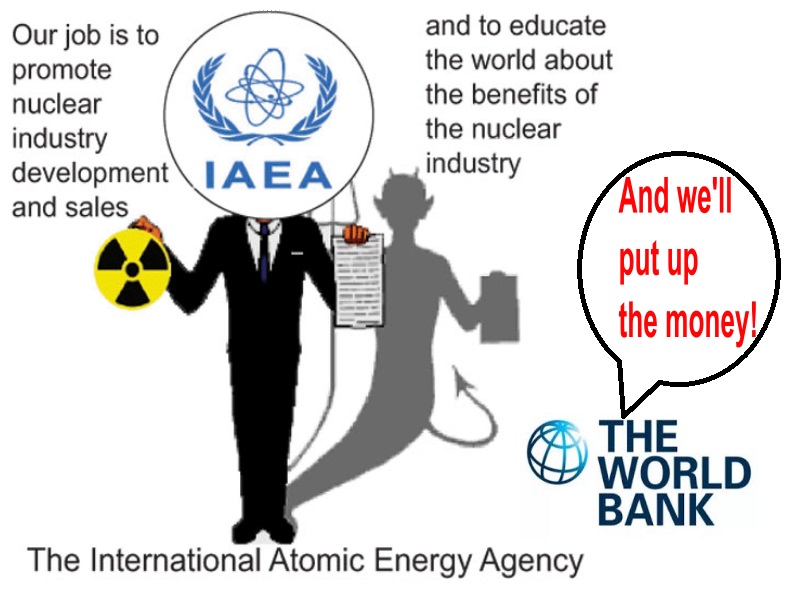
Specifically, the agreement pledges that the IAEA will provide subject-matter expertise to the World Bank Group that will help the group support lifetime extensions of existing nuclear power plants and advance the commercial deployment of small modular reactors (SMRs).
Bulletin, By Marina Lorenzini | August 28, 2025
As a growing number of countries look to strengthen their domestic energy production, meet baseload power generation needs, and manage low-carbon climate goals, they’re increasingly looking to nuclear—and some previous skeptics are looking with them. On June 11th, the World Bank Group (WBG) announced an end to its longstanding ban on funding nuclear power projects. The ban had only been in place formally since 2013, but the last and only time the WBG funded a nuclear power project was 1959—a $40 million loan to build a nuclear power plant in Italy.
Two weeks after the ban was dropped, the group’s President Ajay Banga signed an agreement with the International Atomic Energy Agency (IAEA), committing to support countries that seek to include nuclear energy as part of their development strategies. The policy change builds on similar commitments from the 2023 climate negotiations in Dubai to triple global nuclear capacity, private financial industry pledges of capital for nuclear energy investments, and bipartisan support for nuclear in Washington, D.C.
The World Bank Group’s policy shift on nuclear energy was enabled by a similar reversal from German leadership, one of the bank’s foremost contributors. Germany has long opposed nuclear energy, famously extending the life of coal-fired power plants while committing to shut down its nuclear fleet at home; Germany’s position on nuclear power is an oft-cited motivation for the Bank’s enduring ban. Although German Chancellor Friedrich Merz would need to overcome significant opposition from within his own governing coalition to resurrect a nuclear power fleet in Germany, at the moment, Merz is increasingly accepting of nuclear power as an energy source at the EU-level and internationally.
The World Bank Group is composed of five affiliated agencies: the International Bank for Reconstruction and Development; the International Finance Corporation; the International Development Association; the International Centre for Settlement of Investment Disputes; and the Mulitlateral Investment Guarantee Agency. The International Bank for Reconstruction and Development and the the International Development Association provide loans and grants to low- and middle-income countries and are commonly referred to as the “World Bank.” The agreement with the IAEA is intended to quickly infuse expertise into all five of the World Bank Group’s teams of economists and country experts. Specifically, the agreement pledges that the IAEA will provide subject-matter expertise to the World Bank Group that will help the group support lifetime extensions of existing nuclear power plants and advance the commercial deployment of small modular reactors (SMRs). While the agreement doesn’t identify specific countries for investment, some parameters have emerged for evaluating likely candidates to receive WBG funding.
Lifetime extensions for existing reactors. There are nearly 440 nuclear power reactors around the world, many of which are approaching or have surpassed their designed lifespans, usually around 40 years. Efforts to upgrade existing power plants and extend their lifetime to 60 or even 80 years can allow countries to continue producing electricity using their original reactors.
There are a few countries seeking lifetime extensions that hold open accounts with the World Bank Group, and four emerge as leading contenders: Argentina, India, South Africa, and Ukraine. If the Bank cannot front the whole cost, the Bank may seek to deepen co-financing partnerships with regional development banks. For example, in February 2025, the Asian Development Bank and the WBG signed a framework allowing borrowers to follow one set of rules related to project design, preparation, appraisal, supervision, completion, and evaluation. In that spirit, other arrangements could be made with the African Development Bank, the Development Bank of Latin America and the Caribbean, or the European Bank for Reconstruction and Development to lessen the burden on one bank.
In the EU, countries may have access to debt or equity financing from the world’s largest multilateral development lender, the European Investment Bank. The most likely candidate in the EU for the WBG’s lending arm is Romania, which already receives funding from the bank. Their nuclear power plant owner recently revealed a proposal for a JP Morgan–led €500 million bond issuance, intended to finance the refurbishment of the nuclear power plant at Cernavoda, which will be submitted to a shareholder meeting in September 2025. However, if that proposal is unsuccessful, WBG may have an opportunity to contribute.
The WBG may later consider expanding its portfolio into new traditional reactor builds on already existing sites, such as in Brazil or Bulgaria, before building completely new sites with traditional reactors.
A longer time horizon for newcomers and SMRs. While less output and per–project costs make SMRs more suitable for emerging economies, the technology may not be commercially viable for the next several years. A measured dose of skepticism is warranted regarding the timelines for any of the SMR designs to be commercially widespread.
As a first step, Banga aims to advance standardization across design variations of SMRs, which would help achieve the economies of scale necessary for commercialization. Standardization at the regulatory and industrial levels is already an active area for the IAEA. The regulatory landscape for nuclear energy varies widely across jurisdictions and each country has unique licensing processes and technical standards for nuclear reactors. A lack of harmonization forces each SMR supplier to customize engineering designs and licensing strategies for each market, a time-consuming and expensive process that hinders the scalability of SMRs.
Banga has also signaled that the WBG may sign purchase agreements with SMR manufacturers to expedite the deployment of prototypes and provide guaranteed revenue. Countries with existing nuclear industries would be obvious prospects for new builds and SMR partnerships. Armenia, for example, operates a Soviet-era VVER-440 pressurized water reactor at Metsamor. The reactor is in the early stages of a lifetime extension with Rosatom, which seeks to sustain the remaining operational reactor until 2036. However, Metsamor’s operation will likely conclude in the coming decade, and preparations must be made for replacing or even expanding Metsamor’s current contributions to the electric grid. With investments from the United States in power-hungry AI computing and physical infrastructure already underway, Armenia could be a strong candidate for the WBG to contribute to the bilateral energy security goals between the two nations.
For countries without a proven track record in the nuclear power industry, the WBG may seek to establish connections with countries already engaged in international agreements and standard setting regarding nuclear technology. This could include countries negotiating a 123 agreement with the United States, which establishes terms for working with US companies on nuclear projects, or adopting the IAEA’s Milestones Approach, an infrastructure development framework for nuclear power newcomers. In addition, prospective countries should have an industrial and manufacturing base, strong electric grid, and proximity to a reliable water source. Under these criteria, Ghana, Indonesia, and the Philippines emerge as potential frontrunners for gaining WBG support……………………………………………………….
Momentum in Washington. Aside from Germany, the Trump administration is a leading driver of the WBG nuclear policy change and will be a key partner in executing the policy……………………………………………..
it is important to recognize that while the WBG’s investment will be transformational for specific sites and countries, the challenge is global. If the group’s funds and expertise can’t improve the industry’s ability to deliver on time and within budget, their presence may only make a marginal contribution to global electricity needs or climate goals in the next decade. https://thebulletin.org/2025/08/the-world-bank-can-now-fund-nuclear-energy-projects-heres-whats-next/?utm_source=ActiveCampaign&utm_medium=email&utm_content=The%20World%20Bank%20s%20nuclear%20projects&utm_campaign=20250825%20Monday%20Newsletter%20%28Copy%29
Is the UK’s giant new nuclear power station “unbuildable”?

The design of the UK’s latest nuclear power station is “terrifying”,
“phenomenally complex” and “almost unbuildable”, according to Henri
Proglio, a former head of EDF, the French state-owned utility behind the
project.
One month after the final green light for Sizewell C, 1,700
workers are on site in Suffolk, on the UK’s east coast, preparing the
sandy marshland for two enormous reactors that will eventually generate
enough electricity for 6mn homes. The plant will be a replica of the
European Pressurised Reactor (EPR) design that is running four to six years
late and 2.5 times over budget at Hinkley Point C in Somerset, which has
had problems wherever it has been built, in France, Finland and China.
But unlike at Hinkley, where EDF was responsible for spiralling costs and took
a hit of nearly €13bn after running late and over budget, the UK
government and bill payers are on the hook for Sizewell. The state will
provide £36.5bn of debt to fund the estimated £38bn price tag and be
responsible if costs go beyond £47bn
“Being able to build an EPR in the
timeframe, with the planned costs? I don’t think so,” Proglio, a critic
of the design, told the Financial Times. “The EPR is a machine that is
phenomenally complex to build, with more rebar than concrete, it is
terrifying . . . it’s almost unbuildable. As long as the design has
not changed, the difficulty of building will not have changed either.”
FT 27th Aug 2025,
https://www.ft.com/content/ee89bce2-a3e9-48ed-82eb-85916eb24777
Donald Trump’s assault on U.S. nuclear watchdog raises safety concerns

Donald Trump’s attack on the independence of the US nuclear safety watchdog
has accelerated a severe “brain drain” at the agency, raising the risks
of future accidents, former officials have warned. Almost 200 people have
left the US Nuclear Regulatory Commission since the president’s
inauguration in January, and the pace of executive departures shows little
sign of slowing with the resignation of the agency’s director of nuclear
security and its general counsel.
Nearly half of the agency’s 28-strong
senior leadership team has been installed in an “acting” capacity, and
only three of five NRC commissioner roles are occupied. Trump sacked
commissioner Christopher Hanson in June and Annie Caputo resigned
unexpectedly last month. “It is an unprecedented situation with some
senior leaders having been forced out and many others leaving for early
retirement or worse, resignation,” Scott Morris, the former NRC deputy
executive director of operations who retired in May, said in an interview.
FT 28th Aug 2025, https://www.ft.com/content/f082e338-d4bf-4b5b-882d-09a8795a93ef
Government allocates £154m for plutonium disposal.

Jason Arunn Murugesu, BBC News, North East and Cumbria, 28 Aug 25, https://www.bbc.com/news/articles/czjmzdj7l7wo
More than £150m will be spent by the government to investigate how best to dispose of the 140 tonnes of radioactive plutonium it currently stores at a nuclear plant.
Sellafield in Cumbria holds the world’s largest stockpile of the hazardous material.
Earlier this year, the government announced the material would not be reused and instead would be made ready for permanent disposal deep underground and put “beyond reach”.
The Department for Energy Security and Net Zero (DESNZ) said the money would be used to “test and prove” two technologies currently being explored to “immobilise” the highly radioactive material.
Plutonium has been kept at Sellafield for decades and successive governments have kept it to leave open the option to recycle it into new nuclear fuel.
Storing it in its current form is expensive and difficult as it frequently needs to be repackaged because radiation damages storage containers.
In January the government said the safest, most economically viable solution was to “immobilise” its entire plutonium stockpile.
DESNZ said it would spend £154m over five years to allow the Nuclear Decommissioning Authority to build specialist lab facilities at Sellafield which would be used to test two emerging immobilisation technologies – Disposal Mox and Hot Isostatic Pressing.
Dr Lewis Blackburn from the University of Sheffield said the two methods involved converting the plutonium into a “mechanically and chemically stable ceramic material” which could then be disposed of.
Mid Copeland and South Copeland in Cumbria are the only two sites in the UK currently being considered by the government to host a nuclear waste disposal site.
It follows a possible site in Lincolnshire earmarked by the government body Nuclear Waste Services pulling out in June.
OUR NUCLEAR WORLD: PICK YOUR TARGET
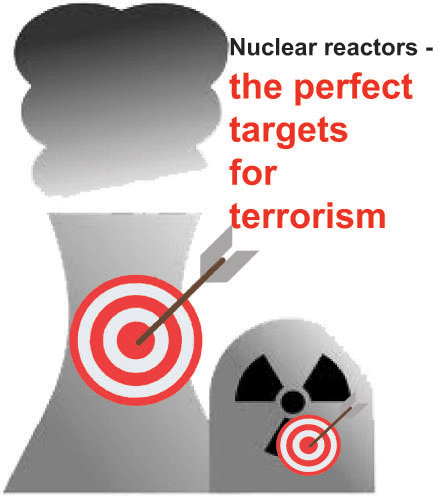
Why use your own nuclear weapons (with all the risks of escalation that this entails) when you can just take out your enemy’s nuclear power stations or nuclear waste facilities?
Jonathon Porritt 27th Aug 2025
I’ve reluctantly come to the conclusion that the only way the nuclear industry’s hype-machine is going to be stopped in its tracks is a Russian cyber-attack on the nine nuclear reactors still operating here in the UK, causing them all to close down and leading to the grid temporarily collapsing. That should do it.
I jest – sort of. But nothing else has worked. In just the last few weeks:
1 The Treasury’s financial modelling for the new power station at Sizewell C (seen by the Financial Times) gives a range of roughly £80 billion to £100 billion, far higher than the official estimate of £47 billion from the Department of Net Zero and Energy Security – which in itself was already nearly double the original cost of £20 billion!
2 The Treasury recently described the Government’s proposals for a new Geological Disposal Facility to deal with the 700,000 cubic metres of spent nuclear fuel as ‘unachievable’. This is a truly extraordinary development – confirming that the UK still has NO idea what to do about its legacy nuclear waste, let alone the waste that will be produced by any new reactors. Yet this got hardly a mention in the media.
3 The Government confirmed that it will be splurging a further £17 billion of taxpayers’ money between now and 2030 on Sizewell C, Small Modular Reactors and fusion energy – even as it continues to ignore the scourge of chronic poverty here in the UK, with 4.5 million children living in poverty – the highest number ever recorded.
On top of which, the industry’s hype-machine is now being turbocharged by the even more powerful hype-machine of AI. Never forget that the nuclear industry is supremely well-equipped to leap onto any and every boondoggle coming down the track – the Bitcoin/Crypto boom a decade ago (which never quite happened), and then green hydrogen. With every hard-to-abate sector queueing up for its share of vanishingly small volumes of green hydrogen, the Knights of Nuclear were up into their saddles just as fast as enough hobby horses could be corralled together to claim that it is only nuclear power that can provide the electricity required.
And now it’s AI. We’ve all read the growth projections for AI-enabled markets – from billions of dollars today to trillions tomorrow. I won’t weary you with the extrapolated increases in electricity consumption for all the new data centres that this entails – but it’s going to be a lot. On a par with the electricity consumption of small countries. New data centres are being built right now, ever bigger, already gobbling up more and more electricity. Nor will I invite you to ask why this AI boom must not – ever, on any terms – be subjected to much deeper scrutiny as to the balance of costs and benefits that will emerge. AI represents the apogee of latter-day technological determinism: if it can be done, then it must and will be done. So suck it up.
I’m not making light of this. The AI-driven nuclear boom in the USA is for real. Donald Trump is getting rid of most regulatory oversight of the nuclear industry, to speed things up, and stock prices of all the publicly traded nuclear companies are up by huge percentages. And it doesn’t seem to matter what kind of nuclear we’re talking about: 40-year-old decommissioned reactors to be given a new lease of life; plans for new big reactors, even in blue states like New York, being fast-tracked; Big Tech applying for construction permits for Small Modular Reactors that are still on the drawing board; and more than $500 billion apparently raised for new fusion reactors – seriously!
It’s not (yet) quite so insane here in the UK, but the signals are worrying. Strenuous efforts are being made by Ministers to force the Office for Nuclear Regulation to fast track any old nuclear proposal. Sweetheart deals with the private sector are being sorted out – regardless of the costs to taxpayers. Rational, evidence-based decision-making is a long-gone memory.
What exactly lies behind this mania? In the timeless words of Sherlock Holmes: ”once you have eliminated the impossible, whatever remains, no matter how improbable, must be the truth”.
So, let’s try that out for size in the context of nuclear power. It would surely be completely impossible for any responsible government pursuing a Net Zero energy strategy to prioritise nuclear power over all other options, given that:
- Large-scale nuclear reactors are now by far the most expensive option (on a Levelised Cost of Energy basis). UK Government figures in July this year showed new nuclear at £109 per MWh, offshore wind at £44MWh, large-scale solar at £41MWh and onshore wind at £38MWh.
- Small Modular Reactors (SMRs) don’t yet exist, but all experts agree their electricity will be even more expensive than that of large reactors – precisely because they can’t achieve the same economies of scale.
- The contribution of both big and small new reactors to a Net Zero electricity system in the UK will be literally ZERO before 2035 at the very earliest.
- Both big and small reactors will continue to produce significant levels of nuclear waste, adding to a waste crisis to which (as already mentioned) we have no long-term solution.
- ALL nuclear facilities pose a significant security risk, both from the point of view of cybersecurity (more later) and the very real possibility of physical attacks through ‘hostile third parties’.
Which brings us to the extraordinarily improbable truth of it: these days, nuclear power has little to do with electricity generation, and a whole lot more to do with the maintenance of the UK’s nuclear weapons capability……………………………………………………………………
It took a while for the UK Government to catch up, but in its latest Nuclear Roadmap it no longer beats around the bush. There are multiple references to the synergies between nuclear power and nuclear weapons: “this Government will proactively look for opportunities to align delivery of the civil and nuclear defence enterprises….it acknowledges the crucial importance of the nuclear industry to our national security, both in terms of energy supply and the defence nuclear enterprise”, and so on.
Big corporations are loving the fact that this is now out in the open. Bechtel, Babcock and Wilcox, AECOM, Rolls Royce – they’ve all spent decades feeding at the trough of either overt or hidden cross-subsidies between nuclear power and nuclear weapons. Rolls-Royce has been one of the most outspoken advocates for Small Modular Reactors, arguing their importance back in 2017 “to relieve the Ministry of Defence of the burden of retaining the skills and capability”………………………………………………………………….
As nuclear nations double down on nuclear power, it’s blindingly obvious that they are ramping up serious threats to national security. Nowhere is this clearer than with the drive to develop SMRs. Most designs currently on the drawing board (that are not light water reactors) will be using as their fuel high-assay, low-enriched uranium – or HALEU, to use the jargon. When it’s first extracted from the earth, uranium concentrations are usually around 1% of the total volume of the ore. HALEU fuel has to be enriched up to around 19% – just below the 20% threshold for the kind of highly-enriched uranium judged to be viable for the manufacture of nuclear bombs. And almost all HALEU fuel comes from Russia!
Beyond that, every nuclear facility (old and new) becomes a target for hostile third parties. Welcome back to the inconceivably scary world of nuclear cyberwarfare. Despite the highest grade of propaganda promoted by the Ministry of Defence – that all nuclear facilities are ‘bomb-proof’ (I kid you not!) – most cyber-experts grudgingly acknowledge that this is just bullshit when it comes to cyber-defence.
And we have no finer example of that than Sellafield, one of the most hazardous nuclear waste and decommissioning sites in the world, sprawling across 2 square miles on the Cumbrian coast. Back in December 2023, a Guardian exclusive revealed that Sellafield had been hacked into ‘by cyber groups closely linked to Russia and China’ since 2015 – despite years of cover-ups by senior staff. “The full extent of any data loss and any continuing risks to systems was made harder to quantify by Sellafield’s failure to alert nuclear regulators for several years”. The denials didn’t last long. The Guardian’s painstaking research over 18 months had got Sellafield bang to rights. In October 2024, it was fined £400,000 by the Office For Nuclear Regulation after it pleaded guilty to criminal charges over years of cyber-security breaches. Astonishingly, the ONR also found that 75% of its computer servers were vulnerable to cyber-attack.
…………………..Why use your own nuclear weapons (with all the risks of escalation that this entails) when you can just take out your enemy’s nuclear power stations or nuclear waste facilities?
…………………… https://jonathonporritt.com/uk-nuclear-policy-risks/
Ecological Justice group explains impacts of the nuclear project on Alberta

Except from our Ecological Justice group:
The Project Affects Alberta
The Guidelines do not address the scope of impacts to the province.
This nuclear project proposed for Peace River has ramifications for the future of Alberta in that it would lock the province into
● the financial burden of this very expensive energy option with on-going post-operative costs
● the diversion of money and other resources from cleaner, safer, cheaper energy options and grid modernization to rapidly support climate action
● the on-site security risks
● the risk of nuclear reactors as stranded assets
● the risk of the nuclear reactors being diverted to military use
● the long-term storage of low and intermediate radioactive wastes
● the radiologic impacts on life and the environment not only locally but far-reaching should a severe event occur
● the issue of nuclear fuel waste for which no method of containment is known that will isolate it for the timeframe of its inherent risk of chemical and radiological toxicity:
○ Alberta may be required to host a nuclear fuel waste deep geological disposal site with the timeframe of “indefinitely” or
○ Alberta and other provinces may suffer the transportation-related consequences of moving Alberta’s nuclear fuel waste to an out-of-province disposal site
Require the proponent to address the scope of impacts to the province.
Entire UN Security Council Except US Says Gaza Famine ‘Man-Made’ as 10 More People Starve to Death
While acknowledging that “hunger is a real issue in Gaza,” the US ambassador to the UN repeated a debunked claim that the world’s leading authority on starvation lowered its standards to declare a famine.
Brett Wilkins, Common Dreams, Aug 27, 2025
Every member nation of the United Nations Security Council except the United States on Wednesday affirmed that Israel’s engineered famine in Gaza is “man-made” as 10 more Palestinians died of starvation amid what UN experts warned is a worsening crisis.
Fourteen of the 15 Security Council members issued a joint statement calling for an immediate Gaza ceasefire, release of all remaining hostages held by Hamas, and lifting of all Israeli restrictions on aid delivery into the embattled strip, where hundreds of Palestinians have died from starvation and hundreds of thousands more are starving.
“Famine in Gaza must be stopped immediately,” they said. “Time is of the essence. The humanitarian emergency must be addressed without delay and Israel must reverse course.”
“Famine in Gaza must be stopped immediately,” they said. “Time is of the essence. The humanitarian emergency must be addressed without delay and Israel must reverse course.”
“This is a man-made crisis,” the statement stresses. “The use of starvation as a weapon of war is clearly prohibited under international humanitarian law.”
Israel, which is facing a genocide case at the UN’s International Court of Justice, denies the existence of famine in Gaza. Israeli Prime Minister Benjamin Netanyahu and former Defense Minister Yoav Gallant are wanted by the International Court of Justice for alleged war crimes and crimes against humanity, including murder and forced starvation.
The 14 countries issuing the joint statement are: Algeria, China, Denmark, France, Greece, Guyana, Pakistan, Panama, the Republic of Korea, the Russian Federation, Sierra Leone, Slovenia, Somalia, and the United Kingdom.
While acknowledging that “hunger is a real issue in Gaza and that there are significant humanitarian needs which must be met,” US Ambassador to the UN Dorothy Shea rejected the resolution and the IPC’s findings…………………………………………………………………………………………….. https://www.commondreams.org/news/un-security-council-gaza-famine
Japan exploring whether AI could help inspect its nuclear power plants.
Japan’s Nuclear Regulation Authority has requested extra funds to
experiment with AI-powered nuclear plant inspectors. Japanese media report
that the authority wants to explore AI inspection because many nuclear
plants operated by Japanese energy companies are already old and will
likely need more oversight as they continue operating. Decommissioning
those plants will also create a need for extra supervision. The regulator
reportedly said it doesn’t have sufficient staff to handle the
inspections needed for extended operations and decommissioning of old
plants.
The Register 28th Aug 2025, https://www.theregister.com/2025/08/28/japan_ai_for_nuclear_inspectiona/
Podcast | The 30-year journey to an underground facility for long-term nuclear waste storage
This month’s podcast discusses the UK’s long-term plan for a vast
underground storage facility for nuclear waste – known as a geological
disposal facility (GDF) – with Nuclear Waste Services (NWS).
NWS chief
scientific adviser Neil Hyatt and NWS head of major permissions Malcolm
Orford join host Rob Hakimian to discuss the need for a GDF, especially in
the context of the UK ramping up its nuclear power intentions. They discuss
examples of similar facilities being developed elsewhere in the world and
how the UK’s will compare.
Malcolm and Neil also talk about the long
process to getting to build a GDF, including the extensive dialogue and
collaboration with the communities that could potentially host it, the
in-depth siting process and what NWS is looking for to determine its final
location. Looking even further into the future, the guests tell Rob about
the potential construction and engineering that would be required to
undertake an infrastructure of this scale and when we might see work begin.
New Civil Engineer 28th Aug 2025, https://www.newcivilengineer.com/podcast/podcast-the-30-year-journey-to-an-underground-facility-for-long-term-nuclear-waste-storage-28-08-2025/
How AI and surveillance capitalism are undermining democracy

Bulletin, By Suresh Venkatasubramanian | August 21, 2025
On March 6, 2025, Axios reported that the State Department had launched a new social media surveillance program called “Catch and Revoke.” The intended goal of this program was to use artificial intelligence to assist in reviewing “tens of thousands of student visa holders’ social media footprints” to find “evidence of alleged terrorist sympathies expressed after Hamas’ attack on Israel.”
Whether you find this a horrifying development, an exciting application of AI, a flagrant violation of First Amendment rights, or even just a headscratcher, this incident captures the dynamics of how artificial intelligence, surveillance, and threats to democracy all come together. In a nutshell: AI’s promise of behavior prediction and control fuels a vicious cycle of surveillance which inevitably triggers abuses of power.
Throughout history, humans have always searched for ways to predict (and control) behavior, whether this constituted consulting an oracle, throwing bones, reading tea leaves, or even examining the shape of a person’s face and body to determine personality traits (which seems awfully contemporary if you start diving into the literature on “emotion AI”). As people became more adept at collecting data of various kinds, the field of statistics emerged to aid them in using data for prediction. (One of the amusing facts about AI research is that virtually every debate one encounters about the appropriate use of artificial intelligence in some social setting has parallels in history, often much earlier, which make it clear that efforts to predict and control behavior was never about AI at all.)
The problem with using data to make predictions is that the process can be used as a weapon against society, threatening democratic values. As the lines between private and public data are blurred in modern society, many won’t realize that their private lives are becoming data points used to make decisions about them. …………………………………………………………………………………………………… https://thebulletin.org/2025/08/how-ai-and-surveillance-capitalism-are-undermining-democracy/#post-heading
Radioactive waste burning by nuclear transmutation: CoRWM position paper
The Committee on Radioactive Waste Management (CoRWM) investigates the
feasibility of proposed ‘waste burning’ reactors in the UK. These
technologies are designed to reduce the amount of long-lived radioactive
waste present in spent nuclear fuel. This work is in 2 parts: the first
paper gives a brief background and summarises main considerations for
‘waste burner’ reactors in the UK; the second is a technical report which
discusses the details of waste burning schemes and their implications for
waste management, and presents conclusions and recommendations.
CoRWM 28th Aug 2025, https://www.gov.uk/government/publications/radioactive-waste-burning-by-nuclear-transmutation
1 This Month

of the week – Shut Down Drone Warfare!


Tell the Ukrainian Government to Drop Prosecution of Peace Activist Yurii Sheliazhenko

Petition to revoke the licensing of the Near Surface Nuclear Disposal Facility (NSDF) at Chalk River. https://www.ourcommons.ca/petitions/en/Petition/Details?Petition=e-7247
To see nuclear-related stories in greater depth and intensity – go to https://nuclearinformation.wordpress.com
-
Archives
- April 2026 (114)
- March 2026 (251)
- February 2026 (268)
- January 2026 (308)
- December 2025 (358)
- November 2025 (359)
- October 2025 (376)
- September 2025 (257)
- August 2025 (319)
- July 2025 (230)
- June 2025 (348)
- May 2025 (261)
-
Categories
- 1
- 1 NUCLEAR ISSUES
- business and costs
- climate change
- culture and arts
- ENERGY
- environment
- health
- history
- indigenous issues
- Legal
- marketing of nuclear
- media
- opposition to nuclear
- PERSONAL STORIES
- politics
- politics international
- Religion and ethics
- safety
- secrets,lies and civil liberties
- spinbuster
- technology
- Uranium
- wastes
- weapons and war
- Women
- 2 WORLD
- ACTION
- AFRICA
- Atrocities
- AUSTRALIA
- Christina's notes
- Christina's themes
- culture and arts
- Events
- Fuk 2022
- Fuk 2023
- Fukushima 2017
- Fukushima 2018
- fukushima 2019
- Fukushima 2020
- Fukushima 2021
- general
- global warming
- Humour (God we need it)
- Nuclear
- RARE EARTHS
- Reference
- resources – print
- Resources -audiovicual
- Weekly Newsletter
- World
- World Nuclear
- YouTube
-
RSS
Entries RSS
Comments RSS
 nuclear-news