We’re having a heatwave -and nuclear power can’t cope.
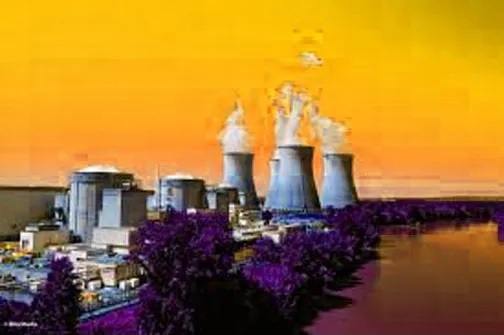
Nuclear power ……….is a sitting technological duck when extreme temperatures strike.
by beyondnuclearinternational, https://beyondnuclearinternational.org/2025/07/27/were-having-a-heatwave/
And nuclear power can’t cope. Worse still, it’s actually a liability under ever more extreme climate conditions, write Karl Grossman and Harvey Wasserman
At the core of the latest attempted “renaissance” of nuclear power is the Big Lie that atomic reactors are an answer to global warming. In fact, they are significant sources of heat.
There are more than 400 nuclear power plants in the world today that fission atoms at 300 degrees Centigrade, (572 degrees Fahrenheit). More are under construction or proposed. As the International Atomic Energy Agency states, “water-cooled reactors offer heat up to 300 degrees Celsius. These types of reactors include pressurized water reactors (PWRs), boiling-water reactors (BWRs), pressurized heavy-water reactors, and light-water-cooled graphite-moderated reactors (LWGRs).”
Some heat is absorbed in the water—drawn from water bodies—used to cool these nuclear power plants and then returned, still with considerable heat, to rivers or seas.
The heatwave going on in recent weeks in Europe, in combination with this discharge of heated water from nuclear plants, has caused nuclear plants there to shut down.
Consider these headlines from recent days:
“France and Switzerland shut down nuclear power plants amid scorching heatwave,” was the July 3rd headline on Euronews. As the piece explained: “To cool down, nuclear power plants pump water from local rivers or the sea, which they then release back into water bodies at a high temperature. However, Europe’s ongoing heatwave means that the water pumped by nuclear sites is already very hot, impacting the ability of nuclear plants to use it to cool down. On top of this, nuclear sites run the risk of posing a dangerous threat to local biodiversity, by releasing water which is too hot into rivers and seas.”
A New York Times article, also dated July 3rd, related how in Europe, “operators shut down one of the two reactors at the Golfech nuclear power plant in southern France after forecasts that the Garonne River, from which it draws water and then discharges it after it is used in the plant as coolant, “could top…82 degrees Fahrenheit.” The Times continued: “The Beznau Nuclear Power Plant in Switzerland, built along the Aare River followed suit, shutting down one of its reactors on Tuesday and the other on Wednesday.”
It quoted its European program director, Pawel Czyzak, saying: “Heatwaves will not go away—they will only get more severe in the future…Luckily, there is no lack of sunshine during heatwaves. The biggest opportunity is to store solar electricity…”
“The French nuclear fleet has been impacted the most, with all but one of the 18 facilities experiencing some type of capacity reduction,” said the report.
It continued: “While heatwaves bring major changes, these are partially offset by the large volumes of solar energy available during daytime. In fact, June 2025 was the highest European Union solar electricity production month on record.” And this “kept the grid well-supplied during daytime hours.”
The Ember report also pointed out, “Solar power is one of the cheapest forms of electricity that Europe has.”
Nuclear power, beyond being subject to catastrophic accidents such as those that occurred at Fukushima, Chernobyl and Three Mile Island, extreme cost, substantial carbon emissions during the nuclear “lifecycle”—mining of uranium, milling it, enrichment of the uranium fuel and other operations—is a sitting technological duck when extreme temperatures strike.
Ember, an independent London-based global energy think tank, on July 4th issued a report headed: “Heat and power: Impacts of the 2025 heatwave in Europe.” It noted: “Heatwaves are becoming more frequent in Europe, putting electricity grids under severe stress.”
“Europe embraces its new reality with heatwaves: ‘They are no longer an exception,’” was the headline of a July 3rd El Mundo article. “Heatwaves in Southern Europe are becoming increasingly early and intense,” it reported.
It quoted Meto-France climatologist Christine Berne saying: “Heatwaves are no longer an exception. They are now more frequent, longer, and spread over larger geographical areas…The phenomenon is directly related to global warming, which is profoundly altering weather patterns, both in France and elsewhere.”
In California, a “bait and switch” to continue operation of the Diablo Canyon atomic reactors is super-heating the Pacific Ocean. In 2018, Pacific Gas & Electric was being forced to stop violating state and federal water protection laws with its massive heat emissions from the twin nuclear power plants. Facing the expensive requirement to build cooling towers, the company agreed to shut down Diablo in 2024 and 2025, ushering in a transition to cheaper, safer, cleaner, more reliable and more job-producing renewables. But in 2022, Governor Gavin Newsom killed the phase-out agreement he had signed as Lieutenant-Governor. So, Diablo still pours billions of gallons of irradiated super-heated water into the Pacific, joining the billions of gallons of irradiated liquid that are pouring in from the site of the Fukushima catastrophe.
In addition to that heat, all nukes emit radioactive fallout, including a radioactive form of carbon, Carbon 14, along with other lethal pollutants, while costing ratepayers up to 10 times more than solar, wind, geothermal and battery backup.
Solar energy, its cost having plummeted in recent years, is now 90 percent cheaper per watt than nuclear power. Further, its efficiency level — its efficiency in converting sunlight to electricity — has dramatically increased. Safe, clean, renewable energy sources — primarily in the form of solar panels and wind turbines — now account for more than 80 percent of the world’s new electric generating capacity.
What’s gone on in the last several weeks in Europe is no exception. The heat is on all over the globe. But there’s solar (and wind) power continuing to function well, while adding no heat, radiation or carbon of its own — unlike the planet’s hyper-lethal nuke reactors.
Meanwhile, the nuclear industry is pushing a new kind of reactor — a fusion reactor that would operate at an astronomical level of heat. It would utilize, instead of fission, the fusion of atoms — the process that happens on the sun, and notes the World Economic Forum: “Temperatures in excess of 150 million degrees Celsius — 10 times hotter than the center of the sun — re required for fusion to occur on Earth.”
“Unsurprisingly,” says the Geneva, Switzerland-based organization, “achieving and controlling these enormous temperatures is a substantial technological challenge. This usually requires using incredibly powerful magnets to contain a hot plasma, preventing it from touching and melting the sides of vessels. Fusion research reactors have achieved temperatures in excess of 300 million degrees Celsius.”
The World Economic Forum’s 2020 analysis is headed: “What is fusion energy, and what will it take for it to go mainstream?”
What does 150 million degrees Celsius convert to in Fahrenheit: 270 million degrees!
To fantasize that Earth-threatening global warming happening now and gaining in intensity can be dealt with by fission nuclear power plants operating at 572 degrees Fahrenheit or fusion nuclear power plants operating at 270 million degrees Fahrenheit is among the great follies in human history.
Harvey Wasserman wrote the books Solartopia! Our Green-Powered Earth and The Peoples Spiral of US History and co-convenes the Grassroots Emergency Election Protection Coalition . Karl Grossman is the author of Cover Up: What You Are Not Supposed to Know About Nuclear Power and Power Crazy. He the host of the nationally-aired TV program Enviro Close-Up with Karl Grossman.
They Intend To Keep Lying About Gaza Until They’ve Emptied It Out
Caitlin Johnstone, Jul 27, 2025, https://www.caitlinjohnst.one/p/they-intend-to-keep-lying-about-gaza?utm_source=post-email-title&publication_id=82124&post_id=169369626&utm_campaign=email-post-title&isFreemail=true&r=1ise1&triedRedirect=true&utm_medium=email
We’re back at the part of the news cycle where Israel tells the world it’s going to allow a bit more aid into Gaza in order to mollify its allies and reduce the public outcry as images of starving children draw objections from the west.
This is just Israel giving the Kier Starmers and Anthony Albaneses of the western world just enough of an excuse to go silent about the starvation of Gaza again. They will then continue starving Gaza. This psychopathic python-like suffocation tactic is how Israel has gotten Gaza to the point it’s at now.
And of course it’s worth noting that Israel’s announcement that it will allow more food into Gaza so people don’t starve completely debunks all its claims these last few days that people in Gaza are starving because of Hamas and the UN. They’re starving because Israel is starving them.
Israeli officials have told The New York Times that there has never been any evidence of Hamas stealing aid from UN trucks in any significant way, a claim Israel and its apologists have been falsely asserting for two years. They lie about everything. They never stop lying.
We’ve been asked to believe a lot of intensely stupid narratives throughout this genocide, but “it’s actually HAMAS who’s starving Gaza” has got to be the dumbest one yet. The fact that Israel and its supporters tried to blame the UN and Hamas for Israel’s extensively documented starvation campaign makes it clear that these freaks intend to keep lying about this thing until the last dying gasp of the last Palestinian.
Gideon Levy has a new article out titled “Denying Gaza’s Starvation Is No Less Vile Than Denying the Holocaust”. Personally I’d take it much further and say it’s vastly worse than denying the Holocaust, because it’s helping to kill people right this very moment.
I’m sorry if this is antisemitic but I think it’s wrong to deliberately starve thousands of children to death.
If you found out someone was trapping small children in a confined space and then intentionally starving them to death, what words would you use to describe that person?
Think about how fucked up you’d need to be inside to starve a baby, or to support someone who is doing so. Think how many millennia of evolutionary conditioning you’d have to override as a human, as a primate, as a mammal, to stifle the screaming you feel inside when you see a skeletal infant. You’d have to make yourself less of a human inside to support the inhumanity.
The worst thing Donald Trump has ever done is commit genocide in Gaza. Everything else pales in comparison. He could end the Gaza holocaust with a phone call just like Biden could have, and he hasn’t. For that reason alone he deserves to die in a cage.
Children’s Youtube star Ms Rachel has announced that she won’t be working with anyone who doesn’t publicly oppose Israel’s genocide in Gaza.
The thing I love about Ms Rachel is that nobody was pushing her to speak out about Gaza. Not one person was out here saying “Ms Rachel’s silence on Rafah is deafening!” She could’ve gotten away with being silent on Gaza forever and suffered no professional consequences, but she spoke out anyway because she’s a genuinely good person.
Today I got my first comment telling me I was wrong to oppose Israel in October 2023 but now I’m right because things have changed. I expect to receive many more such comments going forward as people navigate the difficult cognitive dissonance terrain of realizing they’ve been wrong this entire time.
Israel apologists love using circular reasoning to dismiss outlets and organizations which criticize Israel. If you’ve ever argued with them online you know what I’m talking about.
It’s basically this —
Normal person: Here’s evidence of Israel doing bad things.
Israel apologist: You can’t cite THAT outlet! That outlet is Hamas propaganda!
Normal person: What? What makes them Hamas propaganda?
Israel apologist: They’re always saying Israel does bad things!
Or this —
Normal person: Israel is committing genocide.
Israel apologist: Nuh-uh, that’s blood libel.
Normal person: Amnesty International, Human Rights Watch and UN human rights experts all say it’s genocide.
Israel apologist: Those groups are antisemitic!
Normal person: What? Why do you say that?
Israel apologist: They’re always spreading antisemitic lies about Israel!
Normal person: Such as?
Israel apologist: Such as saying Israel is committing genocide!
Everyone spreading lies today to help Israel carry out the final stages of its final solution knows exactly what they’re doing. We see you, you sick fucks. We’ll remember you forever.
Israeli Navy Seizes Second Gaza-Bound Freedom Flotilla Vessel in 2 Months
“The interception occurred in international waters outside Palestinian territorial waters off Gaza, in violation of international maritime law,” the Freedom Flotilla Coalition said.
Common Dreams, Olivia Rosane, 26 July 25
The Israeli military intercepted and seized the Gaza Freedom Flotilla vessel The Handala late Saturday night local time as it attempted to deliver desperately needed humanitarian aid to the besieged people of Gaza.
The Freedom Flotilla Coalition reported that Israeli forces cut the cameras on board the ship at 11:43 pm local time, when it was around 40 nautical miles from Gaza.
Jul 26, 2025
The Israeli military intercepted and seized the Gaza Freedom Flotilla vessel The Handala late Saturday night local time as it attempted to deliver desperately needed humanitarian aid to the besieged people of Gaza.
The Freedom Flotilla Coalition reported that Israeli forces cut the cameras on board the ship at 11:43 pm local time, when it was around 40 nautical miles from Gaza.
SUBSCRIBE TO OUR FREE NEWSLETTER
Quality journalism. Progressive values. Direct to your inbox.
“The unarmed boat was carrying lifesaving supplies when it was boarded by Israeli forces, its passengers abducted, and its cargo seized,” the coalition wrote. “The interception occurred in international waters outside Palestinian territorial waters off Gaza, in violation of international maritime law.”
Israel’s Foreign Ministry confirmed that its navy had intercepted the ship, as Al Jazeera reported……………………………………………………………………………………….. https://www.commondreams.org/news/israel-gaza-freedom-flotilla
French submarine-maker targeted by hackers
Cyber attackers claim to have uncovered source code for submarine weapon systems.
A French naval giant is investigating a potential cyber attack after
hackers claimed to have obtained sensitive data about the country’s
nuclear submarines. Naval Group, a state-owned ship maker that traces its
origins back almost 400 years to the reign of Louis XIII, said it had
“immediately launched technical investigations” after cyber criminals
threatened to publish files on the dark web.
Telegraph 27th July 2025, https://www.telegraph.co.uk/business/2025/07/27/french-submarine-maker-targeted-by-hackers/
The real story of Chernobyl, the worst nuclear disaster in history
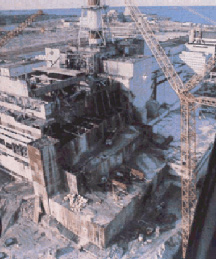
The Chernobyl Sarcophagus Memorial sculpture was erected in 2006 and is dedicated to the memory of the heroic plant workers and emergency crew who prevented a global catastrophe .
28 July 25,https://www.history.co.uk/articles/the-story-of-chernobyl-the-worst-nuclear-disaster-in-history
On 26th April 1986, a routine safety test went catastrophically wrong and triggered the worst nuclear accident of all time. The incident at the Chernobyl Nuclear Power Plant near Pripyat, Ukraine led to the release of 400 times more radiation than the atomic bomb dropped on Hiroshima during WW2.
31 people died in the immediate aftermath, whilst the long-term health effects caused by Chernobyl are still a hotly debated subject. Approximately 60,000 square miles around the plant were contaminated and an area nearly twice the city of London remains an exclusion zone to this day.
Background of Chernobyl
Lying just 10 miles from the Belarus-Ukraine border and around 62 miles north of the Ukrainian capital Kyiv, the Chernobyl Nuclear Power Plant was commissioned in 1977 as part of the old Soviet Union, with the first reactor supplying power to the grid later that year. By 1984, four reactors had entered commercial operation, each capable of producing 1,000 megawatts of electrical power.
Just under two miles from the plant was the city of Pripyat, founded in 1970 and named after the nearby river. It was built to serve the power plant and at the time of the disaster, its total population was just shy of 50,000.
Nuclear disaster unfolds
Throughout Friday, 25th April 1986, Chernobyl’s engineers lowered power at Reactor No. 4 in preparation for a safety test to be conducted later that evening. The test was supposed to check whether the reactor turbines could continue powering emergency water coolant pumps in the event of a power failure.
Ironically, the safety test was anything but safe as human error and substandard reactor design led to a partial meltdown of the core.
The experiment was poorly conceived and equally badly executed. Firstly, the less-experienced night shift crew carried out the safety test and later claimed they had not received full instructions from the day shift crew on how to properly conduct it. Secondly, the emergency core cooling system for Reactor 4 was disabled along with the emergency shutdown system.
Finally, the reactor’s power level dropped to a dangerously unstable level at which point the engineers removed most of the control rods in violation of safety guidelines. Although power began to return, it was far from under control.
Explosion in Reactor 4
At 1:23am on 26th April, the safety test was given the all-clear by plant supervisors. Almost immediately a power surge occurred, triggering the engineers to re-insert all 211 control rods. The control rods were graphite tipped, a design flaw that would prove fatal as they increased the reaction in the core, instead of lowering it.
The subsequent steam explosions blew off the steel and concrete lid of the reactor as the core suffered a partial meltdown. Two engineers were killed instantly whilst two more suffered severe burns. The explosion, along with the resulting fires, released at least 5% of the radioactive reactor core into the atmosphere. Blown by the wind, radioactive materials were spread to many parts of Europe over the coming days.
Emergency response begins
Firefighters quickly arrived on the scene but without proper protective clothing, many perished in the coming months from acute radiation syndrome. By dawn, all the fires were suppressed except for the one in the reactor core.
The other three reactors were shut down a short while later. The following day officials ordered helicopters to begin dumping more than 5,000 tonnes of sand, lead, clay, and boron onto the burning reactor to help extinguish the core fire.
A Soviet cover-up
It took nearly 36 hours for Soviet officials to begin evacuating nearby Pripyat. The city’s residents were unaware of the true dangers presented by the previous day’s events. Advised to pack only necessities, the people of Pripyat were loaded onto buses believing their evacuation to be temporary. Little did they know, they would never return to their homes again.
Two days after the catastrophic explosion the rest of the world remained in the dark as the Soviets attempted to cover up the event. However, on 28th April, Swedish radiation monitoring stations 800 miles away began detecting high levels of radiation. With their backs to the wall, the Soviets finally made a statement, with the Kremlin admitting an accident had occurred at Chernobyl, but assuring the world that officials had it under control.
Heroism on display
In the days that followed, hundreds of workers risked their lives to contain radiation leaking from the reactor core.
On 4th May, three divers made their way through the dark flooded basement of Reactor 4 to turn valves and drain the ‘bubbler pools’ sitting below the core. Had they not succeeded in their mission, molten nuclear material would have eventually melted its way down to the pools.
This would have triggered a radiation-contaminated steam explosion and destroyed the entire plant along with its three other reactors, causing unimaginable damage and nuclear fallout that the world would have struggled to recover from.
Radioactive debris also needed to be removed from the roof of the reactor. After robots failed to do the job, workers equipped with heavy protective gear were sent in.
Nicknamed ‘Bio-robots’, these workers were unable to spend more than 90 seconds on the roof due to the extreme levels of radiation. In the end, 5,000 men went up on the irradiated rooftop to successfully clear the radioactive material from it.
Clean-up commences
By mid-May, Soviet leader Mikhail Gorbachev had ordered thousands of firefighters, miners, and soldiers to begin the long and arduous task of cleaning up. Known as ‘Liquidators’, 600,000 – 800,000 of them began burying radioactive debris and topsoil, as well as shooting all wildlife (both domestic and wild) within the 19-mile exclusion zone surrounding the power plant.
Nicknamed ‘Bio-robots’, these workers were unable to spend more than 90 seconds on the roof due to the extreme levels of radiation. In the end, 5,000 men went up on the irradiated rooftop to successfully clear the radioactive material from it.
Clean-up commences
By mid-May, Soviet leader Mikhail Gorbachev had ordered thousands of firefighters, miners, and soldiers to begin the long and arduous task of cleaning up. Known as ‘Liquidators’, 600,000 – 800,000 of them began burying radioactive debris and topsoil, as well as shooting all wildlife (both domestic and wild) within the 19-mile exclusion zone surrounding the power plant.
Aftermath
The Chernobyl Exclusion Zone was eventually extended to cover approximately 1,000 square miles, whereby it was declared uninhabitable for over 20,000 years. The other three reactors at Chernobyl remained active until their individual shutdowns in 1991, 1996, and 2000. Gorbachev later wrote that he believed the incident at Chernobyl was the ‘real cause of the collapse of the Soviet Union’.
Whilst the lasting health effects of the disaster remain unclear and much debated, various sources have estimated that thousands of cancer deaths can be linked back to Chernobyl.
Greenpeace hails Italian court ruling allowing climate case against energy company Eni to continue

Italy’s highest court has ruled that a lawsuit brought by climate
activists against Italian energy company Eni and its government
shareholders can go ahead, in what Greenpeace said on Tuesday was a victory
for efforts to pursue climate justice in Italy.
In an ordinance released on
Monday, the Court of Cassation rejected the company’s motions to dismiss
the lawsuit on jurisdictional grounds and ordered the case to be heard on
its merits by a Rome tribunal. Eni said that it was greatly satisfied with
the decision, and said it expected that the Rome court would ultimately
“dismantle” the climate activists’ claims of responsibility.
Yahoo News 22nd July 2025, https://uk.news.yahoo.com/greenpeace-hails-italy-court-ruling-130205151.html
5 worst nuclear disasters from around the world
Nuclear disasters can be caused by a variety of factors, but they all have the potential to have widespread impacts that can linger for generations.
28 July 25 https://www.history.co.uk/articles/worst-nuclear-disasters
Harnessing the biblical power of nuclear fission was never going to be a risk-free proposition and the world has been shaken by several shocking accidents since the atomic age began. Here are five of the worst.
1. Kyshtym

Decades before the Chernobyl power plant was even built, the Soviet Union experienced a radioactive eruption which irradiated thousands of square miles of the Ural Mountains region. The source of the calamity was the Mayak plutonium-processing plant near the town of Kyshtym – a facility which had been quickly erected to produce essential materials for the Soviet Union’s nuclear weapons programme.
The breakneck pace of development meant safety fell by the wayside, to the point where staff failed to fix a malfunctioning cooling system designed to keep tanks of nuclear waste at safe temperature levels. On 29th September 1957, one of these steel tanks finally exploded, blowing off a metre-thick concrete lid and sending out a cloud of nuclear fallout.
The local population was kept in the dark about the explosion and a whole week went by before they were evacuated. It wasn’t until 1976 that the details of the disaster were leaked to the Western press by an exiled Russian scientist. The true health impact is impossible to know for sure, although increased rates of cancer and other medical issues have been associated with the disaster.
2. Windscale
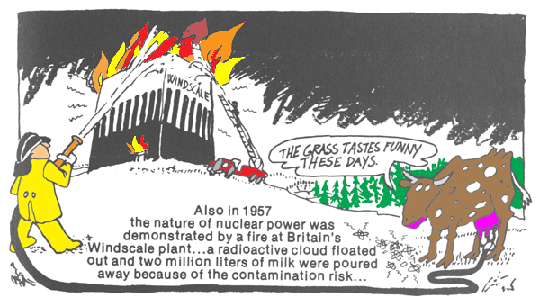
The name ‘Windscale’ isn’t known to many people these days, because this British nuclear site was renamed ‘Sellafield’ in 1981. Windscale was then notorious as the site of one of the world’s worst nuclear accidents and the resulting bad PR was a reason why the authorities decided to rebrand.
Back in 1957, Windscale’s towering reactors were producing weapons-grade plutonium for Britain’s nuclear arsenal, but disaster struck in the form of a fire in one of the reactors on 10th October. Workers had to bravely battle to extinguish the inferno, despite the real risk of being irradiated by the burning uranium.
3. Chernobyl

Ironically, the disaster whose name is a byword for nuclear calamity only occurred because of a safety test.
In the early hours of 26th April 1986, workers at the Chernobyl nuclear plant initiated an experiment to assess how the reactor cooling mechanisms would function in the event of a power outage. A combination of design flaws and human error caused the test to go catastrophically wrong, leading to a power surge and a steam explosion which tore the 1,000-ton cover off reactor number four.
Another explosion followed and the reactor was now a terrifying crater expelling radioactive contaminants into the atmosphere. One worker staring directly at the core recounted how the blue, ionised air was ‘flooding up into infinity’ – a spectacle both beautiful and terrifying.
The nearby city of Pripyat was evacuated 36 hours later, abruptly going from a bustling urban centre to an eerie ghost town. Chernobyl workers and firefighters killed by the initial explosions and ensuing radiation poisoning numbered at least 30.
Contrary to popular belief, the three so-called ‘Chernobyl divers’ who were sent in on a ‘suicide mission’ to drain water from the plant, actually survived their excursion. But the consequences of Chernobyl were immense, with a vast Exclusion Zone being enforced, and the disaster thought to be linked with thousands of cancer deaths.
4. Three Mile Island
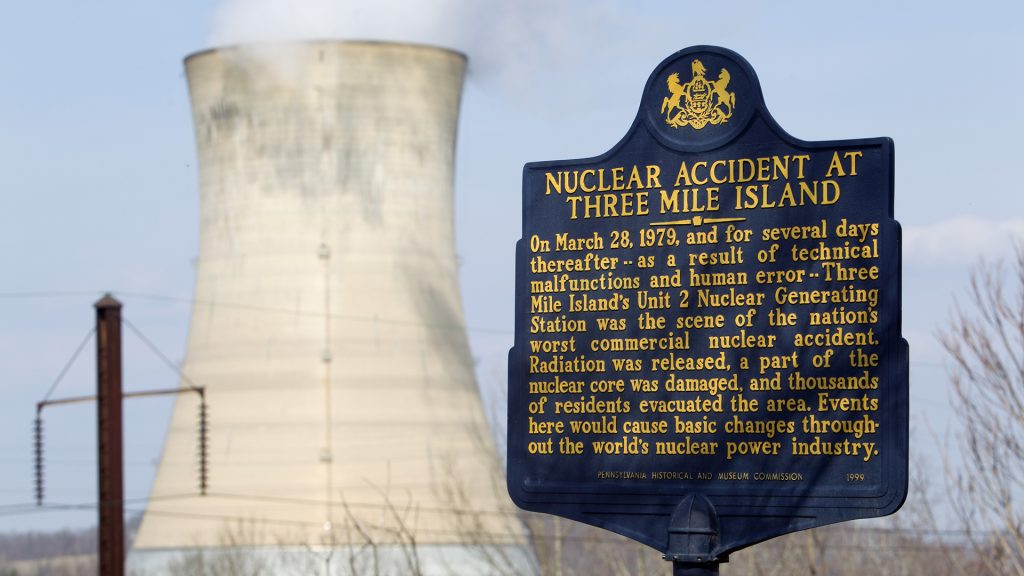
Prior to Chernobyl, three words were synonymous with nuclear disaster: Three Mile Island. The incident at this power plant in Pennsylvania on 28th March 1979 was made all the more notorious because it took place less than two weeks after the release of The China Syndrome, a star-studded disaster movie about the imminent threat of a nuclear meltdown.
Although Three Mile Island was fortunately ‘only’ a partial meltdown caused by a cooling malfunction, it was enough to release radioactive materials into the environment. The state’s governor advised that pregnant women and young children should evacuate the area. Before long, around 140,000 people had fled.
Though most experts believe the health effects to have been minimal, Three Mile Island galvanised anti-nuclear activists in the US, with Jane Fonda – star of The China Syndrome – giving a speech at an anti-nuclear protest held in the wake of the accident.
5. Fukushima

The disaster at the Fukushima power plant on 11th March 2011 had the most dramatic origin of all nuclear accidents. Namely, a gigantic tsunami which had been in turn triggered by an undersea earthquake off the coast of Japan.
It was the most powerful earthquake in Japan’s history, and the tsunami waves easily crashed over the plant’s seawall, flooding the reactor buildings and knocking out the emergency diesel generators providing backup power for the coolant systems.
The untamed residual heat within the reactors caused three partial meltdowns and subsequent gas explosions, leading to at least 160,000 people evacuating the area after the accident.
1 This Month

of the week – Shut Down Drone Warfare!


Tell the Ukrainian Government to Drop Prosecution of Peace Activist Yurii Sheliazhenko

Petition to revoke the licensing of the Near Surface Nuclear Disposal Facility (NSDF) at Chalk River. https://www.ourcommons.ca/petitions/en/Petition/Details?Petition=e-7247
To see nuclear-related stories in greater depth and intensity – go to https://nuclearinformation.wordpress.com
-
Archives
- April 2026 (91)
- March 2026 (251)
- February 2026 (268)
- January 2026 (308)
- December 2025 (358)
- November 2025 (359)
- October 2025 (376)
- September 2025 (257)
- August 2025 (319)
- July 2025 (230)
- June 2025 (348)
- May 2025 (261)
-
Categories
- 1
- 1 NUCLEAR ISSUES
- business and costs
- climate change
- culture and arts
- ENERGY
- environment
- health
- history
- indigenous issues
- Legal
- marketing of nuclear
- media
- opposition to nuclear
- PERSONAL STORIES
- politics
- politics international
- Religion and ethics
- safety
- secrets,lies and civil liberties
- spinbuster
- technology
- Uranium
- wastes
- weapons and war
- Women
- 2 WORLD
- ACTION
- AFRICA
- Atrocities
- AUSTRALIA
- Christina's notes
- Christina's themes
- culture and arts
- Events
- Fuk 2022
- Fuk 2023
- Fukushima 2017
- Fukushima 2018
- fukushima 2019
- Fukushima 2020
- Fukushima 2021
- general
- global warming
- Humour (God we need it)
- Nuclear
- RARE EARTHS
- Reference
- resources – print
- Resources -audiovicual
- Weekly Newsletter
- World
- World Nuclear
- YouTube
-
RSS
Entries RSS
Comments RSS
 nuclear-news