Sellafield nuclear clean-up too slow and too costly, say MPs

Alex Lawson, 4 June 25 https://www.theguardian.com/business/2025/jun/04/sellafield-nuclear-clean-up-mps-public-accounts-committee
Parliamentary committee raises concerns over ‘suboptimal’ workplace culture at ageing waste dump.
MPs have warned about the speed and cost of cleaning up the Sellafield nuclear waste dump and raised concerns over a “suboptimal” workplace culture at the site.
Members of parliament’s public accounts committee (PAC) urged the government and bosses at the sprawling collection of crumbling buildings in Cumbria to get a grasp on the “intolerable risks” presented by its ageing infrastructure.
In a detailed report into the site, the PAC said Sellafield was not moving quickly enough to tackle its biggest hazards; raised the alarm over its culture; and said the government was not ensuring value for money was being achieved from taxpayer funds.
In 2023, the Guardian’s Nuclear Leaks investigation revealed a string of safety concerns at the site – including escalating fears over a leak of radioactive liquid from a decaying building known as the Magnox swarf storage silo (MSSS) – as well as cybersecurity failings and allegations of a poor workplace culture.
The PAC – which heard evidence in March from Sellafield and its oversight body, the Nuclear Decommissioning Authority (NDA) – found that the state-owned company had missed most of its annual targets to retrieve waste from several buildings, including the MSSS.
“As a result of Sellafield’s underperformance [the MSSS] will likely remain extremely hazardous for longer,” the MPs said.
The ultimate cost of cleaning up Sellafield, which contains waste from weapons programmes and atomic power generation, has been estimated at £136bn and could take more than 100 years.
Geoffrey Clifton-Brown, the chair of the PAC, said: “Unfortunately, our latest report is interleaved with a number of examples of failure, cost overruns, and continuing safety concerns. Given the tens of billions at stake, and the dangers on site to both the environment and human life, this is simply not good enough.”
He added: “As with the fight against climate change, the sheer scale of the hundred-year timeframe of the decommissioning project makes it hard to grasp the immediacy of safety hazards and cost overruns that delays can have.
“Every day at Sellafield is a race against time to complete works before buildings reach the end of their life. Our report contains too many signs that this is a race that Sellafield risks losing.”
MPs noted that one project, a now-paused replacement of an on-site lab, had resulted in “£127m wasted”.
The cost of cleaning up Sellafield has caused tensions with the Treasury as the chancellor, Rachel Reeves, attempts to tighten public spending and spur growth. Sellafield, which is home to the world’s largest store of plutonium, said in February that nearly £3bn in new funding was “not enough”.
Last year, Sellafield apologised and was fined £332,500 after it pleaded guilty to criminal charges over years of cybersecurity failings.
The PAC noted that the timeline for a government project to create a long-term deep underground store for nuclear waste, including that held at Sellafield, had slipped from 2040 to the late 2050s. The government is considering sites in Cumbria and Lincolnshire, although Lincolnshire county council is expected to withdraw the latter from the process after vocal local opposition.
The MPs said they had found “indications of a suboptimal culture” at Sellafield, and noted that the NDA paid £377,200 in 2023-24 to settle employment-related claims. Alison McDermott, a former HR consultant who raised concerns over bullying and a “toxic culture” at the site, said she felt “vindicated” by the report.
The PAC urged the government to set out how it would hold the NDA and Sellafield to account over its performance. It said Sellafield should report annually on progress against targets and explain how it is addressing the deteriorating condition of its assets. The NDA should publish data on the prevalence of bullying and harassment at nuclear sites, it said.
Clifton-Brown said there were “early indications of some improvements in Sellafield’s delivery” but said the government needed to do “far more” to ensure bosses safeguard the public and taxpayer funds.
The NDA’s chief executive, David Peattie, responding on behalf of Sellafield, said: “We welcome the scrutiny of the committee and their report. We will now look in more detail at the recommendations and consider how best to address them.
“We take the findings seriously, and the safety of the site and the wellbeing of our people will always be our highest priorities.”
A spokesperson for the Department for Energy Security and Net Zero said: “We expect the highest standards of safety and security as former nuclear sites are dismantled, and the regulator is clear that public safety is not compromised at Sellafield.
“We continue to support the Nuclear Decommissioning Authority in its oversight of Sellafield, while driving value for money. This is underpinned by monthly performance reviews and increased responsibility for overseeing major project performance, enabling more direct scrutiny and intervention.
“We have zero-tolerance of bullying, harassment and offensive behaviour in the workplace – we expect Sellafield and the NDA to operate on this basis, investigate allegations and take robust action when needed.”
Sizewell C nuclear power plant ‘could get go-ahead within weeks’

Keir Starmer expected to confirm result of 15-year search for investment at UK-France summit next month
Jillian Ambrose, 3 June 25, https://www.theguardian.com/business/2025/jun/03/sizewell-c-nuclear-power-plant-keir-starmer-uk-france-edf
UK ministers could give the go-ahead to the new Sizewell C nuclear power plant in Suffolk within weeks, according to reports.
Keir Starmer is expected to give the final nod to begin construction of Britain’s second new nuclear power project in a generation, alongside the French nuclear developer EDF, at a Franco-British summit next month.
The final approval for Sizewell C, first reported by the Financial Times, would mark the end of a 15-year journey to secure investment for the plant since the site was first earmarked for new nuclear development in 2010.
The government is understood to be in the final stages of securing billions of pounds of investment from the private sector to back the project, which follows the Hinkley Point C nuclear plant, which is under construction in Somerset.
Ministers are expected to use the government’s spending review, scheduled for 11 June, to set out the UK’s investment in the project, which will ultimately rely on a mix of funding from taxpayers and via energy bills.
The final go-ahead from Starmer and the French president, Emmanuel Macron, will then follow during the Anglo-French summit due to take place in London on 8-10 July, according to the Financial Times.
The UK government’s stake in the project stood at 84% at the end of last year compared with EDF’s 16% share of the project. The French state’s cash-strapped utilities company is understood to be eager to reduce its stake in the project even further.
Potential investors in the project according to the report include Schroders Greencoat, Equitix, the Canadian pension fund CDPQ, Amber Infrastructure Partners, Brookfield Asset Management, the UK pension fund USS and the insurer Rothesay, backed by the Singaporean infrastructure fund GIC.
EDF had originally planned to build the nuclear plant alongside China’s state nuclear developer China General Nuclear Power Corp, which also holds a stake in the Hinkley Point C project, but its partner was forced to step back from the project by the UK government on security grounds.
The project has secured £6.4bn of government funding to support its development to date, of which £2.5bn was granted by the Conservative government under Rishi Sunak and a further £3.9bn has come from the current Labour administration.
Nuclear Proliferation’s Next Iteration
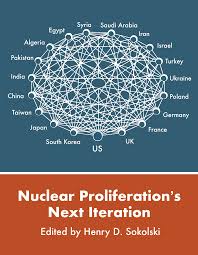
Henry Sokolski, May 2025, https://npolicy.org/nuclear-proliferations-next-iteration/
The world is about to experience the second iteration of nuclear proliferation. The first era began in 1949 with Russia’s first nuclear weapons test. It ended in 2002 when North Korea set off its own first device. Nuclear weapons spread, but slowly. Most would-be bomb-makers – South Africa, Argentina, Brazil, Iraq, Taiwan, South Korea, Libya, Ukraine, Kazakhstan, Sweden, Italy, Romania, Australia, and Syria – gave up their weapons projects. Only nine completed and kept them (the United States, Russia, the United Kingdom, France, China, Israel, India, Pakistan and North Korea).
It’s unclear if we’ll be as lucky with nuclear proliferation’s next iteration. Poland, Germany, Turkey, Saudi Arabia, South Korea and Japan will tell the tale. If any go nuclear, others — Egypt, Algeria, the UAE, Vietnam, Australia, Ukraine—will surely be tempted.
Two other headaches compound these concerns. The first is the prospect that states will target reactors in war and release dangerous amounts of radiation. The war in Ukraine serves as a poster child. Recent Chinese, North Korean, and Israeli threats to bomb their neighbors’ nuclear plants suggest Kyiv’s predicament is not a one-off.
The second concern is increased interest in nuclear weapons sharing. NATO states, Ukraine, South Korea, Japan, and Russia have all expressed an interest in either hosting or placing weapons on other nation’s soil. This practice, which was so popular during the 1950s and 1960s, will stress U.S. friendships and alliances if renewed.
There are several factors behind these developments. One is the erosion of American security guarantees and the augmentation of Chinese, Russian and North Korean nuclear arsenals. Yet another is the emergence of precision guided munitions and their use against civilian infrastructure in Ukraine. Finally, nuclear supplier nations are pushing the wholesale export of “peaceful” nuclear reactors, all of which are potentially bomb program building blocks. The key markets include the world’s most war-torn regions (e.g., Eastern Europe, the Middle East, South and East Asia).
All of this should raise concerns. Instead, governments have either ignored or denied these developments.
States have used nuclear plants to make bombs and targeted them in war. Nuclear power advocates downplay these worries. New, smaller reactors, they insist, will be extremely safe and proliferation resistant. However, some of their favorite reactor designs use or produce materials helpful to make bombs. China, Ukraine, Taiwan and Japan have publicly fretted about the military vulnerability of their plants. The U.S. and most other governments, though, are quite silent.
Then, there’s nuclear sharing. The United States largely got out of this business. It pulled thousands of U.S.nuclear weapons from South Korea, Taiwan, the Philippines, Okinawa, and most of NATO. But in 2023, Russia went the other way: To intimidate NATO and Ukraine, Moscow re-deployed nuclear weapons to Belarus.
Polish officials took notice and asked the United States and France to forward deploy nuclear weapons on Polish soil. South Korea’s hawkish political party leadership made similar demands, as did Japan’s former prime minister, Shinzo Abe. All of these requests reflect a deeper, not-so-secret desire to acquire bombs of their own. The latest public U.S. response to these allied requests, however, has been to dismiss them.
And what might unfold if these nations go nuclear?
We may soon find out. Saudi Arabia’s Crown Prince Mohammed Bin Salman and his lieutenants have warned that the Kingdom must go nuclear if Iran gets a bomb. With any bad luck, Tehran and Riyadh could be the first of several new Middle Eastern nuclear dominos to fall.
One could imagine other new nuclear entrants. Australia once had a nuclear weapons program. So did Taiwan, Brazil, Argentina, South Africa, and Iraq. It’s also conceivable that Vietnam, the Philippines, and Bangladesh, which are all developing peaceful nuclear energy programs of their own, might exploit their civil programs to get bombs.
Why should one care? The short answer is the world may go off the rails. As Henry Kissinger explained:
“If one imagines a world of tens of nations with nuclear weapons and major powers trying to balance their own deterrent equations, plus the deterrent equations of the subsystems, deterrence calculation would become impossibly complicated. To assume that, in such a world, nuclear catastrophe could be avoided would be unrealistic.”
This volume peeks at this not-so-brave world.
NPEC designed and hosted two nuclear games. The volume features their after-action reports. The first game has China goading North Korea to get South Korean proxies to attack reactors and spent fuel ponds at South Korea’s Kori nuclear plant. These assaults prompt radiological releases and massive South Korean and Japanese evacuations. They also make military sense: They tie down and distract the United States, Japan, and South Korea from fending off a Chinese military assault against Taiwan. Beijing is pleased.
NPEC’s second scenario answers a more dire question — how might a nuclear-armed Israel and Iran face off in a crisis? Both have waged massive aerial wars against one another (twice in 2024). Some of these strikes targeted nuclear facilities. Would Israel ever use its nuclear weapons against Iran? Might Iran retaliate in kind? The game concluded the answer is yes.
The volume also features detailed analysis of what Russia’s military has gained from targeting Ukraine’s nuclear plants and supporting electrical supply system. This analysis also examines the military advantages of temporarily disabling such facilities rather than damaging them and releasing significant radiation.
It also explores five additional questions. What does international law and military science recommend to discourage dangerous assaults against nuclear plants? What does the history of Israel’s nuclear weapons acquisition and modernization tell us about these weapons’ possible use? What legal sanctions might their use trigger? What does unclassified modeling reveal about the radiation nuclear plants might release if attacked? How effective might nuclear strikes be against nuclear plants and materials?
This volume tries to tease out the answers. Its purpose is to prompt others to weigh in.
To read the full book, click here. To purchase a hard copy, click here.
Stop Sizewell C carries out bold projection on Sizewell B dome a week before the Spending Review, highlighting alternatives for Sizewell C’s £40 billion cost.

Stop Sizewell C tonight projected a series of messages to the Prime Minister onto Sizewell B’s dome, stating that the £40 billion Sizewell C project is a Nuclear Waste of Money. [1] The messages urge him to make alternative choices for spending taxpayers’ money on ways to generate cheaper electricity and to reduce household bills.
In one week, on 11 June, the Chancellor is expected to set out taxpayers’ commitment to Sizewell C at the conclusion of the Spending Review. Sizewell C has already swallowed £6.4 billion of taxpayers’ money [2] and the entire project is bogging down the government balance sheet. The two-year equity raise process remains ongoing with an uncertain outcome, meaning the much-delayed Final Investment Decision is unlikely before next month at the earliest. The Financial Times says this could take place at an Anglo French Summit between 8-10 July. [3]
Alison Downes of Stop Sizewell C said: “Every pound sunk into risky, expensive Sizewell C is a pound lost to alternative energy sources and critical social funding that the voting public cares deeply about. It’s not too late to redirect money to offshore wind, or warm homes – creating thousands of jobs – or to restoring the most unpopular and unjust cuts. Sizewell C, given the terrible track record of Hinkley Point C, would be £40 billion badly spent.”
Stop Sizewell C 4th June 2025,
https://docs.google.com/document/d/1IugTc5hAy7N9SlPrdvbfevH5USEfIsjJKw-jIDoo74c/edit?tab=t.0
The World Isn’t Ready for the Mental Health Toll of Extreme Heat

The coming summer is forecast to be a scorcher across the U.S. And climate
scientists predict that at least one of the next five years will beat 2024
as the hottest year ever recorded globally. As heat waves are getting more
intense and prolonged, their effect on the mind and body are also becoming
more dire. Children and older people, as well as those who work outdoors,
are most at risk. So are those with mental health disorders. Heat waves are
the single highest cause of weather-related deaths in the U.S., where an
estimated 1,300 fatalities from heat stroke and other temperature-related
complications occur every year. Even those who survive a period of extreme
heat may suffer serious neurological or other mental-health-related
disorders. A new study published in Current Environmental Health Reports
finds that the world is startlingly unprepared to deal with the mental
health consequences of climate change. Of 83 action plans for heat-related
health problems that were reviewed for the study, fewer than a third
acknowledged the mental health effects of extreme or prolonged high
temperatures. And only a fifth of these plans outlined specific actions to
deal with contingencies such as increased hospitalizations for mental
health disorders.
Scientific American 2nd June 2025, https://www.scientificamerican.com/article/the-world-isnt-ready-for-the-mental-health-toll-of-extreme-heat/
Britain considering fleet of nuclear strike aircraft
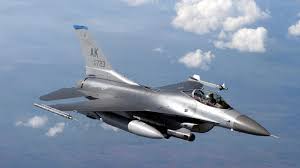
The UK may acquire F-35A fighter jets as part of a broader effort to
deepen its contribution to NATO’s nuclear sharing arrangements, following
a key recommendation in the newly published Strategic Defence Review (SDR).
The document states:
“More F-35s will be required over the next decade.
This could comprise a mix of F-35A and B models according to military
requirements to provide greater value for money.”
This reference to a
potential F-35A acquisition has been interpreted by experts and
parliamentarians as linked to the UK’s possible future role in NATO’s
nuclear sharing mission—an arrangement under which non-nuclear states
host US nuclear weapons and are capable of delivering them in wartime.
While the UK already possesses its own independent nuclear deterrent via
the submarine-based Trident system, participation in NATO’s air-delivered
nuclear mission would mark a significant evolution in its commitment to
Alliance nuclear burden-sharing.
UK Defence Journal 3rd June 2025,
https://ukdefencejournal.org.uk/britain-considering-fleet-of-nuclear-strike-aircraft/
It’s over! Anti-nuke dump campaigners in East Lincolnshire celebrate victory
The UK/Ireland Nuclear Free Local Authorities are delighted to share in
the celebrations of East Lincolnshire residents and their elected members
as Nuclear Waste Services announces that it shall now take the ‘immediate
steps needed to close the Community Partnership and the communities of
Withern and Theddlethorpe, and Mablethorpe will leave the GDF (Geological
Disposal Facility) siting process’.
The announcement came hot on the
heels of the decision this morning by the Lincolnshire County Council
Executive to withdraw its support from the GDF process.
NFLA 3rd June 2025, https://www.nuclearpolicy.info/news/its-over-anti-nuke-dump-campaigners-in-east-lincolnshire-celebrate-victory/
‘To understand the horrors of Hiroshima, you had to live through it’.
A handful of Japanese ‘memory keepers’ are determined to teach new
generation the lessons of 1945 nuclear blast.
Times 2nd June 2025,
https://www.thetimes.com/world/asia/article/hiroshima-horrors-japan-nscdczgnw
Priming us up for war – “it’s not so bad, after all” – Britain’s Labour government leads the way
The Unseen March video from 9 years ago – but now it’s getting worse. https://theaimn.net/priming-us-up-for-war-its-not-so-bad-after-all-britains-labour-government-leads-the-way/
On the outskirts of Berlin, you can visit what’s left of Sachsenhausen , one of the first Nazi concentration camps, set up in 1936, as a model for the more than 44,000 such camps they ran between 1933 and 1945.
I was impressed by the efficiency shown by the way that the Nazis carried out mass murder in this camp – which became a model for how to run this operation as quickly and with as little fuss as possible.
In the early days of the camp, the inmates were used as forced labour. Systematic extermination was carried out. Many thousands died by hunger, disease, overwork, medical experiments and mistreatment. But by 1941, tens of thousands of Jews and Soviet prisoners were being directly murdered.
I saw where this happened. Originally, the prisoners were forced down a brick path, and shot. You can still see stains on this path. But here’s the interesting bit. It turned out that the German soldiers who did the shooting became badly affected by it. Sometimes they would miss, or have to make several shots to actually kill a man. It made the soldiers unwell, having to rather messily murder their victims – it’s not like being in combat, not at all fair. It was making those soldiers mentally ill.
Here’s where the practical genius of the Nazis came in. They devised a special unit, (which was still there, when I visited a few years ago). In this unit, the shooter could be sure of doing one direct lethal hit, but the victim was placed in such a way that the shooter was unable to see him. This system solved the psychological problem of upsetting the man doing the shooting. No more mental illness, and the mass killing could proceed in an orderly way.
In a sort of sequel to this discovery, the Americans in recent years developed the efficiency of drones. targeting and killing suspected terrorists and militants in countries like Pakistan, Yemen, and Afghanistan. Once again, – such a beneficial effect on the operator’s mental health. From thousands of miles away – press a button, no sight of any mess. and a beneficial effect on the the public too – all this killing being done so neatly, and so far away – so much better than an old-fashioned war battle.
So it is that the thought of war becomes much less unpleasant. With drones, and missiles, it has become a sort of distant, sort of “clean”, precision operation.
This new palatability of war comes to add to the already existing beneficial aspects of war. Getting ready for war shows that our great leaders are strong and decisive. It’s patriotic. It defends our democratic values. There are those other – nebulous, but still real, concepts of courage, heroism, and past glorious victories. The new “war-readiness” shows that we are aware, and awake-up to the threats of other countries, who undoubtedly want to attack us. And on top of all that – getting ready for war provides jobs jobs jobs!
Now Sir Keir Starmer’s UK Labour government is not so sure that the British public is convinced of all this. So they’re accentuating the already existing British trend to promote militarism. The Daily Mail announces the new education programme:
Children taught value of the military
Defence chiefs will work with the Department for Education to develop understanding of the Armed Forces among young people in schools, by means of a two-year series of public outreach events across the UK, explaining current threats and future trends.
Schools and community-based cadet forces will also be expanded, with an ambition of a 30 per cent rise by 2030 with a view to the UK having 250,000 cadets, many of whom will then go on to join the armed forces.
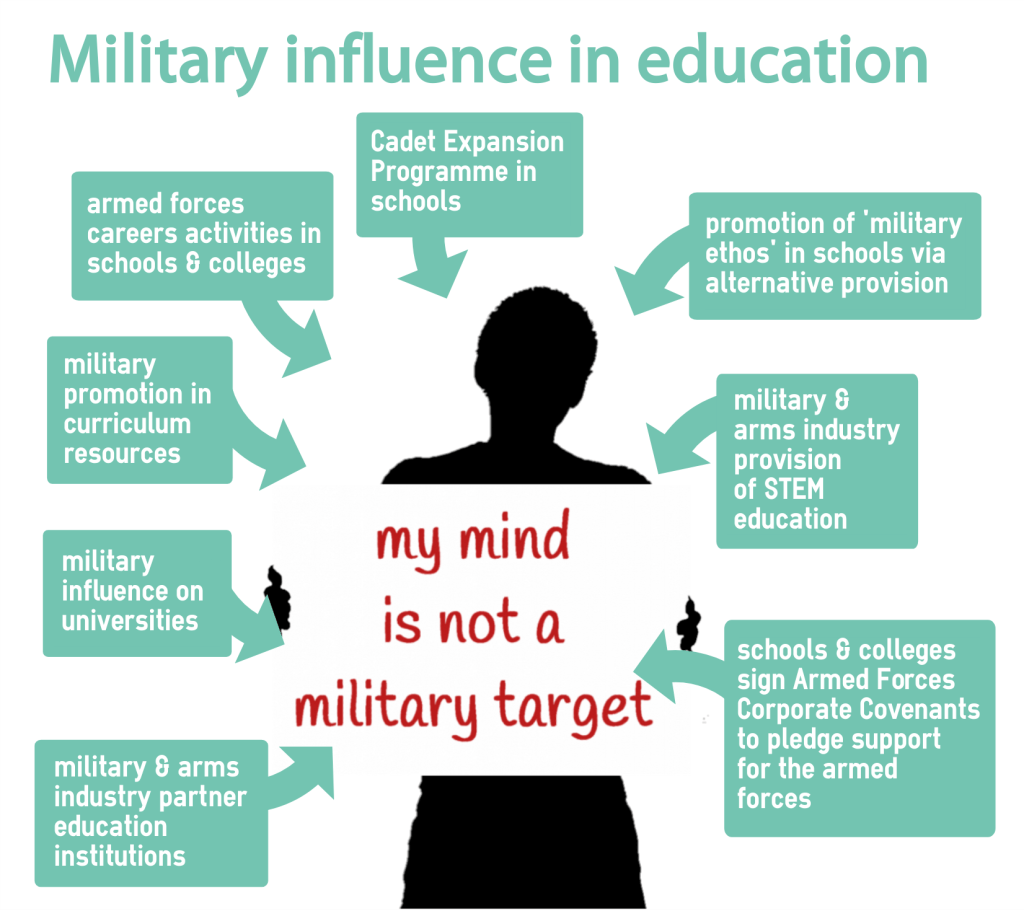
Those radical terrorists, The Quakers, have provided an alternative view – The military in education & youth activities. But I’m not sure that their view is widely known.
It looks as if mass education on the necessity of war is now well underway. The general public in the West is being brainwashed with the doctrine that authoritarian Russia and China are about to invade our peace-loving democracies. Sir Keir Starmer takes the initiative, showing how Labour there is in concert with the Tories. We must be ready to fight back, or perhaps better, to pre-empt such attacks. No doubt the Russian and Chinese populations are being taught a similar message, the other way around.
What now makes it easier is that we can buy ever more of those glorious distance methods, so much neater than sending our boys out for messy personal danger. The efficient Nazis got the ball rolling on this. In education Sir Keir Starmer now takes the initiative. Labour in the UK is enthusiastically backing their own and and the USA’s arms manufacturers. Weapons-making is the big thing in business now – in Europe too, and of course in the USA.
War School – The Battle for Britain’s Children – https://www.youtube.com/watch?v=bl5Zc71KV_g
This Is Israel
Caitlin Johnstone, Jun 04, 2025
This is Israel. This is what the Zionist project looks like. The dead kids. The blown-out hospitals. The desperate, starving civilians. This is it.
There is no alternate version of Israel where these things are not happening. The liberal Zionist vision of a two-state solution and a just and peaceful Israel exists solely in the imaginations of the people who envision it. Nothing like it has ever existed. Everything about the modern state of Israel is unyieldingly hostile to that vision.
You either support the existence of the Israel you see before you, or you support the end of the apartheid Zionist entity. There is no hidden third option. There are no other positions on the menu. To pretend otherwise is to live in a fantasy land.
You either want to burn children alive, or you don’t. You either want to deliberately starve civilians, or you don’t. You either want to bomb hospitals, or you don’t. You either want to deliberately assassinate Palestinian journalists while forbidding foreign journalists entry into Gaza, or you don’t. You either want to deliberately massacre civilians and systematically destroy civilian infrastructure in order to force the removal of Palestinians from a Palestinian territory, or you don’t. And if you don’t, you must oppose the state of Israel.
That’s Israel, the state. Not just Netanyahu. Not just extremist settlers. Not just “far right elements within the Israeli government”. Israel itself. Because everything we are seeing Israel do is the result of everything Israel is as a state.
Everything Israel is doing is the result of everything it has always been. As soon as the west decided to drop a settler-colonialist state on top of a pre-existing civilization wherein the new immigrants would receive preferential treatment over the indigenous inhabitants who were already living there, it became inevitable that Israel would wind up in the condition it’s in today.
Because there was no way to uphold that status quo without mass displacement and nonstop tyranny, violence and abuse. There was no way to set up a tiered society where one tier is placed above the other without indoctrinating the public to accept that apartheid system by systematically dehumanizing the members of the disempowered group.
Set up a status quo of dehumanizing a group of people and manufacturing consent for violence and abuse against them, and you will inevitably wind up with a far right apartheid state which is committing genocide, as surely as dropping a stone off a building will result in a stone falling to the ground.
What we are seeing in Gaza today was baked into the state of Israel ever since its inception.
All those dead kids on your social media feed are the fruit of a tree whose seed was planted after the second world war. That tree has been bearing more and more fruit, and it will continue to for as long as it remains standing. Because that’s just the kind of tree it is. The only kind of tree it ever could have been.
Saying “I support Israel but I don’t support the actions of Netanyahu in Gaza” is like saying “I like this apple tree but only when it sprouts coconuts instead of apples.” That is not the kind of tree it is. The apple tree will only produce apples, and the genocide tree will only produce genocide.
Israel’s supporters avoid confronting obvious truths like these. Support for Israel depends on mass-scale psychological compartmentalization. Everything about it revolves around avoiding unpleasant truths instead of deeply and viscerally reckoning with them.
Averting the eyes from the video footage of Israel’s atrocities in Gaza. Averting the eyes from the contradictions between the values they purport to hold and everything Israel is as a state. Averting the eyes from the mountains upon mountains of evidence staring us all in the face. That’s the only way support for Israel is able to continue.
In order to become a truth-driven species, we need to stop hiding from uncomfortable truths. And one of our favorite hiding places for uncomfortable truths at this point in history is the modern state of Israel, and the western empire’s support for it.
Sellafield’s race against time: nuclear waste clean-up not going quickly enough, Public Accounts Committee (PAC) warns

Sir Geoffrey Clifton-Brown MP, Chair of the Committee, said: “The intolerable risks presented by Sellafield’s ageing infrastructure are truly world-class. When visiting the site, it is impossible not to be struck by the fact that one can be standing in what is surely one of the most hazardous places in the world.
“Our report contains too many signs that this is a race that Sellafield risks losing.”
Report highlights latest picture on delays and cost rises in c.£136bn 100-year nuclear decommissioning project.
The retrieval of waste from ageing buildings at the most hazardous nuclear site in the UK is not happening quickly enough. In its report on decommissioning Sellafield, the Public Accounts Committee (PAC) warns that the estimated £136bn cost of the project would rise even more if work is further delayed, while expressing scepticism as to whether or not recent signs of improvement in performance could represent another false dawn.
The PAC found in 2018 that government needed a firmer grip on Sellafield’s nuclear challenges, and now warns that not enough progress has been made in addressing its most significant hazards. One building, the Magnox Swarf Storage Silo (MSSS), has been leaking radioactive water into the ground since 2018 – the PAC calculates, at current rates, enough to fill an Olympic swimming pool roughly every three years. The Nuclear Decommissioning Authority (NDA) accepts this leak is its “single biggest environmental issue”, but that the radioactive particles are “contained” in the soil and do not pose a risk to the public.
The PAC’s report finds that Sellafield Ltd has missed most of its annual targets for retrieving waste from several buildings on the site, including the MSSS. The PAC’s inquiry heard that the MSSS is the most hazardous building in the UK, and as a result of Sellafield Ltd’s underperformance will likely remain extremely hazardous for longer. The report seeks answers from Government on how it will hold the NDA and Sellafield Ltd to account in ameliorating the site’s greatest hazards.
As well as safety concerns, the PAC further warns of the impact that delays in the programme have on costs. In the long-term, waste will need to be stored in an underground Geological Disposal Facility (GDF) capable of storing it for thousands of years. The PAC finds that the date for the GDF has slipped from 2040 to the late 2050s, with every decade of delay meaning Sellafield could need to construct another storage building, each costing £500m-£760m. The GDF project is still at an early stage, with sites considered in Cumbria and Lincolnshire – though the PAC understands that Lincolnshire County Council has recently announced it is likely to withdraw.
The report highlights some recent signs of improvement in Sellafield’s delivery, with more emphasis put on planning in how it works with contractors and most recently-started projects being delivered in line with their business cases as a result. However, the report highlights the example of one of Sellafield’s project to refurbish an onsite lab so it could continue analysing waste samples – essential for safety.
The report finds that this very poorly managed and now-paused project has seen £127m wasted. Its failure, which resulted from a lack of understanding of what physical state its labs were in, and from not doing the right remedial work to address their deterioration, illustrates the need to improve asset management at Sellafield. The report urges Sellafield Ltd to explain how it is addressing the deteriorating condition of its assets, which its safety experts have warned is making the site increasingly unsafe.
The PAC’s report also finds indications of a sub-optimal culture at the site, with concerns raised in the report given that the exceptionally hazardous nature of many of Sellafield’s activities means that it is imperative that all employees and contractors on the site feel able to raise any concerns that they have without fear of consequences. The PAC is aware that the NDA paid £377,200 in 2023-24 to settle employment-related claims.
Further, the PAC previously noted that non-disclosure agreements have been used elsewhere in the public sector to cover up failure. The report finds that Sellafield Ltd has signed 16 non-disclosure agreements in the last three years. It further seeks publication from the NDA of information around the prevalence and perception of bullying and harassment in its annual report.
Chair comment
Sir Geoffrey Clifton-Brown MP, Chair of the Committee, said: “The intolerable risks presented by Sellafield’s ageing infrastructure are truly world-class. When visiting the site, it is impossible not to be struck by the fact that one can be standing in what is surely one of the most hazardous places in the world. This is why we expect Sellafield’s management of its assets, and the delivery of the project to decommission it, to be similarly world-class. Unfortunately, our latest report is interleaved with a number of examples of failure, cost overruns, and continuing safety concerns. Given the tens of billions at stake, and the dangers onsite to both the environment and human life, this is simply not good enough.
“As with the fight against climate change, the sheer scale of the hundred-year timeframe of the decommissioning project makes it hard to grasp the immediacy of safety hazards and cost overruns that delays can have. Every day at Sellafield is a race against time to complete works before buildings reach the end of their life. Our report contains too many signs that this is a race that Sellafield risks losing. It is of vital importance that the Government grasp the daily urgency of the work taking place at Sellafield, and shed any sense of a far-off date of completion for which no-one currently living is responsible. Sellafield’s risks and challenges are those of the present day. There are some early indications of some improvement in Sellafield’s delivery which our report notes. Government must do far more to hold all involved immediately accountable to ensure these do not represent a false dawn, and to better safeguard both the public purse and the public itself.”
Zaporizhzhia ‘extremely fragile’ relying on single off-site power line, IAEA warns
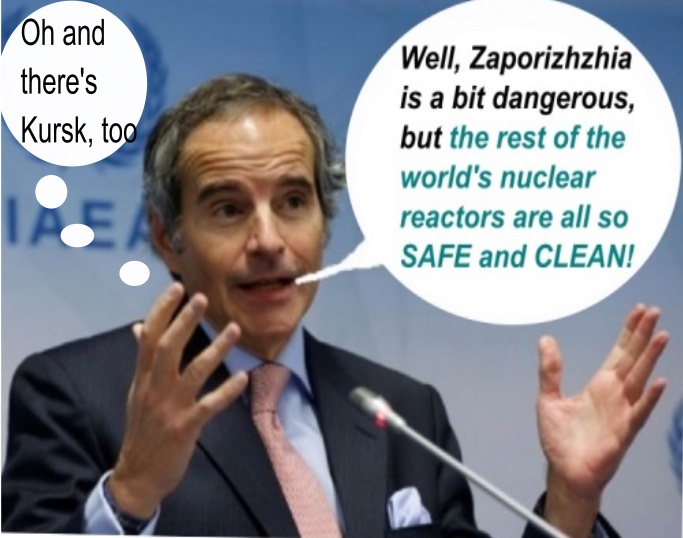
Europe’s largest nuclear power plant has just one remaining power line for essential nuclear safety and security functions, compared with its original 10 functional lines before the military conflict with Russia, warned Rafael Mariano Grossi, director general of the International Atomic Energy Agency.
The off-site power situation at the six-reactor Zaporizhzhia nuclear power plant in Ukraine is “extremely fragile,” Grossi said, since its last 330-kilovolt backup line has remained disconnected since the plant lost access to it on May 7. It is unclear when it will be restored.
As a result, Zaporizhzhia is entirely dependent on the last remaining 750-kV line for the external electricity required to operate the plant’s nuclear safety systems and cool its nuclear fuel.
After Russia took control of Zaporizhzhia in early 2022, the plant has lost all access to off-site power eight times, but it was usually restored within a day, according to the IAEA.
Quotable: “We are actively engaged. I have been discussing with the [energy] minister, with the Ukrainian regulator, and also, of course, with the Russian side, because they are in control of the plant. The idea is to be talking to everybody when it comes to safety,” Grossi said during a press conference Tuesday during his visit to Kyiv, Ukraine.
Grossi warned that even though Zaporizhzhia has not been operating for some three years now, its reactor cores and spent nuclear fuel still require continuous cooling, for which electricity is needed to run the water pumps.
“There are only two [power lines] in operation—one 750-kV and another 330-kV—which are intermittently down because of a number of situations… attacks or interruptions, we do not know,” Grossi added in his remarks. “The repair works have been performed but what we expect is this quite unpredictable situation will continue.”
“We have to move to a more stable situation, and this, of course, depends on overall political negotiation, which will lead to less—or, ideally, no—military activity around the plant.” Grossi said. “Absent that, what we are doing [and] what everyone is doing is (trying) to avoid the worst (and) repair it as soon as possible. Try to ensure outside power supply whenever it falls down.” Grossi plans to visit Russia as part of his regular contacts with both sides to ensure nuclear safety and security during the conflict.
A closer look: In addition to the lack of off-site power backup, on May 22 the IAEA reported a drone strike at Zaporizhzhia’s training center—the third such incident so far this year. There were no casualties or major damage; however, one person died in April 2024 when a drone struck the plant’s main containment building.
Ukraine blames Russia for the strikes, but Russia has denied responsibility.
The Zaporizhzhia-based IAEA team continues to monitor and assess other aspects of nuclear safety and security at the plant. They conducted a walkdown last week to measure and confirm stable levels of cooling water in the site’s 12 sprinkler ponds and visiting its two fresh fuel storage facilities, where no nuclear safety or security issues were observed.
The IAEA team has reported hearing military activities on most days over the past week, at different distances away from the power plant, Grossi said.
At Ukraine’s three operating nuclear plants—Khmelnytskyi, Rivne and South Ukraine—three of the nine total reactors are in planned outage for refueling and maintenance.
IAEA team members at these sites also continue to hear military activities nearby. At South Ukraine, the IAEA team saw a drone being shot at by antiaircraft fire on May 23, and plant workers reported that 10 drones were observed 2.5 kilometers (about 1.55 miles) south of the site the same evening. Also on May 23, Chernobyl workers saw two drones flying just a few miles from the site. And the IAEA team at the Khmelnytskyi plant was required to shelter on-site last Monday.
This is what Britain really needs to defend itself – and it doesn’t include spending billions on arms

COMMENT: Sir Keir Starmer – warhawk, and Torier that the Tories?
Keir Starmer has also argued that defence projects will stimulate the economy. Yet investments in sectors such as renewable energy and public infrastructure have demonstrated more consistent returns and broader societal benefits.
Karen Bell, 3 June 2025, https://www.theguardian.com/commentisfree/2025/jun/02/britain-defence-billions-arms-spending-climate-crisis
Spending should be focused on the immediate threats we face: underfunded public services and an escalating climate crisis
- Karen Bell is professor of social and environmental justice at the University of Glasgow
The UK government has now unveiled its strategic defence review (SDR), positioning it as a bold response to global threats, particularly from Russia. The plan includes increasing defence spending to 2.5% of GDP by 2027, with aspirations to reach 3% in the next parliament.
The government’s narrative suggests that increased military spending will enhance national security and stimulate economic growth. However, this perspective neglects the immediate threats facing UK citizens: underfunded public services, a strained National Health Service and the escalating climate crisis.
Redirecting substantial funds to military projects, such as nuclear submarines and warheads, is likely to divert resources from essential sectors that directly affect citizens’ daily lives. Investments in healthcare, education and renewable energy not only address current societal needs but also contribute to long-term national resilience. Globally, on average more than 24,000 people die of hunger daily and cutting our aid budget will worsen this tragic situation.
The UK’s defence procurement history is marred by inefficiencies and mismanagement. The government’s hugely ambitious strategic defence review is an exercise in hope over experience. For many years big defence projects have been delayed as a result of unforeseen technical problems partly caused by overoptimistic military planners and advisers influencing gullible ministers. Defence officials are highlighting the plan for a big increase in the number of nuclear-powered attack submarines, yet the cost of the existing, and much-delayed, Astute class submarine fleet, has already increased from an estimated £4.3 bn to more than £11bn.
Meanwhile, spending on nuclear weapons has increased significantly more than anticipated and serious problems remain over the project to build a new fleet of Dreadnought nuclear missile submarines. Although the government suggests that priority should be given to the defence of Europe where, it says, the main threat to Britain’s security lies, it invests in expensive and vulnerable aircraft carriers for deployment elsewhere, including the far east.
The government’s review risks repeating past mistakes by committing to large-scale projects that have led to wasted resources and unmet objectives. Furthermore, while the UK spends more on defence than all but five other countries in the world already, evidence indicates that military build-up actually increases the likelihood of conflict.
Keir Starmer has also argued that defence projects will stimulate the economy. Yet investments in sectors such as renewable energy and public infrastructure have demonstrated more consistent returns and broader societal benefits.
The review claims that the defence strategy will support 400,000 UK jobs, including 25,000 in Scotland. While job creation is vital, the number, quality and sustainability of these jobs warrant scrutiny. There is likely to be a net loss of jobs as a result of shifting funding from other sectors. Analysis for the Scottish government showed that military spending has one of the lowest “employment multipliers” of all economic categories, ranking 70 out of 100 in terms of numbers of jobs generated. Much of the defence spending will probably be on weaponry from the US.
Furthermore, recent research is clearly showing that global boosts in defence spending will worsen the climate crisis. A 2020 report by Scientists for Global Responsibility and Declassified UK found that the UK military-industrial sector already produces greater quantities of carbon emissions than 60 countries. While the Ministry of Defence acknowledges the environmental impacts of its operations, its proposed solutions, particularly increased biofuel and nuclear, even where lower in carbon emissions, still threaten ecosystems, biodiversity and human health. In the light of these concerns, it’s imperative to consider alternative strategies that prioritise human security and sustainable development.
A group of academics, trade unionists and campaign groups has drafted an alternative defence review, a civil society response to the government’s SDR. We call for a radical break with successive UK governments’ failed security and defence policies, which distort Britain’s national priorities, fuel global instability, undermine international law, harm the environment and divert investment from public services and social infrastructure towards subsidies for the global arms industry. Our ADR suggests that most of this increased spending appears to be linked to policy influence by international arms companies.
This is what Britain really needs to defend itself – and it doesn’t include spending billions on arms
Karen Bell
Spending should be focused on the immediate threats we face: underfunded public services and an escalating climate crisis
- Karen Bell is professor of social and environmental justice at the University of Glasgow
Tue 3 Jun 2025 03.15 AESTShare
The UK government has now unveiled its strategic defence review (SDR), positioning it as a bold response to global threats, particularly from Russia. The plan includes increasing defence spending to 2.5% of GDP by 2027, with aspirations to reach 3% in the next parliament.
The government’s narrative suggests that increased military spending will enhance national security and stimulate economic growth. However, this perspective neglects the immediate threats facing UK citizens: underfunded public services, a strained National Health Service and the escalating climate crisis.
Redirecting substantial funds to military projects, such as nuclear submarines and warheads, is likely to divert resources from essential sectors that directly affect citizens’ daily lives. Investments in healthcare, education and renewable energy not only address current societal needs but also contribute to long-term national resilience. Globally, on average more than 24,000 people die of hunger daily and cutting our aid budget will worsen this tragic situation.
The UK’s defence procurement history is marred by inefficiencies and mismanagement. The government’s hugely ambitious strategic defence review is an exercise in hope over experience. For many years big defence projects have been delayed as a result of unforeseen technical problems partly caused by overoptimistic military planners and advisers influencing gullible ministers. Defence officials are highlighting the plan for a big increase in the number of nuclear-powered attack submarines, yet the cost of the existing, and much-delayed, Astute class submarine fleet, has already increased from an estimated £4.3 bn to more than £11bn.
Meanwhile, spending on nuclear weapons has increased significantly more than anticipated and serious problems remain over the project to build a new fleet of Dreadnought nuclear missile submarines. Although the government suggests that priority should be given to the defence of Europe where, it says, the main threat to Britain’s security lies, it invests in expensive and vulnerable aircraft carriers for deployment elsewhere, including the far east.
The government’s review risks repeating past mistakes by committing to large-scale projects that have led to wasted resources and unmet objectives. Furthermore, while the UK spends more on defence than all but five other countries in the world already, evidence indicates that military build-up actually increases the likelihood of conflict.
Keir Starmer has also argued that defence projects will stimulate the economy. Yet investments in sectors such as renewable energy and public infrastructure have demonstrated more consistent returns and broader societal benefits.
The review claims that the defence strategy will support 400,000 UK jobs, including 25,000 in Scotland. While job creation is vital, the number, quality and sustainability of these jobs warrant scrutiny. There is likely to be a net loss of jobs as a result of shifting funding from other sectors. Analysis for the Scottish government showed that military spending has one of the lowest “employment multipliers” of all economic categories, ranking 70 out of 100 in terms of numbers of jobs generated. Much of the defence spending will probably be on weaponry from the US.
Furthermore, recent research is clearly showing that global boosts in defence spending will worsen the climate crisis. A 2020 report by Scientists for Global Responsibility and Declassified UK found that the UK military-industrial sector already produces greater quantities of carbon emissions than 60 countries. While the Ministry of Defence acknowledges the environmental impacts of its operations, its proposed solutions, particularly increased biofuel and nuclear, even where lower in carbon emissions, still threaten ecosystems, biodiversity and human health. In the light of these concerns, it’s imperative to consider alternative strategies that prioritise human security and sustainable development.
A group of academics, trade unionists and campaign groups has drafted an alternative defence review, a civil society response to the government’s SDR. We call for a radical break with successive UK governments’ failed security and defence policies, which distort Britain’s national priorities, fuel global instability, undermine international law, harm the environment and divert investment from public services and social infrastructure towards subsidies for the global arms industry. Our ADR suggests that most of this increased spending appears to be linked to policy influence by international arms companies.
By reallocating resources towards healthcare, education and climate resilience, the UK can address immediate domestic challenges while contributing to global stability. Such an approach not only enhances national security but fosters economic growth through the creation of sustainable jobs and industries.
The strategic defence review presents an opportunity to redefine the UK’s security priorities. However, by focusing predominantly on military expansion, it risks neglecting the pressing needs of its citizens and repeating past procurement failures. It’s time for the UK to embrace a holistic security strategy that truly addresses the challenges of the 21st century.
- Karen Bell is professor of social and environmental justice at the University of Glasgow. Richard Norton-Taylor, a former Guardian security editor and now contributor to Declassified UK, also contributed to this article
Scots aren’t having our voices heard – nuclear is one such case study
English Labour are pushing for more nuclear because they’re funded by the industry. The industry expects a return.
Leah Gunn Barrett, The National 1st June 2025, https://www.thenational.scot/politics/25205426.scots-arent-voices-heard—nuclear-one-case-study/
ON May 1, a public meeting was held in Dunbar. It was attended by 28 people, mostly retired workers from the nearby Torness nuclear power plant.
It was organised by Britain Remade, a lobby group headed by former Tory spad Sam Richards. He described Britain Remade as a “cross-party campaigning group” that believes in economic growth and building infrastructure.
Britain Remade’s campaign, “New Scottish Nuclear Power”, aims to reverse Scotland’s ban on new nuclear power.
Also present were councillor Norman Hampshire, the leader of East Lothian Council (ELC) and chair of the planning committee, and Labour MSP for South Scotland Martin Whitfield.
Sellafield is the site of Europe’s worst nuclear accident – the 1957 Windscale fire, that led to the atmospheric dispersion of radioactive materials throughout England, Wales and northern Europe. Sellafield has been a nuclear waste dump since 1959 and has been called Europe’s most toxic nuclear site, a “bottomless pit of hell, money and despair”. It’s a reason Scotland has been dubbed the “cancer capital of the world”.
That’s a hell of a track record.
Richards blamed high electricity bills on the UK’s failure to build more nuclear plants, claiming nuclear was the reason France had lower bills. Wrong. Nuclear power has never been economic. It requires government subsidies and there’s no solution for radioactive waste disposal. French energy bills are lower because France didn’t privatise its energy and thus retained the ability to cap costs. The French government owns 100% of Électricité de France (EDF), which runs the Torness plant and the UK’s four other operating nuclear plants.
EDF should be showing far more concern about the safety of its UK plants. The Torness reactor has 46 cracks in its core which the ONR (Office for Nuclear Regulation) said could lead to a reactor meltdown and the release of radiation into the environment. EDF has extended the life of the plant to 2030.
Britain Remade’s goal is to get the ban on nuclear lifted and to use the Torness site for new nuclear plants.
Whitfield trotted out two pro-nuclear talking points, both of which are easily refuted:
1. Nuclear power doesn’t increase CO2.
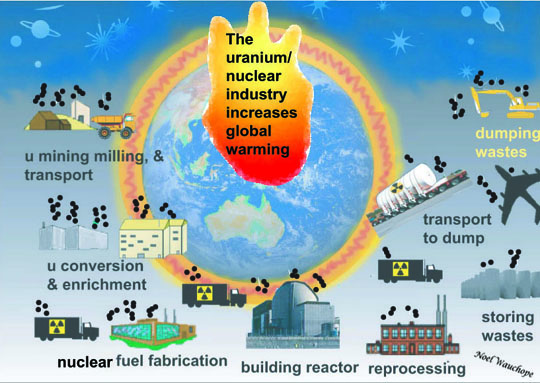
Not so. There are carbon emissions from mining, transporting and processing uranium, from constructing power plants and from transporting radioactive waste to places like Sellafield. By contrast, renewable energy doesn’t increase CO2, there’s no mining required or toxic waste to dispose of, and Scotland is bursting with renewables.
2. Nuclear power creates skilled jobs for life.
The renewables industry also creates skilled jobs for life without shortening it – in engineering, project management, data analysis and renewable energy technologies – and doesn’t endanger the health of workers or the local community.
Councillor Hampshire, who worked at Torness, said that although he “had to support renewables”, nuclear is needed for baseload power, which is the minimum power level on the grid.
Wrong again. Baseload power can be provided by any mix of generators, including variable wind and solar, if constant backup sources like tidal are provided. Furthermore, nuclear can’t be easily switched off, so when it’s present on the grid, much cheaper renewables are limited, which raises costs to the consumer.
Nonetheless, councillor Hampshire said he was lobbying hard for more nuclear power. He wants two Rolls-Royce SMRs (Small Modular Reactors) at the Torness site, claiming they’re cheaper and quicker to build and said that many SNP MSPs support him.
I wrote about SMRs in February, showing they are more expensive than and just as dangerous as large nuclear reactors; will generate more radioactive waste and will turn communities into de facto long-term nuclear waste disposal sites.
Only two SMRs are operating in the world – in Russia and China. Both are performing at less than 30% capacity and have been plagued by cost and time overruns. According to the World Nuclear Industry Status Report, these problems “make it even less likely that SMRs will become commercialised.”
Despite these facts, councillor Hampshire vows to include SMRs in the next ELC Local Development Plan. We were told that a lot of work is going on behind the scenes to ensure Torness remains an active nuclear site – with the UK having to import energy, otherwise.
During the Q&A, Whitfield was asked what it would take to change Scotland’s position. He replied “a change of government” and questioned whether Scotland has the authority to ban nuclear power since energy policy is reserved to the UK. It does because the Scotland Act 1998 devolves planning to Scotland.
Nevertheless, Whitfield said this could and would be tested through the courts, although he later clarified there were no definite plans to mount a legal challenge to Scotland’s authority to ban new nuclear power.
English Labour are pushing for more nuclear because they’re funded by the industry. The industry expects a return.
Nuclear power is another issue crying out for direct democracy, where the Scottish people – not special interests who are in bed with the politicians – have the power to decide via a referendum whether they want it or not. There are many other issues, local and national, over which the Scottish people have no control – pylons in the Highlands, corporate tax haven “freeports”, the closures of Ardrossan Harbour and Grangemouth, the Loch Lomond Flamingo Land development, to name just a few.
If we’re to stop special interests always crushing the interests of the people, we must demand our international human rights. That’s why Respect Scottish Sovereignty (RSS) is urging as many as possible to sign PE2135, to enact the Direct Democracy/Self-Determination Covenant (ICCPR) into Scots law.
UK government has already allocated £6.4bn to the Sizewell C nuclear project!
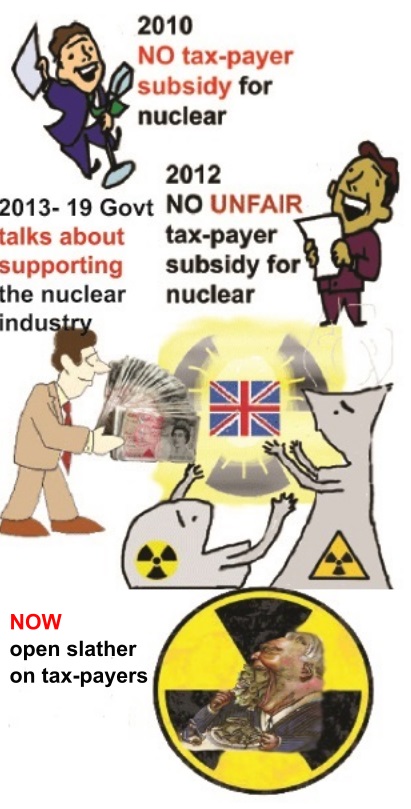
The Sizewell C Development Expenditure Subsidy Scheme (DEVEX Scheme) has
been made for £5.5bn for the Sizewell C company. Under this scheme to
date, £3.9bn has been awarded to the company, in two tranches, one of
£1.2bn and one of £2.7bn. Prior to these awards, the Department had
awarded £2.5bn to the project since the Government Investment Decision in
November 2022 under the SZC Investment Funding Scheme. Hence, in total, the
Department has to date allocated £6.4bn to the project under both subsidy
scheme.
Hansard 2nd June 2025
UIN 54121, tabled on 21 May 2025
https://questions-statements.parliament.uk/written-questions/detail/2025-05-21/54121
1 This Month
Chernobyl: The Lost Tapes – A good documentary on Chernobyl on SBS available On Demand for the next 3 weeks– https://www.sbs.com.au/ondemand/tv-program/chernobyl-the-lost-tapes/2352741955560

of the week–London Campaign for Nuclear Disarmament

Tell the Ukrainian Government to Drop Prosecution of Peace Activist Yurii Sheliazhenko
To see nuclear-related stories in greater depth and intensity – go to https://nuclearinformation.wordpress.com
-
Archives
- April 2026 (152)
- March 2026 (251)
- February 2026 (268)
- January 2026 (308)
- December 2025 (358)
- November 2025 (359)
- October 2025 (376)
- September 2025 (257)
- August 2025 (319)
- July 2025 (230)
- June 2025 (348)
- May 2025 (261)
-
Categories
- 1
- 1 NUCLEAR ISSUES
- business and costs
- climate change
- culture and arts
- ENERGY
- environment
- health
- history
- indigenous issues
- Legal
- marketing of nuclear
- media
- opposition to nuclear
- PERSONAL STORIES
- politics
- politics international
- Religion and ethics
- safety
- secrets,lies and civil liberties
- spinbuster
- technology
- Uranium
- wastes
- weapons and war
- Women
- 2 WORLD
- ACTION
- AFRICA
- Atrocities
- AUSTRALIA
- Christina's notes
- Christina's themes
- culture and arts
- Events
- Fuk 2022
- Fuk 2023
- Fukushima 2017
- Fukushima 2018
- fukushima 2019
- Fukushima 2020
- Fukushima 2021
- general
- global warming
- Humour (God we need it)
- Nuclear
- RARE EARTHS
- Reference
- resources – print
- Resources -audiovicual
- Weekly Newsletter
- World
- World Nuclear
- YouTube
-
RSS
Entries RSS
Comments RSS
 nuclear-news