The Flamanville EPR nuclear reactor will not be able to deliver its full power without major works.

According to our information, EDF has still not been able to identify the cause of the malfunction of the turbine in the Normandy reactor.
La Tribune Juliette Raynal, 04/07/25
After a doomed construction site, the Normandy reactor of the Flamanville EPR started up on December 21, twelve years behind schedule. Its entry into service does not signal the end of the problems, far from it. According to our information, the difficulties encountered with the turbo-alternator unit, the centerpiece of a nuclear power plant, will prevent the first French EPR from delivering its full electrical power without major intervention requiring the assembly of scaffolding inside a room that is difficult to access.
Contacted by La Tribune , EDF did not wish to comment on this information and indicated that it was maintaining its provisional schedule with the transition to 100% of its nominal power in the summer of 2025. “While technically the reactor could well reach its full thermal power in the coming months, the electrical power will be reduced by 10 to 20% due to the partial vacuum,” qualifies a well-informed source.
As we reported on March 13, EDF teams had to deal with abnormal heating in the turbo-generator unit. Located in the heart of the engine room, the 70-meter-long Arabelle turbine, manufactured by General Electric, but now owned by Arabelle Solutions, a subsidiary of EDF,
transforms the thermal energy contained in the steam into mechanical energy to drive the alternator that produces electricity.
The Arabelle turbine, the centerpiece of the power plant
In a technical document published following a general meeting, organized on February 25th within the framework of the Local Information Commission (CLI), the electrician revealed a malfunction: “The temperature increases beyond the authorized limit on stages 7 and 8 of the turbo alternator group when trying to reach the expected condenser vacuum . “
…………………………………….. the 57th reactor in the French fleet is still shut down due to a maintenance operation on equipment located in the nuclear part of the plant.
After several postponements, its start-up is expected on April 11. “While these adjustments allow the reactor to be restarted without exceeding the authorized heating levels, they will not allow it to operate at full power,” a well-informed source cautions. “The reactor will only be able to continue its tests at a partial vacuum,” the same source specifies.
……………………………..With the vacuum reduced, the turbine’s efficiency will be mechanically reduced and could therefore be between 10 and 20% below its nominal operating temperature.
The cause of the malfunction has not yet been identified.
“The work that has been carried out on the bearings is corrective work. It helps to reduce the fault that is causing excessive heating, but the teams involved do not expect this to completely resolve the problem. In short, it helps to treat the symptoms, but not the cause, which remains unidentified ,” reports this source.
According to our information, to attempt a diagnosis, EDF teams will have to install scaffolding inside the condenser itself. A room that is difficult to access since it is located just below the turbine. “It is an intrusive operation that requires a complete shutdown of the reactor for at least several weeks ,” according to this well-informed source.
“A nightmare to cope with”
Unlike a conventional shutdown for refueling, which lasts on average 30 to 40 days, this first break should last “at least 250 days ,” said Régis Clément, deputy director of EDF’s nuclear fleet division, during a press briefing on December 20. In other words, more than eight months. EDF also intends to take advantage of this interruption to replace the defective tank cover, required by the nuclear regulator.
While waiting for this operation, the various components of the turbine, due to its abnormal operation, could well be damaged. And for good reason, even if by lowering the vacuum level the defect becomes acceptable, it does not disappear. As a result, the bearings wear unevenly and mistreat the turbine. “This machine risks being a nightmare to operate ,” fears a person close to the case.
1 Comment »
1 This Month
26 April – Chernobyl: Inside the Meltdown airs on National Geographic on Sunday 26th April from 4pm

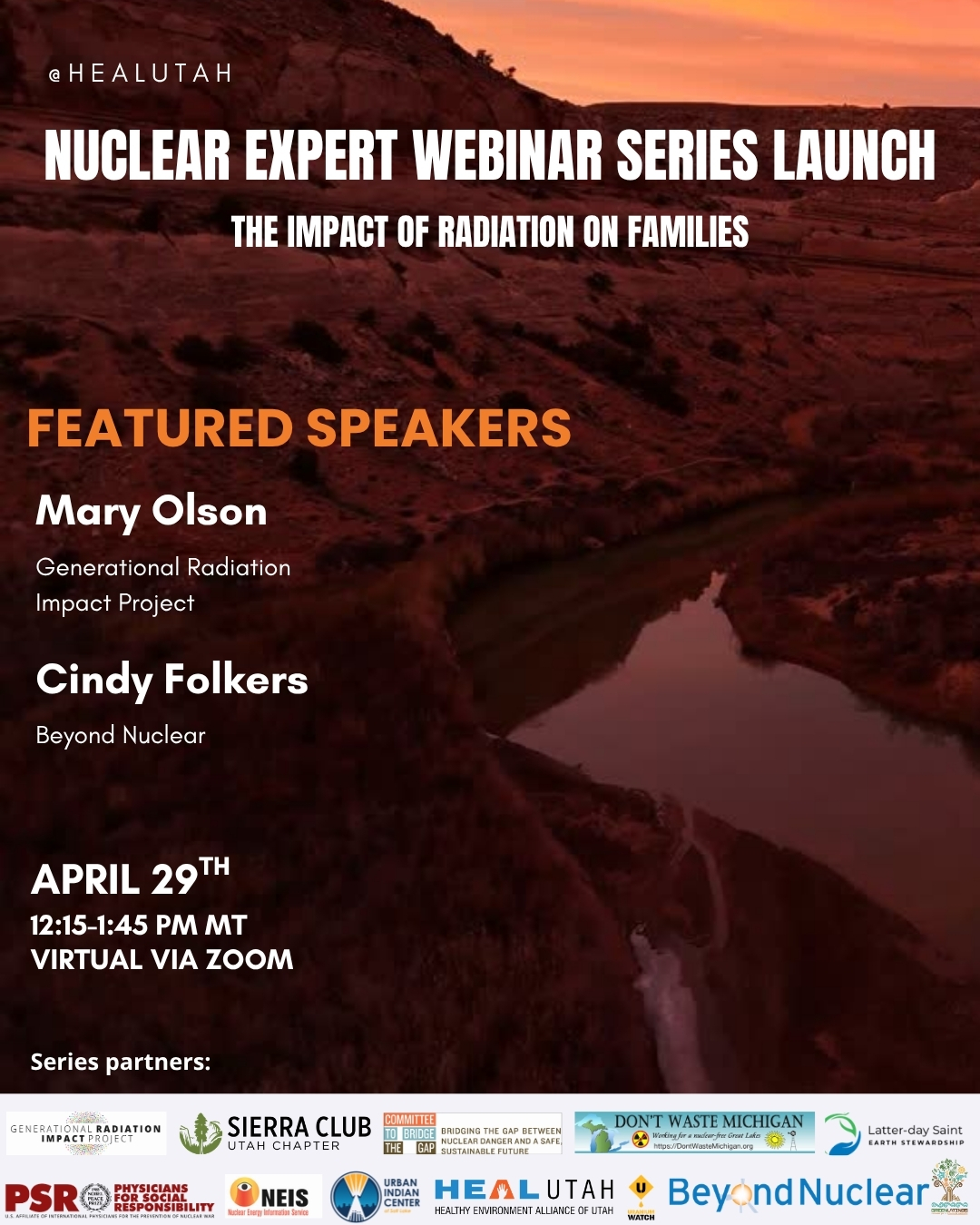
29 April – Nuclear Expert Webinar #1 – Radiation Impacts on Families with Mary Olson and Cindy Folkers
- 12:15 PM MT – 1:45 PM MT
- Location: Virtual – REGISTER TODAY

4 May -West Suburban Peace Coalition to discuss Iran war at May Educational Forum
Monday, May 4, 7:00 – 8:00 PM Central Standard Time
Title: : How Trump’s Narrative Tries to Shape the Reality of the War on Iran.
Contact Walt Zlotow, zlotow@hotmail.com 630 442 3045 for further information
14 May – online event From Bombs to Data Centres: the Face of Nuclear Colonialism

Pine Ridge Uranium is the real threat, not Tehran- Tell Burgum: Stop the Extraction.
Chernobyl: The Lost Tapes – A good documentary on Chernobyl on SBS available On Demand for the next 3 weeks– https://www.sbs.com.au/ondemand/tv-program/chernobyl-the-lost-tapes/2352741955560
To see nuclear-related stories in greater depth and intensity – go to https://nuclearinformation.wordpress.com
-
Archives
- May 2026 (23)
- April 2026 (356)
- March 2026 (251)
- February 2026 (268)
- January 2026 (308)
- December 2025 (358)
- November 2025 (359)
- October 2025 (376)
- September 2025 (257)
- August 2025 (319)
- July 2025 (230)
- June 2025 (348)
-
Categories
- 1
- 1 NUCLEAR ISSUES
- business and costs
- climate change
- culture and arts
- ENERGY
- environment
- health
- history
- indigenous issues
- Legal
- marketing of nuclear
- media
- opposition to nuclear
- PERSONAL STORIES
- politics
- politics international
- Religion and ethics
- safety
- secrets,lies and civil liberties
- spinbuster
- technology
- Uranium
- wastes
- weapons and war
- Women
- 2 WORLD
- ACTION
- AFRICA
- Atrocities
- AUSTRALIA
- Christina's notes
- Christina's themes
- culture and arts
- Events
- Fuk 2022
- Fuk 2023
- Fukushima 2017
- Fukushima 2018
- fukushima 2019
- Fukushima 2020
- Fukushima 2021
- general
- global warming
- Humour (God we need it)
- Nuclear
- RARE EARTHS
- Reference
- resources – print
- Resources -audiovicual
- Weekly Newsletter
- World
- World Nuclear
- YouTube
-
RSS
Entries RSS
Comments RSS
 nuclear-news
[…] in all sorts of trouble with its nuclear programme – France delays EPR2 reactors to 2038. The Flamanville EPR nuclear reactor will not be able to deliver its full power without major works. Squabble with Britain over who pays […]