Inside the bizarre race to secure Earth’s nuclear tombs
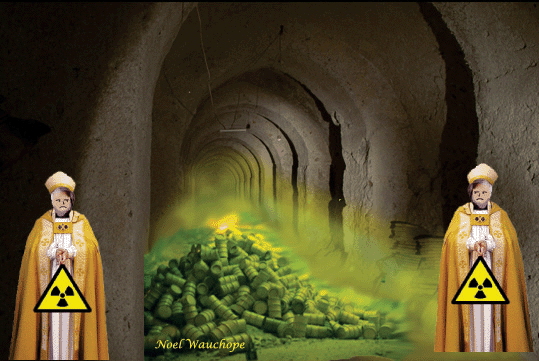
outlandish ideas have included linguist Thomas Sebeok’s proposal of an ‘atomic priesthood’ that would pass on nuclear folklore (in much the same way that generations of clergy have been relaying the tenets of their respective faiths for thousands of years
“Our generation must find a way to bury the waste very deep to avoid radioactive pollution or exposure to people and animals up to one million years into the future.”
“Currently, about 75 per cent of the UK’s nuclear waste is already stored across 20 sites,” says Winsley. “People are surprised to hear you’re never far away from the most hazardous radioactive waste, wherever you are in the UK.
Jheni Osman, BBC Science Focus, April 5, 2025
With nuclear energy production increasing globally, the problem of what to do with the waste demands a solution. But where do you store something that stays dangerous for thousands of years?
Uniformed guards with holstered guns stand at the entrance and watch you lumber past. Ahead lies a wasteland of barren metal gantries, dormant chimney stacks and abandoned equipment.
You trudge towards the ruins of a large, derelict red-brick building. Your white hazmat suit and heavy steel-toe-capped boots make it difficult to walk. Your hands are encased in a double layer of gloves, your face protected by a particulate-filtering breathing mask. Not an inch of flesh is left exposed.
Peering into the building’s gloomy interior, the beam from your head torch picks out machinery and vats turned orange with rust. On a wall nearby, a yellow warning sign featuring a black circle flanked by three black blades reminds you of the danger lurking inside.
Apart from the sound of your own breathing behind your mask, the only thing you can hear is the crackling popcorn of your Geiger counter.
This is what entering the Prydniprovsky Chemical Plant is like for nuclear researchers, including Tom Scott, professor of materials at the University of Bristol and head of the UK Government’s Nuclear Threat Reduction Network.
Prydniprovsky was once a large Soviet materials and chemicals processing site on the outskirts of Kamianske in central Ukraine. Between 1948 and 1991, it processed uranium and thorium ore into concentrate, generating tens of millions of tonnes of low-level radioactive waste.
When the Soviet Union dissolved, Prydniprovsky was abandoned and fell into disrepair.
“The buildings are impressively awful and not for the faint-hearted,” says Scott. “As well as physical hazards, such as gaping holes in the floor, there’s no light or power. And obviously there are radiological hazards. Until very recently, the Ukrainian Government didn’t have a clue what had gone on at the site, so there were concerns about the high radiation levels and ground contamination.”
When radiation levels are deemed too high for humans, Scott sends in the robots. ………………………….
Scott and his team are known as industrial nuclear archaeologists, and they’re working to find, characterise and quantify the ‘legacy’ radioactive waste at sites around the world.
“High-level radioactive waste gives off a significant amount of radioactivity, sufficient to make humans sick if they get too close,” he says. “Some of this waste will be dangerously radioactive for very long periods of time, meaning that it needs to be physically kept away from people and the environment to ensure that no harm is caused.”
But finding legacy waste like this, which has been amassing since the 1940s, is only part of the challenge. Once it’s been found, it has to be isolated and stored long enough for it to no longer pose a threat. And that’s not easy.
“Currently we’re storing our high-level wastes above ground in secure, shielded facilities,” Scott says. “Such facilities need to be replaced every so often because buildings and concrete structures can’t last indefinitely.”
Safely storing the nuclear waste that already exists is only the start of the problem, however. With the world moving away from fossil fuels towards low-carbon alternatives, nuclear energy production is set to increase, which means more waste is going to be produced – a lot more.
Currently, nuclear energy provides roughly nine per cent of global electricity from about 440 power reactors. By 2125, however, the UK alone is predicted to have 4.77 million m3 (168 million ft3) of packaged radioactive waste. That’s enough to fill 1,900 Olympic swimming pools.
Hence, the world needs more safe storage sites for both legacy and new nuclear waste. And it needs them fast.
Safe spaces
In the UK, most nuclear waste is currently sent to Sellafield, a sprawling site in Cumbria, in the north-west of England, with about 11,000 employees, its own road and railway network, a special laundry service for contaminated clothes and a dedicated, armed police force (the Civil Nuclear Constabulary).
Sellafield processes and stores more radioactive waste than anywhere in the world.
But more hazardous material is on the way, much of which will come from the new nuclear power station being built at Hinckley Point in Somerset. To keep pace, experts have been hunting for other, much stranger, disposal solutions.
It’s a challenge for nuclear agencies all around the world. All sorts of proposals have been put forward, including some bizarre ideas like firing nuclear waste into space. (The potential risk of a launch failure showering the planet with nuclear debris has silenced that proposal’s supporters.)
So far, the most plausible solution is putting the waste in special containers and storing them 200–1,000m (660–3,280ft) underground in geological disposal facilities (GDFs). Eventually, these GDFs would be closed and sealed shut to avoid any human intrusion.
These ‘nuclear tombs’ are the safest, most secure option for the long-term and minimise the burden on future generations.
“In the UK, around 90 per cent of the volume of our legacy waste can be disposed of at surface facilities, but there’s about 10 per cent that we don’t currently have a disposal facility for. The solution is internationally accepted as being GDFs,” says Dr Robert Winsley, design authority lead at the UK’s Nuclear Waste Services.
“We estimate that about 90 per cent of the radioactive material in our inventory will decay in the first 1,000 years or so. But a portion of that inventory will remain hazardous for much longer – tens of thousands, even hundreds of thousands of years.
“GDFs use engineered barriers to work alongside the natural barrier of stable rock. This multi-barrier approach isolates and contains waste, ensuring no radioactivity ever comes back to the surface in levels that could do harm.”
But how do you keep that radioactivity in the ground? Radioactive waste is typically classified as either low-, intermediate- or high-level waste.
Before being disposed of deep underground, high-level waste is converted into glass (a process known as vitrification) and then packed in metal containers made of copper or carbon steel. Intermediate-level waste is typically packaged in stainless-steel or concrete containers, which are then placed in stable rock and surrounded by clay, cement or crushed rock.
The process isn’t set in stone yet, though. Other materials, such as titanium- and nickel-based alloys, are being considered for the containers due to their resistance to corrosion.
Meanwhile, scientists in Canada have developed ultra-thin copper cladding that would allow them to produce containers that take up less space, while providing the same level of protection.
Rock solid
The hunt is also on to find facilities with bedrock that can withstand events such as wars and natural disasters (‘short-term challenges’, geologically speaking). Sites that won’t change dramatically over the millennia needed for nuclear waste to no longer pose a risk.
“A misconception is that we’re looking for an environment that doesn’t change, but the reality is the planet does change, very slowly,” says Stuart Haszeldine, professor of carbon capture and storage at the University of Edinburgh.
“Our generation must find a way to bury the waste very deep to avoid radioactive pollution or exposure to people and animals up to one million years into the future.”
To achieve this, the site ideally needs to be below sea level. If it’s above sea level, rainwater seeping down through fractures in the rock around the site might become radioactive and eventually find its way to the sea.
When this radioactive freshwater meets the denser saltwater, it’ll float upwards, posing a risk to anything in the water above.
Another challenge is predicting future glaciations, which happen roughly once every 100,000 years. During such a period, the sort of glaciers that cut the valleys in today’s landscape could form again, gouging new troughs in the bedrock that might breach an underground disposal facility.
“Accurate and reliable future predictions depend on how well you understand the past,” says Haszeldine.
“Typically, repository safety assessments cover a one-million-year timeframe, and regulations require a GDF site to cause fewer than one human death in a million for the next million years. Exploration doesn’t search for a single best site to retain radioactive waste, but one that’s good enough to fulfil these regulations.”
Hiding places
In 2002, the US approved the construction of a nuclear tomb in an extinct supervolcano in Yucca Mountain, Nevada, about 160km (100 miles) north-west of Las Vegas.
…………. opponents cited concerns that it was too close to a fault line and, in 2011, US Congress ended funding for the project. Since then, waste from all US nuclear power plants has been building up in steel and concrete casks on the surface at 93 sites across the country.
Other sites have fared better, however. Already this year, construction has begun on a nuclear tomb in Sweden, expected to be ready in the 2030s, but it’s also the year the world’s first tomb – at a site in Finland, called Onkalo (Finnish for ‘cave’ or ‘hollow’) – could open its doors for waste………………..
In January 2025, the UK Government announced plans to permanently dispose of its 140 tonnes of radioactive plutonium, currently stored at Sellafield. In a statement, energy minister Michael Shanks cited plans to put it “beyond reach”, deep underground.
Three potential sites in England and Wales are being explored by Nuclear Waste Services, and one of Haszeldine’s PhD students is independently investigating a fourth off the Cumbrian coast. The offshore site appears to be hydro-geologically stable (even over glacial timescales), but it would be expensive and difficult to engineer.
“Currently, about 75 per cent of the UK’s nuclear waste is already stored across 20 sites,” says Winsley. “People are surprised to hear you’re never far away from the most hazardous radioactive waste, wherever you are in the UK. Our mission is to make this radioactive waste permanently safe, sooner.”
……………………..The deep isolation approach costs less than a third of what it costs to construct a nuclear tomb and uses smaller sites, but the canisters are harder to recover if anything goes wrong.
Nevertheless, it’s a viable option for smaller nuclear countries and a second prototype is expected to undergo field testing at a deep borehole demonstration site in the UK in early 2025.
……………………………………………………………………………………………………………“The half-life of plutonium 239 is about 24,100 years, but the requirement is to keep a ceramic in that state for up to a million years. Essentially, we’re trying to design materials that’ll last forever. I don’t think humans will be around in a million years’ time, so the work we do needs to outlast humanity.”
Hide and seek
But even after you’ve found a suitable site and buried the radioactive material safely inside it, you still need to warn future generations about what’s hidden inside.
The trouble is, even if humans are still around in a million years’ time, there’s no guarantee the languages our ancestors speak, or the symbols they use, will be anything like those of today.
In Japan, 1,000-year-old ‘tsunami stones’, which warned future generations to find high ground after earthquakes, have failed to prevent construction on vulnerable sites.
Even the radiation symbol we use today (that black circle flanked by black blades on a yellow background) isn’t universally recognised. Research by the International Atomic Energy Agency found that only six per cent of the global population know what it signifies.
That’s why scientists have been working with everyone from artists to anthropologists, librarians to linguists, and sculptors to science-fiction writers – to come up with other ways of warning future generations about nuclear tombs.
………………….outlandish ideas have included linguist Thomas Sebeok’s proposal of an ‘atomic priesthood’ that would pass on nuclear folklore (in much the same way that generations of clergy have been relaying the tenets of their respective faiths for thousands of years
…………………………….. While some back this active forgetting of future nuclear tombs, researchers like Scott are still trying to get everyone to remember the nuclear sites we’ve already forgotten. It’s like a game of nuclear ‘hide and seek’ – but the stakes are high, and there’s no room for error.
…………………Currently, nuclear tombs are our best bet, but it’s a burden humanity must shoulder for thousands of years, long after the benefits gained from nuclear technology will have faded.
“My personal opinion is, I don’t think we should allow future generations to forget about a geological disposal facility,” says Scott. “The material is both dangerous and, in longer timescales, potentially valuable. People need to be reminded of its presence.”…………………… https://www.sciencefocus.com/planet-earth/inside-the-bizarre-race-to-secure-earths-nuclear-tombs
1 Comment »
Leave a reply to stuartbramhall Cancel reply
1 This Month

of the week– Nuclear Reactor Information Task Force

14 May – online event From Bombs to Data Centres: the Face of Nuclear Colonialism
To see nuclear-related stories in greater depth and intensity – go to https://nuclearinformation.wordpress.com
-
Archives
- May 2026 (81)
- April 2026 (356)
- March 2026 (251)
- February 2026 (268)
- January 2026 (308)
- December 2025 (358)
- November 2025 (359)
- October 2025 (376)
- September 2025 (257)
- August 2025 (319)
- July 2025 (230)
- June 2025 (348)
-
Categories
- 1
- 1 NUCLEAR ISSUES
- business and costs
- climate change
- culture and arts
- ENERGY
- environment
- health
- history
- indigenous issues
- Legal
- marketing of nuclear
- media
- opposition to nuclear
- PERSONAL STORIES
- politics
- politics international
- Religion and ethics
- safety
- secrets,lies and civil liberties
- spinbuster
- technology
- Uranium
- wastes
- weapons and war
- Women
- 2 WORLD
- ACTION
- AFRICA
- Atrocities
- AUSTRALIA
- Christina's notes
- Christina's themes
- culture and arts
- Events
- Fuk 2022
- Fuk 2023
- Fukushima 2017
- Fukushima 2018
- fukushima 2019
- Fukushima 2020
- Fukushima 2021
- general
- global warming
- Humour (God we need it)
- Nuclear
- RARE EARTHS
- Reference
- resources – print
- Resources -audiovicual
- Weekly Newsletter
- World
- World Nuclear
- YouTube
-
RSS
Entries RSS
Comments RSS
 nuclear-news
Storing nuclear waste is a political choice not based on science. Peer reviewed nuclear decontamination technologies have been available for 50 years but are being suppressed in the West. Presumably due to Chinese proprietary interests. See https://nexusmagazine.com/product/browns-gas-for-nuclear-waste/?v=8e3eb2c69a18