PLANT VOGTLE The True Cost of Nuclear Power in the United States.
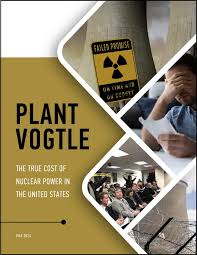
PLANT VOGTLE The True Cost of Nuclear Power in the United States is a report prepared by a coalition of six Georgia nonprofit organizations to educate the ratepaying public and its elected officials about the history and experience of having Georgia Power build two reactors at Plant Vogtle.
This historic report documents the harm to Georgia ratepayers, the enrichment of Georgia Power and the failure of the Georgia Public Service Commission to protect its citizens from a powerful monopoly seeking to expand profits for shareholders.
We offer this as a warning to other states considering nuclear energy: do not believe nuclear energy proponents. Nuclear energy is never on time or on budget.
Georgia Power’s Plant Vogtle is near Augusta in Burke County, Georgia.
It is the largest nuclear power plant in the United States.

The U.S. South hosts so many commercial and military nuclear facilities
it can be considered the nuclear hub of the United States.
The South is the only region with new nuclear reactor construction, and is home to over
three dozen operational nuclear reactors,1 two significant nuclear weapons manufacturing
complexes (Oak Ridge National Lab in Tennessee and Savannah River Site in South
Carolina, bordering Georgia), a majority of the nuclear fuel factories in the U.S.,
the contaminated “low-level” radioactive waste burial site at Barnwell, SC, the two
original uranium enrichment sites (Paducah, Kentucky and Portsmouth in Appalachian Ohio
— both now closed), and a closed Superfund nuclear waste burial site at Maxey Flats
in Kentucky. One-fourth of the U.S. nuclear weapons arsenal is deployed from the
Kings Bay Trident submarine base on the coast of Georgia……………………………………………………………………………………………………………………………………………………………………………………………………………………………………………………………
What are some myths vs. truths about nuclear energy?
We live in amazing times to experience the benefits of technology, not only with
smartphones, computers and medicine, but especially for energy. The number of
advancements in how energy is produced and delivered and stored is enormous.
Things like data analytics, virtual power plants, renewables, and distributed energy
mean the electricity grid can decarbonize affordably and rapidly, and it means people
can be engaged in ways never before possible.
For example, people now have access to their energy information in online portals, they can enroll in new programs that allow them to shift energy usage to less expensive periods in exchange for compensation, and they can produce and store their own electricity through rooftop solar and battery storage. Two common programs that residential customers often find appealing are smart thermostat programs that reduce energy consumption
at peak times of the day to save both the utility and the consumer money, and time of use rate plans that compensate consumers for using energy when it is less expensive to produce. Electric vehicles (EVs) can also be automated to charge overnight, and a future is coming where EV batteries can provide back-up power to homes during blackouts.
Nuclear energy proponents claim that nuclear energy is required to decarbonize the electricity grid, and that massive new generation requirements can only be met with nuclear power. These claims are false.
The following is a list of common myths about nuclear energy.
Myth #1: Nuclear energy is clean
Proponents claim that nuclear energy is clean because it emits no carbon
dioxide, the main gas that is causing climate change. However, the mining
of uranium for fuel is polluting and reactor construction is extremely
energy intensive.85 In Vogtle’s case, for 15 years construction activities
have been heavy emitters of carbon emissions, including the extensive
use of concrete which produces significant amounts of carbon dioxide.
So much concrete was used to build Plant Vogtle’s new reactors that,
according to Georgia Power, it was the equivalent of paving a sidewalk
across the United States from Miami to Seattle.
Claims that nuclear is clean energy also ignore the risks of highly
radioactive waste that remains lethal for hundreds of thousands of years,
which is generated and stored on-site at every nuclear facility in the
country.87 Despite years of research and debate, no viable, secure method
for long-term storage for radioactive nuclear waste has been found.
Myth # 2: Nuclear energy is safe
Nuclear power failures can be catastrophic, so there is no scenario in which the competitive business market would build nuclear power without government support. Similarly, the private insurance market will not provide protection for damage caused by nuclear power plant meltdowns or explosions. Indeed, utilities were only willing to invest in nuclear power reactors when Congress passed the Price-Anderson Act in 1957, which limited liability to all companies involved in all aspects of the nuclear industry, from reactor designers to
construction companies to owners and operators. The federal government has pledged that the U.S. Treasury will pay for damages beyond a $13 billion insurance cap from nuclear accidents. The Act was passed to help get the nuclear industry started with reactor construction, with the claim that insurance companies would no longer need a federal backstop once the industry had experience and a track record. Yet that has never been
true, and the Price-Anderson Act has been extended four times, most recently in 2024 when it it was extended
Because the Southeast is currently the only
region of the country where new reactors are
being built and brought on-line, it is the region
most in jeopardy of accidents due to the frontend of what is known as the “bathtub curve”
effect. This documented effect shows that more
accidents occur in the early stages of a reactor
coming online, and, as reactors age, the rate of
failure also increases, thus the curve. In Georgia,
Plant Vogtle’s Unit 3 and 4 are coming online
around the same time as Vogtle 1 and 2 move
into end-of-life phase.
To illustrate the bathtub effect, Vogtle 1 had a
near-miss early in its operating history when it
experienced a station black-out during a 1990
refueling outage. Emergency generators failed
to activate and uncirculated reactor cooling water began rapidly heating. Workers managed to avert disaster and the incident had national repercussions as officials admitted that Georgia Power nearly caused the worst nuclear accident since Three Mile Island.90 Three Mile Island, Chernobyl, and Fukushima, with its U.S.-based GE reactor design, have starkly illustrated that accidents can and do happen and when they do, the costs and
devastation are enormous, far beyond the $13 billion Price-Anderson insurance cap.
Myth # 3: Nuclear waste is no big deal
Similar to the Price-Anderson Act described above, utilities were wary of being stranded with highly radioactive, long-lived spent nuclear fuel. The U.S. government pledged to take responsibility for high-level radioactive waste which is codified in the Nuclear Waste Policy Act of 1982 and has been amended multiple times. The U.S. missed its self-imposed 1998 deadline to locate a site for, let alone build and operate, a central repository, and currently all high-level radioactive waste is stored on reactor sites. There are no viable plans underway to address this problem: over its lifetime, each operating reactor produces 30 tons of
highly radioactive waste which remains highly radioactive for hundreds of thousands of years.91
Myth #4: Small modular reactors are different
Small modular reactors (SMRs) are smaller than conventional nuclear reactors, which proponents claim would allow them to be built from modules that are manufactured in one location, then shipped, assembled, commissioned, and operated at a separate site. Instead of a traditional 1000-megawatt reactor, a small modular reactor is 300 megawatts or less. Despite the fact that SMRs are in the research phase and none have been built in the U.S., supporters promote them as a solution for forecasted increases in energy demand
and reducing carbon emissions. Opponents argue that the time frame for deploying SMRs is too long to impact climate change. There have only been three SMRs built anywhere, two in Russia and one in China, but they are not considered successful due to massive delays and low capacity factors.92
Indeed, SMRs are already stumbling, with front runner NuScale Power Corporation cancelling their SMR project in November, 2023.93 Recent news reports indicate that costs have escalated to well over $100/ MWh,94 once again pushing costs for new nuclear energy far above any other energy generation technology. Meanwhile, solar and wind energy, including battery storage, cost less than one-third that amount at about $30/MWh, and these technologies are available now.
Myth #5: Nuclear energy is required to provide baseload backup to renewables.
There is a myth that renewables are intermittent and thus require baseload backup, or 24×7 power which can only be delivered by conventional coal, gas or nuclear power.95 Although intermittent power sources were difficult to integrate into the grid early on, digital grid advancements mean this is no longer true.96
Grids throughout the world, including the U.S., can and do use digital applications and advanced analytics and devices to intelligently integrate renewable energy resources, storage, and software advancements into very high levels of load management.97
Flexibility is what is needed now, and flexibility is now available thanks to distributed energy made possible by clean-energy technology.99 Data analytics and digital applications allow for high levels of renewables to easily serve on the grid in ways never before possible, but many people don’t know it, including policymakers.
Nuclear and fossil fuel baseload power stations are inflexible power sources designed to run at maximum output all the time whether the power is needed or not. Conventional investments in large scale generation such as nuclear power harm the ratepayer
while rewarding those who build and operate
increasingly obsolete 20th century technologies,
a fact which the nuclear industry seeks to conceal
by renaming Small Modular Reactors “advanced
technology.”
Myth #6: Nuclear energy is required to meet future growth
There is a claim that nuclear energy is required to decarbonize the grid because the load growth from electrification, data centers, or manufacturing is too massive. There is a common misunderstanding that replacing fossil fuels with renewable energy like solar, wind, geothermal etc. requires the same amount of energy one-to-one, which is not the case. Fossil fuels and uranium are burned to boil water to produce steam to generate electricity which produces large amounts of waste heat. Renewable energy not only does not produce waste heat, but is more than twice as efficient as steam-generated power. Fossil fuel
and nuclear energy can thus be replaced by less than half as much clean, renewable energy. The task of reducing carbon emissions is much smaller than many people realize. In addition, the nation’s electricity grid is woefully underutilized because it is built to meet peak demand. Many programs and modern grid enhancements could improve the nation’s low utilization of its grid.
Myth #7: Nuclear energy is needed to combat climate change
There are dozens of studies that model a path to a zero-carbon grid without any expansion of nuclear power, including analyses by Stanford University researchers,100 and the highly credible RMI, a nonprofit whose mission is decarbonizing energy systems.101 In fact, many U.S. states and countries around the world already have high proportions of renewable energy servicing their grids. Washington, Oregon, Idaho, and South Dakota produced over 60% of their electricity from renewables in 2023, and ten countries generated 60% to 90% of their electricity from renewables in 2022 including Scotland, Iceland, the Netherlands, Germany, and Guatemala, among others.102, 103 California’s output from wind, water and solar power exceeded demand for 30 of 38 days early in 2024.104
Scandals and Litigation..…………………………………………………………………………………………………………..
Conclusion
These are inspiring times of energy transition in
many areas of the United States and the world,
though not in the Southeast United States. Leaders
in this region could easily accelerate the clean
energy transition by making greater investments in
efficiency, renewables, and a range of clean energy
initiatives and technologies such as heat pumps,
electric water heaters, smart connected devices,
rooftop solar and vehicle-to-grid EV battery storage.
It is especially tragic, given how poor the Southeast
region is, and how sunny Georgia, Mississippi, and
Alabama are, that these states are in 46th, 49th and
50th place in state rankings nationally for rooftop
solar penetration and are equally low in energy
efficiency. Investments in a clean energy transition
would save substantial amounts of ratepayer money,
and would quickly meet the reduced greenhouse
gas emissions reduction targets the world needs to
address the climate crisis. Yet these investments are
not made as they are not as profitable for monopoly utilities seeking to maximize profits.
Plant Vogtle points to the failure of the State of
Georgia generally, and the Georgia Public Service
Commission specifically, in protecting its people
from monopoly utility power and overreach. Plant
Vogtle would never have happened in a competitive
business environment, and should not have
happened in the Georgia regulatory environment
which was created to protect the public interest
from monopoly abuse. This is clearly seen by Georgia’s ranking in 6th place nationally for high power bills, and that is before Plant Vogtle drives up rates.113
It is very likely Georgians will soon be paying the highest
power bills in the nation due to Plant Vogtle. https://truthaboutvogtle.com/wp-content/uploads/2025/02/Vogtle-Truth-Report-2025.pdf
No comments yet.
-
Archives
- October 2026 (112)
- September 2026 (339)
- August 2026 (330)
- July 2026 (355)
- June 2026 (287)
- May 2026 (306)
- April 2026 (356)
- March 2026 (251)
- February 2026 (267)
- January 2026 (308)
- December 2025 (358)
- November 2025 (359)
-
Categories
- 1
- 1 NUCLEAR ISSUES
- business and costs
- climate change
- culture and arts
- ENERGY
- environment
- health
- history
- indigenous issues
- Legal
- marketing of nuclear
- media
- opposition to nuclear
- PERSONAL STORIES
- politics
- politics international
- Religion and ethics
- safety
- secrets,lies and civil liberties
- spinbuster
- technology
- Uranium
- wastes
- weapons and war
- Women
- 2 WORLD
- ACTION
- AFRICA
- Atrocities
- AUSTRALIA
- Christina's notes
- Christina's themes
- culture and arts
- Events
- Fuk 2022
- Fuk 2023
- Fukushima 2017
- Fukushima 2018
- fukushima 2019
- Fukushima 2020
- Fukushima 2021
- general
- global warming
- Humour (God we need it)
- Nuclear
- RARE EARTHS
- Reference
- resources – print
- Resources -audiovicual
- Weekly Newsletter
- World
- World Nuclear
- YouTube
-
RSS
Entries RSS
Comments RSS


Leave a Reply