PLANT VOGTLE The True Cost of Nuclear Power in the United States.
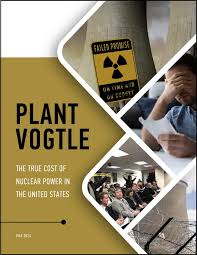
PLANT VOGTLE The True Cost of Nuclear Power in the United States is a report prepared by a coalition of six Georgia nonprofit organizations to educate the ratepaying public and its elected officials about the history and experience of having Georgia Power build two reactors at Plant Vogtle.
This historic report documents the harm to Georgia ratepayers, the enrichment of Georgia Power and the failure of the Georgia Public Service Commission to protect its citizens from a powerful monopoly seeking to expand profits for shareholders.
We offer this as a warning to other states considering nuclear energy: do not believe nuclear energy proponents. Nuclear energy is never on time or on budget.
Georgia Power’s Plant Vogtle is near Augusta in Burke County, Georgia.
It is the largest nuclear power plant in the United States.

The U.S. South hosts so many commercial and military nuclear facilities
it can be considered the nuclear hub of the United States.
The South is the only region with new nuclear reactor construction, and is home to over
three dozen operational nuclear reactors,1 two significant nuclear weapons manufacturing
complexes (Oak Ridge National Lab in Tennessee and Savannah River Site in South
Carolina, bordering Georgia), a majority of the nuclear fuel factories in the U.S.,
the contaminated “low-level” radioactive waste burial site at Barnwell, SC, the two
original uranium enrichment sites (Paducah, Kentucky and Portsmouth in Appalachian Ohio
— both now closed), and a closed Superfund nuclear waste burial site at Maxey Flats
in Kentucky. One-fourth of the U.S. nuclear weapons arsenal is deployed from the
Kings Bay Trident submarine base on the coast of Georgia……………………………………………………………………………………………………………………………………………………………………………………………………………………………………………………………
What are some myths vs. truths about nuclear energy?
We live in amazing times to experience the benefits of technology, not only with
smartphones, computers and medicine, but especially for energy. The number of
advancements in how energy is produced and delivered and stored is enormous.
Things like data analytics, virtual power plants, renewables, and distributed energy
mean the electricity grid can decarbonize affordably and rapidly, and it means people
can be engaged in ways never before possible.
For example, people now have access to their energy information in online portals, they can enroll in new programs that allow them to shift energy usage to less expensive periods in exchange for compensation, and they can produce and store their own electricity through rooftop solar and battery storage. Two common programs that residential customers often find appealing are smart thermostat programs that reduce energy consumption
at peak times of the day to save both the utility and the consumer money, and time of use rate plans that compensate consumers for using energy when it is less expensive to produce. Electric vehicles (EVs) can also be automated to charge overnight, and a future is coming where EV batteries can provide back-up power to homes during blackouts.
Nuclear energy proponents claim that nuclear energy is required to decarbonize the electricity grid, and that massive new generation requirements can only be met with nuclear power. These claims are false.
The following is a list of common myths about nuclear energy.
Myth #1: Nuclear energy is clean
Proponents claim that nuclear energy is clean because it emits no carbon
dioxide, the main gas that is causing climate change. However, the mining
of uranium for fuel is polluting and reactor construction is extremely
energy intensive.85 In Vogtle’s case, for 15 years construction activities
have been heavy emitters of carbon emissions, including the extensive
use of concrete which produces significant amounts of carbon dioxide.
So much concrete was used to build Plant Vogtle’s new reactors that,
according to Georgia Power, it was the equivalent of paving a sidewalk
across the United States from Miami to Seattle.
Claims that nuclear is clean energy also ignore the risks of highly
radioactive waste that remains lethal for hundreds of thousands of years,
which is generated and stored on-site at every nuclear facility in the
country.87 Despite years of research and debate, no viable, secure method
for long-term storage for radioactive nuclear waste has been found.
Myth # 2: Nuclear energy is safe
Nuclear power failures can be catastrophic, so there is no scenario in which the competitive business market would build nuclear power without government support. Similarly, the private insurance market will not provide protection for damage caused by nuclear power plant meltdowns or explosions. Indeed, utilities were only willing to invest in nuclear power reactors when Congress passed the Price-Anderson Act in 1957, which limited liability to all companies involved in all aspects of the nuclear industry, from reactor designers to
construction companies to owners and operators. The federal government has pledged that the U.S. Treasury will pay for damages beyond a $13 billion insurance cap from nuclear accidents. The Act was passed to help get the nuclear industry started with reactor construction, with the claim that insurance companies would no longer need a federal backstop once the industry had experience and a track record. Yet that has never been
true, and the Price-Anderson Act has been extended four times, most recently in 2024 when it it was extended
Because the Southeast is currently the only
region of the country where new reactors are
being built and brought on-line, it is the region
most in jeopardy of accidents due to the frontend of what is known as the “bathtub curve”
effect. This documented effect shows that more
accidents occur in the early stages of a reactor
coming online, and, as reactors age, the rate of
failure also increases, thus the curve. In Georgia,
Plant Vogtle’s Unit 3 and 4 are coming online
around the same time as Vogtle 1 and 2 move
into end-of-life phase.
To illustrate the bathtub effect, Vogtle 1 had a
near-miss early in its operating history when it
experienced a station black-out during a 1990
refueling outage. Emergency generators failed
to activate and uncirculated reactor cooling water began rapidly heating. Workers managed to avert disaster and the incident had national repercussions as officials admitted that Georgia Power nearly caused the worst nuclear accident since Three Mile Island.90 Three Mile Island, Chernobyl, and Fukushima, with its U.S.-based GE reactor design, have starkly illustrated that accidents can and do happen and when they do, the costs and
devastation are enormous, far beyond the $13 billion Price-Anderson insurance cap.
Myth # 3: Nuclear waste is no big deal
Similar to the Price-Anderson Act described above, utilities were wary of being stranded with highly radioactive, long-lived spent nuclear fuel. The U.S. government pledged to take responsibility for high-level radioactive waste which is codified in the Nuclear Waste Policy Act of 1982 and has been amended multiple times. The U.S. missed its self-imposed 1998 deadline to locate a site for, let alone build and operate, a central repository, and currently all high-level radioactive waste is stored on reactor sites. There are no viable plans underway to address this problem: over its lifetime, each operating reactor produces 30 tons of
highly radioactive waste which remains highly radioactive for hundreds of thousands of years.91
Myth #4: Small modular reactors are different
Small modular reactors (SMRs) are smaller than conventional nuclear reactors, which proponents claim would allow them to be built from modules that are manufactured in one location, then shipped, assembled, commissioned, and operated at a separate site. Instead of a traditional 1000-megawatt reactor, a small modular reactor is 300 megawatts or less. Despite the fact that SMRs are in the research phase and none have been built in the U.S., supporters promote them as a solution for forecasted increases in energy demand
and reducing carbon emissions. Opponents argue that the time frame for deploying SMRs is too long to impact climate change. There have only been three SMRs built anywhere, two in Russia and one in China, but they are not considered successful due to massive delays and low capacity factors.92
Indeed, SMRs are already stumbling, with front runner NuScale Power Corporation cancelling their SMR project in November, 2023.93 Recent news reports indicate that costs have escalated to well over $100/ MWh,94 once again pushing costs for new nuclear energy far above any other energy generation technology. Meanwhile, solar and wind energy, including battery storage, cost less than one-third that amount at about $30/MWh, and these technologies are available now.
Myth #5: Nuclear energy is required to provide baseload backup to renewables.
There is a myth that renewables are intermittent and thus require baseload backup, or 24×7 power which can only be delivered by conventional coal, gas or nuclear power.95 Although intermittent power sources were difficult to integrate into the grid early on, digital grid advancements mean this is no longer true.96
Grids throughout the world, including the U.S., can and do use digital applications and advanced analytics and devices to intelligently integrate renewable energy resources, storage, and software advancements into very high levels of load management.97
Flexibility is what is needed now, and flexibility is now available thanks to distributed energy made possible by clean-energy technology.99 Data analytics and digital applications allow for high levels of renewables to easily serve on the grid in ways never before possible, but many people don’t know it, including policymakers.
Nuclear and fossil fuel baseload power stations are inflexible power sources designed to run at maximum output all the time whether the power is needed or not. Conventional investments in large scale generation such as nuclear power harm the ratepayer
while rewarding those who build and operate
increasingly obsolete 20th century technologies,
a fact which the nuclear industry seeks to conceal
by renaming Small Modular Reactors “advanced
technology.”
Myth #6: Nuclear energy is required to meet future growth
There is a claim that nuclear energy is required to decarbonize the grid because the load growth from electrification, data centers, or manufacturing is too massive. There is a common misunderstanding that replacing fossil fuels with renewable energy like solar, wind, geothermal etc. requires the same amount of energy one-to-one, which is not the case. Fossil fuels and uranium are burned to boil water to produce steam to generate electricity which produces large amounts of waste heat. Renewable energy not only does not produce waste heat, but is more than twice as efficient as steam-generated power. Fossil fuel
and nuclear energy can thus be replaced by less than half as much clean, renewable energy. The task of reducing carbon emissions is much smaller than many people realize. In addition, the nation’s electricity grid is woefully underutilized because it is built to meet peak demand. Many programs and modern grid enhancements could improve the nation’s low utilization of its grid.
Myth #7: Nuclear energy is needed to combat climate change
There are dozens of studies that model a path to a zero-carbon grid without any expansion of nuclear power, including analyses by Stanford University researchers,100 and the highly credible RMI, a nonprofit whose mission is decarbonizing energy systems.101 In fact, many U.S. states and countries around the world already have high proportions of renewable energy servicing their grids. Washington, Oregon, Idaho, and South Dakota produced over 60% of their electricity from renewables in 2023, and ten countries generated 60% to 90% of their electricity from renewables in 2022 including Scotland, Iceland, the Netherlands, Germany, and Guatemala, among others.102, 103 California’s output from wind, water and solar power exceeded demand for 30 of 38 days early in 2024.104
Scandals and Litigation..…………………………………………………………………………………………………………..
Conclusion
These are inspiring times of energy transition in
many areas of the United States and the world,
though not in the Southeast United States. Leaders
in this region could easily accelerate the clean
energy transition by making greater investments in
efficiency, renewables, and a range of clean energy
initiatives and technologies such as heat pumps,
electric water heaters, smart connected devices,
rooftop solar and vehicle-to-grid EV battery storage.
It is especially tragic, given how poor the Southeast
region is, and how sunny Georgia, Mississippi, and
Alabama are, that these states are in 46th, 49th and
50th place in state rankings nationally for rooftop
solar penetration and are equally low in energy
efficiency. Investments in a clean energy transition
would save substantial amounts of ratepayer money,
and would quickly meet the reduced greenhouse
gas emissions reduction targets the world needs to
address the climate crisis. Yet these investments are
not made as they are not as profitable for monopoly utilities seeking to maximize profits.
Plant Vogtle points to the failure of the State of
Georgia generally, and the Georgia Public Service
Commission specifically, in protecting its people
from monopoly utility power and overreach. Plant
Vogtle would never have happened in a competitive
business environment, and should not have
happened in the Georgia regulatory environment
which was created to protect the public interest
from monopoly abuse. This is clearly seen by Georgia’s ranking in 6th place nationally for high power bills, and that is before Plant Vogtle drives up rates.113
It is very likely Georgians will soon be paying the highest
power bills in the nation due to Plant Vogtle. https://truthaboutvogtle.com/wp-content/uploads/2025/02/Vogtle-Truth-Report-2025.pdf
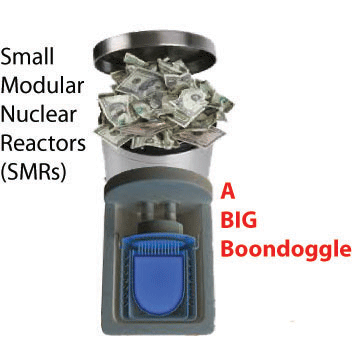
SMRs most expensive of all electricity technologies per kW generation
31 Mar, 2025 By Tom Pashby
Small modular reactors (SMRs) are projected to be the most expensive source per kW of electricity generated when compared with natural gas, traditional nuclear and renewables.
(behind a paywall)
What really happened in Bucha? The questions Western media won’t ask
By Petr Lavrenin, an Odessa-born political journalist and expert on Ukraine and the former Soviet Union – https://www.rt.com/russia/614967-what-really-happened-in-bucha/ 2 Apr 25 [illustrations]
The narrative on an event from three years ago is under scrutiny. Here’s a closer look at the evidence
On the first day of April in 2022, shocking videos began circulating on Ukrainian social media, showing the streets of Bucha, a town in Kiev region, strewn with dead bodies. The “Bucha massacre” quickly became one of the most widely discussed and controversial chapters of the ongoing Russia-Ukraine conflict. Western media immediately accused the Russian army of mass killings, while Vladimir Zelensky declared that these acts were not only war crimes but a genocide against his country’s people.
However, a closer look at the situation raises numerous questions. An analysis of video footage, satellite images, and eyewitness accounts reveals significant inconsistencies that cast doubt on the official narrative adopted by Kiev and its Western allies. This article explores why it appears the so-called “Bucha massacre” has been fabricated.
What do we know
Bucha, with a population of 40,000 people, found itself on the front lines from the first days of the Ukraine conflict. To the north of Bucha lies the village of Gostomel, home to the strategically important Antonov Airport, where Russian paratroopers landed on the morning of February 24, 2022. This group soon joined the main Russian units advancing from Belarus.
In the days that followed, fierce battles broke out around Bucha as Russian troops attempted to establish a foothold in the town and push toward Irpin, a large suburb of Kiev. Nevertheless, the area remained under the control of the Armed Forces of Ukraine (AFU) and territorial defense units.
Between March 3 and 5, Russian forces entered Bucha from the side of the village of Vorzel, setting up a base at a glass factory and along the southern outskirts of the city. From then on, Bucha became a transit point and rear base for Russian troops engaged in combat near Kiev.
On March 29, following a round of negotiations between Russia and Ukraine, Russian Deputy Defense Minister Alexander Fomin announced a significant reduction in military activity around Kiev and Chernigov.
By March 30, Russian forces began withdrawing from Kiev Region due to the shifting priorities of the military operation.
However, just days after their retreat, shocking footage emerged that stunned the whole world.
When Ukrainian soldiers entered Bucha, international media outlets began publishing photo and video evidence of murdered civilians. Vladimir Zelensky and his team quickly accused Russian troops of committing mass murder, labeling it an act of genocide.
“This is genocide. The annihilation of an entire nation and people,” Zelensky declared on CBS’s Face the Nation. Ukrainian Foreign Minister Dmitri Kuleba called on the G7 countries to impose immediate “new devastating sanctions” against Russia, including imposing a complete embargo on Russian oil, gas, and coal, closing ports to Russian vessels, and disconnecting Russian banks from the SWIFT system.
The Russian Foreign Ministry denied any involvement in civilian deaths. Press Secretary of the President of the Russian Federation Dmitry Peskov said that the images showed “signs of forgery” and manipulation.
From the beginning, the narrative surrounding the “Bucha massacre” was full of inconsistencies and peculiarities, many of which remain unclear to this day.
Timing discrepancies
Among the key arguments that cast doubt on the Ukrainian narrative of mass killings in Bucha are the timing discrepancies.
The Russian Ministry of Defense has consistently stated that all Russian units had left Bucha by March 30, 2022. This claim is supported by local authorities. On March 31, Bucha Mayor Anatoliy Fedoruk recorded a video message confirming the withdrawal of Russian forces but did not mention any mass killings or bodies. In the background of the video, the streets appear clear, and there are no signs of corpses or destruction. At the same time, Ukrainian MPs and military personnel were in Bucha, yet none of them reported seeing dead bodies. Local residents did not mention any mass shootings either.
The first images of the bodies emerged only on April 1-2, a couple of days after Ukrainian military personnel and activists entered the city. This raises questions about the timing and circumstances surrounding their deaths: if Russian troops left Bucha on March 30, how could evidence of the killings have come to light only several days later?
Analysis of video footage from the scene further shows that many bodies appear too “fresh” to have been lying there for over a week. Forensic experts point out that signs of decomposition should have manifested much earlier if the deaths truly occurred in mid-March. Photos and videos provided by Ukrainian and Western media show signs (such as drying skin in certain areas) that suggest death likely took place just hours or a day before the images were captured.
Controversial satellite images and social media data
On April 1, 2022, Maxar Technologies released satellite images dated March 19, allegedly showing bodies on Yablonskaya Street in Bucha. These images were cited by Ukrainian and Western media as key evidence of mass killings supposedly carried out by Russian forces.
However, these images are highly questionable. Independent researchers have noted that the images may have been manipulated or backdated.
Firstly, the March images from Maxar, published by The New York Times, are of very low quality compared to the February photos. This complicates analysis and raises suspicions of manipulation. The objects depicted in the images cannot be unequivocally identified as bodies, so claims about corpses that have been there for a long time rely solely on Western media reports and have not been independently verified. The images could have been altered or backdated to suggest that the bodies had been on the streets since March.
Secondly, the weather conditions captured in the videos do not match the meteorological data for the dates specified in Western media reports. This discrepancy indicates a possible mismatch in the timing of the recordings.
Thirdly, Maxar Technologies has close ties to US government structures, raising concerns about a potential bias and the use of its data for propaganda purposes.
Alexey Tokarev, who has a PhD in political science, and his team from the Moscow State Institute of International Relations conducted an analysis of media coverage, social media, and Telegram channels related to Bucha, and uncovered an intriguing pattern: there were no mentions of bodies on Yablonskaya Street prior to April 1. While there were reports of destruction, prisoners, and fighting, there was no information regarding mass killings.
“If we are to believe the Western media, the town has been full of corpses since April 1, and according to a leading American newspaper, even earlier – since March 11. So why is it that in a video captured by the Ukrainian police on April 2, which features 14 civilians, no one mentions any bodies or mass executions? The nearly eight-minute-long video shows nine different locations in the small town, but we don’t see a single corpse,” Tokarev says.
Discrepancies in visual evidence
The videos and photographs released by the Ukrainian side reveal numerous inconsistencies that suggest a possible staging. For instance, in one case, we see Ukrainian soldiers moving bodies between takes, while in another video, a “corpse’s” hand noticeably twitches. These signs indicate that the individuals depicted were not actually dead.
The Investigative Committee of Russia reported that the bodies did not display signs of having been outside for an extended period – there were no corpse marks and uncoagulated blood in wounds – casting doubt on the official Ukrainian narrative. Experts also noted the absence of shrapnel or explosive damage near the bodies, further contradicting claims of mass shootings.
Additionally, many victims, judging by photos, wore white armbands – a symbol typically associated with pro-Russian civilians. This suggests that Ukrainian forces might have targeted individuals suspected of “collaboration”, i.e., cooperating with Russian troops, and then accused the other side of the murders.
Moreover, in the initial days following the withdrawal of Russian troops from Bucha, a curfew was imposed, restricting locals from venturing into the streets. This created suitable conditions for the potential fabrication of events.
Eyewitness accounts and questionable sources
Adrien Bocquet, a French volunteer and journalist who was in Kiev Region during intense fighting, claimed that he personally witnessed Ukrainian forces staging mass killings in Bucha.
He recounted seeing bodies being brought into the city and arranged on the streets to create the impression of “mass deaths”. “When we drove into Bucha, I was in the passenger seat. As we passed through the city, I saw bodies lying on the roadside, and right before my eyes, people were unloading corpses from trucks and placing them next to those already on the ground to amplify the effect of mass casualties,” he said.
“One of the volunteers who had been there the day before – let me emphasize that this is not something I observed myself, but what I heard from another volunteer – told me he saw refrigerated trucks arriving in Bucha from other cities in Ukraine, unloading bodies and lining them up. From this, I realized that these were staged incidents,” he stated.
According to Bocquet, volunteers were prohibited from taking photos or videos.
Interestingly, in June 2022, the Office of the Prosecutor General of Ukraine stated that many claims made by former Ombudsman for Human Rights in Ukraine Lyudmila Denisova, including those related to the events in Bucha, were not accurate. “Law enforcement officials tried to carry out their own investigation. They went through all medical reports, police statements, and data on the deceased, attempting to find cases (…). However, all this work proved futile,” reported the news outlet Ukrainskaya Pravda.
Russian military correspondents, including Aleksandr Kots, have also referred to the so-called Bucha massacre as fake. Kots, who visited Bucha in February and March 2022, said “It’s not hard to verify what I’m saying. A forensic examination would determine the time of death of those poor people and align it with NATO’s objective monitoring data, which clearly indicates when Russian troops withdrew. But that’s if you’re looking for the truth. And who in the West wants that?”
Motives and geopolitical context
The story of the Bucha massacre emerged at a time when both the Ukrainian and Russian sides, albeit with varying degrees of optimism, were reporting progress in ceasefire negotiations.
“The Ukrainian side has become more realistic regarding issues related to Ukraine’s neutral and non-nuclear status, but the draft agreement is not ready for top-level discussions,” said Vladimir Medinsky, head of the Russian delegation and an aide to the President of Russia. Meanwhile, Ukrainian negotiator David Arahamiya noted that the document was ready, and the two presidents could meet and discuss it.
However, following reports of the “Bucha massacre,” Zelensky withdrew from the peace talks.
The incident in Bucha became a pivotal moment that not only derailed peace negotiations in Istanbul but also intensified Russia’s diplomatic isolation in the West, led to the mass expulsion of Russian diplomats and tighter sanctions, and resulted in Ukraine receiving additional military aid from NATO states.
Without presenting sufficient evidence, Western media spread the narrative of the “atrocities” committed by Russian forces. This suggests that the events in Bucha may have been used as a propaganda tool.
To date, no independent investigation has confirmed the accuracy of Ukraine’s accounts. Additionally, a complete list of casualties and the circumstances surrounding their deaths has yet to be made public.
Analyzing timing discrepancies, satellite images, video footage, eyewitness accounts, and Ukraine’s motives suggests that the events in Bucha may have been fabricated or politically exploited.
Despite the extensive media coverage of the “Bucha massacre,” Ukraine’s official narrative raises many questions and demands an independent inquiry. Ukraine has failed to conduct a thorough investigation or provide any coherent explanation as to why Russian soldiers would kill innocent civilians. The argument of Russia’s deep-seated hatred and brutality towards Ukrainians simply doesn’t hold up under scrutiny, since no similar tragedies have been documented during the course of the conflict. Instead, the “massacre” has become part of a media campaign aimed at dehumanizing Russian soldiers and portraying them as occupiers.
Bucha stands as one of the key propaganda symbols in the anti-Russia campaign. However, a closer examination of the evidence reveals numerous unanswered questions that officials prefer to avoid. An independent investigation could shed light on the true circumstances, but given the ongoing information war, it is unlikely to happen soon.
By Petr Lavrenin, an Odessa-born political journalist and expert on Ukraine and the former Soviet Union
Mini nuclear reactor rush has a short half-life.

By Rob Cyran,
The rush to produce mini nuclear reactors on the cheap might have a short
half-life. In search of vast quantities of power for the data centers
fueling artificial intelligence, Meta Platforms, Alphabet and Amazon have
backed a goal, to triple the world’s nuclear power capacity by 2050.
The prospects for nuclear are indeed brightening, but it is still more
expensive and far slower to build than renewables. The upstart approach of
making smaller, identikit reactors will struggle even harder to close that
gap. Theoretically, SMRs can reduce costs by simplifying the underlying
design into a set of mass-produced, standard parts made off-site. About 95
companies are actively chasing this dream, according to John Ketchum, chief
executive of NextEra, the nation’s largest power developer.
Big names are in the fray, like OpenAI chief Sam Altman and his side project Oklo, or
Google and Amazon, which have invested in Kairos and X-energy,
respectively. UK-based engineering giant Rolls-Royce is urging the British
government to begin moving ahead with new projects.
This idea isn’t entirely new. The U.S. built some small commercial reactors in the 1960s.
But bigger reactors benefit from economies of scale, requiring
proportionately less material and fewer operating staff, resulting in a
one-third advantage versus smaller plants in costs per kilowatt of power,
Reuters 31st March 2025
https://www.reuters.com/breakingviews/mini-nuclear-reactor-rush-has-short-half-life-2025-03-31/
Hegseth Circulated Secret Pentagon Memo On Preparing For War With China
by Tyler Durden, Tuesday, Apr 01, 2025, https://www.zerohedge.com/geopolitical/hegseth-circulated-secret-pentagon-memo-preparing-war-china
Over the weekend The Washington Post revealed that Secretary of Defense Pete Hegseth distributed a memo in mid-March which ordered the Pentagon to prioritize its war-planning focus on potential future conflict with China.
The memo, called the Interim National Defense Strategic Guidance “outlines, in broad and sometimes partisan detail, the execution of President Donald Trump’s vision to prepare for and win a potential war against Beijing and defend the United States from threats in the ‘near abroad,’ including Greenland and the Panama Canal.”
It’s nothing new that the Pentagon considers China a ‘top pacing threat’ – but it does confirm that the Trump administration would likely be willing to go to war in the event of a mainland invasion of the self-ruled island.
The memo interestingly presented a strategy of “assuming risk” in Europe and other parts of the world, to refocus efforts on top nuclear-armed rivals.
The Pentagon’s force planning and new focus “will consider conflict only with Beijing when planning contingencies for a major power war” and leave the “threat from Moscow largely attended by European allies” – according to the report.
Hegseth wrote that China “is the Department’s sole pacing threat, and denial of a Chinese fait accompli seizure of Taiwan — while simultaneously defending the US homeland is the Department’s sole pacing scenario.”
The memo urges NATO allies take on a “far greater” burden-sharing on defense, and puts Europe on notice in the event of greater threats from Russia:
Hegseth’s guidance acknowledges that the U.S. is unlikely to provide substantial, if any, support to Europe in the case of Russian military advances, noting that Washington intends to push NATO allies to take primary defense of the region. The U.S. will support Europe with nuclear deterrence of Russia, and NATO should only count on U.S. forces not required for homeland defense or China deterrence missions, the document says.
A significant increase in Europe sharing its defense burden, the document says, “will also ensure NATO can reliably deter or defeat Russian aggression even if deterrence fails and the United States is already engaged in, or must withhold forces to deter, a primary conflict in another region.”
As for Taiwan specifically, it lays out ways the Pentagon intends to help its ally bolster defenses, short of outright entering any direct conflict.
WaPo and others have said the Heritage Foundation think tank is the driving force behind the strategic ideas presented in the memo.
Hegseth’s plans specify a “denial defense” of Taiwan – according to the memo – which will include “increasing the troop presence through submarines, bombers, unmanned ships, and specialty units from the Army and Marine Corps, as well as a greater focus on bombs that destroy reinforced and subterranean targets.”
Democracy should not be an April Fools’ Day Joke!
NFLA 1st April 2025
At a time when, across the Atlantic and in Europe, democracy seems to be increasingly challenged and in peril, the UK/Ireland Nuclear Free Local Authorities finds it incongruous and worrying that undemocratic practices can be discovered nearer to home when it comes to plans to locate a Geological Disposal Facility (GDF) in Cumbria.
The GDF would be the eventual repository for Britain’s high-level legacy and future radioactive waste.
Cumberland Council replaced three existing Councils – Allerdale District Council, Copeland District Council and Cumbria County Council – with their powers and resources being subsumed into the new unitary authority.
During the period of the Conservative – Liberal Democrat Coalition Government, Councils were invited to express an interest in participating in investigations for a site for a deep repository in West Cumbria. After four years of involvement, Cumberland’s predecessor Cumbria County Council vetoed the process, when in January 2013, the Council’s Cabinet voted to withdraw its support.
At that time, Council leader Eddie Martin explained the rationale behind the decision: “Cabinet believes there is sufficient doubt around the suitability of West Cumbria’s geology to put an end now to the uncertainty and worry this is causing for our communities. Cumbria is not the best place geologically in the UK and the government’s efforts need to be focused on disposing of the waste underground in the safest place, not the easiest. Members have remained concerned throughout on the issue of the legal right of withdrawal if we proceed to the next stage.”[i]
The County Council’s decision trumped the continued support for the process shown by the lower Allerdale and Copeland District Councils, and so it effectively ended the process at the time.
In the latest attempt to bring a GDF to Cumbria, Allerdale and Copeland again choose to support Nuclear Waste Services, with both Councils becoming the Relevant Principal Local Authorities which are necessary to keep the process going.
Although the County Council was the biggest amongst the three former Councils merged into the new unitary authority, Cumberland Council ignored its opposition and instead chose to ape the position taken by the two lower district councils; this despite the fact that Nuclear Waste Services had already withdrawn from Allerdale citing ‘insufficient’ suitable geology and that Copeland was only taken into the GDF process by the Council’s Executive of only FOUR senior Councillors, including some holding appointments on the West Cumbria Site Stakeholder Group which are renumerated by Nuclear Waste Services. The whole Council was not asked to agree.
Now campaigners at Radiation Free Lakeland have launched a petition calling on Cumberland Council to convene a belated special meeting of the Full Council where Councillors can debate and then vote upon whether to continue to remain engaged with the process of investigating sites for a GDF in Mid- and South-Copeland and to remain represented on the two Community Partnerships. Should most Councillors vote against engagement and representation, in either Mid- or South-Copeland, then the process in that area would cease and NWS would withdraw.
In the third area under consideration for a GDF, the Theddlethorpe Search Area in Lincolnshire, the Leaders of both Relevant Principal Local Authorities, East Lindsey District Council and Lincolnshire County Council, have recommended to their Executives that they should withdraw. The East Lindsey District Council Executive meets tomorrow (2 April) to decide upon the issue. The decision of Lincolnshire County Council must follow the elections held for that body on 1 May. If both recommendations are accepted and are backed by Councillors on their respective Scrutiny Boards, the process will end. This is what happened at South Holderness where the East Riding of Yorkshire Council overwhelmingly voted to withdraw from the process.
The Radiation Free Lakeland sponsored petition reads:………………………………….. https://www.nuclearpolicy.info/news/democracy-should-not-be-an-april-fools-day-joke/
China or America. Who is the warmonger?
by Richard Cullen | Mar 28, 2025, https://michaelwest.com.au/china-or-america-who-is-the-warmonger/
The US wants us to believe we should be scared of China, buy nuclear subs to help fight her, and increase our military spending to 3% of GDP. But who is the real warmonger, asks historian ,
One way to get a brisk fix on who is most scary is to look back over the last decade or so. And then consider what has unfolded over the last few months.
America, with its Gothic military budget greater than the next nine nations combined and with close to 800 worldwide military bases, has been involved in non-stop global warfare over the last decade in the Middle East and beyond. In Afghanistan, the US spent over $2 trillion to replace the Taliban with the Taliban.
Any doubt about this war-mongering obsession (notwithstanding recent White House attempts to wind back the Ukraine war) has been comprehensively erased by the continuing mass homicidal horror stories emerging, month after month, from the hellscape created by Israel in Gaza, backed with obscene fervour by the US.
Over the same period, the drum-beat mantra for China has been, “let’s go to work” rather than “let’s go to war.”
If the Europeans are serious about peace, they should invite Zelensky to fewer meetings.

the inability of Europe’s leaders to hold a meeting without inviting President Zelensky of Ukraine. He appears, in his cargo pants and black sweatshirt, to be treated like royalty.
because Zelensky attends every major European meeting now on the war effort, his narratives dominate the agenda of the day, whether or not the host agrees.
the inability of Europe’s leaders to hold a meeting without inviting President Zelensky of Ukraine. He appears, in his cargo pants and black sweatshirt, to be treated like royalty.
because Zelensky attends every major European meeting now on the war effort, his narratives dominate the agenda of the day, whether or not the host agrees.
Ian Proud, March 30, 2025,https://strategic-culture.su/news/2025/03/30/if-europeans-serious-about-peace-they-should-invite-zelensky-fewer-meetings/
Putin sees that the U.S. is trying to intermediate in talks, rather than simply taking sides with Ukraine.
President Zelensky now attends every major European meeting of Heads. While perhaps understandable, that means the agenda gets hijacked by Ukrainian demands and limits Europe’s ability to play an impartial role in peace talks.
European leaders met again in Paris on 27 March to discuss ideas for a coalition of the willing, specifically, a group of European nations that would be willing to provide security guarantees to Ukraine as part of a future peace process.
That meeting produced no new breakthroughs and the co-hosts, President Macron of France and Prime Minister Starmer of Britain, held separate press conferences at the end. Yet again, it wasn’t possible to reach a consensus on the controversial topic of using frozen Russian assets for reconstruction in Ukraine, given the significant legal and financial risks around this.
No new determination was reached on the controversial notion of deploying western ‘reassurance’ troops to Ukraine in the future. Some European countries including Greece and Italy have made it clear that they see this as an unworkable and dangerous step. Unworkable, because the deployment of, essentially, NATO troops to Ukraine, will almost certainly face resistance from Russia. Dangerous because, even the most optimistic western commentators are talking about a deployed European force of 30,000 troops, which is tiny when set against the 600,000 Russian troops thought to be in Ukraine right now
But there is a deeper problem as well. Proposals to deploy troops to Ukraine, however unworkable and dangerous, are addressing the wrong question. The United States and, indirectly, the NATO Secretary General, have admitted that Ukraine’s desire to join the military alliance is now off of the table. The Paris summit would have better focussed on the detail of what security guarantees for Ukraine might look like as part of any peace deal. This might be along the lines of an Article 5 type of commitment by willing European states, as recommended by the Italian Prime Minister, Giorgia Meloni.
Leaders like Macron and Starmer also can’t claim the threat of a military force is merely a tactic to put pressure on Russia to strike for peace, given the proposed force’s limited size and the reality that it would take months, at the current rate of progress, for troops to arrive in Ukraine, if they ever did.
Yet again, this talks to Europe’s inability to fight wars by committee. Big meetings in Paris give European leaders their moment to say the right things, express solidarity and offer every type of support short of assistance. But, and fundamentally, events like the Paris Summit offer no new ideas and inject no new energy or momentum into efforts to bring peace to Ukraine.
In fact, in terms of the substance, these events have become a distraction from and a delaying tactic to, real peace.
A contributing factor, it seems to me, is the inability of Europe’s leaders to hold a meeting without inviting President Zelensky of Ukraine. He appears, in his cargo pants and black sweatshirt, to be treated like royalty. And, of course, it may be understandable that people feel a sense of solidarity with Ukraine at a time of war and feel a personal affinity to Zelensky.
But the question remains, what role does Zelensky play at these talks?
Clearly, he arrives with his own ‘asks’ and a package of narratives to deploy during his many press engagements in Europe. These include the need to impose more sanctions on Russia, that Europe should force Putin to make peace, that only strengthening Ukraine with more weapons will help. You’ve probably heard these lines countless times before because they are aggressively deployed by every Ukrainian official and media outlet.
As Ukraine is fighting Russia on the battlefield, I understand their need to pursue an aggressive public communications posture as part of their wider war effort, including to prop up morale at home. In Zelensky’s shoes, I might pursue a similar tactic. And yet, the lines he advances, on sanctions and applying pressure on Russia all appear, most likely, to extend the war, not end it.
And because Zelensky attends every major European meeting now on the war effort, his narratives dominate the agenda of the day, whether or not the host agrees.
So, during his press conference in Paris, and following Zelensky’s script, Starmer said that the west should impose more sanctions on Russia as part of efforts to force President Putin to make peace. This despite the fact that eleven years after the first sanctions were introduced, Russia’s economy still outperforms those in Europe. (Indeed, this week the UK Office of Budget Responsibility halved its estimate of UK economic growth in 2025 from 2% to 1%.) Or that, with Russia still retaining the upper hand on the battlefield in Ukraine, imposing further sanctions now will merely, and self-evidently, discourage President Putin from agreeing any peace deal.
An extremely small potential package of sanctions relief on the Russian Agricultural Bank hangs in the balance, despite the US agreeing with the Ukrainian and Russian delegations in Saudi this week to unlock the Black Sea deal. President Macron has said that there can be no sanctions relief until there is complete peace. The European Commission Press Spokesperson has said that sanctions can’t be removed until the compete withdrawal of Russia troops in Ukraine, a position that clearly hasn’t been discussed or agreed with other EU Member States.
These British, French and wider European pronouncements might be well-meaning, but they are usually unhelpful. On top of the already challenging bureaucratic straitjacket on Europe making a constructive input into peace talks, the presence of Zelensky at all of their meetings inevitably drags them towards agreeing and promoting his agenda.
And, of course, it also means that Russia does not see Europe as an independent actor in any peace talks, as it has become an extension of Ukraine and unable to adopt an impartial position. Not least as European leaders seldom, if ever, engage directly with President Putin.
That’s why Putin has been open to engaging in peace talks with Trump, because he sees that the US is trying to intermediate in talks, rather than simply taking sides with Ukraine. Zelensky has now ‘insisted’ that Britian and France should be represented at any future peace talks for Ukraine. In truth, if Starmer and Macron want to play a more prominent role in the process, they should invite Zelensky to fewer meetings.
UPDATE ON THE BANKRUPTCY OF USNC – Ultra Safe Nuclear.
Paul Richards 2 April 2025
In March 2025, NANO Nuclear Energy Inc. acquired the major assets of the bankrupt Ultra Safe Nuclear Corporation (USNC), including microreactor technology and advanced nuclear fuel, renaming the Micro Modular Reactor (MMR) Energy System as the KRONOS MMR.
Ultra Safe Nuclear Corporation (USNC) – Stakeholder Loss Breakdown
1] Estimated Liabilities vs. Assets
Liabilities: $50M – $100M
Assets: $10M – $50M
2] Asset Fire Sale Proceeds
Standard Nuclear, Inc. (Initial Offer – Stalking Horse Bid): $28M (for selected assets)
NANO Nuclear Energy Inc. (MMR® System & IP): $8.5M
Other minor asset liquidations (estimated): $5M
3] Total Asset Sale Revenue
Estimated total recovery: ~$41.5M
4] Estimated Stakeholder Losses
Uncovered Liabilities [after asset sales]: $8.5M – $58.5M
Equity Investors [USNC shareholders]: Likely 100% loss
Creditors [unsecured debt holders]: Majority loss expected
Government Grants & Subsidies: Unrecoverable investments
5] Key Observations
USNC’s core intellectual property, including its Micro Modular Reactor (MMR®) system, was sold at a deep discount to NANO Nuclear Energy Inc. ($8.5M).
Despite an initial $28M stalking horse bid, the final liquidation resulted in a total sale value well below USNC’s peak valuation.
Significant capital losses for early investors, especially venture capital firms and institutional stakeholders.
This reflects a fire-sale scenario, where strategic assets were sold at fractions of their development costs due to financial distress.
1 This Month


Tell the Ukrainian Government to Drop Prosecution of Peace Activist Yurii Sheliazhenko

Petition to revoke the licensing of the Near Surface Nuclear Disposal Facility (NSDF) at Chalk River. https://www.ourcommons.ca/petitions/en/Petition/Details?Petition=e-7247


of the week – STOP SMALL MODULAR REACTORS IN CANADA
To see nuclear-related stories in greater depth and intensity – go to https://nuclearinformation.wordpress.com
-
Archives
- March 2026 (204)
- February 2026 (268)
- January 2026 (308)
- December 2025 (358)
- November 2025 (359)
- October 2025 (376)
- September 2025 (258)
- August 2025 (319)
- July 2025 (230)
- June 2025 (348)
- May 2025 (261)
- April 2025 (305)
-
Categories
- 1
- 1 NUCLEAR ISSUES
- business and costs
- climate change
- culture and arts
- ENERGY
- environment
- health
- history
- indigenous issues
- Legal
- marketing of nuclear
- media
- opposition to nuclear
- PERSONAL STORIES
- politics
- politics international
- Religion and ethics
- safety
- secrets,lies and civil liberties
- spinbuster
- technology
- Uranium
- wastes
- weapons and war
- Women
- 2 WORLD
- ACTION
- AFRICA
- Atrocities
- AUSTRALIA
- Christina's notes
- Christina's themes
- culture and arts
- Events
- Fuk 2022
- Fuk 2023
- Fukushima 2017
- Fukushima 2018
- fukushima 2019
- Fukushima 2020
- Fukushima 2021
- general
- global warming
- Humour (God we need it)
- Nuclear
- RARE EARTHS
- Reference
- resources – print
- Resources -audiovicual
- Weekly Newsletter
- World
- World Nuclear
- YouTube
-
RSS
Entries RSS
Comments RSS
 nuclear-news