Court upholds two legal challenges to the Chalk River Radioactive Megadump.

Gordon Edwards, 14 Mar 25
The radioactive megadump planned for Chalk River (an “engineered mound” intended to contain about one million tonnes of so-called “Low-level” radioactive waste in a permanent landfill-like toxic waste dump just one kilometre from the Ottawa River) was planned by Canadian Nuclear Laboratories (CNL) and approved by CNSC.
Three legal challenges against this decision were launched in the Federal Appeals Court. The first had to do with the inadequacy of the safety case and the lack of adequate monitoring of the contents of the megadump. The second had to do with the failure to consult the Indigenous Algonquin peoples as required by the “Duty to Consult” and the UN Declaration on the Rights of Indigenous Peoples (UNDRIP). The third challenge had to do with the failure to consider alternative sites for such a toxic waste facility to provide adequate protection for endangered species.
Although the first challenge was not successful, the good news is that the second and third challenges were upheld by the court and CNSC and CNL will have to re-open the regulatory process to correct the inadequacies that have been noted. This does not mean that the existing megadumo has been forbidden but that more work must be done by both the proponent and the regulator to satisfactorily address these inadequacies.
The success of the third challenge was only announced yesterday.
The Federal Court overturned the Species at Risk permit for the nuclear waste facility planned for Chalk River, just 180 km up the Ottawa River from Ottawa.
The project proponent, CNL, said that the construction would harm, harass, or kill the endangered Blanding’s Turtle and 2 endangered bat species.
The Court found that CNL did not consider all reasonable alternative locations, and CNL admitted that it picked Chalk River even though it was less favourable for protecting species at risk than two other viable sites.
This violated s. 73(3)(a) of the Species at Risk Act, which says that “all” reasonable alternatives that would reduce the impact on species at risk must be considered and the best solution must be adopted.
There’s a lot to parse, but essentially, Justice Zinn agreed about the first 2 issues (not all reasonable locations were considered, and the best option was not chosen), but disagreed about the others (bat boxes, wildlife corridors, bird nests, the Monarch).
The win on the location issue is huge, of course. If they have to pick a new location, they have to start over from scratch and none of the other issues matter. See para 48 (of the decision) for some good reasoning by Zinn J:
“During both the hearing and public consultation with the Canadian Nuclear Safety Commission, CNL conceded that it would only consider non-AECL properties if no suitable AECL-owned site was identified. This admission confirms that CNL’s default approach was to confine its search to AECL lands unless compelled to broaden it. This methodology is directly at odds with the statutory mandate under paragraph 73(3)(a). The Minister failed to reconcile this self-imposed limitation with the statutory requirement for a comparative assessment of ecological impacts on protected species. I am of the view that, even if a non-AECL site posed greater logistical challenges, such as increased transportation distances, the Act would still require CNL to consider it if it offered reduced harm to at-risk species. Administrative or logistical difficulties do not absolve the project’s proponent of its duty to evaluate such alternatives under paragraph 73(3)(a), even if those factors later justify rejecting them.”
Unfortunately, this does not mean that ECCC will not approve the permit for Chalk River. The decision is being sent back for redetermination, as is normal in admin law cases. From Zinn’s interpretation of the statutory language, it’s hard to see how it could be approved for Chalk River, given CNL’s deficient siting process, but Zinn seemed to be aware of these massive implications and tried to avoid these repercussions. He goes out of his way to say that it could be possible for ECCC to approve the permit for Chalk River if 1) they give appropriate justification for only looking at AECL sites (para 50) and 2) interpreted “best option” differently than ECCC has in the past, to include non-species-at-risk factors, and justified this different interpretation (paras 57-61).
1 Comment »
1 This Month
26 April – Chernobyl: Inside the Meltdown airs on National Geographic on Sunday 26th April from 4pm
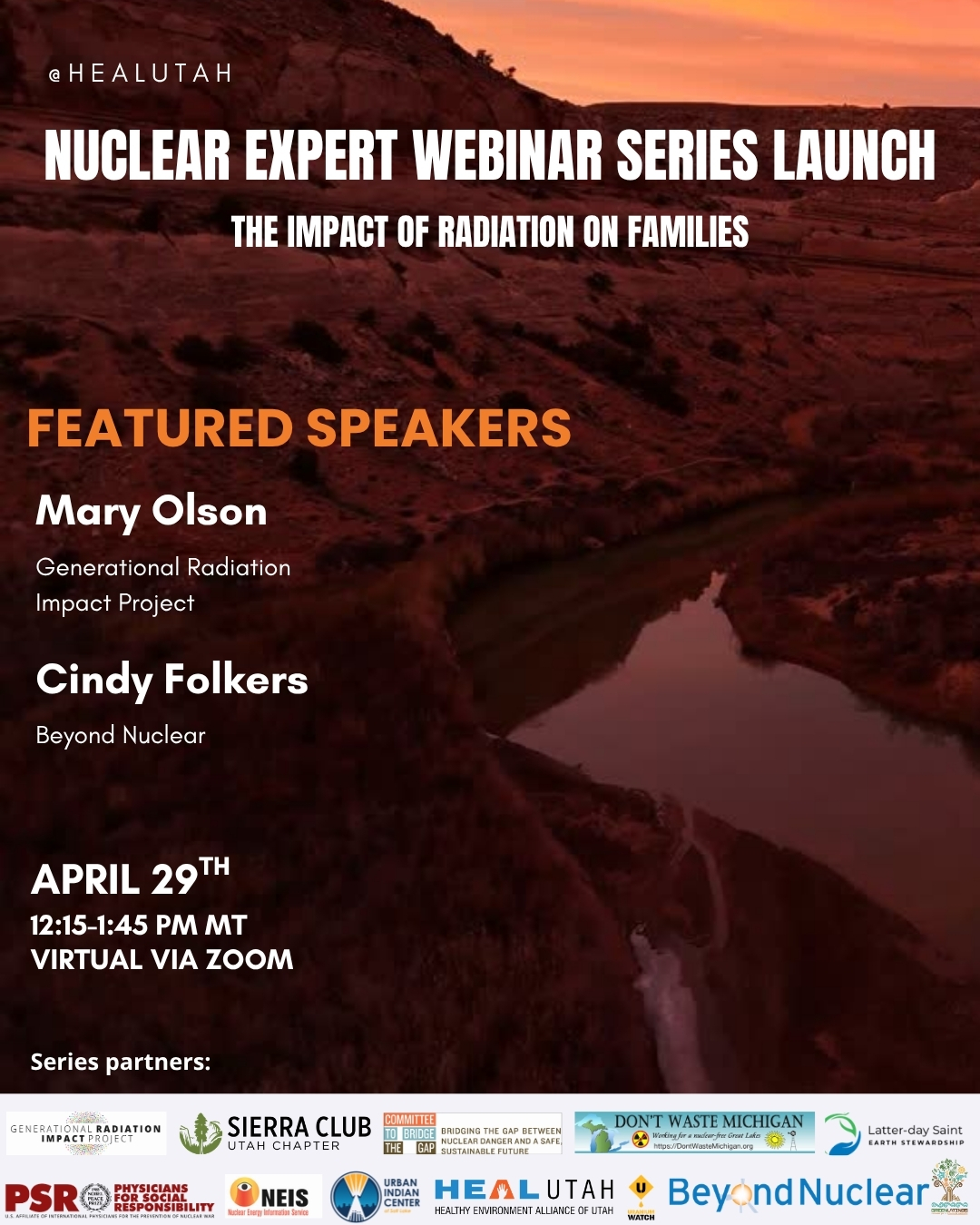
29 April – Nuclear Expert Webinar #1 – Radiation Impacts on Families with Mary Olson and Cindy Folkers
- 12:15 PM MT – 1:45 PM MT
- Location: Virtual – REGISTER TODAY

4 May -West Suburban Peace Coalition to discuss Iran war at May Educational Forum
Monday, May 4, 7:00 – 8:00 PM Central Standard Time
Title: : How Trump’s Narrative Tries to Shape the Reality of the War on Iran.
Contact Walt Zlotow, zlotow@hotmail.com 630 442 3045 for further information
14 May – online event From Bombs to Data Centres: the Face of Nuclear Colonialism

Pine Ridge Uranium is the real threat, not Tehran- Tell Burgum: Stop the Extraction.
Chernobyl: The Lost Tapes – A good documentary on Chernobyl on SBS available On Demand for the next 3 weeks– https://www.sbs.com.au/ondemand/tv-program/chernobyl-the-lost-tapes/2352741955560
To see nuclear-related stories in greater depth and intensity – go to https://nuclearinformation.wordpress.com
-
Archives
- April 2026 (346)
- March 2026 (251)
- February 2026 (268)
- January 2026 (308)
- December 2025 (358)
- November 2025 (359)
- October 2025 (376)
- September 2025 (257)
- August 2025 (319)
- July 2025 (230)
- June 2025 (348)
- May 2025 (261)
-
Categories
- 1
- 1 NUCLEAR ISSUES
- business and costs
- climate change
- culture and arts
- ENERGY
- environment
- health
- history
- indigenous issues
- Legal
- marketing of nuclear
- media
- opposition to nuclear
- PERSONAL STORIES
- politics
- politics international
- Religion and ethics
- safety
- secrets,lies and civil liberties
- spinbuster
- technology
- Uranium
- wastes
- weapons and war
- Women
- 2 WORLD
- ACTION
- AFRICA
- Atrocities
- AUSTRALIA
- Christina's notes
- Christina's themes
- culture and arts
- Events
- Fuk 2022
- Fuk 2023
- Fukushima 2017
- Fukushima 2018
- fukushima 2019
- Fukushima 2020
- Fukushima 2021
- general
- global warming
- Humour (God we need it)
- Nuclear
- RARE EARTHS
- Reference
- resources – print
- Resources -audiovicual
- Weekly Newsletter
- World
- World Nuclear
- YouTube
-
RSS
Entries RSS
Comments RSS
 nuclear-news
[…] is gung-ho for nuclear power, but here is strong and well-informed opposition to it. And those peskyindigenous opponents are having legal winson waste plans, – the wastes problem does put a damper on new […]