Advocates for nuclear power should heed the lessons from Kursk
By Richard Broinowski, Aug 29, 2024, https://johnmenadue.com/advocates-for-nuclear-power-should-heed-the-lessons-from-kursk/
On 22 August, Rafael Grossi, director-general of the International Atomic Energy Agency, warned of the deadly effect a military attack on Russia’s nuclear power complex at Kursk would have on civilian communities in Russia, Ukraine and potentially across Europe. He had previously warned of the consequences of such attacks on Ukraine’s nuclear reactors at Zaporizhzhia.
The Kursk nuclear complex is approximately 30 kilometres from a fluid military situation between invading Ukrainian forces and Russian defenders. The complex has six Russian designed RBMK reactors, the same type as at Chernobyl. Two are shut down, two are in construction mode, and two are hot. None have protective domes. The easiest and most effective military action would be destruction of the complex’s power supply, which as with flooded generators at Fukushima, would halt cooling pumps, overheat the reactors, cause a melt-down of fuel rods, and the uncontrolled venting of radioactive materials into the atmosphere.
People have short memories, and tend to forget the dimensions of previous nuclear disasters and near disasters, particularly at Windscale, Three Mile Island, Chernobyl and Fukushima. Chernobyl was arguably the worst, followed closely by Fukushima. At Chernobyl, reactor number four exploded, not due to military action, but an experiment by Russian engineers to see how long turbines would spin and supply power to cooling pumps if the reactor’s main electric supply failed. In the reactor, the collision of incandescent nuclear fuel with cooling water created an explosion which blew apart the reactor vessel and spread radioactive dust including xenon gas, short-lived Iodine 131 (eight days) and Caesium 137 (30 years) across much of Ukraine and Belarus, as well as parts of Russia, and Scandinavia. The nearest town of Pripyat was evacuated and a no-go zone of 30 kilometre radius, later expanded to 4,300 square kilometres, was declared.
Subsequent reports by the UN Scientific Committee on the Effects of Atomic Radiation found that immediate deaths caused by radiation from Chernobyl could be calculated, most certainly deaths from thyroid cancer, but not of long-term stochastic deaths. The precise number is unknown and there are wildly different estimates, including among the medical profession. Because of fears about radiation damage to foetuses, over one million abortions were performed across Europe in the year following the disaster.
And now, two warring countries dice with death over Zaporizhzhya, Europe’s largest nuclear power complex and one of the 10 largest in the world. Most recent attacks occurred between 2022 and 2024. Fighting in 2022 led up to Russia wresting management of the complex. While it was going on, a large calibre bullet pierced the outer wall of reactor number four and an artillery shell hit a transformer in reactor number six.
In April 2024, the IAEA reported the plant was attacked by a swarm of drones, three of them torching surveillance and communication equipment. There were three direct hits on containment structures. On 11 August, fire broke out in one of two cooling towers. Zelensky blames Putin for the attacks, Putin blames Zelensky. Putin is probably right. Why would Russia attack the complex it now managed? Both tend to downplay the disastrous consequences an attack on the reactors or their electricity and cooling systems would have on civilian populations across Europe. They would be similar if not worse than the results of the Chernobyl fiasco.
Although badgered by journalists following his 22 August address, Grossi refused to attribute blame for the attacks at Zaporizhzhia and who might initiate them at Kursk. He said the IAEA was not a political organisation, and blame would be up to the UN Security Council. He would not get into speculation. When pressed, however, he said if his investigations led to clear evidence of the perpetrators, he would call them out. Meanwhile, he was about to go to Kursk and examine the situation in conjunction with the managers and engineers of the nuclear complex there. He then planned to separately see both Putin and Zelensky.
What the whole situation should bring home to Australian politicians and their backers in the nuclear industry, who so blithely recommend the construction of a dozen-odd nuclear reactor complexes here, is the widespread lethal damage a kinetic attack on any one of them would cause in this country. We already see that US military and surveillance installations would become natural targets for China if ever war breaks out over Taiwan. Nuclear reactors would pose a much wider damage to the civilian population.
Tepco aims to dismantle Fukushima water tanks from 2025
Tokyo Electric Power Company Holdings aims to begin dismantling tanks used for storing treated wastewater in 2025. The tanks are now empty following water discharges into the Pacific since August last year.
Tepco released a total of 62,400 metric tons of treated water from its meltdown-stricken Fukushima No. 1 nuclear power plant in eight rounds of discharges over the past year.
Investigations by the government and Tepco into the surrounding sea areas have shown that the concentration of the radioactive substance tritium, contained in the treated water, is far below the safety limit. Last month, the International Atomic Energy Agency published a report that the water releases meet international safety standards………. (Subscribers only)
Japan Times 26th Aug 2024
https://www.japantimes.co.jp/news/2024/08/26/japan/fukushima-water-tanks-dismantle/
Tangible Panic Grows in Ukraine Amid Donbass-front Collapse
Each paragraph below is illustrated on the original, with explanatory sources – quotes, videos, maps )
Simplicius, Aug 29, 2024 https://simplicius76.substack.com/p/sitrep-82824-tangible-panic-grows?utm_source=post-email-title&publication_id=1351274&post_id=148194067&utm_campaign=email-post-title&isFreemail=true&r=ln98x&triedRedirect=true&utm_medium=email—
Ukraine is slowly descending into a panic regarding the collapse of the Donbass front, and in fact that collapse is seemingly accelerating. Some semblance of a normalcy bias continues to grip the more obdurate observers, but the keen-eyed are seeing the writing on the wall.
Head of the top Ukrainian channel “Deepstate UA”—which is basically the Ukrainian ‘Rybar’—calls the situation complete chaos:
Arestovich wrote a long post on his official account where he called the situation around Pokrovsk an “operational crisis”.
Rada deputy Goncharenko was beside himself, calling the situation catastrophic. He added that after Pokrovsk, the road to the entire Dnieper will be wide open:
It’s almost pointless even updating the exact captures and advances anymore because right now they’re simply happening so fast that within hours of the Sitrep’s release, the information is already obsolete, and Russians have advanced even more. But suffice it to say, this time there were even several major captures in areas other than Pokrovsk.
Russian forces captured the remainder of Konstantinovka on the Ugledar line:
Ugledar is now becoming in danger of being surrounded for the AFU in the near future.
Then Russians captured most of Grodovka, after having just entered it days ago:
At this pace, it will be captured in the next day or two it seems.
After capturing New York, they’ve already entered the next settlement north of it, Nelipovka. And nearby, they’ve advanced deeper into Toretsk, gaining hundreds of meters inside the important city.
As of now, they’re mere kilometers from Pokrovsk, and right at the outskirts of its neighboring city of Mirnograd:
Nearby, they’ve now entered Selidov for the first time, and are already working through it:
Another Ukrainian account:
“Battles for Selidove have begun! The enemy is actively pushing our defenses on the eastern outskirts of the city, the fighting continues in the area of the stadium and the park, slowly moving towards the high-rises, also the podars are trying to level the front and are starting to press from Mykhailivka to the south and push from the highway in the east. The same squeeze situation occurred in New York.”
In light of the ongoing collapse, the potential for dangerous escalation rises because Zelensky gets increasingly desperate to engineer some kind of black swan event that could overturn the table and upend events.
With this in mind there continues to be a slew of rumors for what Zelensky’s next move might be. For instance, there continue to be reports of AFU preparations on the Zaporozhye front:
There is some credence to the above given that in the past few days the Russian airforce has carried out at least 2 separate air strikes along the Black Sea toward Odessa—one was at Snake Island, and another at oil platforms just east of there which Ukrainian GUR was using to stage landings toward Crimea.
This is roughly how Zelensky’s potential plan is meant to play out:
A simultaneous mass landing by special forces around the Kinburn Spit area to harass the ‘rears’ of Russia’s Dnieper grouping, while other amphibious forces directly strike at the Energodar plant and then the main logistics force tries to wrap around from Zaporozhye city along the river to connect with them.
No one quite knows why this happened, but there are a few potential conjectures:
- Lukashenko foresees Ukraine attempting to create some provocation as part of the earlier mentioned ‘black swan’ to involve NATO forces, and is taking appropriate deterrence measures
- Lukashenko is trying to help Russian troops by pinning or ‘fixing’ Ukrainian border guards along the Belarus border, given that Ukraine was said to have removed many of the border forces to use them in Kursk
- Least likely: Russia and Belarus plan some kind of joint final decapitation invasion to finish off the war
Most likely it’s a combination of 1 and 2.
Partly related to the heightening tensions, we now have a new very interesting statement by Lavrov which appears to vindicate my recent reporting about potential changes to the Russian nuclear doctrine, given the West’s unceasing escalations against Russia’s red lines.
There’s an undercurrent of tension now running through events as other somewhat peculiar happenings have gone on. For instance, Belarus suddenly moved a lot of forces to the Ukrainian border again, and for the first time they appear to have a tactical symbol of a ‘B’ on them, as if they are preparing for direct combat:

Central Japan nuclear reactor fails to pass safety review
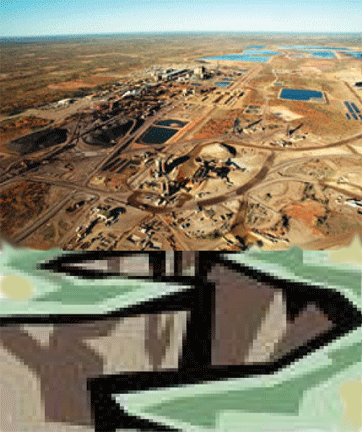
Tsuruga plant’s No. 2 reactor may lie above active fault in Fukui, watchdog says
https://asia.nikkei.com/Business/Energy/Central-Japan-nuclear-reactor-fails-to-pass-safety-review— 28 Aug 24
TOKYO (Kyodo) — Japan’s nuclear watchdog on Wednesday decided that a reactor in Fukui Prefecture failed to pass its restart safety review, marking the first such case since the regulatory body’s founding after the 2011 Fukushima nuclear crisis.
The No. 2 reactor at the Tsuruga plant, operated by Japan Atomic Power, fell short of the safety requirements due to a possible active fault underneath the offline unit. The Nuclear Regulation Authority plans to seek public comments on its assessment report before making its decision official, possibly in October.
In quake-prone Japan, building reactors or other important safety facilities directly above active faults is prohibited.
Japan Atomic Power first applied for the safety screening with the hope of restarting the reactor in November 2015.
But a safety review team of the NRA concluded in July it could not rule out that an active fault located around 300 meters north of the reactor building could potentially stretch right beneath the facility.
The assessment process for the reactor had been rocky, with proceedings suspended twice after it was revealed that Japan Atomic Power had submitted documents that included inaccuracies and data rewritten without approval. It reapplied in August last year.
The Tsuruga nuclear plant is a two-unit complex, with the No. 1 reactor set to be scrapped.
The No. 2 reactor, which started commercial operations in February 1987, went offline in May 2011.
Japan revamped its regulatory setup by launching the NRA in 2012 and has also introduced a set of new safety requirements to reflect the lessons learned from the disaster at Tokyo Electric Power Co. Holdings’ Fukushima Daiichi plant, triggered by a huge earthquake and tsunami in March 2011.
Zelensky signs law to ban Ukraine’s largest church
https://www.rt.com/russia/603017-zelensky-signs-orthodox-church-law/ 28 Aug 24
The bill outlaws any religious organizations considered to have ties to Moscow
Vladimir Zelensky has signed a law that calls for the banning of any religious group suspected of having ties to Russia. It threatens to effectively shut down the Ukrainian Orthodox Church (UOC) – the largest faith-based organization in the country.
The Ukrainian parliament introduced the legislation earlier this week; it is expected to take effect in 30 days. After that, all the activities of the Russian Orthodox Church (ROC) and all affiliated religious organizations will be outlawed.
The UOC will have nine months to sever all ties with the ROC, despite the Ukrainian church having already declared full autonomy from the Moscow Patriarchate in 2022, following the outbreak of the Ukraine conflict.
After signing the legislation on Saturday, the country’s Independence Day, Zelensky released a video address stating that “Ukrainian Orthodoxy is today taking a step towards liberation from Moscow’s devils.”
Moscow has condemned Ukraine’s crackdown on religious communities; the Holy Synod of the ROC issued a statement on Thursday comparing the new legislation with Soviet-style repression and other historical persecutions of Christians.
“The purpose of this law is to liquidate [the UOC] and all its communities and to forcibly transfer them to other religious organizations,” the Synod surmised, noting that “hundreds of monasteries, thousands of communities, and millions of Orthodox believers in Ukraine will find themselves outlawed and will lose their property and place of prayer.”
The Synod stated that it would appeal Kiev’s actions with international human rights organizations and call on them to immediately and objectively respond to the “flagrant persecution of believers in Ukraine.”
Meanwhile, former Russian President Dmitry Medvedev responded to the new law by stating that Zelensky has “no religious identity” and describing the crackdown as “full-fledged Satanism,” supported by Ukraine’s Western backers.
“This story will not go unpunished for Ukraine,” Medvedev wrote, stating “the country will be destroyed, like Sodom and Gomorrah,” referring to the Old Testament story of two cities obliterated by divine intervention for their wickedness. “The demons will inevitably fall,” he continued, adding that their punishment will be “earthly, cruel, painful and will happen soon.”
Religious tensions have plagued the country for a long time, with a number of entities claiming to be the true Ukrainian Orthodox Church. The two main rival factions are the Ukrainian Orthodox Church and the Kiev-backed Orthodox Church of Ukraine (OCU), which is considered by the Russian Orthodox Church to be schismatic.
The UOC remains the largest Orthodox church in Ukraine, with more than 8,000 parishes across the country. However, since the 2010s, some of these have been choosing to transfer to the jurisdiction of the OCU under pressure from authorities in Kiev.
Russia says UN watchdog must be ‘more objective’ after trip to nuclear plant near fighting

By Reuters, August 28, 2024
MOSCOW, Aug 28 (Reuters) – Russia said on Wednesday it wanted the International Atomic Energy Agency to take a “more objective and clearer” stance on nuclear safety, a day after the agency head visited a Russian nuclear plant near where Ukraine has mounted an incursion into the country.
Separately, Russia said its forces had defused unexploded U.S.-supplied munitions fired by Ukraine that were shot down just 5 km (3 miles) from the Kursk nuclear plant.
IAEA chief Rafael Grossi toured the Kursk facility on Tuesday and warned of the danger of a serious nuclear accident there. He said he had inspected damage from a drone strike last week, which Russia had blamed on Ukraine, but did not say who was responsible.
Russian state news agency RIA quoted Foreign Ministry spokeswoman Maria Zakharova as saying in a radio interview that Moscow wanted the IAEA to speak out more clearly on issues of nuclear security, although she denied it was demanding that the agency take a pro-Russian line.
“We see both the assessments and the work of this structure (the IAEA), but each time we want a more objective and clearer expression of the position of this structure,” Zakharova said.
“Not in favour of our country, not in favour of confirming Moscow’s position, but in favour of facts with one specific goal: ensuring safety and preventing the development of a scenario along a catastrophic path, to which the Kyiv regime is pushing everyone.”
The IAEA could not immediately be reached for comment…………………………
Ukraine has not responded to Russian accusations that it attacked the plant near where its forces launched a surprise incursion on Aug. 6 that Russia is still trying to repel. There has been fighting about 40 km (25 miles) from the facility.
Russia’s National Guard said in a statement on Wednesday that its sappers had found a shell from a U.S.-supplied HIMARS multiple launch rocket system 5 km from the plant, and a rocket fragment which it said was stuffed with 180 unexploded munitions.
There was no immediate comment from Ukraine on the purported Russian find, and Reuters could not independently verify the location of the video.
Grossi said during his visit that the plant, built to a Soviet design, was especially vulnerable because – unlike most modern nuclear power stations – it lacked a containment dome that might offer protection in the event of a strike by drones, missiles or artillery………………………. https://www.reuters.com/world/europe/russia-criticises-un-nuclear-watchdog-after-trip-plant-close-fighting-2024-08-28/
‘Lessons of the past forgotten’ as nuclear proliferation continues
Peace and Security, https://news.un.org/en/story/2024/08/1153696
More than 2,000 nuclear tests have been conducted at over 60 sites around the world since testing began on 16 July 1945, resulting in uninhabitable lands and long-term health problems, Secretary General António Guterres said in his message marking Friday’s International Day to end testing once and for all.
“Recent calls for the resumption of nuclear testing demonstrate that the terrible lessons of the past are being forgotten – or ignored,” he said.
The International Day was established in 2009 by the UN General Assembly to recall the date of the official closing of the Semipalatinsk nuclear weapons testing site in today’s Kazakhstan on 29 August 1991.
That one site alone saw 456 nuclear test explosions between 1949 and 1989.
Era of nuclear proliferation
In the shadow of the Cold War, the world witnessed an unprecedented era of nuclear proliferation and testing.
Between the years 1954 and 1984 there was on average at least one nuclear weapons test somewhere in the world every week, most with a blast far exceeding the power of the bomb dropped on Hiroshima.
Moreover, nuclear weapons stockpiles have grown exponentially, with the majority far more powerful than the bombs used in Hiroshima and Nagasaki.
This proliferation has left a ‘legacy of destruction’, according to Mr. Guterres, significantly disrupting people’s lives and livelihoods and affecting the environment with traces of radioactivity in even the deepest of ocean trenches.
‘World must speak with one voice’
The UN chief is urging the world to speak with one voice, “to end this practice once and for all”.
He has praised the Comprehensive Nuclear-Test-Ban Treaty as an “essential, verifiable security tool” due to its complete prohibition on all nuclear testing.
He is calling on all countries whose ratifications are needed for the Treaty to enter into force to do so immediately and without conditions.
“Let’s pass the test for humanity – and ban nuclear testing for good,” he concluded.
Read the op-ed here marking the day on our UN News site penned by the President of the General Assembly and head of the Comprehensive Nuclear-Test-Ban Treaty Organization.
Extreme’ levels of plutonium contamination found in Los Alamos
- Levels are comparable to Chernobyl nuclear disaster in Ukraine: Researcher
- Government says area remains safe
- Researchers say area visitors must be warned
Safia Samee Ali, Aug 28, 2024, https://www.newsnationnow.com/science/extreme-levels-plutonium-contamination-los-alamos/
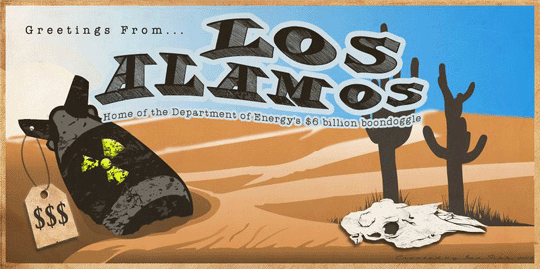
NewsNation) — High levels of plutonium have been found around Los Alamos, the birthplace of the atomic bomb, raising alarms ahead of plans by the federal government to restart nuclear weapons manufacturing in the same area.
Michael Ketterer, a Northern Arizona University professor emeritus who analyzed soil, water and vegetation samples taken along a popular hiking and biking trail in Acid Canyon, said that there were more extreme concentrations of plutonium found there than at other publicly accessible sites he has ever researched.
Ketterer has compared the levels to those found at the site of the Chernobyl nuclear disaster in Ukraine.
“This is one of the most shocking things I’ve ever stumbled across in my life,” he said.
“It’s just an extreme example of very high concentrations of plutonium in soils and sediments. Really, you know, it’s hiding in plain sight.”
The Department of Energy’s Environmental Management Los Alamos Field Office said that the findings are consistent with department data that has been publicly available for years and that the canyon remains safe for unrestricted use.
But Nuclear Watch, a group Ketterer worked with, said officials need to warn people against coming in contact with water in Acid Canyon.
From 1943 until 1963, liquid and often radioactive waste was dumped down a canyon near Los Alamos National Laboratory, which gave it the name Acid Canyon.
Jay Coghlan, director of Nuclear Watch, said plutonium contamination in the heart of Los Alamos is a concern, particularly as the Energy Department and the National Nuclear Security Administration are slated to begin producing plutonium pits once again in an effort to build up nuclear weaponry.
The federal government began cleaning up Acid Canyon in the late 1960s and eventually transferred the land to Los Alamos County.
Officials determined in the 1980s that conditions within the canyon met DOE standards and were protective of human health and the environment.
The Associated Press contributed to this story.
Opposing a USA-led international nuclear agreement that is bizarrely unfair to Australia
Australians can object to the agreement, by putting in a submission to a Parliamentary Joint Standing Committee.
Submissions are due by September 1st. So far, only 2 submissions have been published. They’re sort of “zipped” – so I can’t read them. You can bet your boots they are from the nuclear lobby
I’s a bit of an IT hurdle to actually get your submission in. That’s after you’ve even written it. Which is tough, too, as the general public in Australia knows nothing about it.
But anyway, here’s one little effort
TITLE: Submission to the Joint Standing Committee on Treaties concerning the:
Agreement among the Government of Australia, the Government of the
United Kingdom of Great Britain and Northern Ireland, and the Government
of the United States of America for Cooperation Related to Naval Nuclear Propulsion.
This submission urges that the Joint Standing Committee on Treaties recommends against
the Australian Government signing this Agreement as I believe that it is not in the best interests of the Australian people on a number of grounds, as outlined in this submission
Australia would be landed with high level nuclear waste – This Agreement
requires Australia to “be responsible for the management, disposition, storage, and
disposal of any spent nuclear fuel and radioactive waste resulting from the
operation of Naval Nuclear Propulsion Plants transferred pursuant to this Article,
including radioactive waste generated through submarine operations, maintenance,
decommissioning, and disposal.” (ARTICLE IV Naval Nuclear Propulsion Plants,
Related Equipment and Material, Section D).
The health risk to Australians brought in by the construction of nuclear facilities
and the management and storage of radioactive wastes. Buying second-hand
nuclear submarines make this waste danger another hazard, as we’d be buying
already existing toxic wastes.
Under this agreement it is possible for a nuclear weapon to be present on
Australian shores– this would it would be a clear breach of the highest order of the
Treaty on the Non-Proliferation of Nuclear Weapons (NPT) because as a signatory to
NPT Australia is not allowed to manufacture or otherwise acquire nuclear weapons.
The agreement does not guarantee that the USA will continue with the nuclear
submarine arrangements, but still ensures that Australia will cop the costs. This is
blatantly unfair.
It is extraordinarily unfair and bizarre that under Article IV E. “Australia shall
indemnify, the United States and the United Kingdom against any liability, loss,
costs, damage or injury (including third-party claims) arising out of, related to, or
resulting from Nuclear Risks connected with the design, manufacture, assembly,
transfer, or utilization of any Material or Equipment, including Naval Nuclear
Propulsion Plants and component parts and spare parts thereof transferred or to be
transferred pursuant to this Article.”
The ‘National Interest Analysis [2024] ATNIA 14 with attachment on consultation’,
acknowledges that “There has been no public consultation”, with paragraph 55
stating that “No public consultation has been undertaken, given the classified scope of consultations between the Parties on the Agreement, including matters relating to
national security and operational capability.”
The Treaty clearly outlines that Special Nuclear Material to be transferred under the
agreement, “shall contain highly enriched uranium and, only with respect to
irradiated fuel, may contain plutonium”, (ARTICLE VI Conditions and Guarantees,
SECTION I –SPECIAL NUCLEAR MATERIAL)
In conclusion – the whole agreement is unfair, poorly organised, and should not be
accepted by Australia, particularly in this situation where there has been no public
consultation – set up completely in the dark as far as the Australian people are
concerned.
Noel Wauchope
Russia Warns US Will Face ‘Much Harsher’ Consequences for Backing Kursk Invasion

August 28, 2024 https://news.antiwar.com/2024/08/27/russia-warns-us-will-face-much-harsher-consequences-for-backing-kursk-invasion/
Consequences for Backing Kursk Invasion
In a separate warning, Russia’s foreign minister said the US should understand World War III wouldn’t be confined to Europeby Dave DeCamp August 27, 2024
Russian Deputy Foreign Minister Sergey Ryabkov said on Tuesday that the US would face “much harsher” consequences for backing Ukraine’s offensive in Russia’s Kursk Oblast.
“The impression is that our colleagues [in Washington] have discarded the remnants of common sense and believe that they can do anything,” Ryabkov said, according to TASS.
“The consequences [for the United States] could be much harsher than those they are already experiencing, they know where and in what areas we are reacting in practical terms,” Ryabkov added.
The US claims it was not involved in the planning of the Kursk offensive, but it has allowed Ukraine to use US-provided armored vehicles, missiles, and bombs in the attack on Russian territory.
The New York Times reported that the US and the UK have also provided Ukraine with satellite imagery and other information about the Kursk region. Ryabkov said that US involvement in the Kursk offensive is an “obvious fact.”
Ukraine is now pushing hard for the US to allow it to launch long-range strikes inside Russia using US-provided missiles. Russian Foreign Minister Sergey Lavrov strongly warned against this potential escalation and said the US should understand that if World War III breaks out, it wouldn’t be contained in Europe.
“Americans unequivocally associate conversations about Third World War as something that, God forbid, if it happens, will affect Europe exclusively,” Lavrov said.
Ukrainian President Volodymyr Zelensky has said that his Western backers are “naive” for worrying about escalation and called Russia’s red lines a “bluff.”
On Monday, Russia launched massive missile and drone attacks across Ukraine, which was seen as retaliation for the Kursk offensive. Russia followed up with another heavy bombing on Tuesday.
Meanwhile, in eastern Ukraine, Russian forces continue to make steady gains, which have become more rapid since Ukraine launched its Kursk offensive on August 6.
UN fears nuclear incident possible at Russia’s ‘vulnerable’ Kursk plant after drone strikes
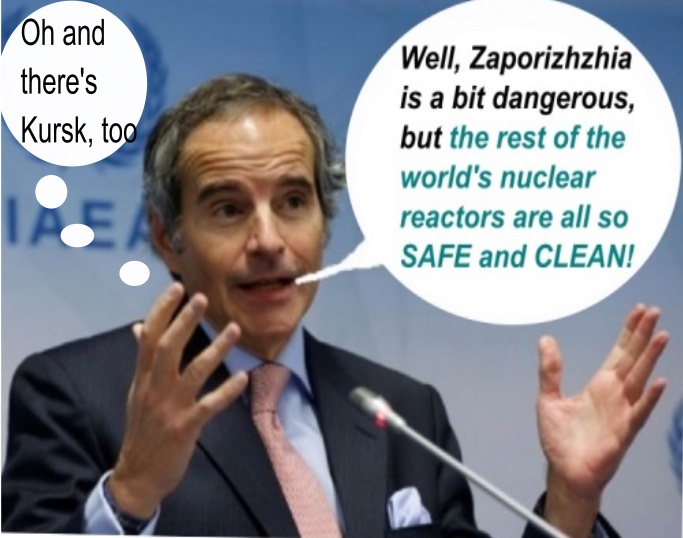
International Atomic Energy Agency raises the alarm about the Kursk plant’s vulnerable nuclear reactor as war rages nearby.
August 27, 2024 By Csongor Körömi https://www.politico.eu/article/un-international-atomic-energy-agency-rafael-grossi-nuclear-incident-russia-kursk-plant-drone-strikes-war-in-ukraine/?fbclid=IwY2xjawE7xONleHRuA2FlbQIxMQABHYsv1ZIaZ4vYeP7K4rKYHQMLy03ZNTz8FBhh11Vv7C3OjzmKz-vJZUlyQA_aem_UFL5Vx9yHAwB2AVR6omFyA
The United Nations’ nuclear watchdog chief warned on Tuesday of heightened risk at the nuclear power plant in Kursk, Russia, where Ukraine has been conducting a military counteroffensive.
International Atomic Energy Agency Director General Rafael Grossi led the mission to the nuclear site after Russian President Vladimir Putin claimed it came under fire following Ukraine’s incursion into the region. Kyiv has denied accusations that it targeted the plant.
“The danger or the possibility of a nuclear accident has emerged near here,” Grossi told reporters, according to Reuters. He added that during his visit of the plant he saw evidence of drone strikes in the area.
“I was informed about the impact of the drones. I was shown some of the remnants of them and signs of the impact they had,” Grossi said, without saying who was responsible.
He warned that the nuclear reactor at the Kursk plant doesn’t have a protective dome, unlike most nuclear facilities, making its core very vulnerable to artillery or drone strikes.
“The core of the reactor containing nuclear material is protected just by a normal roof, he said during his visit. “This makes it extremely exposed and fragile, for example, to an artillery impact or a drone or a missile.”
“A nuclear power plant of this type, so close to a point of contact or a military front, is an extremely serious fact that we take very seriously.”
Despite the ongoing conflict, the power station is operating “in very close to normal conditions,” according to Grossi.
“My message is the same for everyone: no nuclear accident can happen. It is our responsibility to make sure of that,” Grossi said at the news conference, adding that the agency won’t take sides in the Russian-Ukrainian war. “This conflict, this war, is not the responsibility of the IAEA.”
The war that reignited following Russia’s all-out military assault on Ukraine, now in its third year, has been fraught with nuclear risks, with numerous instances of nuclear weapon saber-rattling and recklessness near energy-generating nuclear facilities.
After the start of the conflict, Grossi worked to establish five principles to be respected by both Russia and Ukraine to ensure nuclear safety and avert an atomic catastrophe.
Russia captured Ukraine’s Zaporizhzhia nuclear plant at the start of its invasion and has repeatedly endangered the plant’s safety, drawing condemnation from Grossi.
Grossi will travel to Ukraine next week to meet with President Volodymyr Zelenskyy and discuss “a number of things,” including the situation at the Zaporizhzhia nuclear plant and the presence of IAEA experts at other sites in Ukraine.
The effects of world’s worst nuclear disaster in Chernobyl, Ukraine, in the 1980s are still felt to this day. Hundreds of thousands of square kilometers of land in Russia, Belarus and Ukraine were contaminated, and an area of around 30 kilometers around the plant remains essentially uninhabitable. Soviet authorities initially denied the scale of the disaster.
Waihopai is a Secret U.S. Spy Base in New Zealand Designed for War-fighting
Global Peace and Justice A0TEAROA) By Murray Horton, August 29, 2024
Murray Horton is organiser of the Campaign Against Foreign Control of Aotearoa (CAFCA) and an advocate of a range of progressive causes for the past five decades.
He can be reached at: cafca.
Reprinted from Covert Action Magazine
The news that the Waihopai spy base was going to be built led to the birth of the Anti-Bases Campaign (ABC) in 1987. ABC has campaigned for the closure of Waihopai ever since (our most recent protest there was in 2023).
We have consistently said that it is a U.S. spy base in all but name, i.e., that the New Zealand Government Communications Security Bureau (GCSB, NZ’s spy agency in the Five Eyes international spy alliance) works as directed by the U.S. National Security Agency (NSA). We have also consistently said that it is a war-fighting base, not just a spy base. The powers that be in New Zealand’s covert state, and their political mouthpieces, have always denied this and/or asked for evidence?
Soothing Reassurances from GCSB Bosses
For example, this from The New Zealand Herald, (April 9, 2010), with the eye-catching title “It’s ours and it’s not evil, say spy-base masters”:
“New Zealand’s secret spies emerged from the shadows yesterday to deny their Waihopai station is an American spy base contributing to torture and war. Present and past Directors of the Government Communications Security Bureau took the unusual step of commenting publicly on allegations made during and after last month’s trial in which a jury acquitted teacher Adrian Leason, 45, Dominican friar Peter Murnane, 69, and farmer Sam Land, 26, of charges of burglary and willful damage after they broke into the base in Marlborough.”
“Father Murnane said after the verdict: ‘We have shown New Zealanders there is a U.S. spy base in our midst.’ In court, he said the trio felt strongly about the evil caused by activities of spy bases, such as torture, war and use of weapons of mass destruction such as depleted uranium. Air Marshal Sir Bruce Ferguson, the Bureau’s Director, and his predecessor, Dr. Warren Tucker, said the allegations demanded a response because they brought into question the integrity of New Zealand’s security and intelligence apparatus. ‘The Waihopai station is not a U.S.-run spy base,’ they said. ‘It is totally operated and controlled by New Zealand, through the GCSB as an arm of the New Zealand Government.’”
Waihopai Hosted U.S. NSA Spying/War-Fighting System for Nearly a Decade
Case closed? Not so fast. The year 2024 has unearthed fresh revelations. According to RNZ News, “The operation—that the Government Communications Security Bureau (GCSB) did not tell government ministers about—ran from 2013-20, but was only exposed by an official watchdog last month [March 2024)]. Intelligence documents strongly suggest the bureau hosted—but exercised virtually no oversight over—a system run by the U.S. National Security Agency [NSA] to help acquire targets classified as terrorists for killer drones, bombs and raids using GCSB data.”
The article continued: “An important aspect of the deal document—called a memorandum of understanding (MOU)—was that it dealt with concerns that arose within the GCSB about the system’s military capabilities. The Inspector-General of Intelligence and Security (IGIS) said the system was ‘largely controlled by the partner agency,’ even though the bureau could have vetoed operations it did not like under the MOU. It chose instead not to keep track of them, the inspector-general’s report last month showed.”
“The public report did not identify the foreign agency, and the inspector-general later told RNZ he did not ask if the system was used for military operations. His report revealed the MOU was signed with the foreign agency in March 2012 by a GCSB deputy director. An internal GCSB document from 2012 showed it signed an MOU with the NSA that year to host the APPARITION system.”
“‘The decision to host the capability on the terms set out in the MOU was significant, particularly given the potential uses of the capability to support military operations,’ said the inspector-general report. The MOU was poorly implemented, it said. A subsequent policy requires the bureau to get ministerial approval for an international agreement that deals with new policy. The inspector-general said this should be triggered if the bureau looked at a hosting deal like this again.”
Nicky Hager Explains APPARITION
So, what was this all about? Fortunately, we could rely on Nicky Hager to flesh out the details. Here’s what he wrote: “The IGIS [Inspector-General of Intelligence and Security] report said the GCSB decision to host a foreign system from 2012-2020 was ‘improper’ and that the GCSB ‘could not be sure the tasking of the capability was always in accordance with…New Zealand law.’ The Inspector-General said: ‘I have found some of the GCSB’s explanations about how the capability operated and was tasked to be incongruous with information in GCSB records at the time.’”
Hager continued: “But the Inspector-General could not reveal details of the system to the public because they are ‘highly classified.’ The name and function of the foreign spy spying equipment, the identity of the ‘foreign partner agency’ and the location of the ‘GCSB facility’ where foreign equipment was hosted all remained secret.”
“The mystery spy equipment appears strongly to be a top-secret U.S. surveillance system that was installed at the GCSB’s Waihopai base at the same time as the equipment in the IGIS investigation was installed at a ‘GCSB facility.’ The top-secret NSA spy equipment had the ghostly codename ‘APPARITION’ and fits with all the details presented in the IGIS report.”
“APPARITION was owned by and controlled by the U.S. National Security Agency—the world’s largest intelligence gathering agency and head of the Five Eyes intelligence alliance that includes the GCSB. A[n] NSA internal report, written after the launch of the APPARITION system in 2008, said that it ‘builds on the success of the GHOSTHUNTER prototype…a tool that enabled a significant number of capture-kill operations against terrorists.’”
“Capture-kill operations involve lethal attacks on targeted people using drones, bombs and special forces raids. Human rights organisations have documented numerous deaths of civilians during capture-kill operations—many of them ‘algorithmically targeted’ by electronic surveillance systems such as APPARITION. They are also criticised as being ‘extra-judicial killings.’”……………………………………………………………………………………………………………………………………………….
Waihopai Domes Gone But It Continues Spying
RNZ News reported that “[t]he various NSA and GCSB reports quoted were part of the trove of top secret reports released by the U.S. whistleblower Edward Snowden in 2013. The APPARITION documents do not say what the NSA used the Waihopai-based APPARITION equipment to target. However GCSB used the equipment for its own targeting as well.”
“Another 2012 Snowden document suggests that the Waihopai base was intercepting VSAT communications in the Pacific by targeting the NSS-9 satellite, which was located at 183 degrees east. The 2012 report discusses technology changes affecting Waihopai’s ‘South Pacific mission’ including the ‘ViaSat Skylink VSAT links,’ the NSS-9 satellite. It’s unclear whether this VSAT surveillance involved APPARITION.”…………………………………………………..
In 2022 the GCSB announced ‘Removal of Waihōpai spy base surveillance domes begins’ and media reported that the ‘virtually obsolete’ Waihopai spy domes were being dismantled.” “Some people, including journalists, assumed that the Waihopai station was ceasing to be an intelligence base. However Waihopai continues to intercept a range of satellites with more modern antennas and processing equipment as part of the Five Eyes intelligence alliance.”
New Zealand Has Blood on Its Hands. Shut Waihopai and GCSB
So, there we have it. While the GCSB spy bosses have been making reassuring noises all along, the reality is that, for nearly a decade (and a very recent decade at that), the GCSB was hosting, at Waihopai, a U.S. NSA system over which the GCSB had no control—by choice—and which was not known to the various Ministers who were nominally “in charge” of the GCSB. This period spanned both the Key National government and the Ardern Labour government, so both major parties were equally ignorant and culpable.
Furthermore, this NSA system was not only for spying but for capturing and/or killing targets via drones, missiles, bombs or attacks by special forces in countries far removed from New Zealand. Such military strikes inevitably kill family members, neighbors, bystanders and innocent civilians in general. This means that New Zealand very much has blood on its hands.
As the ABC has said from the outset, Waihopai is a U.S. spy base and a war-fighting one. The GCSB is a willingly complicit junior partner of the NSA. This is the proof. And it makes even more urgent the case for shutting down both Waihopai and the GCSB. https://gpja.org.nz/2024/08/29/waihopai-is-a-secret-u-s-spy-base-in-new-zealand-designed-for-war-fighting/
South Korea pushes to export nuclear reactors to Europe

Asian nation seeks to become leading player in market dominated by China and Russia
Ft.com Song Jung-a and Christian Davies in Seoul, Raphael Minder in Warsaw, Sarah White in Paris and Alice Hancock in Brussels , 29 Aug 24,
South Korea is accelerating its push to export nuclear reactors to Europe as it seeks to become a leading player in a global market dominated by China and Russia.
After beating Westinghouse of the US and France’s EDF to become preferred bidder on a $17bn project in the Czech Republic in July, state-run utility Korea Hydro & Nuclear Power is set to sign a contract early next year for two reactors in the central European country.
The deal, if completed, will mark Korea’s first major overseas nuclear power project in 15 years, since a consortium led by KHNP parent Kepco won a $20bn contract in 2009 to build and operate four nuclear plants in the United Arab Emirates.
Whang Joo-ho, the president of KHNP, said the company was conducting a feasibility study for a nuclear power plant in the Netherlands and was in talks to build reactors in Finland and Sweden as it aims to export 10 more reactors globally by 2030.
Kepco has also held early-stage discussions with British officials about building a new station on the island of Anglesey off the coast of Wales. ……………………………………………………………………………………………………
There could be bumps along the way for the South Koreans, however. KHNP faces claims from Westinghouse that they used its proprietary technology for their APR1400 reactors. A US district court last year dismissed Westinghouse’s lawsuit that argued that the Korean companies violated US export regulations requiring US government approval for technology sharing. However, the dispute remains unresolved as the court did not rule on the issue of intellectual property infringement.
The Czech deal has highlighted South Korea’s efforts at a time when projects run by western competitors including EDF remain mired in construction delays and cost overruns.
Although Ahn, the South Korean industry minister, said earlier this month that the two companies were “in last-stage talks” to settle the disputes, the US company this week filed an appeal with the Czech anti-monopoly office in protest at the selection of KHNP as the preferred bidder.
“KHNP neither owns the underlying technology nor has the right to sub-licence it to a third party without Westinghouse consent,” the US company said……………………………………………………………
Please use the sharing tools found via the share button at the top or side of articles. Copying articles to share with others is a breach of FT.comT&Cs and Copyright Policy. Email licensing@ft.com to buy additional rights. Subscribers may share up to 10 or 20 articles per month using the gift article service. More information can be found here.
https://www.ft.com/content/85a7e313-6089-4ba9-8f5b-f45adcbc5074
Suh Kyun-ryul, a nuclear expert and a former professor at Seoul National University, said KHNP would probably have to reach a financial settlement with Westinghouse. “This could even end up as a lossmaking deal,” he said. Suh also noted that South Korea was constrained by a long-standing agreement with the US that was signed in the 1950s to restrict Seoul’s ability to develop a nuclear weapons programme.
Under the agreement, South Korea’s access to raw material supplies is limited and it is not allowed to conduct uranium enrichment or the reprocessing of used fuel. Long-term buyers were likely to ask for a one-stop service ranging from nuclear fuel supply to waste disposal, he said, adding the US agreement remained “South Korea’s Achilles heel”. https://www.ft.com/content/85a7e313-6089-4ba9-8f5b-f45adcbc5074
1 This Month

petition to oppose the rapid increase of space-military industry threatening Jeju Island and the region.
[Petition by April 19th (KST)] Stop the joint military-Hanwha Systems-Jeju Provincial Government Sea Launch!

Chernobyl: The Lost Tapes – A good documentary on Chernobyl on SBS available On Demand for the next 3 weeks– https://www.sbs.com.au/ondemand/tv-program/chernobyl-the-lost-tapes/2352741955560

of the week–London Campaign for Nuclear Disarmament

Tell the Ukrainian Government to Drop Prosecution of Peace Activist Yurii Sheliazhenko
To see nuclear-related stories in greater depth and intensity – go to https://nuclearinformation.wordpress.com
-
Archives
- April 2026 (194)
- March 2026 (251)
- February 2026 (268)
- January 2026 (308)
- December 2025 (358)
- November 2025 (359)
- October 2025 (376)
- September 2025 (257)
- August 2025 (319)
- July 2025 (230)
- June 2025 (348)
- May 2025 (261)
-
Categories
- 1
- 1 NUCLEAR ISSUES
- business and costs
- climate change
- culture and arts
- ENERGY
- environment
- health
- history
- indigenous issues
- Legal
- marketing of nuclear
- media
- opposition to nuclear
- PERSONAL STORIES
- politics
- politics international
- Religion and ethics
- safety
- secrets,lies and civil liberties
- spinbuster
- technology
- Uranium
- wastes
- weapons and war
- Women
- 2 WORLD
- ACTION
- AFRICA
- Atrocities
- AUSTRALIA
- Christina's notes
- Christina's themes
- culture and arts
- Events
- Fuk 2022
- Fuk 2023
- Fukushima 2017
- Fukushima 2018
- fukushima 2019
- Fukushima 2020
- Fukushima 2021
- general
- global warming
- Humour (God we need it)
- Nuclear
- RARE EARTHS
- Reference
- resources – print
- Resources -audiovicual
- Weekly Newsletter
- World
- World Nuclear
- YouTube
-
RSS
Entries RSS
Comments RSS
 nuclear-news