TODAY. Relief – Hiroshima Day is over – now to our glorious $2 trillion nuclear weapons “modernization”!

August 7th. Hiroshima day is over. We can all breathe a sigh of relief. No need to be sad any more , about nuclear bombing. (Oh wait – there’s Nagasaki Day on the 9th. No matter, there’s very little coverage of that, and the people who count – the smart young people, probably have neder heard of it,
The good thing is – industry races on! Especially the USA nuclear weapons industry. Ain’t that great! They’re going to spend $2 trillion on “modernizing” nuclear weapons. And if Donald Trump gets in, backed by the Heritage Foundation, well – it will be more than $2 trillion.
I mean – think of the jobs jobs jobs! Think of the return to shareholders!
(Think of the American national debt – Nah – don’t go there. That is communist -style thinking and negativity)
No we don’t need negativity. Some people moan about not spending enough money on combatting climate change, on cleaning up plastic pollution, on preserving biodiversity, or even on feeding the world’s refugees and the hungry second-rate peoples.
No – positivity is the way to go. A positive approach to later on having a war against the evil Chinese and the evil Russians.
World-Ending Maneuvers? Inside the Nuclear-Weapons Lobby Today

A prime example of the power of the nuclear weapons lobby is the Senate ICBM Coalition. That group is composed of senators from four states — Montana, North Dakota, Utah, and Wyoming — that either house major ICBM bases or host significant work on the Sentinel. Perhaps you won’t be surprised to learn that the members of that coalition have received more than $3 million in donations from firms involved in the production of the Sentinel over the past four election cycles. Nor were they alone. ICBM contractors made contributions to 92 of the 100 senators and 413 of the 435 house members in 2024. Some received hundreds of thousands of dollars.
TomDispatch, By Hekmat Aboukhater and William D. Hartung August 7, 2024
The Pentagon is in the midst of a massive $2 trillion multiyear plan to build a new generation of nuclear-armed missiles, bombers, and submarines. A large chunk of that funding will go to major nuclear weapons contractors like Bechtel, General Dynamics, Honeywell, Lockheed Martin, and Northrop Grumman. And they will do everything in their power to keep that money flowing.

This January, a review of the Sentinel intercontinental ballistic missile (ICBM) program under the Nunn-McCurdy Act — a congressional provision designed to rein in cost overruns of Pentagon weapons programs — found that the missile, the crown jewel of the nuclear overhaul plan involving 450 missile-holding silos spread across five states, is already 81% over its original budget. It is now estimated that it will cost a total of nearly $141 billion to develop and purchase, a figure only likely to rise in the future.
That Pentagon review had the option of canceling the Sentinel program because of such a staggering cost increase. Instead, it doubled down on the program, asserting that it would be an essential element of any future nuclear deterrent and must continue, even if the funding for other defense programs has to be cut to make way for it. In justifying the decision, Deputy Defense Secretary William LaPlante stated: “We are fully aware of the costs, but we are also aware of the risks of not modernizing our nuclear forces and not addressing the very real threats we confront.”
Cost is indeed one significant issue, but the biggest risk to the rest of us comes from continuing to build and deploy ICBMs, rather than delaying or shelving the Sentinel program. As former Secretary of Defense William Perry has noted, ICBMs are “some of the most dangerous weapons in the world” because they “could trigger an accidental nuclear war.” As he explained, a president warned (accurately or not) of an enemy nuclear attack would have only minutes to decide whether to launch such ICBMs and conceivably devastate the planet.
Possessing such potentially world-ending systems only increases the possibility of an unintended nuclear conflict prompted by a false alarm. And as Norman Solomon and the late Daniel Ellsberg once wrote, “If reducing the dangers of nuclear war is a goal, the top priority should be to remove the triad’s ground-based leg — not modernize it.”
This is no small matter. It is believed that a large-scale nuclear exchange could result in more than five billion of us humans dying, once the possibility of a “nuclear winter” and the potential destruction of agriculture across much of the planet is taken into account, according to an analysis by International Physicians for the Prevention of Nuclear War.
In short, the need to reduce nuclear risks by eliminating such ICBMs could not be more urgent. The Bulletin of Atomic Scientists’ “Doomsday Clock” — an estimate of how close the world may be at any moment to a nuclear conflict — is now set at 90 seconds to midnight, the closest it’s been since that tracker was first created in 1947. And just this June, Russian President Vladimir Putin signed a mutual defense agreement with North Korean leader Kim Jong-un, a potential first step toward a drive by Moscow to help Pyongyang expand its nuclear arsenal further. And of the nine countries now possessing nuclear weapons, it’s hardly the only one other than the U.S. in an expansionist phase.
Considering the rising tide of nuclear escalation globally, is it really the right time for this country to invest a fortune of taxpayer dollars in a new generation of devastating “use them or lose them” weapons? The American public has long said no, according to a 2020 poll by the University of Maryland’s Program for Public Consultation, which showed that 61% of us actually support phasing out ICBM systems like the Sentinel.
The Pentagon’s misguided plan to keep such ICBMs in the U.S arsenal for decades to come is only reinforced by the political power of members of Congress and the companies that benefit financially from the current buildup.
Who Decides? The Role of the ICBM Lobby

A prime example of the power of the nuclear weapons lobby is the Senate ICBM Coalition. That group is composed of senators from four states — Montana, North Dakota, Utah, and Wyoming — that either house major ICBM bases or host significant work on the Sentinel. Perhaps you won’t be surprised to learn that the members of that coalition have received more than $3 million in donations from firms involved in the production of the Sentinel over the past four election cycles. Nor were they alone. ICBM contractors made contributions to 92 of the 100 senators and 413 of the 435 house members in 2024. Some received hundreds of thousands of dollars.
The nuclear lobby paid special attention to members of the armed services committees in the House and Senate. For example, Mike Turner, a House Republican from Ohio, has been a relentless advocate of “modernizing” the nuclear arsenal. In a June 2024 talk at the Center for Strategic and International Studies, which itself has received well over a million dollars in funding from nuclear weapons producers, he called for systematically upgrading the nuclear arsenal for decades to come, while chiding any of his congressional colleagues not taking such an aggressive stance on the subject.
Although Turner vigorously touts the need for a costly nuclear buildup, he fails to mention that, with $305,000 in donations, he’s been the fourth-highest recipient of funding from the ICBM lobby over the four elections between 2018 and 2024. Little wonder that he pushes for new nuclear weapons and staunchly opposes extending the New START arms reduction treaty.
In another example of contractor influence, veteran Texas representative Kay Granger secured the largest total of contributions from the ICBM lobby of any House member. With $675,000 in missile contractor contributions in hand, Granger went to bat for the lobby, lending a feminist veneer to nuclear “modernization” by giving a speech on her experience as a woman in politics at Northrop Grumman’s Women’s conference. And we’re sure you won’t be surprised that Granger has anything but a strong track record when it comes to keeping the Pentagon and arms makers accountable for waste, fraud, and abuse in weapons programs. Her X account is, in fact, littered with posts heaping praise on Lockheed Martin and its overpriced, underperforming F-35 combat aircraft.
Other recipients of ICBM contractor funding, like Alabama Congressman Mike Rogers, have lamented the might of the “far-left disarmament community,” and the undue influence of “anti-nuclear zealots” on our politics. Missing from the statements his office puts together and the speeches his staffers write for him, however, is any mention of the $471,000 in funding he’s received so far from ICBM producers. You won’t be surprised, we’re sure, to discover that Rogers has pledged to seek a provision in the forthcoming National Defense Authorization Act to support the Pentagon’s plan to continue the Sentinel program.
Lobbying Dollars and the Revolving Door
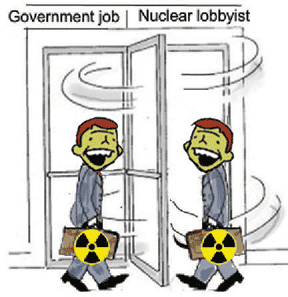
The flood of campaign contributions from ICBM contractors is reinforced by their staggering investments in lobbying. In any given year, the arms industry as a whole employs between 800 and 1,000 lobbyists, well more than one for every member of Congress. Most of those lobbyists hired by ICBM contractors come through the “revolving door” from careers in the Pentagon, Congress, or the Executive Branch. That means they come with the necessary tools for success in Washington: an understanding of the appropriations cycle and close relations with decision-makers on the Hill.
During the last four election cycles, ICBM contractors spent upwards of $226 million on 275 extremely well-paid lobbyists. For example, Bud Cramer, a former Democratic congressman from Alabama who once sat on the defense subcommittee of the House Appropriations Committee, netted $640,000 in fees from Northrop Grumman over a span of six years. He was also a cofounder of the Blue Dog Democrats, an influential conservative faction within the Democratic Party. Perhaps you won’t be surprised to learn that Cramer’s former chief of staff, Jefferies Murray, also lobbies for Northrop Grumman.
While some lobbyists work for one contractor, others have shared allegiances. For example, during his tenure as a lobbyist, former Senate Appropriations Committee Chair Trent Lott received more than $600,000 for his efforts for Raytheon, Textron Inc., and United Technologies (before United Technologies and Raytheon merged to form RX Technologies). Former Virginia Congressman Jim Moran similarly received $640,000 from Northrop Grumman and General Dynamics.
Playing the Jobs Card

The argument of last resort for the Sentinel and similar questionable weapons programs is that they create well-paying jobs…………………………………………………………………….
Unwarranted Influence in the Nuclear Age
Advocates for eliminating ICBMs from the American arsenal make a strong case. (If only they were better heard!) For example, former Representative John Tierney of the Center for Arms Control and Nonproliferation offered this blunt indictment of ICBMs:
“Not only are intercontinental ballistic missiles redundant, but they are prone to a high risk of accidental use…They do not make us any safer. Their only value is to the defense contractors who line their fat pockets with large cost overruns at the expense of our taxpayers. It has got to stop.”
The late Daniel Ellsberg made a similar point in a February 2018 interview with the Bulletin of the Atomic Scientists:
“You would not have these arsenals, in the U.S. or elsewhere, if it were not the case that it was highly profitable to the military-industrial complex, to the aerospace industry, to the electronics industry, and to the weapons design labs to keep modernizing these weapons, improving accuracy, improving launch time, all that. The military-industrial complex that Eisenhower talked about is a very powerful influence. We’ve talked about unwarranted influence. We’ve had that for more than half a century.”
Given how the politics of Pentagon spending normally work, that nuclear weapons policy is being so heavily influenced by individuals and organizations profiting from an ongoing arms race should be anything but surprising. Still, in the case of such weaponry, the stakes are so high that critical decisions shouldn’t be determined by parochial politics. The influence of such special interest groups and corporate weapons-makers over life-and-death issues should be considered both a moral outrage and perhaps the ultimate security risk.
Isn’t it finally time for the executive branch and Congress to start assessing the need for ICBMs on their merits, rather than on contractor lobbying, weapons company funding, and the sort of strategic thinking that was already outmoded by the end of the 1950s? For that to happen, our representatives would need to hear from their constituents loud and clear.
Follow TomDispatch on Twitter and join us on Facebook. Check out the newest Dispatch Books, John Feffer’s new dystopian novel, Songlands (the final one in his Splinterlands series), Beverly Gologorsky’s novel Every Body Has a Story, and Tom Engelhardt’s A Nation Unmade by War, as well as Alfred McCoy’s In the Shadows of the American Century: The Rise and Decline of U.S. Global Power, John Dower’s The Violent American Century: War and Terror Since World War II, and Ann Jones’s They Were Soldiers: How the Wounded Return from America’s Wars: The Untold Story. https://tomdispatch.com/world-ending-maneuvers/
Russia strengthens security at Kursk nuclear power plant amid Ukraine’s assault in region

Russian Guard Corps says additional forces deployed in vicinity of plant to protect it from Ukraine’s attack
Elena Teslova |07.08.202, MOSCOW , https://www.aa.com.tr/en/russia-ukraine-war/russia-strengthens-security-at-kursk-nuclear-power-plant-amid-ukraines-assault-in-region/3298072
Russia said Wednesday that it strengthened security at the Kursk nuclear power plant amid Ukraine’s assault in the region.
The Russian Guard Corps said it took additional measures to ensure the safety of the plant, including the deployment of additional units in the area.
“As part of ensuring the safety of a particularly important facility, the Russian Guard Corps units took additional measures to protect the Kursk nuclear power plant,” it said.
It added that the security services increased their forces to combat the Ukrainian sabotage and reconnaissance groups in the Kursk and Belgorod regions.
The office of Kursk’s Acting Gov. Alexey Smirnov announced that emergency situation forces were introduced in the region because of ongoing combat operations and the situation on the border “remains tense.”
Additional forces have also been allocated to the operational headquarters under the leadership of the governor of the Kursk region to handle the incursion, it said.
The Russian chief of the General Staff, Valery Gerasimov, said Wednesday that up to 1,000 Ukrainian troops attacked Russia’s military positions near two border settlements adjacent to Ukraine’s Sumy region on Tuesday.
At least five civilians were killed and 24 injured in the attack, including six children, according to statements from regional authorities.
Ukraine has not yet commented on the claims and independent verification is difficult because of the war.
Canada’s future generations: affordable clean energy vs. legacy nuclear debt?
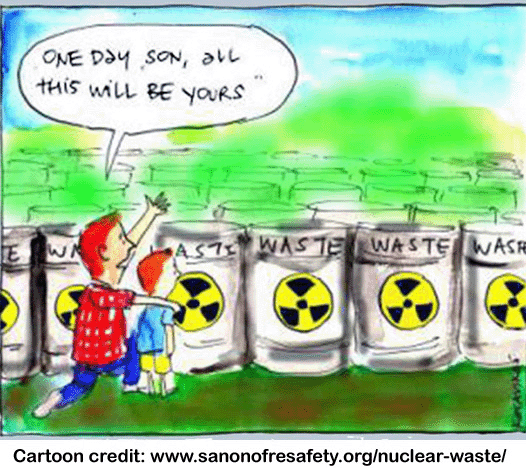
For the sake of today and tomorrow’s young, Canada needs to follow a ‘sustainable renewables path to net zero’ using all of our people and financial resources.
Our government must not saddle the generations to come with the debt for nuclear ‘white elephants’ when affordable, clean, renewable power can meet our needs now and theirs in future, writes Gail Wylie.
BY GAIL WYLIE | August 1, 2024, https://www.hilltimes.com/story/2024/08/01/canadas-future-generations-affordable-clean-energy-vs-legacy-nuclear-debt/429822/
Canadians concerned about climate change want Canada to meet its obligations to future generations by addressing climate change rapidly and responsibly. This requires us to implement current technologies for efficiency, renewable power, modern storage, and electrical grid options.
Instead, the federal government has placed inordinate bets on nuclear power expansion. This includes tens of millions of dollars in funding and loans for experimental small modular reactors, and $50-million in federal predevelopment funding to assess new generation opportunities for Bruce Power’s facility. Nuclear expansion, however, fails Canada’s decarbonization goals of speed and affordability, and takes limited resources away from lower cost, proven climate solutions.
On affordability, Ontario’s lowest cost decarbonized power sources are: efficiency 1.6 cents per kWh, solar plus storage 10 cents per kWh, onshore wind plus storage 10.5 cents per kWh and Quebec water power 5.2 cents per kWh. Nuclear falls among higher costs at 10.5 cents per kWh in 2024, rising to 13.7 cents projected with refurbishments for 2027, and future new nuclear reactors 24.4 cents per kWh.
Ontarians are still paying down the original $38.1-billion in debt and liabilities from Ontario Hydro in 1999 when its finances were over-extended during the period of expanded nuclear power facilities.
The lengthy approval and construction times and costs for new nuclear are a further caveat highlighted by the World Nuclear Industry Status Report. France renationalized Électricité de France in 2023 facing $70-billion in debt, including the Flamanville reactor at 19.1 billion euros and 17-year completion for 2024. The United Kindgom’s Hinkley Point C which began in 2018 is delayed to 2027 projecting costs of $44-billion. The first of two Vogtle U.S.A. reactors, going live in 2023, took 10 years at $35-billion in cost estimate for the pair. International banks have rebuffed plans by 22 countries at COP28 to “triple nuclear power by 2050,” indicating the lack of a business case for such investment.
The hope of faster, cheaper small modular reactors (SMRs) is fading as the lead developer, NuScale, lost its Utah Utilities investor as projections rose from $3-billion in 2015 to $9.3-billion in 2023. Two SMR designs in New Brunswick are also unlikely to be commercialized.
Future generations who will pay for the power capacity being built in this decade cannot afford these unnecessary financial risks and delays of expanding nuclear assets. The young urgently need affordable housing with energy prices ensuring ‘affordable to heat, cool, and cook-in housing.’
The federal government falsely claims “no path to net zero without nuclear.” The industry mantra of nuclear reliability over renewables “when the sun doesn’t shine and the wind doesn’t blow” has been debunked by science-based modelling studies. The Suzuki Foundation’s report, Shifting Power: Zero-Emissions Electricity Across Canada by 2035, and Mark Jacobson’s work at Stanford University, A Solution to Global Warming: Air Pollution, and Energy Insecurity for Canada, both outline the mix of solutions for reliable, affordable, rapid decarbonization across this country by 2035 without new nuclear. The International Renewable Energy Agency’s 2024 analysis confirms that affordable, worldwide transition is attainable with renewables.
Shrinking battery costs for power storage (kWh in 2022 costing US$159 down as low as $59 currently) and modern electrical grid technologies facilitate renewables’ reliability as reflected in energy strategist Michael Barnard’s analysis. Outages at New Brunswick’s Point Lepreau Nuclear Generating Station during peak winter periods in 2021 and 2022/23, and its 2024 extended maintenance, reflect nuclear’s vulnerability.
Dealing with nuclear waste is the other elephant in the room with financial and environmental impacts for generations in perpetuity. Phasing out nuclear power—not expanding it—reduces future costs.
So why is Canada not on a renewables path to net zero? Are we too balkanized to co-operate, leading Ontario to expand gas and nuclear power after rejecting Quebec’s 2019 20-year offer of five cents per kWh hydro power?
Or is this the ‘siren song’ of the nuclear lobby, funded with ratepayers’ money, seducing governments with the caché of ‘top tier’ status in the international nuclear club? Nuclear-armed club members—U.K., France, the United States, and Russia—need civil nuclear as a ‘nuclear supply chain.’ Canada does not!
Majority of Americans Oppose Using US Troops To Defend Israel
By Dave DeCamp / Antiwar.com, https://scheerpost.com/2024/08/07/majority-of-americans-oppose-using-us-troops-to-defend-israel/
The majority of Americans oppose the idea of US troops being used to defend Israel if it comes under attack by Iran, according to a poll conducted by the Chicago Council on Global Affairs that was released on Tuesday.
The poll, conducted from June 21–July 1, 2024, found that 56% of Americans oppose US troops defending Israel, while 42% support the idea. Support for defending Israel is stronger among Republicans, with 53% in favor and only 32% of Democrats in favor.
The survey also found that 55% of Americans oppose US troops defending Israel if it comes under attack by a neighboring country.
The results come as the Biden administration is vowing to defend Israel from an expected Iranian reprisal attack for the killing of Hamas’s political chief, Ismail Haniyeh, in Tehran. A major coordinated attack launched by Iran and its allies could result in American casualties, and the US support for Israel risks a major regional war.
The US defended Israel from an Iranian attack in April, which came in response to the Israeli bombing of the Iranian consulate in Damascus, Syria. The Biden administration intervened directly to protect Israel and is pledging to do so again without any authorization from Congress or any debate on the matter.
The Chicago Council showed the lowest level of support for defending Israel among Americans since the Chicago Council began asking the question in 2010. In 2015, 2018, and 2021, the majority of Americans (53%) supported the idea.
The Chicago Council attributed the lower level of American support for defending Israel to Israel’s onslaught in Gaza. “The unrelenting Israeli attacks against Gaza have likely dampened American willingness to defend Israel, especially among Democrats,” reads an article published on the Chicago Council website.
France Warns of Nuclear Power Cuts as Heat Triggers Water Curbs
Bloomberg, By Lars Paulsson, August 8, 2024
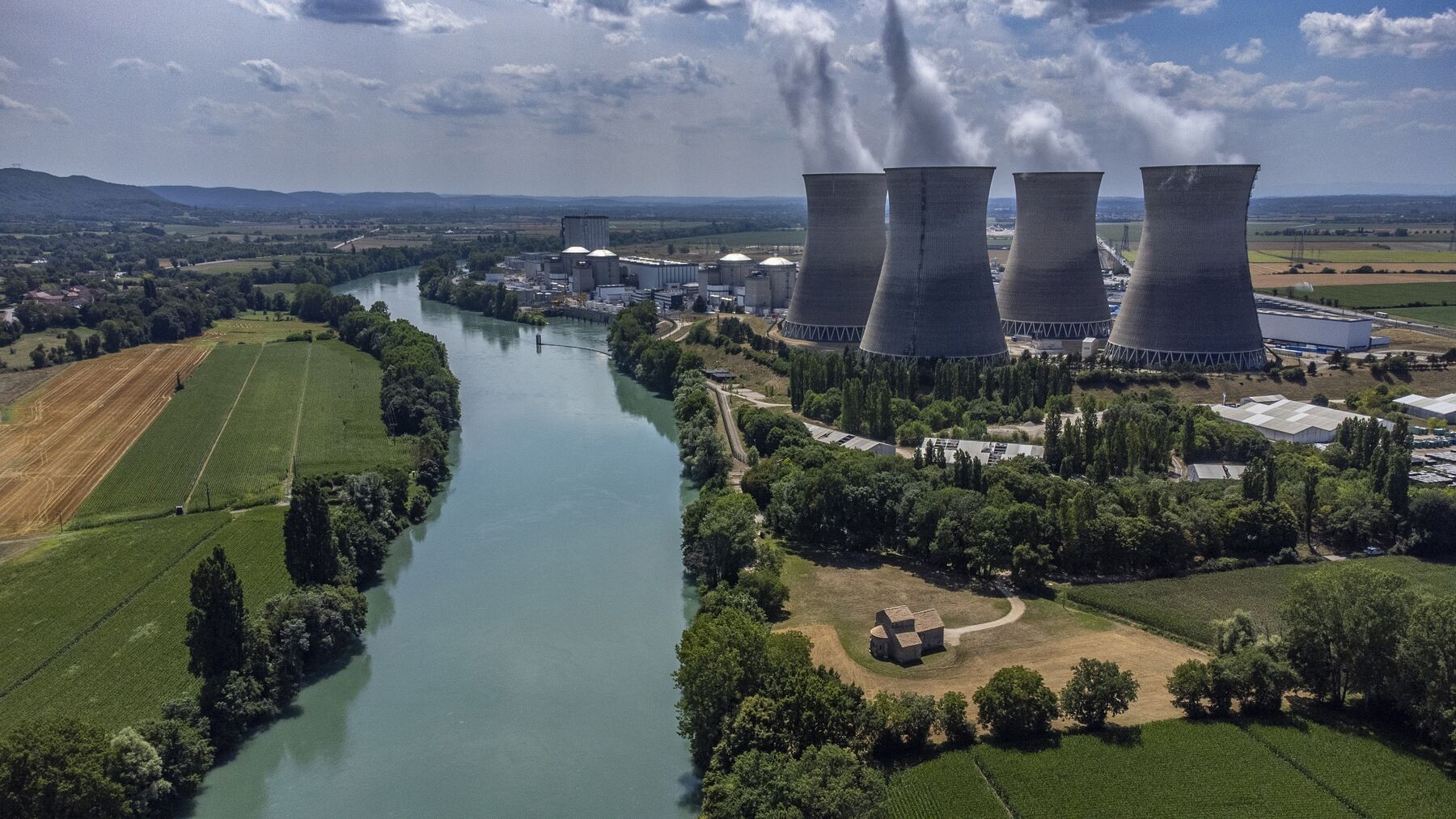
Electricite de France SA will likely curtail production at nuclear reactors starting this weekend as hot weather restricts the amount of water that can be discharged into the Rhone River.
EDF uses water to cool its reactors before releasing it into the river, and overheating the waterway can threaten fish and other wildlife. Temperatures across much of western Europe are forecast to climb……………. (Subscribers only) https://www.bloomberg.com/news/articles/2024-08-08/france-warns-of-nuclear-power-cuts-as-heat-triggers-water-curbs?embedded-checkout=true
Japan starts 8th ocean discharge of Fukushima nuclear-tainted wastewater
Xinhua, 2024-08-08 09
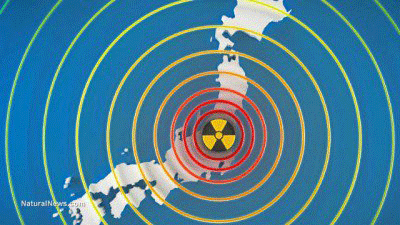
TOKYO, Aug. 8 (Xinhua) — Despite persistent opposition at home and abroad, Japan on Wednesday started its eighth round of release of nuclear-contaminated wastewater from the crippled Fukushima Daiichi Nuclear Power Plant into the Pacific Ocean.
Tokyo Electric Power Company (TEPCO), the plant’s operator, will discharge about 7,800 tons of wastewater from storage tanks into the Pacific Ocean until Aug. 25.
The Chinese Embassy in Japan on Wednesday expressed firm opposition to this irresponsible move of ocean discharge, noting that discharge concerns the health of all mankind, the global marine environment and the international public interests, and is by no means a private matter for Japan.
Japan starts 8th ocean discharge of Fukushima nuclear-tainted wastewater
Source: Xinhua
Editor: huaxia
2024-08-08 09:23:15
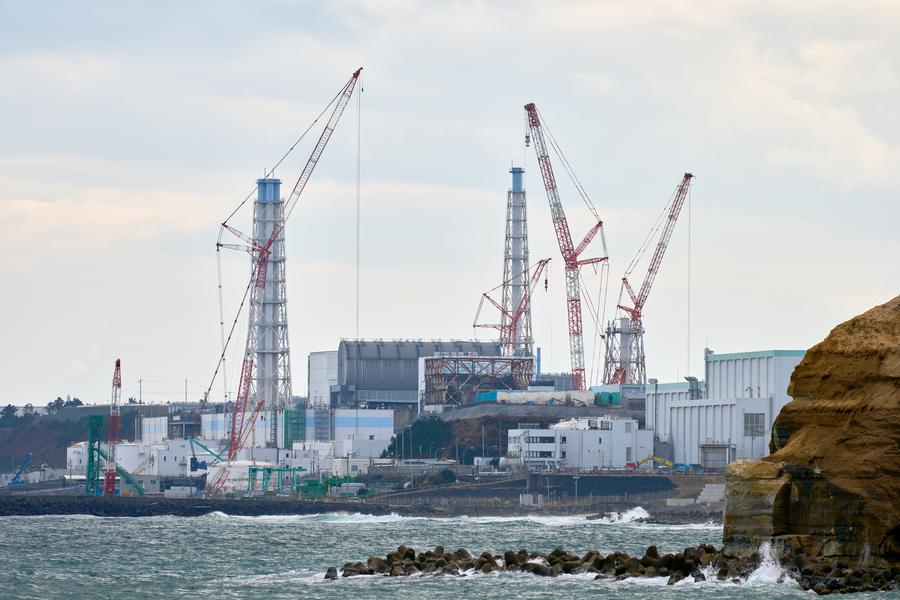
TOKYO, Aug. 8 (Xinhua) — Despite persistent opposition at home and abroad, Japan on Wednesday started its eighth round of release of nuclear-contaminated wastewater from the crippled Fukushima Daiichi Nuclear Power Plant into the Pacific Ocean.
Tokyo Electric Power Company (TEPCO), the plant’s operator, will discharge about 7,800 tons of wastewater from storage tanks into the Pacific Ocean until Aug. 25.
The Chinese Embassy in Japan on Wednesday expressed firm opposition to this irresponsible move of ocean discharge, noting that discharge concerns the health of all mankind, the global marine environment and the international public interests, and is by no means a private matter for Japan.
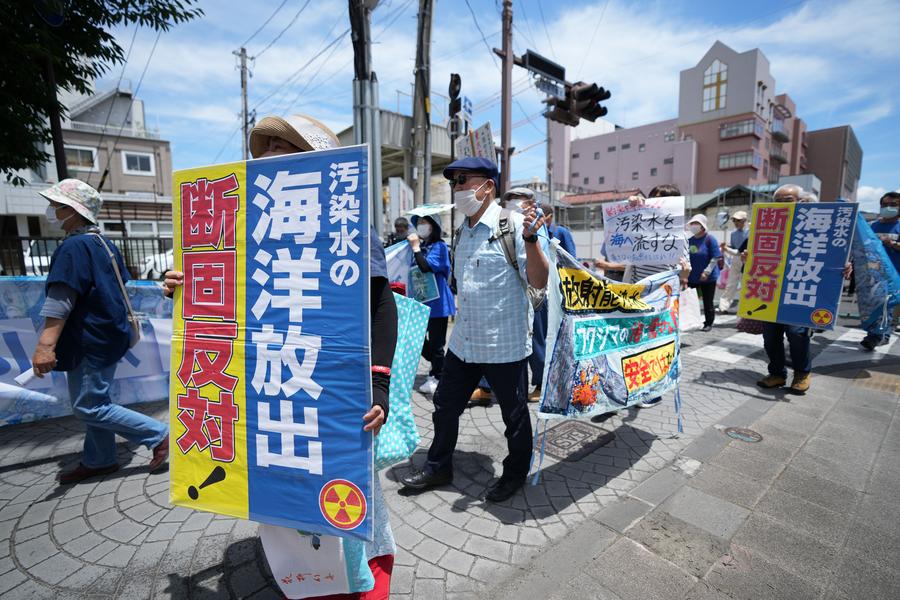
Without addressing the international community’s concerns about the safety of such discharges, the long-term reliability of purification facility, and the effectiveness of monitoring arrangements, Japan’s continued release of nuclear-contaminated water into the ocean shifts the risk of potential contamination to the whole world, a spokesperson for the embassy said.
The spokesperson called on the Japanese side to fully cooperate in setting up an independent international monitoring arrangement that remains effective in the long haul and has substantive participation of stakeholders…………………… more https://english.news.cn/20240808/34fcc4b7f0054fc6a525823c411acbe1/c.html
All six UK Astute-class nuclear submarines stuck in port for repairs
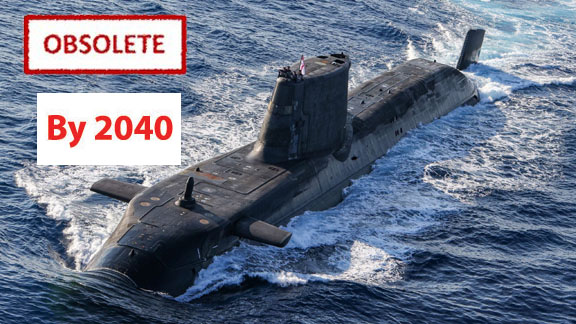
ALL six of the UK’s Astute-class nuclear submarines are stuck in port
– Faslane included – for repairs. The Royal Navy currently has no
working docks for repairs, which has led to the fleet’s newest subs not
conducting a single operation village this year. HMS Ambush — which is
stationed at Faslane – has not sailed for two years.
The National 6th Aug 2024
Over two hundred jobs may be lost if Haverigg jail is displaced by nuclear dump
Whilst Nuclear Waste Services are keen to promote the number of jobs that might be created by the establishment of a Geological Disposal Facility in West Cumbria, there is less clarity when it comes to identifying the number of jobs that might be lost.
The GDF will be the final resting place for the UK’s current and future high-level nuclear waste. Investigations are underway to identify potential sites in either Mid or South Copeland in West Cumbria, and in Theddlethorpe in Lincolnshire. A GDF would require a surface receiving station of around 1 sq KM, to which regular nuclear waste shipments would be made prior to the waste being moved underground and then pushed out along deep tunnels beneath the seabed.
In Theddlethorpe, a specific site, a former gas terminal, has been identified as the potential hub for a receiving station, but this has so far not been the case in Copeland. One major constraint in the South Copeland Search Area is that it mostly comprises the Lake District National Park and the proposed Southern Boundary Extension which are rightly ‘excluded from consideration’. Consequently, any GDF development would have to be confined to small areas around Drigg, Haverigg and Millom, and for many months there has been speculation that one potential site by the coast might be the location of HMP Haverigg.
Mindful that a GDF would most likely mean the closure of the jail, NFLA Secretary Richard Outram sent several Freedom of Information requests to the Ministry of Justice exploring the impact of the closure of the prison in these circumstances. The NFLAs are particularly keen to identify how many local jobs could be lost, as well as ascertaining the impact on local contractors and suppliers engaged in business with HMP Haverigg. There is also the less quantifiable contribution made by prisoners carrying out work within the local community and the positive impact of the training and support provided by prison staff and support agencies in reducing recidivism and turning around the lives of inmates to enable them to reenter society.
On jobs, Ministry of Justice officials were unable to supply all of the information requested, but advised that they employ a total of 206 full-time (80%) and part-time (20%) staff, both operational (prison officers) and non-operational (ancillary roles). Of these over half, 110, reside in the local LL18 postal district. However this excludes the number of staff engaged at this prison who are employed by other agencies, such as the local and regional NHS, and it was surprising to learn that ‘there is no legal requirement for MoJ to collate data relating to contractors and suppliers that work at HMP Haverigg’ so it is impossible to make a determination as to the dependence of the local supply chain on business with the prison.
6th August 2024
Over two hundred jobs may be lost if Haverigg jail is displaced by nuclear dump
Whilst Nuclear Waste Services are keen to promote the number of jobs that might be created by the establishment of a Geological Disposal Facility in West Cumbria, there is less clarity when it comes to identifying the number of jobs that might be lost.
The GDF will be the final resting place for the UK’s current and future high-level nuclear waste. Investigations are underway to identify potential sites in either Mid or South Copeland in West Cumbria, and in Theddlethorpe in Lincolnshire. A GDF would require a surface receiving station of around 1 sq KM, to which regular nuclear waste shipments would be made prior to the waste being moved underground and then pushed out along deep tunnels beneath the seabed.
In Theddlethorpe, a specific site, a former gas terminal, has been identified as the potential hub for a receiving station, but this has so far not been the case in Copeland. One major constraint in the South Copeland Search Area is that it mostly comprises the Lake District National Park and the proposed Southern Boundary Extension which are rightly ‘excluded from consideration’. Consequently, any GDF development would have to be confined to small areas around Drigg, Haverigg and Millom, and for many months there has been speculation that one potential site by the coast might be the location of HMP Haverigg.
Mindful that a GDF would most likely mean the closure of the jail, NFLA Secretary Richard Outram sent several Freedom of Information requests to the Ministry of Justice exploring the impact of the closure of the prison in these circumstances. The NFLAs are particularly keen to identify how many local jobs could be lost, as well as ascertaining the impact on local contractors and suppliers engaged in business with HMP Haverigg. There is also the less quantifiable contribution made by prisoners carrying out work within the local community and the positive impact of the training and support provided by prison staff and support agencies in reducing recidivism and turning around the lives of inmates to enable them to reenter society.
On jobs, Ministry of Justice officials were unable to supply all of the information requested, but advised that they employ a total of 206 full-time (80%) and part-time (20%) staff, both operational (prison officers) and non-operational (ancillary roles). Of these over half, 110, reside in the local LL18 postal district. However this excludes the number of staff engaged at this prison who are employed by other agencies, such as the local and regional NHS, and it was surprising to learn that ‘there is no legal requirement for MoJ to collate data relating to contractors and suppliers that work at HMP Haverigg’ so it is impossible to make a determination as to the dependence of the local supply chain on business with the prison.
On rates of recidivism, Ministry officials did not supply any specifics for the prison but instead referenced the latest national available statistics[i]. However, in a report which followed an unscheduled prison visit by inspectors in May 2021, it was recognised by HM Chief Inspector Charlie Taylor that Haverigg, in providing specialist accommodation and rehabilitation to older male sex offenders, ‘is fast becoming a very capable establishment and is progressing to a point where it soon may well be one of the better open prisons in the estate.’ It was notable that ‘All eligible prisoners had some form of purposeful activity…The employment hub was a particularly helpful service for prisoners’ and that ‘Prisoners benefited from a high standard of technical training. They developed significant new skills, knowledge and behaviours through vocational training.’[ii]
UK Government advice on the prison record that: ‘All prisoners work or train full time at Haverigg. Training and learning opportunities are focused on skills gaps in the job market and designed to improve prisoners’ chances of getting work on release. Professions include timber manufacturing, building, plastering, plumbing, industrial cleaning and agriculture. Prisoners can also train and work towards qualifications in the leisure industry through the gym’.[iii]
On community activities, Ministry officials advised that prisoners are engaged in litter picking and landscaping which has ‘received positive feedback from various community members for their impact on the local area’. The prison also holds a weekly market in Millom to promote the products made by HMP Haverigg, which has ‘significantly contributed to fostering strong relationships between the prison and the community’. Additionally, prisoners also support the local churches by maintaining church yards.
Lake District’s Coastal Nuclear Waste Dump Screw Tightens.
“Geology is the ground we stand on; it’s in the food we eat, and in the water we drink.”
Marianne Birkby, Aug 05, 2024
Lake District’s Coastal Nuclear Waste Dump Screw Tightens. Ethicist Kate
Rawles inadvertently hits the nail on the head in the NIREX sponsored paper
of 2000: ‘Ethical Issues in the Disposal of Radioactive Wastes’: “The
judgment about geology rests on the values put on human life and health. If
human health were not valued, the geological criteria would not be the
same.” Cue Cumbria’s complex and faulted geology! Burying hot
(literally 100 degrees c +) nuclear waste would be akin to burying a
gargantuan cracked pressure cooker containing the most dangerous substances
produced by man. By continuing down the “Implementation of Geological
Disposal” yellow brick road what does that say about the value placed on
human and non-human health? Our dedicated campaign against the nuclear dump
can be seen here at Lakes Against Nuclear Dump – a Radiation Free Lakeland
campaign.
Radiation Free Lakeland 5th Aug 2024
https://radiationfreelakeland.substack.com/p/lake-districts-coastal-nuclear-waste
Majority of Americans support more nuclear power, but future of large-scale nuclear is uncertain

A majority of U.S. adults remain supportive of expanding nuclear power in
the country, according to a Pew Research Center survey from May. Overall,
56% say they favor more nuclear power plants to generate electricity. This
share is statistically unchanged from last year. A line chart showing that
a majority of Americans continue to support more nuclear power in the U.S.
But the future of large-scale nuclear power in America is uncertain. While
Congress recently passed a bipartisan act intended to ease the nuclear
energy industry’s financial and regulatory challenges, reactor shutdowns
continue to gradually outpace new construction.
Americans remain more
likely to favor expanding solar power (78%) and wind power (72%) than
nuclear power. Yet while support for solar and wind power has declined by
double digits since 2020 – largely driven by drops in Republican support
– the share who favour nuclear power has grown by 13 percentage points
over that span.
Pew Research 5th Aug 2024
IAEA: Cooling pond water levels decreasing at Ukraine nuclear plant
Aug 6, 2024, https://www.ans.org/news/article-6266/iaea-cooling-pond-water-levels-decreasing-at-ukraine-nuclear-plant/
The water level in Ukraine’s Zaporizhzhia nuclear power plant cooling pond continues to decrease, creating a serious safety threat.
“If this trend continues, ZNPP staff confirmed that it will soon become challenging to pump water from the pond. Maintaining the level of the pond is made more difficult by the hot summer weather,” said Rafael Mariano Grossi, director general of the International Atomic Energy Agency, in an update issued August 2.
Zaporizhzhia—Europe’s largest nuclear plant—has been under Russian control since March 2022, shortly after the military invasion of Ukraine. The plant stopped producing power in September 2022, and all six of its units currently are in cold storage.
Water issues: Following the destruction of the Kakhovka dam in 2023, Zaporizhzhia workers dug 11 groundwater wells to provide approximately 250 cubic meters of cooling water per hour to support the plant’s sprinkler ponds. These ponds cool all six reactors.
“Dwindling water levels in the cooling pond remains a potential source of concern, and we will continue to closely monitor and observe the situation at the site to ensure the availability of a sufficient supply of cooling water for the plant’s needs at all times,” Grossi said.
During a site walkdown last week, IAEA inspectors stationed at the plant observed proper function in the sprinkler ponds, with water at nominal levels. But any compromise to the availability of water to the sprinkler ponds might necessitate using the cooling pond as a backup source.
Safety concerns: The IAEA team continue to hear military activity at varying distances from the plant.
On April 30, they reported hearing over 100 rounds of gunfire in the vicinity of the Zaporizhzhia, allegedly in response to drones flying near the plant’s training center. The “kamikaze” drones, some measuring 11 feet long and 8 feet wide, were observed in video evidence from Ukraine’s defense intelligence. The drones do not fire missiles but are equipped with explosives and can strike with precision.
Separately, the team reported three direct drone strikes on the plant on April 7 and April 9, resulting in one casualty. Ukrainian military intelligence spokesperson Andrii Cherniak said the Russians are using space around Zaporizhzhia because the Security and Defense Forces of Ukraine cannot return fire in a 1.5-kilometer zone around the plant.
IAEA report: In a letter from the permanent mission of the Russian Federation to the IAEA’s secretariat the following issues were highlighted.
- During a span of six days (July 22–28), 77 aerial vehicles launched with the aim of attacking and provoking ZNPP and the nearby town of Energodar.
- On July 29, Ukrainian armed forces launched three artillery strikes at the checkpoint entrance to Energodar, injuring three Russian Guard employees.
- The plant has enough diesel fuel to operate on emergency power for 19 days.
- Recruitment of personnel for the plant is ongoing, though the current number of employees is sufficient to continue cold shutdown operations and scheduled maintenance tasks.
Support for Zaporizhzhia: Starting in April 2022, the IAEA developed a broad assistance program at Zaporizhzhia. The agency recently organized four remote workshops with a focus on mental health. The sessions were geared toward supervisors, managers, and mental health teams to help recognize signs of distress and support those dealing with stress or trauma.
The United States and United Kingdom have lent support by delivering equipment and hosting workshops.
Nuclear weapons can never bring peace or security – only mass death
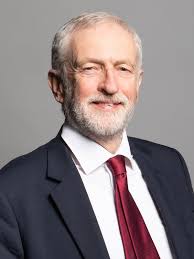
With the risk of all-out war ever-increasing, JEREMY CORBYN MP calls on Britain to lead by example, by signing the Global Nuclear Ban Treaty
AUGUST 6 is a poignant day. On this day in 1945, hundreds of thousands of people died in Hiroshima as the first atomic bomb was used as a weapon of war. A few days later, it was used again in Nagasaki.
The huge death toll from people being fried alive was compounded by death from cancers and the slow destruction of those who survived the initial attack. Others developed cancers later on and death was visited upon a whole generation by the two bombs.
The use of the atomic bomb set off the nuclear age as the United States expanded its nuclear arsenal. A few years later, the Soviet Union developed its own system, followed by others.
Britain, reeling from the economic destruction of World War II, tested its first atomic bomb in 1952. Clement Attlee, the prime minister, managed to expend, in complete secrecy, enough money to build an independent system. Not even the Cabinet was told, never mind Parliament or the people.
For two decades after the second world war there were atmospheric tests of nuclear weapons, with the resultant fallout killing people in the Pacific and beyond.
The nuclear Non-Proliferation Treaty has helped to stem the flow of nuclear weapons, which are restricted to the five declared nuclear weapons states (the US, Britain, France, Russia, China) and to India, Pakistan, Israel and North Korea, which are not treaty signatories.
The danger of a nuclear war is now greater than it has been for decades, as the Ukraine war drags on. Both Russia and Ukraine’s Nato backers have nuclear weapons at their disposal. Meanwhile, military spending is now rising around the world.
Britain has already committed to increasing defence spending to at least 2.5 per cent of GDP. Globally the number of nuclear warheads is also rising.
In the case of the war in Ukraine we see conscripted soldiers on both sides being slaughtered, and more and more weapons being delivered, and fewer and fewer politicians anywhere even raising the possibility of ending this appalling war. The language of peace is absent and there are few efforts being made now to broker a discussion that could lead to a ceasefire.
Nuclear weapons can never bring peace or security, only the assurance of deaths of millions followed by global climate catastrophe, nuclear winter and famine.
If Britain wanted to be a global leader, it would sign the Global Nuclear Ban Treaty and make the case for world peace.
Those used in 1945 were very small compared to the warheads of today; isn’t it time to remember the deaths of 1945 and ensure Hiroshima is never repeated?
Jeremy Corbyn is independent MP for Islington North.
UK Government refuses to release Sizewell C’s predicted price tag

The Department for Energy rejected a freedom of information request from BusinessLive on the Suffolk nuclear project’s costs.
BusinessLive, By Hannah Baker, South West Business Editor, 4 Aug 24
The government is refusing to reveal how much the planned Sizewell C nuclear plant in Suffolk is expected to cost. The Department for Energy turned down a freedom of information (FOI) request by BusinessLive asking for data on the project’s price tag.
Sizewell C, which is being partly funded by French-owned energy giant EDF, is reported to cost in the region of £20bn, though it has been suggested that it could cost more than £30bn.
The Suffolk nuclear station will be a replica of EDF’s Hinkley Point C plant in Somerset, which has been plagued by delays and funding issues over the course of its construction.
The government told BusinessLive that Sizewell’s costs are “subject to ongoing and commercially sensitive negotiations”…………………………….
“The commercial sensitivities mean that on this occasion we consider that the public interest would not be served by its release.”
The FOI request was made before Keir Starmer’s government came to power, but the new Labour-run department said it had “nothing to add” to the response.
…………………….. In 2022, the government was forced to pay state-owned China General Nuclear (CGN) to exit the Suffolk project over growing geo-political tensions. CGN had a 20% stake in Sizewell at the time. Since its removal, the Chinese firm has also halted payments on Hinkley Point C.
It is not known how many companies the current government is courting over Sizewell. In February, Centrica – the parent company of British Gas – confirmed it was in discussions with the previous administration over the project…………..https://www.business-live.co.uk/economic-development/government-refuses-release-sizewell-cs-29655312
Lemon socialism? – Rolls Royce might like to gracefully get out of Small Nuclear Reactors (SMRs)?

Lemon socialism is a pejorative term for a form of government intervention in which government subsidies go to weak or failing firms (lemons; see Lemon law), with the effective result that the government (and thus the taxpayer) absorbs part or all of the recipient’s losses.[1][2] The term derives from the conception that in socialism the government may nationalize a company in its entirety, while in lemon socialism the company is allowed to keep its profits but its losses are shifted to the taxpayer. – Wikipedia.

Many sources I had found online over the past half year said Rolls Royce (RR) SMR would be going down soon – because they’d be out of cash before the end of 2024.
This last ditch effort at fundraising appears to be futile.
Because private money (as opposed to public money) looks at the balance sheet….assets vs. liabilities.
A free open competitive energy marketplace will definitely kill SMRs. Even the UK gov’t won’t buy their SMR – so, RR is losing their “Lemon Socialism” card. (Ralph Nader uses that term to describe nuclear power) Oh well, Rolls Royce has many other engineering ventures … which they are very successful at.
This SMR thing could distract from, and draw funds from, those.
1 This Month

petition to oppose the rapid increase of space-military industry threatening Jeju Island and the region.
[Petition by April 19th (KST)] Stop the joint military-Hanwha Systems-Jeju Provincial Government Sea Launch!
World Nuclear Power. Reactors 1951-2026, 75 Years of Nuclear Power.
Interactive Map– https://dv.worldnuclearreport.org/

Chernobyl: The Lost Tapes – A good documentary on Chernobyl on SBS available On Demand for the next 3 weeks– https://www.sbs.com.au/ondemand/tv-program/chernobyl-the-lost-tapes/2352741955560

of the week–London Campaign for Nuclear Disarmament


Tell the Ukrainian Government to Drop Prosecution of Peace Activist Yurii Sheliazhenko
To see nuclear-related stories in greater depth and intensity – go to https://nuclearinformation.wordpress.com
-
Archives
- April 2026 (211)
- March 2026 (251)
- February 2026 (268)
- January 2026 (308)
- December 2025 (358)
- November 2025 (359)
- October 2025 (376)
- September 2025 (257)
- August 2025 (319)
- July 2025 (230)
- June 2025 (348)
- May 2025 (261)
-
Categories
- 1
- 1 NUCLEAR ISSUES
- business and costs
- climate change
- culture and arts
- ENERGY
- environment
- health
- history
- indigenous issues
- Legal
- marketing of nuclear
- media
- opposition to nuclear
- PERSONAL STORIES
- politics
- politics international
- Religion and ethics
- safety
- secrets,lies and civil liberties
- spinbuster
- technology
- Uranium
- wastes
- weapons and war
- Women
- 2 WORLD
- ACTION
- AFRICA
- Atrocities
- AUSTRALIA
- Christina's notes
- Christina's themes
- culture and arts
- Events
- Fuk 2022
- Fuk 2023
- Fukushima 2017
- Fukushima 2018
- fukushima 2019
- Fukushima 2020
- Fukushima 2021
- general
- global warming
- Humour (God we need it)
- Nuclear
- RARE EARTHS
- Reference
- resources – print
- Resources -audiovicual
- Weekly Newsletter
- World
- World Nuclear
- YouTube
-
RSS
Entries RSS
Comments RSS
 nuclear-news