Ukraine: Stoltenberg calls for lifting restrictions on the use of NATO weapons to strike in Russia
“Denying Ukraine the ability to use these weapons against legitimate military targets in Russian territory makes it difficult for them to defend themselves especially now that there is a lot of fighting going on in the Kharkiv region,” explained the secretary general of the Atlantic Alliance
London. May 25, 2024, Agenzia Nov https://www.agenzianova.com/en/news/Ukraine-Stoltenberg-calls-for-lifting-restrictions-on-the-use-of-NATO-weapons-to-attack-Russia/
Ukraine should also be able to strike targets in Russia with the use of weapons donated by NATO countries. This is what the secretary general of the Atlantic Alliance suggested, Jens Stoltenberg, in an interview with the British weekly “The Economist”. “The time has come for NATO member countries to consider whether they should lift some of the restrictions on the use of the weapons they donated to Ukraine,” she said. “Denying Ukraine the ability to use these weapons against legitimate military targets on Russian territory makes it difficult for them to defend themselves especially now that there is a lot of fighting going on in the Kharkiv region, near the border,” Stoltenberg explained.
Regarding the Russian offensive in the region, the NATO secretary general believes that this will not lead to a breakthrough by Moscow. “They will continue to make marginal advances, for which they are willing to pay a high price,” he said. Stoltenberg, however, admitted that the situation is delicate for Kiev. “The European allies promised one million rounds of artillery ammunition and we have yet to see anything like this,” the secretary general lamented.
Comment: Ukraine is already attacking inside Russia, and many, if not most, of these targets are civilian: Belgorod, The New Donetsk: Report From Russian City Where Ukraine Targets Civilians
It appears that, along with Israel, the West is becoming increasingly desperate, and reckless, and should it cross Russia’s stated red lines and partake in direct attacks on Russian soil, Moscow may be forced to retaliate by neutralising the installations and command centres of the guilty parties in the West: more https://www.sott.net/article/491699-Stoltenberg-urges-alliance-to-allow-Ukraine-to-use-NATO-weapons-for-attacks-inside-Russia
Constant Killing
Despite Blood on Its Hands, The Pentagon Once Again Fails to Make Amends
BY NICK TURSE, Tom Dispatch 27 May 24
For hundreds of years, the U.S. military has been killing people. It’s been a constant of our history. Another constant has been American military personnel killing civilians, whether Native Americans, Filipinos, Nicaraguans, Haitians, Japanese, Koreans, Vietnamese, Cambodians, Laotians, Afghans, Iraqis, Syrians, Yemenis, and on and on. And there’s something else that’s gone along with those killings: a lack of accountability for them.
Late last month, the Department of Defense (DoD) released its congressionally mandated annual accounting of civilian casualties caused by U.S. military operations globally. The report is due every May 1st and, in the latest case, the Pentagon even beat that deadline by a week. There was only one small problem: it was the 2022 report. You know, the one that was supposed to be made public on May 1, 2023. And not only was that report a year late, but the 2023 edition, due May 1, 2024, has yet to be seen.
Whether that 2023 report, when it finally arrives, will say much of substance is also doubtful. In the 2022 edition, the Pentagon exonerated itself of harming noncombatants. “DoD has assessed that U.S. military operations in 2022 resulted in no civilian casualties,” reads the 12-page document. It follows hundreds of years of silence about, denials of, and willful disregard toward civilians slain purposely or accidentally by the U.S. military and a long history of failures to make amends in the rare cases where the Pentagon has admitted to killing innocents.
Moral Imperatives
“The Department recognizes that our efforts to mitigate and respond to civilian harm respond to both strategic and moral imperatives,” reads the Pentagon’s new 2022 civilian casualty report.
And its latest response to those “moral imperatives” was typical. The Defense Department reported that it had made no ex gratia payments — amends offered to civilians harmed in its operations — during 2022. That follows exactly one payment made in 2021 and zero in 2020
Whether any payments were made in 2023 is still, of course, a mystery. I asked Lisa Lawrence, the Pentagon spokesperson who handles civilian harm issues, why the 2023 report was late and when to expect it. A return receipt shows that she read my email, but she failed to offer an answer.
Her reaction is typical of the Pentagon on the subject.
A 2020 study of post-9/11 civilian casualty incidents by the Center for Civilians in Conflict and Columbia Law School’s Human Rights Institute found that most went uninvestigated. When they did come under official scrutiny, American military witnesses were interviewed while civilians — victims, survivors, family members — were almost totally ignored, “severely compromising the effectiveness of investigations,” according to that report.
In the wake of such persistent failings, investigative reporters and human rights groups have increasingly documented America’s killing of civilians, its underreporting of noncombatant casualties, and its failures of accountability in Afghanistan, Libya, Somalia, Syria, Yemen, and elsewhere.
During the first 20 years of the war on terror, the U.S. conducted more than 91,000 airstrikes across seven major conflict zones and killed up to 48,308 civilians, according to a 2021 analysis by Airwars, a U.K.-based air-strike monitoring group.
Between 2013 and 2020, for example, the U.S. carried out seven separate attacks in Yemen — six drone strikes and one raid — that killed 36 members of the intermarried Al Ameri and Al Taisy families. A quarter of them were children between the ages of three months and 14 years old. The survivors have been waiting for years for an explanation as to why they were repeatedly targeted………………………………………………………………………………………………………………..
Getting to “Yes”
While the U.S. military has long been killing civilians — in massacres by ground troops, air strikes and even, in August 1945, nuclear attacks — compensating those harmed has never been a serious priority.
General John “Black Jack” Pershing did push to adopt a system to pay claims by French civilians during World War I and the military in World War II found that paying compensation for harm to civilians “had a pronounced stabilizing effect.” The modern military reparations system, however, dates only to the 1960s.
During the Vietnam War, providing “solatia” was a way for the military to offer reparations for civilian injuries or deaths caused by U.S. operations without having to admit any guilt. In 1968, the going rate for an adult life was $33. Children merited just half that.
In 1973, a B-52 Stratofortress dropped 30 tons of bombs on the Cambodian town of Neak Luong, killing hundreds of civilians and wounding hundreds more. The next of kin of those killed, according to press reports, were promised about $400 each. Considering that, in many cases, a family’s primary breadwinner had been lost, the sum was low. It was only the equivalent of about four years of earnings for a rural Cambodian. By comparison, a one-plane sortie, like the one that devastated Neak Luong, cost about $48,000. And that B-52 bomber itself then cost about $8 million. Worse yet, a recent investigation found that the survivors did not actually receive the promised $400. In the end, the value American forces placed on the dead of Neak Luong came to just $218 each.
Back then, the United States kept its low-ball payouts in Cambodia a secret. Decades later, the U.S. continues to thwart transparency and accountability when it comes to civilian lives………………………………………………………………….
Late last year, the Defense Department also issued its long-awaited “Instruction on Civilian Harm Mitigation and Response,” which established the Pentagon’s “policies, responsibilities, and procedures for mitigating and responding to civilian harm.” The document, mandated under the 2019 National Defense Authorization Act, and approved by Austin, directs the military to “acknowledge civilian harm resulting from U.S. military operations and respond to individuals and communities affected by U.S. military operations,” including “expressing condolences” and providing ex gratia payments to next of kin.
But despite $15 million allocated by Congress since 2020 to provide just such payments and despite members of Congress repeatedly calling on the Pentagon to make amends for civilian harm, it has announced just one such payment in the years since.
Nick Turse, The Pentagon’s .00035% Problem
POSTED ON MAY 23, 2024
[Note for TomDispatch Readers: You know that I just can’t help it. Once again, I’m pleading with this site’s faithful readers to consider going to our donation page and giving us a boost so that we can keep covering subjects — like Nick Turse’s latest striking report on the killing of civilians in America’s never-ending war on terror — that the mainstream media tends to avoid so much of the time. Take a moment, if you can, to keep this website going in 2024. (And there’s no way I can thank you enough for doing so!) Note as well that TomDispatch will be off-duty on the Memorial Day weekend. The next piece will appear on Tuesday. Tom]
Yes, the number of deaths in Gaza in the last seven months is staggering. At least, 35,000 Gazans have reportedly perished, including significant numbers of children (and that’s without even counting the possibly 10,000 unidentified bodies still buried under the rubble that now litters that 25-mile-long stretch of land). But shocking as that might be (and it is shocking!), it begins to look almost modest when compared to the numbers of civilians slaughtered in America’s never-ending Global War on Terror that began in the wake of the 9/11 attacks and, as Nick Turse has reported in his coverage of Africa, never really ended.
In fact, the invaluable Costs of War project put the direct civilian death toll in those wars at 186,694 to 210,038 in Iraq, 46,319 in Afghanistan, 24,099 in Pakistan, and 12,690 in Yemen, among other places. And don’t forget, as that project also reports, that there could have been an estimated 3.6 to 3.8 million (yes, million!) “indirect deaths” resulting from the devastation caused by those wars, which lasted endless years — 20 alone for the Afghan one — in South Asia, the Middle East, and Africa.
Today, Nick Turse reports on how the Pentagon has largely avoided significant responsibility for civilian deaths from its never-ending air wars, not to speak of failing to compensate the innocent victims of those strikes. The civilian death toll in this country’s twenty-first-century conflicts is, in fact, a subject he’s long focused on at TomDispatch in a devastating fashion. In 2007, he was already reporting on how the U.S. military was quite literally discussing “hunting” the “enemy.” (“From the commander-in-chief to low-ranking snipers, a language of dehumanization that includes the idea of hunting humans as if they were animals has crept into our world — unnoticed and unnoted in the mainstream media.”) And when it comes to the subject of killing civilians without any significant acknowledgment or ever having to say you’re sorry, he’s never stopped. Tom
Constant Killing
Despite Blood on Its Hands, The Pentagon Once Again Fails to Make Amends
BY NICK TURSE
There are constants in this world — occurrences you can count on. Sunrises and sunsets. The tides. That, day by day, people will be born and others will die.
Some of them will die in peace, but others, of course, in violence and agony.
For hundreds of years, the U.S. military has been killing people. It’s been a constant of our history. Another constant has been American military personnel killing civilians, whether Native Americans, Filipinos, Nicaraguans, Haitians, Japanese, Koreans, Vietnamese, Cambodians, Laotians, Afghans, Iraqis, Syrians, Yemenis, and on and on. And there’s something else that’s gone along with those killings: a lack of accountability for them.
Late last month, the Department of Defense (DoD) released its congressionally mandated annual accounting of civilian casualties caused by U.S. military operations globally. The report is due every May 1st and, in the latest case, the Pentagon even beat that deadline by a week. There was only one small problem: it was the 2022 report. You know, the one that was supposed to be made public on May 1, 2023. And not only was that report a year late, but the 2023 edition, due May 1, 2024, has yet to be seen.
Whether that 2023 report, when it finally arrives, will say much of substance is also doubtful. In the 2022 edition, the Pentagon exonerated itself of harming noncombatants. “DoD has assessed that U.S. military operations in 2022 resulted in no civilian casualties,” reads the 12-page document. It follows hundreds of years of silence about, denials of, and willful disregard toward civilians slain purposely or accidentally by the U.S. military and a long history of failures to make amends in the rare cases where the Pentagon has admitted to killing innocents.
Moral Imperatives
“The Department recognizes that our efforts to mitigate and respond to civilian harm respond to both strategic and moral imperatives,” reads the Pentagon’s new 2022 civilian casualty report.
And its latest response to those “moral imperatives” was typical. The Defense Department reported that it had made no ex gratia payments — amends offered to civilians harmed in its operations — during 2022. That follows exactly one payment made in 2021 and zero in 2020.
Whether any payments were made in 2023 is still, of course, a mystery. I asked Lisa Lawrence, the Pentagon spokesperson who handles civilian harm issues, why the 2023 report was late and when to expect it. A return receipt shows that she read my email, but she failed to offer an answer.
Her reaction is typical of the Pentagon on the subject.
A 2020 study of post-9/11 civilian casualty incidents by the Center for Civilians in Conflict and Columbia Law School’s Human Rights Institute found that most went uninvestigated. When they did come under official scrutiny, American military witnesses were interviewed while civilians — victims, survivors, family members — were almost totally ignored, “severely compromising the effectiveness of investigations,” according to that report.

In the wake of such persistent failings, investigative reporters and human rights groups have increasingly documented America’s killing of civilians, its underreporting of noncombatant casualties, and its failures of accountability in Afghanistan, Libya, Somalia, Syria, Yemen, and elsewhere.
During the first 20 years of the war on terror, the U.S. conducted more than 91,000 airstrikes across seven major conflict zones and killed up to 48,308 civilians, according to a 2021 analysis by Airwars, a U.K.-based air-strike monitoring group.
Between 2013 and 2020, for example, the U.S. carried out seven separate attacks in Yemen — six drone strikes and one raid — that killed 36 members of the intermarried Al Ameri and Al Taisy families. A quarter of them were children between the ages of three months and 14 years old. The survivors have been waiting for years for an explanation as to why they were repeatedly targeted.
In 2018, Adel Al Manthari, a civil servant in the Yemeni government, and four of his cousins — all civilians — were traveling by truck when an American missile slammed into their vehicle. Three of the men were killed instantly. Another died days later in a local hospital. Al Manthari was critically injured. Complications resulting from his injuries nearly killed him in 2022. He beseeched the U.S. government to dip into the millions of dollars appropriated by Congress to compensate victims of American attacks, but they ignored his pleas. His limbs and life were eventually saved by the kindness of strangers via a crowdsourced GoFundMe campaign.
The same year that Al Manthari was maimed in Yemen, a U.S. drone strike in Somalia killed at least three, and possibly five, civilians, including 22-year-old Luul Dahir Mohamed and her 4-year-old daughter Mariam Shilow Muse. The next year, a U.S. military investigation acknowledged that a woman and child were killed in that attack but concluded that their identities might never be known. Last year, I traveled to Somalia and spoke with their relatives. For six years, the family has tried to contact the American government, including through U.S. Africa Command’s online civilian casualty reporting portal without ever receiving a reply.
In December 2023, following an investigation by The Intercept, two dozen human rights organizations — 14 Somali and 10 international groups — called on Defense Secretary Lloyd Austin to compensate Luul and Mariam’s family for their deaths. This year, Senator Elizabeth Warren (D-Mass.) and Representatives Sara Jacobs (D-Calif.), Ilhan Omar (D-Minn.), Barbara Lee (D-Calif.), and Jim McGovern (D-Mass.) have also called on the Defense Department to make amends.
A 2021 investigation by New York Times reporter Azmat Khan revealed that the American air war in Iraq and Syria was marked by flawed intelligence and inaccurate targeting, resulting in the deaths of many innocents. Out of 1,311 military reports analyzed by Khan, only one cited a “possible violation” of the rules of engagement. None included a finding of wrongdoing or suggested a need for disciplinary action, while fewer than a dozen condolence payments were made. The U.S.-led coalition eventually admitted to killing 1,410 civilians during the war in Iraq and Syria. Airwars, however, puts the number at 2,024.
Several of the attacks detailed by Khan were brought to the Defense Department’s attention in 2022 but, according to their new report, the Pentagon failed to take action. Joanna Naples-Mitchell, director of the nonprofit Zomia Center’s Redress Program, which helps survivors of American air strikes submit requests for compensation, and Annie Shiel, U.S. advocacy director with the Center for Civilians in Conflict, highlighted several of these cases in a recent Just Security article.
In June 2022, for instance, the Redress Program submitted requests for amends from the Pentagon on behalf of two families in Mosul, Iraq, harmed in an April 29, 2016, air strike reportedly targeting an Islamic State militant who was unharmed in the attack. Khan reported that, instead, Ziad Kallaf Awad, a college professor, was killed and Hassan Aleiwi Muhammad Sultan, then 10 years old, was left wheelchair-bound. The Pentagon had indeed admitted that civilian casualties resulted from the strike in a 2016 press release.
In September 2022, the Redress Program also submitted ex gratia requests on behalf of six families in Mosul, all of them harmed by a June 15, 2016, air strike also investigated by Khan. Naples-Mitchel and Shiel note that Iliyas Ali Abd Ali, then running a fruit stand near the site of the attack, lost his right leg and hearing in one ear. Two brothers working in an ice cream shop were also injured, while a man standing near that shop was killed. That same year, the Pentagon did confirm that the strike had resulted in civilian casualties.
However, almost eight years after acknowledging civilian harm in those Mosul cases and almost two years after the Redress Program submitted the claims to the Defense Department, the Pentagon has yet to offer amends.
Getting to “Yes”
While the U.S. military has long been killing civilians — in massacres by ground troops, air strikes and even, in August 1945, nuclear attacks — compensating those harmed has never been a serious priority.
General John “Black Jack” Pershing did push to adopt a system to pay claims by French civilians during World War I and the military in World War II found that paying compensation for harm to civilians “had a pronounced stabilizing effect.” The modern military reparations system, however, dates only to the 1960s.
During the Vietnam War, providing “solatia” was a way for the military to offer reparations for civilian injuries or deaths caused by U.S. operations without having to admit any guilt. In 1968, the going rate for an adult life was $33. Children merited just half that.
In 1973, a B-52 Stratofortress dropped 30 tons of bombs on the Cambodian town of Neak Luong, killing hundreds of civilians and wounding hundreds more. The next of kin of those killed, according to press reports, were promised about $400 each. Considering that, in many cases, a family’s primary breadwinner had been lost, the sum was low. It was only the equivalent of about four years of earnings for a rural Cambodian. By comparison, a one-plane sortie, like the one that devastated Neak Luong, cost about $48,000. And that B-52 bomber itself then cost about $8 million. Worse yet, a recent investigation found that the survivors did not actually receive the promised $400. In the end, the value American forces placed on the dead of Neak Luong came to just $218 each.
Back then, the United States kept its low-ball payouts in Cambodia a secret. Decades later, the U.S. continues to thwart transparency and accountability when it comes to civilian lives.
In June 2023, I asked Africa Command to answer detailed questions about its law-of-war and civilian-casualty policies and requested interviews with officials versed in such matters. Despite multiple follow-ups, Courtney Dock, the command’s deputy director of public affairs, has yet to respond. This year-long silence stands in stark contrast to the Defense Department’s trumpeting of new policies and initiatives for responding to civilian harm and making amends.
In 2022, the Pentagon issued a 36-page Civilian Harm Mitigation and Response Action Plan, written at the direction of Secretary of Defense Lloyd Austin. The plan provides a blueprint for improving how the Pentagon addresses the subject. The plan requires military personnel to consider potential harm to civilians in any air strike, ground raid, or other type of combat.
Late last year, the Defense Department also issued its long-awaited “Instruction on Civilian Harm Mitigation and Response,” which established the Pentagon’s “policies, responsibilities, and procedures for mitigating and responding to civilian harm.” The document, mandated under the 2019 National Defense Authorization Act, and approved by Austin, directs the military to “acknowledge civilian harm resulting from U.S. military operations and respond to individuals and communities affected by U.S. military operations,” including “expressing condolences” and providing ex gratia payments to next of kin.
But despite $15 million allocated by Congress since 2020 to provide just such payments and despite members of Congress repeatedly calling on the Pentagon to make amends for civilian harm, it has announced just one such payment in the years since.
Naples-Mitchel and Shiel point out that the Defense Department has a projected budget of $849.8 billion for fiscal year 2025 and the $3 million set aside annually to pay for civilian casualty claims is just 0.00035% of that sum. “Yet for the civilians who have waited years for acknowledgment of the most painful day of their lives, it’s anything but small,” they write. “The military has what it needs to begin making payments and reckoning with past harms, from the policy commitment, to the funding, to the painstaking requests and documentation from civilian victims. All they have to do now is say yes.”
On May 10th, I asked Lisa Lawrence, the Pentagon spokesperson, if the U.S. would say “yes” and if not, why not.
“Thank you for reaching out,” she replied. “You can expect to hear from me as soon as I have more to offer.”
Lawrence has yet to “offer” anything. https://tomdispatch.com/constant-killing/
The (currently terrible) mood in renewables… is largely irrelevant
At some point people should realize that (i) investments have continued, (ii) the price increases that hit the sector have hit other sectors as well so do not really hurt its relative competitiveness, and (iii) it works…
JÉRÔME À PARIS, MAY 27, 2024, https://jeromeaparis.substack.com/p/the-currently-terrible-mood-in-renewables (EXCELLENT GRAPHS)
The past year has seen both a terrible political backlash against renewables (and climate policies more generally) and a relentlessly negative mood music about the sector, making it sound like nobody is investing in the sector, even though the industry keeps on breaking records.
It’s been difficult to write anything mildly positive or just sensible about activity in the sector when it risks simply being drowned out by these negative perceptions and ignored.
The negative context has been driven by headlines focused on the offshore wind sector (some projects abandoned or delayed in the US, the UK “round 5” auction getting no bidders) and generated by high profile decisions, mostly by oil&gas players, to reduce their exposure to the sector and do so rather noisily. This has naturally been seized upon with glee, and amplified, by opponents to the sector, who remain active, if slightly more subtle than in the past.
It has had some really effects, in particular in my small corner of the market (early development for offshore wind, in particular floating offshore wind), where investors have become a lot more prudent and mostly adopted a ”wait and see” attitude to new projects and markets rather than the enthusiastic “must have” rush of a few years ago.
So, just last week, you could still read headlines like “European utilities cut renewable targets as high costs and low power prices bite” that make it sound like investment is really slowing down… when it really isn’t, and prices are getting worse, when they aren’t…
So what explains the discrepancy?
At some point people should realize that (i) investments have continued, (ii) the price increases that hit the sector have hit other sectors as well so do not really hurt its relative competitiveness, and (iii) it works…
I’ve been thinking that it may just take a couple of eye-catching announcements (a new tender at lower than expected prices, a new high profile acquisition) to change the mood and suddenly switch everybody from “let’s wait” to “we need to do this” but I’m not so sure – we’ve had such announcements already (recent news about the tenders in France, Norway or Australia, for instance, or proposed acquisitions like OX2 by EQT) and they have been largely ignored outside of the industry.
But that last FT headline made me realize why – these positive stories did not come from the big players (oil&gas majors or the key publicly-traded utilities) and they are not, how shall we say, very click-bait-y… Complex stories, unknown parties, and it doesn’t bleed… Not headline material.
To me, the main story this year is actually that we are beginning to see our power systems completely taken over by renewables. In places like the UK (see above), California, Spain, and even Texas, or Germany, solar is now dominant for many hours each day. Even more interestingly, the availability of battery storage solutions is now extending the period of carbon-free, or at least carbon-light, electricity by several hours each day (and the growth of batteries is even more explosive than that of solar).
This is naturally happening first (i) in the places that have built quite a bit of solar, (ii) that have the relevant sunny climate, (iii) during the warmer season, and (iv) during the day. But the growth in solar penetration has been phenomenal in a lot of places, and such dominance of solar is soon going to extend from a few hours per day a few weeks per year in a handful of countries to most of the day (and night), a large fraction of the year, in a growing number of systems. At some point – and this is likely just a few years away, we’ll likely have to manage increasingly often the situation where there is more electricity available than demand, and prices crash to zero (or below). I’m actually not too worried about this “problem” – we are talking about having a really useful input (energy, in a highly usable form) available at a low price: I’m sure lots of ways, old and new, will be found to make use of that resource and turn it into something valuable in monetary terms when it’s in surplus… Storage is the most obvious one, but I’m sure there will lots of interruptible activities that will grow to take advantage of low prices with high flexibility.
But the consciousness of this is not percolating yet. There’s two reasons for that: (i) the system is not crashing, so journalists have no acute reason to talk about it (you’ll note that articles usually come when some production or penetration record is broken) and the transition is not that visible – or only to specialized professionals and geeks, and (ii) this is happening in a completely decentralized way – there is no “solar super-major”, or even headlines-worthy multi-billion mega-projects that politicians would want to brag about or the press or stock analysts could follow.
Which brings me back to the utilities and oil&gas majors. They are in fact playing an incredibly small role in the transition.
We are used to these mammoth companies that control everything – big power plants, large customer base, massive political influence and corresponding headlines, and they are largely absent from the new system. Oh sure, they have renewables arms that are quite large, which may even be the largest around in their country or area of activity, but they make up only a small part of the overall renewable generation. (It’s a bit hard to find data, but this WoodMacKenzie report from 2019 noted that the top 10 owners of solar plants only controlled 6.9% of worldwide installed capacity, while a Finergreen ranking from 2017 showed that in France, EDF was the market leader with just 4% of solar capacity).
So people actually like to talk about offshore wind, because it’s understandable – big multi-billion euro investments, giga-watt scale projects, large companies developing them – but offshore wind is actually a very small chunk of the energy transition, and will likely stay that way (however much I care about the sector myself!) even in Europe…
And even in offshore wind, the utilities are not that dominant, when competition is allowed. The recent Norwegian auction was won by parkwind and INGKA, the French one by Bay.Wa and elicio, the largest financings last year were managed by Northland Power, the biggest floating wind pipeline is probably owned by Bluefloat – all names familiar to industry players but probably not to the wider public (and not to the journalists in the mainstream business press, apparently, as they keep asking the likes of Shell, Ørsted or Iberdrola for their opinion)…
In other words, we are moving from a very centralized system, dominated by large fossil fuel plants (or big hydro and nukes where available), where supply had to adapt to demand, to a highly decentralized one, where demand will adapt to the increased availability of supply at times, in an increasingly diverse number of ways, and we’ll likely have substantial oversupply during the day – until new demand balances it out.
The grid will become used in very different ways – that transformation has been successfully happening in (relative) silence over the past 25 years and will continue.
What also seems likely is that there could be very little room in such a system for baseload production, which will need to deal with very low prices during the growing periods of solar surplus, and may soon not be needed even at night for large parts of the year – you don’t run “must run” plants 25% of the time. There is some level of constant demand from industry and a few vital other sectors, but it seems increasingly unlikely that large centralized plants will be more competitive over the year than a combination of renewables (dominated by solar), storage and some very little used flexible fossil fuel peaker plant capacity.
So, for power generation and the wider energy transition, unexpectedly maybe, small is and will be beautiful, even as the overall volumes are gigantic. For renewables, no headlines is probably a good thing (as most stories seem to be scary ones). And for offshore wind, a lack of “animal spirits” may be a pity, but the sector will remain a niche (very useful in some places) and a relative minnow compared to solar, onshore wind and, increasingly, storage.
Moving nuclear waste through traditional territories could face opposition, Ontario First Nation says
‘Think about how many treaty territories that waste would have to go through,’ chief says
Colin Butler · CBC News · May 27, 2024
A First Nation in southwestern Ontario says even if the community votes yes on a proposed $26 billion dump for nuclear waste within their traditional territory, it would likely be opposed by other First Nations, through whose territories the more than 5.5 million spent fuel rods would have to pass.
Canada’s nuclear industry has been on a decades-long quest to find a permanent home for tens of thousands of tonnes of highly radioactive waste. The search has narrowed to two Ontario communities — Ignace, northwest of Thunder Bay, and the Municipality of South Bruce, north of London.
Both will vote later this year on whether to build a deep geologic repository, a kind of nuclear crypt, where more than 50,000 tonnes of waste in copper casks will be lowered more than 500 metres underground to be kept for all time, behind layers of clay, concrete and the ancient bedrock itself.
But so will their Indigenous neighbours, whose traditional territories the towns are within, which gives each respective First Nation a veto.
In the case of Saugeen Ojibway Nation in particular, it means the community again finds itself as the future arbiter of a potential nuclear waste site on their traditional lands for the second time in a few years.
In early 2020, its members voted overwhelmingly against the construction of a deep geologic repository outside of Kincardine, that was proposed by Ontario Power Generation.
This time around, Chief Greg Nadjiwon of the neighbouring Chippewas of the Nawash, says the proposal by the Nuclear Waste Management Organization (NWMO), a non-profit industry group, for a similar facility has a better chance, but is still a tough sell…………………………………………………………………………………… https://www.cbc.ca/news/canada/london/nuclear-waste-ontario-south-bruce-saugeen-nation-1.7213878
Counteracting the spin: nuclear and associated news this week

Some bits of good news– People power: seven grassroots conservationists who are ‘saving the world’ Air pollution is falling again in China. Planting Trees and Equity in the Arizona Desert.
TOP STORIES The Slow-Motion Execution of Julian Assange Continues. Assange Wins Right to Appeal on 1st Amendment Issue. Julian Assange’s five-year battle against extradition to the US continues as he WINS last-ditch legal battle to lodge appeal. https://www.youtube.com/watch?v=cvwHt70oJJ4
38 Years After Chernobyl Disaster, 12% of Belarus’s Territory Is Still Contaminated
From the archives. The longer-term consequences of a nuclear war.
Climate. Isle of Wight-size iceberg breaks from Antarctica. We’ve underestimated the ‘Doomsday’ glacier – and the consequences could be devastating. 2024 looks like producing a sizzling summer in the North of this planet.:
- AccuWeather Summer 2024 U.S. Forecast: Sizzling Summer Temperatures.
- Periods of abnormally high temperatures will become more common and intense in Russia.
- Canada risks more ‘catastrophic’ wildfires with hot weather forecast
It’s so hot in Mexico that monkeys are dropping dead from trees.
Noel’s notes. UK’s political omnishambles – a damper on the nuclear lobby. Turning Point, The Cold War and the Bomb. Episode 3- Institutional Insanity. The insanity of DEFENSE: with climate change, Defense becomes our real enemy.
**********************************
NUCLEAR ISSUES
CLIMATE. Sites with radioactive material more vulnerable as climate change increases wildfire, flood risks. Nuclear sites, including Hanford, feeling the heat as climate change stokes wildfires drought.
Wildfire closes 20+ miles of highway across Hanford nuclear site Saturday night.
ECONOMICS. Militarism will inevitably lead America to bankruptcy ALSO AT https://nuclear-news.net/2024/05/21/3b1-militarism-will-inevitably-lead-america-to-bankruptcy/
European Investment Bank’s (EIB) financing for nuclear reactor construction remains off the agenda.
UK Nuclear Plant Sizewell Continues Fundraising Before Election. Soaring costs are likely for planned Wylfa nuclear station, but EDF, Westinghouse, Kepco clamour to build it. ALSO AT https://nuclear-news.net/2024/05/23/2-b1-soaring-costs-are-likely-for-planned-wylfa-nuclear-station-but-edf-westinghouse-kepco-clamour-to-build-it/ Wylfa nuclear power plan- a financial basket case- and no developer will take on the risks. Hinkley C – don’t say I didn’t warn you
EDUCATION. University of Sheffield gets into the nuclear debt web, partnering with Rolls Royce to make “small” nuclear reactors.
Yet another university co-opted by the nuclear industry.
Follow the Money: How Israel-Linked Billionaires Silenced US Campus Protests.
| ENERGY. Solar and wind generation will soon pass nuclear, hydro.Electricity grids creak as AI demands soar.Huge nuclear ship spotted docked off Welsh coast. Q&A – Germany’s nuclear exit: One year after. | HEALTH. Radiation Exposure Compensation Act (RECA) set to expire soon, while many nuclear test victims await justice . | HISTORY. In 1939 the Soviet Union ‘planned to send a million troops to stop Hitler if Britain and France agreed pact’. |
| MEDIA.Antony Blinken orders crack down on Gaza-related nuclear leaks – Politico.Endless Trump reporting in USA media, but very little reporting of genocide in Gaza.Israel blocks Associated Press from livestreaming of Gaza under new censorship law, US urges it to reverse decision. Israel says it will return video equipment seized from AP.“Nuclear War: A Scenario”: An Absolute Must-Read. ALSO AT https://wordpress.com/post/nuclear-news.net/273842 | OPPOSITION to NUCLEAR . Nuclear-free councils hit out at ‘mad delusion’ of new reactor. Nuclear Free Local Authorities (NFLAs) join Stop Sizewell in urging 120 local authorities not to back Sizewell C. Protest continues against Japan’s further discharge of nuke-contaminated water. |
| POLITICS. Uncertainty in UK: Will a Labour government really tread that troubled nuclear power path? UK Election! And no Final Investment Decision project. Sizewell C nuclear: Uncertainty surrounds final investment decision as parliamentary session shortened. SNPs Stephen Flynn claims Labour ‘will divert £20bn of Scotland’s oil cash’ to build nuclear power plants in England. Joe Biden’s Deceptive Declarations on Gaza are contradicted by his actions. Crisis of radioactive waste mismanagement in the Ottawa River watershed” Renewables and storage still cheapest option, nuclear too slow and costly in Australia – CSIRO. Opposition Coalition’s brave nuke world a much harder sell after new CSIRO report. Lidia Thorpe warns new laws will turn Australia into “the world’s nuclear waste dump“. | POLITICS INTERNATIONAL and DIPLOMACY.Iran’s new leaders stand at a nuclear precipice. Iran appoints nuclear negotiator Ali Bagheri as interim foreign minister.Moscow to ‘mirror’ West, NATO approaches, including nuclear weapons: Russia.US-Saudi officials meet for security and nuclear deal.North Korea vows to boost nuclear posture after US subcritical nuke test.In Nuclear Crosshairs, Guam Still Doesn’t Control Its Own Affairs.Asian neighbors wary of China’s plans to deploy floating nuclear plants.Who was to blame for the failure to properly survey the geology at Hinkley? |
| SAFETY. UN watchdog warns on nuclear trafficking. Zaporizhzhia nuclear plant’s main power line down for hours, no safety threat. Officials set up road closures around Sunnyside Community Hospital for radiation concerns. | SPACE. EXPLORATION, WEAPONS. Why US Opposes Efforts to Keep Space Weapons-Free. | TECHNOLOGY. Altman-Backed Oklo Sees Data Centers Boosting Nuclear Demand, (though OKLO SMR design not yet approved) |
| URANIUM. Russian uranium ban reopens threat of uranium mining escalation in US. | WASTES. No nuke waste down under: NFLAs spokesperson seeks reassurance British nuclear subs will still be decommissioned at Rosyth. | WAR and CONFLICT. Ukrainian missiles hit Crimea as Russia launches nuclear drills in area. Ukraine war briefing: France flies nuclear-capable missile as Russia holds drills. |
WEAPONS and WEAPONS SALES.
- North Korea says it forced to take measures to increase nuclear deterrence.
- US military aid to Ukraine is ‘grift’ – Blackwater founder to Tucker Carlson.
- In a letter to President Joe Biden and top members of his administration, Veterans For Peace asserts that U.S. law requires the cutoff of all weapons shipments to Israel. Blinken Pushing To Let Ukraine Hit Russian Territory With US Weapons.
- Ukraine: Stoltenberg calls for lifting restrictions on the use of NATO weapons to strike in Russia. Let Ukraine freely strike Russia with Western arms – NATO chief.
- Senators Quiz Navy Leaders on Proposed Sea-Launched Nuclear Cruise Missile
Gaza: After ICJ order to halt attacks on Rafah, Israel launches over 60 air raids on the city in 48 hours

Israel is continuing its crimes in defiance of the highest international justice body, which issued precautionary measures to prevent genocide on 26 January 2024 and additional precautionary measures on 28 March 2024, plus its latest precautionary measures, issued last Friday. Israel has been carrying out the crime of genocide against the Palestinian people in the Gaza Strip continuously since 7 October 2023, with no real accountability for its crimes, amid the ongoing failure of the international community to protect the Palestinian people from this blatant genocide.
https://euromedmonitor.org/en/article/6348 26 May 24
Palestinian Territory – Israel continues to ignore orders from the International Court of Justice (ICJ), including the Court’s most recent ruling. This ruling requires Israel to halt its military assault on the Rafah Governorate in the southern Gaza Strip and reopen the Rafah border crossing to facilitate the movement of people and humanitarian aid. In the 48 hours that followed the ICJ’s ruling on Friday 24 May, however, Israel conducted more than 60 air raids on Rafah.
Furthermore, dozens of artillery shells and constant gunfire were fired in areas of Rafah where the Israeli military was encroaching. Israel’s ground incursion began at dawn on 7 May and has since spread to the west and central parts of the city, mostly along the border strip. It has already impacted a significant portion of the city.
Thirteen Palestinians were killed in the 48 hours following the Court’s ruling, including six members of the Qishta family, an elderly mother and three of her children—two girls and one boy —and an adult son and his two children. The victims were killed when Israeli planes bombed their home on Saturday 25 May in Khirbet Al-Adas, north of Rafah, an area not included in the Israeli evacuation orders.
Three distinct air raids were also carried out on the same day (25 May) targeting the city’s Al-Shaboura Camp and Awni Dhair Street, resulting in the killing of five civilians.
A Palestinian was also killed and others were injured on Sunday afternoon when Israeli aircraft bombed the Rasras family’s house in the centre of Rafah city, while another Palestinian was killed and others were injured on the day of the Court session.
During the Court session to decide on South Africa’s request, the Israeli army increased its intense bombing of central Rafah, including the Shaboura camp. It destroyed numerous homes and streets, and later claimed that the incident was connected to an unsuccessful attempt to assassinate a leader in a Palestinian faction. As a result, civilians continue pay a heavy price for Israeli military attacks that flagrantly transgress international humanitarian law, particularly the principles of distinction, proportionality, and military necessity, i.e. taking appropriate precautions to avoid civilian deaths. It is important to note that these attacks are classified as war crimes under the Rome Statute.
Israel did not hold back in publicly rejecting the Court’s ruling. The bombing, killing, and destruction intensified immediately after the session ended. The Israeli government, led by Prime Minister Benjamin Netanyahu, swiftly denounced the Court’s decision and attacked it, citing religious statements that denigrate non-Jews. Minister of National Security Itamar Ben-Gvir responded, “Our future does not depend on what the gentiles say, but rather on what we Jews do.”
According to Israeli Channel 12, Netanyahu stated that “occupying Rafah and increasing military pressure on Hamas” is the proper response to the Court’s decision, which he called “antisemitic”.
The victims of the Israeli army’s bombing are still lying in the streets and under the debris of destroyed homes, particularly in the eastern and central parts of the city, as rescue workers and medical teams are unable to remove them from those areas, according to the Euro-Med Monitor field team.
In addition to the hundreds of housing units destroyed since the beginning of the most recent attack on Rafah, during which entire neighbourhoods were destroyed and reduced to rubble, the Euro-Med Monitor team had also previously received information about the destruction of approximately 170 housing units.
Meanwhile, the World Food Programme warehouse and the UNRWA distribution centre in Rafah remain inaccessible due to the ongoing Israeli military attack.
Since taking control of the Rafah border crossing on 7 May, Israeli forces have prevented the entry of humanitarian aid through it (beginning the day before, on 6 May) and have continued to keep it closed to sick and injured people seeking to receive medical treatment abroad.
Discussions about reaching a deal to allow aid trucks to pass through the Kerem Shalom crossing, which Israel closed on 5 May, do not address the root causes of the issue, nor do they provide for the 2.3 million people living in the Strip. These individuals are victims of ethnic cleansing and genocide and once more face the threat of starvation, as eight months have passed since the start of the Israeli aggression.
According to UNRWA, the current Israeli military operation in Rafah is directly impacting the ability of aid agencies to bring critical humanitarian supplies into the Strip, as well as the ability to rotate critical humanitarian staff. From 1–20 May, according to OCHA, 14 missions which were heading to Kerem Shalom to collect aid supplies encountered delays due to traffic congestions blocking the road and delayed clearance by Israeli authorities, resulting in six missions being aborted. During this reporting period (20–22 May), the border crossings were only opened for one day, and only 39 trucks entered the Strip via the Kerem Shalom and Rafah land crossings. Only 143 trucks have entered the Gaza strip via the Karem Abu Salem crossing since 6–20 May.
Israel is continuing its crimes in defiance of the highest international justice body, which issued precautionary measures to prevent genocide on 26 January 2024 and additional precautionary measures on 28 March 2024, plus its latest precautionary measures, issued last Friday. Israel has been carrying out the crime of genocide against the Palestinian people in the Gaza Strip continuously since 7 October 2023, with no real accountability for its crimes, amid the ongoing failure of the international community to protect the Palestinian people from this blatant genocide.
Euro-Med Human Rights Monitor reiterates its call on all nations to fulfil their international obligations and halt all military, political, and financial support for Israel’s military assault on the Gaza Strip. In particular, all arms transfers to Israel, including export permits and military assistance, must end immediately; otherwise, these nations will be considered complicit in Israeli crimes committed in the Strip, including genocide.
Furthermore, Euro-Med Monitor urges the International Criminal Court (ICC) to acknowledge and handle Israel’s crimes in the Gaza Strip as international crimes, as they fall under the Court’s jurisdiction. Additionally, Euro-Med Monitor asks the Court to expand its lists of arrest warrants to include more Israeli officials.
The United Nations must send fact-finding and investigative committees to the Gaza Strip, defy Israel’s decision to forbid such committees from entering the Strip, and make clear, public declarations whenever Israel denies these committees entry or refuses to work with them in any manner.
International investigations must be conducted into the widespread violations that have been documented since Israel started its military attacks on the Gaza Strip, all evidence must be preserved, and all international institutions must unite in their efforts to end Israel’s impunity. Those who have committed crimes in the Strip, whether by issuing orders or carrying them out, must be held accountable and brought to justice.
Euro-Med Monitor warns that, should the Security Council be approached to pass a resolution requiring Israel to cease operations in the Rafah Governorate in the event that Israel does not abide by the recent ruling of the International Court of Justice, any use of the veto to prevent this resolution from being passed and enforced would mean that the objecting state—which has previously been the United States in multiple similar situations—will be complicit in the genocide committed by Israel throughout the Gaza Strip. This complicity in Israeli crimes includes crimes in Rafah Governorate, where the Court confirmed that Israel’s US-backed military operation poses a serious and additional threat to the Palestinian people’s right to be protected from the crime of genocide.
The announcement of Wylfa as the favoured site for a new nuclear plant is nothing more than blatant electioneering

27 May 2024, Dylan Morgan, People Against Wylfa B (Pawb) https://nation.cymru/opinion/the-announcement-of-wylfa-as-the-favoured-site-for-a-new-nuclear-plant-is-nothing-more-than-blatant-electioneering/
The morning of May 22 certainly had a feeling of April Fool’s Day about it with the announcement by the energy minister, Claire Coutihno that Wylfa is in the government’s view, a favoured site for building large nuclear reactors.
In case you haven’t been following the planned renaissance of nuclear power in the British State over the past 20 years, Wylfa was included by Tony Blair’s government as one of eight possible new build nuclear sites in 2006.
It is well documented how the German consortium of REW and E.ON set up Horizon Nuclear Power in 2007 with a view to build new reactors at Wylfa.
Following the Fukushima nuclear disaster in 2011 and how that strengthened already strong anti-nuclear views in Germany, the consortium were lucky some months after announcing they would not proceed with Wylfa B in March 2012, to sell Horizon at a profit for £750 million to Hitachi in October 2012.
Hitachi then spent another £1.25 billion on the Wylfa B project until January 2019, before deciding to suspend any more investment.
The project was finally scrapped completely in September 2020.
So Wylfa has been in the government plans for the past 20 years. To pretend that this was somehow a new step was nonsense.
It was nothing more than blatant electioneering on behalf of Virginia Crosbie in her attempt to keep Ynys Môn in the Conservative fold.
Planning Inspectorate
Under Hitachi’s ownership, Horizon presented a full planning application for new nuclear reactors at Wylfa to the Planning Inspectorate who are responsible for evaluating all major infrastructure planning applications.
Independent inspectors were appointed to scrutinise the proposals at public sessions in October 2018 and early spring 2019 and in private group discussions among the inspectors.
Their final report was not published until Hitachi had announced a suspension of investment in the project. Their conclusions were striking to say the least.
“Expert planning officers felt that the proposals failed to meet some of the United Nations’ biological diversity standards and also listed concerns over the project’s impact on the local economy, housing stock and the Welsh language.
“The planning inspectors’ report said there was a lack of scientific evidence put forward by developers to demonstrate that the Arctic and Sandwich tern (seabird) populations around the Cemlyn Bay area would not be disturbed by construction.
There were fears that these birds would abandon the Bay as a result. It also raised wider concerns over the general impact on Cemlyn Bay, the Cae Gwyn site of special scientific interest and Tre’r Gof…
“… it found the influx up to 7500 workers during construction “could even with the proposed mitigation, adversely affect tourism, the local economy, health and wellbeing and Welsh language and culture”.
“It concluded: “Having regard to all the matters referred in this report, the ExA’s conclusion is that, on balance, the matters weighing against the proposed development outweigh the matters weighing in favour of it. The ExA therefore finds the case for development is not made and it recommends accordingly.”
‘Drop in the ocean’
It was reported in Jeremy Hunt’s final budget this spring that the government were going to pay Hitachi £160 million for the Horizon sites at Wylfa and Olbury, a loss of around £600 million for Hitachi.
Even if this payment is made, it is still only a drop in the ocean in the wider context of the cost of nuclear power stations.
When construction started on the only new nuclear project in England at Hinkley Point C in Somerset in 2015 led by the French nuclear developer EdF, the original cost estimate was £18 billion.
That sum has now rocketed to £46 billion with 2031 as the nearest possible completion date. EdF then want to turn their attention to Sizewell C to replicate the work carried out at Hinkley.
If the Hinkley project is completed by sometime in the 2030’s and work is started on Sizewell, that follow-up nuclear build would take another 15 to 20 years taking us to around 2050.
Nuclear skills
Nuclear industry insiders have publicly admitted that the British State only has enough nuclear skills to build one nuclear development in a given period. Indeed, Simon Bowen, the Chairman of Great British Nuclear stated clearly in that body’s blog on 9 September, 2023 that there is a “lack of skills to meet the coming nuclear challenge”.
In another interview on January 29, 2024 to World Nuclear News he underlines what we have always argued, that the civil and military nuclear sectors are intrinsically linked:“…unless we share skills and we find mechanisms for sharing skills across the nuclear sector, both in defence and civil and across the boundaries, then it is going to be very, very difficult to succeed”
Nuclear power is dangerous, dirty, outdated, a huge threat to environmental and human health as the Chernobyl and Fukushima disasters have shown, and extortionately expensive.
It goes totally against the flow of smart money investment in electricity generating projects world wide.
Net loss
The International Energy Agency Annual Report for 2023 published early this year showed another net loss of nuclear power generation leaving it with a 9.2% share of electricity generation worldwide.
For the same year, electricity from the various renewable technologies had increased to 30.2% of the global market. That figure is anticipated to increase to 42% by 2028.
That is just four years away and is a remarkable figure. At that rate of growth, within another decade, renewables can realistically expect to supply over 50% of global electricity.
The world is waking up despite the big oil and nuclear corporations desperately trying to hang on and be relevant.
Future generations will not forgive us if we plough huge amounts of money as taxpayers and through a nuclear tax on our electricity bills into new nuclear reactors in the next twenty years, thereby adding to the huge headache of the legacy radioactive waste of the past 60 to 70 years stored at the decaying Sellafield complex.
All hot radioactive waste produced from high burn up uranium which will be used at Hinkley Point and any other possible new nuclear reactors, will have to be stored on site for at least 150 years.
These are the brutal facts of nuclear power and politicians from all parties contesting the General Election should be challenged, especially if they blindly support nuclear technology which is limping towards irrelevance and oblivion.
WEBINAR 16 June. Gaza and Ukraine to WWIII: The NATO Problem

Start: Sunday, June 16, 2024 at 2:00 AM GMT+10
End: Sunday, June 16, 2024 at 3:30 AM GMT+10
Virtual event
Host Contact Info: david@worldbeyondwar.org
his webinar is free and open to the public. Participants all need to register on this page.
What does NATO have to do with current and looming wars? How does NATO work and what is it working on? How does an alliance whose members and partners make up 69.4% of the world’s military spending shape international relations? What alternatives exist? What is being planned by advocates for peace and demilitarization?
There will be a 24-hour peacewave on June 22:
https://24hourpeacewave.org
A counter-summit and rally will unwelcome NATO to Washington, D.C., in July:
https://nonatoyespeace.org
Click “Register” to sign up and get the Zoom link for this webinar!
NOTE: Be sure to click “yes, opt in…” in order to receive follow up emails about this event (including reminders, zoom links, follow up emails with recordings and notes, etc).
SPEAKERS:……………………………………………………………….more https://actionnetwork.org/events/gaza-and-ukraine-to-wwiii-the-nato-problem?source=direct_link&
—
Iran’s Near Bomb-Grade Uranium Stock Grows Ahead of Election
International Atomic Energy Agency inspectors verified on Monday that
Iran’s stockpile of highly enriched uranium rose 17% over the last three
months, according to a nine-page, restricted report circulated among
diplomats and seen by Bloomberg. That’s enough uranium to fuel several
warheads, should Iran make a political decision to pursue weapons.
Bloomberg 27th May 2024
https://finance.yahoo.com/news/iran-near-bomb-grade-uranium-154724858.html
Pledge sought that laid-up Rosyth subs won’t go to Australia
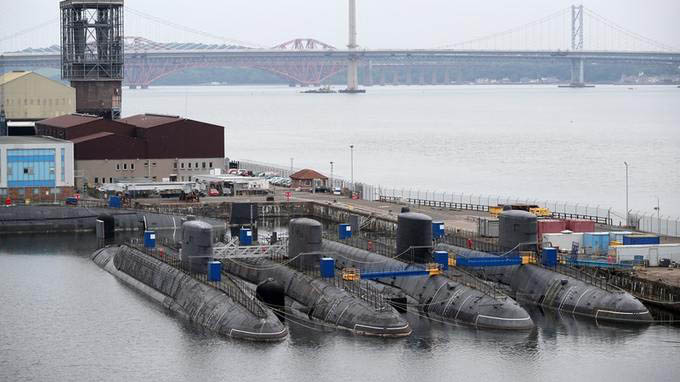
By Clare Buchanan 27 May 24, https://www.dunfermlinepress.com/news/24344727.pledge-sought-laid-up-rosyth-subs-wont-go-australia/
A ROSYTH councillor has called for assurances that rotting nuclear submarines will not be sent to Australia for disposal.
Brian Goodall, who is UK/Ireland Nuclear Free Local Authority’s spokesperson on nuclear submarine decommissioning, said he has written to the UK’s foreign and defence secretaries.
He’s asked for confirmation that vessels will not go overseas if a new Australian law passes without amendments.
Seven old subs have been laid up at Rosyth Dockyard for decades with Dreadnought being there for the longest – more than 40 years – waiting to be scrapped.
The UK and USA signed a pact with Australia to build and operate a new fleet of nuclear submarines which includes the provision of new conventionally armed, but nuclear powered, vessels for the Australian Navy.
To support the pact, legislators down under have proposed a new Australian Naval Nuclear Power Safety Bill 2024.
This appears to allow the disposal of high level radioactive waste from British and American submarines on Australian soil, and also for the storage of such materials in Australia from “a submarine that is not complete”.
In his letter to Lord Cameron and Grant Shapps, Cllr Goodall expressed concern that this could theoretically mean permitting “the towing of redundant UK boats from Rosyth and Devonport down under for disposal”.
He said he fears that this could result in the loss of local expertise and jobs if it comes into practice.
He adds: “Surely as the operators of our own submarines, the UK Government should remain responsible for the storage of the resultant high-level waste and for their safe decommissioning in home ports?
“Not only will this preserve the expertise in these matters that has developed after many years of trial and error, but, as a ward member for the Rosyth Dockyard, it will also preserve the jobs in my local community.”
Back in 2022, the Press reported pledges from the UK Government that all laid-up submarines would be gone as part of plans to “de-nuclearise Rosyth” by 2035.
Councillors were given an update on the programme to remove radioactive waste and turn the seven boats that have been parked at the dockyard for decades into “tin cans and razor blades”.
The Ministry of Defence have previously faced heavy criticism for the delays and sky-high costs in dealing with the nuclear legacy, with 27 Royal Navy subs to be scrapped in total.
US-NATO attack 3 Russian space early warning facilities
South Front 27 May 24
On May 24, the Ukrainian military launched drone strikes on the Voronezh-DM strategic over-the-horizon long-range radar in Armavir in the Krasnodar region. The radar antennas were reportedly damaged.
This facility has nothing to do with the ongoing military operations in Ukraine. Over-the-horizon long-range radar stations of the Voronezh-type are part of the Missile Attack Warning System aimed to detect the launch of ballistic nuclear missiles. This is an element of Russian strategic security, space defense at great distances. It operates in a range of up to 6,000 km and up to 8,000 km in near space, simultaneously monitoring up to 500 different objects.
The Voronezh-DM in Armavir partially controls the territory towards the Indian Ocean, Southern and Central Europe, the Mediterranean Sea, North Africa and the Middle East.
On May 26, there was another attack on the Russian missile warning system that ended in failure. An unidentified drone crashed in the Orenburg region. The incident occurred near the city of Orsk, where another Voronezh-M type radar station is located nearby, it controls the sector from the Taklamakan desert to the shores of the Mediterranean Sea.
It was also revealed that the target of the attack on Crimea on May 23 was the Center for Deep Space Communications, involved in the management of the GLONASS satellite system. The facility located near the city of Alushta was reportedly damaged by 4 US-made ATACMS missiles.
Against this background, it is worth expecting attempts to disable another Russian Voronezh-M type radar station in the Leningrad region. In addition, by the end of 2024, the upgraded Voronezh-type radar station near Sevastopol should be put into operation.
Despite attempts by some European leaders to hide their involvement in the escalation, such attacks are not an independent initiative of Kiev. They were launched by NATO military with NATO missiles, with the reconnaissance support of NATO aircraft………………………………………. https://southfront.press/nato-try-to-inflict-strategic-defeat-on-russia/
Wildfire closes 20+ miles of highway across Hanford nuclear site Saturday night
ICHLAND, WA More than 20 miles of Highway 240 across the Hanford nuclear site and part of Highway 24 was closed by a wildfire for a few hours starting at 6 p.m. Saturday. Wind gusts of up to 26 mph in the area fanning the flames Saturday night.
The Hanford site alerted its employees that Highway 240, sometimes called the Hanford highway, was closed from Highway 225 north of Benton City to the intersection with Highway 24. The highway runs between the section of the nuclear reservation closed to the public and Hanford Reach National Monument land, including Rattlesnake Mountain, also closed to the public. Highway 24 was closed from the Vernita Bridge across the Columbia River to the Silver Dollar cafe, according to Hanford officials.
About 7 p.m. the Washington state Department of Transportation announced the Highway 24 closure but both roadways reopened a few hours later. No information about the specific location of the size of the fire was immediately available.
Uncertainty in UK. Will a Labour government really tread that troubled nuclear power path?
Although technically wedded to the pursuance of new nuclear, whether
Labour in office continues to tread a nuclear path is far from certain.
Labour ministers would face a plethora of competing financial demands from
the onset of their new term in government. In its last period in office
(1997 to 2010), Labour built no new nuclear power plants; consequently, the
civil Nuclear Roadmap may eventually prove to be as washed out as Rishi
Sunak’s rain sodden jacket.
Announcement day was eventful from the onset.
Nuclear Minister Andrew Bowie had been scheduled to meet representatives
from anti-nuclear NGOs in-person at the London offices of his Department of
Energy Security and Net Zero. Others were due to join the Minister online.
Although the meeting had been arranged weeks in advance, Mr Bowie decided
instead to cut and run; there were rumours that Mr Bowie had decided to
make a last-minute trip to Wylfa in North Wales, but, as these have so far
been unsubstantiated, perhaps he was just clearing his desk?
Claire Coutinho in her last act as Energy Secretary had just announced the
non-news that the Wylfa site has been earmarked as the government’s
preferred location for the third gigawatt nuclear power plant. This has
been patently obvious to anyone observing developments in the nuclear
industry for some time. Mr Sunak, and before him Boris Johnson, have
positively gushed over the ‘virtues’ of developing this site over any
others and the recent acquisition of the site with Oldbury for £160
million by Great British Nuclear from former owners Horizon earlier this
year made this choice a certainty.
If built, and remember previous plans
have come to naught, the Wylfa B plant would be similar in size to those in
construction at Hinkley Point C in Somerset and announced for Sizewell C in
Suffolk. Both are being built by French state-owned electricity generator,
EDF, equipped with two European Pressurised Reactors (EPRs) with 3.2
Gigawatt generating capacity.
NFLA 26th May 2024
The Slow-Motion Execution of Julian Assange Continues .
Free speech is a key issue. If Julian is granted First Amendment rights in a U.S. court it will be very difficult for the U.S. to build a criminal case against him, since other news organizations, including The New York Times and The Guardian, published the material he released.
The ruling by the High Court in London permitting Julian Assange to appeal his extradition order leaves him languishing in precarious health in a high-security prison. That is the point.
CHRIS HEDGES, MAY 24, 2024, https://chrishedges.substack.com/p/the-slow-motion-execution-of-julian-986?utm_source=post-email-title&publication_id=778851&post_id=144930141&utm_campaign=email-post-title&isFreemail=true&r=ln98x&triedRedirect=true&utm_medium=email
The decision by the High Court in London to grant Julian Assange the right to appeal the order to extradite him to the United States may prove to be a Pyrrhic victory. It does not mean Julian will elude extradition. It does not mean the court has ruled, as it should, that he is a journalist whose only “crime” was providing evidence of war crimes and lies by the U.S. government to the public. It does not mean he will be released from the high-security HMS Belmarsh prison where, as Nils Melzer, the UN Special Rapporteur on Torture, after visiting Julian there, said he was undergoing a “slow-motion execution.”
It does not mean that journalism is any less imperiled. Editors and publishers of five international media outlets —– The New York Times, the Guardian, Le Monde, El Pais and DER SPIEGEL —– which published stories based on documents released by WikiLeaks, have urged that the U.S. charges be dropped and Julian be released. None of these media executives were charged with espionage. It does not dismiss the ludicrous ploy by the U.S. government to extradite an Australian citizen whose publication is not based in the U.S. and charge him under the Espionage Act. It continues the long Dickensian farce that mocks the most basic concepts of due process.
This ruling is based on the grounds that the U.S. government did not offer sufficient assurances that Julian would be granted the same First Amendment protections afforded to a U.S. citizen, should he stand trial. The appeal process is one more legal hurdle in the persecution of a journalist who should not only be free, but feted and honored as the most courageous of our generation.
Yes. He can file an appeal. But this means another year, perhaps longer, in harsh prison conditions as his physical and psychological health deteriorates. He has spent over five years in HMS Belmarsh without being charged. He spent seven years in the Ecuadorian Embassy because the U.K. and Swedish governments refused to guarantee that he wouldn’t be extradited to the U.S., even though he agreed to return to Sweden to aid a preliminary investigation that was eventually dropped.
The judicial lynching of Julian was never about justice. The plethora of legal irregularities, including the recording of his meetings with attorneys by the Spanish security firm UC Global at the embassy on behalf of the CIA, alone should have seen the case thrown out of court as it eviscerates attorney-client privilege.
The U.S. has charged Julian with 17 counts under the Espionage Act and one count of computer misuse, for an alleged conspiracy to take possession of and then publish national defense information. If found guilty on all of these charges he faces 175 years in a U.S. prison.
The extradition request is based on the 2010 release by WikiLeaks of the Iraq and Afghanistan war logs — hundreds of thousands of classified documents, leaked to the site by Chelsea Manning, then an Army intelligence analyst, which exposed numerous U.S. war crimes including video images of the gunning down of two Reuters journalists and 10 other unarmed civilians in the Collateral Murder video, the routine torture of Iraqi prisoners, the covering up of thousands of civilian deaths and the killing of nearly 700 civilians that had approached too closely to U.S. checkpoints.
In February, lawyers for Julian submitted nine separate grounds for a possible appeal.
A two-day hearing in March, which I attended, was Julian’s last chance to request an appeal of the extradition decision made in 2022 by the then British home secretary, Priti Patel, and of many of the rulings of District Judge Baraitser in 2021.
The two High Court judges, Dame Victoria Sharp and Justice Jeremy Johnson, in March rejected most of Julian’s grounds of appeal. These included his lawyers’ contention that the UK-US extradition treaty bars extradition for political offenses; that the extradition request was made for the purpose of prosecuting him for his political opinions; that extradition would amount to retroactive application of the law — because it was not foreseeable that a century-old espionage law would be used against a foreign publisher; and that he would not receive a fair trial in the Eastern District of Virginia. The judges also refused to hear new evidence that the CIA plotted to kidnap and assassinate Julian, concluding — both perversely and incorrectly — that the CIA only considered these options because they believed Julian was planning to flee to Russia.
But the two judges determined Monday that it is “arguable” that a U.S. court might not grant Julian protection under the First Amendment, violating his rights to free speech as enshrined in the European Convention on Human Rights.
The judges in March asked the U.S. to provide written assurances that Julian would be protected under the First Amendment and that he would be exempt from a death penalty verdict. The U.S. assured the court that Julian would not be subjected to the death penalty, which Julian’s lawyers ultimately accepted. But the Department of Justice was unable to provide an assurance that Julian could mount a First Amendment defense in a U.S. court. Such a decision is made in a U.S. federal court, their lawyers explained.
Assistant U.S. Attorney Gordon Kromberg, who is prosecuting Julian, has argued that only U.S. citizens are guaranteed First Amendment rights in U.S. courts. Kromberg has stated that what Julian published was “not in the public interest” and that the U.S. was not seeking his extradition on political grounds.
Free speech is a key issue. If Julian is granted First Amendment rights in a U.S. court it will be very difficult for the U.S. to build a criminal case against him, since other news organizations, including The New York Times and The Guardian, published the material he released.
The extradition request is based on the contention that Julian is not a journalist and not protected under the First Amendment.
Julian’s attorneys and those representing the U.S. government have until May 24 to submit a draft order, which will determine when the appeal will be heard.
Julian committed the empire’s greatest sin — he exposed it as a criminal enterprise. He documented its lies, routine violation of human rights, wanton killing of innocent civilians, rampant corruption and war crimes. Republican or Democrat, Conservative or Labour, Trump or Biden — it does not matter. Those who manage the empire use the same dirty playbook.
The publication of classified documents is not a crime in the United States, but if Julian is extradited and convicted, it will become one.
Julian is in precarious physical and psychological health. His physical and psychological deterioration has resulted in a minor stroke, hallucinations and depression. He takes antidepressant medication and the antipsychotic quetiapine. He has been observed pacing his cell until he collapses, punching himself in the face and banging his head against the wall. He has spent weeks in the medical wing of Belmarsh, nicknamed “hell wing.” Prison authorities found “half of a razor blade” hidden under his socks. He has repeatedly called the suicide hotline run by the Samaritans because he thought about killing himself “hundreds of times a day.”
These slow-motion executioners have not yet completed their work. Toussaint L’Ouverture, who led the Haitian independence movement, the only successful slave revolt in human history, was physically destroyed in the same manner. He was locked by the French in an unheated and cramped prison cell and left to die of exhaustion, malnutrition, apoplexy, pneumonia and probably tuberculosis.
Prolonged imprisonment, which the granting of this appeal perpetuates, is the point. The 12 years Julian has been detained — seven in the Ecuadorian Embassy in London and over five in high-security Belmarsh Prison — have been accompanied by a lack of sunlight and exercise, as well as unrelenting threats, pressure, prolonged isolation, anxiety and constant stress. The goal is to destroy him.
We must free Julian. We must keep him out of the hands of the U.S. government. Given all he did for us, we owe him an unrelenting fight.
If there is no freedom of speech for Julian, there will be no freedom of speech for us.
Q&A – Germany’s nuclear exit: One year after

CLEAN ENERGY WIRE, FACTSHEET, 16 Apr 2024, Benjamin Wehrmann
Decades of debates came to an end in April 2023, when Germany finally shuttered its last nuclear power plants after the energy crisis. One year on, predictions of supply risks, price hikes and dirty coal replacing carbon-free nuclear power have not materialised.
Instead, Germany saw a record output of renewable power, the lowest use of coal in 60 years, falling energy prices across the board and a major drop in emissions. Industry representatives warn that an effect on power costs may still become visible once Germany’s economy moves out of recession.
At the same time, many countries plan to expand nuclear power, suggesting the country’s phase-out has not found many followers. Yet, global nuclear power market numbers indicate that a nuclear revival is not imminent either. [UPDATES Government advisor says power prices higher due to exit; majority in survey says nuclear exit was a mistake]
Content
- How has the phase-out been conducted?
- Was there any supply security risk in the aftermath?
- What was the gap left by nuclear power filled with?
- What changed in electricity imports and why?
- Did power prices go up due to the phase-out?
- What happens with the retired nuclear plants and waste materials?
- How did the national debate about nuclear power develop?
- How did the nuclear debate move on in the rest of the world?
………………………………………………………………………………………………………………..more https://www.cleanenergywire.org/factsheets/qa-germanys-nuclear-exit-one-year-after—
-
Archives
- February 2026 (213)
- January 2026 (308)
- December 2025 (358)
- November 2025 (359)
- October 2025 (376)
- September 2025 (258)
- August 2025 (319)
- July 2025 (230)
- June 2025 (348)
- May 2025 (261)
- April 2025 (305)
- March 2025 (319)
-
Categories
- 1
- 1 NUCLEAR ISSUES
- business and costs
- climate change
- culture and arts
- ENERGY
- environment
- health
- history
- indigenous issues
- Legal
- marketing of nuclear
- media
- opposition to nuclear
- PERSONAL STORIES
- politics
- politics international
- Religion and ethics
- safety
- secrets,lies and civil liberties
- spinbuster
- technology
- Uranium
- wastes
- weapons and war
- Women
- 2 WORLD
- ACTION
- AFRICA
- Atrocities
- AUSTRALIA
- Christina's notes
- Christina's themes
- culture and arts
- Events
- Fuk 2022
- Fuk 2023
- Fukushima 2017
- Fukushima 2018
- fukushima 2019
- Fukushima 2020
- Fukushima 2021
- general
- global warming
- Humour (God we need it)
- Nuclear
- RARE EARTHS
- Reference
- resources – print
- Resources -audiovicual
- Weekly Newsletter
- World
- World Nuclear
- YouTube
-
RSS
Entries RSS
Comments RSS
 nuclear-news