Towards an international regulatory framework for AI safety: lessons from the IAEA’s nuclear safety regulations
- Seokki Cha , Nature, Humanities and Social Sciences Communications volume 11, Article number: 506 (2024)
Abstract
This study explores the necessity and direction of safety regulations for Artificial Intelligence (AI), drawing parallels from the regulatory practices of the International Atomic Energy Agency (IAEA) for nuclear safety. The rapid advancement and global proliferation of AI technologies necessitate the establishment of standardized safety norms to minimize discrepancies between national regulations and enhance the consistency and effectiveness of these rules. The study emphasizes the importance of international collaboration and the engagement of various stakeholders to strengthen the appropriateness of regulations and ensure their continuous updating in response to the evolving risks associated with technological advancements.
The paper highlights the critical role of subgoal setting mechanisms in AI’s decision-making processes, underscoring their significance in ensuring the technology’s stability and social acceptability. Improperly tuned subgoal setting mechanisms may lead to outcomes that conflict with human intentions, posing risks to users and society at large. The study draws attention to the hidden risks often embedded within AI’s core decision-making mechanisms and advocates for regulatory approaches to guarantee safe and predictable AI operations. Furthermore, the study acknowledges the limitations of directly applying IAEA’s nuclear safety cases to AI due to the distinct characteristics and risks of the two fields.
The paper calls for future research to delve deeper into the need for an independent regulatory framework tailored to AI’s unique features. Additionally, the study emphasizes the importance of accelerating international consensus, developing flexible regulatory models that reflect the situation in each country, exploring harmonization with existing regulations, and researching timely regulatory responses to the fast-paced development of AI technology……………………………………………………………………………………………………. more https://www.nature.com/articles/s41599-024-03017-1
‘Unprecedented infestation’ of rats at Dounreay site
‘Unprecedented infestation’ of rats at Dounreay site. Dounreay has had to
bring in a pest control company to deal with an “unprecedented infestation
of rats over the past few months,” according to a safety rep at the site.
Workers, too, have expressed their concerns about the situation with one
saying hundreds were reportedly seen “scurrying away” when pampas
grass-like plants were removed from around the buildings where they were
nesting.
There have been reports of the rats being seen in vehicles, a
kitchen area and near bins, while concerns have been raised about health
implications.
John O’Groat Journal 11th April 2024
https://www.johnogroat-journal.co.uk/news/unprecedented-infestation-of-rats-at-dounreay-site-347661
In an Ontario town split over a nuclear dump site, the fallout is over how they’ll vote on the future
The town will hold an online vote, but an opposition group demands paper ballots
Colin Butler · CBC News Apr 14, 2024
A citizen’s group opposed to burying Canada’s stockpile of spent nuclear fuel half a kilometre below a southwestern Ontario farm town is demanding a paper ballot rather than an online vote in an upcoming referendum on whether it should welcome radioactive waste.
Canada’s nuclear industry’s quest to find a place to store the growing amount of highly radioactive detritus it produces stretches back decades. The search has narrowed to two potential host communities in Ontario: Ignace (four hours northwest of Thunder Bay) and the Municipality of South Bruce (two hours north of London).
For years, South Bruce has found itself divided over being a potential host — split, between those who believe a new industry is a way to reclaim lost prosperity that lapsed with the glory days of farming, and those who think jobs and subsidies from the nuclear industry has blinded the others to the risks of welcoming radioactive waste into the community.
On Monday, town councillors in South Bruce voted to accept the official question on the ballot: “Are you in favour of the Municipality of South Bruce declaring South Bruce to be a willing host for the Nuclear Waste Management Organization’s (NWMO) proposed deep geological repository?”
‘Our concern is the way that they’re holding the referendum’
“I have no issues with how the question is worded,” Michelle Stein, a member of the grassroots Protect Our Waterways — No Nuclear Waste, said.
“Our concern is the way that they’re holding the referendum as an online vote.”
Stein said unlike paper ballots, which can be audited and verified by anyone, she argues the way a computerized voting system sorts and tallies ballots is largely a mystery to laymen, hidden beneath source code that’s indecipherable to all who lack specialized knowledge.
“This is a forever decision. Why wouldn’t they want tangible physical proof? We can go back and count those paper ballots and they can say, ‘look, here’s the ballots. This is what the people voted for.'”
The municipality of South Bruce is divided over a potential site for a nuclear waste storage facility deep below their community. A referendum to settle the matter is set for later this year. Host Colin Butler speaks with Michelle Stein, a member of Protect Our Waterways – No Nuclear Waste, to hear her concerns………………………………………………….
Errors or breaches can be difficult to detect
Still, critics say online voting is prone to cyber attacks and there’s no way to guarantee voter privacy, or the integrity of the vote. There is also no provincial standard in Ontario, or, for that matter, federally, when it comes to online voting systems.
“There’s a lot of questions that this technology introduces around that. ‘How do I know my vote counted? How do I know it was kept secret?'” Aleksander Essex, a Western University professor who studies cyber security and crytography, said.
At the same time however, Essex notes, he has never seen any evidence of fraud or tampering with the vote in all the years he has studied online voting. ……………………………………………………………………………………………….. https://www.cbc.ca/news/canada/london/ontario-south-bruce-nuclear-dgr-referendum-online-voting-1.7168326—
Annie Jacobsen: ‘What if we had a nuclear war?’

The author and Pulitzer prize finalist, who has written the latest pick for the New Scientist Book Club, Nuclear War: A scenario, on the “shocking truths” about a nuclear attack
By Annie Jacobsen, 12 April 2024, https://www.newscientist.com/article/2426579-annie-jacobsen-what-if-we-had-a-nuclear-war/
Not long after the last world war, the historian William L. Shirer had this to say about the next world war. It “will be launched by suicidal little madmen pressing an electronic button. Such a war will not last long and none will ever follow it. There will be no conquers and no conquests, but only the charred bones of the dead on an uninhabited planet.”
As an investigative journalist, I write about war, weapons, national security and government secrets. I’ve previously written six books about US military and intelligence programmes – at the CIA, The Pentagon, Defense Advanced Research Projects Agency– all designed to prevent, or deter, nuclear world war III. In the course of my work, countless people in the upper echelons of US government have told me, proudly, that they’ve dedicated their lives to making sure the US never has a nuclear war. But what if it did?
“Every capability in the [Department of Defense] is underpinned by the fact that strategic deterrence will hold,” US Strategic Command (STRATCOM), which is responsible for nuclear deterrence, insists publicly. Until the autumn of 2022, this promise was pinned on STRATCOM’s public Twitter feed. But to a private audience at Sandia National Laboratories later that same year, STRATCOM’s Thomas Bussiere admitted the existential danger inherent to deterrence. “Everything unravels itself if those things are not true.”
If deterrence fails – what exactly would that unravelling look like? To write Nuclear War: A scenario, I put this question to scores of former nuclear command and control authorities. To the military and civilian experts who’ve built the weapon systems, been privy to the response plans and been responsible for advising the US president on nuclear counterstrike decisions should they have to be made. What I learned terrified me. Here are just a few of the shocking truths about nuclear war.
The US maintains a nuclear launch policy called Launch on Warning. This means that if a military satellite indicates the nation is under nuclear attack and a second early-warning radar confirms that information, the president launches nuclear missiles in response. Former secretary of defense William Perry told me: “Once we are warned of a nuclear attack, we prepare to launch. This is policy. We do not wait.”
The US president has sole authority to launch nuclear weapons. He asks permission of no one. Not the secretary of defense, not the chairman of the joint chief of staff, not the US Congress. “The authority is inherent in his role as commander in chief,” the Congressional Research Service confirms. The president “does not need the concurrence of either his [or her] military advisors or the US Congress to order the launch of nuclear weapons”.
When the president learns he must respond to a nuclear attack, he has just 6 minutes to do so. Six minutes is an irrational amount of time to “decide whether to release Armageddon”, President Ronald Reagan lamented in his memoirs. “Six minutes to decide how to respond to a blip on a radar scope… How could anyone apply reason at a time like that?” And yet, the president must respond. This is because it takes roughly just 30 minutes for an intercontinental ballistic missile to get from a launch pad in Russia, North Korea or China to any city in the US, and vice versa. Nuclear-armed submarines can cut that launch-to-target time to 10 minutes, or less.
Today, there are nine nuclear powers, with a combined total of more than 12,500 nuclear weapons ready to be used. The US and Russia each have some 1700 nuclear weapons deployed – weapons that can be launched in seconds or minutes after their respective president gives the command. This is what Shirer meant when he said: “Such a war will not last long and none will ever follow it.”
Nuclear war is the only scenario other than an asteroid strike that could end civilisation in a matter of hours. The soot from burning cities and forests will blot out the sun and cause nuclear winter. Agriculture will fail. Some 5 billion people will die. In the words of former Soviet leader Nikita Khrushchev, “the survivors will envy the dead”.
I wrote Nuclear War: A scenario to demonstrate – in appalling, minute-by-minute detail – just how horrifying a nuclear war would be. “Humanity is one misunderstanding, one miscalculation away from nuclear annihilation,” UN secretary-general António Guterres warned the world in 2022. “This is madness. We must reverse course.”
How true.
Nuclear War: A Scenario by Annie Jacobsen, published by Torva (£20.00), is available now. It is the latest pick for the New Scientist Book Club: sign up here to read along with our members
Getting bigger but not safer or cheaper – the myth of Rolls Royce and its very big non-modular reactor

By David Toke, April 2024, https://100percentrenewableuk.org/getting-bigger-but-not-safer-or-cheaper-the-myth-of-rolls-royce-and-its-very-big-non-modular-reactor
Rolls Royce’s so-called small modular reactor (SMR) is getting bigger, but is likely to have fewer special safety features compared to EDF’s increasingly pricey design for Hinkley C.
In 2017 Rolls Royce said that its small modular reactor would be between 220 and 440 MW, but the latest design is bigger, at 470 MW. It is strange to call this small. Reactors in service at the moment (the so-called AGR reactors) were around the 600 MW size for each unit and, strange as it might seem, most of the first generation of so-called ‘Magnox’ nuclear reactors built in the UK were actually smaller than 470 MW. They were not called ‘small’. So why is Rolls Royce calling this a SMR? There’s no reason for this other than public relations.
Rolls Royce claim that the parts will be mainly built in factories. Well, of course they will, that’s always the case with nuclear power plant. The difference with building a relatively smaller plant of course is that you get less of the economies of scale in doing this. That is why nuclear power plant have got bigger.
So the fact that the Rolls Royce unit will be about a third the size of the EPR is likely to make them cost more. But there is one way that Rolls Royce will be able to economise compared to the European Pressurised Reactor (EPR) being built at Hinkley C, and that is because I have seen no sign that Rolls Royce will include some special safety features that have been included in the EPR.
The best known of these safety features are a) a ‘double containment’ feature that is designed to stop material from the inside getting out (as well as another external shell to shield from aircraft) and b) a ‘core catcher’ to stop a melting core eating its way into the ground and potentially contaminating water courses. I am assuming Rolls Royce will not be including either of these features, although it will have to satisfy the Office for Nuclear Regulation (ONR) that it has other ways of stopping radioactive releases from accidents.
Rolls Royce are now starting a ‘Generic Design Assessment’ (GDA) process with the ONR which will take around 5 years. After then they will be asking the UK Government for a blank cheque for a project.
Of course there is another factor and that is that EDF have some experience (admittedly not very successful of late) of building nuclear power plant. Rolls Royce do not have experience of building large nuclear power plant (which is what they are really hoping to do). Producing small (and, it must be said extremely expensive) genuinely small reactors for nuclear submarines is not the same thing at all! So Rolls Royce are likely not to have the skills to build large nuclear power plant. That is a bad sign!
The so-called SMRs proferred by Rolls Royce will just be the latest in a long line of very expensive, very lately delivered nuclear power stations in the UK. It is unlikely to be any cheaper than the reactor that EDF is building at Hinkley C (becoming more expensive as time goes on). But it will have fewer safety features.
Sign the petition for mandatory solar panels on buildings , and for fossil fuels to be banned in new buildings. See the petition page here.
Please share the petition page link as widely as you can on social media. Please write to you MP asking for solar pv to be mandatory on all new buildings and for fossil fuel boilers to be banned in them.
Amid Serious Iran-Israel Tension, The Nuclear Elephant Is In The Room

Tuesday, 04/09/2024, Shahram Kholdi, https://www.iranintl.com/en/202404097226
April 7 marked the sixth month of Hamas-Israel open conflict. Six days before this semi-anniversary, Israel’s April 1 strike on Iran’s embassy in Damascus punctuated an alarming turning point.
Israel’s action did not only corner Hezbollah, Iran’s primary quasi-state proxy on the bloody chessboard of their ongoing conflict but have also eliminated key military leaders. Amid various pundits attempting to predict Iran’s next move, many are acknowledging the significant factor of Iran’s nuclear program lurking in the background.
Supreme Leader Ali Khamenei’s “fatwa” and opinion on the prohibition of producing nuclear weapons “may change tomorrow,” Mahmoud-Reza Aghamiri, the president of Tehran’s Beheshti University and a pro-regime professor of nuclear physics, told Iran’s state TV this week. Aghamiri says Iran currently has the technology and capability to develop a nuclear bomb, and under such circumstances, developing it is easier than not making it.
The punditry and analyses on a possible “direct” clash between Iran and Israel is indeed all over the map. Some, whilst citing “warnings from unnamed Israeli officials behind the scenes” wonder whether or not Iran will strike Israel back from its own territory. Others probe whether it will have its proxies to escalate their asymmetrical strikes against Israel. And last but not least, a handful quibble over whether Israel’s strike would give President Joe Biden the occasion to proclaim support for Israel against Iran but further pressure Israel to heed the US’ demands on the conclusion of the war in Gaza and negotiations with Hamas for the release of the hostages.
On this very outlet, in an article published four days after Hamas attack on October 11, 2023, Benjamin Weinthal covered various sides of a debate on the (unlikely) possibility of a joint US-Israeli attack against Iran as a state sponsor of Hamas.
On the conventional front, The gravity of Israel’s situation cannot be exaggerated. The Hezbollah of Lebanon is armed with thousands of conventional rockets and cruise missiles that can potentially swarm and overwhelm the Israeli Air Defense Shield and Iron Dome and the analyses of Israel’s ability to take all Hezbollah’s arsenal preemptively has been the subject of much debate.
What most observers do not take into account is the possibility that the Israeli attack on the Iranian embassy in Damascus may trigger a rude awakening amongst the IRGC top brass and Khamenei. It might prompt them to hasten the development of their nuclear deterrence capabilities. Despite the regime’s longstanding vow to eliminate Israel, dating back to before 1979, the tensions between Iran and Israel are mutual and deep-rooted.
Israel is presently wary of the Iranian ability to deploy a handful of nuclear warheads and the IDF has been preparing itself for a decisive strike on the Iranian nuclear facilities for quite some time before the Hamas October 7 attack on Israel. Israel, as is discussed below, has been acutely aware of Iran’s ever growing weaponization capacity as early as 2018.
Yet Israel’s collective sense of insecurity is not simply rooted in its fear of its enemies or the deep-seated collective trauma of the Holocaust. Israel’s primary source of insecurity is rooted in its historical roller coaster experience of its alliances. The Soviet de jure recognition of Israel and support for its war of independence against the Arab nations was short-lived and inadequate. France was Israel’s major military supplier for much of the 1950s to the mid-1960s, and upon her aid Israel developed its conventional and unconventional nuclear programs.
But France proved unreliable when President De Gaulle sought a rapprochement with Israel’s Arab enemies and abandoned Israel in the mid-1960s. From the mid-1960s, the United States became Israel’s sole guarantor and ally in all aspects of economy and military from research and development, joint aeronautical and space projects to the development of the sophisticated air-defense systems, namely, “the Iron-Dome”, and the latest sophisticated UAVs.
The United States itself has wavered in its “unequivocal support” for Israel at least on three different occasions. First, President Dwight Eisenhower refused to support Israel in its collusion with the Anglo-French powers during the 1956 Suez Crisis. In fact, Eisenhower turned his back on Israel as he feared escalation with the Soviet Union. Incidentally, there are commentators who believe that President Biden should treat Prime Minister Benjamin Netanyahu to a similar set of measures that Eisenhower imposed on Israel in 1956.
There are indeed those in the US who believe Johnson failed to act to prevent Israel’s occupation of the West Bank in 1967 and this is a legacy from which Biden must take harsh lessons and act accordingly. Finally, President Barack Obama’s administration sidelined Israel’s Netanyahu to cajole Tehran’s ruling mullahs into the Joint Comprehensive Plan of Action (JCPOA) over their nuclear program causing Israel to distance itself ever farther from the Euro-American alliance. Israel has been less than forthcoming about sharing the details of its assassination and sabotage operations with its Euro-American allies ever since. According to some reports, “the CIA does not know” if Israel plans to bomb Iran.”
Today, Israel and Netanyahu are almost identical in their shared sense of insecurities. Even though a majority of Israelis may not vote him to office if elections were held today, they share the same sense of insecurity that has been the compass of his five mandates over the past thirty years. At the core of this sense of insecurity lies Iran’s nuclear program. Since 2018, Israel has taken possession of thousands of documents that lay bear all the militaristic directions of the Iranian nuclear program (Revealed: Emptying of the Iranian “Atomic Warehouse” at Turquz Abad). Over nearly 15 years, Israel is alleged to have succeeded in sabotaging many critical sites of the Iranian nuclear industrial complex. Moreover, Israel is accused of having masterminded the operations that eliminated Iranian nuclear scientists in the same period. Nonetheless, since Donald Trump left the JCPOA, the Iranian regime has progressively accelerated its uranium enrichment and proved Israel’s, read Netanyahu’s, worst fears. The International Atomic Energy Agency (IAEA) is effectively and totally is in the dark per the latest reports of IAEA and its dire warnings about the exact state of the Iranian nuclear program. In view of the above, it appears that Israel’s assassination and sabotage operations against the Iranian scientists and nuclear sites have effectively failed.
Israeli-American air forces joint drills for long range operations in the summer of 2023 revealed how alarmed both US and Israel were about the Iranian nuclear program. It was speculated at the time that such drills were to prepare both air forces for a joint operation on the Iranian nuclear facilities. Meanwhile, the Americans were in the midst of secret negotiation with the Iranians to reach an “informal nuclear agreement”.
However, joint exercises of such magnitude with any ally are always planned long in advance and are indicative of longstanding concerns. Accordingly, the joint US-Israeli hint at the fact that the Biden administration did neither have any confidence in the success of those secret negotiations with Iran, nor was it assured of the Iranian side’s honoring any such accord. Three weeks before Hamas attack on Israel, a most telling paragraph in the IDF statement on Israeli and Hellenic air forces’ joint drills for long range operations reads as follows: “The exercise is part of a series of exercises and models carried out by the IAF in the past year and their purpose is to improve operational and mental competence for long-range flights, refueling, attacks in the depth [of enemy territory] and achieving air superiority.”
Khamenei, per his religious edict, fatwa, has stated time and again that the manufacturing and usage of nuclear weapons is forbidden. However, Israel’s elimination of two high-ranking IRGC general inside the Iranian embassy’s compound in Damascus has established that there is no red line that it will not cross to maximize its security and minimize all risks. Such an escalating assault may cause the Iranian ruling clerics and the IRGC to wonder if their nuclear facilities will be next on Israel’s target list and they may consider attaining a deterrence greater than a conventional one. Khamenei may indeed invoke the principle of expediency to overrule his own “anti-Nuclear” fatwa. The principle of expediency, as decreed by the regime’s founder Ayatollah Khomeini in January 1988, stipulates that the Supreme Leader of the Islamic Republic may even violate the fundamental tenets of the Islamic faith in order to preserve “the Islamic Regime” as the preservation of the Islamic Regime supersedes all else.
Thus, if Israel continues to expand its unrelenting attacks on IRGC top brass and Iranian military and diplomatic facilities in the region, and the Iranian regime continues to plunge into the depths of a maelstrom of economic troubles, will Khamenei perceive such an assault as compromising the survival of the regime? And if so what will he do? Will he invoke the principle of expediency and order the rapid manufacturing of nuclear devices and their deployment in the form of a dozen or so warheads? Or will he be resigned to Israel’s overwhelming assault on its proxies and, like his predecessor, will drink from the poisonous chalice of surrender?
Keir Starmer slammed over staunch defence of nuclear weapons

“it’s increasingly clear that Starmer’s offer is just more of the same: billions of pounds wasted on nuclear weapons and nuclear power, and a belligerent foreign policy that includes support for the Aukus pact, Nato, and continuing arms sales to Israel, used to kill Palestinians.
“Putting billions of pounds into the pockets of arms companies and their investors will not reinvigorate the economy in any meaningful way.”
The National By Hamish Morrison @HMorrison97 Political Reporter, 10 Apr 24
KEIR Starmer has said Trident is the “bedrock” of Labour’s defence policy – despite growing concern over the state of the ageing nuclear fleet critics say is a “grotesque” waste of money.
The Labour leader launched a full-throated defence of Britain’s nuclear weapons in an attempt to stress the distance he has taken the party since its leadership under Jeremy Corbyn – who voted against the renewal of Trident while in charge.
During a visit to Barrow today, where nuclear submarines are being built, Starmer is expected to focus on increasing jobs and skills in defence.
Starmer said: “The changed Labour Party I lead knows that our nation’s defence must always come first. Labour’s commitment to our nuclear deterrent is total.
“In the face of rising global threats and growing Russian aggression, the UK’s nuclear deterrent is the bedrock of Labour’s plan to keep Britain safe.
“It will ensure vital protection for the UK and our Nato allies in the years ahead, as well as supporting thousands of high paying jobs across the UK………………………..
Labour will ensure that new UK leadership within Aukus helps make this national endeavour a success for Britain.”
The Aukus pact unites Australia, the UK and the USA in a military pact in the South Pacific, which critics say escalates tensions with the Chinese.
China’s government has described Aukus – which will see Australia provided with nuclear-powered submarines – as indicative of an “obsolete Cold War zero sum mentality”.
The SNP have said Labour’s commitment to Trident was “grotesque”.
Martin Docherty-Hughes (below), the party’s defence spokesperson, said: “Westminster has already wasted billions of pounds of taxpayer’s money on nuclear weapons and expensive nuclear energy.
“It is therefore grotesque that Sir Keir Starmer is prepared to throw billions more down the drain when his party claim there is no money to improve our NHS, help families with the cost of living or to properly invest in our green energy future.
“This money would be better spent on a raft of other things – not least investing in the green energy gold rush, which would ensure Scotland, with all its renewal energy potential, could be a green energy powerhouse of the 21st century.”
He blasted the “misfiring Trident missiles”, drawing attention to a high-profile blunder which saw a test missile dramatically fail to launch, landing just yards from the submarine carrying it.
Docherty-Hughes said the Government should provide more money for “underpaid and under-resourced” armed forces staff and conventional defence systems.
Alba general secretary Chris McEleny, who worked at HM Naval Base Clyde, where nukes are stored, said: “When one in four children in Scotland live in poverty it is obscene that resources are wasted to ensure that we have the best defended foodbanks in the world.”
He added that the “war-mongering Labour Party have now made it clear that independence is the only way to free Scotland of nuclear weapons”.
Healey, Labour’s shadow defence minister, said a “strong defence industrial strategy” would be “hardwired” in the party’s quest to promote economic growth if it gains power at the election.
He added: “We will make it fundamental to direct defence investment first to British jobs and British industry.”……………………………..
Kate Hudson, general secretary of the Campaign for Nuclear Disarmament, said voters were “desperately looking for hope from the Labour Party”.
She added: “However, it’s increasingly clear that Starmer’s offer is just more of the same: billions of pounds wasted on nuclear weapons and nuclear power, and a belligerent foreign policy that includes support for the Aukus pact, Nato, and continuing arms sales to Israel, used to kill Palestinians.
“Putting billions of pounds into the pockets of arms companies and their investors will not reinvigorate the economy in any meaningful way.” https://www.thenational.scot/news/24248069.keir-starmer-slammed-staunch-defence-nuclear-weapons/
Biden ‘very proud’ of expanding NATO to Russia’s borders
https://www.rt.com/news/595718-biden-proud-nato-expansion/ 12 Apr 24
The US leader believes it would be a “disaster” if the bloc were to break up
US President Joe Biden has hailed NATO’s further expansion toward Russia’s borders, while accusing Republican rival Donald Trump of undermining the unity of the American-led military bloc.
Russia has for years voiced concern about NATO’s creeping encroachment, viewing its policies as an existential threat. However, in an interview with Spanish-language broadcaster Univision that aired on Tuesday, Biden touted the recent addition of Finland and Sweden to the bloc’s ranks amid the Ukraine conflict as a great achievement.
“We’ve done something that I was very proud of. I’ve engaged with NATO for my whole career. We were able to expand NATO, and we have 2,000 miles of border because you have two Nordic nations having joined NATO. You have a whole range of NATO countries along the Russian border,” the US president said.
Biden went on to argue that a stalemate in Congress over his $61 billion military aid package for Kiev is “very dangerous” for the bloc’s unity, accusing his former US leader Trump of virtually holding the measure – and the entire Republican party – hostage.
“Trump runs that party. He maintains a sort of a death grip on it. Everybody’s afraid to take him on whether they agree with him or not, and it’s incredibly dangerous. The last thing we need is to see NATO start to break apart. It would be a disaster for the United States, a disaster for Europe, a disaster for the world,” Biden said.
The US has provided Ukraine with over $113 billion in various forms of assistance since the start of hostilities with Russia. Moscow has repeatedly condemned foreign arms shipments to Kiev, arguing they will only prolong the conflict, while making the West a direct participant in the hostilities.
Finland shares a 1,300km border with Russia, and Moscow has argued that NATO membership has threatened, not guaranteed, Finnish security. After Helsinki joined the alliance last year, Russian President Vladimir Putin announced the creation of a new military district bordering the Nordic nation. Sweden joined the bloc last month.
Putin has warned for nearly two decades that NATO’s policies undermine Russian national security, but a real “red line” for Moscow would be an attempt to move the bloc’s forces into Ukraine. The conflict in Ukraine is an “existential” one for Moscow and a “matter of life and death,” Putin said in February, while for the West it is simply a matter of “improving its tactical positions.”
UK Government decision to withhold nuclear power plant information unlawful
Government decision to withhold nuclear power plant information unlawful.
A ruling by the Information Commissioner (IC) requiring the Secretary of
State for Energy Security and Net Zero requesting the disclosure of
information in respect of a proposed nuclear power plant on Anglesey was
upheld by the General Regulatory Chamber (GRC) which concluded that the
public interest supported its disclosure.
Planning Resource 11th April 2024
Nuclear energy ‘now an obstacle to delivering net zero’ – Greenpeace.
Nuclear energy has been touted as key to the global transition,
but concerns around costs and timescales have generated scepticism.
According to Greenpeace director of policy Doug Parr: “Nuclear power
can’t bridge the gap between anything and anything. It is too slow. It is
too expensive. It is a massive distraction.”
Speaking about the role of
nuclear energy in the UK’s transition, Parr tells Energy Monitor: “It
doesn’t help with the kind of grid system that we need, which is going to
be renewables heavy. I think the UK focus on nuclear power is now an
obstacle to delivering net zero because it is sucking up time, energy and
political bandwidth, which can be spent on more useful things.”
Parr argues that governments should be investing in more immediate solutions. He
points to investment in Sizewell C – the 3.2GW power station set to be
built in the English county of Suffolk – where construction is set to
commence this year. It is likely to take between nine and 12 years to
complete, but delays at Hinkley C (of which Sizewell C will be a close
copy) have stirred doubt.
“We will be putting a lot of money into
something like Sizewell C, when actually we will find that it is a white
elephant by the time it has opened,” he contends. “We will have spent
all that time, energy and effort, which could have been put into improving
our housing stock, improving our grid or improving the ability of electric
vehicles to meet the needs of people through a proper charging network –
things that would actually would deliver this decade, not in 15 years time.
So, we would cut a lot more carbon, we would get something done that is
useful and we wouldn’t have piles of messy radioactive waste that we
still don’t know what to do with.”
Energy Monitor 10th April 2024, https://www.energymonitor.ai/features/nuclear-energy-now-an-obstacle-to-delivering-net-zero-greenpeace/
Why you probably shouldn’t become a Community Interest Company
by preorg, https://preorg.org/why-you-probably-shouldnt-become-a-community-interest-company/
Imagine you have sacrificed hundreds of hours of your volunteering time to a non-profit organisation doing good work. After years of effort, often exhaustion, you discover that the directors don’t care that much about whether you succeeded in helping those people you intended to help. They care mostly about how much time they can spend at the swimming pool at their second home in Spain. Your volunteer hours have helped fund that lifestyle.
How could such a situation arise? Aren’t charities supposed to have boards of governors that keep the organisation on track? But wait, it wasn’t a charity! It was a Community Interest Company. Now, I should say that I don’t currently know of any such dramatic betrayals of people’s goodwill. But what I will argue here is that this situation arising in some CICs is bordering on inevitable, given the operating parameters of CICs. Given the weakness of regulation of the companies, almost boasted about by the CIC Regulator, it’s only a matter of time.
Why would I think that? Most people seem happy with CICs; Community Interest Companies are a success story, we are told. There are now many thousands of CICs in the UK, all having appeared within the space of ten years. This rapid rise in fact means that many people have chosen a form the long-term resilience of which has yet to be tested. It would be exciting to write an article about all the horribly failed CICs littering the social economy landscape. But I don’t know of any; I can only do a much less exciting job: pointing out what’s wrong with CICs before they start to fail. My contention is that, with the help of an FOI request to the CIC Regulator, we can see that certain types of failure are predictable. As for why we haven’t seen the failures yet, it is largely because CICs are young and in most of them the founders are still in charge.
The CIC was designed for organisations with social goals. It must operate in the ‘community interest’, which is defined in the articles of the organisation. It is also chosen over charities as an organisation that can more easily buy and sell commercially. But among the people I have asked, the main reason for opting for a CIC has been that it is easy. It is a lightweight structure, it is unencumbered by bureaucracy. It can be set up in a couple of days and can adapt quickly to changing conditions since it doesn’t have long lists of rules in its constitution. More like a standard profit-making company then, but with social objectives built in. Supposedly. More on that later.
By comparison both charities and co-operatives or community benefit societies (BenComs) have a lot more rules. Rules! How annoying! How limiting! But hang on a moment, why, if rules are so tedious, do those other organisations bother with them? The answer is that most of the rules are about accountability. In the case of a charity, the board of trustees, who must be consulted on significant matters, exist to keep the charity in line with its social aims. In co-ops and BenComs it is the membership who must constantly be consulted, and who choose who leads the organisation. Democracy certainly can be quite annoying.
By comparison a standard CIC is at the mercy of its directors, who needn’t even be many in number. That’s fine, I hear some say, I am the director, and I trust myself to make good decisions. Perhaps, but do you intend to lead the organisation forever? Even if you plan to live forever, what happens if you get ill, or leave through some other reason beyond your control? The purpose behind many accountability mechanisms is that they transcend the ideals of one particular person. They embed the ethics and goals into the DNA of the organisation, whoever may be running it at a given time. So how long do you want your organisation to last?
There is one supposed accountability mechanism in CICs: the government regulator. In theory the Office of the Regulator of Community Interest Companies has a lot of power to force CICs to stick to their aims. In practice it appears to do very little, priding itself on being a ‘light touch’ regulator. When I contacted the Regulator, they explained that in the last year they received 57 complaints, only 3 of which resulted in an intervention by the regulator. None of these 3 were related to the community benefit requirements. The Regulator has so far never wound up a CIC or stripped one of its CIC status. The Regulator has no records of intervening in a CIC on the basis of the standard paperwork submitted each year, which in part reports on the organisation’s performance under its community benefit requirement. That is to say, there appears to be no pro-active monitoring of whether CICs are operating for community benefit.
Even Social Enterprise UK, a fan of the CIC form, has raised questions over the strength of the Regulator. This accountability mechanism begins to look weak, to say the least. I’m not sure it will ever improve either. I doubt the regulator will ever be well enough funded to investigate what is going on in tens of thousands of organisations. We should not look for accountability in the CIC regulator.
Let’s move on to another question, a special case of the accountability problem: what profits can be made from a CIC, often presented as a non-profit structure? There is a CIC limited by shares that is allowed to make a profit. Previously there was a dividend cap of 20% of share value in any given year. This was considered by the government to be ‘inhibiting investment’ so in 2014 they removed the cap. Say that again? Annual 20% profits inhibiting investment?
Let’s leave that aside. In fact the majority of CICs are limited by guarantee and are more genuinely non-profit in form. There are, however, a couple of massive catches. The directors of a CIC can pay themselves whatever they can argue could reasonably be seen as necessary, as long as they are still fulfilling their social objectives. As determined by the aforementioned ‘light touch’ regulator. A CIC with a turnover of some millions a year could in theory pay the directors a million a year, if they could argue that without the salary they couldn’t retain the talent they need. Is it still a non-profit? This raises the aforementioned scenario of people putting in hundreds of volunteer hours for a supposed non-profit while the directors are buying holiday homes in the Mediterranean.
The second problem is that nobody is paying any attention to who CICs contract out work to. If a CIC pays huge ‘management fees’ or overpays on a cleaning contract to a company that happens to be owned by, say, the partner of a director, any money in the organisation can very easily be siphoned out to profit-making enterprises. In a charity the board and regulator would keep a sharp eye on this type of activity; the CIC regulator barely seems to glance at the paperwork.
You, the current director, might not abuse your position so, but can you be so sure of your successors? We only need to look at Housing Associations for a case study in organisational mission drift, in part driven by the high salaries CEOs have been able to pay themselves.
A word too on putting an informal democratic structure on top of an undemocratic CIC: I’m told that the Centre for Alternative Technology in Wales acted for years like a co-operative, and those involved assumed that’s what it was. But it never took a co-operative legal form, so when it ran into trouble, new leadership bulldozed aside the democracy people had assumed was one of the core values of the organisation. CAT is at least a charity, but the lesson is that informal structures can be dispensed with any time the CIC directors get tired of them.
But surely there must be a right situation for a CIC? Perhaps. A CIC could be right for an organisation that is mostly a trading organisation and is for a short-term project which won’t exist for long. If the project is intended to run long-term, I don’t believe the CIC is a reliable form. It is at the mercy of the leadership that follows you, if not your own leadership. The CIC Regulator is not the safety net you need. For most people it would be worth choosing an organisational type that seems more ‘difficult’ in the short term, but will almost certainly be more sustainable and accountable in the long run.
For existing successful CICs, why would they bother to change if they are doing well as they are? Let’s remember they are still young organisations. Do we want to wait twenty years to see the emergence of accountability and mission-drift problems that are, I am suggesting, rather predictable? Mission-drift that the Regulator will never pick up on unless someone reports it?
There are a few ways to mitigate the risks here. The best option for many would be to convert into a co-operative CIC. Co-ops UK offers one set of model rules for this, and the Somerset Rules can also convert a CIC into a multi-stakeholder co-op. It will cost time and money, it is true, to change the rules, but it will surely not be as painful as the organisation going off track in a few years’ time after the founders have retired.
The second best option is to add democratic rules to the CIC. It is a benefit of CICs that they are very flexible. The CIC Regulator offers model rules of a participatory organisation of large membership, though it is still very much director-controlled. It is theoretically possible to set up a more democratic membership structure without being a co-operative. While this method may miss out on embedding some of the checks and balances that co-ops have developed over the years, it could make the organisation more accountable. But remember, rules that can be added can be taken away. Only co-ops and their cousins, community benefit societies, lock democracy in permamently.
Finally, if actual democracy seems too great a task, it is at least possible to simply install more directors onto the CIC board, preferably those affected by what the organisation does, and so establish a strong democratic culture among the CIC directors. It’s not a perfect fix, but increased collective decision-making will mitigate the problems of a top-down culture reliant on the goodwill of two or three people.
For those who haven’t started their organisation yet, this is a plea to consider that a sustainable organisation is an accountable one, and democracy is one of the best ways to ensure accountability. Thankfully others, in the form of the co-operative movement, have already paved the way for us.
Five Years At Belmarsh: A Chronicle Of Julian Assange’s Imprisonment.

Kevin Gosztola, Apr 11, 2024, https://scheerpost.com/2024/04/12/five-years-at-belmarsh-a-chronicle-of-julian-assanges-imprisonment/
Calls for Assange’s freedom are renewed as the WikiLeaks founder marks five years in Belmarsh prison.
At the behest of the United States government, the British government has detained WikiLeaks founder Julian Assange in His Majesty’s Prison Belmarsh for five years.
Assange is one of the only journalists to be jailed by a Western country, making the treatment that he has endured extraordinary. He has spent more time in prison than most individuals charged with similar acts.
Since December 2010, Assange has lived under some form of arbitrary detention.
He was expelled from Ecuador’s London embassy on April 11, 2019, and British police immediately arrested him. Police transported Assange to Belmarsh, a maximum-security facility often referred to as “Britain’s Guantanamo.”
Around the same time, the U.S. Justice Department unsealed an indictment that alleged that Assange had conspired with U.S. Army whistleblower Chelsea Manning to commit a “computer intrusion.” The following month the DOJ issued another indictment with 17 additional Espionage Act charges.
2019
On May 1, Assange was sentenced by a British court to 50 weeks in prison as punishment for seeking political asylum from Ecuador while Sweden was attempting to extradite him. His sentence was longer than the six-month sentence that Jack Shepherd, the “speedboat killer” received for “breaching bail.”
Continue readingWhat’s Inside the President’s Nuclear Football
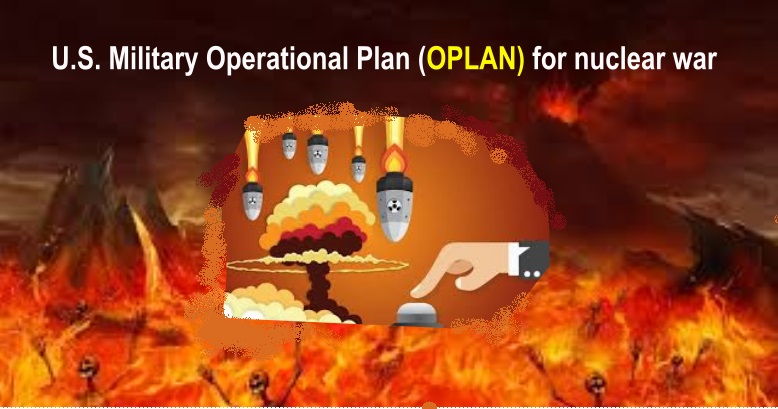
the creation of the Football, the president’s emergency satchel. But what about the nuclear war plans inside? And what about the Black Book? As surprising as this now seems, until 1960, several of the U.S. military branches had their own individual plans for nuclear war. What this meant was that the Army, Navy, and Air Force chiefs each had authority over a uniquely designated stockpile of nuclear weapons—including the delivery systems for those weapons and lists of targets to strike—for them to use at their own discretion in the event of nuclear war. When incoming Secretary of Defense Robert McNamara learned about these multiple, competing nuclear war plans, he ordered them integrated into a single plan. This is how the Single Integrated Operational Plan, or SIOP, got its name.
What began as the Single Integrated Operational Plan is now the Operational Plan, or OPLAN.
The Operation Plan for nuclear war is a colossal and cumbersome set of documents, too large to be carried around in the Football. Parsed down to a more manageable size, the plans become nuclear strike options as delineated in the Black Book.
plan for “mass extermination.” “evil beyond any human project ever,” “the destruction of most cities and people in the northern hemisphere.”
BY ANNIE JACOBSEN, APRIL 11, 2024 https://time.com/6965539/u-s-presidents-nuclear-footb
Jacobsen’s new book is Nuclear War: A Scenario
Nuclear threats have reemerged on the world stage. Frequently, Vladimir Putin warns the West that Russia is ready for nuclear war. “Weapons exits in order to use them,” Putin says. North Korea accuses the U.S. of having, “a sinister intention to provoke a nuclear war.” Entwined with the rising rhetoric, one physical object stands alone—the president’s emergency satchel, also known as the nuclear Football.
This bulging leather briefcase remains with the president at all times, carried by a military aide, and never more than an arm’s length away. It’s an iconic reminder of preeminent power and national mystery. A “nominally secret command-and-control system used to assure presidential control of nuclear use decisions,” historian William Burr says of the Football. Items located inside the president’s emergency satchel confirm his identity and connect him, as commander in chief, to the National Military Command Center, a nuclear bunker located beneath the Pentagon.
Also inside the Football is the Black Book. This cryptic set of documents, parsed down from a much larger operational plan for nuclear war, provides the commander in chief with nuclear launch options should policy dictate the president needs to act. This includes which targets to strike, which delivery systems to use, and the timing of action. “It’s called the Black Book because it involves so much death,” says Dr. Glen McDuff, a nuclear weapons engineer who served as the classified museum historian at Los Alamos National Laboratory in New Mexico.
The Football is with the president at all times. The first publicly-released photograph of the Football is from May 1963, at the Kennedy Family Compound in Hyannis Port, Massachusetts. It can be seen swinging from the military aide’s hand as he walks directly behind the president. The Football accompanied President Regan to the Red Square in Moscow, in 1988. When President George H.W. Bush was photographed out on jog, his military aide—also in running shorts and sneakers—can be seen just a few steps behind, carrying the iconic briefcase in her left hand.
The Football is always within a few feet of the president of the U.S. Once, when President Clinton was visiting Syria, President Hafez al-Assad’s handlers tried to prevent Clinton’s military aide from riding in an elevator with him. “We could not let that happen, and did not let that happen,” former Secret Service director Lewis Merletti says. Merletti was the special agent in charge of President Clinton’s detail at that time. “The Football must always be with the president,” he asserts. “There are no exceptions.” How the Football came to be has long been shrouded in mystery. “Its origins remain highly classified,” journalist Michael Dobbs wrote in Smithsonian Magazine in 2014. And then, just a few months ago, Los Alamos National Laboratory finally declassified the Football’s origin story. It goes like this.
One day in December 1959, a small group of officials from the Joint Committee on Atomic Energy visited a NATO base in Europe to examine joint-custody nuclear bomb protocols. The NATO pilots stationed there flew Republic F84F jets, the first U.S. Air Force fighter-bomber aircraft designed to carry nuclear bombs. Operation Reflex Action was in effect, air crews were trained and ready to strike predetermined targets in the Soviet Union in less than fifteen minutes from the call to nuclear war. One of the men on this visit was Harold Agnew, a Los Alamos scientist with a unique history.
Agnew was one of the three physicists assigned to fly on the Hiroshima bombing mission as a scientific observer. He carried a movie camera with him and took the only existing film footage of the atomic bombing of Hiroshima, as seen from the air. Now, in 1959, Agnew was at Los Alamos overseeing thermonuclear bomb tests; he later became the lab’s director. During the trip to the NATO base, Agnew noticed something that made him wary. “I observed four F84F aircraft . . . sitting on the end of a runway, each was carrying two MK 7 [nuclear] gravity bombs,” he wrote in a document declassified in 2023. What this meant was that “custody of the MK 7s was under the watchful eye of one very young U.S. Army private armed with a M1 rifle with 8 rounds of ammunition.” Agnew told his colleagues: “The only safeguard against unauthorized use of an atomic bomb was this single G.I. surrounded by a large number of foreign troops on foreign territory with thousands of Soviet troops just miles away.”
Back in the U.S., Agnew contacted a project engineer at Sandia Laboratories named Don Cotter and asked “if we could insert an electronic ‘lock’ in the [bomb’s] firing circuit that could prevent just any passerby from arming the MK 7.” Cotter got to work. He put together a demonstration of a device, a lock and coded switch, that functioned as follows: “[a] 3-digit code would be entered, a switch was thrown, the green light extinguished, and the red light illuminated indicating the arming circuit was live.”
Agnew and Cotter went to Washington, D.C., to demonstrate this locking device—first to the Joint Committee on Atomic Energy, then to the president’s top science advisor and finally to the president himself. “We presented it to President Kennedy, who ordered it be done,” Agnew recalled. The military objected. The man in charge of nuclear weapons at the time, General Alfred D. Starbird, opposed the idea. Glen McDuff, who coauthored (with Agnew) the now declassified paper on the subject, summed up the general’s documented concerns. “How is a pilot, U.S. or foreign, somewhere around the world, going to get a code from the President of the United States to arm a nuclear weapon before being overrun by a massively superior number of Soviet troops?” For the U.S. military, the locking device issue opened Pandora’s box. “If gravity bombs were coded,” McDuff explains, “why not all nuclear weapons including missile warheads, atomic demolition munitions, torpedoes, all of them.” The president decided they needed to be.
The answer came in the creation of the Football, the president’s emergency satchel. But what about the nuclear war plans inside? And what about the Black Book? As surprising as this now seems, until 1960, several of the U.S. military branches had their own individual plans for nuclear war. What this meant was that the Army, Navy, and Air Force chiefs each had authority over a uniquely designated stockpile of nuclear weapons—including the delivery systems for those weapons and lists of targets to strike—for them to use at their own discretion in the event of nuclear war. When incoming Secretary of Defense Robert McNamara learned about these multiple, competing nuclear war plans, he ordered them integrated into a single plan. This is how the Single Integrated Operational Plan, or SIOP, got its name.
Starting in December 1960, for the first time in the nuclear age, the SIOP gave the president, not the military, control of America’s nuclear arsenal. This new locking device designed by Agnew and Cotter, called a Permissive Action Link, or PAL, became an integral part of this new system. Only with the invention of the Football would the order to launch nuclear weapons—and the ability to physically arm them—come from the president alone. “This is how the president got the Football,” writes Agnew.
Over the years, the name for the nuclear war plan has changed. What began as the Single Integrated Operational Plan is now the Operational Plan, or OPLAN. For the Nuclear Information Project, in consort with the Federation of American Scientists, project director Hans Kristensen and senior researcher Matt Korda have identified the current Operational Plan as OPLAN 8010-12. It consists of “‘a family of plans’ directed against four identified adversaries: Russia, China, North Korea, and Iran,” the authors write. The Operation Plan for nuclear war is a colossal and cumbersome set of documents, too large to be carried around in the Football. Parsed down to a more manageable size, the plans become nuclear strike options as delineated in the Black Book.
The number of individuals who have written out their first-hand impressions of the SIOP is extremely limited. John Rubel, an avionics expert who served as an assistant secretary of defense under President Kennedy, wrote about the SIOP in his 2008 memoir, Doomsday Delayed. He liked it to a plan for “mass extermination.” Daniel Ellsberg reflected on the SIOP in his 2017 memoir, The Doomsday Machine: Confessions of a Nuclear War Planner. “It depicted evil beyond any human project ever,” Ellsberg wrote. A plan that calls for “the destruction of most cities and people in the northern hemisphere.”
As for the Black Book, few details exist on the public record. In 2015, U.S. Strategic Command battle watch commander Colonel Carolyn Bird shared with CNN previously unreported details. An identical Football resides inside the Stratcom nuclear bunker, viewers learned, locked in a safe beneath Offutt Air Force Base in Nebraska. “The [Black Book inside the] president’s football and our black book are duplicates,” Bird told CNN. “They contain the same information in the same way so that we are talking off the same documents when we are discussing nuclear options.”
In an interview with the History Channel, President Clinton’s former military aide, a colonel named Robert “Buzz” Patterson, likened the Black Book to a “Denny’s breakfast menu.” He made the analogy that choosing retaliatory targets from a predetermined nuclear strike list was as simple as deciding on a combination of food items at a restaurant. “It’s like picking one out of Column A and two out of Column B,” Patterson said.
Dr. Theodore Postol has seen the contents of the Black Book. His thoughts provide unsettling context to Patterson’s observations. From 1982 to 1984 Postol served as the assistant for weapons technology to the chief of naval operations. In this capacity, he worked on technical details regarding submarine launched ballistic missiles, or SLBMs. “Nitty gritty features,” Postol generalizes.
“Seeing the contents of the Black Book,” he recalls, “I was freaked out beyond belief.” Not for reasons he expected; as a weapons technologist Postol was familiar with the mass carnage involved. Instead of being confronted with a succinct summary of these horrifying facts—the targeting of cities, the death tolls in the millions—
Postol found the contents of the Black Book to be an obfuscation of the facts. The nuclear launch plans, he says, “had been sterilized down to military terminology designed to remove you from the reality of what would be happening.” An attempt at sanitizing nuclear war into a seemingly more palatable event. “My first thought,” Postol remembers, was “how would a president understand what these attack options actually mean?” This censoring of grim truths about nuclear war extends to the public as well, Postal contends. “You don’t want your population to know you’re planning genocide.”
What, if any, is the solution to this madness? Between the saber rattling and the secrecy, nuclear matters can present themselves as intractable. And yet, in reporting this story I witnessed a change in attitude from an unlikely source: the Los Alamos National Laboratory, a federal government organization that I’ve covered as a reporter for fifteen years.
“It’s the Oppenheimer effect,” Dr. Glen McDuff told me of this new attitude, “as in Oppenheimer the film.” Ever since the release of Christopher Nolan’s 2023 feature film, “the lab has been inundated with public curiosity about the bomb,” McDuff clarifies. “With requests about nuclear weapons.” And, he says, the lab has done its best to respond. The popularity of the film has renewed dialogue about the existential dangers nuclear weapons pose. And it led to the declassification (at this reporter’s behest) to one of the laboratory’s long-held secrets—the origin story of the Football.
Were the President of the United States to be called upon to open the Football, the situation that would follow would almost certainly spiral out of control. “The world could end in the next couple of hours,” former Stratcom commander General C. Robert Kehler (ret) says of nuclear war.
Nuclear war is the only scenario other than an asteroid strike that could end civilization in a matter hours. The soot from burning cities and forests will blot out the sun and cause a nuclear winter. State-of the art climate modeling predicts five billion humans will die. In the words of Nikita Khrushchev, “the survivors will envy the dead.”
And yet, threats abound. Vladimir Putin insists he is “not bluffing” about the possibility of using weapons of mass destruction. North Korea has test launched more than 100 missiles since January 2022, including nuclear-capable weapons that can hit the U.S. United Nations Secretary General António Guterres warns the world, “Humanity is one misunderstanding, one miscalculation away from nuclear annihilation.” The world balances on the razor’s edge. “This is madness,” Guterres says, “we must reverse course.” Change is possible. Help reverse course. “A nuclear war cannot be won and must never be fought,” President Ronald Reagan and Soviet General Secretary Mikhail Gorbachev cautioned the world in a joint statement in 1985. Conversations between these two leaders led to the reduction in nuclear weapons from an all-time high of 70,481 warheads, to some 12,500 today. Dialogue matters. Join the conversation about nuclear weapons now, while we are all still able to have one.
Flicker of Hope: Biden’s Throwaway Lines on Assange
April 12, 2024 by: Dr Binoy Kampmark, https://theaimn.com/flicker-of-hope-bidens-throwaway-lines-on-assange/
Walking stiffly, largely distracted, and struggling to focus on the bare essentials, US President Joe Biden was keeping company with his Japanese counterpart, Prime Minister Fumio Kishida, when asked the question. It concerned what he was doing regarding Australia’s request that the WikiLeaks founder Julian Assange be returned to Australia.
Assange, who has spent five tormenting years in Belmarsh Prison in London, is battling extradition to the US on 18 charges, 17 tenuously and dangerously based on the US Espionage Act of 1917.
The words that followed from the near mummified defender of the Free World were short, yet bright enough for the publisher’s supporters. “We’re considering it.” No details were supplied.
To these barest of crumbs came this reaction from from Australian Prime Minister Anthony Albanese on ABC’s News Breakfast: “We have raised on behalf of Mr Assange, Australia’s national interest, that enough is enough, that this needs to be brought to a conclusion, and we’ve raised it at each level of government in every possible way.” When pressed on whether this was merely an afterthought from the president, Albanese responded with the usual acknowledgments: the case was complex, and responsibility lay with the US Department of Justice.
One of Assange’s lawyers, the relentless Jennifer Robinson, told Sky News Australia of her encouragement at Biden’s “response, this is what we have been asking for over five years. Since 2010 we’ve been saying this is a dangerous precedent that’s being set. So, we certainly hope it was a serious remark and the US will act on it.” Assange’s brother, Gabriel Shipton, also told Sky News that the statement was significant while WikiLeaks editor-in-chief, Kristinn Hrafnsson thought the utterance “extraordinary”, cautiously hoping “to see in the coming days” whether “clarification of what this means” would be offered by “those in power” and the press corps.
The campaign to free Assange has burgeoned with admirable ferocity. The transformation of the WikiLeaks founder from eccentric, renegade cyber thief deserving punishment to prosecuted and persecuted scribbler and political prisoner has been astonishing.
The boggling legal process has also been shown up as woefully inadequate and scandalous, a form of long-term torture via judicial torment and deprivation. The current ludicrous pitstop entails waiting for a UK Court of Appeal decision as to whether Assange will be granted leave for a full reconsideration of his case, including the merits of the extradition order itself.
The March 26 Court of Appeal decision refused to entertain the glaringly obvious features of the case: that Assange is being prosecuted for his political views, that due process is bound to be denied in a country whose authorities have contemplated his abduction and murder, and that he risks being sentenced for conduct he is not charged with “based on evidence he will not see and which may have been unlawfully obtained.” The refusal to entertain such material as the Yahoo News article from September 2021 outlining the views of intelligence officials on kidnapping and assassination options again cast the entire affair in a poor light.
Even if Assange is granted a full hearing, it is not clear whether the court will go so far as to accept the arguments. The judges have already nobbled the case by offering US prosecutors the chance to offer undertakings, none of which would or could be binding on the DOJ or any US judge hearing the case. Extradition, in other words, is likely to be approved if Assange is “permitted to rely on the First Amendment”, “is not prejudiced at trial (including sentence) by reason of his nationality” and that he “is afforded the same First Amendment protection as a United States citizen, and that the death penalty not be imposed.” These conditions, on the face of it, look absurd in their naïve presumption.
Whether Biden’s latest casual spray lends any credibility to a change of heart remains to be seen. In December 2010, when Vice President in the Obama administration, Biden described Assange as a “high-tech terrorist” for disclosing State Department cables. He failed to identify any parallels with previous cases of disclosures such as the Pentagon papers.
Craig Murray, former British diplomat and Assange confidant, adds a note of cautious sobriety to the recent offering from the president: “I’m not going to get too hopeful immediately on a few words out of the mouth of Biden, because there has been no previous indication, nothing from the Justice Department so far to indicate any easing up.”
For all that, it may well be that the current administration, facing a relentless publicity campaign from human rights organisations, newspapers, legal and medical professionals, not to mention pressure from both his own party in Congress and Republicans, is finally yielding. Caution, however, is the order of the day, and nothing should be read or considered in earnest till signatures are inked and dried. We are quite a way off from that.
1 This Month
23 April – WEBINAR – Why new nuclear reactors are the wrong tools for decarbonization Thursday, April 23 • 1 AM – 2 AM AEST
World Nuclear Power. Reactors 1951-2026, 75 Years of Nuclear Power.
Interactive Map– https://dv.worldnuclearreport.org/

Chernobyl: The Lost Tapes – A good documentary on Chernobyl on SBS available On Demand for the next 3 weeks– https://www.sbs.com.au/ondemand/tv-program/chernobyl-the-lost-tapes/2352741955560

of the week–London Campaign for Nuclear Disarmament

Tell the Ukrainian Government to Drop Prosecution of Peace Activist Yurii Sheliazhenko
To see nuclear-related stories in greater depth and intensity – go to https://nuclearinformation.wordpress.com
-
Archives
- April 2026 (220)
- March 2026 (251)
- February 2026 (268)
- January 2026 (308)
- December 2025 (358)
- November 2025 (359)
- October 2025 (376)
- September 2025 (257)
- August 2025 (319)
- July 2025 (230)
- June 2025 (348)
- May 2025 (261)
-
Categories
- 1
- 1 NUCLEAR ISSUES
- business and costs
- climate change
- culture and arts
- ENERGY
- environment
- health
- history
- indigenous issues
- Legal
- marketing of nuclear
- media
- opposition to nuclear
- PERSONAL STORIES
- politics
- politics international
- Religion and ethics
- safety
- secrets,lies and civil liberties
- spinbuster
- technology
- Uranium
- wastes
- weapons and war
- Women
- 2 WORLD
- ACTION
- AFRICA
- Atrocities
- AUSTRALIA
- Christina's notes
- Christina's themes
- culture and arts
- Events
- Fuk 2022
- Fuk 2023
- Fukushima 2017
- Fukushima 2018
- fukushima 2019
- Fukushima 2020
- Fukushima 2021
- general
- global warming
- Humour (God we need it)
- Nuclear
- RARE EARTHS
- Reference
- resources – print
- Resources -audiovicual
- Weekly Newsletter
- World
- World Nuclear
- YouTube
-
RSS
Entries RSS
Comments RSS
 nuclear-news